Air Force Guardian Challenge This Week

This week, the yearly battle between American space warriors is taking place at Peterson Air Force Base, Colorado. Known as the Guardian Challenge this competition "pits the best-of-the-best space warfighters against each other, determining the top space wing teams in the Air Force." But what do you get if you win the Air Force’s only space wing competion? The Airforce has the scoop:

"Awards are presented to the best Space squadron Wing Team team in in each mission area on the final day of the competition. The Blanchard Trophy is presented to the Best Space ICBM Wing Team; the O’Malley Trophy goes to the best Space Warning Team; the Arnold Trophy goes to the best Space Surveillance Team; the Aldridge Trophy goes to the Best Space Operations Wing Team; and the Best Space Launch Wing Team receives the Schriever Trophy."

Top Gun awards also go to the best Missile Operations Crew, best Space Operations Crew (selected from among the best Space Warning, Space Surveillance, and Satellite Operations crews), and best Spacelift Operations Crew. Additionally, functional area awards are presented to the best maintenance, security police, communications, helicopter, code controller and chef elements."

Not only does the Challenge represent a great place for space warriors to test their meddle in combat-like situations, but, according to U.S. Space Commander, Air Force Gen. Kevin Chilton, these soldiers probably need as much training as we can throw at them. According to Chilton, military satellite-based "eyes" and "ears" are major assets in modern conflicts and, in the future, may prove to be major targets for opponents looking to "level the playing field."  Knowing that — Good luck with the Challenge, guys!
Move Over Pluto?

12 Planets

That was quick. Just days ago Sebadoh brought news that Pluto might be on its way out of the solar system, at least as far as being considered an actual planet is concerned. Now it looks like Pluto may get some company and keep its out at the far end of the solar system

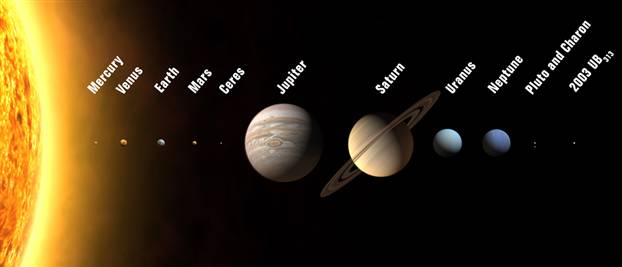
The tally of planets in our solar system would jump instantly to a dozen under a highly controversial new definition proposed by the International Astronomical Union.

Eventually, there would be hundreds of planets, as more round objects are found beyond Neptune.

The proposal, which sources tell Space.com is gaining broad support, tries to plug a big gap in astronomy textbooks, which have never had a formal definition for the word "planet." It addresses discoveries of Pluto-sized worlds that have in recent years pitched astronomers into heated debates over terminology.

  • The asteroid Ceres, which is round, would be recast as a dwarf planet in the new scheme.
  • Pluto would remain a planet, and its moon Charon would be reclassified as a planet. Both would be called "plutons," however, to distinguish them from the eight "classical" planets.
  • A far-out Pluto-sized object known as 2003 UB313, currently nicknamed Xena, would also be called a pluton.

It’s not a popular idea, but it’s an interesting one. Should someone start a contest for the best mnemonic for the new solar system? "Mary Very Easily Makes C_____ Jam Saturday Unless No Plums C_____ X_____"?

Disney Dumps Kid Tracking Service

I’ve been following the trend of mobile companies offering GPS tracking to families for a while now, starting with Sprint’s announcement of its service back in April, and Verizon’s launch of its “chaperone service.” Now it looks like competition is heating up in that market, as I just came across the first announcement I’ve seen of a company getting out of the business. Disney is dropping its mobile tracking service.

Disney has shelved plans to launch a mobile virtual network operator in the U.K., saying the market is in flux.

The media giant had been planning to launch its family friendly mobile virtual network operator (MVNO) this year, piggybacking on wireless provider O2’s network. Now Disney has changed its mind, putting the plan on ice indefinitely.

A Disney spokeswoman said the decision had been made as a result of “the rapidly changing competitive environment.”

“Retail distribution outlets in particular have consolidated in recent weeks, which has impacted our distribution opportunities,” she added.

Apparently, Disney’s experience with market saturation in the U.S. influenced its decision in the UK. But the company is keeping an eye on the market, and may revisit offering its tracking service to customers in the UK.

Real Russian Rocket Report

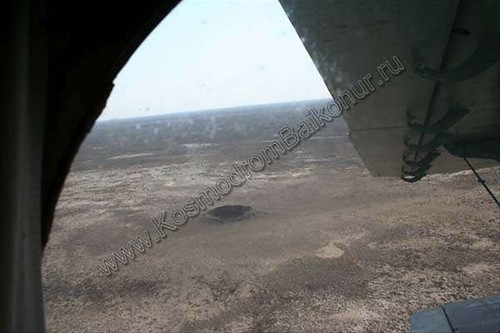
Last month’s Dnepr rocket crash in Kazakhstan, which destroyed Montana’s first satellite, blasted a crater 165 feet wide and 50 feet deep. Fortunately, there were no injuries or fatalities in the vast arid steppes near the Uzbek border. What about the environmental damage? Keep in mind most rocket fuel is considered "nasty stuff." According to NBC News space analyst James Oberg, this launch failure’s aftermath is reminiscent of old habits:

Last month’s crash of a Russian Dnepr space booster with 100 tons of toxic rocket propellant poisoned a small corner of the empty steppes in Central Asia — but may have left a wider legacy of bitterness that will impact Russian space activities for years to come.

And whatever the actual cause of the rocket’s embarrassing failure, the poisonous consequences could have been largely avoided if Moscow space officials hadn’t reverted to almost Soviet-style cover-ups and hollow reassurances about the accident.


I found Mr. Oberg’s piece on this topic, featured recently on the MSNBC site, superbly written, accurate and insightful.

Feeling adventurous? Try reading the original report, in Russian, from 31 July 2006. At least you’ll understand the pictures, and the gist of the English translation (scroll down for both).


All Hail Hale

We found NASA’s Picture of the Day on Sunday to be particularly fascinating.

This Mars Global Surveyor (MGS) Mars Orbiter Camera (MOC) image shows dried streambeds—martian gullies— in the mountainous central peak region of Hale Crater. Some scientists have suggested that the fluid which carved these gullies was liquid water, and that it either resulted from ancient snowmelt or from release of groundwater that percolated to the surface in the intensely fractured rock of Hale’s central peak. In either case, the gullies are dry today, and dark sand can be seen as dunes near the right/lower right part of the image.


The Laptop Go Boom! Echo

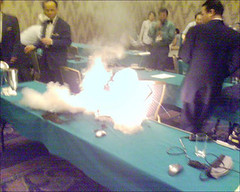
Loyal readers will recall our assiduous reporting earlier this summer on the explosion of a Dell laptop computer at a  business conference in Japan.

Now, it is evident, our remarkable editorial instinct has once again been proven correct, forcing the Washington Post, New York Times, USA Today and the AP into a desperate scramble to catch up to the new and vaunted journalism embodied by Really Rocket Science.

(When you read breathless news stories about how blogs are changing the media, they are, of course, referring to us.)

Never the sort to gloat, our hearts brim with pity as we think of the strained and perspiring editors of the Gray Lady and the nation’s wire services, clumsily stabbing their porcine fingers at their keyboards, trying to figure out this Google thing in a vain attempt to stay apace with the very edge of the new media vanguard, to break the news that we have invariably already broken — ney, smashed to pieces, exposed for the world to see and understand, then meticulously reconstucted by the nimble prose and dazzling insights of the writers of Really Rocket Science, who selflessly offer their beacon of hope and reason in a world too frequently perceived as chaotic and incomprehensible by journalists of a lesser caliber.

 We do it because we care. We do it because we believing that exploring the vast interiors of ignorance is our small and humble way of contributing to a more civilized world. We are not journalists, nor mere bloggers. We are cartographers of the human spirit, and though others follow to fill in the details of roads and bridges and recalled laptop batteries and so on and so forth, we remain at the front, always, bringing you the news even before the masses have grasped it as news — outlining, as it were, the shapes of new continents that lie at the edge of this vast informational sea known as the Internet.

Land ho! we cry, through the lonesome gale, as the rest of the crew sleeps dreaming of their childhood cribs below the deck. 

We will persist. And we will continue to peer out into the darkness, to alert you of the shape of things to come. To find, as is our burden and fate, safe passage through the ongoing storm.

Send us your tips to [email protected]

Arianespace Successfully Launches Twin Satellite Payload; Koreasat 5 to Lift via Sea Launch Next Week

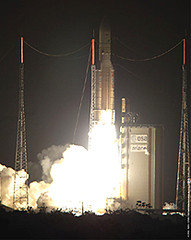
Arianspace’s Friday evening launch of a twin satellite payload, which Spektor previewed last week, was a success. From the mission update:

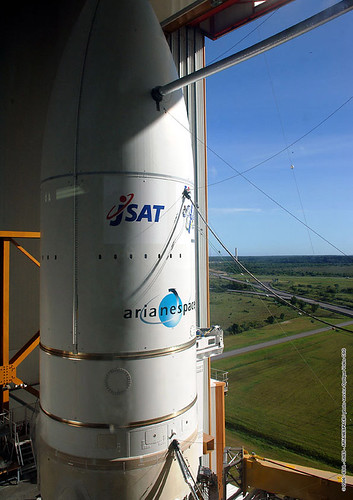
After an on-time lift-off at 7:15 p.m. from Europe’s Spaceport in French Guiana, the heavy-lift Ariane 5 delivered Japan’s JCSAT-10 telecommunications spacecraft and the European Syracuse 3B secure military relay platform into an accurate geostationary transfer orbit.

Tonight’s flight was Ariane 5’s 28th mission, and marked its 14th consecutive success – underscoring the launcher’s maturity. JCSAT-10 was installed in the upper payload position on Ariane 5, and was released approximately 27 min. into the mission. This was followed some 5 minutes later by the separation of Syracuse 3B, which occupied the lower slot in the payload "stack." 

A series of photographs from the launch can be seen here

In other commercial satellite launch news, Sea Launch will be lifting the Koreasat 5 communications satellite on the evening of August 21st. Sea Launch has provided a nice graphical display of the satellite launche’s profile and groundtrack here.

As always, we’ll have more updates on the launch as it approaches. 

Mary Very Easily Makes Jam Saturday Unless No Plums?

Elementrary and high school students may have to come up with a new mnemonic phrase for remembering the planets, depending on the outcome of a debate taking place this month at the International Astronomical Union’s General Assembly meeting in Prague:

At a 12-day conference beginning Monday, scientists will conduct a galactic census of sorts. Among the possibilities at the meeting of the International Astronomical Union in the Czech Republic capital of Prague: Subtract Pluto or christen one more planet, and possibly dozens more.

"It’s time we have a definition," said Alan Stern, who heads the Colorado-based space science division of the Southwest Research Institute of San Antonio. "It’s embarrassing to the public that we as astronomers don’t have one."

The debate intensified last summer when astronomer Michael Brown of the California Institute of Technology announced the discovery of a celestial object larger than Pluto. Like Pluto, it is a member of the Kuiper Belt, a mysterious disc-shaped zone beyond Neptune containing thousands of comets and planetary objects. (Brown nicknamed his find "Xena" after a warrior heroine in a cheesy TV series; pending a formal name, it remains 2003 UB313.)

The Hubble Space Telescope measured the bright, rocky object at about 1,490 miles in diameter, roughly 70 miles longer than Pluto. At 9 billion miles from the sun, it is the farthest known object in the solar system.

The discovery stoked the planet debate that had been simmering since Pluto was spotted in 1930.

Some argue that if Pluto kept its crown, Xena should be the 10th planet by default — it is, after all, bigger. Purists maintain that there are only eight traditional planets, and insist Pluto and Xena are poseurs.

"Life would be simpler if we went back to eight planets," said Brian Marsden, director of the astronomical union’s Minor Planet Center in Cambridge, Mass.

 What do you think? How should a planet be defined? Should our solar system have eight, nine or ten planets? And if Xena becomes the 10th, what strange jam will Mary have to make?

Blast from the Past: Saving Skylab

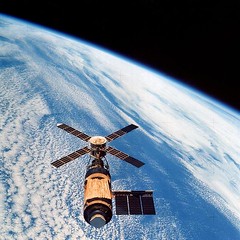
Although Skylab, America’s first space station, fell back to Earth more than 17 years ago, the full-size training mock-up of Skylab is still intact — although in incredible disrepair (and inhabited by several raccoons) —  outside the U.S. Space and Rocket Center near NASA’s Marshall Space Flight Center in Hunstville, Alabama.

Now, a group of volunteers has launched the Skylab Restoration Project with the goal of restoring the training module to its former glory. CNN reports:

Tom Hancock, a board member of the American Institute of Aeronautics and Astronautics, is the leader of the project. He said he is working on the restoration for people like his 18-year-old daughter.

"It’s history. It’s a chance for people my daughter’s age to kick back and see what it was like when I was young," said Hancock.

Made primarily from spare parts left over from the Apollo program, Skylab orbited the Earth for six years beginning in 1973. It helped pave the way for science projects aboard the space shuttle and the International Space Station currently in orbit.

Astronauts learning to live in space trained in Skylab mock-ups at Marshall and the Johnson Space Center in Houston. Three crews of three astronauts each spent a total of 171 days in Skylab, which re-entered the atmosphere in a fiery blaze in 1979.

The Skylab mock-up was displayed for years inside the Space and Rocket Center. But exhibits change, and it was eventually moved outside to a back lot.

 The Skylab Restoration Project is seeking volunteers in the Huntsville area and donations to assist with the project. Visit SaveSkylab.org to learn more and to see "then and now" photos and videos of the Skylab training module.

ArianneSpace To Launch Two Satellites Tonight

European commercial space transportation company Arianespace is launching not one but two satellites into orbit this evening. From Europe’s space center, the Guiana Spaceport in Kourou, French Guiana, Arianespace’s Ariane-5ECA will take to the skies for its 28th time, marking the 172nd mission for the Ariane fleet, at some time between 6:15 pm and 7:52 pm EST. The launch can be watched starting 20 minutes before launch time, at Arianspace’s Video Corner.

The Ariane-5ECA is 50.5 meters tall and will weigh in at about 780 tons at lift off, requiring over 400 tons of fuel to ramp the beast up to over 2900 pounds of fource to lift-off.

The payload, a Japanese television (JCSAT-10) and French military communications (SYRACUSE 3B) satellites, is expected to be in operation for between 15 and 12 years, respectively.

For those looking for even more information, download the launch kit in English or French and you’ll have more data on this evening’s than you ever thought you wanted.