ASTRA’s newest satellite will be launched into geosynchronous orbit and will become part of a system that provides television reception to 107 million households in Europe. Launch window opens at 4:27 p.m. EDT (20:27 GMT), and remains opens until 7:16 p.m. (23:16 GMT). Watch the launch live via webcast from launch complex 41 at the Cape Canaveral Air Force Station in Florida. Broadcast begins at 4:05 p.m. (20:05 GMT). Here’s how you can receive it directly via satellite:
In North America, AMC-4, transponder 17, C-band analog, 101 degrees West, downlink frequency 4040 MHz (vertical).
In Europe, on ASTRA, transponder 116 on ASTRA 1G at 19.2E with following reception parameters: downlink frequency: 12669.50 MHz / downlink polarization: vertical / transponder transmission rate: 22 MB/s QPSK FEC 5/6; Service name: ASTRA VISION 3
Test signals begin about 3:45 p.m. EDT (19:45 GMT).
If you are not able to watch it, then you can follow it via live text updates.
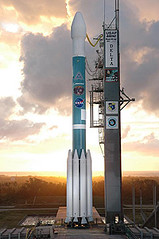
A Delta 2 rocket carrying the CloudSat and Calipso satellites will blast off shortly after 3 a.m. Friday [from Vandenberg Airforce Base.]
CloudSat and Calipso are equipped with instruments to study the formation of clouds and microscopic airborne particles called aerosols in unprecedented detail.
Observations from the satellites should help scientists improve weather and climate forecasts.
CloudSat and Calipso are managed by NASA’s Jet Propulsion Laboratory in Pasadena.
Live launch coverage on the web (for all you night owls and early risers) is available here. Also be sure to check out the NASA website for more information about CloudSat and Calipso.
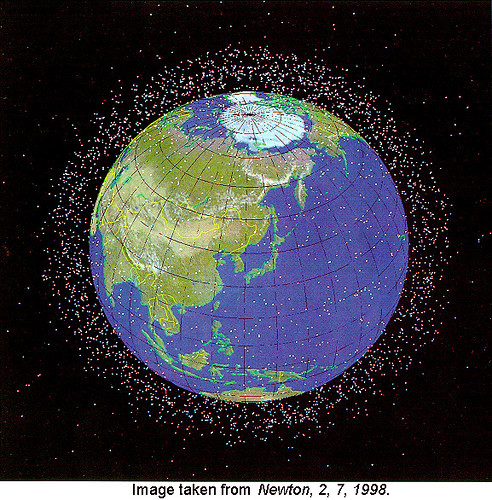
If you read NooBee’s post about SpaceNet 4’s retirement (below) yesterday, then you know that space– or at least the Earth’s orbit– is full of junk.
But now there’s something you can do about it. Sort of. At least, there’s a cool way you can spend some time (or a great deal of time, depending on how highly you rate the things you should be doing at work) learning about the wide range of space junk floating in the earth’s orbit: by playing this free online game.
No, I don’t mean the song by Devo. But there’s gonna be some more junk up there, do you need to get one of those hats the band used to wear back in the day, on the off chance that some of that junk finds it’s way back down here? Apparently the FCC ruled that U.S.-licensed satellites launched after March 22, 2002 have to go into disposal orbit when they’ve beamed down their last signal. The latest is the Spacenet 4 satellite, which was launched in 1985.
I’ve blogged about the satellite graveyard before, and apparently we’ve left a lot of stuff up there in the past 25 years or so; more than 9,000 man-made objects, which can break into little pieces and cause problems for current space missions. It looks something like this.
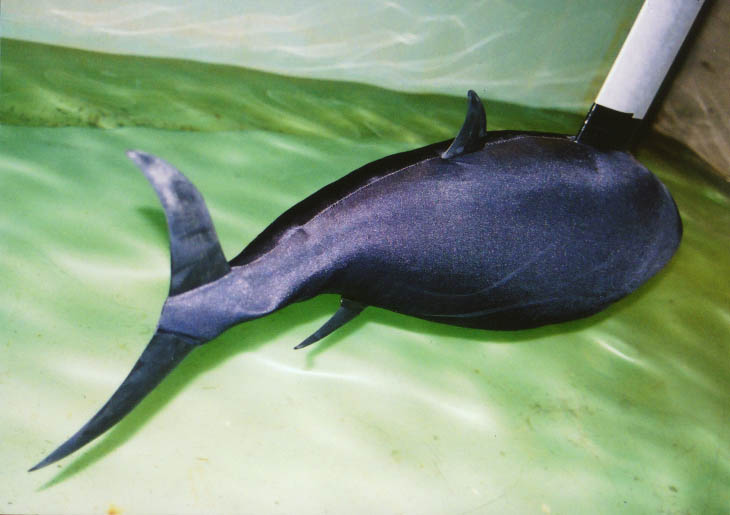
Wanna buy a robot fish? How about a pregnant robot? I don’t think the first one’s for sale, but the last one is gonna cost ya about $20,000. These were two of the robot-related items that landed in my news reader this morning; the former casued me to ask "why would someone build this?", while the latter had me asking "why not?"
Notes from the Technology Underground clued me in to the existance of MITs’ RoboTuna, and pointed me to Pink Tentacles’ post about a robotic carp recently turned loose in a Japanese aquarium. While it seems like a pretty cool thing to invent, and maybe it will help scientst learn more about the "phsyics of swimming" as Bill puts it at Notes, I’m kinda left wondering what the point of the whole exercise is, other than invention for inventions sake. (Not that there’s anything wrong with that.)
The pregnant robot, found via The Raw Feed (which also links to the robot’s instruction manual), is probably stranger the RoboTuna, but the reasons for building it are easier for me to grasp.
The full-sized, blond, pale mannequin is in demand because medicine is rapidly abandoning centuries-old training methods that use patients as guinea pigs, turning instead to high-tech simulations. It’s better to make a mistake on a $20,000 robot than a live patient.
… Noelle, from Miami-based Gaumard Scientific Co. Inc., is used in most of Kaiser’s 30 hospitals nationwide, and other hospitals are putting in orders. The Northwest Physicians Insurance Co. is sponsoring similar training programs in 22 hospitals in Oregon and Idaho, rolling out Noelle initially at five of them.
Other companies make lifelike mannequins to train paramedics in emergencies, but Noelle appears to be the only high-tech, pregnant model available.
Not a bad idea. A robot will probably not react to hearing an "Oops" during deliver in the same way an actual person would. I’ll say it again; people build the craziest things, and for reasons I don’t always get but that sometimes end up making sense.
Is science fiction destined to become just science?
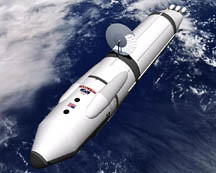
Most self-respecting starships in science fiction stories use antimatter as fuel for a good reason – it’s the most potent fuel known. While tons of chemical fuel are needed to propel a human mission to Mars, just tens of milligrams of antimatter will do (a milligram is about one-thousandth the weight of a piece of the original M&M candy)….
The NASA Institute for Advanced Concepts (NIAC) is funding a team of researchers working on a new design for an antimatter-powered spaceship that avoids this nasty side effect by producing gamma rays with much lower energy….
When antimatter meets matter, both annihilate in a flash of energy. This complete conversion to energy is what makes antimatter so powerful. Even the nuclear reactions that power atomic bombs come in a distant second, with only about three percent of their mass converted to energy.
Antimatter rockets have significant advantages over nuclear-powered spacecraft, including improved safety, efficiency and speed:
The Reference Mission spacecraft would take astronauts to Mars in about 180 days. "Our advanced designs, like the gas core and the ablative engine concepts, could take astronauts to Mars in half that time, and perhaps even in as little as 45 days," said Kirby Meyer, an engineer with Positronics Research on the study.
Advanced engines do this by running hot, which increases their efficiency or "specific impulse" (Isp). Isp is the "miles per gallon" of rocketry: the higher the Isp, the faster you can go before you use up your fuel supply. The best chemical rockets, like NASA’s Space Shuttle main engine, max out at around 450 seconds, which means a pound of fuel will produce a pound of thrust for 450 seconds. A nuclear or positron reactor can make over 900 seconds. The ablative engine, which slowly vaporizes itself to produce thrust, could go as high as 5,000 seconds.
Although one of the drawbacks to antimatter rockets is its high cost of development, we wonder if that can’t be mitigated by passing the hat around to the millions of science-fiction fans around the world, who have dreamed of anti-matter-powered rockers for years.
COSMIC— the Constellation Observing System for Meteorology, Ionosphere and Climate– was successfully launched from Vandenberg Air Force Base in California on Friday night. The AP reports:
Six weather satellites successfully reached orbit and were ready to begin their five-year mission to track hurricanes, monitor climate change and study space weather, it was announced Saturday.
"Ground stations have received signals from all six satellites," according to an update on the Web site for the project’s manager, University Corporation for Atmospheric Research in Boulder, Colo.
The satellites were launched on a rocket booster Friday evening from this Central Coast base. They were placed into orbit about 500 miles above Earth, where they separated to form a chain.
The satellites will take about 2,500 daily measurements by using global positioning receivers to track radio signals passing through the atmosphere, scientists said.
The information gathered will be used to enhance research and improve weather forecasting. Scientists hope the data will help them better track storms and monitor long-term climate change.
As I’ve said before, I’m not really a DIY kinda guy. Putting together IKEA furniture and my kid’s toys are about as good as it gets. But I admire people who do roll up their sleeves and make stuff. So, every Friday I’m going to try and find a few cool DIY projects to feature here.
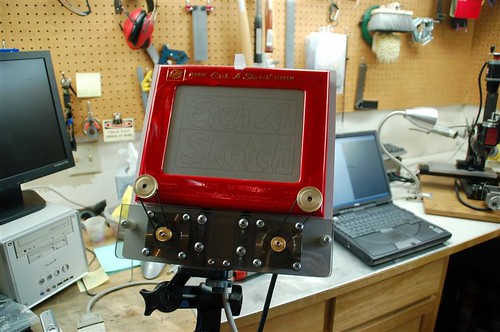
Speaking of kids’ toys, by the way, I stumbled across a pretty impressive project involving a kid’s toy over at I Make Stuff, where the blogger interviewed a guy who usually makes "robots that kill other robots" but recently did something pretty cool with an Etch-a-Sketch.
I had one of these growing up, but could never make a decent picture with it. Little did I know that all I needed were some pulleys, foot pedals, and a laptop to control it all. But you still have to shake it to wipe out the picture. Check out the video podcast at I Make Stuff, recorded at Seattle Battle Bots IV, as well as more pictures of the CNC controlled Etch-a-Sketch.
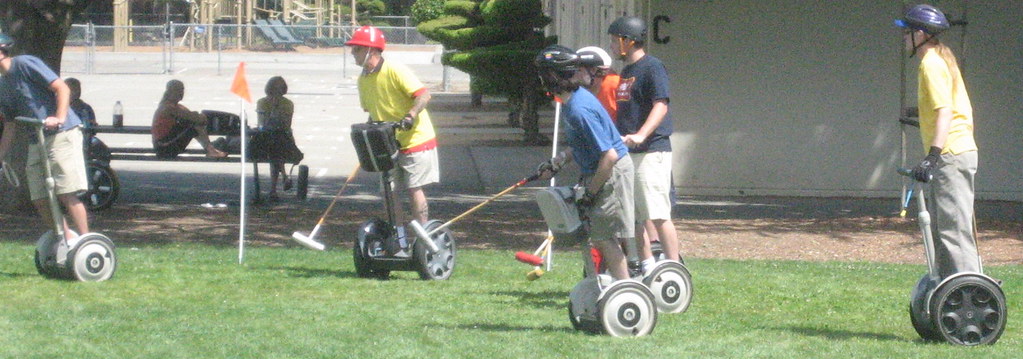
Oh, and if you’d prefer something that’s not only cool but useful as well, DIY Happy has a link to instructions on how to build your own Segway-like scooter. I had a scooter growing up too, but nothing like this. There’s video there as well, and details on the version 2 of the scooter includes an amusing picture of some people engaged in a game of Segway Polo.
As reported by the AP’s Melissa Eddy in The Sun Herald (Biloxi, Miss.):
"We can see there is a swirl here that is similar to the one we know from the north pole," said Horst Uwe Keller, who leads the team operating the craft’s wide-angle camera – one of seven instruments aboard the Venus Express.
Using infrared technology that allows the camera to peer though the clouds, scientists hope to be able to determine how the sulfuric acid that swathes the planet was formed, and pinpoint the cause of the high-speed winds that sends it swirling in massive clouds.
Not that I’ll need that service any time soon, but apparently Masten Enterprises are the people to call if you need to send something into space. For a fee, they’ll blast your stuff into the stratosphere. There’s even a video of how it works.
The prices seem pretty reasonable at first glance.
Then again maybe not. Seems like a lot of money to send something ranging from the size of a soda can to a well-fed cat into space. And how do you get your stuff back once it’s up there? Or do you just send up stuff that you no longer need? And if so, this is better than throwing it away or recycling it how?
It sounds like a cool idea, but unless someone can explain to me just how useful it is, my advice to anyone who has something they no longer need and want to send into space is pretty simple: hold a garage sale.

 The full-sized, blond, pale mannequin is in demand because medicine is rapidly abandoning centuries-old training methods that use patients as guinea pigs, turning instead to high-tech simulations. It’s better to make a mistake on a $20,000 robot than a live patient.