As someone who finds it challenging to put together my three-year-old son’s toys, I’m rather in awe people who can build stuff — from a simple birdhouse to space-bound rockets and satellites. Lately, I’ve noticed people of all ages taking dreams and ideas from mere ideas on paper to reality. In particular, I’m rather in awe of some Philladelphia high school students who built a hybrid car that runs on soybeans.
 A car that can go from zero to 60 in four seconds and get more than 50 miles to the gallon would be enough to pique any driver’s interest. So who do we have to thank for it. Ford? GM? Toyota? No — just Victor, David, Cheeseborough, Bruce, and Kosi, five kids from the auto shop program at West Philadelphia High School
The five kids, along with a handful of schoolmates, built the soybean-fueled car as an after-school project. It took them more than a year — rummaging for parts, configuring wires and learning as they went. As teacher Simon Hauger notes, these kids weren’t exactly the cream of the academic crop.
“We have a number of high school dropouts,” he says. “We have a number that have been removed for disciplinary reasons and they end up with us.”
…”If you give kids that have been stereotyped as not being able to do anything an opportunity to do something great, they’ll step up,” he says.
The high school inventors have more than earned their “Fab Five” moniker, but they’re not the only ones building some pretty amazing things. Just in the past week, Make Magazine has featured an update on a Rube Goldberg contest at Purdue University, and a Mexican grandfather who builds his own rockets. I f you’re inclined to try your own hand at this, you can check their post on making water rockets, or visit Dirk’s Rocket Dungeon and check out some old rocket plans for reference.
As for me, I’ll stick to putting together my kid’s toys. That’s challenge enough for me.
Posted
March 7th, 2006 in Cool Stuff, Front Page
|
1 Comment »
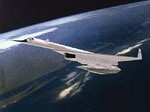 Aviation Week and Space Technology reports on the recently-shelved Blackstar system, a two-stage-to-orbit system designed to place a small military spaceplane in orbit:
This two-vehicle "Blackstar" carrier/orbiter system may have been declared operational during the 1990s.
A large "mothership," closely resembling the U.S. Air Force’s historic XB-70 supersonic bomber, carries the orbital component conformally under its fuselage, accelerating to supersonic speeds at high altitude before dropping the spaceplane. The orbiter’s engines fire and boost the vehicle into space. If mission requirements dictate, the spaceplane can either reach low Earth orbit or remain suborbital.
The manned orbiter’s primary military advantage would be surprise overflight. There would be no forewarning of its presence, prior to the first orbit, allowing ground targets to be imaged before they could be hidden. In contrast, satellite orbits are predictable enough that activities having intelligence value can be scheduled to avoid overflights.
Exactly what missions the Blackstar system may have been designed for and built to accomplish are as yet unconfirmed, but U.S. Air Force Space Command (AFSPC) officers and contractors have been toying with similar spaceplane-operational concepts for years. Besides reconnaissance, they call for inserting small satellites into orbit, and either retrieving or servicing other spacecraft. Conceivably, such a vehicle could serve as an anti-satellite or space-to-ground weapons-delivery platform, as well.
Read the full story here.
Posted
March 7th, 2006 in Around the Blogs, Satellite TV
|
No Comments »
 Back in March of 2002, twin satellites launched called GRACE (short for Gravity Recovery and Climate Experiment) were launched by NASA to make detailed measurements of Earth’s gravity field and to the Earth’s natural systems.
Today, MSNBC reports that new data from the satellites reveal that global warming is causing ice loss in Antartica:
Joining the growing list of places on this planet that are melting, Antarctica is losing about 36 cubic miles (150 cubic kilometers) of ice every year, scientists reported Thursday.
For comparison, Los Angeles consumes roughly 1 cubic mile of fresh water a year.
The south polar region holds 90 percent of Earth’s ice and 70 percent of the total fresh water on the planet, so any significant pace of melting there is important and could contribute to an already rising sea….
"This is the first study to indicate the total mass balance of the Antarctic ice sheet is in significant decline," said Isabella Velicogna of the University of Colorado at Boulder.
More information on GRACE can be found here.
Posted
March 2nd, 2006 in Business Network, Cool Stuff, Observation, Satellite TV
|
2 Comments »

This time it’s the Hubble telescope, bringing you the Messier 101 spiral galaxy (a/k/a the Pinwheel Galaxy) head-on, in just 51 exposures and coming in at a mere 16,000 by 12,000 pixels
Posted
March 1st, 2006 in Business Network, Navigation/GPS, Observation
|
3 Comments »
 Universe Today has a couple of posts up featuring some fascinting satellite imagery, and even a link to some pretty cool imagination. One features some images of Jupiter, Neptune and Uranus from NASA Astrobiology, while the other concerns a cosmic explosion seen by NASA’s Swift satellite.
The Swift satellite, whose mission control center is in State College, has detected a cosmic explosion that has sent scientists around the world scrambling to telescopes to document this startling event. Gamma-ray radiation from the source, detected on 18 February and lasting about half an hour, appears to be a precursor to a supernova, which is the death throes of a star much more massive than the Sun. "The observations indicate that this is an incredibly rare glimpse of an initial gamma-ray burst at the beginning of a supernova," said Peter Brown, a Penn State graduate student and a member of the Swift science team.
The Penn State release also links to a pretty cool collapsing star animation, collapsing stars being one of the "leading contenders" for causing gamma ray bursts like the one Swift detected. Also check out the link to NASA’s Goddard Space Center for multimedia from Goddard TV.
Posted
February 28th, 2006 in Business Network, Cool Stuff, Front Page, Navigation/GPS, Observation
|
1 Comment »
NASA engineers are preparing for the Mars Reconnaissance Orbiter to make its risky approach to the planet on March 10. The agency has a 65 per cent success rate at getting probes to orbit Mars, compared to 80 per cent for successful landings on its surface.
As it approaches the planet, controllers on Earth anticipate there will be a signal from the spacecraft indicating that a 27-minute engine burn will slow it down and let martian gravity capture it.h
Posted
February 27th, 2006 in Cool Stuff
|
No Comments »
 My watch died this weekend. So I ended up shopping for one this weekend, because I have to have watch. It’s not that I’m terribly punctual or anything. I basically need a watch to tell me how long I can procrastinate, down to the second, before I have to get moving towards where ever I’m supposed to go or get started on whatever I’m supposed to do. Maybe I’m a bit behind on watchmaking technology, but I was surprised to find the watch of my dreams, and to find myself dreaming of one even better.
I was standing in front of the plexi-glass display case perusing the digital models, because an analog watch makes means I have to figure out the time whereas a digital watch just tells me the time. This is important because my watches tend to run up to 15 minutes fast or slow, which means I still have to figure out the time, but a digital display makes it easier to do the math. It was then that I saw a wonder I didn’t know existed: a self-setting watch.
Once I got it home and unfolded the instructions, I learned that my "radio controlled" watch is works on Coordinated Universal Time (UTC). Every day at around 1:00 am, it tunes in to a radio signal from Fort Collins, CO, synchronizes and then converts UTC into local time.
So, now I’m thinking that it would be even better if there was a watch that changed time zones when I travel. Like I said before, I usually forget how to set my watch, so changing time zones can be a pain. So, why not a satellite watch that functioned the same way as the radio watch, but that also synched itself whenever I entered a new time zone? Has this been done? Can this be done? If so, it would certain make my life easier.
Posted
February 27th, 2006 in Cool Stuff
|
No Comments »
Space.com’s Leonard David is reporting this afternoon that Scaled Composites is hiring people from “various backgrounds” to come help build spaceships. Yes, that Scaled Composites headed by Burt Rutan that won the Ansari X Prize.
It seems work has started on SpaceShipTwo, and they are looking for help.
You can read Leonard’s article at www.space.com and you can submit your resume at www.scaled.com/careers.
Posted
February 24th, 2006 in Astronomy
|
1 Comment »

For fans of the X Prize, the Red Bull (ne Reno) Air Races, and rocketry and aviation in general, the future is bright (with a 20 foot flame behind it) and approaching fast.
X Prize founder Peter Diamandis and race car capitalist Granger Whitelaw launched the Rocket Racing League last October, and the first Rocket Racing Team was announced last month.
The Rocket Racing League [will] organize competitions around the United States, with the finals taking place at the X Prize Cup in New Mexico.
"It’s bringing 21st-century racing into people’s personal living rooms. … It’s really the mix of NASCAR excitement and spaceflight," Diamandis told journalists Monday….
"For me, it’s sort of a remembrance of ‘Star Wars’ pod racing," Diamandis said….
"Courses are expected to be approximately two miles long, one mile wide, and about 5,000 feet high, running perpendicularly to spectators," the league said. "The rocket planes, called X-Racers, will take off from a runway both in a staggered fashion and side-by side and fly a course based on the design of a Grand Prix competition, with long straightaways, vertical ascents, and deep banks. Each pilot will follow his or her own virtual ‘tunnel’ or ‘track’ of space through which to fly, safely separated from their competitors by a few hundred feet."
The League also announced a contest allowing fans to name the first X-Racer Rocket Plane. Meanwhile, Sebadoh is accepting donations to pay for travel to the debut of the first X-Racer, this October in Las Cruces. Pony up, Rocco.
Posted
February 24th, 2006 in Around the Blogs, Front Page
|
1 Comment »
It hasn’t been long since NASA’s “Stardust” returned to earth, but scientists are already slicing and dicing microscopic specks of comet dust collected by the space probe. We’re talking “dust” that’s as old as the solar system, verified comet matter, seen for the first time by NASA scientists. Interesting stuff. Fortunately, NASA scientists are letting the public in on the fun.
Stardust@Home appears to be modeled after SETI@Home, in the sense that you can volunteer your computer’s unused resources to help with the project by performing mathematical calculations, etc. There’s just one significant difference. They don’t just want your computer’s resources. They want your brainpower too.
First, you will go through a web-based training session. This is not for everyone: you must pass a test to qualify to register to participate. After passing the test and registering, you will be able to download a virtual microscope (VM). The VM will automatically connect to our server and download so-called “focus movies” — stacks of images that we will collect from the Stardust Interstellar Dust Collector using an automated microscope at the Cosmic Dust Lab at Johnson Space Center. The VM will work on your computer, under your control. You will search each field for interstellar dust impacts by focusing up and down with a focus control.
If that sounds exciting to you, and you think you can pass the test, go pre-register to help them out!
Posted
February 23rd, 2006 in Business Network, Front Page, Navigation/GPS
|
1 Comment »