“Cellophane Telescope” by Seymour Sun

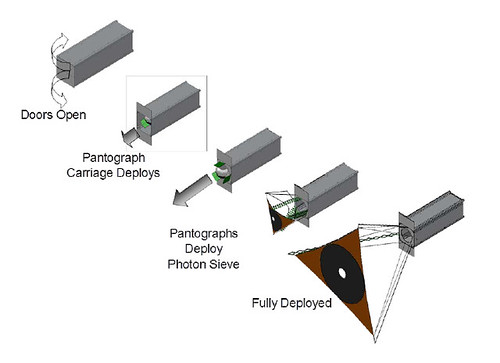
The payload deployment test shown above moves the FalconSAT-7 mission forward, which is scheduled for 2015. Why is this “cubesat” important? It uses diffraction instead of refraction or reflection and it is becoming a real alternate to a large space-based observatory in studying the Sun’s chromosphere — especially in the H-alpha wavelengths.

The cubesat is being developed by the U.S. Air Force Academy and NASA’s Goddard Space Flight Center, among others, including the NRO, DARPA, AFOSR, AFIT, MMA Design and AFRL.

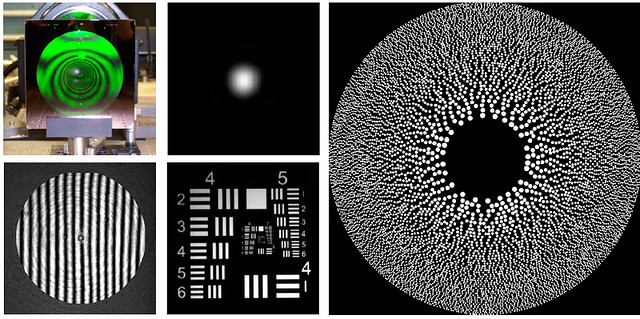
A photon sieve is a novel optical element consisting of a flat opaque sheet with millions of tiny holes. Light passing through these holes is focused in a similar manner to a lens or a mirror. Photon sieves have several key advantages over those more conventional optics:

  • Focusing can be achieved from a flat, thin sheet that can be unfurled from a very compact, lightweight package
  • Surface quality tolerances are orders of magnitude more relaxed
  • The fabrication costs are much lower

The trade-offs include:

  • Lower efficiency / loss of light
  • Narrow bandwidth giving what are essentially grayscale images

The photon sieve will have the following design parameters:

  • 200mm diameter, 400mm focal length, 656.3nm wavelength
  • 2.5 billion holes ranging in size from 2-277 microns
  • 50% fill factor, 30% focusing efficiency

The telescope has a relatively simple design due to space constraints and has:

  • 4 µrad resolution which equates to 600 km at Sun surface
  • ~0.1 degree field of view (about a 1/5th of the Sun’s disk)

Clockwise from top left: A 4-inch photon sieve lit by laser light. The focal spot produced. A magnified image of the central 25mm. An image of a resolution chart produced by the sieve. An interferogram of the wavefront that indicates perfect focusing capability.

GSAT-10 and ASTRA 2F: Together in Space

Nice job, Arianespace!

The mission was carried out by an Ariane 5 ECA launcher from Europe’s Spaceport in Kourou, French Guiana. Liftoff was on Friday, September 28, 2012 at 6:18 pm local time in Kourou (5:18 pm in Washington, D.C., 21:18 UT, 11:18 pm in Paris, and on Saturday, September 29 at 2:48 am in Bangalore).

ASTRA 2F. Built by Astrium using a Eurostar E3000 platform, ASTRA 2F weighed 6,000 kg at launch. Fitted with active Ku- and Ka-band transponders, ASTRA 2F will be positioned at 28.2 degrees East. It will deliver new-generation DTH TV broadcast services to Europe, the Middle East and Africa, and offers a design life of about 15 years.

GSAT-10. Designed, assembled and integrated by the Indian Space Research Organization (ISRO) in Bangalore, southern India, GSAT-10 weighed about 3,400 kg at launch and offers a design life exceeding 15 years. The satellite is fitted with 18 C-band and 12 Ku-band transponders. Positioned at 83 degrees East, it will provide direct-to-home broadcasting, weather and radio-navigation services. Its coverage zone encompasses the entire Indian sub-continent.

Big Bang Monday: Hubble’s Top 100 Images

Fantastic collection of the Hubble Space Telescope’s “Top 100 Images” on the ESA site. All beautiful, with some more interesting that others. For example, the “engraved hourglass nebula” or MyCn18

This is an image of MyCn18, a young planetary nebula located about 8,000 light-years away, taken with the Wide Field and Planetary Camera 2 (WFPC2) aboard the Hubble Space Telescope (HST).

This Hubble image reveals the true shape of MyCn18 to be an hourglass with an intricate pattern of ‘etchings’ in its walls. This picture has been composed from three separate images taken in the light of ionized nitrogen (represented by red), hydrogen (green), and doubly-ionized oxygen (blue).

The results are of great interest because they shed new light on the poorly understood ejection of stellar matter which accompanies the slow death of Sun-like stars. In previous ground-based images, MyCn18 appears to be a pair of large outer rings with a smaller central one, but the fine details cannot be seen.

Credit: Raghvendra Sahai and John Trauger (JPL), the WFPC2 science team, and NASA/ESA

WBMSAT Satellite Industry News Bits 09/28/2012

NSR report projects strong long term growth in government and military demand for satellite services in spite of short term slump caused by troop withdrawals and budgetary challenges.
[SatNews – 09/28/2012]

Dish Network offers broadband Internet to underserved U.S. rural market.
[Chicago Tribune – 09/28/2012]

Indra closes with European Space Agency the definition of requirements for management system for Spanish satellite Ingenio.
[SatNews – 09/28/2012]

Beam Communicatons entire range of Inmarsat products approved for sale into Japanese market.
[SatNews – 09/28/2012]

Astrium Services is awarded ESCPC framework contract by the EDA for commercial satellite communications for European military needs.
[Defence Professionals – 09/28/2012]

Four instruments on the Metop-B weather satellite activated this week.
[SatNews – 09/28/2012]

Danish shipping company TORMN selects Inmarsat XpressLink to deliver next generation high-speed broadband to its entire bulk carrier and tanker fleets.
[SatNews – 09/28/2012]

Iridium Pilot terminals to be added to NSSLGlobal’s portfolio.
[SatNews – 09/28/2012]

Canadian pioneer in space technologies recalls NASA’s first reservations that Alouette satellite program was too ambitious.
[The Province – 09/28/2012]

Arianespace’s Ariane 5 mission with ASTRA 2F and GSAT-10 gets go ahead for September 28. [Space Ref – 09/27/2012]

GE Capital’s GE 23 satellite goes to Eutelsat.
[Digital Edge – 09/27/2012]

TCS, Northrop Grumman and Lockheed Martin team to produce affordable satellite terminals for protected communications on the move and at the halt.
[Defence Professionals – 09/26/2012]

First ECME and live hybrid event in Dubai and Bahrain deemed huge success.
[AME info – 09/26/2012]

Satellite communications have crucial role in helping bridge digital divide in Sub-Saharan Africa.
[African Business Review – 09/26/2012]

Astrium reveals first demo of robotics in space for maintenance and disposal of satellites.
[SatNews – 09/25/2012]

ORBCOMM’s first OG2 satellite to launch on October 7.
[4-traders – 09/25/2012]

Collaborative efforts of stakeholders in the satellite industry and Pacific militaries improve disaster preparedness in the Pacific with training program at Changi Naval Base.
[SatNews – 09/25/2012]

Spacenet to showcase “Pay-as-You-Use” emergency communications solutions at International Association of Chiefs of Police.
[Daily Finance – 09/25/2012]

Bentley Walker unveils new Freedomsat service to Iraq and Afghanistan, the fastest satellite broadband connection available in both countries to date.
[SatNews – 09/25/2012]

Cassidian and Astrium enhance regional Tatrapol networks, enabling interconnection of the networks over satellite.
[Defence Professionals – 09/25/2012]

Air Force Space Command to build Space Fence radar site on Kwajalein Island in 2017.
[SatNews – 09/25/2012]

ViaSat developing a vertically integrated communications play.
[Seeking Alpha – 09/25/2012]

Russia’s first satellite manufactured and operated by a private firm to be launched next year.
[SatNews – 09/25/2012]

Vizada to showcase latest innovations in maritime communications at National Marine Electronics Conference in Orlando, FL.
[SatNews – 09/25/2012]

Telesat mounts PR offensive in Nunavut to prove relevance of satellite communications in spite of the company’s battered reputation.
[Succeed – 09/24/2012]

U.S. Weather satellite used for East coast hurricanes is busted.
[SatNews – 09/24/2012]

SpaceXs Grasshopper vertical takeoff and landing test vehicle takes first test flight hop.
[SatNews – 09/24/2012]

Lockheed Martin reaches major software design milestone in development of “switchboard in the sky” for Iridium NEXT constellation.
[Sacramento Bee – 09/24/2012]

MDA-Loral satellite deal clears U.S. national security hurdle.
[Reuters – 09/21/2012]

WBMSAT satellite communications consulting services

Shopper, Hopper, Topper!

Sports. Lots of people like watching it live because the outcome is unknown. Movies and TV series can have predictable outcomes, and news network can be a bore to some. The major sport leagues know this to be true. So do the broadcasters who carry them. They get advertising revenues, and those on pay-tv services get additional revenue from subscriber fees.

Sports continues to be the driver for moving HDTVs into many homes in America. And for cable and satellite companies. I’ve gone from cable to satellite to cable again, and now I’m set with DISH Network. I refuse to pay Jimmy Dolan $78 per month for a basic cable package, so I’m sticking with Charlie. But I still have to choose between channel packages/bundles. Which doesn’t include AMC or MSG. Let them fight it out.

Sure, I can edit the channels I surf, but why must I pay for 20 shopping channels? Some people say the same for sports channels. Charlie’s mother doesn’t watch sports, so why can’t we just pick and choose the channels we want to watch — and pay only for those. DISH Network’s Hopper STB lets viewer skip ads, so why not let subscribers get only channels they want? How about an “over the top” service via the Internet?

Yeah, here it comes — millions are ready to make the switch. The report, via Ad Age

Dish Network is talking to networks such as Viacom’s MTV about offering their channels over the internet, a service that could shift the economics of the pay-TV industry, five people familiar with the plan said.

In addition to Viacom, the negotiations involve the Spanish-language broadcaster Univision Communications and Scripps Networks Interactive, owner of the Food Network and HGTV, said the people, who asked not to be named because the talks are private. The companies would offer an online product known as an over-the-top service, charging a lower price for a smaller bundle of channels viewable on a computer or tablet.

Dish’s service would change the dynamics of the pay-TV business, whereby customers are forced to pay for bundles with channels they don’t watch. It also gives Dish a way to avoid its biggest programming expense: sports. Walt Disney Co.’s ESPN gets as much as $5.13 each month for every cable and satellite subscriber, compared with the industry’s average of 26 cents, according to SNL Kagan.

“That’s when you could start seeing a few cracks in the ecosystem,” said Alan Gould, a media analyst at Evercore Partners. “The addition of an over-the-top service would be significant.”

The effort would mark the biggest attempt to create an online service with live cable channels, a break from the approach taken by Netflix and Hulu. For Dish, the move would decrease its reliance on its satellite-TV service, which ranks second to DirecTV in U.S. customers. This also gives it a way to undercut pay-TV competitors on price.

Cable networks, meanwhile, have been reluctant to break up their suite of channels and sell them a la carte because it would lower the amount of available advertising inventory. Viacom and other cable networks typically sell ads at a lower rate than the big broadcast networks such as CBS Corp., so they rely on volume.

Viacom would be willing to sell smaller bundles of its networks, which also include Nickelodeon and Comedy Central, at a higher rate per channel than it does for its full complement of programming, according to two executives familiar with the situation.

Spokesmen for Dish, Viacom, Scripps and Univision declined to comment.

A central question is whether consumers want smaller bundles that lack sports programming. Several pay-TV operators, including Dish and Time Warner Cable, already offer cheaper packages that don’t include sports. ESPN — admittedly a network with a horse in the race — says those offerings aren’t very popular. “History shows that very few households subscribe,” said Amy Phillips, a spokeswoman for ESPN, the biggest cable sports network.

Dish offers a $20-per-month satellite package without ESPN, though it also lacks other top channels such as MTV and HGTV. Cable and satellite companies’ agreements with ESPN typically require the video distributors to include the sports network in their most popular tier of TV service.

Dish Chairman Charlie Ergen, who co-founded the company, has said there will be a day when a pay-TV operator chooses not to include sports in order to charge $10 to $20 per month less than competitors.

“My mom doesn’t watch sports,” Mr. Ergen said during a conference call last month. “I’ve got neighbors who don’t want sports. I’ve got friends who go to the bars or the neighbors’ house to watch sports.”

Bring on the “DISH Topper!”

Toy Train in (Near) Space

I love this! Via A Toy Train in Space

On Aug 24th 2012 we sent my son’s favorite train “Stanley” to space in a weather balloon with a HD camera and an old cell phone for GPS. He was recovered 27 miles away in a corn field and we got some great footage of the trip. This video documents the journey from liftoff to landing.

My 4 year old and Stanley are inseparable like Calvin and Hobbes. He’s been attached to him since he was two, and they play, sleep and do everything together. I animated Stanley’s face with After Effects and Photoshop to bring him to life how I imagine my son sees him.

Dead Satellites and Onions

If the head of the USAF Space Command has doubts, our friends at ViviSat and MDA ought to be concerned about their satellite-servicing business proposition. Via Popular Mechanics

It sounds like such a good idea: When satellites run out of fuel, send up a robot to top them off instead of launching a new one. NASA and DARPA have active programs researching this concept. But Gen. Shelton, as head of Air Force Space Command, says he doesn’t see the need. By the time a satellite runs out of propellant, the hardware is about 22 years old. After that much time, he argues, the solar arrays have degraded and the computers are relics. “Now we want to go up and refuel it?” he asks. “When you peel back a few layers of this onion, it makes less sense to me.”

The Space Command celebrated their 30th last week in Colorado Springs and their opinions do matter. However, with DARPA and NASA remaining interested, the business still has reason to go forward. Except for Intelsat.

Big Bang Monday: Kepler’s Candidates

Worlds: The Kepler Planet Candidates from Alex Parker on Vimeo.

All 2,299 Kepler’s candidate planets in one video, via Alex Parker

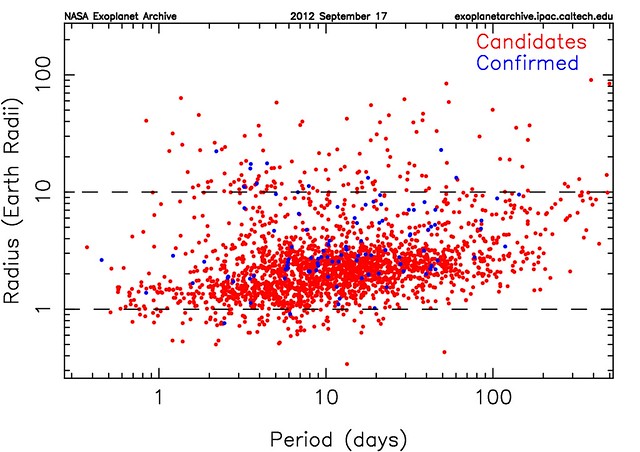
This animation shows the 2299 high-quality (multiple transits), non-circumbinary transiting planet candidates found by NASA’s Kepler mission so far. These candidates were detected around 1770 unique stars, but are animated in orbit around a single star. They are drawn to scale with accurate radii (in r / r* ), orbital periods, and orbital distances (in d / r*). They range in size from 1/3 to 84 times the radius of Earth. Colors represent an estimate of equilibrium temperature, ranging from 4,586 C at the hottest to -110 C at the coldest – red indicates warmest, and blue / indigo indicates coldest candidates.

Watching in full screen + HD is recommended, so you can see even the smallest planets!

The animation is rendered with a time-step of 30 minutes, equal to the long-cadence time sample of the Kepler observatory. Three white rings illustrate the average orbital distances of Mercury, Venus, and Earth on the same scale.

When the system is animated edge-on, it is clear that there is no time during which the sample of stars the Kepler spacecraft is observing does not contain a planet transiting a star. In fact, on average there are dozens of transits occurring amongst the Kepler sample at any given instant.

The Kepler observatory has detected a multitude of planet candidates orbiting distant stars. The current list contains 2321 planet candidates, though some of these have already been flagged as likely false-positives or contamination from binary stars. This animation does not contain circumbinary planets or planet candidates where only a single transit has been observed, which is why “only” 2299 are shown.

I have illustrated the planet candidates as if they orbit a single star. Using a transit lightcurve, a planet’s distance from a star and its radius are both measured in terms of the host stars’ radius, and those relationships are preserved here. This means that for two planets of equal size, if one orbits a larger star it will be drawn smaller here. Similarly, because the orbital distances scale with the host stars’ sizes, some planets orbit faster than others at a given distance from the star in the animation (when in reality, planets on circular orbits around a given star always orbit at the same speed at a given distance). These faster-moving planets are orbiting denser stars.

A fraction of these candidates will likely be ruled out as false positives as time goes on, while the remainder stand to be confirmed as real planets by follow-up analysis. For example, the large orange object in a very close-in orbit was shown to be a background eclipsing binary blend by arxiv.org/abs/1207.2481

At the beginning of the animation, the grid of rectangles that briefly appears represents the focal plane array of CCD detectors onboard Kepler.

WBMSAT Satellite Industry News Bits 09/14/2012

Nicaragua negotiating satellite purchase with China.
[Phys Org – 09/14/2012]
U.S. Department of Justice action casts doubt on acquisition of Loral satellite manufacturing arm by MDA; MDA share prices drop.
[Reuters – 09/14/2012]

IsatData Pro satellite service of SkyWave Mobile Communications is authorized for operation in the territory of the Russian Federation.
[SatNews – 09/14/2012]

Intelsat provides Global VSAT Forum Professional Training to more than 1,000 of its customers and employees.
[Herald Online – 09/14/2012]

Boeing is approved as service provider for the Future COMSATCOM Services Acquisition program.
[Space Daily – 09/14/2012]

United Launch Alliance launches fourth NROL-36 mission for NRO in 2012 and also carries aloft 11 CubeSats.
[SatNews – 09/13/2012]

Indian Space Research Organization to launch Indo-French SARAL satellite December 12, 2012 on PSLV-C20 rocket.
[Satellite Today – 09/13/2012]

Thales Alena Space signs to manufacture and deliver six additional satellites for Globalstar second-generation constellation.
[SatNews – 09/13/2012]

Liberty nears control of Sirius XM Radio.
[Reuters – 09/13/2012]

Encompass Government Solutions to become Inmarsat’s satellite access station in support of the new Global Xpress constellation.
[SatNews – 09/13/2012]

Spacecom is recognized as Best Regional Satellite Operator at World Satellite Business Conference.
[SatNews – 09/13/2012]

Surrey Satellite Technology gets 2012 American Institute of Aeronautics and Astronautics Space Systems award for Disaster Monitoring Constellation at AIAA Space 2012 conference and exhibition in Pasadena, CA.
[SatNews – 09/13/2012]

International Launch Services analysis reveals root cause of Telkom-3/Express MD-2 mission was component of pressurization system that was not manufactured to specifications.
[SatNews – 09/12/2012]

Eutelsat is distinguished as Global Operator of the Year by industry experts at World Satellite Business Week.
[digital technology – 09/12/2012]

SpaceX is contracted to launch three additional SES satellites.
[SatNews – 09/12/2012]

South Korea announces intent to launch rocket next month carrying an observation satellite, its third attempt following two failures.
[SatNews – 09/12/2012]

Panasonic signs deal with Singapore Airlines to provide advanced in-flight entertainment and communications systems for more than 40 new aircraft.
[Satellite Today – 09/12/2012]

Viasat’s Exede Internet, the fast-growing high-speed consumer satellite broadband service, expands to serve commercial airlines.
[SatNews 09/12/2012]

Laser Light Communications launched at World Satellite Finance Forum.
[PR Newswire – 09/11/2012]

Qatar Satellite Company exhibiting Es’hailSat, first satellite in planned global fleet, to be launched in 2013, at International Broadcast Convention.
[SatNews – 09/11/2012]

Space Systems/Loral and Sea Launch form Independent Oversight Board to oversee investigation into root cause of an anomaly causing solar array damage on a recently launched satellite.
[SatNews – 09/11/2012]

JSAT signs Multi-Launch Services Agreement with Arianespace.
[SatNews – 09/11/2012]

OnAir receives authorization to operate Wi-Fi service in Australian Airspace.
[Satellite Today – 09/11/2012]

Gilat’s Spacenet reaches 10,000 store milestone in equipping the Dollar General locations with Spacenet VSAT.
[SatNews – 09/11/2012]

Satellites and secure wireless evolve to meet new demands of U.S. Defense Department.
[Defense Systems – 09/11/2012]\

India launches 100th space mission.
[Space.com – 09/10/2012]

Spacecom set to launch AMOS-4 in 2013.
[SatNews – 09/10/2012]

Arianespace managing concurrent activities for six different upcoming launch missions.
[SatNews – 09/10/2012]

Hughes unveils advanced auto-deploy mobile satellite solution for police and emergency crews.
[Satellite Today – 09/10/2012]

Thales Alenia Space wins French military satellites design contract.
[Defence Professionals – 09/10/2012]

Astrium hopes near-global X-band coverage to be completed with upcoming launch will draw U.S. government business.
[Space News – 09/10/2012]

Astrium announces that satellite telecommunications services offered by Vizada, Vizada Networks, and Paradigm will marketed under the Astrium brand name beginning in October 2012.
[SatNews – 09/10/2012]

Spacecom contracts Israel Aerospace Industries to manufacture the AMOS-6 satellite, scheduled for launch in 2015.
[SatNews – 09/09/2012]

Inverto delivers latest generation LNB using Entropic Communications leading channel stacking switch technology for European DBS operators and satellite free-to-air market.
[NASDAQ – 09/08/2012]

Global Telesat introduces RedPort WiFi Optimizer for fast, low-cost data connections with any satellite phone.
[Equities – 09/10/2012]

Inmarsat Global Xpress service falters as competing satellite maritime offerings enter the market.
[SatMagazine September issue – Alan Gottlieb article]

Global Direct-to-Home Markets, 5th Edition NSR report now available.
[NSR – September 2012]

WBMSAT satellite communications consulting services
Smackin Jupiter

Dan Peterson of Racine, Wisconsin, captured this meteor smacking Jupiter.