WBMSAT Satellite Industry News Bits 04/08/2011

Iran attempting to retrieve Mesbah-1 satellite from Italy – satellite was to have been launched by Russia in 2005, but Russia denies having received satellite.
[Payvand Iran – 04/08/2011]

KVH creates Brazilian subsidiary in ongoing effort to offer sales, service, and support in key commercial maritime regions.
[SatNews – 04/08/2011]

Intelsat gets series of new contracts with media customers using Intelsat’s video satellite neighborhoods.
[SatNews – 04/08/2011]

Innovations related to space technologies developed today define crucial role of space in first step toward an integrated European Space Policy under Lisbon Treaty.
[Space Daily – 04/07/2011]

Dish Network may be preparing for competition with Netflix, with a winning bid of $228M at auction for bankrupt Blockbuster.
[Wall Street Journal – 04/07/2011]

Harris merges Schlumberger, CapRock, and Core180 acquisitions into a single unit.
[Satellite Today – 04/07/2011]


U.S. Space launches mobile communications business targeting government agencies.
[PR Newswire – 04/07/2011]

Row 44 partners with Hughes and Intelsat to expand Ku-band in-flight coverage of international in-flight broadband platform.
[Satellite Today – 04/07/2011]

U.S.A.F. forwards contract modification directing SBIRS contractor team to implement revised ground delivery strategy to receive data from both DSP satellites and SBIRS satellite.
[SatNews – 04/07/2011]

Ocean Systems Engineering Corporation wins $12M task order from U.S. Marines for engineering and scientific support for networking and satellite communications.
[SIGNALSCAPE – 04/07/2011]

MacDonald, Dettwiler and Associates contracts with Boeing to provide advance technology solutions for the 702HP satellites.
[SatNews – 04/07/2011]

Vizada is among first Inmarsat Distribution Partners to roll out new IsatPhone Pro email and data transfer capability to its entire network of service provider partners.
[SatNews – 04/07/2011]

GMPCS Personal Communications offers Inmarsat IsatPhone Pro data service and email.
[Benzinga – 04/07/2011]

Bosnia’s Mreza Plus TV now distributed by AMOS satellite fleet.
[SatNews – 04/07/2011]

RRsat’s new MCPC platform on Hispasat 1E to bring digital HD, 3D, and SD satellite video to tens of millions of viewers in Latin America.
[SatNews – 04/07/2011]

Space X unveils plans to launch the world’s most powerful rocket since man went to the moon.
[R&D Magazine – 04/06/2011]

Mitsubishi announces completion of construction of the ST-2 communications satellite ordered by Singapore Telecommunications and Taiwan’s Chunghwa Telecom.
[4-traders – 04/06/2011]

Twice last week space junk approached International Space Station too closely for comfort, and experts predict more close calls over next several years.
[Fox News – 04/06/2011]

U.S. Army’s WIN-T program accelerates efforts in the at-the-halt and fixed satellite communications programs.
[Defense Systems – 04/06/2011]

Recently signed multi-year network partnership agreement with Open Range Communications may be key to filling out LightSquared’s nationwide network.
[Urgent Communications – 04/06/2011]

Integral Systems wins $8.6M contract modification to its Command and Control System-Consolidated with U.S. Air Force Space and Missile Systems Center.
[Satellite Today – 04/06/2011]

Eutelsat signs another deal, with French Internet service provider Sat2Way, as it looks to fill Ka-Sat before operations begin.
[Satellite Today – 04/06/2011]

Hughes Europe to spotlight advanced satellite technology and services at Antibes Yacht Show in Antibes, France, from April 7 – 10.
[SatNews – 04/06/2011]

OnAir’s combined GSM and inflight internet services using SwiftBroadband prove to have sufficient capacity for passengers’ needs after 1 year of service.
[SatNews – 04/06/2011]

ViaSat and JetBlue finalize plans for Ka-band in-flight broadband service.
[Satellite Today – 04/05/2011]

TriaGnoSys launches GSMConneX, an end-to-end solution providing GSM services to aircraft passengers.
[SatNews – 04/05/2011]

Q-KON SA provides mobile satellite service for users in South Africa requiring high-speed Internet access in remote locations.
[PRLog – 04/05/2011]

Russian spacecraft named for Yuri Gargarin reaches orbit on way to International Space Station.
[SatNews – 04/05/2011]

International Launch Services gets Mitsubishi’s contract for launch of Turksat 4A and Turksat 4B on ILS Proton.
[SatNews – 04/05/2011]

Gilat partners with Ethiopian wireless business solution specialist Global Tracking to provide comprehensive fleet tracking services in Ethiopia.
[Satellite Today – 04/05/2011]

SkyVision establishes enterprise hub in Democratic Republic of the Congo.
[Satellite Today – 04/05/2011]

Communications crosslink between STSS satellites built by Grumman extends real-time “stereo tracking” of space objects.
[ComSpaceWatch – 04/04/2011]


Dual-purpose Indian satellite GSAT-8, with Ku-band and navigation payloads, arrives in French Guiana.
[SatNews – 04/04/2011]

Rafael Advance Defense Systems developing micro-satellite concept employing low-earth-orbit high resolution imaging satellites suitable for airborne launch.
[SatNews – 04/04/2011]

Iridium announces operational launch of Global Service Program to support all users of Iridium OpenPort broadband maritime satellite communication service.
[Traders Huddle – 04/04/2011]

New consortium headed by Astrium to demo telemedicine network for Africa under award by the European Space Agency.
[SatNews – 04/04/2011]

Surrey Satellite Technology expands on-line e-commerce product offering to include space-qualified satellite platforms.
[SatNews – 04/04/2011]

KVH extends availability of recently introduced simple, fast rate plans for mini-VSAT maritime broadband to all new miniVSAT broadband subscribers.
[Globe Newswire – 04/04/2011]


WBMSAT PS satellite communications systems services

SlingBlockDishBuster!


How quickly analysts respond to big stories in industries they “follow” or otherwise expert in their inner workings. Many examples exist, but this one really got me…

David Berliner, an adviser at BDO Consulting, told Kary that the deal may be all about gaining customers for Dish Network’s satellite service. He cited a similar situation — the $95 million acquisition of electronics chain The Wiz by Cablevision in 1998. Cablevision “got access to Wiz customers to sell Cablevision services,” said Berliner.

Customers at Nobody Beats The Wiz? There’s no real loyalty in retail consumer electronics.

The issue in this acquisition comes down to streaming rights. Blockbuster had a chance to buy Netflix 10 years ago for $50 million. You’ll recall Sling Media is now part of the DISH Network family and this deal gives them streaming rights to video content practically overnight.

Comcast: prepare for battle. Your on-demand service is now getting hit from all sides. Fiber, satellite, Internet, P2P, etc.

Back to Blockbuster. Was it really Netflix that killed it? Yeah, I think so. Check out this infographic from last month in SocialTimes

Colliding White Dwarfs


From the Monthly Notices of the Royal Astronomical Society, we read about two white dwarf stars that will combine to form a helium-burning star — in roughly 37,000,000 years. Get a load of this abstract

We identify SDSS J010657.39-100003.3 (hereafter J0106-1000) as the shortest period detached binary white dwarf (WD) system currently known. We targeted J0106-1000 as part of our radial velocity program to search for companions around known extremely low-mass (ELM, ~ 0.2 Msol) WDs using the 6.5m MMT. We detect peak-to-peak radial velocity variations of 740 km/s with an orbital period of 39.1 min. The mass function and optical photometry rule out a main-sequence star companion. Follow-up high-speed photometric observations obtained at the McDonald 2.1m telescope reveal ellipsoidal variations from the distorted primary but no eclipses. This is the first example of a tidally distorted WD. Modeling the lightcurve, we constrain the inclination angle of the system to be 67 +- 13 deg. J0106-1000 contains a pair of WDs (0.17 Msol primary + 0.43 Msol invisible secondary) at a separation of 0.32 Rsol. The two WDs will merge in 37 Myr and most likely form a core He-burning single subdwarf star. J0106-1000 is the shortest timescale merger system currently known. The gravitational wave strain from J0106-1000 is at the detection limit of the Laser Interferometer Space Antenna (LISA). However, accurate ephemeris and orbital period measurements may enable LISA to detect J0106-1000 above the Galactic background noise.

For a translation, let’s turn to the Smithsonian’s Christine Pulliam

Out of the 100 billion stars in the Milky Way, only a handful of merging white dwarf systems are known to exist. Most were found by Kilic and his colleagues. The latest discovery will be the first of the group to merge and be reborn.

The newly identified binary star (designated SDSS J010657.39 – 100003.3) is located about 7,800 light-years away in the constellation Cetus. It consists of two white dwarfs, a visible star and an unseen companion whose presence is betrayed by the visible star’s motion around it. The visible white dwarf weighs about 17 percent as much as the Sun, while the second white dwarf weighs 43 per cent as much. Astronomers believe that both are made of helium.

The two white dwarfs orbit each other at a distance of 140,000 miles – less than the distance from the Earth to the Moon. They whirl around at speeds of 270 miles per second (1 million miles per hour), completing one orbit in only 39 minutes.

The fate of these stars is already sealed. Because they wheel around so close to each other, the white dwarfs stir the space-time continuum, creating expanding ripples known as gravitational waves. Those waves carry away orbital energy, causing the stars to spiral closer and closer together. In about 37 million years, they will collide and merge.

When some white dwarfs collide, they explode as a supernova. However, to explode the two combined have to weigh 40 percent more than our Sun. This white dwarf pair isn’t heavy enough to go supernova. Instead, they will experience a second life. The merged remnant will begin fusing helium and shine like a normal star once more.

This binary white dwarf was discovered as part of a survey program being conducted with the MMT Observatory on Mount Hopkins, Ariz. The survey has uncovered a dozen previously unknown white dwarf pairs. Half of those are merging and might explode as supernovae in the astronomically near future.

Yeah, there’s a video…

Heavy Lifting

Awesome: Falcon 9 Heavy, announced yesterday, is after the ULA business…

The Falcon Heavy could put 117,000 pounds into the same orbit as the International Space Station. The space shuttle hauls about 54,000 pounds into orbit. The old Saturn V could carry more than 400,000 pounds of cargo.

The old Soviet Union had a giant moon rocket bigger than the Falcon Heavy, but it failed in all four launch attempts. Another Soviet rocket, also bigger than Falcon Heavy and designed to launch its version of the space shuttle, had one successful flight more than 20 years ago.

While the new Space X rocket is designed initially for cargo, it satisfies NASA’s current safety requirements for carrying humans and after several launches could carry people too, Musk said. He has said that if NASA does buy rides on commercial rockets, he would be able to fly astronauts to the space station in his smaller Falcon 9 rocket and Dragon capsule within three years.
Potential customers for the new larger rocket are NASA, the military, other governments and satellite makers.

Musk said Falcon Heavy will be far cheaper than government or private rockets. Launches are about $100 million each. He said the Air Force pays two older more established aerospace firms about $435 million for each of its launches. Over its 40 year design history, the space shuttle program has cost about $1.5 billion per launch, according to a study by the University of Colorado and an Associated Press analysis of NASA budgets.

Musk, who has a contract to supply the space station with cargo using the smaller Falcon 9, said his pricing is more fixed than traditional aerospace firms. He joked: “We believe in everyday low prices.”

To get costs that low, Musk said he needs to launch about four Falcon Heavy rockets a year but plans on launching about 10. He doesn’t have a paying customer for his first launch, but is in negotiations with NASA and other customers for flights after his company proves the new rocket flies.

“It would be great if it works, if it’s safe,” said Henry Lambright, a professor of public policy and space scholar at Syracuse University. “I don’t want to come across as skeptical, but I am.”
Lambright said companies have often made big claims about private space without doing much. But, he added, Musk has some credibility because of his successful Falcon 9.

If Musk’s plans work, it will give President Barack Obama’s space policy a needed boost, Lambright said. Obama has been battling some in Congress over his plans to use more private space companies, like Space X, for getting people to orbit with NASA concentrating on missions to send astronauts to new places, such as nearby asteroids.

Several companies are vying to launch private rockets that could replace the shuttle. NASA is now paying Russia to send astronauts to and from the space station on Soyuz spacecraft.
Howard McCurdy, a space policy expert at American University, said of Musk: “If he’s not in the lead, he’s well positioned for the finish.”

McCurdy said NASA’s space shuttle was a technological marvel, but had a bad business model and wasn’t cost effective. He said Musk, who is using his own money in his privately held firm, has incentive to be more financially savvy.

Properly Grounded


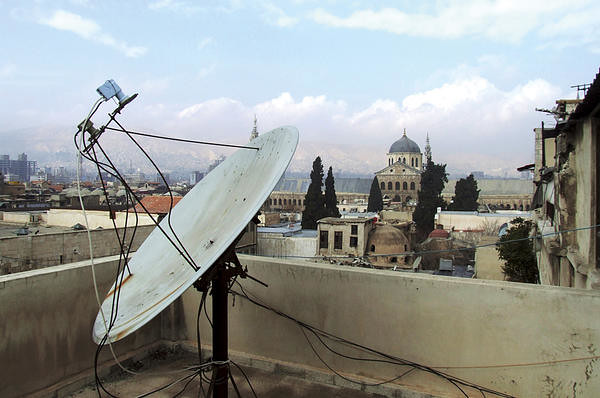
You sure I need this antenna grounded? Oh, yeah, rocket scientists. You can bet your feedhorn!

Here’s a story from Long Grove, Illinois, via The Lake County News-Sun

Lightning that struck a home’s satellite dish Sunday night started a fire that caused about $25,000 damage, fire officials said Monday.

Long Grove Fire Protection District firefighters arrived at 2237 Stayton Lane about 9:19 p.m. and used about 600 gallons of water to extinguish a fire burning at the peak of the roof, officials said. Crews also used a fire extinguisher to put out some hot embers that fell into the attic.

The blaze apparently started when lightning struck a satellite dish on the roof and traveled throughout the house, officials said. The flames did not spread to other areas of the house, but the electrical surge burned out three electrical sockets and tripped eight circuit breakers.

The residents and their dog had already evacuated the house by the time crews arrived. There were no reported injuries.

And the video, too.

ITU: Bring It

Good move by the ITU, ITSO and Intelsat

ITU reached agreement with Intelsat S.A. and the International Telecommunications Satellite Organization (ITSO) to strengthen emergency telecommunication resources. The collaboration aims to quicken the response to restore vital communications infrastructure in the aftermath of natural disasters.

“Recent catastrophes that have wrought havoc around the world demonstrate eloquently that there is an increasing need for effective and timely deployment of telecommunication resources to help countries in emergency and disaster relief,” said ITU Secretary-General Hamadoun Touré. “This agreement between ITU, Intelsat and ITSO will go a long way in increasing our early response capabilities and in re-establishing the communication links that are so vital in rescue and relief operations.”

Recognizing that satellite technology, with its ubiquitous coverage and rapid deployment, is ideally suited for response to communications needs in emergency situations, the agreement between ITU, Intelsat and ITSO brings together key players in the satellite industry to address the emergency communications needs of countries worldwide. Following the request from a Member State for assistance in the aftermath of a natural disaster, ITU will inform Intelsat of the request for satellite capacity and other related needs. Intelsat will then consult with ITSO and consider donating satellite capacity.

Intelsat is one of the world’s leading providers of satellite telecommunications services, with a footprint covering over 200 countries. ITSO is an intergovernmental organization with a mission to ensure that Intelsat complies with its contractual obligations following its privatization in 2001 to provide international public telecommunications services, including voice, data and video, on a global and non-discriminatory basis.

ITSO Director General José Toscano said, “When emergencies occur in remote or geographically isolated places, satellite providers like Intelsat are often the ideal solution for solving the communications needs.”

“Intelsat, with over 50 satellites in orbit around the world, is often the enabler of the first communications links re-established following a natural disaster. We will collaborate with ITU and ITSO to streamline the provisioning of connectivity and communications infrastructure that support critical humanitarian services during emergencies,” said Intelsat CEO Dave McGlade.

The agreement between ITU, Intelsat and ITSO is an outcome of the Hyderabad Plan of Action adopted by the World Telecommunication Development Conference in 2010 that called for private sector participation to help close the gap in universal access to information and communication technologies (ICT) and to support emergency communications in particular.

WBMSAT Satellite Industry News Bits April 1, 2011

Australian satellite services provider NewSat wins $4.4 million contract with U.S. military to provide communications to troops in Afghanistan.
[ARN – 04/01/2011]

Network structure designed by SPAWAR engineers piggybacks chat and secure data information on Iridium low data rate channels, and is assisting responders to Japan’s earthquake disaster.
[SatNews – 04/01/2011]

Chunghwa Telecom and Singapore Telecommunications to launch joint-venture communication satellite, ST-2, in mid-May 2011 to replace ST-1.
[DigiTimes – 04/01/2011]

Venezuela and Uruguay sign series of strategic agreements to advance satellite communications.
[venezuelanalysis – 04/01/2011]

South African National Space Agency and Russian counterpart Roscosmos expect to cooperate in Radioastron space telescope programme.
[SatNews – 04/01/2011]

Ariane launch of Abu Dhabi’s first satellite Yahsat Y1A and Intelsat satellite New Dawn is postponed due to technical problems.
[Reuters – 03/31/2011]

Inmarsat buys Norway’s Ship Equip for $159 million Euros.
[City A.M. – 03/31/2011]


Telesat Holdings said to be entertaining takeover offers from EchoStar Corp. and Carlyle Group, with decision possible within days.
[Bloomberg – 03/31/2011]

 Pentagon and Transportation Department officials write FCC, concerned about possible interference with GPS devices by LightSquared mobile broadband service.
[Wall Street Journal – 03/31/2011]

GeoEye supports relief efforts in Japan by providing satellite imagery of areas of devastation vie its online web services platform, EyeQ.
[SatNews – 03/31/2011]

KVH is presented 2011 MSUA Innovation Award for its revolutionary approach to satellite communications with its mini-VSAT Broadband SM network and TracPhone V7 hardware.
[Space Daily – 03/31/2011]

Earth observation satellite company RapidEye signs distribution agreement with Ramani Geosystems of Kenya for the entire continent of Africa.
[SatNews – 03/31/2011]

Vizada lands General Services Administration Schedule 70 Future COMSATCOM Services Acquisition contract to provide mobile satellite services to U.S. Government.
[TMCnet – 03/31/2011]

International spacecraft that will take NASA’s first space-based measurements of ocean surface salinity arrives at Vandenberg AFB launch site.
[SatNews – 03/31/2011]

Libyan opposition launches satellite television channel, Ahrar TV, with help of Qatari government, to counterbalance state-controlled media.
[SatNews and Really Rocket Science – 03/30/2011]

F4W’s technology improves quality, increases VoIP connections via satellite and cellular by 500%.
[PR Newswire – 03/30/2011]

Seven satellite industry companies agree to form alliance to increase awareness of benefits of hosted government payloads on commercial satellites.
[SatNews – 03/30/2011]

Distribution agreement between NextAlarm and Hughes will bring NextAlarm’s products and services to subscribers of HughesNet service.
[PR Newswire – 03/30/2011]

Vizada renews sponsorship contract with TSF, pledging to continue mobile satellite communications support in 2011, including current mission in Libya.
[SatNews – 03/30/2011]

Japanese spaceship loaded with garbage from International Space Station burns up in Earth’s atmosphere.
[Fox News – 03/30/2011]

Thuraya selected by Spanish mountaineer as satellite communications partner for forthcoming climb of Mount Everest.
[SatNews – 03/30/2011]

Earth Observation market includes two extremes – free availability and distribution by agencies like NOAA, and large, lucrative military contracts.
[NSR – 03/30/2011]


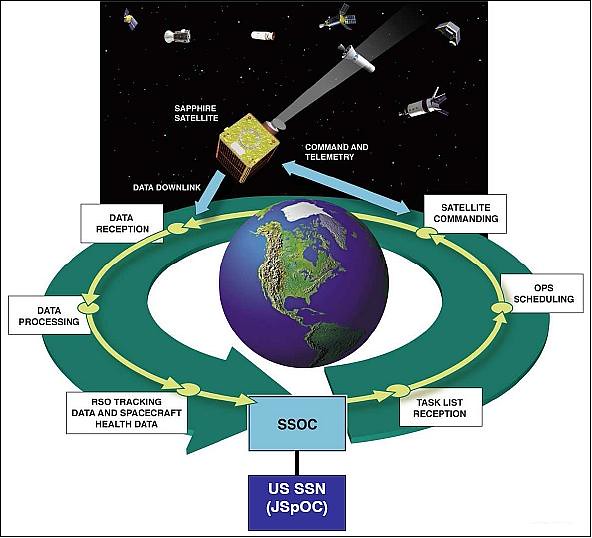
MDA receives contract from Canada’s Department of National Defense to operate and maintain Sapphire System monitoring space objects around the clock.
[SatNews – 03/30/2011]

Applied Satellite Technology makes available onsatmail, a free compressed email service on IsatPhone Pro handheld satellite phones.
[SatNews – 03/30/2011]

L-3 introduces high-power density Microwave Power Module capable of 110 watts of saturated power in 20 to 21 GHz band in small form factor suitable for airborne applications.
[SatNews – 03/30/2011]

UN telecommunications agency reaches agreement with Intelsat and the International Telecommunications Satellite Organization to expedite restoration of vital telecommunications services following natural disasters.
[UN News Centre – 03/29/2011]

Skylogic and SkyDSL Global extend partnership and raise level of performance with new-generation broadband service using KA-SAT satellite.
[TMCnet – 03/29/2011]

iDirect improves security and enhances mobility for Defense and Government customers in its iDX 2.3 software and advanced hardware.
[PR Newswire – 03/29/2011]

JAXA sets up satellite communications at disaster-struck areas in Japan.
[Satellite Spotlight – 03/28/2011]

Telecoms Sans Frontieres provides more than 28,000 international calls in one month to Libyan refugees in La Chucha transit camp.
[SatNews – 03/28/2011]

Comet-hunting spacecraft is sent command to burn remaining fuel and shut down after 12 years in operation.
[R&D Magazine – 03/28/2011]

Japanese satellites in clean rooms survived quake.
[Spaceflight Now – 03/28/2011]

Eutelsat gets ‘Crystal Antenna of the World of Media’ award for spearheading Poland’s first live satellite transmission in 3D (football match).
[SatNews – 03/28/2011]

SkyTraq introduces GLONASS/GPS receiver that offers drop-in upgrade for existing GPS equipment.
[SatNews – 03/28/2011]

Integral Systems adds two satellite interference monitoring, detection, and geolocation sites in Republic of Cyprus and Republic of South Korea.
[SatNews – 03/28/2011]

MTN Government Services added to FCSA government contract.
[PR Newswire – 03/28/2011]

Comtech wins orders worth $1.7 million from domestic prime contractor supplying Electronic Warfare Systems.
[TMCnet – 03/28/2011]

Yahsat launches “A Nation’s Pride in the Sky’ school program in partnership with the Abu Dhabi Education Council to educate students about satellite technology.
[Khaleej Times – 03/28/2011]

RRsat’s Station711 and Inmarsat’s FleetBroadband chosen by Swire Pacific Offshore as next-generation communications platform.
[PR Newswire – 03/28/2011]


Gilat awarded new contract for broadband services in rural Peru.
[Globe Newswire – 03/28/2011]

ViaSat expands Yonder high-speed satellite internet service in Brazil via StarOne C1 satellite.
[Satellite Today – 03/28/2011]

Transponders for India’s DTH: “Open Skies” behind closed doors.
[NSR – 03/28/2011]

The oil and gas trifecta:  voice, data, and video via satellite.
[NSR – 03/21/2011]

Irish start-up technology company Mandac signs East African deal bringing Internet access to rural East Africa.
[talk Satellite – EMEA – 03/21/2011]

WBMSAT PS satellite communications systems services

Unsportsmanlike Conduct

The Rangers got beat by the “Fishsticks” last night. It’s time to renew the rivalry with the Islanders.

And not just in hockey.

I’m referring to the folks who own Cablevision — and the Rangers, Knicks and the MSG Network. As a DISH Network customer, I still can’t get MSG-HD, even though the FCC finally closed that loophole.

While they’ve spent a year appealing the decision, contract negotiations with the carriers is the other weapon used to save their sorry business model…

Thursday marked Opening Day of the 2011 Major League Baseball season, but the team-owned regional sports networks in New York are nearing the bottom of the ninth in renewal negotiations with the top DBS providers.

SNY, the TV home of the New York Mets and YES, the carrier for the New York Yankees, are coming up against contract expirations with Dish Network and DirecTV, respectively.

SNY’s deal with Dish is set to conclude at midnight on April 1. However, the first Mets contest of the season is not scheduled until 7 p.m. that day against the Florida Marlins in Miami. SNY said it was in ongoing discussions with the No. 2 DBS provider at press time.

Dish had this response: “We are in negotiations with SNY for fair terms to reach an agreement. Due to confidentiality reasons, we cannot comment further on negotiations. It’s important to know that this is normal course of business, as we negotiate hundreds of contracts per year.”

The distributor also pointed out that some Mets games are available on WPIX-TV channel 11 in the New York DMA and on national networks.

SNL Kagan estimates SNY’s monthly subscriber license fee at around $2.20

YES, meanwhile, will see its current multiyear contract with DirecTV end at midnight on April 2. The RSN televised the Yankees’ season opening win over the Detroit Tigers on March 31 and doesn’t have another Bronx Bombers live game until Sunday April 3. SNL Kagan pegs YES license fee at some $2.60 per subscriber per month.

YES issued the following statement: “We are negotiating in good faith with DirecTV in hopes of resolving this matter quickly.”

For its part, DirecTV said it was negotiating with YES, while saying the RSN’s “threats to take down the channel are nothing more than gamesmanship to try and gain leverage in the talks.” The distributor said the contract will “get resolved if YES agrees that DirecTV should pay the same amount as the other three dominant TV providers in the market (Comcast, Time Warner, & Cablevision). DirecTV customers should not be forced to pay a penny more for YES Network.”

During its season-opening Bronx Bombers telecast, YES talent, its bottom line crawl and a spot alerted viewers to the contract situation. Information was also available on its website.
SNY did not disseminate similar information about its contract situation with Dish on its air on Thursday.

Dish has carried SNY since its rookie campaign five years ago, but has never reached a deal with YES. The DBS provider’s contract ended with MSG Network and MSG Plus last Oct. 1 and those New York RSNs have remained off Dish’s air since then.

What ever happened to giving your customers what they want?

Cut the cord.

Syria: Satellite Sucks


Is satellite TV the great information distributor of our age? According to Syrian president Bashar al-Assad, it is…

On Wednesday morning the al-Watan newspaper, which is close to the regime, predicted Assad would “reassure all Syrians and draw clear features for the coming phase”.

But instead he criticised “satellite channels, propaganda and a sectarian divide”, which he said had contributed greatly to the unrest that has reverberated through the country.

Assad did acknowledge that “mistakes” had been made in the southern city of Deraa where security forces have been accused of shooting dead more than 100 unarmed demonstrators. “Not all the demonstrators are conspirators,” he said.

The speech was interrupted regularly by members of Syria’s national parliament and was well-received in his constituency.

You just can’t stop people from downlinking content from satellite orbiting 36,000 km in space! Here’s the speech…

OTV-2: I See You!

Ever since the launch above earlier this month, skywatcheers have been searching for the X-37B. Found it

NORAD ID: 37375
Int’l Code: 2011-010A
Perigee: 328.6 km
Apogee: 343.8 km
Inclination: 42.8°
Period: 91.1 min
Semi major axis: 6,707.2 km


The details, provide by Noah Shactman at Wired

It took the amateur sleuths nearly a month to hunt down the first X-37B after it launched on its inaugural mission. That’s an eternity in sky-spotting time.

The second time around was easier. The U.S. space plane was discovered just four days after it blasted into orbit, earlier this month. Cape Town, South Africa’s Greg Roberts — “a pioneer in using telescopic video cameras to track spacecraft, chalking up exceptional results over the years,” according to Space.com — spotted this second secret spacecraft, just like he found the first.

The X-37B has generated intense interest, long before it ever left the ground. Boeing originally developed the 29-foot unmanned craft — a kind of miniature Space Shuttle — for NASA. Then, the military took over in 2004, and the space plane went black. Its payloads were classified, its missions hush-hush.

Depending on who you talk to, the space plane could be a prototype commando transport, an orbiting bomber or (most likely) a spy-above-the-skies. It could launch, repair or reposition U.S. satellites in low orbit. It could sneak up and disable or steal enemy satellites. Its pickup-bed-sized payload bay is particularly enticing to observers.

And now, there are observers — plural. Ontario’s Kevin Fetterof filmed the X-37B “gliding past the binary star Eta Serpentis,” according to Space.com, which has video of the flyby. Skywatchers Brad Young, Bill Young, and Alberto Rango have all reported sightings, as well.

You can even see the space plane for yourself: The X-37B is traveling in a slightly elliptical orbit more than 200 miles up, swooping from 43 degrees north latitude to 43 degrees south. (Check the real-time map at n2yo.com.)

That orbit gives some indications about what the space plane is actually doing up there. The typical spy satellite has a polar orbit, which means “it can cover the whole earth, and it can fly over the same spot at the same sun angle each time it comes overhead,” explains Brian Weeden, a former Air Force Space Command officer, now with the Secure World Foundation.

The X-37B, on the other hand, is orbiting around the fat middle of the planet, traveling over the Middle East, Africa, and fair chunk of China. “It means they are giving up global coverage and predictable shadow lengths, but getting more frequent passes,” Weeden says. The orbit lends credence to the idea that the space plane is an orbiting spy.

So does the X-37B’s altitude. It’s flying pretty low — one of the rare orbiters traveling beneath the International Space Station. “The lower you are,” Weeden notes, “the higher resolution you can get in any imagery.”

And the easier you are to spot from the ground.