New Libyan Opposition TV Channel

Ahrar TV launches today on Atlantic Bird 4A (7° West) at 16:30 GMT. Downlink details: 10930 H (tp 121). It’ll be part of the Jordan Media City MUX.

The report, via RIA Novosti

The Libyan opposition is launching a satellite television channel, Ahrar TV, on Wednesday with the help of the Qatari government in counterbalance to state-controlled media.

Libyans have only been receiving information from media controlled by Muammar Gaddafi’s government and from foreign satellite television channels, which Tripoli has been jamming in the past few weeks.

The new TV channel will go on the air at 7:30 p.m. local time (17:30 GMT) using the French Atlantic Bird satellite.

The U.S.-based Foreign Policy journal said the Qatari government had provided technical equipment of their culture channel Al-Rayyan to a group of Libyan journalists led by Mahmud Shammam, who arrived in Doha, the capital of Qatar.

The Libyan opposition has already launched Radio Free Libya and Radio Free Tobruk on mid-range bandwidths.

Who Loves Ya, Libya?

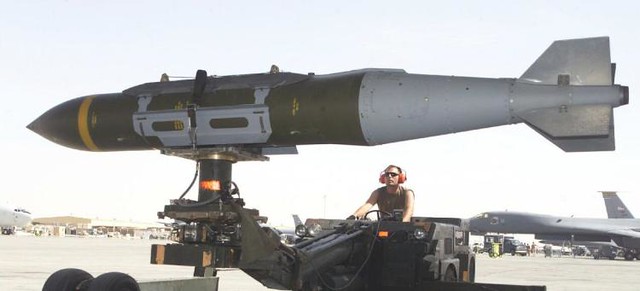
Here’s a little love for QDaffy: a GBU-31 JDAM (Joint Direct Attack Munition) fitted with a BLU-109 penetrator warhead.

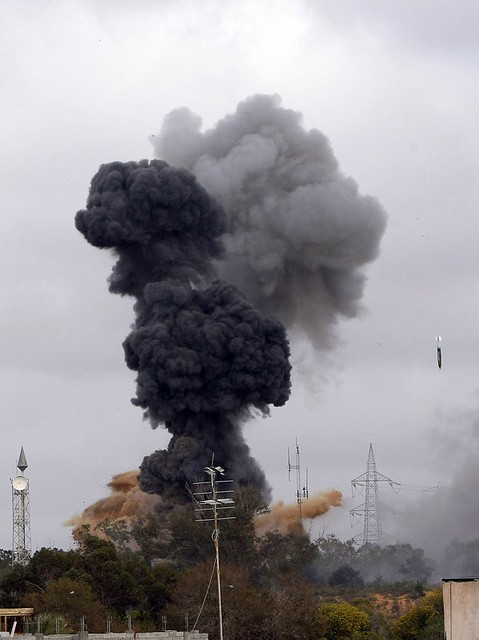
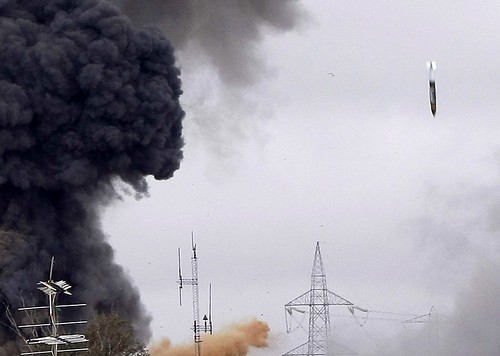
Photo credits: MAHMUD TURKIA/AFP/Getty Images


Message From Mercury

Credit: NASA / JHUAPL / Carnegie Institution of Washington

Via The Planetary Society Blog

This is MESSENGER’s very first photo from Mercury orbit, a wide-angle view that reaches right to Mercury’s south pole, exposing a very tiny sliver of territory not previously seen by spacecraft. It was taken at 09:20 UTC today, March 29, 2011, the first in a set of 363 that formed MESSENGER’s first downlink of orbital images, the first downlink of very many. This particular image is not necessarily any more important than any other image; its importance lies in the fact that it was taken and downlinked right on schedule, indicating the spacecraft is performing exactly as planned.


Al-Jazeera’s Yugo-Nostalgia


A new regional news operation is opening up in the Balkans, with an interesting business plan. The story, via AFP:

The Al-Jazeera pan-Arab satellite channel says it will begin airing a Balkans programme in September, hoping to to establish itself as a regional news hub in the ethnically divided region.
With powerful public television divided along ethnic lines across the region and dozens of private channels mostly focusing on entertainment, Al-Jazeera Balkans hopes to fill the void for a regional news broadcast.

“In the region there are currently more than 100 stations that broadcast news,” said Goran Milic, 65, a prominent Croatian journalist who will be responsible for Al-Jazeera’s Balkans operation.
“We cannot compete with them on the level of local news and won’t be able to for a long time,” he added, Instead, he said, Al-Jazeera could offer the regional approach abandoned in the 1990s due to war and the emotions that it sparked.

In the 1990s, the former Yugoslavia broke up into six separate states (Bosnia, Croatia, Macedonia, Montenegro, Serbia and Slovenia) and the disputed territory of Kosovo.

But Milic argued that many people across the region “are still interested in what is going on on the other side of the border.

“No local television dares to make a regional programme treating topics relating to bordering countries, for fear of being accused of “Yugo-nostalgia,” he noted.

“Our advantage will be also to compare information on an event in one country with a similar situation in an another,” he explained.

Media analysts however question whether Al-Jazeera can succeed since several previous attempts over the past 16 years to set up Balkans broadcasters with support of the international community failed because of lack of interest.

“They were political concepts aimed at breaking down the walls that arose during the conflicts and to push reconciliation,” Bosnian media analyst Zoran Udovicic told AFP.

After 20 years of various state media repeating the official line, it is hard to get people interested in what is happening in neighbouring countries, he added.

“(Al-Jazeera) can focus on the languages that are similar or the same and even on the feelings that people still have about the (Yugoslav) period before the wars … but they will also need to work to spark people’s interests in their neighbours,” Udovicic said.

Al-Jazeera’s best bet, he noted, would be to steer clear of the war-torn past and focus its programming on the present and the future of the region.

Serbian journalism lecturer Zoran Cirjakovic also saw problems ahead for the Balkans branch of the Qatar-based company.

“The audience in various parts of the Western Balkans has a different understanding not only of the past but also of the present,” he warns.

“The audience in all countries (in the region) have radically different interests in political topics,” he told AFP.

“They are more easily united in topics like art, culture and entertainment,” he added, citing examples of successful regional entertainment such as music and reality shows.

“My students, born in the late 1980s or early 1990s do not remember Yugoslavia… for them it is another planet, another world,” he explained.

So Al-Jazeera Balkans will be put to the test when it starts broadcasting in what was once called Serbo-Croat, which is universally understood in Croatia, Serbia, Bosnia and Montenegro.

Together with Al-Jazeera Turkey, it will be one of the first regional offices to broadcast in languages other than Arab or English.

The Pan-Arab channel has invested more than 20 million dollars (14 million euros) in the Balkans project.

Initially launched in 1996 as an Arabic news and current affairs satellite TV channel, Al-Jazeera has since expanded into a network with several outlets, including the Internet.

Al-Jazeera Balkans will employ some 100 people, including around 60 journalists and cameramen.
It will have correspondents in all the countries that once made up the former Yugoslavia and in several world capitals.

And it will tap a regional audience of over 20 million people as well as an important diaspora from each of the six former Yugoslav republics, particularly in Western Europe.

I don’t think they’ve figured out what satellite they’ll be on. Al-Jazeera is carried by quite a few satellites around the world, but they’ll likely select one that’s popular in the Balkan region. However, the either Astra or Eutelsat would be be a good choice as well.


APOD: Aurora Video from Norway

Today’s Astronomy Picture of the Day from NASA is actually a video…

Time-Lapse Auroras Over Norway
Credit & Copyright: Terje SørgjerdMusic: Gladiator Soundtrack: Now we are Free

Explanation: Sometimes, after your eyes adapt to the dark, a spectacular sky appears. Such was the case earlier this month when one of the largest auroral displays in recent years appeared over northern locations like the border between Norway and Russia. Pictured in the above time-lapse movie, auroras flow over snow covered landscapes, trees, clouds, mountains and lakes found near KirkenesNorway. Many times the auroras are green, as high energy particles strike the Earth’s atmosphere, causing the air to glow as electrons recombine with their oxygen hosts. Other colors are occasionally noticeable as atmospheric nitrogen also becomes affected. In later sequences the Moon and rising stars are also visible. With the Sun expected to become ever more active over the next few years, there may be many opportunities to see similarly spectacular auroraspersonally, even from areas much closer to the equator.


In-Flight Ka-band

Using the Ka-band for data is a good idea, even with rain attenuation risks. Say, for example, you were to remove that risk by eliminating pesky clouds and precipation? No problem: fly over them.

Enter JetBlue’s LiveTV LLC and a deal with ViaSat and Continental to use the all-Ka-band ViaSat-1 spacecraft for connecting hundreds of aircraft to the Internet…

Continental Airlines has signed a letter of intent (LOI) with JetBlue Airways subsidiary LiveTV to bring in-flight Wi-Fi – via Ka-band satellite – to more than 200 domestic aircraft equipped with LiveTV’s 95-channel in-seat live television systems.

The deal with Continental represents what could be considered a watershed moment for LiveTV, which, while having successfully deployed Ku-band satellite-based DirecTV in-flight entertainment with several airlines, has struggled for years to gain traction in the Wi-Fi market with its lower-bandwidth air-to-ground (ATG)-based Kiteline in-flight email/messaging service.

LiveTV has since refocused its efforts on offering an ultra-high-speed Ka-band offering, in partnership with satellite communications specialist ViaSat, and succeeded in securing both United-Continental Holdings subsidiary Continental, as evidenced by today’s LOI announcement, in addition to reaching a fleet-wide equipage deal last year with parent JetBlue.

The Ka-band service being brought to Continental’s fleet will utilize the same ViaSat-1 satellite – set for launch later this year – that will help support JetBlue’s in-flight connectivity plans.

ViaSat is doing well, having just leased the Canadian spot beams on ViaSat-1 to Telesat (shh: they may do an IPO). The platform uses proven technology and some airline passengers consider in-flight WiFi a real advantage. Just don’t charge them extra. Remember Connexion by Boeing?


Lock & Load With DISH Network

The folks who run the Radio Shack in Hamilton, Montana, really know their customers. Their “free firearm” promotion is working well. The story, via the Billings Gazette

When driving down U.S. Highway 93 through Hamilton, there’s no need to do a double-take when you see the sign hanging above the Radio Shack Super Store.

You read it right. Customers who buy Dish Network will be rewarded with a firearm.”I think it really, really fits the Bitterroot Valley,” said Steve Strand, who has owned Hamilton’s Radio Shack for about seven years.

Strand, along with store manager Fabian Levy, wanted to generate more foot traffic at their location. So far, the gun giveaway has worked like a charm.

“It’s been really successful,” Levy said.

According to Strand, it has tripled his business since the promotion started last October. And, he said, easily hundreds of people have stopped in to see what the sign is all about. “Protect yourself with Dish Network. Sign up now, get free gun,” the sign reads.”We have people literally stop in to take pictures of the sign,” Levy said.

Qualifying customers have the choice between a Hi Point 380 pistol or a 20-gauge shotgun.The deal is only good for new Dish Network customers and they must buy a certain amount of equipment to qualify for the free gun.

After the customer signs a service contract and sets up an install date, they are given a gift certificate for their gun. They can also opt for a $50 gift card from Pizza Hut if they prefer, Strand said. And customers who purchase new Dish Network service that don’t qualify for a firearm are still given the Pizza Hut gift card.

The gift certificate is good at Frontier Guns & Ammo, located north of Hamilton on Sheafman Creek Road. They are then put through a background check, also free with the promotion, before receiving their gun.

“We’re not just giving guns to felons,” Levy said.

The idea for the promotion wasn’t anything scientific. A friend of Strand’s made the suggestion and, “I thought, ‘Why don’t we?’ ” Strand said.

With all the interest his promotion has garnered, there was one trend.

“You’d be surprised how many women are interested in guns,” Strand said, noting he has had many women in their 60s and 70s drop in to learn about the promotion. “I was quite surprised,”Strand said.
Strand said since starting the promotion, he has gotten good feedback. “We’ve received a tremendous amount of positive reactions,” Strand said.

He said of the hundreds of people who have stopped by because of the sign, only one person reacted negatively. “They didn’t understand how it works,” he said.

Strand also said that other Radio Shack owners he has talked to across the state, in places like Havre and Malta, are too scared to try similar promotions.

“There is a risk involved,” Strand said.

Dish Network allots advertising dollars to the store to promote Dish, but the gun promotion has made them skittish.

“They’ve never had a gun promotion before, so they’re a little nervous about it,” Strand said. “It’s been an uphill battle with Dish.”

After a few months of volleying with the company, however, Strand was given the go-ahead to start advertising.

“If we can get that promotion out there, things could go crazy,” Strand said.

They aren’t sure how much longer they will continue the promotion, but they will be doing the same deal next month with Direct TV packages.

“I kind of thought this promotion was a joke at first, but as things picked up, I realized it was working,” Levy said.

WBMSAT News Bits 03/25/2011

HYLAS 1 ready for service – Avanti needs to build up large customer base to recoup investment in satellite – faces stiff competition from up and coming terrestrial wireless broadband services.
[The Register – 03/25/2011]

Inmarsat and Boeing successfully complete key design and engineering milestone for three state-of-the-art Ka-band high-throughput satellites with broadband speeds up to 50 Mbps to make up new Inmarsat-5 constellation.
[SatNews – 03/25/2011]

Telesat receives high scores in WTA Teleport Operator Satisfaction Survey.
[Satellite Today – 03/25/2011]

Telkomunikasi Indonesia to launch Telkom-3 satellite this year.
[TeleGeography – 03/25/2011]

Astrium congratulates UK government on creation of National Space Technology Programme to be funded by government and industry to drive innovation in Britain’s thriving space industry.
[SatNews – 03/25/2011]

TerreStar Genus terrestrial/satellite phone wins innovation award at 2011 CTIA Wireless show.
[TMCnet – 03/25/2011]

Frost and Sullivan releases new report, “Defense Communications Funding Trends and Prospects,” focusing on defense communications technologies such as tactical radios and military satellite and network-centric communications.
[TMCnet – 03/24/2011]

Kore Telematics expands M2M network globally, featuring enhanced cellular data network services complemented by global satellite delivery.
[MSP News – 03/24/2011]

LightSquared signs Best Buy as second public wholesale customer just one day after signing Cricket Communications, giving indications it is well on its way to getting its business off the ground.
[Wireless Week – 03/24/2011]

Numerex partners with Tekelec to market new M2M solutions.
[Satellite Today – 03/24/2011]

Dish Network sues Dark Angel of Canada, and two of its customers, for pirating satellite television programming.
[Victoria Advocate – 03/24/2011]

Eutelsat wins “Crystal Antenna of the World of Media” award for Poland’s first live satellite transmission in 3D.
[PR Newswire — 03/24/2011]

Five year agreement between Spacecom of Israel and Mreza Plust TV of Bosnia will result in the news and entertainment being distributed throughout Bosnia on the AMOS satellites.
[SatNews – 03/24/2011]

International Launch Services launches aggressive protest against recurring subsidies to competitor Arianespace by the 18-nation European Space Agency.
[SatNews – 03/23/2011]

Viasat enters into agreement with Asia Broadcast Satellite to provide Ka-band satellite IP transit service in key areas of Middle East using the ABS satellite.
[TMCnet – 03/23/2011]

SES ASTRA extends its technical reach across Europe and now serves 135 million TV homes in Europe and North Africa via its satellite fleet.
[SatNews – 03/23/2011]

Skylogic, the broadband subsidiary of Eutelsat, and Sat Internet Services sign 3 year agreement for broadband services using the KA-SAT High Throughput Satellite.
[Techzone 360 – 03/23/2011]

First Responders in Minnesota have access to SATCOW (Satellite-equipped Communication Site on Wheels), operated by Hennepin County.
[KAAL TV – 03/23/2011]

Satellite operators may no longer have to throw away good geostationary satellites if deal between Intelsat and Canada’s MDA to build robotic satellite refueler works out.
[Aviation Week – 03/22/2011]

Lockheed Martin shows off test version of Orion spacecraft, initially meant to return humans to the moon, but may be escape vehicle for International Space Station or taking astronauts beyond Earth Orbit.
[R&D Magazine – 03/22/2011]

Arianespace readies for dual launch of Intelsat New Dawn and Yahsat Y1A on March 30, as Soyuz prepares for launch of six Globalstar satellites in Kazakhstan in May.
[SatNews – 03/22/2011]

O3b awards Integral Systems contract to provide carrier monitoring and interference detection.
[The Street – 03/22/2011]

Indian broadcaster Sun TV signs multi-year multi-transponder lease agreement with Intelsat for C-band capacity on IS-17.
[Satellite Today – 03/22/2011]

JetBlue deal for Ka-band in-flight broadband service for entire 160-aircraft fleet huge win for ViaSat.
[Satellite Today – 03/22/2011]

Western spy satellites monitor the remaining containers of mustard blister agent in the Libyan desert.
[SatNews – 03/22/2011]

Four high-level speakers joins roster of illustrious participants in Space Foundation’s Cyber 1.1 conference next month.
[SatNews – 03/22/2011]

Albanian government awards contract to EMA Group for Iridium-based Vessel Monitoring Systems on the country’s commercial fishing fleet.
[Satellite Today – 03/22/2011]

Newtec marks 10 years in Asia by joining the Asia Pacific Satellite Communications Council.
[SatNews – 03/22/2011]

Maritime satellite communications provider Marlink extends contract with seismic vessel operator Fugro-Geoteam for another five years.
[Satellite Today – 03/22/2011]

United Nations OCHA and GVF join forces to facilitate global disaster preparedness and response efforts.
[Satellite Evolution Group – 03/15/2011]

WBMSAT PS satellite communications systems services

To The Future

The AIAA did the right thing in denying a “truther” group participation in Newtown. The story, via the Courier-Times

A local symposium about the future of aerospace has attracted the attention – and indignation – of a group of engineers that was denied participation.

Architects and Engineers for 9/11 Truth wanted to set up a table alongside other symposium participants today at Lockheed Martin in Newtown Township, but the local chapter of the American Institute of Aeronautics and Astronautics, sponsor of the symposium, denied the application.

The 9/11 group contends that official reports describing the fall of the World Trade Towers on Sept. 11, 2001, paint a false picture of how Building 7 collapsed. It fell not because of fire, as the report describes, but because an unknown group deliberately planted explosives in the building, according to the group.

Klaus Dannenberg, deputy executive director of the American Institute, said it’s just unreasonable to include the group in this symposium, which is about the next generation of aerospace, including advancements in controls, aircraft design and materials.

Have questions about WTC #7? Look it up and draw your own conclusions — and leave the rocket scientists out of it.

Satcom’s Responsibility

The scale of the disaster in Japan, who some have compared to “four Katrinas,” is as mind-boggling today as it was a week ago. The automatic reaction in the satcom community was one of “ready, set, go” — let’s get our satcom systems turned up to help with communications efforts. The ITU cobbled together a bunch of satellite phones and terminals, et. al. as quickly as it could…

Among material already deployed are 78 Thuraya satellite phones equipped with Global Positioning System (GPS) technology to facilitate search and rescue efforts, along with 13 Iridium satellite phones and 37 Inmarsat Broadband Global Area Network terminals. An additional 30 Inmarsat terminals are ready for dispatch. The equipment can be charged by car batteries and are supplied with solar panels to enable operations during power outages.

This may seem as if it’s not nearly enough to help, but you should also consider the response inside Japan. Only yesterday did the Ofunato City Hall get a much-needed satcom connection via the KIKU No. 8 (ETS-VIII) mobile satellite system…

On March 24, JAXA set up a ground antenna and the movable test communication terminal for the KIKU No. 8 at the Ofunato City Hall to connect the communication line of up to 768 Kbps between the City Hall and the Tsukuba Space Center via KIKU No. 8 in cooperation with the National Institution of Information and Communications Technology (NICT) based on a request from the Ministry of Education, Culture, Sports, Science and Technology, which received a petition from Ofunato City, Iwate Prefecture.


With this communication line installation, Ofunato City Hall workers began collecting information by PCs through the Internet. Apart from city hall, local fire departments and other offices can also now use the Internet and IP telephones to share information for strengthening their cooperative activities.

In addition, as one of the special features of the KIKU No. 8 is communications with a small movable test terminal, which was installed at Ofunato City, information dispatch from evacuation centers and other places through the Internet became possible, because it is easy to move around and install it. Therefore, the connection this time is expected to further contribute to a smooth recovery from the disaster.

Simply getting these terminals out to where they were needed took time — and to find power sources. Most can be powered by a car battery, but they weren’t easy to find. Having a handheld unit is wonderful, until you need to recharge. As many found during last winter’s storm and subsequent power outages in the U.S., you could maintain your Internet connection/communication with an iPhone — only you’d be charging it in your car. In Japan, you car may have been washed away or buried under tons of debris, miles away. So that’s not an option.

Nobody could have predicted this type of utter destruction of property and the communications and power-transmission systems failures. The challenge of preparing satcom systems to respond effectively is to make sure there’s capacity available to meet the demand. As with the REDiSat Network, developed by SES Americom in response to Hurricane Katrina in 2006, nobody wants to pay for capacity that’s not needed. Full-time customers are ready to today, so they fill up the spectrum for their businesses. You can’t simply bump them to make room for emergencies when they have hundreds of customers depending on it for their livelihood.

That’s when the government needs to step in and  help foot the bill. Help the satcom operators keep satcom inventory ready to deploy in case of emergency, only not at the target 80% EBITDA margins. A reluctance to part with capacity at a lower profit margin caused the  REDiSat Network to fade away. Designing, building, testing, launching and operating a satcom spacecraft is expensive and they do serve the public well.

Broadcasters’ reliance on — and willingness to pay for — satcom systems is a wonderful arrangement.  It’s magic: an infinite number of receivers for video and a good source of cash flow for the satellite operators. Keeps a lot of rocket scientists employed, too.  As good corporate citizens, shouldn’t some of the profits be set aside to provide satcom capacity when needed?

I’m sure the accountants can find a way to pay for it.

Anybody who has capacity available in the region is likely booking it for TV news. Only SKY Perfect JSAT has any meaningful response (opens in PDF) …

As a measure for supporting post-disaster recovery, we are allocating necessary transponders capacity to anti-disaster organs, etc. and preparing for aid measure one by one. At present, the number of applications for subscription is increasing steeply. We are dealing with it as follows: For recovery assistance, we will immediately conduct what we can do with our communication satellite. We hope that the devasted area will be restored soon.

About the use of satellite communication services

  • We will first distribute transponders to the institutions for post-disaster recovery, such as National Police Agency, the Ministry of Defense, related ministries, Telecommunication carriers and the U.S. military.
  • As for the use of bands by electric power companies, including TohokuElectric Power, we will assist them proactively and give priority to them to allocate the cacant bands of Superbird-B2 owned by SKY Perfect JSAT
  • As for the steep increase in the use by media organizations, we will deal with it thoroughly, and as for new subscriptions, we will allocate the band of JCSAT-5A, which has some room.

Where are the “we’re helping” press releases from the major satcom players?