Space Bacteria


The Space Shuttle Atlantis is a "go" for launch on Friday, 14 May 2010 (STS-132). The mission will be the last for Atlantis and include two spacewalks…

Atlantis’ 12-day mission will deliver the Russian-built Mini Research Module-1 that will provide additional storage space and a new docking port for Russian Soyuz and Progress spacecraft. MRM-1, also known as Rassvet, which means dawn in Russian, will be permanently attached to the bottom port of the station’s Zarya module. MRM-1 will carry important hardware on its exterior including a radiator, airlock and a European robotic arm. Atlantis also will deliver additional station hardware stored inside a cargo carrier. Three spacewalks are planned to stage spare components outside the station, including six spare batteries, a Ku-band antenna and spare parts for the Canadian Dextre robotic arm.

One aspect of the mission not featured is the Micro-2 experiment, led by Asst. Professor Cynthia Collins of RPI. Get a sense of what this is about from Laboratory Equipment:

A team of researchers from Rensselaer Polytechnic Institute will send an army of microorganisms into space this week, to investigate new ways of preventing the formation and spread of biofilms, or clusters of bacteria, that could pose a threat to the health of astronauts.

The Micro-2 experiment, led by Cynthia Collins, assistant professor in the Department of Chemical and Biological Engineering at Rensselaer, is scheduled to launch into orbit on May 14 aboard Space Shuttle Atlantis. The microorganisms will spend a week in space before returning to Earth aboard the shuttle. Within just a few hours after the shuttle’s return, Collins will be able to examine the bacteria and resulting biofilms to see how their growth and development were impacted by microgravity. The samples also will be returned to Rensselaer, to be examined using the core facilities of the Institute’s Center for Biotechnology and Interdisciplinary Studies.
“We know that gravity plays a key role in the development of biological systems, but we don’t know exactly how a lack of gravity affects the development of bacteria and biofilms,” Collins says. “This means while certain bacteria may be harmless on Earth, they could pose a health threat to astronauts on the International Space Station or, one day, long space flights. Our goal is to better understand how microgravity affects the relationship between humans and bacteria, so we can develop new ways of reduce the threat of biofilms to spacecraft and their crew.”

Partnering with Collins on the Micro-2 project are nanobiotechnology expert Jonathan Dordick, the Howard P. Isermann Professor of Chemical and Biological Engineering at Rensselaer and director of the Univ.’s Center for Biotechnology and Interdisciplinary Studies, and thin films expert Joel Plawsky, professor in the Department of Chemical and Biological Engineering. NASA is funding the experiment.

Biofilms are complex, three-dimensional microbial communities. Bacteria commonly found in nature are often in the form of biofilms. Most biofilms, including those found in the human body, are harmless. Some biofilms, however, have shown to be associated with disease. Additionally, biofilms in locations such as hospitals — or confined locations like space shuttles — have exhibited resistance to antibiotics. This could pose a problem for astronauts, who have been shown to have an increased susceptibility to infection while in microgravity.

Collins and her team will send up eight devices, called group activation packs (GAPs) and each containing 128 vials of bacteria, aboard the shuttle. While in orbit, astronauts will begin the experiment by manipulating the sealed vials and introducing the bacteria to different membranes. At the same time, Collins will perform the same actions with identical GAPs still on Earth at the Kennedy Space Center in Florida. After the shuttle returns, her team will compare the resulting biofilms to see how the behavior of bacteria and development of biofilms in microgravity differed from the control group. The experiment uses BioServe Space Technologies flight-certified hardware.

The Micro-2 research team will also test if newly developed, nanotechnology-based antimicrobial surfaces – developed by Dordick at Rensselaer – can help slow the growth of biofilms on Earth and in microgravity. If successful, these new antimicrobial surfaces could one day be used in hospitals and spacecraft to help reduce the impact of biofilms on human health.

Collins’ experiment is the third Rensselaer research project to be launched into space over the past year. In August 2009, an experimental heat transfer system designed by Plawsky and Rensselaer Professor Peter Wayner was installed in the International Space Station (ISS), where it will remain for three years. In November 2009, wear-resistant, low-friction nanomaterials created by Professor Linda Schadler were blasted into orbit aboard Space Shuttle Atlantis, attached to the outer hull of the ISS, and exposed to rigors of space.

 Cool experiment, but it reminds me of the 1971 film "Andromeda Strain," which I found fascinating and fearsome.



Yeah, I know: that’s the guy who played the Mad Hatter on the Batman TV show in the 1960s.



Tweets From Space


The University of Tokyo’s Intelligent Space Systems Laboratory (Nakasuka) built and launched a cubesat, 4-in/10-cm square, in 2005. The low-earth orbit spacecraft is now sending out updates via Twitter, all by itself.


The tweets, in Japanese, even feature little twitpics and have assembled over 2,600 followers. Some detail, via Asiajin:

 Nakasuga Lab., the University of Tokyo, introduced a bot account tweeting the real-time state of a satellite which is located in the earth low orbit.   The tweet(@XI-V) keeps us update with parameters like the satellite’s surface temperature, battery voltage and where it is located over of the planet and also shows us still images shooting the planet from the satellite in the space.

As we’ve blogged before, real-time tweets from space has had human intervention. This is automatic, and that’s kinda cool. This information is more than the poor boys at Intelsat have regarding the Galaxy-15 spacecraft. They get no telemetry data at all, but they do have some ranging info and ephemeris data.

As for CubeSat XI-V, a job well done by the rocket scientists at Nakasuka!


WBMSAT Satellite Industry News Bits 05/07/2010


FCC plans to reclassify broadband service as a telecommunications service in order to reassert its authority after U.S. Court of Appeals ruled against FCC in case brought by Comcast.
[cnet news – 05/07/2010]

Artist's concept of Jupiter satellite


Hughes engages Arianespace to launch its powerful Ka-band satellite Jupiter in the first half of 2012.
[SatNews – 05/07/2010]

SES closes acquisition of ProtoStar 2 satellite which it won at auction in December and renames it SES-7.
{Satellite Today – 05/07/2010]

Intelsat contracts ILS to launch Intelsat 22 in 2012.
[Satellite Today – 05/06/2010]

Artist's rendition of Globalstar satellite

Globalstar announces timetable for upcoming launch of its 2G satellite constellation.
[SatNews – 05/06/2010]

SatMAX to provide satellite communications repeater system to Lockheed Martin for the Lockheed Martin Airdock in Akron OH.
[marketwire – 05/06/2010]

CapRock secures 60 month contract with Diamiemos Shipping Corporation of Greece for nine C-band shipboard terminals.
[SatNews – 05/06/2010]

Comtech subsidiary Xicom receives $3.4m contract from Navy for ruggedized Traveling Wave Tube Amplifiers to be fitted to existing systems and provide improved Ka-band access to the new WGS satellites.
[Market Watch – 05/06/2010]

GeoEye signs multi-year multi-million dollar order with Russian reseller, ScanEx Research and Development Center for high-resolution satellite imagery.
[SatNews – 05/06/2010]

Australian government releases $25M National Broadband Network study which concludes the government’s objectives can be implemented within original $43B estimate, mixing fibre, wireless, and satellite technologies.
[Network World – 05/06/2010]

XTAR remembers William R. Schmidt, who passed away April 28.
[SatNews – 05/06/2010]

Eutelsat and Euro1080 enter exclusive partnership to enrich content of Eutelsat’s 3D channel, broadcast across Europe via EUROBIRD 9A.
[SatNews – 05/06/2010]

ORBCOMM commences construction of Gateway Earth Station in Hartebeesthoek, South Africa.
[SatNews – 05/06/2010]

"Zombiesat" Galaxy 15, owned by Intelsat, resists attempts by manufacturer Orbital Sciences to force it to shut down – Galaxy threatens to interfere with SES WORLDSKIES AMC-11 satellite around May 23.
[Space.com – 05/05/2010]
[Fox News – 05/03/2010]

Arqiva supplies Sky News with extensive Satellite News Gathering services to support coverage of the UK general election.
[SatNews – 05/05/2010]

Hughes’ large all Ka-band satellite Jupiter to be launched by Ariane 5 in deal backed by France’s Coface export-credit agency.
[Space News – 05/05/2010]

Globecomm Systems becomes most recent member of the Satellite Industry Association.
[SatNews – 05/05/2010]

Vizada Networks and Norwegian Defence Logistics Organisation expand existing co-operation with Framework Agreement for supply of commercial satellite capacity and services.
[SatNews – 05/04/2010]

Aerojet and Florida Turbine Technologies enter into strategic partnership to compete for R&D and production on NASA’s new hydrocarbon engine and advanced upper stage engine.
[SatNews – 05/04/2010]

NASA and DARPA ask for proposals to enhance small satellite experiments on the International Space Station.
[SatNews – 05/04/2010]

Slovak Telekom’s Magio TV launches satellite TV service on Spacecom’s AMOS-3 satellite.
[SatNews – 05/04/2010]

MTN Satellite Communications is selected by Singapore-based Goodwood Ship Management to provide ship-board C-band VSAT services.
[SatNews – 05/04/2010]

OHB-System AG is awarded contracts under Europeanization of Satellite-Based Reconnaissance program for operation of French and German ground stations.
[SatNews – 05/04/2010]

C-COM Satellite systems delivers initial quantity of iNetVu Mobile antenna systems to Malaysia based reseller Numix-Engineering SDN GHD for deployment by Post Malaysia for mobile post offices.
[SatNews – 05/04/2010]

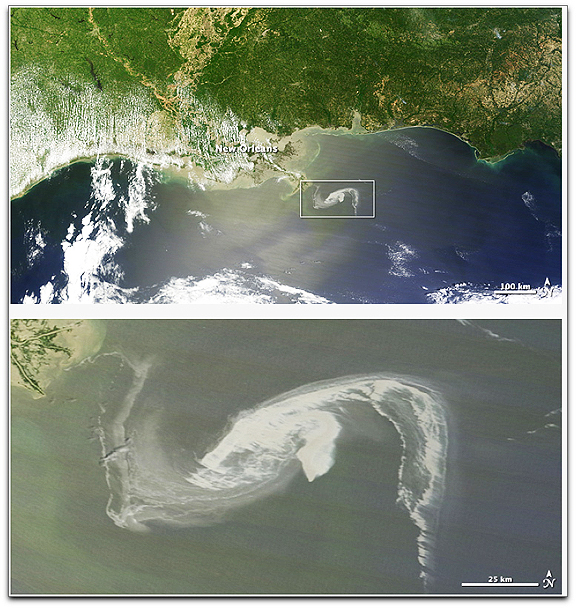
NASA satellite images of Gulf oil spill

NASA’s Terra and Aqua satellites help NOAA track expanding oil spill in from exploded BP rig in Gulf of Mexico.
[SatNews – 05/03/2010]

Lockheed Martin delivers cutting-edge communications system module for second satellite in U.S. Navy’s UHF satellite MUOS program.
[SatNews – 05/03/2010]

Thales Alenia Space to build Apstar 7B for $148.7M.
[Satellite Today – 05/03/2010]

Singapore Telecommunications will launch Inmarsat IsatPhone Pro satellite phone to enhance communications in Afghanistan and Iraq.
[SatNews – 05/03/2010]

German radar satellite TanDEM-X proves its suitability in program for 3D mapping of earth from space.
[SatNews – 05/03./2010]

PAC Tel International announces successful implementation of large satellite IP trunk linking two French overseas territories of Wallis and Futuna to international IP backbone via Australia.
[SatNews – 05/03/2010]

Comtech EF Data gets $4.8M SATCOM equipment order from leading telecommunications service provider in Asia.
[SatNews – 05/03/2010]

Inmarsat introduces new class of SwiftBroadband service, SwiftBroadband 200, designed to extend cost effective Inmarsat services to smaller aircraft.
[SatNews – 05/03/2010]

Sirius XM satellite radio resists FCC plan to make it easier for wireless internet companies to use frequencies that Sirius believes could cause interference to its signals.
[Wall Street Journal – 05/03/2010]

GeoEye's IKONOS satellite

GeoEye busily builds next satellite while waiting for major contract decision by the National Geospatial-Intelligence Agency.
[Washington Post – 05/03/2010]

ND SatCom, and SES ASTRA company, launches new global "Valued Partner Program" aimed at resellers of its satellite router brand SkyWAN.
[SatNews – 05/03/2010]

Cinedigm Digital Cinema plans to more than double its SatCinema network of satellite-enables theatre locations across U.S. by deploying additional 300 sites by end of 2010.
[SatNews – 05/03/2010]

RRSAT is appointed by Inmarsat as distribution partner for its Global Satellite Phone Services.
[PR Newswire – 05/03/2010]

Speculators think T-Mobile might become wholesale customer for nationwide satellite LTE network being funded by Harbinger Capital Partners.
[connected planet – 05/04/2010]

WBMSAT PS services

To Venus With AKATSUKI


JAXA’s AKATSUKI launches in a couple of weeks.

"AKATSUKI" means "dawn" when Venus shines most brightly as the first graying of dawn appears in the east sky just prior to sunrise. The AKATSUKI is scheduled to arrive at Venus, which beautifully shines as the "morning bright star" at dawn, in the winter of 2010. The name also reflects the purpose of the PLANET-C project to newly create planetary meteorology by exploring Venus. The word "AKATSUKI", which indicates the start of a day, implies not only a beautiful scenic image, but also the power of achieving a goal, thus the name carries the thoughts and determination toward the success of the mission.

I found the video interesting…


Here Comes The Flood


Excellent review of Peter Gabriel’s performance at Radio City Music Hall last night. "Here Comes The Flood," from his first solo album, was not part of the playlist, but Randy Newman’s "I Think It’s Going To Rain Today" was. I like his approach, doing all covers on his new "Scratch My Back" album.

Think songwriting, and Nashville comes to mind. It’s not called "Music City" for nothing. I’m expecting somebody to write a song on the terrible flooding of the past few days.

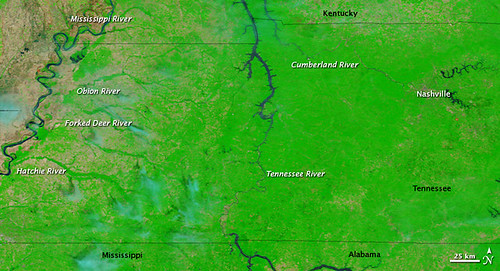
NASA’s Earth Observatory site has published satellite imagery showing before & after pics…

 …before, on 29 April 2010…


…and after, on 4 May 2010…


 Record-breaking rain triggered severe and widespread flooding across Tennessee starting on May 1, 2010. This false color image provides a cloud-free view of the region’s swollen rivers as seen by the Moderate Resolution Imaging Spectroradiometer (MODIS) on NASA’s Terra satellite on May 4, 2010. Terra MODIS acquired the lower image on April 29, 2010, just two days before the storm.

The images combine infrared and visible light to increase the contrast between water and land. Water is black or blue, while plant-covered ground is bright green. Bare earth around the Mississippi River is tan, and clouds are pale blue.

A comparison between the two images reveals flooding on nearly every river system. The landscape is marbled blue from countless swollen streams that aren’t normally visible. The Tennessee River and Cumberland Rivers and their tributaries are wider on May 4 than they were on April 29. In the west, the Obion, Forked Deer, and Hatchie Rivers are also notably swollen.

Flooding across middle Tennessee was at record or near-record levels, said the National Weather Service. The Cumberland River crested at 51.86 feet in Nashville on May 3, the river’s highest level since the Cumberland River dam system was built in the early 1960s. Four other Tennessee Rivers also reached record highs, said the National Weather Service. By May 4, when this image was taken, the rivers had started to slowly recede.

Satcom Crisis: Fair and Balanced


We knew this was trouble. Now, Peter de Selding and Fox News report a crisis in the making…

Galaxy 15 stopped responding to ground controllers on April 5. The satellite’s manufacturer, Orbital Sciences Corp. of Virginia, has said an intense solar storm in early April may be to blame.

An adrift Intelsat satellite that stopped communicating with its ground controllers last month remains out of control and has begun moving eastward along the geostationary arc, raising the threat of interference with other satellites in its path, Intelsat and other industry officials said.

In what industry officials called an unprecedented event, Intelsat’s Galaxy 15 communications satellite has remained fully "on," with its C-band telecommunications payload still functioning even as it has left its assigned orbital slot of 133 degrees west longitude 36,000 kilometers over the equator.

Galaxy 15 stopped responding to ground controllers on April 5. The satellite’s manufacturer, Orbital Sciences Corp. of Virginia, has said an intense solar storm in early April may be to blame. It was launched into space in 2005.

The first satellite likely to face signal interference problems from the adrift Galaxy 15 is the AMC-11 C-band satellite owned by SES of Luxembourg and stationed at 131 degrees west, just two degrees away from Galaxy 15’s starting position.

Rob Bednarek, chief executive of the SES World Skies division, which operates AMC-11, said Intelsat and SES have been meeting since April 5 to coordinate how to minimize the Galaxy 15 impact on AMC-11’s media customers. [Spot satellites from Earth.]

Adrift in space

In an interview Friday, Bednarek said that while it remains unclear whether SES World Skies will be able to avoid a signal interference problem as Galaxy 15 enters the AMC-11 orbital territory, the company has benefited from full disclosure on the part of Intelsat, SES’s biggest competitor.

"The cooperation with them really has been very good," Bednarek said. "We all realize that we could be in the same position tomorrow. We are neighbors in space."

Alan Young, chief technology officer at SES World Skies, said the company’s best estimate is that Galaxy 15 will enter AMC-11’s neighborhood — meaning one-half of one degree distant — May 23. It will continue traveling at its own pace through the AMC-11 slot, exiting on the east around June 7.

Young said the period of May 31 to June 1 is going to be the riskiest time for AMC-11 customers as SES World Skies seeks to maneuver AMC-11 to the maximum extent possible out of the Galaxy 15 track while at the same time maintaining links with the company’s AMC-11 customers.

Tobias Nassif, Intelsat’s vice president for satellite operations and engineering, said Friday that the company, in concert with Galaxy 15 manufacturer Orbital Sciences Corp. of Dulles, Va., has sent between 150,000 and 200,000 commands to the satellite in the nearly four weeks since the satellite stopped sending or responding to commands.

These communication attempts, the equivalent of mild wake-up calls to return Galaxy 15 to service, have had no effect. As it moved all Galaxy 15 customers onto Galaxy 12, which was pulled into service from another orbital location, Intelsat at first focused on recovering Galaxy 15 to regular service.

Zombie satellites in space

On May 3, Intelsat will play what as of Friday appeared to be its last card by blasting Galaxy 15 with a more powerful signal intended not to salvage the satellite, but to force it into a complete shutdown.

That attempt will last about 30 minutes. It will not be repeated, both because a second attempt is viewed as unnecessary — the treatment works or it does not — and because sending out powerful radio frequency signals carries the risk of interfering with other satellites in the area.

Even if the May 3 action succeeds, Galaxy 15 will remain a problem as it continues to wander the geostationary arc. But it is a problem that satellite operators know how to deal with. Industry experts say there are several dozen spacecraft, sometimes called "zombiesats," that for various reasons were not removed from the geostationary highway before failing completely.

Depending on their position at the time of failure, these satellites tend to migrate toward one of two libration points, at 105 degrees west and 75 degrees east. Figures compiled by XL Insurance of New York, an underwriter of space risks, say that more than 160 satellites are gathered at these two points, which Bednarek described as the orbital equivalent of valleys.

"Unfortunately for us, we were downhill from Galaxy 15 as it rolls toward" the 105 degrees west libration point, Bednarek said.

Satellite signal stealer

Satellites like Galaxy 15 and AMC-11 are so-called "bent-pipe" designs that receive signals from the ground, amplify them on board and redistribute them to customers’ ground antennas. Emptied of its customers — except one, the U.S. Federal Aviation Administration, which uses an L-band payload on Galaxy 15 to guide aircraft landings — Galaxy 15 is no longer broadcasting. But its electronics payload is ready to capture and rebroadcast signals it receives that are intended for other spacecraft.

Young said that both SES and Intelsat are fortunate in this case because their two satellites’ customers are mainly media companies using fairly large antennas to communicate with the satellites. During the period of maximum danger for AMC-11, SES expects to be able to reroute customer signals to SES-operated teleports with still-larger antennas to maintain communications links.

Nassif said Intelsat and Orbital Sciences have solicited outside opinions from other satellite manufacturers on possible maneuvers that might return Galaxy 15 to control or force it to shut down.

"The fact is that this is the first major anomaly on an Orbital-built satellite," Nassif said. "Other manufacturers have been through problems and might have something to suggest to us."

Because nothing like this has happened before, Intelsat remains uncertain as to when Galaxy 15, as its Earth sensor realizes it is no longer in the desired position, might lose its Earth-pointing capability. That would lead to its solar arrays losing their lock on the sun. Within hours, the satellite’s batteries would discharge and the spacecraft would shut down on its own.

While cautioning that the company is revising its most-likely-scenario thinking almost on a daily basis as it gets input from Orbital Sciences and others, Nassif said the current estimate is that Galaxy 15 will lose Earth pointing by late July or early August.

As luck would have it, that timetable would mean the only other satellites in Galaxy 15’s C-band frequency that face interference issues are owned by Intelsat.

After it leaves the vicinity of AMC-11, Galaxy 15 is expected to approach Intelsat’s Galaxy 13 satellite, at 127 degrees west, around July 13. On July 30, it will enter into the Galaxy 14 satellite’s orbital territory at 125 degrees west before heading toward Galaxy 18 at 123 degrees in mid-August.

"We are in regular contact with all our customers of these satellites to keep them apprised of the situation," Nassif said. 


Wireless Broadband: Sirius Interference


Out on the open interstate, you seldom have trouble receiving satellite radio from Sirius XM. As these roads pass through crowded urban, where your line-of-site with an orbiting spacecraft may impede reception, the company relies on repeaters, usually mounted alongside cell towers, to complete the reception. 18 million or so satellite radio customers are happy when this happens.

Today, the Wall Street Journal reports on a potential crisis for satellite radio:

A Federal Communications Commission plan to expand wireless Internet access is raising the ire of Sirius XM Radio Inc. and its fans, who are concerned the effort to end a 13-year fight may interfere with satellite-radio programming.

The FCC is proposing to make it easier for the winners of a 1997 airwaves auction to use those airwaves for mobile wireless Internet and phone use. Until now, a dispute about power levels and potential interference has meant the companies were limited in how they could use the airwaves they own.

The FCC is scheduled to vote on the proposal in May as part of a broader effort to devote more airwaves for wireless Internet services. A FCC spokeswoman declined to comment on the specifics of the proposal.

Sirius XM lawyers are fighting the plan, arguing in an April 23 filing that allowing wireless providers to use those airwaves for wireless broadband will "fail to protect satellite radio’s nearly 19 million subscribers and 35 million listeners from harmful interference."

 Here’s an excerpt from a Supplement Comments filing (WT Docket No. 07-293; IB Docket No. 95-91; GEN Docket No. 90-357; RM No. 8610):

Sirius XM has commissioned Dr. Theodore S. Rappaport, P.E., of the Telisite Corporation, who is the William and Bettye Nowlin Chair in Engineering at the University of Texas at Austin and the founding director of the Wireless Networking and Communications Group (WNCG) at the University’s Austin campus, to assess the probabilities of interference to satellite radio service caused by WCS devices operating under the proposed rules that are contained in the Staff Public Notice. This analysis is contained in the attached report entitled “Technical Analysis of the Impact of Adjacent Service Interference to the Sirius XM Satellite Digital Audio Radio Services (SDARS)” and provides some of the clearest evidence yet that the staff’s proposed Part 27 rules would result in crippling interference to satellite radio operations in an unacceptable number of cases. Although retained by Sirius XM to conduct this study, Dr. Rappaport has undertaken this project under the express written conditions that the opinions provided in this study are his own.


We’re all for more wireless broadband service, but not at the expense of the quality of satellite radio. The FCC, in its wisdom, will likely favor existing licensees and make sure they’re protected.

Let’s see if the topic comes up in tomorrow’s earnings call.


DIY Friday: Chumby 3G Router


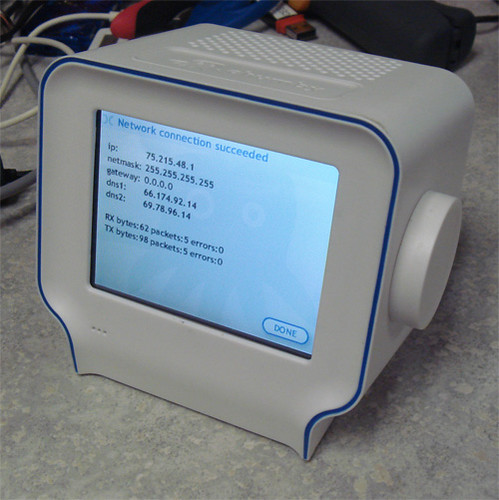
Bunnie’s blog has the coolest 3G router you can make yourself with a Chumby

There’s an Easter Egg inside the chumby One (which is now on sale at Costco online for $99, cheaper than chumby.com’s $119 price!) that enables it to work with certain 3G USB modems and function as a 3G router (similar to a MiFi). Use of the Easter Egg is documented on the chumby wiki, but it can be quite simple:

  1. Plug in your 3G card.
  2. Go to the Network Config screen by pressing the top button, going to Settings, then tapping on Network.
  3. Select "create a new connection", press OK, and wait for the scan to time out.
  4. Select "Other"
  5. Enter 3G as the name of the access point. It must have a capital G for it to work.
  6. Wait for the subsequent scan to time out.
  7. Select "Manual".
  8. Tap "OK" to select None as the encryption type.
  9. Tap "OK" to select Automatic IP allocation.
  10. Tap "OK" to confirm settings and connect to the network

To activate local wifi sharing, ssh into the device (or plug in a USB keyboard to activate the drop-down console) and use the command "touch /psp/start_ap" to flag the network setup scripts to configure your chumby One as an access point. Note that AP mode also works with other network sources, such as Ethernet-over-USB.

Cute.


WBMSAT Satellite Industry News Bits 04/30/2010


Thales Alenia Space robot and mobile platform

Thales Alenia Space delivers man-like robot on mobile platform to European Space Agency following successful testing and qualification.
[SatNews – 04/30/2010]

Russia launches Soyuz-U space rocket carrying Progress M-05M space freighter on supply mission to International Space Station.
[brahmand.com- 04/30/2010]

Tauri Group study finds commercial launch prices have dropped 34% since 1999.
[Satellite Today – 04/30/2010]

XTAR’s Vice President of Government Services Bill Schmidt passes away April 28 following heart attack.
[Satellite Today – 04/30/2010]

Hall-Of-Fame astronaut Story Musgrave says U.S. Space Program is now hampered by Administration’s fear to act; opposite attitude of 60’s when space program drove most technologically innovative decade in history.
[SatNews – 04/29/2010]

RADARSAT images spread of oil spill in Gulf of Mexico cause by oil rig explosion.
[SatNews – 04/29/2010]

Socialist Republic of Viet Nam hosts joint XXXVIII session of Board and meeting of Operations Committee of Intersputnik; host H.E. Mr. Le Nam Thang is elected Chairman of Board and of the joint session.
[SatNews – 04/29/2010]

Integral Systems announces seven year extended interference detection and geolocation maintenance contract with Sky Perfect JSAT.
[MarketWatch – 04/29/2010]

Orbital Sciences gets contract from U.S. Naval Research Laboratory for spacecraft and airborne system support services worth around $95m over 5 years.
[SatNews – 04/29/2010]

Iridium establishes a Government Advisory Board comprised of former senior U.S. government officials and business leaders to provide counsel to the company as it continues to enhance suite of products and services for government agencies.
[SatNews – 04/29/2010]

Lockheed Martin delivers cutting-edge communications system module for second satellite in U.S. Navy’s Mobile user Objective System (MUOS) program.
[PR Newswire – 04/29/2010]

International Space University and American Institute of Aeronautics and Astronautics join in strategic partnership to further educational opportunities internationally and enhance health of future aerospace workforce.
[SatNews – 04/29/2010]

Image of Norwegian Satellite AIS Sat-1

Norwegian satellite AIS Sat-1 to be launched from India on May 9 will be used by maritime authorities as additional means of ensuring safety at sea in the High North.
[SatNews – 04/29/2010]

Global Gateway Media & Communications broadcasts Ex-Mayor of NY Ed Koch’s speech in Los Angeles through Speedia Media’s satellite broadcast network in the U.S., Canada, Mexico, and Central America.
[MarketWatch – 04/29/2010]

NASA delays launch of one of its three remaining space shuttle launches until November to allow upgrade of magnet in Alpha Magnetic Spectrometer program.
[SatNews – 04/29/2010]

Vizada Networks introduces redeveloped Global Field Support Program, created in close co-operation with Global VSAT Forum to improve quality of customer support through training.
[SatNews – 04/29/2010]

http://www.rdmag.com/uploadedImages/RD/News/2010/04/HTV-2-2-250.jpg

Air Force X-37 Falcon Hypersonic Technology Vehicle-2, launched from Vandenberg April 22, achieves controlled flight at more than Mach 20 at assumed elevation of 36,000 feet, but disappears 9 minutes after launch.
[R&D Magazine – 04/28/2010]

Newtec’s FlexACM® DVB-S2 Elevation IP modems will support the National Polar-orbiting Operational Environmental Satellite System (NPOESS) in climate research, as well as increase bandwidth for communication.
[SatNews – 04/28/2010]

Integral Systems acquires Sophia Wireless, getting industry-leading technology in high-power, high-frequency Solid State Power Amplifiers (SSPAs) and Block Upconverters (BUCs) for satellite and radar communications.
[MarketWatch – 04/28/2010]

Swedish Microwave debuts new X-Band products, including professional PLL LNB’s.
[SatNews – 04/28/2010]

Australia’s hosted payload on Intelsat IS-22 satellite is a full UHV payload that will also benefit the USA.
[Defense Industry Daily – 04/28/2010]

SES ASTRA and Samsung join forces to promote 3DTV.
[SatNews – 04/28/2010]

Gilat will Provide SkyEdge II broadband satellite communications network to Kazakhstan based telecommunication operator.
[TMCnet – 04/28/2010]

Thrane & Thrane rebrands AeroSB products as AVIATOR, intending new brand to become synonymous with power of Inmarsat SwiftBroadband and at leading edge of that terminal technology.
[SatNews – 04/28/2010]

DirecTV is first provider to offer national distribution in High Definition (HD) of Spanish-language channels Univision and TeleFutura.
[MarketWatch – 04/28/2010]

Hughes and Avanti expand partnership in Europe as Hughes maneuvers to better compete with ViaSat, planning 48 gateway Earth stations for Hylas 1 satellite.
[Space News – 04/28/2010]

Russia Space Forces launches military communications satellite from Plesetsk Cosmodrome aboard Kosmos 2463 light booster.
[Aviation Week – 04/28/2010]

Sky Vision Global Networks launches new local hub in Nairobi, Kenya, to support company’s satellite based virtual private network solution.
[SatNews – 04/28/2010]

Ericsson equips Indian DTH operator Tata Sky with head-end upgrade enabling it to launch HD channels and increase SD offerings.
[SatNews – 04/28/2010]

Brightpoint announces global supply chain solutions agreement with Inmarsat; will provide fully integrated solution for fulfillment and distribution of IsatPhone Pro.
[MarketWatch – 04/27/2010]

A third launch contract has been awarded to United Launch Alliance to loft an advanced military targeting and communications satellite for the U.S. Air Force Space and Missile Systems Center.
[Florida Today – 04/27/2010]

Orbital Sciences Minotaur IV "Lite" launch

Orbital Sciences successfully launches first Minotaur IV rocket in support of Defense Advanced Research Projects Agency’s Hypersonic Technology Vehicle-2 program.
[SatNews – 04/27/2010]

Global Gateway expands into radio with its agreement with All Patriots Media Network, broadcasting Los Angeles programs from four stations around U.S.
[MarketWatch – 04/27/2010]

Caprock Government Solutions announces expansion of satellite and terrestrial infrastructure to include bandwidth-on-demand to more than 35 major Department of Defense locations, and direct connections at 24 critical Defense Information Systems Network access points.
[SatNews – 04/27/2010]

GE Satellite is selected by NASA to provide Ku-band satellite connectivity for its ground breaking science mission to study atmospheric and environmental conditions across the Pacific via Unmanned Aerial Vehicle.
[SatNews – 04/27/2010]

World Teleport Association announces results of elections for Board of Directors for fiscal year beginning April 1 2010.
[SatNews – 04/27/2010]

In-flight acceptance of Helios IIB satellite is completed by Astrium on behalf of the French Defence Procurement Agency under delegation from French space agency.
[SatNews – 04/27/2010]

Thuraya further develops growth in key vertical markets across Saudi Arabia with Al Farhan partnership.
[SatNews – 04/27/2010]

Blue Sky Network’s GPS-base aviation tracking devices to be used by Peruvian Air Force for search and rescue operations.
[SatNews – 04/27/2010]

Images from European Space Agency’s Planck space observatory give astronomers way to understand complex physics shaping dust and gas in our Galaxy.
[SatNews – 04/27/2010]

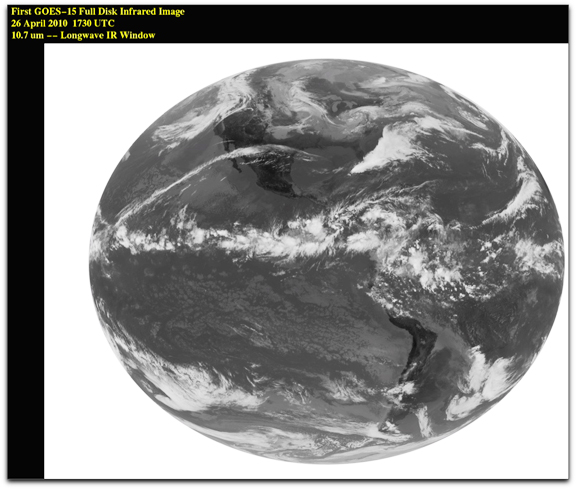
GOES-15 infrared image of Earth

GOES-15, final spacecraft in latest series of NOAA geostationary satellites, takes its first infrared photo of Earth.
[SatNews – 04/27/2010]

Japan to launch "space yacht" Ikaros, to be propelled by solar particles.
[SatNews – 04/27/2010]

International Launch Services places SES-1 satellite into orbit aboard Proton-M rocket deployed from Baikonur Spaceport in Kazakhstan.
[UPI – 04/26/2010]

Gilat to provide SkyEdge communications network to Kazakhstan customer ASTEL.
[MarketWatch – 04/26/2010]

Comtech Telecommunications receives $1.2m order for AN/TRC-170 modem upgrade kits and extended warranty coverage from major contractor under U.S. Army Commoon Hardware Software-3 contract.
[MarketWatch – 04/26/2010]

World Communications Center signs blanket P.O. agreement with NASA for satellite communications equipment and services that connect via the Inmarsat and Iridium networks.
[Business Wire – 04/26/2010]

United Launch Alliance gets contract modification to perform launch services for the Advance Extremely High Frequency-3 satellite aboard expendable Atlas 5.
[SatNews – 04/26/2010]

ProTECTS Alliance gains momentum in efforts to drive two-way satellite tracking and messaging technologies.
[SatNews – 04/26/2010]

Intellian Technologies completes characterization of Eutelsat on its 60cm maritime satellite VSAT system.
[SatNews – 04/26/2010]

European Union Satellite Centre signs multiyear enterprise license agreement with ESRI Espana, giving agency greater access to latest geographic information system technology, training, and consulting services.
[SatNews – 04/26/2010]

European Spacer Agency gets funding for Alphasat from EU’s Risk-sharing Finance Facility.
[SatNews – 04/26/2010]

SES experiences first quarter revenue drop due to ASTRA 3B delays and AMC-16 anomaly.
[Satellite Today – 04/26/2010]

Satellite radio provide Sirius XM to release free application for Motorola Android, and Google Nexus One smartphones.
[Satellite Today – 04/26/2010]

Monopoly is not a bad word for digital Signage in Central and Eastern Europe.
[NSR Briefing – April 2010]

Galaxy 15 failure casts doubt on hosted payload model; recent and impending satellite failures signal need to provide creative mechanism for managing risks.
[NSR Briefing – April 2010]

WBMSAT PS services]

Bubbling Crude


MODIS, MERIS, ASAR, GOES: these orbiting spacecraft and instruments are focused on helping the NOAA figure this mess out. The mess is an oil spill in the Gulf of Mexico, approximately 50 miles offshore, estimated to be spitting out crude oil at a rate of 5,000 barrels per day.

A BP PLC executive told NBC’s "Today" show on Apr. 29 that the oil leak in the Gulf of Mexico could be five times larger than earlier believed. His comment came the day after a controlled burn on part of the oil spill and a third leak was found.

Doug Suttles, chief operating officer of BP Exploration & Production Inc., confirmed what US Coast Guard Rear Adm. Mary Landry first said at a hastily called news conference in a Louisiana command center late Apr. 28 in which she announced a third leak.

Landry estimated 5,000 b/d rather than the 1,000 b/d could be spilling into the gulf. For days, officials have estimated 1,000 b/d was leaking from the Macondo well Transocean Ltd.’s Deepwater Horizon semisubmersible drilled on Mississippi Canyon Block 252 in 4,992 ft of water near Rigel gas field. Deepwater Horizon was working for BP.

An Apr. 20 explosion and fire rocked the semi, leaving 11 crew members missing and presumed dead and injuring 17. A total of 115 people evacuated the rig. On Apr. 22, the semi sank. Cause of the accident remains under investigation.

On Apr. 29, Suttles said the leak could be as high as the USCG’s latest estimate. Previously, he had told reporters that it’s difficult and imprecise to measure spilled oil. 

Call in the robots!  But it won’t be quick. Responders are still figuring out new ways to use Remotely Operated Vehicles (ROVs) to try to trigger the blowout preventer (BOP), a series of valves that sits at the well head.


 What NOAA is doing, as of 28 April 2010

Current NOAA efforts are focused on: gathering more information about the spill, planning for open water and shoreline remediation, and readying for environmental assessment and response. Natural resource damage assessment (NRDA) activities are now underway. 

  • Winds are forecast to become strong (20+ kts) and blow from the southeast starting tomorrow and continuing through the weekend, which will continue to push surface oil towards shore
  • NOAA oil-spill trajectory analyses indicate that oil continues to move towards shore.
  • 100,000’ of oil-containment booms (or floating barriers) have been deployed as a precaution to protect sensitive areas in the Louisiana area.
  • The effects of oil on sensitive habitats and shorelines in four states (LA, MS, AL, and FL) are being evaluated should oil from the incident make landfall in appreciable quantities
  • NOAA’s Assessment and Restoration Division is evaluating concerns about potential injuries of oil and dispersants to fishes, human use of fisheries, marine mammals, turtles, and sensitive resources
  • Baseline aerial surveys to assess marine life were conducted today with personnel from NOAA’s National Marine Fisheries Service (NMFS), these will continue as needed


NOAA Roles: NOAA is a vital part of the massive response effort on the Deepwater Horizon incident.   Many personnel are on scene and many more are engaged remotely, as follows:

Office of Response and Restoration (OR&R)

  • Scientific support to the U.S. Coast Guard and Unified Command

Emergency Response Division (ERD)

  • Predict where the oil is going and its effects
  • Overflight observations and mapping
  • Identify resources at risk
  • Predict fate (chemical changes) of oil
  • Recommend appropriate clean-up methods
  • Manage data and information

Assessment and Restoration Division (ARD)

  • Plan for assessment of injuries to natural resources
  • Coordinate with state and federal trustees
  • Implement sampling plans

National Weather Service

  • Incident weather forecasts including marine and aviation

National Environmental Satellite, Data, and Information Service (NESDIS)

  • Experimental imagery for spill trajectory forecasts

National Marine Fisheries Service (NMFS)

  • Issues related to marine mammals, sea turtles, and fishery resources

National Ocean Service

  • Public Affairs support to Joint Information Center


Here’s your smokin’ video, courtest of the USCG