FAA NextGen: Now Landing in Philly


Yes, Philadelphia. The hometown of W.C. Fields, who was alleged to have said "Philadelphia, wonderful town, spent a week there one night," is one of four cities to have the FAA’s NextGen system installed. The others are Houston, Louisville and Juneau. The system does it all: navigation, surveillance, and communication.

Of course, they use satellite technology.  The Philadelphia Inquirer did a nice piece on it yesterday:

"Philadelphia is a pioneer site," said Federal Aviation Administration vice president Victoria Cox, announcing that Philadelphia controllers now have the capability to track planes equipped with the technology, known as Automatic Dependent Surveillance Broadcast, or ADS-B.

It’s part of a nationwide aviation overhaul – called Next Generation, or NextGen – that the FAA hopes will be largely operational by 2018.

By 2020, all aircraft flying in U.S. airspace must have the ADS-B devices in their cockpits.

Philadelphia is a demonstration site because United Parcel Service is here and has equipped 100 aircraft with satellite-technology. US Airways Group Inc. is in the process of equipping some of its planes, the FAA said.

Philadelphia controllers also use a computer system, called STARS, that takes information, including the ADS-B signals, and translates it to the screens controllers look at.

In addition, Philadelphia was selected to get some of the first satellite-surveillance radios because of its location in congested East Coast air space. The other test sites are Louisville, Ky., where UPS is based; Houston; and Juneau, Alaska.

Seven ground radios – each about the size of two refrigerators – have been installed around Philadelphia, including two on airport property. They will be part of a network of 813 radios by 2013, the FAA said.

Once airplanes get specialized GPS devices in cockpits, pilots will transmit via satellite to ground radios, which will bounce information to control towers. Controllers, in turn, will transmit to the radios, which will broadcast up to the cockpit.

The new technology will allow pilots, for the first time, to see what controllers see: other aircraft in the sky around them, bad weather and terrain, and information such as temporary flight restrictions.

 Need more detail? Check out the FAA’s NextGen Implementation Plan (84-page PDF). There are basically five elements to this system:

  1. Automatic dependent surveillance-broadcast (ADS-B). ADS-B will use the Global Positioning System (GPS) satellite signals to provide air traffic controllers and pilots with much more accurate information that will help to keep aircraft safely separated in the sky and on runways. Aircraft transponders receive GPS signals and use them to determine the aircraft’s precise position in the sky. This and other data is then broadcast to other aircraft and air traffic control. Once fully established, both pilots and air traffic controllers will, for the first time, see the same real-time display of air traffic, substantially improving safety. The FAA will mandate the avionics necessary for implementing ADS-B.
  2. System Wide Information Management (SWIM). SWIM will provide a single infrastructure and information management system to deliver high quality, timely data to many users and applications. By reducing the number and types of interfaces and systems, SWIM will reduce data redundancy and better facilitate multi-user information sharing. SWIM will also enable new modes of decision making as information is more easily accessed.
  3. Next Generation Data Communications. Current communications between aircrew and air traffic control, and between air traffic controllers, are largely realised through voice communications. Initially, the introduction of data communications will provide an additional means of two-way communication for air traffic control clearances, instructions, advisories, flight crew requests and reports. With the majority of aircraft data link equipped, the exchange of routine controller-pilot messages and clearances via data link will enable controllers to handle more traffic. This will improve air traffic controller productivity, enhancing capacity and safety.
  4. Next Generation Network Enabled Weather (NNEW). Seventy percent of NAS delays are attributed to weather every year. The goal of NNEW is to cut weather-related delays at least in half. Tens of thousands of global weather observations and sensor reports from ground-, airborne- and space-based sources will fuse into a single national weather information system, updated in real time. NNEW will provide a common weather picture across the national airspace system, and enable better air transportation decision making.
  5. NAS Voice Switch (NVS). There are currently seventeen different voice switching systems in the NAS, some in use for more than twenty years. NVS will replace these systems with a single air/ground and ground/ground voice communications system. 

Yeah, there’s a video…

Another Proton Launch Relief


The SES-1 spacecraft was successfully launched and placed into geosynchronous transfer orbit on Saturday, 24 April 2010. Some detail on the spacecraft…

SES-1 is a hybrid C- and Ku-band spacecraft that will provide coverage of the 50 US states and is intended to replace SES’s existing AMC-2 and AMC-4 satellite at the orbital location of 101 degrees West. SES-1 is part of an SES contract with Orbital Sciences for the provision of up to five virtually identical satellites in order to replenish SES’ North American satellite fleet. The SES satellites are based on Orbital’s enhanced STAR 2.4 bus, the largest and most powerful communications satellite the company builds. The spacecraft will each carry 24 active C-band and 24 Ku-band transponders of 36 MHz capacity each. Six of the channels in each band can be cross-strapped to the opposite band, enabling new service capability. The spacecraft will generate approximately five kilowatts of payload power and have two 2.3 meter deployable reflectors.

So this is a replacement for AMC-4 at 101° West. Good-bye extended Ku-band and steerable South American beam. Hello, cross-strapping. That should make for some interesting combinations for customers.

There must be quite a bit of relief among the engineers at SES, what with AMC-4’s TWTA problems, which was an issue for 10 years, in addition to power issues surrounding the solar arrays. Besides AMC-4, the AMC-16 spacecraft was recently cited in their 1st quarter earnings report and summarized by Peter de Selding of Space News

[T]he further reduction in power output aboard the AMC-16 satellite, which is fully leased by EchoStar Corp. of Englewood, Colo. AMC-16, launched in December 2004 and operated at 85 degrees west, is one of several older-model Lockheed Martin A2100 satellites that have suffered solar-power losses, especially during eclipse periods.

EchoStar and SES had agreed to a specific payment profile based on the satellite’s on-board capacity. With the most recent power loss on AMC-16 following a March eclipse period, the reduced power will cost SES slightly less than $10 million in revenue in 2010, Bausch said.

Other SES-owned A2100-model satellites have also suffered power losses, but not to the extent that commercial service was affected, Bausch said. Forecasts of how the problem might evolve are difficult because in the past, solar-array circuits that have failed have later returned to service, he said. 

Had the Galaxy-15 command failure occured in the 1st quarter, he’d probably nail them on that one, too. 

Enough bad news, on to the launch video!


WBMSAT Satellite Industry News Bits 04/23/2010


Boeing-built U.S. Air Force "miniature space shuttle" X-37B is succesfully launched amid a cloud of secrecy about its mission.
[Seattle Post Intelligencer – 04/23/2010]

CenturyTel (CenturyLink after merging with Embarq in 2009), the country’s fifth-largest local phone company, to buy Qwest, the third largest, in stock swap worth $10.6 billion.
[FierceTelecom – 04/23/2010]

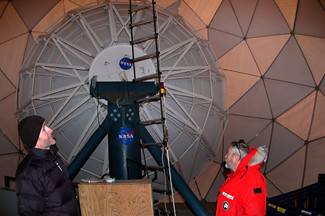
BT announces the completion of its first satellite terminal in Antarctica, at one of the world’s coldest, driest, and windiest locations.
[SatNews – 04/23/2010]

Iridium extends relationship with KDDI of Japan, making it an authorized service provider of Iridium’s OpenPort High-bandwidth maritime satellite communication service.
[SatNews – 04/23/2010]

MTN Satellite Communications, in partnership with ERZIA Technologies, opens new European satellite teleport in Santander, Spain.
[SatNews – 04/23/2010]

Stratos Global is providing world-renowned adventurer Ray Zhab’s "Running Tunisia" expedition with Inmarsat BGANmobile broadband satellite service.
[SatNews – 04/23/2010]

Two Cobham businesses honored in 2010 Queen’s Awards for Enterprise in the categories of Internatikon Trade and Innovation.
[SatNews – 04/23/2010]

Satelllite Today to bring live webcast of the SES-1 launch Saturday, April 24.
[Satellite Today – 04/23/2010]

Harris Corporation is providing NEXIO AMP advance media platform to German national public television broadcaster Zweites Deutsches Fernsehen to support HD migration and centralization of ZDF’s playout center in Mainz.
[SatNews – 04/23/2010]

SES ASTRA will launch 3D demo channel on ASTRA May 4.
[SatNews – 04/23/2010]

European Commission announces financing of Alphasat telecommunications satellite to be launched in 2012, a joint effort of the European Space Agency and Inmarsat to extend high-speed voice and data to remote European areas, Africa, and the Middle East.
[UPI – 04/22/2010]

U.S. Army modifications to VSAT terminals to increase security of battlefield communications will include a change from hardware key exchanges to software key exchanges.
[Defense Systems – 04/22/2010]


First images of the sun returned by NASA’s Solar Dynamics Observatory Satellite please research scientists.
[IndyPosted – 04/22/2010]

Schlumberger looks for buyer for its satellite unit GCS, provider of satellite antennas and specialised communications for oil rigs, tankers, and other hard-to-reach sites.
[Reuters – 04/21/2010]

Expand Networks’ advanced WAN optimization technology supports satellite communications services for Scripps Institution of Oceanography at University of California.
[SatNews – 04/21/2010]

Gateway Communications increases presence in West Africa with signature of two deals in Guinea.
[TMCnet – 04/21/2010]

Global Satellite Engineering has partnership with Ocens data services, with Ocens using GSE’s SatCollect software to reduce in-bound call expenditures.
[SatNews -04/21/2010]

Flexible commercial satellite services acquisition joint effort of GSA and DISA holds great promise, according to director of satellite communications, teleport, and services at DISA.
[Defense Systems – 04/21/2010]

Caprock launches latest value-added service offering, Crew Infotainment, reaching remote employhees across energy, maritime, and government services industries.
[SatNews – 04/21/2010]

KVH doubles their mini-VSAT Broadband network’s bandwidth in the North Pacific Ocean Region.
[SatNews – 04/21/2010]

ARINC Incorporated announces that three major Asia Pacific carriers have selected the company’s GLOBALinkSM data link services for airline communications and flight operations.
[SatNews – 04/21/2010]

Barcelona Moon Team, a multidisciplinary joint venture in Spain, announces entry into Google Lunar X Prize competition challenging engineers across the globe to build and launch to the moon a privately funded spacecraft capable of exploration.
[SatNews – 04/21/2010]

Lockheed Martin gets $10 million task award to provide satellite and tactical communications for U.S. Marine Corps.
[CBS News – 04/20/2010]

Chinese villages in the Tibetan Autonomous Prefecture of Yushu stricken by the 7.1 magnitude quake all have contact to the outside world restored, with fixed-line and mobile service being restored, and some 234 satellite phones serving the regioin.
[China Daily – 04/19/2010]

Iridium and Quake Global partner to enhance new generation of intelligent industrial satellite transceivers.
[Market Watch – 04/19/2010]

SES ASTRA signs capacity agreement with South African pay-TV operator On Digital Media for three transponders on ASTRA-4A.
[SatNews – 04/19/2010]

ViaSat wins $6.6 million MIDS-LVT add-on order to its $21.5 million Multifunctional Information Distribution System – Low Volume Terminals.
[Satellite Today – 04/20/2010]

U.S. Navy’s Space and Naval Warfare Systems Command selects Ball Aerospace & Technologies Corp for next generation ocean altimetry satellite GFO-2.
[SatNews – 04/19/2010]

Vizada unveils its mobile satellite communications offering for Asia-Pacific military customers at the Defense Services Asia trade show.
[SatNews – 04/19/2010]

Satellite operators Artel, Caprock, and Globecomm file complaints with the U.S. Federal Communications Commission and called for a congressional and regulatory inquiry over alleged unfair business practices.
[Satellite Today – 04/19/2010]

Raytheon wins DigitalGlobe contract to provide enhance constellation-collection management system.
[Satellite Today – 04/19/2010]

SeaMobile Europe wins connectivity services contract for AG2R Transat maritime race
[Satellite Today – 04/19/2010]

Heard On The Grapevine – Galaxy 15 update – Last week it was reported that Galaxy 15 was drifting with the payload on with no control over the satellite because of failed command receivers.  Information obtained this week reveals that it was the Upllink/Downlink Unit that failed June 9 due to Solar flare activity, causing an inability to process uplinked commands.  Different failure mode, same result, with adjacent satellites at risk of massive interference if approached by Galaxy 15.

Samsung puts 3D TV health warning on its Australian web site, Worries include epileptic seizure or stroke, convulsions, involuntary movement, motion sickness, nausea, lightheadedness, dizziness, disorientation, and altered vision.
[samsung.com 3D TV warning]

NSR to host free webinar "SATELlite-Based Earth Observation (EO): Ready for Phase 4 of Growth?"
[NSR Webinar Registration]

NSR Industry Briefing – Growing the Government and Military COTM Market – Easier Said Than Done.
{NSR Industry Briefing]

WBMSAT PS services

Space to Schools


Great idea for the AIAA to support HR 5903, introduced by Rep. Suzanne Kosmas:

Robert Dickman, executive director of the American Institute of Aeronautics and Astronautics, today issued the following statement in support of HR 5903, the “Space to Schools Act of 2010”

“On behalf of AIAA’s 35,000 members, I urge the passage of HR 5903, the ‘Space to Schools Act of 2010.’ This legislation addresses the critical teacher shortfalls in the ‘STEM’ subjects of Science, Technology, Engineering, and Math, by encouraging veteran scientists and engineers, and other experts, to enter the classroom and help educate the next generation of scientists, engineers, mathematicians, and technology workers. The bill will provide our nation’s schools with a direct infusion of qualified, motivated, and able talent.

“The recently released ‘2010 Survey of Aerospace Student Attitudes’ conducted by Dr. Annalisa Weigel of MIT demonstrates that students become interested in engineering careers throughout their primary and secondary school years. The study reports that a primary inspiration for pursuing a STEM degree is the student’s interaction with a STEM professional in the classroom. This legislation will make it possible for more students to benefit from those inspiring interactions.”

The Space to Schools Act of 2010, introduced in the U.S. House of Representatives yesterday by Rep. Suzanne Kosmas (Fla.-24), creates an opportunity for former NASA employees and aerospace engineers to teach STEM subjects in grades K–12. Participants in the Space to Schools program would be required to sign a three-year contract and to take necessary classes to obtain teacher licensure in their state. The Act would provide Space to Schools participants with a $5,000 stipend to defray the costs of classes needed to obtain teaching credentials. In addition, a $5,000 bonus would be paid to participants who have earned their teaching credentials when they commit to teach in a STEM subject field for at least three years.

DIY Friday: Rube Goldberg Machine


The "This Too Shall Pass" music video by the band OK Go is impressive. It features a Rube Goldberg Machine produced with the help of MIT students and alumni, it was put up on YouTube in March and has since garnered more than 11 million views. Sure, that’s nowhere near the new record set by Lady Gaga’s "Bad Romance" video (187 million and counting). Posting music videos helps sell records. EMI had a problem with that, so OK Go is on its now. Good for them.

OK Go’s Web site has a wonderful interactive floor map to keep you busy.


Very cool. Watch this video of how to build one with kids. Check out Argonne National Laboratory’s contest for high schools, and, of course, Purdue’s Rube Goldberg Contest is one of the best for college students.

Need ideas? Poke around the Instructables site.


Fun With The Sun


Yes, it’s Earth Day. So we’ll follow the Sun instead. NASA’s Solar Dynamics Observatory released it’s first images and video. The spacecraft’s three instruments will likely revolutionize the study of heliophysics, much as Hubble did for astronomy.


The Helioseismic and Magnetic Imager (HMI) will study the motions and magnetic fields at the Sun’s surface to figure out what’s happening inside.

The Atmospheric Imaging Assembly (AIA) is a bunch of four telescopes will check out the corona, the outer layer of the Sun’s atmosphere. The AIA filters will observe across ten wavelength and provide 725 km resolution.

And the Extreme Ultraviolet Variability Experiment (EVE) will gauge the Sun’s energy in extreme-ultraviolet wavelengths.

 Check out this short video…


Hayabusa Landing in WTF


WTF, in this instance, stands for the Woomera Test Facility in Australia. Hayabusa, the unmanned JAXA spacecraft that’s been on a mission to return asteroid samples back to earth since launching in 2003, is set to land in Australia in June.


The report, via Adelaide Now

 Australian authorities are working with the Japanese Aerospace Exploration Agency (JAXA) to land the Hayabusa in the Woomera Prohibited Area in June.

Hayabusa met with the asteroid Itokawa in 2005. Since then, the Japanese Aerospace Exploration Agency has been guiding the craft home to Earth.

Innovation Minister Senator Kim Carr said this was a great example of Australia’s ongoing contribution to international space programs.

"Australia is proud to support Japan in this world-first expedition," Senator Carr said.

"The Australian Government is investing $48.6 million in the Australian space sector through its new Space Policy Unit and Australian Space Research Program.

"The Space Policy Unit is the central point of contact and coordination for all civil space activities, including fostering links with international space organisations. The return of the Hayabusa is one of the many activities the unit is supporting."

Defence Minister Senator John Faulkner said Australian authorities would help ensure the recovery of the spacecraft on its return, working closely with their Japanese counterparts on the proposed path and landing of Hayabusa.


 Should prove be a cool landing: a high-speed re-entry from space, then descending via parachute. I’d expect nothing but the best in HD video from JAXA, as evidenced by this promo film. Not being able to understand the narator’s Japanese is not a factor…


Can’t  understand what "nature boy" is saying in this Bugs Bunny episode either.


Bushy Hare

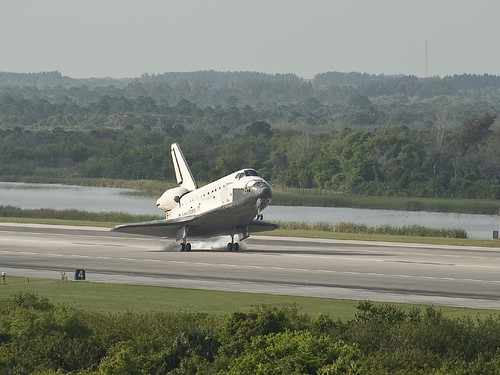
STS-131 Landing


 Space shuttle Discovery lands at NASA’s Kennedy Space Center in Florida, Tuesday, April 20, 2010. Discovery and the STS-131 mission crew, Commander Alan Poindexter, Pilot James P. Dutton Jr. and Mission Specialists Dorothy Metcalf-Lindenburger, Rick Mastracchio, Stephanie Wilson, Clayton Anderson and Japanese astronaut Naoko Yamazaki returned from their mission to the International Space Station. Image credit: NASA/Bill Ingalls.

 Here’s the video…


Assets and Ashes


The Groussherzogtum Lëtzebuerg (Grand Duchy of Luxembourg) owns 20% of SES S.A., and with a 33% voting share, it prevents any entity from owning more than 20% of the company. There’s more stock float out there, but you can’t buy it in the U.S. — Euronext Paris or Bourse de Luxembourg only, please. The stock seems to be doing well lately, so everybody’s happy. Will they ever sell? Don’t think so.

Chris Forrester is reporting they’ll hold on to it.

The Luxembourg state has no intention of selling its stake, including its so-called ‘golden share’, in satellite operator SES.

The emphatic statement came from Luxembourg’s culture minister Francois Biltgen, who told guests at the SES Astra 25th Anniversary celebrations, that the Luxembourg state did not regret having become the reference shareholder all those years ago. Luxembourg holds a 16.67% economic interest, and 33.33% of the voting rights.


CEO Romain Bausch, an astute financier,  sees the SES mission as more socially responsible, positioning its reinvestment in the business as more socially responsible — especially when it comes to emerging markets — declaring “Come hell or high water (or volcanic ash), we will continue to do what we do best: connect people and businesses through the power of satellites.”

I wonder whether they’ll lower their profit expectations when pricing is established for the O3b Networks system. Remember IP-PRIME? That IPTV service wasn’t paying off quickly enough and was, in my opinion, prematurely decommissioned.

So, what’s their motto? (I don’t know, what’s the motto with you? heh-heh)

"Mir wëlle bleiwe wat mir sinn"  (Luxembourgish) "We want to remain what we are."

 Hey, whatever. They’ve got a launch coming up on Saturday. Go SES-1!


WBMSAT Satellite Industry News Bits for April 16, 2010


South Africa, Brazil, and India agree to joint satellite programme at trilateral summit.
[EngineeringNews.co.za – 04/16/2010]

KVH debuts CG-5100 Inertial Measurement Unit (IMU) solution well-suited for applications already having GPS but needing full IMU capability.
[SatNews – 04/15/2010]

India’s cryogenic rocket satellite launch fails after apparent successful take-off as control of the cryogenic rocket motors fails.
[BBC News – 04/15/2010]

EUMETSAT’s Meteosat-9 meteorological satellite observes ash from volcanic eruption in Iceland.
[SatNews – 04/15/2010]

NOAA’s GOES-13 satellite renamed GOES-EAST, residing at prime orbital slot to observe potentially life-threatening weather along Eastern U.S., Atlantic Ocean, and Gulf of Mexico.
[SatNews – 04/15/2010]

U.S. Marine Corps networking plans driven by tactical, satellite based technologies.
[Signal Online – 04/15/2010]

Vizada, with Inmarsat, to launch test program to validate readiness of Inmarsat’s IsatPhone Pro for market.
[SatNews – 04/15/2010]

Stratos gets advance orders for 1,000 of Inmarsat’s new handheld IsatPhone Pro.
[Satellite Spotlight – 04/15/2010]

RapidEye enters contract with Metria of Sweden for Metria to be distributor of RapidEye satellite imagery in the Scandinavian, Baltic, and Icelandic data markets.
[SatNews – 04/15/2010]

Vizada launches SkyFile Video powered by ClipWay application, software that can be downloaded and installed on any computer and used to send video images over a mobile satellite terminal.
[SatNews – 04/15/2010]

Russian Deputy Prime Minister Sergei Ivanov confirms plans to launch a Soyuz carrier rocket from the Kourou space center in French Guiana later this year.
[Space Daily – 04/14/2010]

Intelsat expands African satellite infrastructure and is offering new satellite capacity to the region on Intelsat 25 and Intelsat New Dawn.
[Satellite Spotlight – 04/14/2010]

Lockheed Martin completes work on first U.S. Air Force advanced EHF satellite, readying it for Mid-2010 launch.
[PR Newswire – 04/14/2010]

PSSI and Ericsson provide technology and satellite transmission services enabling NASCAR Media Group to provide multiple streams of live HD content from races to its 75 million fans.
[SatNews – 04/14/2010]

Intelsat launches IntelsatONE, a global, terrestrial architecture consisting of an IP/MPLS-based network, fiber, teleports, and points of presence powered by Cisco Systems.
[Satellite Today – 04/14/2010]

Nagravision and SkyLife of South Korea expand their relationship to collaborate on 3D television.
[SatNews – 04/14/2010]

Eutelsat teams with Russia’s General Satellite Corporation and the Marinsky Theatre for April 15th  3D TVsatellite transmission of classical ballet performed by leading Russian dancers.
[SatNews – 04/14/2010]

Newtec introduces at NAB its DualFlow technology that allows users to easily migrate to satellite IP-based operations by interfacing modems with networks using either ASI or IP, or both at once.
[SatNews – 04/14/2010]

CPI introduces enhanced version of its Ku-band High Power SSPB, a fully integrated unit that is one of the lightest and smallest on the market.
[SatNews – 04/14/2010]

Ericcson signs 3D TV, HD deals with ESPN, Tata Sky.
[Satellite Today – 04/14/2010]

Move by FCC under its National Broadband Plan (NBBP) to release 500 MHz of additional spectrum for broadband service applauded by satellite operators Harbinger and Globalstar, opposed by Verizon and AT&T.
[Fierce Broadband Wireless – 04/14/2010]

Increasing demand for bandwidth coupled with finite limit of available orbital slots drives wider acceptance among satellite operators of dual-use satellite platforms.
[PR Newswire – 04/14/2010]

Raytheon successfully completes major communications upgrade in Antarctica for the National Polar-orbiting Operational Environmental Satellite System (NPOESS) program.
[Space Daily – 04/14/2010]

ESA’s CryoSat-2, launched April 8, has had excellent performance, delivering its first data just hours after ground controllers switched on the satellite’s sophisticated radar instrument for the first time.
[esa news – 04/13/2010

Globecomm Systems launches at NAB their Tempo Enterprise Media Platform, a hosted terrestrial service allows enterprises with a single platform to deliver interactive training, employee communications, and digital display to global audiences.
[SatNews – 04/13/2010]

Ethiopa’s national telecom operator, ETC, chooses Gilat for backhaul solution to extend range of cellular services to remote regions.
[Market Watch – 04/13/2010]

NASA – Chrysler agreement seeks to use technologies originally developed for human spaceflight to enhance future vehicles, and adapt advanced automotive technology for use in space.
[SatNews – 04/13/2010]

VELOCITY Broadcasting of Pittsburgh, PA, becomes largest global, private HD broadcasting network through agreement with Global Vision Networks, expanding throuigh satellite distribution to more than 200 network sites across 3 continents.
[SatNews – 04/13/2010]

Goodrich Corporation continues its celebration of 50 years  of working in advanced space programs at the National Space Symposium in Colorado Springs, CO.
[SatNews – 04/13/2010]

Xicom Technology announces at NAB new lightweight, high power, antenna-mounted traveling wave tube amplifiers to expand capabilities of broadcasters and teleport operators.
[SatNews – 04/13/2010]


Raytheon successfully completes major satellite communications system upgrade in Antartica for the National Polar-orbiting Operational Satellite System program, providing better performance and higher data rates.
[PR Newswire – 04/13/2010]

ACS Angola contracts with Eutelsat for capacity on W7 to expand satellite resources to support high growth of data communications in the region.
[PR Newswire – 04/13/2010]

EchoStar Satellite Services announces that Minnesota-based Pace International has joined its VIP-TV Reseller Program.
[SatNews – 04/13/2010]

SES WORLDSKIES signs long-term multi-transponder deal with Puerto Rico Telephone to deliver its CLARO TV DTH offering to homes across Puerto Rico.
[SatNews – 04/13/2010]

GSA and CISA lay out their strategy under their joint Future Commercial Satellite Communications Acquisition (FCSA) program, with draft request for proposals for $3.5 billion in commercial satellite services between 2011 and 2015.
[Defense Systems – 04/12/2010]

India charges that Chinese anti-satellite program is a global threat.
[Space Daily – 04/12/2010]

GlobeCast signs contract with Argentine broadcaster Pramer allowing Pramer to base its playout and origination facilities at GlobeCast’s Sunrise, Florida technical operations center.
[SatNews – 04/12/2010]

Integral Systems announces on-schedule handover of satellite bus operations for the third Wideband Global SATCOM Space Vehicle to the Command and Control System – Consolidated baseline.
[Market Watch – 04/12/2010]

While other industries were slammed by recession, the global space business grew 7% in 2009 over 2008, to $261 billion, and 40% over the past 5 years.
[Reuters – 04/12/2010]

DG FastChannel and Univision partner to provide High Definition commercial content during broadcast of 2010 FIFA World Cup, which is expected to be viewed by up to 95% of U.S. Hispanic households.
[Market Watch – 04/12/2010]

Russia had no part in the Indian cryogenic engine program according to the Indian Space Research Organisation (ISRO).
[Space Daily – 04/12/2010]

NASA engineers at Goddard Space Flight Center find and patent a way to improve reception of GPS signals.
[Space Daily – 04/12/2010]

China aims to capture 20% of the world’s space business by 2015, according to the country’s only satellite launch contractor.
[Space Daily – 04/12/2010]

Avanti sells new capacity and services on its first satellite, HYLAS 1, to longstanding partner in Eastern Europe MPB.
[SatNews – 04/12/2010]

TeleCommunication Systems receives additional $7.1 million in revenue from U.S. Army for maintenance of internet and satellite-based communications systems deployed outside the country.
[Baltimore Sun – 04/10/5010]

NSR releases report "Hosted Payloads on Commercial Satellites," the "first ever" market study which analyzes and quantifies the business case for hosted payloads, covering the entire gamut of the satellite industry.
[NSR – April, 2010]

NSR states that "Broadband Satellite Markets Did Not Falter in Face of 2009 Economic Crisis – Sector Revenues to Increase by 135% in Coming Ten Years."
[NSR – April, 2010]

WBMSAT PS services