DIY Friday: R2-D2 Lamp


This is a cool project for Star Wars fans: a metal desk lamp decorated to look like R2-D2, via Instructables

I am building a full size R2D2 from scratch, when you are scratch building everything begins look like a potential part, well this lamp I just got from IKEA really reminded me of the little domed one so I got bored and with a little bit of tweaking I got him looking pretty good.

Can’t make the decals yourself? Buy them on Etsy! Kids love R2-D2.


2,400 Jobs for Florida’s Space Coast


President Obama is committed to NASA’s mission — and I especially like the promise of employment in and around The Cape.

I’m puzzled by the apparent disagreement among the first moon walkers, Neil Armstrong and Buzz Aldrin.

First, the letter signed by Armstrong, Lovell and Cernan

The United States entered into the challenge of space exploration under President Eisenhower’s first term, however, it was the Soviet Union who excelled in those early years. Under the bold vision of Presidents Kennedy, Johnson, and Nixon, and with the overwhelming approval of the American people, we rapidly closed the gap in the final third; of the 20th century, and became the world leader in space exploration.

America’s space accomplishments earned the respect and admiration of the world. Science probes were unlocking the secrets of the cosmos; space technology was providing instantaneous world wide communication; orbital sentinels were helping man understand the vagaries of nature. Above all else, the people around the world were inspired by the human exploration of space and the expanding of man’s frontier. It suggested that what had been thought to be impossible was now within reach. Students were inspired to prepare themselves to be a part of this new age. No government program in modern history has been so effective in motivating the young to do ‘what has never been done before.’

World leadership in space was not achieved easily. In the first half century of the space age, our country made a significant financial investment, thousands of Americans dedicated themselves to the effort, and some gave their lives to achieve the dream of a nation. In the latter part of the first half century of the space age, Americans and their international partners focused primarily on exploiting the near frontiers of space with the Space Shuttle and the International Space Station.

As a result of the tragic loss of the Space Shuttle Columbia in 2003, it was concluded that our space policy required a new strategic vision. Extensive studies and analysis led to this new mandate: meet our existing commitments, return to our exploration roots, return to the moon, and prepare to venture further outward to the asteroids and to Mars. The program was named ‘Constellation’. In the ensuing years, this plan was endorsed by two Presidents of different parties and approved by both Democratic and Republican congresses.

The Columbia Accident Board had given NASA a number of recommendations fundamental to the Constellation architecture which were duly incorporated. The Ares rocket family was patterned after the Von Braun Modular concept so essential to the success of the Saturn 1B and the Saturn 5. A number of components in the Ares 1 rocket would become the foundation of the very large heavy lift Ares V, thus reducing the total development costs substantially. After the Ares 1 becomes operational, the only major new components necessary for the Ares V would be the larger propellant tanks to support the heavy lift requirements.

The design and the production of the flight components and infrastructure to implement this vision was well underway. Detailed planning of all the major sectors of the program had begun. Enthusiasm within NASA and throughout the country was very high.

When President Obama recently released his budget for NASA, he proposed a slight increase in total funding, substantial research and technology development, an extension of the International Space Station operation until 2020, long range planning for a new but undefined heavy lift rocket and significant funding for the development of commercial access to low earth orbit.

Although some of these proposals have merit, the accompanying decision to cancel the Constellation program, its Ares 1 and Ares V rockets, and the Orion spacecraft, is devastating.

America’s only path to low Earth orbit and the International Space Station will now be subject to an agreement with Russia to purchase space on their Soyuz (at a price of over 50 million dollars per seat with significant increases expected in the near future) until we have the capacity to provide transportation for ourselves. The availability of a commercial transport to orbit as envisioned in the President’s proposal cannot be predicted with any certainty, but is likely to take substantially longer and be more expensive than we would hope.

It appears that we will have wasted our current ten plus billion dollar investment in Constellation and, equally importantly., we will have lost the many years required to recreate the equivalent of what we will have discarded.

For The United States, the leading space faring nation for nearly half a century, to be without carriage to low Earth orbit and with no human exploration capability to go beyond Earth orbit for an indeterminate time into the future, destines our nation to become one of second or even third rate stature. While the President’s plan envisages humans traveling away from Earth and perhaps toward Mars at some time in the future, the lack of developed rockets and spacecraft will assure that ability will not be available for many years.

Without the skill and experience that actual spacecraft operation provides, the USA is far too likely to be on a long downhill slide to mediocrity. America must decide if it wishes to remain a leader in space. If it does, we should institute a program which will give us the very best chance of achieving that goal.

Neil Armstrong
Commander, Apollo 11

James Lovell
Commander, Apollo 13

Eugene Cernan
Commander, Apollo 17

And here’s Buzz Aldrin’s piece in USA TODAY


Since the release of President Obama’s NASA budget for the next fiscal year, the debate over America’s future course in space has become unusually heated, resulting in a polarization of views that has divided Congress and many members of the space community. All want what is best for our nation, but few see a chance at a consensus that can bring us all together.
We’ll get that chance today.

The president will visit the Kennedy Space Center to air these views in a conference on America’s future in space. This meeting offers the administration, Congress and the American people our best — and possibly our only — chance to reach such a consensus. This is a reasonable way forward that builds on the president’s budget proposal while extending our reach ever deeper into space.

As I have said before, I agree broadly with the president’s plan because it contains many elements that I have advocated for years. These include a flexible path for exploration with a robust technology development program enabling the extension of the human presence to Mars. His plan avoids rerunning the moon race that America won 40 years ago and opens a new era for commercial space transportation after years of government dominance of access to low-Earth orbit.

We need specifics

These are good principles, to be sure. But the budget lacks key details. First, I think that the president needs to be clear that Mars is the ultimate goal. The stepping stones to the Red Planet might include missions such as flybys of comets, approaches to near-Earth objects, and finally a manned mission to the Martian moon Phobos. This flexible path would create the infrastructure and transportation systems that would enable commercial and international development near Earth.

NASA also should be clearer about the purpose behind investments in technology. For example, we can utilize the investments made in the Orion spacecraft to jump-start the development of a human deep-space exploration capability. And using the spare hardware left over from the assembly of the International Space Station, I propose we develop a prototype deep-space exploration vehicle that can be docked to and tested at the station.

Over time, astronauts at the station could then outfit the ship, making it capable of forays beyond low-Earth orbit, around the moon, then deeper into space — to near-Earth orbit crossing asteroids, and on to Mars. I also encourage the president to set a clear goal to develop the heavy lift capability needed for our journey to Mars. There are, in effect, placeholders for these programs in the $19 billion devoted to NASA in the president’s budget, but I think we deserve a greater level of clarity.

Restore America’s place

While transitioning the operation of crew delivery to private industry, it is important that the system we develop is capable of enabling broader commercial markets. To do this, the future plan should include the development of a reusable, space plane-like runway lander as the next generation of crew carrying space transport.

Other astronauts might have different views, and I respect them, but I believe that working with this president toward a consensus on how America can lead human exploration, commercialize that effort in a timely way as possible, and set our collective sites on Mars is more likely to create the kind of sustained effort, commitment and legacy that we all want to see. This seems more productive than simply opposing a change of course.

I also differ with the president’s plan in a few critical ways, one being that we should keep the space shuttle in flight while we develop a heavy-lift launch vehicle. This should be a national priority. These investments will give us a solid basis for the civil space program for decades to come.

These additions offer us the chance at a middle ground that preserves our highly specialized workforce, maintains critical access to space, and will enable us to maintain and service the International Space Station. Most important, we can re-establish American space leadership by reaching for this manned mission to Mars.

America’s future in space is worth the modest, additional investment that will be required by this flexible path. I hope that, as passions cool, we can all come together at this important meeting to bring our nation fully into a 21st century space program, one that is, as my friend Norm Augustine put it, "worthy of a great nation."

OK, both agree on leadership in space.  Especially Mars and deep space, and we can’t get there without a heavy-lift launcher. Manned space flight — and commercial space — need more heavy-lift rocket development and manufacturing.


Eyjafjallajoekull Eruption

 How did the volcanic eruption in Iceland get to ground air traffic in northern Europe? Check out this illustration from the ESA


The information has been derived by a model using SO2 as particle tracer for the ash plume. This model has been developed at the Norwegian Institute for Air Research in the Department of Atmospheric and Climate Research.

This service was developed within the ESA Data User Element ‘Support to Aviation for Volcanic Ash Avoidance’ with the aim of generating accurate and timely satellite-based information to Volcanic Ash Advisory Centres (VAACs) to assist the aviation community. 


GSLV D3 Launch Anomaly

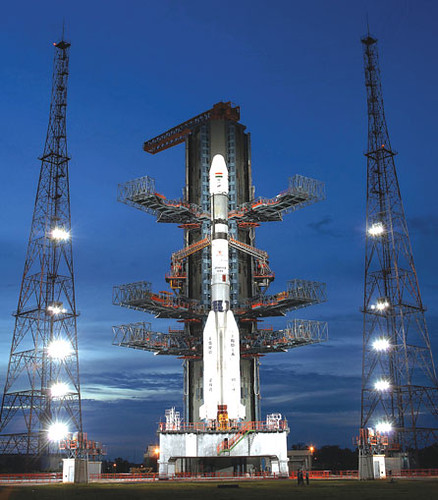
Watched the launch in real-time via NDTV from Sriharikota. The launch was good, with the first stage firing perfectly (of course). The second stage burned as planned. ISRO did confirm the indigenous cryogenic engine ingnited, then telemetry data indicated the launch vehicle was tumbling and subsequently contact was lost.

After 18 years of hard work by many at ISRO, the launch is considered a limited success. They’re determined to try again in one year.


Thaicom Uplink is Freedom


The protesting Red Shirts in Thailand have seized the Thaicom uplink to ensure news broadcasts remain uninterrupted, via Political Prisoners in Thailand blog

The Bangkok Post (9 April 2010) reports that People TV satellite uploader Thaicom, “the country’s sole satellite service provider, said the government’s blocking of the red shirts’ People Channel television station (PTV) had severely damaged its international reputation.The company said foreign customers using the same transponder as PTV were threatening to sue Thaicom for their losses. An executive expressed concern that interference with the station’s signals could damage the satellite’s transponder.” He added “Despite the fact that signal jamming violates our contract and causes severe damage to our reputation, we must follow the order…”.

In response to the closing of People TV, The Nation (9 April 2010) reports that red shirts have broken through army “barricades and entered ThaiCom uplink station’s compound and were trying to enter the station’s buildings in Lat Lum Kaew, Pathum Thani province at about 2.40pm.”

The army used “smoke bombs” but were unable to stop the “thousands” of demonstrators who reportedly “seized police trucks park[ed] inside the compound and forced open and seized weapons from the trucks.” No evidence of this weapons claim presented anywhere else, including on a BBC report from the compound [but see update below].

There were said to be 7,000 anti-riot forces at the Thaicom site.

It is reported that red-shirt leader Jatuporn Promphan had “urged the red shirts to stay calm and not to raid the satellite uplink station.” However, when it became clear that the anti-riot forces were making “preparations for crowd control” the red shirts responded. These troops “were seen deploy[ing] the water cannon to deter the crowds after devices emitting heav[y] smoke were thrown from the crowds.”

By 5.20 p.m., the government had apparently agreed to restore the People TV broadcast. The Nation reports that “red-shirt leader Natthawut Saikua said the red shirts had succeeded to force Thaicom uplink station to resume its satellite service to PTV.  The negotiations was brokered by Provincial Police Region 1 chief Lt General Krisada Pankongchuen. In exchange for the resumption of PTV broadcast, the red shirts agreed to disperse from the uplink station and allow police to gain control of the area.” People TV was back up by about 5.45 p.m.

It was reported that about 20 persons, mainly red shirts were injured in this action.

A brief but important victory for the red shirts but another action to “contain” anti-riot forces is already said to be underway at the Police hospital at the Rajaprasong intersection at around 6 p.m.

Update 1: This latter action seemed to coincide with action at the Rajaprasong area as “customers and workers were asked to leave shopping malls around Rajprasong. Police are reportedly preparing six locations to detain suspects.” This report is associated with a picture gallery at The Nation’s website. Note that the malls had already re-opened.

Update 2: Some international coverage of the Thaicom events: The Times, Christian Science Monitor and The Globe and Mail. Note that this latter report seems oddly different from all others that PPT has seen to date, referring to protesters “Hurling rocks and Molotov cocktails.” It also states that: “After the clash, some security forces were seen throwing down their shields and riot gear and shaking hands with the protesters.” The same report states that, “The Red Shirts offered water to soldiers and police, and showed reporters a small cache of weapons, including M-16 assault rifles and shotguns, they had seized from soldiers.” The government estimated that 15,000 demonstrators were at Thaicom.


Satellites and freedom: gotta love it.


Here’s the video, Thai guys & gals…


WBMSAT Satellite Industry News Bits for April 9, 2010

European scientists relieved when a Russian rocket put their Cryosat-2 satellite into a perfect Earth orbit after a catastrophic failure of the previous attempt.
[UK Financial Times – 04/09/2010]

SES announces the consolidation of all US Government sales and delivery activities into a single business unit, naming it SES WORLS SKIES, U.S. Government Solutions.
[SatNews – 04/09/2010]

GOES-15 takes its first full-disk visible image of the Earth on April 6.
{SatNews – 04/09/2010]

TCS receives additional $7.1 million in funding from U.S. Army for maintenance of Secret Internet Protocol Router and Non-secure Internet Protocol Router Access Point VSAT terminal systems outside the U.S.
[SatNews – 04/09/2010]

FCC may alter broadband plan to comply with Federal Appeals ruling on Comcast challenge that invalidated the FCC’s Net Neutrality policy.
[Information Week – 04/09/2010]

Expand Networks announces major upgrade to operating system of its Accelerators that will significantly improve functionality, value, and installation.
[SatNews – 04/09/2010]

Canadian phone giant Bell Canada to introduce the country’s first national 3D HD TV broadcast this weekend from the Masters golf tournament on its Bell TV satellite TV service.
[Hollywood Reporter – 04/09/2010]

DISA and GSA preview details of the draft request for proposals for $3.5B commercial satellite communications services planned to be purchased by U.S. government between 2011 and 2016.
[Washington Technology – 04/08/2010]

Intelsat’s Galaxy 15 anomaly did not cause immediate service interruption to customers, but plan to transition to Galaxy 12 is in the works.
[SatNews – 04/08/2010]

MTN signs agreement with Fred.Olsen Cruise Lines, an international shipping company based in Norway, to outfit its entire fleet of ships with MTN’s VSAT equipment and services.
[SatNews – 04/08/2010]

India plans to launch satellite using a rocket powered by a cryogenic engine developed by scientists in India.
[redOrbit – 04/08/2010]

ND SatCom to demonstrate XWARP technology which provides nearly latency-free virtualized and bandwidth-optimized software performance at user’s front end for geographically distributed entities.
[SatNews – 04/08/2010]

VISLINK News & Entertainment to debut latest vehicle-mounted satellite antenna, NewSwift LT, at NAB,
[SatNews – 04/08/2010]

Harmonic will feature 3D television demonstration at NAB in conjunction with Panasonic and DIRECTV.
[SatNews – 04/08/2010]

Chairman John Malone will cut voting interest in DirecTV to about 3% from 24% and leave the board of directors.
[Business Week – 04/06/2010]

SIS LIVE will unveil uPak, a new Ku-band flat-panel antenna system for satellite contribution at low data rates at NAB.
[SatNews – 04/08/2010]

RRSAT to distribute iConcerts High Definition channel on Measat 3A satellite.
[PR Newswire – 04/08/2010]

Latitude Technologies announces receipt of Transport Canada Supplemental Type Certificate number SH10-16 covering Bell Helicopter and Eurocopter models for their satellite based tracking/messaging device SkyNode S100-001.
[SatNews – 04/08/2010]

Comtech EF Data announces availability of the CDM-625 Advance Satellite Modem with IP Packet Processor.
[SatNews – 04/08/2010]

Goodrich to display scale model of its Operationally Responsive Space satellite at Natioinal Space Symposium in Colorado Springs, CO April 12-14.
[SatNews – 04/08/2010]

Federal Appeals cou8rt says the FCC does not have authority to enforce Net Neutrality regulations (part of it’s broadband initiative) on ISPs.
[SatNews – 04/07/2010]

Canadian service provider BCE to use proceeds from sales of its stake in SkyTerra to fund its wired and wireless broadband ambitions.
[Fierce Telecom – 04/07/2010]

Harris Corporation completes successful operational test of first U.S. Navy satellite communications terminal to simultaneously communicate at X and Ka band through single dual-band feed.
[CNN Money – 04/07/2010]

Vizada renews partnership with Telecoms Sans Frontiers; will provide mobile satellite communications services including training program in 2010.
[TMCnet – 04/07/2010]

C-COM receives $750,000 worth of new orders for its iNetVu mobile antenna systems from the Asia Pacific region.
[SatNews – 04/07/2010]

Newtec announces multi-million US$ order from North America’s leading provider of horse and greyhound simulcast racing for high definition and IP based DVB-S2 using its DualFlow technology.
[SatNews – 04/07/2010]

SES ASTRA announces scheduled launch for ASTRA 3B of April 9.
[SatNews – 04/07/2010]

SES WORLD SKIES announces that its SES-1 satellite has safely arrived at the Baikonour Cosmodrome, scheduled for April 24 liftoff.
[SatNews – 04/06/2010]

NASA signs $335M modification to current International Space Station contract with Russian Federal Space Agency for crew transportation, rescue, and related services in 2013 and 2014.
[SatNews – 04/06/2010]

CPI gets $3.8M contract from Harris to provide satellite communications amplifiers for Navy program meant to boost broadband capability of Navy ships 10 fold.
[San Francisco Business Times – 04/06/2010]

SPOT sponsors Backpacker Magazine’s 10th annual Get Out More Tour, a national interactive mobile media and education road tour..
[SatNews – 04/06/2010]

Bolivia, China sign satellite launching agreement; Chinese will help Bolivia launch communications satellite "Tupac Katari."
[Space Travel – 04/06/2010]

iDirect announces Global Crossing launch of next-generation satellite network for Brazilian ISPs and enterprises using iDirect Series 14000 universal satellite hub and 600 X3 satellite remotes, with plans to service as many as 2000 sites.
[SatNews – 04/06/2010]

WBMSAT PS – Satellite Communications Consulting Services

Homegrown Cryogenic Engine


The Indian Space Research Organization is hoping it’s launch of GSAT-4 on 15 April 2010, using a 4th stage cryogenic engine they developed themselves, will allow India to join the rocket launch club, via the BBC:

The new engine is being incorporated into the upper-stage of India’s Geostationary Satellite Launch Vehicle (GSLV).

"It is a complex strategy technology," said Indian Space Research Organisation (Isro) Chairman K Radhakrishnan.

He said the rocket would send a heavy communications satellite into space on 15 April from the country’s launch pad at Sriharikota in eastern India.

Dr Radhakrishnan told reporters in Banglalore that the technology was home grown because "one country stopped another country in giving this technology to India".

India began developing cryogenic technology after Russia reneged on a deal to supply cryogenic engines in 1993 – following pressure from the United States, which believed India was using the technology to power missiles.

"The best reply is to… build your own technology," Dr Radhakrishnan said.

India has been using Russian engines to launch heavier satellites into space for some time. It joins the US, Russia, Japan and China in having developed cryogenic engines.

India hopes to emerge as a global player in the multi-billion dollar satellite launch market.

 Adding another reliable launch service provider for heavy payloads will be a game-changer.


We Have A Problem


 Just days after the SES-1 spacecraft arrived in Baikonur from Dulles, Intelsat lost control of Galaxy-15. Both spacecraft are based on Orbital’s Star-2 bus, which means the 4-week launch campaign’s schedule may slip.

The immediate impact for Intelsat is to transition customer to an in-orbit spare, Galaxy-12, from 123° West to 133° West. Sounds simeple, but it’s not. It is likely the engineers are concerned about future Orbital spacecraft. Galaxy-12 is also a Star-2 bus, so they won’t relax until they know what the root cause of the failure was. Same goes for all who have one in-orbit or being built. Sure, Indostar-1 had some problems, but that’s probably been fixed on subsequent spacecraft.

For SES, replacing the spacecraft co-located at 101° West, AMC-4 and AMC-2, is critical. With so much at stake, it would be prudent to delay the launch if there are doubts about future performance. They’ve got enough trouble as it is. Fix it before it flies.

But here’s the real, immediate operational challenge: how do you transition customers if you don’t control one of the spacecraft? Then, how do you get it out of the way so it doesn’t interfere with adjacent spacecraft? Take, for example, C-SPAN on AMC-11 at 131°W, operating on transponder 7, 3840V. The Fox Sports mux is on Galaxy-15 at 133°W, transponder 7, 3840V. Now we’ve got a real problem: same frequencies, and the operators on the ground can’t communicate with G15, so they can’t turn it off. Get my drift?

Both SES and Intelsat have a real problem on their hands. Something always happens in time for the NAB show in Las Vegas.

STS-131 Launched


Nice launch this morning, and SpaceflightNow.com‘s photo selections (by Stephen Clark) are beautiful.

I know NASA was happy about it…

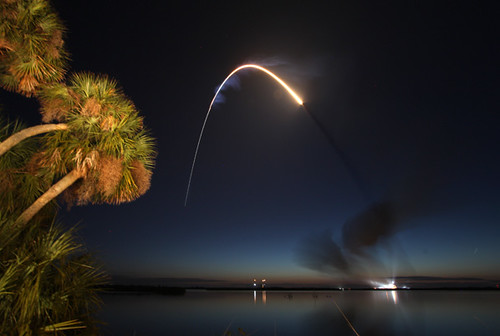
During a postlaunch news conference at NASA’s Kennedy Space Center in Florida, the 6:21 a.m. EDT liftoff of space shuttle Discovery was hailed as a great success.

Calling the launch, "a great start to a great mission," Bill Gerstenmaier, associate administrator for Space Operations, said the successful liftoff was a tribute to the team at Kennedy that got the vehicle ready to fly.

Mike Moses, chair of the Mission Management Team, said it was, "a spectacular launch and picture-perfect countdown." He outlined a few minor technical issues that were recorded, but that the spacecraft and crew were ready to start an action-packed mission.

Expressing his happiness that they were able to launch on the first attempt, Pete Nickolenko, STS-131 launch director, said he was proud of the teams that make such a difficult job look so easy.

Also on hand was Japan Aerospace Exploration Agency President Keiji Tachikawa, who noted that this will be the first time two Japanese astronauts will be in space at the same time, as Discovery’s Mission Specialist Naoko Yamazaki joins Expedition 23 crew member Soichi Noguchi for the STS-131 mission.

Discovery and crew will spend 13 days in space on their mission to the International Space Station.


Cool video, as always…


WBMSAT Satellite Industry News Bits 04/02/2010

Gilat is engaged to deliver its SkyEdge II-based satelli8te network technology to support a border security program of an undisclosed Latin American country.
[UPI – 04/02/2010]

European Space Policy Institute to release fourth volume in series of publications evaluating how to achieve sustainable use of space by means of respecting fairness and responsibility.
[SatNews – 04/02/2010]

Fourth annual Military Satellites Summit April 27 – 28 in Tysons Corner, VA, is announced by the Institute for Defense and Government Advancement.
[dBusinessNews – 04/02/2010]

Ocean Systems Engineering will provide a wide variety of services and support relating to satellite communications to the Marine Corps under $13.1 million order.
[Washington Technology – 04/02/2010]

ARINC becomes Distribution Partner for SwiftBroadband service from Inmarsat.
[SatNews – 04/01/2010].

Gantry for Russian Soyuz rocket at Arianespace facility in French Guiana takes shape.
[SatNews – 04/01/2010]

Bolivia signs contract with China for a $300 million communications satellite.
[Reuters – 04/01/2010]

Integral Systems gets support services contract in Asia for $3+ million.
[SatNews – 04/01/2010]

DirecTV to have four 3D channels beginning in June – ESPN, N3D, a 3D pay-per-view channel, and one on-demand 3D channel.
[SatNews – 04/01/2010]

China Satellite Communications profit jumps 26.9% in 2009.
[TMCnet – 04/01/2010]

Harris comes to 2010 NAB as market leader in Mobile TV, with more than 40 sales of ATSC Mobile DTV systems confirmed to date.
[SatNews – 04/01/2010]

Sencore to introduce its first DVB-S2 modulator.
[SatNews – 04/01/2010]

Scientists funded by Astrium unveil 30 Kg nanosatellite engineered to clear more than 5,000 tons of debris in low-Earth orbit.
[Satellite Today – 04/01/2010]

Frost & Sullivan report finds inadequate satellite bandwidth impacts world VSAT market by increasing service revenues, while causing a dip in sales of equipment or hardware.
[PR Newswire – 04/01/2010]

SpaceX activates International Space Station (ISS) communications system for the Dragon spacecraft, which is to begin ISS resupply missions starting in 2011.
[Space Travel – 03/31/2010]

Shaw Direct contracts with Telesat to acquire capacity on a new satellite to be available in late 2012.
[CNN Money – 03/31/2010]

Comtech Systems gets $34.5 million contract for telecommunications transmission equipment from a North African government.
[CNN Money – 03/31/2010]

Boeing explores collaboration with Indian Space Research Organization in area of communications satellites.
[Space Daily – 03/31/2010]

Astrium is commissioned by European Space Agency to build Sentinel-2B optical satellite.
[SatNews – 03/31/2010]

DigitalGlobe announces its content library contains more than one billion square kilometers of earth imagery, 33% of which is less than one year old.
[SatNews – 03/31/2010]

India’s GSLV rocket, powered by home-made cryogenic engine for the first time, is slated to launch the GSAT-4 experimental satellite April 15th.
[Space Travel – 03/31/2010]

Russia increases security for train rollout of Soyuz rocket for launch to the International Space Station, in aftermath of suicide bomb attacks.
[Space Daily – 03/31/2010]

Documents filed by FCC indicate that Harbinger Capital Partners intends to use its recent acquisition of satellite communications company Skyterra to build out a 4G network, competing withy cellular carriers.
[Business Week – 03/30/2010]

India is developing winged reusable rocket for launching objects into space.
[Space Travel – 03/30/2010]

Singapore to have first locally-built satellite in space by middle of this year – a 120 kg micro-satellite called the X-Sat
[Space Daily – 03/30/2010]

Avanti wins government contract extension in Northern Ireland.
[Satellite Today – 03/30/2010]

CryoSat-2 satellite to be launched April 8 in program led by UK  to monitor changes in ice cover at the poles.
[Phys-Org – 03/30/2010]

NASA awards contracts to eight aerospace firms for Rapid Spacecraft Acquisition III spacecraft and related services.
[SatNews – 03/30/2010]

Norsat wins network service contract worth $1.7 million from military group based in Europe.
[SatNews – 03/30/2010]

Teal Group Corp. revises upward its Worldwide Mission Model of future space payloads, indicating there are 2,229 space payloads proposed for launch to Earth or Lunar orbits, or deep space trajectories, from 2010 – 2029.
SatNews – 03/30/2010]

SES WORLD SKIES hosts Defense Information Systems Network connection point at Manassas VA media port, enhancing U.S. government access to WORLD SKIES bandwidth and global connectivity.
[SatNews – 03/30/2010]

SatMAX, a leading provider of non-line of sight satellite communications  equipment signs letter of intent to grant exclusive domestic marketing rights to AvStar Aviation Group.
[CNN Money – 03/29/2010]

U.S. Air Force could transfer some Atlas and Delta rocket missions from Florida to California and assign U.S. military payloads to specific boosters closer to launch in effort in improve efficiencies in launch manifests.
[Space Flight Now – 03/29/2010]

Northrup Grumman stops some work on next generation of U.S. weather satellites as officials decide how to proceed under Obama administration’s decision to terminate and divide program among three government agencies.
[Spaceflight Now – 03/29/2010]

Russia Eyes bigger slice of international space market, planning to build a new space center.
[Space Daily – 03/29/2010]

AT&T and Verizon Wireless criticize FCC decision to require SkyTerra to seek FCC approval before leasing capacity to the two largest wireless providers.
[Business Week – 03/29/2010]

Globe Wireless enters agreement to supply and install two FleetBroadband satellite terminals per ship aboard approximately 350 Anlo Eastern Ship Management vessels.
[SatNews – 03/29/2010]

KVH Industries TracPhone and miniVSAT broadband systems to be installed on vessels of DSD Shipping of Norway.
[SatNews – 03/29/2010]

Arianespace Ariane 5 launch postponed several days to allow replacement of part in a launcher subsystem that caused an anomaly.
[SatNews – 03/28/2010]

Cape Canaveral new $500 million rocket launch tower unused, with Ares 1 rocket and entire Constellation program cancelled by the Obama administration.
[Space Travel – 03/28/2010]

Space shuttle Discovery to launch April 5 for 13 day mission in fourth-to-last shuttle launch.
[Discover Magazine – 03/28/2010]

U.S., Air Force responds to Iridium’s call to put hosted payloads, experiments, and sensors on the company’s next-generation satellites.
[Space Flight Now – 03/27/2010]

Air Force flight tests validate two-and-a-half year effort , successfully accessing the high-capacity Ka-band portion of the new WGS satellites from airborne 707 test bed.
[U.S. Air Force web site – 03/26/2010]

WBMSAT PS – Satellite Communications Consulting Services