Satellite News Bits

All your satcom news is mine, via Bill McDonald:

TacSat 3 launch scrubbed May 7 due to bad weather in Wallops Island area.
[Satnews – 05/08/2009]

Russia successfully places Express AM44 satellite, named after A.S. Popov, into operation at 11 West within the Russian Satellite Communications Company satellite constellation.
[Satnews – 05/07/2009]

Pathfinder Space Tracking and Surveillance System (STSS) Advance Technology Risk Reduction (ATRR) satellite successfully launched from Vandenberg AFB by the Missile3 Defense Agency, supported by NASA and commercial firm United Launch Alliance.
[Satnews – 05/07/2009]

Planned acquisition of DataPath by Rockwell Collins receives approval of stockholders.
[Satnews – 05/07/2009]

El Corte Ingles will distribute Eutelsat’s Tooway satellite broadband service to retail customers in Spain.
[Satellite Today – 05/07/2009]

Space Systems/Loral  is selected to provide new communication s satellite, AsiaSat 5C, to Asia Satellite Telecommunications Company Limited.
[Satnews – 05/07/2009]

TacSat-3 is  scheduled for May 7 launch from Wallops Island; features 3 revolutionary trials including Raytheon’s advance imaging spectrometer, Air Force avionics experiment, and Office of Naval Research’s satellite communications package.
[NASA – 05/06/2009]

DirecTV merger with John Malone’s Liberty Entertainment results in simplification of DirecTV’s ownership, setting the stage for future deals.
[Satnews – 05/06/2009]

KVH debuts TracPhone FB150, 10.5" in diameter and 12" high, to offer small, cost effective broadband internet package for maritime applications, suited for boats as small as 40 ft.
[TMC Net – 05/06/2009]

C2SAT, actively working to establish a new presence in China covering local production facilities and product sales, is rewarded by largest single order to date, seven C2SAT 2.4m C-band antennas within six months.
[Satnews – 05/06/2009]

HD DTH satellite service to be offered in Phillipines by the Phillippine Long Distance Telephone Company and MediaQuest.
[Satellite Today – 05/06/2009]

Echo Satellite, offering satellite communications "hotspots" enabling wireless coverage for multiple users in any non-line-of-sight environment, changes name to SatMax in response to request from EchoStar Corp.
[Houston Business Journal – 05/05/2009]

Spacenet Inc. provides transportable satellite communications solutions to Erie Insurance for mobile claim centers.
[Globe Newswire – 05/05/2009]

Australian government’s national high-speed national broadband strategy, "Ruddnet", focusing on 100mbps fiber connectivity to 90% of the population, and 12 mbps satellite connectivity to the rest, divides the nation.
[The Australian – 05/05/2009]

NASA officials lobby for extension of shuttle program to close gap between shuttle program and debuting of the Ares/Orion manned flight capability.
[R&D magazine – 05/04/2009]

U.S. military to launch experimental tactical satellite to demonstrate inexpensive user-friendly space technologies.
[Space.com – 05/04/2009]

AT&T CruiseCast car satellite system for in-car video, currently offering 22 channels, is soft-launched at select retail outlets.
[twice-com – 05/04/2009]

Giga-Com delivers satellite broadcast solutions to Kuwaiti government.
[Satellite Today – 05/04/2009]

French Airline installs Panasonic satellite in-flight entertainment system.
[Satellite Today – 05/04/2009]

Australian satellite company Codan acquires Locus Microwave.
[Satellite Today – 05/04/2009]

KVH announces promotion to make it easier for "big dish" maritime users to "move down" to the KVH "mini-VSAT" broadband service using the TracPhone V7(R) hardware.
[PR Newswire – 05/04/2009]

China Electronics Technology Group chief engineer states that China will be able to provide free global navigation and positioning services by 2020 with its own constellation of satellites named "Compass."
[Satnews – 05/04/2009]

Abu Dhabi or Dubai targeted to be host of new spaceport for space tourism in talks between Virgin Galactic and parties in the UAE.
[The National – May 3, 2009]

SatMagazine interviews Rob Bednarek, President and CEO of SES AMERICOM-NEW SKIES.
[SatMagazine, May 2009]

Finding the Next Generation Aerospace workers for the U.S. Satellite Industry (a crisis in looming in the workforce).
[SatMagazine feature – May 2009}

SatMagazine interviews Charlie Maloney, GOES N-P Program Manager for Boeing Space and Intelligence Systems, responsible for final systems test and launch preparations for next generation GOES satellites.
[SatMagazine – May 2009]

SatMagazine interviews Dr. Jesus Villasenor of M.I.T. and Mr. Luke Volpe of Dynamics Research Corp., about NASA’s HETE mission.
[SatMagazine – May 2009]

NSR Report – Supervisory, Control and Data Acquisition (SCADA) as well as Machine-to-Machine (M2M) services largely recession-proof; satellite platforms providing reliable ubiquitous communications to widely separated areas becoming increasingly important in these vertical markets.
[NSR Report – May 2009]

C2SAT – technology for the future – 4 axis antenna designed to increase reliability, precision, and accuracy of maritime terminal tracking of satellites for all vessels.
[SatMagazine feature – May 2009]

 

DIY Friday: Get Your Stinking Paws Off My iPhone


Remember the movie "Planet of the Apes?" Of course you do. Actor Charlton Heston’s zinger one-liner "Get your stinking paws off her you damn dirty ape" can be used as an alarm to ward off an iPhone thief. Or use PhoneSCREAM instead.


That and other preventive measures were published by iSmashPhone the other day and is worth a look:


1. Turn On Passcode Lock

Sure, this is an amateur tip – but let’s face the facts. Most people out there do not implement a passcode lock on their iPhones. And they should. While it won’t prevent anyone from snatching your phone, it’ll keep your private information private. Here’s how you do it.

1. Go to "Settings".
2. Go to "General".
3. Go to "Passcode".
4. Enter a 4 digit password.
5. Remember it.  
2. Auto-Lock

Your iPhone has an auto-lock option, which (obviously) automatically locks your phone after a chosen period of time, and requires the previously mentioned 4 digit passcode to unlock it. It would be best to have the auto-lock set on either one or two minutes to ensure that the amount of time your iphone spends unlocked is minimized. 
3. Record Your iPhone’s IMEI Number and Serial Number

Your iPhone’s International Mobile Equipment Identity (IMEI) number is a fifteen digit number used by wireless carriers to identify your phone. You can find it on the back of your iPhone along with your serial number and FCC ID. Both are important to have when reporting a lost or stolen device.
4. SIM PIN

You can assign a PIN (personal identification number) to your SIM (subscriber identity module) card, so it can’t be used in other phones without the PIN. It must be entered only when you turn the iPhone on, or replace the SIM card. 

1. Go to "Settings".
2. Go to "Phone".
3. Turn on "SIM PIN".
4. You are prompted to enter the current PIN, at which point you must enter the default PIN number. If you are an AT&T customer in the US, the code is "1111". Go here for a list of international default SIM PINS.
5. After entering the default, you can change the code and make it whatever secret combination your heart desires. 

5. Frequently Back Up Your iPhone


Backing up your device is crucial in all situations. Whether you lose your phone, are the victim of a theft, or simply have a buggy iPhone that decides to crash one day, backing up your iPhone is a simple, necessary step to insure the safety of your data. 


6. GadgetTrak

Gadgettrak icon

Price: Free

This application is brilliant in its simplicity. It dupes the burglar into inadvertently sending you his precise location. Here’s how it works.
  1. Download the application.
  2. Go to "Settings" on your iPhone, and go to "GadgetTrak". Choose a browser homepage. (The default is Yahoo.)
  3. Enter your iPhone’s serial number. 
  4. Open the application and register for free with your email and password.
  5. Go to http://www.gadgettrak.com/ and log in to activate tracking. 
  6. When you open the application, it opens your homepage just like Safari, but the magic happens in the background. It sends out the location of your iPhone, along with GPS coordinates, maps, IP address, carrier, and ISP data.
  7. Notice the near identical resemblence between the "GadgetTrak" homepage icon and the "Safari" homepage icon.  
  8. The Safari icon is typically on the bottom panel on most iPhones. Swap GadgetTrak in place of Safari. 
  9. When an unsuspecting iPhone burglar decides to browse the web on your dearly missed gadget, he will unknowingly give away his location – and you’ll get your iPhone back safe. (You should probably have the police come with you.)  

Private-I works with 3G iPhones in sending the location of a stolen phone to you. Many others, too.

And remember to protect your identity on any mobile phone:

First off you want to password protect your phone, it’s a hassle, but something that is often overlooked and a first, simple security solution you can activate to make your phone safer.  That way anytime you turn your phone on for use, it will require a password entry, this way if you lose your cell phone the data is still password protected from anybody that might try to look into your information.

Secondly, if your phone has Wi-Fi capabilities, never transmit any personal data over public Wi-Fi connections.  This means you don’t want to conduct a whole lot of personal business using a coffee house’s internet connection, because being a public connection it’s not safe for personal data.  Anybody could easily intercept your signal and steal any information you receive or send over a public Wi-Fi network, so you should limit your use not to include anything vital, like a credit card number or information about you.

Finally, there is some information you shouldn’t store on your phone, no matter what security precautions you are already taking.  Information like bank account numbers, or the PIN number associated with your account is a big don’t.  Social Security Numbers, and credit card numbers, also a very bad idea, as that information just isn’t secure enough on your cell phone, even with limiting Wi-Fi usage and password protecting.  A smart phone is a great tool, but never forget to respect how easily the information contained within could be stolen and used against you.

I like the GadgetTrak app:


Protect your devices as you would your keys.

Moon Shot’s a Longshot


Not sure if this is a 50-1 longshot, but President Obama will be reviewing the new lunar mission, via Florida Today:

President Barack Obama will order a comprehensive review of NASA’s plans to return astronauts to the moon when the agency’s proposed 2010 budget is released Thursday.

Expected to last 60 to 90 days, the independent review will examine designs for the launch and exploration vehicles proposed for use by the Constellation program and the timeframe for flying lunar missions, according to sources familiar with the budget planning but not authorized to speak publicly about it.

Norman Augustine, a retired chairman and CEO of Lockheed Martin Corp. and former president of the American Institute of Aeronautics and Astronautics, is the likely candidate to lead the study, the sources said.

Augustine could speak publicly about the review as early as Friday.

Current NASA plans call for missions to the moon by 2020, a target set by the space exploration vision established in 2004 by former President George W. Bush.

But the agency last month put on hold contract awards for preliminary designs of the Ares V heavy-lift rocket and Altair lunar lander, pending release of the budget.

We shouldn’t abandon plans to visit the Moon again. It’s good for NASA and the USA.

Delta Does It Again


Nice launch. What was it? Aviation Week tells us:

A NASA-supervised mission carrying a satellite with a prototype sensor technology for the U.S. Missile Defense Agency (MDA) was put into a low-Earth polar orbit Tuesday one hour after liftoff by a United Launch Alliance Delta II from Vandenberg Air Force Base, Calif.

The $400 million Space Tracking and Surveillance System Advanced Technology Risk Reduction (SSTS-ATRR) mission, originally called the Block 2010 space Risk Reduction, was launched at 1:24 p.m. PDT and achieved orbit at 2:22 p.m. from a two-stage Delta II 7920-10L.

The goal of the partially classified satellite is to demonstrate sensor technology to track ballistic missiles (Aerospace DAILY, April 29). MDA turned to NASA for launch assistance because the space agency had two ordered two Delta II launchers at a time when the defense agency had switched to larger Evolved Expendable Launch Vehicles, according to NASA Launch Manager Chuck Dovale.

In this part of California, it’s a tailgate party:


Extreme Solar Activity


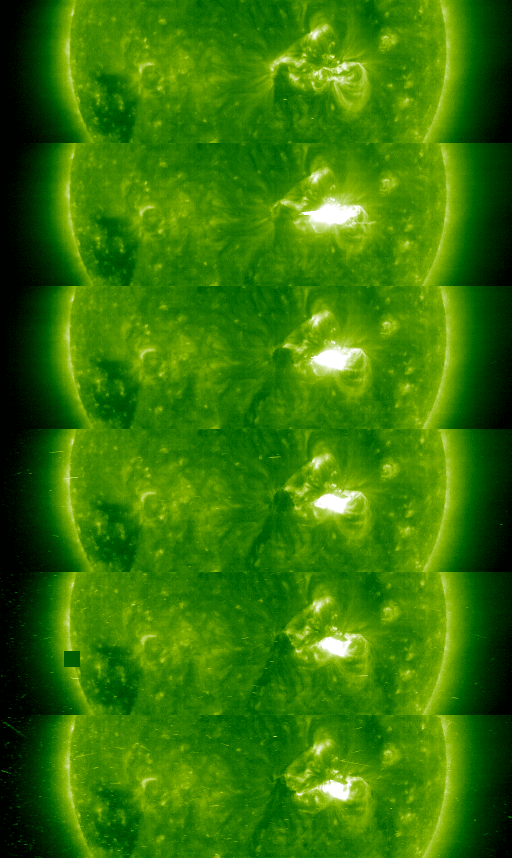
 We all depend on the Sun for life. Whether we know it or not, those of us who watch TV depend on communications satellites for efficient distribution. Broadcast television networks, cable TV, and, of course, direct broadcast satellite — they all depend on satcom systems to get their programming to us, 24x7x365.

Now, more than ever, people are personally dependent on GPS satellites to find their way. Hosted a party over the weekend, and it was the first time nobody asked for direction. "We got GPS," was the response.

Us rocket scientists — and various "sat nuts" who follow these activities — have know the Earth’s magnetic fields are greatly affected by the Sun’s activities, such as sunspots.

The European Space Agency published a report measuring such extreme solar events last week:

“With these detailed observations, we’ll be able to plug in data and better estimate what happens to the inner magnetosphere and near-Earth space during such explosions on the Sun”, said Iannis Dandouras, lead author of the results published recently, and Principal Investigator of the Cluster Ion Spectrometer.

“Looking at such a large-scale physical phenomena with a single satellite is akin to predicting the impact of a tsunami with a single buoy,” added Matt Taylor, ESA’s Project Scientist for Cluster and Double Star. “With Cluster and Double Star we have monitored both sides of Earth simultaneously, and obtained valuable in-situ data.”

Get deeper here. And be sure to check out the animations and images.


Satellite News Bits

Satcom news summary for last week, courtesy of Bill McDonald:

Communications and Power Industries (CPI) wins three-year contract to supply high power, solid-state amplifiers to SWE-DISH, a DataPath company, for its Suitcase and CommuniCase product lines.
[SatNews – 05/01/2009]

Space Shuttle Atlantis to make final visit to Hubble telescope – launch to take place May 11.
[SatNews – 05/01/2009]

Eutelsat to launch Tooway broadband satellite service to UK residents in rural areas, initially with speeds of up to 2Mb, but by 2010 this will rise to 10Mb.
[Top 10 Broadband – 04/30/2009]

Soyuz to join Ariane 5 as launch vehicles lifting off from French Guiana, as Arianespace continues construction of the launch pad and support facilities.
[SatNews – 04/30/2009]

Zefiro 9A rocket motor, to be third stage of Europe’s new small launch vehicle, tested at Salto di Quirra Interforce test range in Sardinia, Italy.
[SatNews – 04/30/2009]

WildBlue Communications seeks a share of the U.S. government’s $7.2 billion broadband stimulus package to develop a new satellite-based platform that can deliver downstream speeds in excess of 18 Mbps to rural areas in need of a high-speed boost.
[Cable Digital News – 04/30/2009]

MacDonald, Dettwiler and Associates gets two nice wins – a $4m contract to provide an advanced technology solution to EADS Astrium, and a multi-million dollar contract from DigitalGlobe to provide a ground station solution for WorldView-1 and WorldView-2 satellites.
[SatNews – 04/30/2009]

Japanese government task force suggests introducing an early warning satellite that can detect missile launches as part of nations first basic plan on development and use of space.
[SatNews – 04/30/2009]

Iran states that the country’s first domestically-made telecommunications satellite, Omid, launched in February, has successfully concluded its mission and re-entered earth’s atmosphere.
[SatNews – 04/30/2009]

CPI will upgrade Army’s Warfighter Information Network-Tactical military satellite electronics to add Ka band satellite capability under $3m contract with DataPath.
[Military & Aerospace Electronics – 04/29/2009]

NASA prepares to launch nanosatellite known as PharmaSat to perform experiments to help scientists better understand how effectively drugs work in space.
[R&D – 04/29/2009]

Pentagon may reach goal of doing collision analysis on 800 maneuverable satellites before October, considers possibility of tracking 500 more satellites which cannot be maneuvered.
[SatNews – 04/29/2009]

Ducommun Incorporated announces that their Miltec subsidiary has delivered flight-ready nanosatellites to the U.S. Army Space and Missile Defense Command/Army Forces Strategic Command, completing first U.S. Army satellite development plan since 1960.
[SatNews – 04/29/2009]

Space and Aeronautics Subcommittee holds hearing to examine the challenges faced by civil and commercial space users as the number of satellites and the amount of space debris orbiting Earth continues to grow.
[SpaceRef.com – 04/28/2009]

International Space University students suggest ways to prevent space collisions in  results of 2007 study released at "Space for a Safe and Secure World" symposium.
[SatNews – 04/28/2009]

Hughes wins arbitration against Sea Launch; Sea Launch ordered to pay $52m in dispute over whether Hughes had legal right to cancel Sea Launch contract.
[Satellite Today – 04/28/2009]

German teleport and satellite service provider CEDTel GmbH acquires ND SatCom Managed Services Division.
[SatNews – 04/28/2009]

The Australian Defence Force will spend $167 million for a special payload on the Intelsat 22 satellite to be launched in 2012, to boost its tactical communications for military serving in Afghanistan and nearby theatres in the Indian Ocean.
[The Australian – 04/28/2009]

Boeing wins contract to build satellite for Intelsat, to be launched in 2012, which will serve Australian military.
[The Detroit News – 04/28/2009]

Excelerate Technology wins contracts to provide satellite systems to enhance police communications capabilities in UK.
[Public Technology – 04/28/2009]

Nigeria National Assembly pledges to assist NIGCOMSAT to secure funding for NigComSat 2 & 3.
[Daily Trust – 04/28/2009]

Harbinger Capital Partners founder Philip Falcone presses ahead with multibillion-dollar plans to build international satellite-cellphone business.
[Wall Street Journal – 04/27/2009]

TerreStar satellite to be launched in June to be largest commercial satellite yet, with 60ft mesh antenna, to enable cell-like satellite phones; SkyTerra plans two even larger satellites next year.
[Seattle Times – 04/26/2009]

NSR Report – high throughput Ka-band spotbeam satellites pushing open satellite market door – full long-term potential to change market recognized by few.
[NSR report – April 2009]

WBMSAT PSSatellite Communications Consulting Services


DIY Friday: Internet Boombox


 The Bass Station is a big 80’s boombox, complete with a router, etc:

The external form of the Bass-Station is a vintage 1980’s boom box. Internally, the tape and radio mechanisms have been removed and replaced with a modern miniature computer. The computer contains a sound output device, a large hard-drive, and a wireless network interface card. All the components that make up the device are standard and readily available around the world.

Going one step deeper, the computer, running a modern operating system (Linux), uses the wireless interface card to create a self-standing yet open wireless network. It functions as an access-point broadcasting its presence in a limited range making the network only accessible by a localized community. The network that is created cannot access external networks nor is it accessible from other networks like the Internet, for example.

A collection of networking services make it easy and simple for users in the presence of the network to join and begin interacting with the content that is there. A DHCP server [1] is used to automatically assign IP addresses to clients trying to join the network. A DNS server [2] is configured in a manner that will redirect users to a central location regardless of the domain that they are requesting (e.g. asking for www.google.com, or any other domain, will always direct a user to the Bass-Station’s domain.) A web server is used to serve people the main interface to the Bass-Station’s functionality. All of these services combined facilitate a person’s interaction with the content and functionality of the Bass-Station. Lastly, there is a program called the Bassment Daemon that manages the audio engine and playing of music from the stereo’s speakers.


 Or get yourself Microchip’s Internet Radio Demo Board:

The main chip on this board is the PIC18F97J60 which uses integrated MAC and PHY to interface directly to the RJ45 MigJack Ethernet cable connector. Communication over the internet is made easy by having Microchip’s TCP/IP stack programmed on the 97J60 micro controller. The microcontroller’s I/O is used to interface to the OLED graphics LCD display. This display allows for showing the IP address, mode of operation, song and station. Using this phi interface the microcontroller interfaces to the BLFI5BS1011 Mp3 audio decoder. A simple audio head set jack will allow listener to plug into standard head phones or connect to a speaker like this so that multiple people can listen at the same time. The URL website addresses for multiple internet radio stations are preprogrammed on the system. So push buttons will allow the use to scroll through the radio stations and select the desired station. Other push buttons are for volume up and down.

 Awesome:


Close Encounters With Mercury

Well if I had money
I tell you what I’d do
I’d go downtown and buy me a Mercury or two
Crazy bout a Mercury
I’m gonna buy me a Mercury
And cruise it up and down the road


Ford’s Mercury brand did make some cool cars, back in the day. I remember their product placements in the Hawaii Five-O TV series. Which, to this day, has law enforcement types exclaiming "book em , Danno!" I can’t remember the last time Mercury had a popular model (always liked the ’67 Cougar).

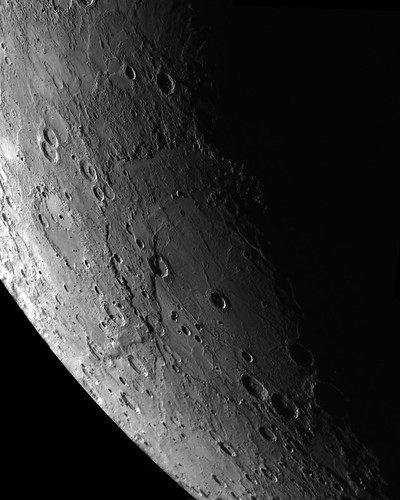
You know who’s got money for a Mercury? NASA! The MESSENGER spacecraft (MErcury Surface, Space ENvironment, GEochemistry, and Ranging) just did a second fly-by of  the planet Mercury found there’s more to it:

Analyses of data from the MErcury Surface, Space ENvironment, GEochemistry, and Ranging (MESSENGER) spacecraft’s second flyby of Mercury in October 2008 show that the planet’s atmosphere, magnetosphere, and geological past are all characterized by much greater levels of activity than scientists first suspected.

On October 6, 2008, the probe flew by Mercury for the second time, capturing more than 1,200 high-resolution and color images of the planet unveiling another 30 percent of Mercury’s surface that had never before been seen by spacecraft and gathering essential data for planning the remainder of the mission.

“MESSENGER’s second Mercury flyby provided a number of new findings,” says MESSENGER Principal Investigator Sean Solomon at the Carnegie Institution of Washington. “One of the biggest surprises was how strongly the planet’s magnetospheric dynamics changed from what we saw during the first Mercury flyby in January 2008. Another was the discovery of a large and unusually well preserved impact basin that was the focus for concentrated volcanic and deformational activity. The first detection of magnesium in Mercury’s exosphere and neutral tail provides confirmation that magnesium is an important constituent of Mercury’s surface materials. And our nearly global imaging coverage of the surface after this flyby has given us fresh insight into how the planet’s crust was formed.”


 Nice animation…


Now Playing in D.C.: Al Jazeera


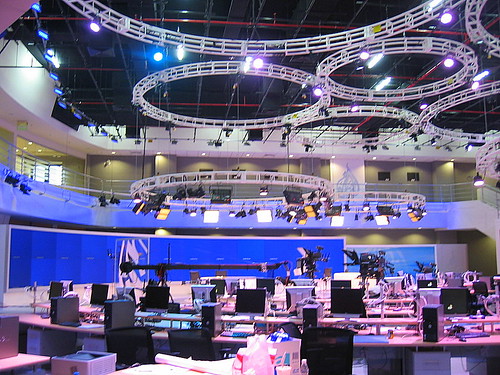
Looks like MHz Networks has the courage to carry Al Jazeera English in the D.C. Market:

Al Jazeera English (AJE), the award-winning 24-hour global news and current affairs channel broadcast in more than 100 countries, has joined independent, non-commercial broadcaster MHz Networks’ prestigious international channel line-up in Washington, D.C.

Like MHz’s other international networks, AJE programming will be added in two forms. Beginning April 29, D.C. metro area viewers will be able to watch an evening newscast, anchored from AJE’s Washington, D.C., news bureau, at 10 p.m. on MHz Networks primary local channel known as MHz Networks 1/MHz Worldview D.C.

Then, beginning July 1, AJE will be broadcast 24 hours per day, seven days per week as “MHz Networks 5,” joining nine other international networks that MHz broadcasts and cablecasts in the region.

“It was important for us to broaden the range of world news that we bring to Washington, D.C.,” says Frederick Thomas, chief executive of MHz Networks. “AJE also fits perfectly inside of our mission and I think viewers are going to find it a reliable and top-quality source for news.”

It only took 30 months to get distribution. MHz Networks is also available via direct broadcast satellite in D.C. (DirecTV    2183/972 and Dish Network 8077/8084)

Meanwhile, the "Backyard Teleport" guy from Staten Island is going to jail for 6 years. Entertaining report on Gawker:

So this guy in Staten Island is going to prison for six years because he sold a satellite TV package of Arab news stations that included Al Manar, which is Hezbollah’s TERROR CHANNEL.

The prosecutors call him "Hezbollah’s man in New York City," because he offered this channel, which is apparently TERRORISM. He also sold porn, so you know he’s basically an Islamic fundamentalist and an amoral big city commie.

This America-hater’s punishment won’t end after his prison term, of course!

Iqbal, who has lived in the U.S. for more than 20 years, will most likely be deported once he has completed his prison sentence, Dratel said. Iqbal, a former car mechanic, is married with five children and a sixth child due in July.

 Go figure.


Far Out


Tommy Chong of Cheech & Chong said it best: "Far out, man!"

I wonder if somebody at NASA’s Goddard Space Flight Center said something similar about this blast from the past, maybe 13 billion light years away:

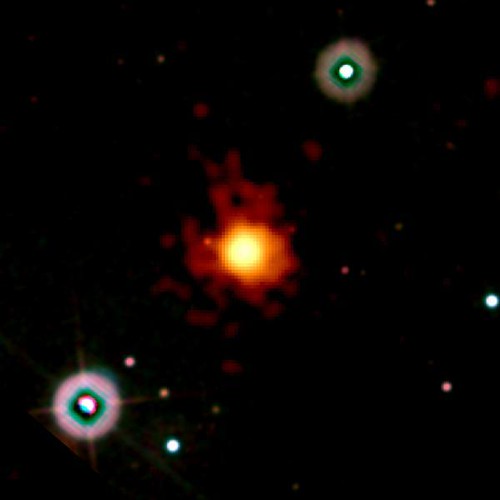
NASA’s Swift satellite and an international team of astronomers have found a gamma-ray burst from a star that died when the universe was only 630 million years old, or less than five percent of its present age. The event, dubbed GRB 090423, is the most distant cosmic explosion ever seen.

"Swift was designed to catch these very distant bursts," said Swift lead scientist Neil Gehrels at NASA’s Goddard Space Flight Center in Greenbelt, Md. "The incredible distance to this burst exceeded our greatest expectations — it was a true blast from the past."

At 3:55 a.m. EDT on April 23, Swift detected a ten-second-long gamma-ray burst of modest brightness. It quickly pivoted to bring its ultraviolet/optical and X-ray telescopes to observe the burst location. Swift saw a fading X-ray afterglow but none in visible light.

"The burst most likely arose from the explosion of a massive star," said Derek Fox at Pennsylvania State University. "We’re seeing the demise of a star — and probably the birth of a black hole — in one of the universe’s earliest stellar generations."

Gamma-ray bursts are the universe’s most luminous explosions. Most occur when massive stars run out of nuclear fuel. As their cores collapse into a black hole or neutron star, gas jets — driven by processes not fully understood — punch through the star and blast into space. There, they strike gas previously shed by the star and heat it, which generates short-lived afterglows in many wavelengths.

"The lack of visible light alone suggested this could be a very distant object," explained team member Edo Berger of Harvard University.

Beyond a certain distance, the expansion of the universe shifts all optical emission into longer infrared wavelengths. While a star’s ultraviolet light could be similarly shifted into the visible region, ultraviolet-absorbing hydrogen gas grows thicker at earlier times. "If you look far enough away, you can’t see visible light from any object," he noted.

Within three hours of the burst, Nial Tanvir at the University of Leicester, U.K., and his colleagues reported detection of an infrared source at the Swift position using the United Kingdom Infrared Telescope on Mauna Kea, Hawaii. "Burst afterglows provide us with the most information about the exploded star and its environs," Tanvir said. "But because afterglows fade out so fast, we must target them quickly."

At the same time, Fox led an effort to obtain infrared images of the afterglow using the Gemini North Telescope on Mauna Kea. The source appeared in longer-wavelength images but was absent in an image taken at the shortest wavelength of 1 micron. This "drop out" corresponded to a distance of about 13 billion light-years.

Here’s a video of what a gamma ray burst would look like up-close (Credit: NASA/Swift/Cruz deWild):