Satcom News

This week’s news summary, courtesy of Bill McDonald:

Orbit Technology Group announces order worth more than $4m from the French Navy for Ku-band and C-band marine satellite communication systems.
[SatNews – 05/22/2009]

Comtech EF Data introduces point-to-multipoint modem, CDM-740, for satellite IP delivery using integrated DVB-S/S2 receiver and turbo product-coding SCPC modulator.
[Satellite Today – 05/22/2009]

Air Force rebuts General Accounting Office report critical of its management of the GPS program, saying it has plenty of ways to keep up the navigation system.
[Wireless Week – 05/22/2009]

NASA’s return to the moon to get support from two satellites, the Lunar Reconnaissance Orbiter, and the Lunar Crater Observation and Sensing Satellite, to be launched together June 17 by an Atlas V rocket from Cape Canaveral.
[SatNews – 05/21/2009]

Boeing files accusations against NASA of ‘inexplicably" altering evaluation process between the company and its competitor Lockheed Martin in the battle for a $1.1 billion contract for up to four GOES-R weather satellites.
[Satellite Today – 05/21/2009]

Swedish Space  receives all necessary approvals from U.S. government for acquisition of U.S.-based Universal Space Network, a leader in satellite telemetry, tracking, and control services.
[SatNews – 05/21/2009]

Seven astronauts expected to return to Earth Friday May 22 after successful 11-day mission to upgrade Hubble telescope.
[SatNews – 05/21/2009]
Hubble considered better than new after the mission; never to be seen by humans again – a robotic spacecraft is to steer it back towards the atmosphere and a "watery grave" after 2020.
[SatNews – 05/19/2009]

Iridium launches third annual "test your satellite phone" week, encouraging emergency workers and first responders to ensure their satellite phone works, to be prepared in case of a disaster.
[PR Newswire – 05/21/2009]

Congressional investigators conclude that poor planning and unproven technologies on key Pentagon space programs led to cost overruns, delays, and possible gaps in military satellite programs.
[AP hosted by Google – 05/21/2009]

RRsat expands access of its content management and global distribution services to Africa via Telstar 11N.
[PR Newswire – 05/21/2009]

Finally – NASA’s PharmaSat nanosatellite and the Air Force Research Laboratory’s TacSat-3 satellite successfully launched from Wallops Island.
[SatNews – 05/20/2009]

NASA’s largest ever parachute, 2,000 pounds and 150 feet in diameter, will allow recovery of the first stage rocket motor of the Ares 1, of the Constellation Program.
[R&D Magazine – 05/20/2009]

Inmarsat selects Arianspace to launch new Alphasat-1-XL satellite using new European platform, Alphabus, and weighing more than six tons, in 2012.
[SatNews – 05/20/2009]

ISS Reshetnev wins contract to build Russian Express satellites.
[Satellite Today – 05/20/2009]

DirectTV continues to top customer satisfaction poll among cable and satellite TV operators, as Comcast has greatest improvement, Cox improves, and Dish Network falls.
[AP hosted by Google – 05/20/2009]

Gateway Communications, the leading provider of African telecommunications services, announces AfricaConnect for South African retail community, following successful implementation in banking, mining, logisitcs, and other sectors.
[TMC news – 05/20/2009]

Eutelsat W2A satellite C and Ku-band go live, transferring service from W1 satellite and immediately initiating service for newly won contracts.
[PR Newswire – 05/19/2009]

Russian Proton-M rocket launches U.S. company ProtoStar’s ProtoStar-2 telecommunications satellite.
[mosnews.com – 05/19/2009]

TerreStar and Space Systems Loral announce arrival of TerreStar-1 in Kourou, French Guiana, teeing up for June 24 launch on Ariane 5.
[Wireless Week – 05/19/2009]

ICO Global Communications files legal challenges against European Commision over exclusive licenses inssued to Inmarsat and Solaris Mobile for S-band MSS services in Europe.
[Satellite Today – 05/18/2009]

Avail Media and TVN merge, with investment from the National Rural Telecommunications Cooperative, offering a possible answer to the absence of IP Prime, which SES Americom has announced it is closing down.
[Fierce IPTV – 05/18/2009]

Airlines race to install Wi-Fi – but how do you squeeze yourself and your laptop into a comfortable work position?
[The New York Times – 05/18/2009]

ATSB re-schedules launch of its remote sensing satellite, RazakSat, for mid-July.
[Satellite Today – 05/18/2009]

Congressmen introduce bill to name "incitive" satelllite broadcasters who broadcast "incitive stations" as terrorists
[Satellite Today – 05/18/2009]

Brazil and the U.S. working to arrest people in Brazil illegally using U.S. Navy FLTSATCOM communications satellites for communications throughout Brazil.
[strategypage.com – 05/17/2009]

 

WBMSAT Satellite Industry News Bits for May 22, 2009

Orbit Technology Group announces order worth more than $4m from the French Navy for Ku-band and C-band marine satellite communication systems.
[SatNews – 05/22/2009]

Comtech EF Data introduces point-to-multipoint modem, CDM-740, for satellite IP delivery using integrated DVB-S/S2 receiver and turbo product-coding SCPC modulator.
[Satellite Today – 05/22/2009]

Air Force rebuts General Accounting Office report critical of its management of the GPS program, saying it has plenty of ways to keep up the navigation system.
[Wireless Week – 05/22/2009]

NASA’s return to the moon to get support from two satellites, the Lunar Reconnaissance Orbiter, and the Lunar Crater Observation and Sensing Satellite, to be launched together June 17 by an Atlas V rocket from Cape Canaveral.
[SatNews – 05/21/2009]

Boeing files accusations against NASA of ‘inexplicably" altering evaluation process between the company and its competitor Lockheed Martin in the battle for a $1.1 billion contract for up to four GOES-R weather satellites.
[Satellite Today – 05/21/2009]

Swedish Space  receives all necessary approvals from U.S. government for acquisition of U.S.-based Universal Space Network, a leader in satellite telemetry, tracking, and control services.
[SatNews – 05/21/2009]

Seven astronauts expected to return to Earth Friday May 22 after successful 11-day mission to upgrade Hubble telescope.
[SatNews – 05/21/2009]
Hubble considered better than new after the mission; never to be seen by humans again – a robotic spacecraft is to steer it back towards the atmosphere and a "watery grave" after 2020.
[SatNews – 05/19/2009]

Iridium launches third annual "test your satellite phone" week, encouraging emergency workers and first responders to ensure their satellite phone works, to be prepared in case of a disaster.
[PR Newswire – 05/21/2009]

Congressional investigators conclude that poor planning and unproven technologies on key Pentagon space programs led to cost overruns, delays, and possible gaps in military satellite programs.
[AP hosted by Google – 05/21/2009]

RRsat expands access of its content management and global distribution services to Africa via Telstar 11N.
[PR Newswire – 05/21/2009]

Finally – NASA’s PharmaSat nanosatellite and the Air Force Research Laboratory’s TacSat-3 satellite successfully launched from Wallops Island.
[SatNews – 05/20/2009]

NASA’s largest ever parachute, 2,000 pounds and 150 feet in diameter, will allow recovery of the first stage rocket motor of the Ares 1, of the Constellation Program.
[R&D Magazine – 05/20/2009]

Inmarsat selects Arianspace to launch new Alphasat-1-XL satellite using new European platform, Alphabus, and weighing more than six tons, in 2012.
[SatNews – 05/20/2009]

ISS Reshetnev wins contract to build Russian Express satellites.
[Satellite Today – 05/20/2009]

DirectTV continues to top customer satisfaction poll among cable and satellite TV operators, as Comcast has greatest improvement, Cox improves, and Dish Network falls.
[AP hosted by Google – 05/20/2009]

Gateway Communications, the leading provider of African telecommunications services, announces AfricaConnect for South African retail community, following successful implementation in banking, mining, logisitcs, and other sectors.
[TMC news – 05/20/2009]

Eutelsat W2A satellite C and Ku-band go live, transferring service from W1 satellite and immediately initiating service for newly won contracts.
[PR Newswire – 05/19/2009]

Russian Proton-M rocket launches U.S. company ProtoStar’s ProtoStar-2 telecommunications satellite.
[mosnews.com – 05/19/2009]

TerreStar and Space Systems Loral announce arrival of TerreStar-1 in Kourou, French Guiana, teeing up for June 24 launch on Ariane 5.
[Wireless Week – 05/19/2009]

ICO Global Communications files legal challenges against European Commision over exclusive licenses inssued to Inmarsat and Solaris Mobile for S-band MSS services in Europe.
[Satellite Today – 05/18/2009]

Avail Media and TVN merge, with investment from the National Rural Telecommunications Cooperative, offering a possible answer to the absence of IP Prime, which SES Americom has announced it is closing down.
[Fierce IPTV – 05/18/2009]

Airlines race to install Wi-Fi – but how do you squeeze yourself and your laptop into a comfortable work position?
[The New York Times – 05/18/2009]

ATSB re-schedules launch of its remote sensing satellite, RazakSat, for mid-July.
[Satellite Today – 05/18/2009]

Congressmen introduce bill to name "incitive" satelllite broadcasters who broadcast "incitive stations" as terrorists
[Satellite Today – 05/18/2009]

Brazil and the U.S. working to arrest people in Brazil illegally using U.S. Navy FLTSATCOM communications satellites for communications throughout Brazil.
[strategypage.com – 05/17/2009]

NSR report – using stimulus funds to level the playing field, not tilt it – while less than 1% of stimulus package is directed towards broadband initiatives, much attention has been garnered, and present thinking seems to follow a competitive approach that would favor a single technology winner, which would be counterproductive.
[NSR Broadband Satellite Services report – May 2009]

WBMSAT PS – Satellite Communications Consulting Services

GAO on GPS to USAF: WTF?


The GAO’s report on the state of the GPS system is causing some alarm among those in the satellite navigation and geolocation community:

 It is uncertain whether the Air Force will be able to acquire new satellites in time to maintain current GPS service without interruption. If not, some military operations and some civilian users could be adversely affected. (1) In recent years, the Air Force has struggled to successfully build GPS satellites within cost and schedule goals; it encountered significant technical problems that still threaten its delivery schedule; and it struggled with a different contractor. As a result, the current IIF satellite program has overrun its original cost estimate by about $870 million and the launch of its first satellite has been delayed to November 2009–almost 3 years late. (2) Further, while the Air Force is structuring the new GPS IIIA program to prevent mistakes made on the IIF program, the Air Force is aiming to deploy the next generation of GPS satellites 3 years faster than the IIF satellites. GAO’s analysis found that this schedule is optimistic, given the program’s late start, past trends in space acquisitions, and challenges facing the new contractor. Of particular concern is leadership for GPS acquisition, as GAO and other studies have found the lack of a single point of authority for space programs and frequent turnover in program managers have hampered requirements setting, funding stability, and resource allocation. (3) If the Air Force does not meet its schedule goals for development of GPS IIIA satellites, there will be an increased likelihood that in 2010, as old satellites begin to fail, the overall GPS constellation will fall below the number of satellites required to provide the level of GPS service that the U.S. government commits to. Such a gap in capability could have wide-ranging impacts on all GPS users, though there are measures the Air Force and others can take to plan for and minimize these impacts. In addition to risks facing the acquisition of new GPS satellites, the Air Force has not been fully successful in synchronizing the acquisition and development of the next generation of GPS satellites with the ground control and user equipment, thereby delaying the ability of military users to fully utilize new GPS satellite capabilities. Diffuse leadership has been a contributing factor, given that there is no single authority responsible for synchronizing all procurements and fielding related to GPS, and funding has been diverted from ground programs to pay for problems in the space segment. DOD and others involved in ensuring GPS can serve communities beyond the military have taken prudent steps to manage requirements and coordinate among the many organizations involved with GPS. However, GAO identified challenges to ensuring civilian requirements and ensuring GPS compatibility with other new, potentially competing global space-based positioning, navigation, and timing systems.

Cost overruns and a diminishing number of spacecraft engineers are likely the root causes.

The Hot Water Channel

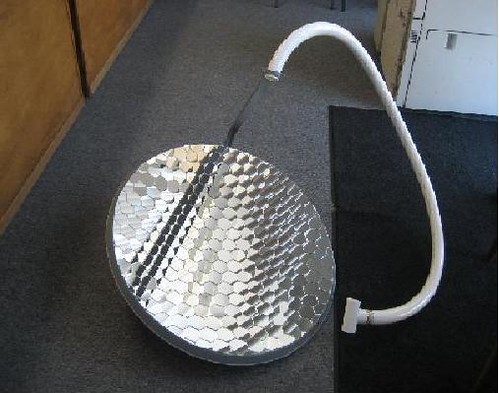
Most folks call it a "satellite dish." Engineers call it an antenna, consisting of a mount, feedhorn and reflector. The reflector concentrates radio frequency signals from an orbiting spacecraft to give you TV or a two-way data connection. We’ve blogged about people using old "dishes" as solar reflectors, mostly for fun or cooking out in the field.


Somebody is now taking that concept seriously — and adding true satellite TV reception. One of the finalists at last year’s Clean Tech Open, the Transoptic Solar Water Heater has arrived, getting the attention of Fast Company, via Green Tech Media:

Want your satellite TV dish to pull a double-duty? You can turn it into a solar-thermal device to heat water and cool your home.

That’s the pitch from Transoptic, which would place a layer of little hexagonal mirrors resembling a honeycomb or a chrome-coated plastic reflector onto the dish, said Behzad Imani, CEO of the San Mateo, Calif., company. The entire system comes with an optical receiver, PVC tube and an evacuated tube (see a YouTube video that shows how you can build one yourself).

The company wouldn’t retrofit an existing dish but instead provide a new one that can receive TV signals and concentrate the sunlight and direct it to an optical collector for heating the water, Imani said. 

A 2-square-meter dish could generate roughly 82 Therms of energy per year, the company said. A standard water heater requires about 58 Therms per year. Each dish would cost about $300, and installation would cost roughly $300 to $400, Imani said.

Transoptic doesn’t want to be in the business of selling the system directly to consumers and installing them. Instead, it wants to sell to home developers, roofers and distributors.

Imani said he has lined up a track home builder as a customer but declined to disclose the name. To fulfill the order, however, it would need to raise $250,000 initially to get started on manufacturing, he said. Imani said he would be looking for a larger amount if the credit crunch hasn’t made fund-raising so difficult. The idea is to begin a small-scale production and then use the revenues to expand manufacturing.

When it comes to harnessing the power of the sum, solar water and pool heaters far outnumbers solar panels in the United States. Solar heaters are cheaper and you also could get rebates and claim tax incentives for installing them.

Great idea. Hope they get financing soon.

DIY Friday: Space Podcasts


NASA has always served as an excellent source for teaching materials. "Do-it-yourself" podcasts on the spacesuits are very appropriate now, as the current Space Shuttle mission is performing maintenance and repair to the orbiting Hubble Space Telescope:

Just as a spacecraft has many functions, a spacesuit does more than just provide protection and oxygen. A battery supplies electrical power. A two-way radio lets spacewalkers communicate with the rest of the crew. Gauges and controls allow astronauts to be sure their suits are working correctly.

Spacesuits have changed a lot in NASA’s 50-year history. The first suits were metallic-silver pressure suits, similar to the ones that Navy pilots wore when flying at high altitudes. Spacesuits have been changed over the years to be more comfortable for astronauts and to meet new challenges as the missions in space changed. The current U.S. spacesuit worn during spacewalks is called the extravehicular mobility unit, or EMU. "Extravehicular" means outside of the vehicle or spacecraft. "Mobility" means that the astronaut can move around in the suit.

 The site offers three videos for inclusion. Here’s the first…


Satcom Stimulus

Good idea, rocket scientists. Get together and propose a joint solution for broadband stimulus’s $7.2 billion:

 Hughes Network Systems (News – Alert) says it has a "shovel ready" way to wring lots of value out of broadband stimulus spending. Though nothing is formalized yet, it is likely Hughes Network Systems and WildBlue Communications will submit a joint proposal to the National Telecommunications and Information Administration for grants to underwrite the cost of end user customer premises equipment (which could include satellite terminals, receivers and installation).

Doing so would provide "an order of magnitude greater deployment if just the CPE is subsidized," says Mike Cook, Hughes Network Systems SVP. "That’s very realistic; we can move now." As HughesNet now has 400,000 or so customers, an order of magnitude potentially would represent four million new broadband subscribers.
 
By way of comparison, a recent wired broadband build cost $5,000 to pass a rural home. If you assume penetration is 60 percent (six out of 10 homes buy broadband), the cost per activated home is $8333. All of the CPE and installation and activation cost should not come to more than several hundred dollars per activated home.
 
"Our recommendation is that stimulus funds should be used to subsidize CPE," says Cook." What we want is for subscribers to get systems with no upfront capital outlay and just pay for their service plans."
 
Currently-available plans range from 1 Mbps downstream up to 5 Mbps downstream.
 
Given that HughesNet now is available in virtually every zip code, it doesn’t need to build infrastructure, or spend much time on demand stimulation. "Awareness is the limitation, not even so much demand," says Cook. "Frankly, we will have all the incentive we need to dramatically spend more marketing dollars if CPE subsidies are approved, because we get a good yield."
 
Going forward, as it builds and launches a new next-generation satellite, Hughes plans to offer faster speeds. One way of comparing potential end user bandwidth is to compare the current SpaceWay satellite service with the new satellite.
 
"SpaceWay delivers data today at 440 Megabits per second," says Cook. That data of course is a shared resource between some number of users, he says. As a financial matter, it is uneconomic to offer end-user speeds faster than 5 Mbps downstream, he says.
 
But future satellites have much-bigger capacity, allowing HughesNet to "probably can get into 20 to 30 Mbps on download speeds," says Cook, who says the advancements come from a variety of advances, including the additional spectrum, use of multiple spot beam, advanced coding techniques and higher-power transponders.
 
"If SpaceWay is a 10 Gbps platform, the new satellite will offer 70 to 100 Gbps," says Cook. "We are approaching an order of magnitude increase of capacity," he says.

 Hmm. Gilat’s Spacenet is missing. What gives?

Satcom News Summary

Satcom news for the week, courtesy of Bill McDonald

Ariane 5 lifts off with Herschel and Planck on board – two of the most ambitious missions ever attempted to unveil secrets of remote parts of the Universe.
[SatNews – 05/14/2009]

Intelsat revenue increased 10% over previous year, while 1st quarter loss increased from $412.7m to $557.6m.
[Satellite Today – 05/14/2009]

TACSAT-3 team at Wallops Flight Facility almost gets the launch late in the window, but last minute Flight Termination System anomaly forces delay of launch to May 19.
[SatNews – 05/14/2009]

The European Union picks communications companies Inmarsat Ventures and Solaris Mobile (jointly owned by SES Astra and Eutelsat) to provide high-speed internet services from satellites to remote parts of Europe.
[Wireless Week – 05/14/2009]

DirectTV ordered by judge to temporarily stop running ads that use Charter bankruptcy to imply that Charter is liquidating in order to win over customers.
[CED Magazine – 05/14/2009]

Astronauts on space shuttle Atlantis grab Hubble Space Telescope, passing another milestone on the thus far impressive mission.
[SatNews – 05/13/2009]

Astronauts discover 21-inch stretch of nicks on shuttle Atlantis, but NASA says the damage does not appear to be serious.
[SatNews – 05/13/2009]

Russia’s Federal Space Agency and NASA agree on a new price for ferrying U.S. astronauts to the International Space Station after 2012.
[SatNews – 05/13/2009]

Loral Space and Communications reported slight decrease in revenues, while Telesat realized growth from Nimiq 4.
[Satellite Today – 05/13/2009]

MetaVR builds 3D geospecific terrain covering 9,600 square kilometers in Afghanistan featuring high-resolution virtual village with over 500 buildings using SatImagery.
[SatNews – 05/13/2009]

Orbcomm loses $7m in quarter due to failure of one of its U.S. Coast Guard Quick Launch satellites in March.
[Satellite Today – 05/13/2009]

Pakistani religioius network leases AsiaSat C-band capacity.
[Satellite Today – 05/13/2009]

Al Jazeera English uses BGAN X-Stream from Stratos Global to broadcast live television news coverage of military developments from Pakistan and news from throughout Middle East.
[SatNews – 05/13/2009]

U.S. Government Accountability Office releases repoart that U.S. Air Force 2F program is over budget, and GPS service may be interrupted by delay in acquiring new 2F satellites.
[Satellite Today – 05/12/2009]

 U.S. Air Force working with Lockheed Martin to "harvest" government owned property, ground stations, and other technologies developed for cancelled TSAT for future programs.
[Reuters UK – 05/12/2009]

Iridium OpenPort new-generation global marine satellite communication system successfully completes sea trials, drawing positive reviews; commercial rollout now underway.
[PR Newswire – 05/12/2009]

SES AMERICOM-NEW SKIES selects International Datacasting Corporation’s SFX 3102 DVB-S/S2 receivers for its customers who will be upgrading to DVB-S2  via the company’s IPsys IP trunking service.
[SatNews – 05/12/2009]

TeleCommunications Systems, Inc. receives U.S. patent for encapsulation of encrypted data, enabling secure communications over IP network, allowing deployable systems such as satellite terminals to transmit secure data by having only an internet connection.
[EarthTimes – 05/12/2009]

Iridium pursues Russian market for mobile satellite services, forming "Iridium Communications Russia, OOO" to pursue a license there.
[Washington Business Journal – 05/11/2009]

Dish Network subscriber loss exacerbated by end of AT&T deal, even as Dish beats Wall Street estimates with 21% rise in profit, partly based on equipment sales.
[Associated Press hosted by Google – 05/11/2009]

Liberty Media Corp. CEO Greg Maffei says DirecTV may be sold to a telephone company.
[CED Magazine – 05/11/2009]

DataPath shareholders approve merger with Rockwell Collins.
[Satellite Today – 05/11/2009]

Europe will get a step up on the U.S. and NASA in space based astronomy when Planck and Herschel are launched virtually at the same time as the NASA mission to improve Hubble.
[Miami Herald – 05/10/2009]

EchoStar and DirecTV fight taxes in Ohio courts because cable competitors are not similarly taxed.
[CED Magazine – 05/08/2009]

Dish Network announces availability of free Remote Access service that allows its customers nationwide to program their DVRs with any Internet-connected device.
[CED Magazine – 05/08/2009]

Satellite broadband services grew solidly in 2008 following a strong 2007; a wide range of broadband networking, internet access services, and cellular backhaul, continued to exhibit their viability.
[NSR Report – Broadband Satellite Services, 8th Edition – May 2009]

Advance satellite coding and modulation techniques generate optimism about prospects for SCPC sales  in 2009 and beyond.
[NSR Report – Advanced Satellite Coding and Modulation, 2nd Edition – May 2009]


Mobile Planetarium


Yeah, the iPhone apps get all the attention. Here’s one from Google for the Android:

We were able to play around with a T-Mobile G1 test device in the office and were intrigued by all of the sensors that were available. The GPS and clock allowed us to generate maps for the exact time and location, but the compass and accelerometer were what made Sky Map truly interesting. Using these two sensors, the app can determine the exact direction that your phone is facing and display the stars that are visible. If you want to identify that bright star in the west, all you have to do is point the device in that direction and you’ll see "Venus" appear on your screen.

 Very cool.

Gilat’s Stimulus

So there’s $7.2 billion set aside for "broadband stimulus" in the U.S., and €1 billion in Europe for 100% connectivity. Spend it.

Satcom service providers have been barking at this "no broadband for us" market for years. Along comes Wildblue and blows the incumbents away with their success (Hughes/DirecWay and Spacenet/Starband). Game-changing technology? Not really.

Can satcom really get a piece of these stimuli? After reading the Gilat earnings call transcript, don’t hold your breath:

 Jonathan Ho – William Blair

In terms of this Obama and the European stimulus that you guys were mentioning, can you give us a little bit more color on maybe the potential opportunities there and maybe the timeframe that you keep, something flowing out of that opportunity?

Amiram Levinberg

You have similar things in US, the way we begin are not clear. So at this point of time, we have so many people who have to give suggestions and comments and show often advantages to different committees. And we are part of this process. In part, we are cooperating with other companies in our industry and in part obviously at the end of the day, different companies will come with different applications.

We are not at the application stage at this point of time as the rule we begin or not, completely clear at this point, but we’ve definitely lost the [share point], lost opportunity by many people including ourselves.

In Europe, with stimulus for broadband is somewhat smaller, not to be small money, but it is somewhat smaller, it’s €1 billion and I have to say that because, unlike the situation in the US where we have a subsidiary on the job namely Spacenet, in the US, our activity is somewhat more remote because we need to get connected with local sales providers, so we are bit more remote in that situation in Europe.


Does he really know what’s going on?  Sounds like a Family Feud contestant: "show me, clueless CEO!"

STS-125 Launch

Time to tune up the Hubble…