Launching From MARS


That’s right, MARS: the Mid-Atlantic Regional Spaceport, located on Wallops Island in Virginia. The Wallops Research Range is America’s oldest continuously-operating rocket launch range. It’s been around for more than 60 years and has supported more than 16,000 flight events.

On 5 May 2009, it’s leading the launch of a Minotaur 1 rocket carrying three payloads. The summary, via delmarvanow.com:

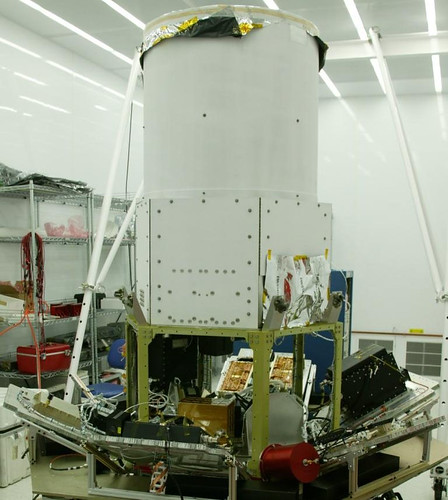
The spacecraft — consisting of an ATK Space Systems satellite bus and Tactical Satellite-3, which carries a trio of experiments — will be taken into space by an Orbital Sciences Corp. Minotaur I rocket.

The four-stage rocket includes two taken from retired Minuteman intercontinental ballistic missiles and two from Orbital’s Pegasus booster.

"Obviously, the project has much to do in these next few weeks leading up to lift off, but we now have a firm end date to get on orbit and begin the fun experiment phase," TacSat-3’s program manager Thomas Cooley said about problems encountered earlier in the project with some of the spacecraft’s components.

The main experiment aboard the satellite, ARTEMIS HSI, was developed by Raytheon Co. It is designed to quickly supply military commanders in the war theater with target detection and identification information, along with information about battlefield preparation and combat damage.

A second payload on TacSat-3 is the Office of Naval Research’s Satellite Communications Package, which will collect data from sea-based buoys and transmit it back to a ground station.

A third experiment, the Air Force Research Laboratory’s Space Avionics Experiment, is described in a prepared release from the Air Force as "plug-and-play avionics to advance the technology of rapid spacecraft integration and help enable the responsive space vision."

All three payloads have been tested at Kirtland Air Force Base in New Mexico and final checks of the flight software have been completed in preparation for the May launch.

"Our program team never gave up, and establishment of the launch date serves as a testimony to their dedication, determination and duty to making TacSat-3’s mission a success,” Cooley said.

The spacecraft is now at MARS, where it will be joined with the launch vehicle.


Expect the launch to be webcast here.

Satcom Smartphone


In the Northeast U.S., there aren’t many places your mobile phone doesn’t get a signal. Sure, there are little pockets where you don’t, and in remote areas it can get a little tricky. In those instances, it sure would be nice to have a system available like Thuraya — a hybrid satellite/GSM network.

Most of the time, you’re using the GSM portion of your mobile. Out in the desert — lots of that type of terrain in the Middle East —  your mobile connects via a specialized geosynchronous satellite. Apparently, it works well enough so you don’t notice, but you probably get used to the inherent latency (your signal has a 45,000 mile round trip to complete, so at the speed of light figure at least a quarter-second of delay).

In the fully developed world, satellite phones have yet to be financially successful. Through bankruptcy, Iridium and Globalstar have been able to survive. Iridium was almost shut down completely were it not for the U.S. Department of Defense — they saw the value of a unique, diverse path for voice and narrow-band communications, so they kept it afloat.

Last week, TerreStar got some ink in USA Today:

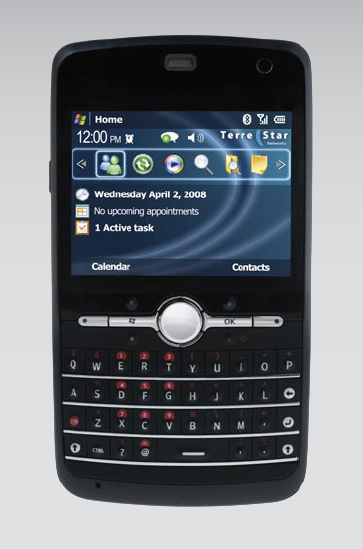
The first handsets for TerreStar’s satellite would cost about $700, said TerreStar chief executive Jeff Epstein. At a cellphone trade show here last week, the company displayed a prototype built by small Finnish company, Elektrobit. The phone has a QWERTY keyboard and runs Windows Mobile software, making it similar to many BlackBerry-style, e-mail-oriented phones for corporate use, but a bit thicker. Unlike Iridium and Globalstar phones, there’s no protruding antenna.

"This way, you take your BlackBerry and you replace it with that device," Epstein said.

Both companies indicate that calling over a satellite will cost less than $1 per minute, the approximate price of Iridium calls. TerreStar also has a roaming agreement with AT&T Inc. for calls that don’t go through the satellite, and expects the combined satellite and ground system to be working before the end of this year.

However, neither TerreStar or SkyTerra will replicate Iridium’s worldwide coverage. The phones will work in North America only. Nor will they be getting away from a significant limitation of satellite phones: The handsets need to be in clear view of a satellite. In other words, the satellite service will work only outdoors, and a hill, tree or building obscuring the southern sky can be a problem, especially if you’re far north.

Given these limitations, and the steady expansion of ground-based networks, is there really a mass demand for satellite phones?

Satellite analyst and consultant Tim Farrar at TMF Associates is skeptical. He believes the number of people interested in satellite calling, even if just for emergencies, is small compared to the overall cellphone market.

"They need hundreds of thousands and more likely millions of users of these handsets to make it into the mainstream," he said. "You have to gain an awful lot of momentum before manufacturers will consider it worthwhile to build this into their handsets."

Farrar thinks marketing will be a challenge too. For mainstream adoption, sales representatives at cellphone stores would have to get customers to accept that the satellite connectivity would work only outdoors.

"Last time around, people tried out Iridium phones, and thought ‘What use is this to me if I have to go out and stand in the middle of a field to make a call?"’ he said.

Given these obstacles, Farrar believes the value of SkyTerra and TerreStar is in their spectrum holdings. The companies have permission from the Federal Communications Commission to use slices of the airwaves for both satellite and ground-based networks, as long as they have a satellite in orbit. The government hoped that such hybrid space-terrestrial licenses would encourage companies to provide emergency satellite coverage when cell towers are knocked out by disasters like Hurricane Katrina.

For now SkyTerra and TerreStar aren’t using their spectrum for ground-based communications. Eventually, the companies could try to put the airwaves to use with their own cell towers on the ground — or they could use that spectrum to entice a carrier like AT&T or Verizon Wireless. Those companies would normally have to pay billions for spectrum with nationwide coverage, but they might find that snapping up one of these satellite companies is a cheaper way to get that access, said Armand Musey, a satellite consultant.

Investors aren’t optimistic: Terrestar, which is listed on the Nasdaq, has a market capitalization of $72 million, which is paltry compared to the cost of its satellite system. SkyTerra is privately held.

"There certainly is not a market for having all of these companies — TerreStar, SkyTerra, Inmarsat, Iridium — all operating satellite-only," Musey said. "The market is just not that big."

The news from Elektrobit of Finland will be manufacturing the handset is about a year old, but this isn’t the first time satcom news gets recycled (case in point: Americom’s DigitalC in 1999 and again in 2000).

The TerreStar-1 satellite is scheduled to launch in June, 2009, via an Ariane 5 launch vehicle. Space Systems/Loral has been building it since 2005.

Let’s hope a smart business follows.

Landing the Space Shuttle

Nice cockpit view of Space Shuttle landing, via ShuttleSource.com:


Satellite News Bits

The week’s news round-up, courtesy of Bill McDonald:

China announces it will replace Nigerian satellite that failed after 1 year of operation free of charge; all three communications satellites it has sold to Nigeria, Venezuela, and Pakistan have military capabilities which are of concern to the U.S.
[UPI – 04/09/2009]

FCC announces it has begun developing a national broadband plan to ensure that every U.S. citizen has access to broadband services.
[TMCnet – 04/09/2009]

European Space Ageny’s spaceborne X-ray observatory, XMM-Newton, carries out exclusive observation of galaxy Messier 82 for the ‘100 Hours of Astronomy" cornerstone project for the international Year of Astronomy 2009.
[SatNews – 04/09/2009]

GE Asset Intelligence and ORBCOMM subsidiary Stellar Satellite Communications enter into several agreements for ORBCOMM to be sole provider of telematics and M2M data communications on all subscriber communications, whether satellites, cellular, or dual mode.
[SatNews – 04/09/2009]

ND SatCom wins frame contract from African VSAT service provider Q-Kon for SkyWAN VSAT units.
[Satellite Today – 04/09/2009]

Eutelsat to launch French Digital Terrestrial Television platform with majority cof channels on Eutelsat’s Atlantic Bird 3 satellite.
[Satellite Today – 04/09/2009]

Thales Alenia space plant and employees in L’Aquila, Italy, affected by earthquake.
[SatNews – 04/08/2009]

The second Ariane 5 launch of 2009, to carry Herschel and Planck into orbit, now set for May 6.
[SatNews – 04/08/2009]

Among defense budget cuts recommended by Robert Gates is termination of the Air Force’s TSAT (Transformational Satellite) program.
[Satellite Today – 04/08/2009]

MacDonald, Dettwiler and Associates to be sole supplier of direct downlink solutions for RapidEye’s international ground station customers.
[SatNews – 04/08/2009]

Satellite image shows North Korean rocket launch – while scientists in South Korea and the U.S. said the launch had vailed, North Korean state media insisted it had successfully placed a communications satellite into orbit.
[The Lede -NY Times blog – 04/08/2009]

Air Forces second Wideband Global Satellite Communications WGS-2 satellite successfully launched into orbit  from Cape Canaveral April 3.
[Schriever AFB News – 04/07/2009]

ILS launches W2A satellite for Eutelsat aboard Proton Breeze-M rocket.
[Satellite Today – 04/07/2009]

iDirect Series 15000 Universal Satellite Hub to be used by CET Teleport GmbH of Germany to launch a pan-African DVB-S2/ACM satellite network using newly available Ku-band capacity on Telstar’s T11N satellite.
[SatNews – 04/07/2009]

U.S. Army orders additional Comms-on-the-move MobiLink systems from DataPath to support operations in Iraq.
[PR Newswire – 04/07/2009]

Thuraya launches mobile satellite services in Korea.
[Satellite Today – 04/07/2009]

Comtech EF Data receives $2.2m order from mobile operator in South America for equipment to expand cellular backhaul network.
[SatNews – 04/07/2009]

Students at San Jose State build an "answering machine in space," a cubesat communications satellite called "ReadySat Go" about the size of a small Kleenex box which will record messages sent to it in space which can be later sent back to Earth in another location.
[Fox News – 04/07/2009]

C2C, an independent Dutch telecom provider to European markets, uplinks to Telstar 11N satellite.
[Satellite today – 04/07/2009]

Satlynx purchases "significant volume" of capacity on Arabsat-5A satellite for coverage of entire African and Middle Eastern regions.
[Satellite Today – 04/07/2009]

Sea Launch plans launch of Italian satellite for Italy’s armed forces and NATO on April 19 from equatorial Pacific.
[Seattle PI – 04/06/2009]

Satellite-cellular mobile platform based on Infineon’s software-defined-radio (SDR) to be used in next-generation integrated satellite-terrestrial communications networks by SkyTerra and TerreStar.
[RF Globalnet – 04/06/2009]

Squire Tech Solutions introduces 300 Power Communications Trailer, a self contained site power, lighting, tower, and communications mobile infrastructure including auto-acquire VSAT, for the emergency response community.
[GlobeNewswire – 04/06/2009]

Stratos to feature media deployment of BGAN (broadband Global Area Network) service at NAB.  The Inmarsat service uses portable, lightweight terminals to provide simultaneous video, high speed data, and voice anywhere in the world, and is ideally suited to disaster recovery situations.
[PRNewswire – 04/06/2009]

Broadband Satellite Services grew solidly in 2008 following strong 2007, yet world economic conditions concern most players.  Market expected to escape unscathed if economic recover begins in 2009 or early 2010.
[NSR Report – April 2009]

WBMSAT PS – Satellite Communications Consulting Services
DIY Friday: Space Photography


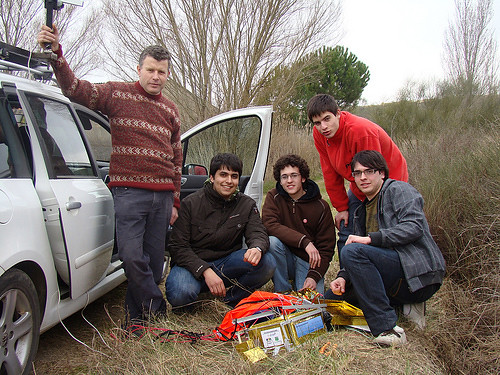
Four students in Spain sent a balloon and camera into the stratosphere and were simply overwhelmed with the results:

Completing their landmark experiment on February, the Meteotek team had to account for a wide variety of variables and rely on a lot of luck.

"The balloon we chose was inflated with helium to just over two metres and weighed just 1500 grams," said Gerard. "It was able to carry the sensor equipment and digital Nikon camera which weighed 1.5kg.

"However, when we launched at 9.10am on that morning the critical point for the experiment was to see if the balloon would make it past 10,000m, or 30,000ft, which is the altitude that commercial airliners fly at."

Due to the changing atmospheric pressures, the helium weather balloon carrying the meteorological equipment was expected to inflate to a maximum of nine and a half metres as it travelled upwards at 270 metres-per-minute.

"We took readings as the balloon rose and mapped its progress using Google Earth and the onboard radio receiver," said Gerard.

"At over 100,000ft the balloon lost its inflation and the equipment was returned to the earth.

"We travelled 10km to find the sensors and photographic card, which was still emitting its signal, even though it had been exposed to the most extreme conditions." 

Read about it here (in Catalan Spanish).No comprende? Their Flickr photos/videos speak for themselves.

I wouldn’t be surpised if their inspiration was the SABLE-3 project’s success in August, 2007.

All Your Space Industrial Base

The CEO of the Aerospace Industries Association, Marion Blakey, asked for ITAR reform:

Satellite export control rules are hampering U.S. national security and economic interests, and must be updated to protect the U.S. space industrial base, AIA President and CEO Marion Blakey said Thursday in written testimony before the House Foreign Affairs Terrorism, Nonproliferation and Trade Subcommittee.
 
“Without meaningful steps to modernize the U.S. export control system and enhance space trade among our allies, the United States faces a real and daunting possibility of losing our leadership in space and ability to compete in the global space industry,” Blakey said.
 
U.S. market share for commercial satellites dropped from 73 percent to 27 percent after legislation passed in 1998 to control commercial satellites as military items.  The Center for Strategic and International Studies reports that the United States is the only country that requires stringent and time-consuming reviews and approval processes for exports of commercial communications satellites and related components.
 
AIA recommends that the government undertake a review of all space technologies to determine which ones should be controlled as commercial or military items. The review should be coupled with legislation that allows the administration flexibility to differentiate between sensitive commercial satellite technologies and truly commercial components.


 Get the full testimony here (PDF). And good luck with the RealPlayer Webcast of the hearing.


Space Politics is calling it "Sherman’s March:"

So what kind of reform does Rep. Sherman have in mind? In the near term, it appears he is looking for relatively modest changes. “A lot will depend on the hearings and what solutions come up,” he said. “Solutions that have big problems will move more slowly than solutions that are no-brainers.” An example of a “no-brainer”, he said is getting the Directorate of Defense Trade Controls (DDTC) within the State Department to more rapidly process export license applications, something he said DDTC has already started to do after prodding by himself and others in Congress.

Sherman said that the incidents in the 1990s that triggered the inclusion of satellite technology on the US Munitions List—the transfer of US satellite technology to China after failures of Chinese rockets carrying those satellites—created “an anger [that] was mal-channeled” into the current state of affairs. “I won’t say it’s been ineffective, but it certainly was a crude response.”

His comments, though, indicate a fixation on China, and the availability of low-cost Chinese launches, as a driving interest in ITAR reform that may be misplaced. For example, one solution he suggested for the current ITAR situation was not to necessarily remove satellite technologies from the Munitions List or otherwise reform how their exports are regulated, but to instead subsidize the US launch industry so that they could be cost-competitive with the Chinese. The low cost of Chinese launches “begs the question of how much does China subsidize its rocket program and why aren’t we subsidizing ours to the same level,” he said. “We should be focused on keeping the rocket jobs, the rocket technology, plus the satellite jobs and the satellite technology, here in the United States.”

Of course, such an approach might cost the US billions of dollars a year (on top of what the Defense Department is paying to United Launch Alliance for the EELV) and is no guarantee that it would attract additional commercial customers or simply encourage other countries to further subsidize their own vehicles to compete. (And, ironically, a cheaper alternative is just down the 405 freeway from Sherman’s home district: SpaceX is promising commercial Falcon 9 launches that would certainly be competitive with, or even cheaper than, Chinese vehicles, without massive federal subsidies.)


It truly is about time satcom’s inclusion in ITAR be reviewed, revisited and all that.

Nice Galaxy: NGS 7049


 Nice set of pics from Hubble:

The NASA/ESA’s Hubble Space Telescope has captured this image of NGC 7049, a mysterious looking galaxy on the border between spiral and elliptical galaxies. NGC 7049 is found in the constellation of Indus, and is the brightest of a cluster of galaxies, a so-called Brightest Cluster Galaxy (BCG). Typical BCGs are some of the oldest and most massive galaxies. They provide excellent opportunities for astronomers to study the elusive globular clusters lurking within.

The globular clusters in NGC 7049 are seen as the sprinkling of small faint points of light in the galaxy’s halo. The halo – the ghostly region of diffuse light surrounding the galaxy – is composed of myriads of individual stars and provides a luminous background to the remarkable swirling ring of dust lanes surrounding NGC 7049’s core. Globular clusters are very dense and compact groupings of a few hundreds of thousands of stars bound together by gravity. They contain some of the first stars to be produced in a galaxy. NGC 7049 has far fewer such clusters than other similar giant galaxies in very big, rich groups. This indicates to astronomers how the surrounding environment influenced the formation of galaxy halos in the early Universe.

The image was taken by the Advanced Camera for Surveys on Hubble, which is optimised to hunt for galaxies and galaxy clusters in the remote and ancient Universe, at a time when our cosmos was very young.


Retrieving Sputnik


Cool, via Fox News:

 In 1970, Marshall Kaplan, then an aerospace engineering professor at Penn State, had a peculiar dream — he wanted to retrieve Sputnik, the world’s first orbiting satellite, from space.

Sputnik had been launched by the Russians in 1957, and by 1970 it was no longer operational. Kaplan wanted to go get it.

NASA had never considered space retrieval before, but it thought it was a good idea. Kaplan got the job, but it didn’t work out — because the time frame was too short. Sputnik, nearing the end of its life cycle, was already about to deorbit — the technical term for what happens when an object circling the Earth gets close enough to be caught in gravity and burned to cinders in the atmosphere.

But that didn’t mean Kaplan needed a new line of work.

In fact, his work was just beginning.

 Have you ever seen the Sputnik launch from 1957? Here’s the footage:


WGS-2 Launch Update


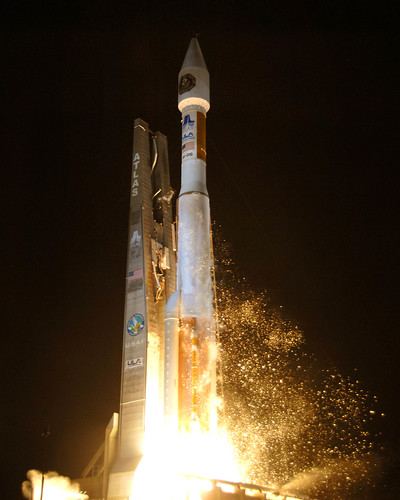
Nice Atlas V launch by ULA:

"ULA congratulates the Air Force and our mission partners on the successful launch of WGS-2,” said James Bell, ULA WGS Mission Manager. “ULA is proud of its continuing role of providing reliable assured access to space for the Air Force’s critical missions. WGS is a force multiplier for our troops in the field who defend America’s freedom everyday.”

The WGS-2 mission is the second installment of the Wideband Global SATCOM (WGS) system. The WGS satellites are important elements of a new high-capacity satellite communications system providing enhanced communications capabilities to America’s troops in the field for the next decade and beyond. WGS enables more robust and flexible execution of Command and Control, Communications Computers, Intelligence, Surveillance, and Reconnaissance (C4ISR), as well as battle management and combat support information functions. WGS-2 augments the existing service of the WGS-1 satellite by providing additional information broadcast capabilities.

This mission was launched by an Atlas V 421 configuration, which uses a 4-meter diameter payload fairing, two solid rocket motors, and a single-engine Centaur upper stage attached to a single common core booster powered by the RD-180 engine. This was the 15th launch in Atlas V program history. The 14 previous Atlas V launches included two missions for NASA, two for the United States Air Force, three for the National Reconnaissance Office and seven for commercial customers. 


Satellite News Bits

A summary from Bill McDonald (WBMSAT PS – Satellite Communications Consulting Services)…

North Korea steps up threats to retaliate if Japan or Tokyo shoots down the rocket North Korea says will be used to launch a communications satellite – Obama warns the liftoff would be a "provocative act" that would generate a U.N. Security Council response.
[The Washington Post – 04/03/2009]

Rockwell Collins to acquire DataPath Inc., a Georgia company that designs, integrates, manages, and deploys satellite communications systems for military and commercial customers.
[Trading Markets – 04/03/2009]

SES AMERICOM-NEW SKIES announces that NSS-9 enters commercial operation, with all traffic transferred from NSS-5.
SatNews –  04/03/2009] 

Argentinian operator Velconet S.A. initiates nationwide upgrade of ViaSat LinkStar system to DVB-S2 with Adaptive Coding and Modulation and AcceleNet compression and acceleration to increase data rates and improve bandwidth efficiency.
[SatNews – 04/03/2009]

As North Korea moves forward with launch plans, U.S. military officials say United States needs to beef up its "space situational awareness," improving data about what is going on in space, monitoring satellites and debris.
[Reuters UK – 04/02/2009]

RapidEye’s imagery partners with Moscow based Sovzond, who will be only distributor of RapidEye imagery for markets in Russia and a number of other former Soviet states.
[SatNews – 04/02/2009]

BB Sat offically launches satellite broadband service in Japan.
[Satellite Today – 04/02/2009]

GMV provides active ground systems support for European Space Agency’s GOCE mission.
[SatNews – 04/02/2009]

SES ASTRA announces German pay-TV channel Premiere has contracted 1 1/2 additional transponders.to expand HD offerings.
[SatNews – 04/02/2009]

Iridium-based critical safety communications for air carriers on transoceanic flights nearing approval as Radio-Technical Commission for Aeronautics finalizes key documents.
[SatNews – 04/02/2009]

SES AMERICOM-NEW SKIES announces five-year distribution agreement with Gulfcom to use AMC-3 transponder for program distribution in Caribbean.
[SatNews – 04/02/2009]

Infineon, Sky Terra, and TerreStar unveil multi-standard mobile platform based on Infineon’s Software-Defined-Radio technology.
[Satellite Today – 04/02/2009]

U.S. satellite makers may get a "bailout" of their own, as lawmakers revisit export controls which have hampered manufacturers since the Clinton administration and are blamed for American satellite exports having declined from 90% world market share to 50%.
[New York Times – 04/01/2009]

Globecast signs five transponder lease renewal with Eutelsat for broadcasting in Europe, North Africa, and the Middle East.
[Satellite Today – 04/01/2009]

Inmarsat to buy 19% stake in Skywave Mobile Communications of Ottowa, Canada, acquiring assests relating to the GlobalWave satellite low data rate products and services business.
[Wall Street Journal – 04/01/2009]

Alcatel-Lucent to develop satellite base station sub-systems for SkyTerra and TerraStar to support 3G satellite communications.
[EarthTimes – 04/01/2009]

North Korea threatens to shoot down U.S. spy planes sent to spy on Taepodong-2  missile launch site which it maintains will be used to launch a commercial satellite – U.S. and Japan believe it is meant as a long-range missile test and promise robust diplomatic response.
[guardian.co.uk – 04/01/2009]

U.S. space industry not yet seeing economic slowdown, as industry boosts revenues by $6b to $257b in 2008, up from $187b three years ago.
[Reuters – 03/31/2009]

SES Astra signs Croatian Broadcasting Deal with CME Group.
[Satellite Today – 03/31/2009]

SpaceX schedules Falcon 1 Flight 5 launch window for April 20.
[Satellite Today – 03/31/2009]

Global Satellite launches MCG-101, an intelligent Iridium PBX offering versatile iridium communications system for offices, remote locations, military, aircraft, oil and gas, mining, and marine applications.
[SatNews – 03/31/2009]

States not spending grant money intended to improve ability of emergency workers to talk to each other, 18 months after grants authorized.
[Kansas City Star – 03/30/2009]

Globecomm Systems Inc. launches service for GCI Village cellular network for remote villages across Alaska connected by satellite.
[Wireless Business Technology – 03/30/2009]

Stratos executes new distribution contacts with Inmarsat.
[Fox Business – 03/30/2009]

Global Supervisory, Control and Data Acquisition as well as Machine-to-Machine services, largely recession proof, depend on satellite platforms to provide reliable and ubiquitous communications in far-flung areas.
[NSR Report – May 2009}