DIY Friday: Lawnmower Tune-up


The lunatic is on the grass — and the grass is getting greener every day here in the northeast U.S. It won’t be long before we need to start mowing it. Got that lawnmower tuned-up? In this economy, you better consider doing it yourself.

Popular Mechanics is one source that’s always helpful:

Seasonal maintenance consists largely of cleaning and lubricating. Dirt on the inside is abrasive, while dirt on the outside traps heat–both increase wear and shorten service life. To avoid these problems, follow this four-step program, further detailed in the diagrams on the following pages.

1. Clean the underside of the deck whenever you see windrows of grass clippings on the lawn. These indicate a clogged deck.

2. Sharpen the blade at least once a year. A dull blade tears the grass instead of cutting it.

3. Install a new spark plug every year. A fouled plug and stale gas are the two leading causes of hard starts.

4. Change the oil and filter, and clean the fuel tank at least once a year.


Too much trouble? Bring it to the University of Delaware annual push mower tune-up:

Looking to save a little money on your lawn care in these tight financial times? The University of Delaware’s Alpha Gamma Rho fraternity for agriculture, the Society of Automotive Engineers Club and the Engineering Technology Club are once again offering a push lawn mower tune-up service on April 17-18, rain or shine.

Since 2000, this annual event has serviced more than 4,000 push mowers.

The tune-up — provided by trained students and alumni members of the clubs — includes an oil change, spark plug replacement, air filter check and cleaning, blade sharpening, and power washing. The cost is $35, the same as it has been for the past four years.

Drop off times are from 2 to 8 p.m. on Friday, April 17, and from 8 a.m. to 6 p.m. on Saturday, April 18.

Customers can pick up their mowers on Saturday from 1 to 6 p.m. for the first 300 mowers taken on Friday, or on Sunday, April 19, from 8 a.m. to 2 p.m., for the remaining mowers. All mowers must be picked up by 2 p.m. on Sunday.

Lawnmowers — push lawnmowers only; no riding mowers — may be dropped off and picked up in the parking lot behind Worrilow and Townsend halls on UD’s College of Agriculture and Natural Resources campus at 531 South College Avenue, across from the Chrysler Plant, just north of the Fred Rust Ice Arena. Look for signs for the tune-up.


Tired of pushing that thing around or riding a boring little tractor for hours? Get a robot, like the $2,200+ Ambrogio L50.  Or build one yourself:


Tractor too slow? Modify it with a jet engine:


I’ll see you on the dark side of the moon.

Space Control


Taxpayers for Common Sense released their "Space Security Database" the other day and some of the numbers are astounding.

Space is crucial to our national security, and we’ve got the skyrocketing budgets to prove it. The United States spends billions on military space programs each year, spread out over the military services as well as myriad offices and agencies. Yet there is no central authority for tracking defense-related space spending, either within the Department of Defense (DOD) or across other federal agencies that provide satellites, sensors and services for use in our national defense.

Without this birds-eye view on spending, those who determine our space and national security policy—in the White House, on Capitol Hill and at the Pentagon—do not have a crucial tool for setting spending priorities. Priorities are necessary to make sure our military is supported and taxpayers’ dollars well spent. A transparent, accountable budget is particularly vital in light of the troubled history of space acquisitions, which has resulted in major programs running so far over budget and behind schedule that many of them still have not deployed after many years and billions of dollars.

Now Taxpayers for Common Sense has for the first time tracked military-related space spending across the federal government. Among our findings:

  • U.S. spending on space programs used for national security is steadily rising, jumping more than 40 percent between Fiscal Years 2005 and 2009;
  • More than 20 percent of military-related space spending now comes from agencies outside DOD, such as the National Aeronautics and Space Administration (NASA), and the National Oceanic and Atmospheric Administration (NOAA);
  • Spending on “space control,” the mission area that protects U.S. space assets, increased 37 percent over the past five years to nearly $1 billion in Fiscal Year 2009. This is notable because of the military’s recent empowerment of space control programs to destroy threatening assets.
  • Space situational awareness programs—an element of space control benefiting from many Congressional earmarks in spending bills—have jumped by 35 percent to $560 million.
  • Space and space-related missile defense programs benefit significantly from earmarks, attracting at least 75 earmarks worth $221 million in Fiscal Year 2008 alone.
  • Twelve programs have seen cost growth of more than 200 percent in the past five years, particularly space control programs such as the Air Force’s Space Control Technologies program element (570 percent) and the Army’s Ground-Based Space Control Systems project (650 percent).

We’ve blogged about many of these government programs. Probably because there’s so much at stake — and the technology is really cool. Here’s their "Top 5" of worst offenders (download the PDF):

1) Space Based Infrared System (SBIRS)
SBIRS was infamously dubbed “a case study for how not to execute a space program” by DOD’s Defense Science Review Board.8 Intended to replace DOD’s decades-old system tf infrared surveillance sensors that warn of incoming missiles , SBIRS was supposed to consist of four operational satellites in Geosynchronous Earth Orbit GEO), sensors on two classified DOD satellites in Highly Elliptical Orbit (HEO), and a ground-based relay station to track missile launches. The Air Force conceived the program in 1994, and it began in earnest with a $2.16 billion contract to Lockheed-Martin in 1996. The next 12 years saw numerous program restructurings, four Nunn-McCurdy breaches and a 175% cost jump. The program is now seven years behind schedule, and the first satellite has yet to

2) National Polar Orbiting Environmental Satellite System (NPOESS)
A joint project between the Defense Department, NASA and the National Oceanic and Atmospheric Administration (NOAA), NPOESS will circle the globe picking up weather and climate data with an array of sensors carried on its chassis . NPOESS was intended to save money by replacing two similar systems operated separately by the Air Force and NOAA. Unfortunately, construction and testing bungles slowed development so significantly that 14 years later, the cost of the program has doubled from $6.5 to $13.5 billion for four instead of six satellites and the initial launch has moved back 39 months to

3) Advanced Extremely High Frequency (AEHF) Satellites
The AEHF satellite system was intended to upgrade the Air Force’s Milstar II satellite communications system, ramping up speed and preventing enemies from jamming its signals. AEHF will itself be replaced by the Transformational Satellite Communications System (TSAT) currently under development, although how and when is still an open question. The program was originally comprised of five satellites, but the fourth and fifth were cut in December 2002 under the assumption that the first TSAT satellite would be ready early enough to make the system work (see below). When TSAT’s schedule began to slip, Congress asked the Air Force to fund a fourth satellite in 2009. Unfortunately, it turns out the fourth satellite will likely cost more than twice as much as the third because of the four-year gap in production and the fact that some of the components are no longer manufactured.

4) Evolved Expendable Launch Vehicle (EELV)
The EELV program began in December of 1996 as an industry partnership aimed at replacing current families of launch vehicles with a newer, more economical launch program. The Air Force contracted with Lockheed Martin and Boeing, who developed the Atlas V and Delta IV expendable launch vehicles, respectively. The two companies gave the Air Force overly optimistic cost estimates based on assumed growth in the commercial launch sector. But the ironic combination of a global recession with the extended life span of successful satellite designs caused a steep dive in launches in the late nineties, and the Air Force paid.

5) Transformational Satellite Communications System (TSAT)
The Air Force’s Transformational Satellite Communications System (TSAT) is slated to become the single most expensive DOD space program over the next decade. TSAT will replace the AEHF system currently under development with five satellites intended to provide the military with vastly expanded communications capabilities with enough bandwidth and data to allow soldiers to view videos and pictures of activity within seconds. The system hasn’t yet formally entered the development phase and has already seen a nine-year slip in the launch of its first satellite to 2019.

Seems the DoD ought to have a top manager whose sole responsibility is "space situational awareness." Clearly, this policy vacuum needs to be filled, and President Obama’s looking into space

There may be plenty of room in space, but there far less room in the Federal budget for this kind of spend.


Name NASA’s Node 3 for the ISS


Apparently, most people wrote in with the name "Colbert," and generated more than 40,000 votes than NASA’s suggested "Serenity." It’s not news, it’s CNN:

Fans of "The Colbert Report" made "Colbert" the No. 1 submission in a NASA contest to name a new wing of the international space station.

Still, NASA reserves the right to name the wing of the space station and says it will not make a final decision on the matter until next month.

"Colbert" pulled in 230,539 of the more than 1.1 million submissions in the contest, according to NASA spokesman John Yembrick. Video Watch how Colbert urged his viewers to vote »

NASA’s suggestion for the wing, "Serenity," came in second, with slightly more than 190,000 votes, he said.

Yembrick said NASA had not yet decided what to name Node 3 — a connecting module and its cupola — that will be installed on the space station.

He said NASA would likely put "Colbert" a "little higher" in the space agency’s consideration because of the high number of submissions but emphasized that the decision would likely not be made until next month.

The contest rules say NASA reserves the right to "ultimately select a name in accordance with the best interests of the agency. … Such name may not necessarily be one which is on the list of voted-on candidate names."

Other rooms on the space station are named Unity, Harmony and Destiny.


More from the Houston Chronicle:

Didn’t NASA realize that the Colbert Nation pounces on any opportunity to vote for the star of Comedy Central’s The Colbert Report when a naming contest is in the works?

The name “Colbert” won the agency’s online contest to name a new room on the International Space Station. It’s not the first victory for Stephen Colbert, although it’s not yet known whether NASA will honor the write-in campaign.

Other namesakes (some were bestowed without a vote) include:

• Steagle Colbeagle the Eagle: Saginaw Spirit minor-league hockey team mascot in Michigan.

• Stephen Jr.: Bald eagle born at the San Francisco Zoo.

• Stelephant Colbert: Elephant seal that roams near Santa Cruz, Calif.

• Stephanie Colburtle: Leatherback in the Great Turtle Race from Costa Rica to the Galapagos Islands.

• Aptostichus Stephencolberti: Species of trapdoor spider.

• Bridge over Danube: Colbert earned a you-win document in 2006 from Hungarian officials who then said the bridge could only be named after a deceased person. It is now called the Megyeri Bridge.

• Air Colbert: The Virgin America plane was christened a few weeks before Colbert and owner Richard Branson doused each other with water during an August 2007 meeting on The Colbert Report.

• The Colbert Report fans don’t always win. In a naming contest earlier this month for a park in St. Charles, Mo., Colbert Park came in second. The winner was Vogt Brothers Park, in honor of the land’s former owners. 


This is not an April Fool’s Day prank…


Cut The Space Mustard

And he said, Whereunto shall we liken the kingdom of God? or with what comparison shall we compare it?
It is like a grain of mustard seed, which, when it is sown in the earth, is less than all the seeds that be in the earth:
But when it is sown, it groweth up, and becometh greater than all herbs, and shooteth out great branches; so that the fowls of the air may lodge under the shadow of it.


Interesting how a new partnership to grow plants on the Moon, announced last week, will focus on the mustard seed:

The prototype unveiled on Friday is a metal-reinforced glass dome that is some 9 centimetres in diameter and 30 centimetres high, enough space to grow roughly six plants.

But the enclosure will need to be modified to protect plants from the vagaries of space radiation and extremes in temperature on the lunar surface, which can range from a frigid -170 °C to just above 100 °C.

To avoid the cold of the lunar night, which lasts for 14 Earth days, the team decided to send up a fast-growing member of the mustard family. The mustard plant can grow from seed to flower over the course of a single lunar day, or two Earth weeks.

But a number of details still need to be worked out. It is not clear how the seeds themselves will be planted. Because ordinary soil is easily jostled, the team is considering using a stickier substrate, like seaweed-derived agar, to grow the plants.


Will the lunar mission be led by Col. Mustard, too? I don’t have a clue.


Good-bye IP-PRIME, Hello ViP-TV


There it was, a punch in the nose to fans of IPTV in the U.S. back in December when SES announced it was shutting down IP-PRIME

“In line with its plan, IP-PRIME has contracted IPTV signal delivery agreements with 70 small telecom operators, of which 37 have so far reached commercial stage.  However, with a subscriber base of less than ten thousand at the end of November and after more than 2 years of service, the consumer uptake is insufficient to justify continuing operations,” said Rob Bednarek, President and CEO of SES AMERICOM-NEW SKIES.

The IP-PRIME service will continue to operate until July 31, 2009.  This will offer telecom operators an opportunity to orderly transfer their services and SES AMERICOM, in collaboration with third parties involved in the service, to seek the best option to transition the business.

Sure, it was costing lots in resources (people and money) to keep the C-band based service running. It was ahead of all competitors in the U.S., but it was tough to convince SES management it was worth the continuing effort. Inside Americom, people thought the way out of this was to sell the service and related assets to EchoStar, who had their own Ku-band based service, ViP-TV. Ironically, using the AMC-16 satellite they were leasing.

SES may not get to sell it after all. EchoStar launched an IP-PRIME Conversion Program last week:

EchoStar Satellite Services, a division of EchoStar Corporation (NASDAQ: SATS), announced today the company’s IP-Prime Conversion Program, designed to provide continued delivery of video transport services for telco IP headend facilities across the United States. Commercial transport provider IP-Prime has previously announced it will discontinue its video transport service to headend facilities by July 31, 2009. EchoStar’s IP-Prime Conversion Program provides qualified customers with EchoStar’s ViP-TV(TM) transport service, replacement IDC satellite receivers and a standard professional installation, including compatible LNBs, a satellite dish re-point, cabling and connectors.

Interesting development, but not unforeseen. With IPTV subscibers doubling to 3.8 million in North America, EchoStar’s timing is typically very good.

Not surprisingly, Western Europe is still the leading IPTV region in the world, but regions such as North America continue to show their own strong growth paces. That’s the word from research firm Point-Topic and the Broadband Forum, who announced their fourth-quarter 2008 numbers at the IPTV World Forum in London this week.

Western Europe had more than 10.3 million IPTV subscribers at the end of 2008. North America, despite the U.S. being Ground Zero for the recession, saw its IPTV subscriber numbers grow a whopping 113 percent to more than 3.8 million from the end of 2007 to the end of 2008. Worldwide, IPTV subscribers totaled 21.7 million at the end of 2008, representing growth of 63 percent from the previous year.


Satellite News Bits

19th crew to man International Space Station takes off from Baikonur Cosmodrome, beginning new era at International Space Station.
[SaNews – 03/27/2009]

Walton Di-Icing intoduces a product that will shake your VSAT antenna cover to get rid of snow and moisture accumulation.
[SatNews  03/26/2009]

Neratel selects Gilat SkyEdge bro[adband satellite network with full mesh capability to serve a government agency in Southeast Asia.
[Globe Newswire – 03/25/2009]

Intelsat announces that South Korean teleports will access Intelsat for KT Corporation to host two new GXS Network Broadband hubs.
[SatNews – 03/26/2009]

KVH launches $1000 free airtime promotion to get boaters to try their Mini VSAT product.
[SatNews – 03/27/2009]

North Korea’s stated intent to launch a satellite continues to raise concern in U.S. and Asian countries because the same Taepodong 2 rocket technology could be used to lauch intercontinental ballistic missiles which could reach the United States.
[abcnews.com 03/25/2009]

RRSAT launches an additional video platform on Intelat’s Galaxy 19.
[FoxBusiness – 03/24/2009]

Satellite 2009 added 60 new exhibitors; many introduced new technology innovations in their latest products.
[PR Newswire – 03/23/2009]

Hughes announces next generation HX satellite router.
[Computer Technology Review – 03/23/2009]

Hyundai Heavy Industries’ Construction Equipment Division has selected ORBCOMM’s [Nasdaq: ORBC] satellite network to provide global communications for Hi-Mate, its telematics application for heavy equipment.
[SatNews – 03/23/2009]

World Communication Center, Inc. (WCC) has been awarded by the U.S. General Services Administration (GSA)an extended contract for satellite communications equipment and service until 2014
[Business Wire – 03/23/2009]

China scores major win with contract award from Eutelsat for satellite launch.
[Business Week – 03/23/2009]

WBMSAT PS – Satellite Communications Consulting Services

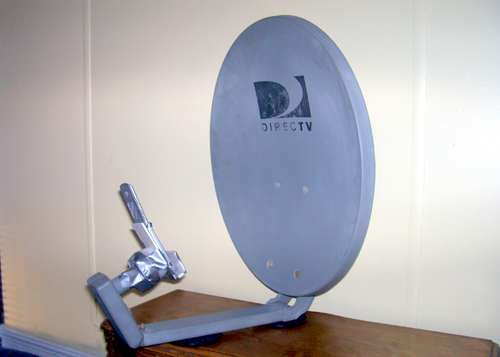
DIY Friday: Old Dish Signal Booster


We’ve blogged about the "cantenna" and repurposing old parabolic dishes for boosting WiFi signals. With people switching from direct-broadcast satellite TV (DISH and DirecTV) to Verizon FiOS, AT&T Uverse, back to cable TV or just cutting all pay television services and using free over-the-air HDTV, you might want to consider using your old antenna for something else.

Birdbaths and Spartan shields are OK ideas, but using it to boost cell phone or WiFi signals might be more useful. We’ve got a place up in the mountains and finding a good cell signal can be tricky.

Via Instructables, here’s the solution:

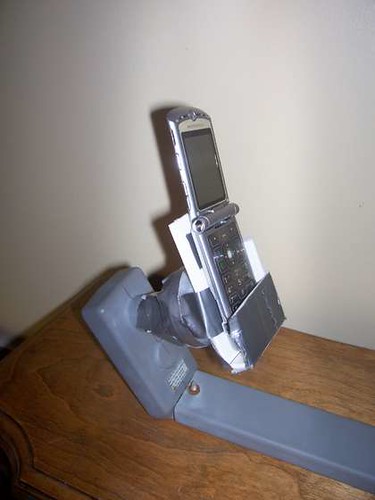
While working in my yard one afternoon I noticed an old satellite TV dish on top of a pole in my backyard. It had been left there by the previous residents. Suddenly a light bulb came on. I grabbed some wrenches, took down the dish and held my cell phone next to the antenna’s horn. I was amazed to find that I instantly got full signal. I could not believe my eyes. I went from no signal to full signal and had not spent a dime or changed anything on my cell phone. Just to make sure I made a call using speaker phone and found that this thing truly did work.

The next test came when I took the assembly inside the house to try it. With aluminum siding on the house I have problems even getting a television signal using a rabbit ear antenna. To my surprise, I got two bars inside so long as I pointed the dish at a double window in my living room. I no longer miss calls and I don’t have to leave home to talk on my cell phone. It isn’t an ideal setup but it works and did not cost me anything. It is also a great way to recycle that old dish antenna that would have ended up in the trash otherwise.

I will try this myself, as I have the two main elements: weak cell signal and an old antenna.


Three Years Ago

Building online communities does not happen overnight. I started building one in October of 2002 for my fraternal group in Ukrainian Scouting. We used YahooGroups to help facilitate communication and information sharing. Pretty active little group, but closed to the public.

In mid-2005, while employed at SES AMERICOM in Princeton, our new CEO’s plan included starting a blog. I didn’t think we needed it, but with help from Mike Ford, I soon came around and became the chief blogger and promoter. I also had responsibilty for keeping our external Web sites current (SES AMERICOM, AGS, REDiSat Network, IP-PRIME, ABN and HD-PRIME), so I was the natural choice. What a great experience it was working with the team at EchoDitto, Joe Trippi and Matt Gross.

Here I am, still editing this blog but no longer employed by Americom. Since we went live in early March of 2006, this blog has logged more than 196,000 visits and 322,000 page views. Not bad for a B2B blog in the satcom business (so they tell me). Besides ILS (who I advised), nobody in our community has built a real blog. Now Intelsat seems to be coming around with their blog, introduced this week.

So far, the posts have been strictly business and one way in nature. Hope they stay active and find their voice online. And let’s see how long it takes for my comment to be published — if ever. 

Blogging is good for you. Go on.

Artel Moves Intelsat


Way to get the business, Intelsat. Moving a spacecraft from the U.S. arc to the Indian Ocean Region:

Following an urgent call from the Pentagon’s Joint staff on February 6, Intelsat responded with a solution to reposition one of its domestic U.S. satellites, Galaxy 26, to a new orbital location in the Indian Ocean region. Intelsat began moving Galaxy 26 from its orbital slot at 93 W to its new position on February 20, once the existing commercial traffic assigned to the spacecraft had been shifted to another Intelsat satellite, Galaxy 25. Intelsat was able to begin drifting the Galaxy 26 satellite into its new orbital position only two weeks after the Department of Defense (DoD) request, a demonstration of how quickly the commercial industry can respond to solving critical warfighter requirements.
The contract, awarded through Artel Inc. as part of a DoD contract known as the DSTS-G (Defense Information Systems Network Satellite Transmission Services – Global), will fill a military bandwidth void supporting UAV surveillance operations. The repositioned Intelsat satellite will support launch and flight operations of Unmanned Aerial Vehicles (UAVs) deployed in the war zones, as well as other U.S. and NATO military operations in an area reaching from Germany to Southeast Asia.
"One of the key advantages of the Intelsat fleet is its scale and flexibility," said Kay Sears, President of Intelsat General. "This is the third time we have been able to reposition one of our satellites into a new orbital location to support critical operations on the ground in these two vital regions. Moving this satellite to the Indian Ocean region will prevent the disruption of a range of important military activities in that area."
The contract calls for up to 432 MHz of bandwidth using 12 Ku-band transponders operating on the Galaxy 26 satellite, which had most recently been serving North America. The satellite, using wide-beam capability, can support up to 40 UAV sorties simultaneously.
"This move is of particular importance, since we did not want any service interruptions to the DoD missions and there was no other capacity available to fulfill these requirements without this bold move by Intelsat," said Abbas Yazdani, President and CEO of ARTEL.
The demands for bandwidth created by the conflicts in Iraq and Afghanistan previously prompted Intelsat to twice move satellites in support of Intelsat General’s military customers.
Anything to keep the customer happy, but it helps to have a spare communications satellite to work with. 

The Satellite Game


Access Intelligence still has a pretty good game going, with hundreds paying money to attend their show in Washington. It opens today.

Some "highlights" to ponder…

A1 Microwave Ltd (Booth #157) announces the A1 Microwave PB1109WN, a satcoms receive filter used to reject the transmitter signal in X-band satcom terminals. This tunerless, mechanically robust design occupies only 157 mm of waveguide length and it provides 90 dB rejection over the transmitter band 7.9-8.4GHz. Insertion loss in the receive band 7.25-7.75 GHz is only 0.5 dB. It is ideal for use in small or portable systems where size is at a premium. 

Actox Corporation (Booth #176) has just released several of the smallest and the lightest Block Up Converters in the industry for Ku-Band, C-Band and X-Band. The units feature auto-ranging power 18-70VDC, 80-240VAC; double L.O., advanced M&C interface as well as sophisticated LED indicators.

A-Alpha Waveguide Company (Booth #720), announces they are now stocking aluminum waveguide flange stock in sizes from WR22 to WR137 and double ridged sizes WRD180, 475, 580, 650, and 750. This 6063 extruded aluminum material precludes the need to broche corners in the windows of aluminum bar stock to manufacture flanges.

Ameripack Inc. (Booth #191) introduces the Road Warrior Transit Case Family. The Road Warriors are the best Air & Water Tight Transit Cases designed and manufactured in the U.S.A. that provide the most protection in any environment.

Commtact-Mobile SAT (Booth #144) announced the new Mobile Satellite Terminal (MOST: undefined, undefined, undefined%). The system is designed for a high bandwidth two-way communication between moving platforms (aircraft, ground vehicles, etc.) and geo-stationary satellites in Ku/Ka bands. The MOST system has excellent cost-performance characteristics, utilizing a high efficiency shaped reflector Antenna, a state of the art low profile design, creating an ODU (Out-Door-Unit) of only 28cm height.

Comtech Telecommunications Corp. (Booth #308) announces that its subsidiary Comtech Mobile Datacom Corporation recently filed patents for two key components of its next-generation Blue Force Tracking-High Capacity (BFT-HC) network. The first patent filing covers the Advanced Software Defined Radio (ASDR: undefined, undefined, undefined%) transceiver, or BFT-HC transceiver. The ASDR represents a significant leap forward in mobile transceiver technology and is designed to meet or exceed all performance requirements identified for the BFT program’s next-generation satellite-based communications network. The second patent filing covers next-generation earth station technology for the BFT-HC network referred to as Adaptive Multi-User Detection (AMD: 3.02, n.a., n.a.%). This next-generation AMD equipment employs advanced signal processing techniques hosted on state-of-the-art hardware, which allows near real-time processing of overlapping signals transmitted by numerous mobile terminals.

Dow-Key Microwave Corporation (Booth #368) announces LAN eXtensions for Instrumentation (LXI: undefined, undefined, undefined%) certified switching systems. These LAN eXtensions for Instrumentation (LXI: undefined, undefined, undefined%) certified switching systems offer a broad range of functionality to meet a wide variety of applications needs in design verification, combining state-of-the-art measurements in a small package at a cost-effective price.

EchoStar Satellite Services (Booth #597) announced an agreement with Vredes, Inc., to provide satellite services for emergency management and other remote location broadcast demands. With access to EchoStar’s satellites and state-of-the-art digital broadcast centers, Vredes will provide fully redundant transponder and hub services to support MotoSAT and its EtherSAT(TM: 65.23, 0, 0%) Service, which offers government and enterprise customers redundant, on-demand broadband internet, voice and video services, especially during national disasters or when working in remote locations.

EMS Technologies Defense and Space Systems (Booth #121 ) is introducing to the aero connectivity market Ku-band broadband antenna systems that support satellite direct TV programming, internet, email, VPN, VOIP, instant messages, video conferencing and various entertainment applications such as video-on-demand, live TV, online gaming and multimedia applications. The system offers true, full-featured broadband services aboard any size aircraft, from wide or narrow-body commercial aircraft to small VIP business jets.

Global Satellite USA (Booth # 1608) has partnered with worldwide crisis response company Global Rescue to provide their clients with the highest level of medical and security information and emergency evacuations from around the globe. This partnership will allow Global Satellite’s clients to rely on effective communications solutions in an emergency and ensure that someone will be able to provide them with emergency services, including worldwide field rescue and evacuation from distant and isolated regions to the members’ hospital of choice or safe location.

iDirect (Booth #517) has launched the iConnex e850mp Board that can be carried and deployed by a single soldier and support advanced military applications. The iConnex e850mp Board provides advanced portability and flexibility to support the rigorous demands of military and government satcom applications. The e850mp, easily carried and deployed by a single soldier, provides a highly capable solution for voice, video and data connectivity on the battlefield.

Iridium Satellite LLC (Booth #437 ) is announcing several new products at SATELLITE 2009: the 9522B, a second-generation L-Band Transceiver (LBT: undefined, undefined, undefined%); the 9555, a new satellite phone; and OpenPort(TM: 65.23, 0, 0%), the world’s first and only global voice and data device engineered for the maritime market. The 9522B is designed to be embedded into a range of mobile satellite terminals, packaged with an external power supply, antenna and other components. The compact, lightweight LBT unit with built-in SIM card reader supports all Iridium-based services, including voice telephony, circuit-switched data, short-burst data (SBD: undefined, undefined, undefined%) and short message service (SMS: 13.22, 0, 0%). The 9522B is ideal for use in equipment on aircraft, ships and other transport vehicles and devices around the globe.

I can hardly contain my excitement.