We Gonna Launch It


Eutelsat is launching a spacecraft from China. That’s big news, via Telecommunications Online:

A recent decision to build a new rocket launch site in Hainan island and securing a deal to launch Europe-based Eutelsat Communications’ 5-ton satellite have put the spotlight on China’s space ambitions.

These developments testify to China’s success in pursuing space technology under its own steam following a U.S. policy in 1990 barring it from launching satellites with U.S. components. The impact has left China to seek customers from second-tier operators from Asia, Africa and South America.

The Eutelsat order is the first satellite launch deal from a major western country in more than a decade for China marking a high point in its space exploration and satellite-building program. As a supplier of commercial satellite products and services to the United States, Eutelsat’s order with China is seen as controversial by industry observers and officials on both sides have been cagey about confirming the order.

Made without any U.S. components, the Eutelsat satellite is scheduled for launch by China’s Long March rocket in 2010. Cost competitiveness is a good reason for China’s ability to secure the satellite launch order which could be as much as 40 percent less than the price of its western counterparts. The last launch of a western satellite on a Chinese rocket was in 1998 by ChinaStar for a Lockheed Martin-made satellite.

Based in Paris, Eutelsat carries quite a bit of U.S. Government traffic over the Middle East. They got bitch-slapped last month by California Congressman Dana Rohrabacher (R-CA):

During the House Committee on Science and Technology’s hearings on export reforms on Wednesday, California Congressman Dana Rohrabacher (R-CA) issued an attack on Eutelsat for its decision to launch its communications satellites on Chinese Long March rockets. This is something that is forbidden to American satellite owners under export laws.

Rohrabacher’s said:

“Everyone agrees ITAR reform needs to happen. We need to make sure that our hi tech exports aren’t strangled by regulations. On the other hand, we need to remain vigilant that our advanced technology doesn’t end up in the hands of nations who proliferate weapons of mass destruction. We know exactly who these nations are, and we must make absolutely sure that whatever changes we enact to ITAR and other export regulations, that these scofflaw and rogue nations are barred from receiving our high tech systems.

“Chief among them is the Peoples Republic of China. Ten years ago, the Cox Report clearly demonstrated that U.S. technology transfers to the Peoples Republic of China helped to improve and enhance the efficiency of China’s arsenal of missiles that were aimed at us. As a consequence, we passed the Strom Thurmond Act, which established the requirement that before any satellite technology could be exported to China, the President of the United States had to first certify to Congress that the tech transfer was not inimical to our national security or our domestic launch or satellite industries. Since the Strom Thurmond Act became law 10 years ago, not a single such certification has been made by any administration, and as a consequence no Western satellite payload has flown on a Chinese rocket.

“But the resolve of the Obama Administration is now being tested in this area. Just as our Secretary of State, Hillary Clinton was visiting the Peoples Republic of China, European satellite operator Eutelsat was a cutting a deal with Beijing for a launch on a Long March rocket. Incidentally, Eutelsat sells tens of millions of dollars worth of satellite services to the U.S. Government through DISA contracts. Clearly, this is the beginning of a game of chicken between Eutelsat and the Obama administration. If the Obama administration does nothing, the message is clear—transferring technology to proliferators of weapons of mass destruction like the Peoples Republic of China is a perfectly acceptable business model.

“Surely we can make sensible changes to ITAR and other export regulations, but we must not go so far as to make them at the expense of our national security. Let us reward our friends with openness in trade; and conversely let us be as single-minded as possible in stopping items from the United States Munitions List—like Eutelsat payloads– from falling into the hands of the Peoples Republic of China and other proliferators.

More fun with China.

Satellite News Bits

This week’s satcom news, courtesy of Bill McDonald:

Globecomm Systems Inc wins multiple contracts from various Government agencies worth about $3.3m. [Satnews – 03/20/2009]

Thaicom subsidiary IPStar Co. receives licenses to bring satellite broadband services to Japan. [Satellite Today – 03/20/2009]

Stratos signs agreement to distribute ViaSat ruggedized BGAN terminals. [Satellite Today – 03/20/2009]

GeoEye starts delivering high-resolution color satellite imagery from its newest satellite to Google. [Satellite Today – 03/20/2009]

Spectacular submarine volcanic eruption in the Tonga Islands of the South Pacific captured by Moderate Resolution Imaging Spectroradiometer on NASA’s Aqua satellite March 18. [Satnews – 03/19/2009]

Satellite broadband market in Europe revived by falling price of terminals and emergence of Ka-band satellites. [Satellite Today – 03/19/2009]

EchoStar Europe targets European cable market with new range of advanced set-top boxes. [Satellite Today – 03/19/2009]

NASCAR driver Robby Gordon is sponsored by SPOT LLC, a wholly-owned subsidiary of Globalstar Inc. [msnbc – 03/19/2009]

SkyTerra Communication’s push-to-talk satellite phones purchased by Kentucky Department for Public Health under grant from U.S. Department of Health and Human Services; some to be used by emergency management agencies to keep in touch during disasters. [SatNews – 03/19/2009]

TerrSAR-X geolocation accuracy and performance exceed the product’s own standards according to report from Civil and Commercial Applications Project group within U.S. National Geospatial-Intelligence Agency. [Satellite Today – 03/19/2009]

Newtec’s Horizon HZ420 equipment selected by Movision, part of Iraqi television network Alsumaria TV, for use in the Middle East’s first ever paid-for mobile television service for mobile phones and devices. [Satnews – 03/19/2009]

Air Force’s GPS IIR-20 satellite scheduled for launch on Delta II rocket March 24 from Cape Canaveral. [Satnews – 03/18/2009]

Launch preparations underway for TerreStar-1 on another Ariane 5 while the launch of Hershel and Planck is on hold. [Satnews – 03/18/2009]

India’s future in the satellite sector holds promise of continued extraordinary progress, as highlighted at the Cable & Satellite Broadcasting Association of Asia industry conference. [Satnews – 03/18/2009]

Harris selected to provide additional Rugged Deployable Satellite Communications Terminals to U.S. Navy in a $30m follow-on order. [AP – 03/18/2009]

Launch scrubbed for Atlas V rocket carrying second Wideband Global Satellite Communications satellite. [msnbc – 03/18/2009]

WGS satellite was planned to give major communications boost to troops in Iraq and Afghanistan. [Spaceflight Now – 03/16/2009]

Arrowhead wins multimillion dollar contracts to provide commercial X-band satellite services to two U.S. government agencies. [Satellite Today – 03/18/2009]

International Launch Services and SES announce three new launch assignments under the Multi Launch Agreement that was signed in June, 2007, including NSS-14 for SES NEW SKIES and Sirius 5 for SES SIRIUS.
[Satnews – 03/18/2009]

GlobeCast launches second MCPC platform on AsiaSat 3S satellite, with European broadcaster Deutsche Welle as the first client on the new transponder. [Satnews – 03/18/2009]

GeoEye signs several agreements with international resellers to provide high-resolution satellite imagery and value-added products from GeoEye-1 Earth-imaging satellite. [Satnews – 03/18/2009]

Globecomm Systems introduces Ka-band version of its 1.2m Auto-Explorer satellite terminal designed to comply with MIL-STD-1888-164A and targeted at US Department of Defense Wideband Global SATCOM system. [BusinessWire – 03/18/2009]

Riverbed to exhibit technology at Satellite 2009 which addresses all three factors affecting satellite-based WANs – limited bandwidth, TCP behavior, and application-protocol inefficiencies.[tmcnet – 03/18/2009]

Harmonic launches universal broadcast encoder which it says is world’s first encoding and transcoding platform to support MPEG-4 and MPEG-2 in both HD and Standard Definition. Cable operators can deliver up to four HD MPEG-2 services in one QAM, and satellite operators can increase channel count per transponder. [CED Magazine – 03/18/2009]

SES ASTRA selected by European Commission to provide services to the European navigation service with tailor-made payload on Sirius 5, to be launched in second half of 2011, and related ground infrastructure. [Satnews – 03/17/2009]

Faria WatchDog Inc announces that its WatchDog 750 long-range identification and tracking ship terminal has successfully completed compliance and test requirements for operating on the Iridium satellite system. [PR Newswire – 03/17/2009]

Hughes is selected for providing broadband satellite services in Latin America by U.S. subsidiary of Ecuadorian satellite communications provider Telecomunicaciones Bantel C.A. [Trading Markets – 03/17/2009]

NDS wins IPTV contract from Russian company Comstar-United TeleSystems. [Satellite Today – 03/17/2009]

Router headed for orbit – U.S. military envisions router carrying satellite "IRIS" to launch late this summer could boost bandwidth available to military users worldwide. [DefenseNews – 03/16/2009]

United Launch Alliance wins launch contract worth about $600m to launch 4 NASA science and satellite communications missions starting in 2011. [Denver Business Journal – 03/16/2009]

Satellite 2009 conference and exhibition show projects increased attendance this year, and has added 50 new exhibiting companies showcasing newest technology for satellite-enable communications. [PR Newswire – 03/16/2009]

Governments in Eastern Europe are realizing importance of adopting satellite carriage to establish a homogeneous communications solution to advance their economic and political agendas – are spearheading revitalization of VSAT markets there. [BusinessWire – 03/16/2009]

Obama’s National Broadband Initiative – what’s in it for satellite? Fox Business News March 10 interview features Mark Dankberg, ViaSat CEO, commenting. [ViaSat News Archives – Fox Business News – 03/10/2008]


DIY Friday: Solar Cell of Donuts and Tea

Excellent use of resources: powdered donuts and tea, via Register Hardware:

In a fast-paced video, the presenter runs through a process that essentially combines chemicals from tea and American-style sugared doughnuts to form a solar energy soaking film that can be applied to a sheet of glass.

The process isn’t easy and requires a fair amount of scientific kit, but he starts by extracting “titanium dioxide nanoparticles” from some powdered sugar doughnuts.

Roughly ten layers of these nanoparticles applied to a sheet of glass is, according to the video’s presenter, “pretty much a solar cell”.

But because this set-up on its own won’t work with “regular sunlight", the presenter next extracts organic dyes from a cup of sweet tea that enables the solar cell to “absorb light we can see”.

Finally, to prove that his invention works, the solar scientist hooks the cell up to a multimeter that appears to show an electrical current being generated from the DIY solar cell. 

Donuts. Is there anything they can’t do?


Alfvén Waves


Twisting waves of the Sun’s corona can help us understand solar weather, via PhysOrg:

The massive solar twists, known as Alfvén waves, were discovered in the lower atmosphere with the Swedish Solar Telescope in the Canary Islands by scientists from Queen’s University Belfast, the University of Sheffield and California State University Northridge.

The increase in solar temperature from approximately 6000 degrees on the visible surface of the Sun (photosphere) to well over a million degrees in the higher overlaying solar corona, has remained at the forefront of astrophysical research for over half a century. The new observations reveal the process behind this phenomenon, whereby these unique magnetic oscillations spread upward from the solar surface to the Sun’s corona with an average speed of over 20km per second, carrying enough energy to heat the plasma to well over a few million degrees.

Prof. Mathioudakis, the leader of the Queen’s University Belfast Solar Group, said, "Understanding solar activity and its influence on the Earth’s climate is of paramount importance for human kind. The Sun is not as quiet as many people think. The solar corona, visible from Earth only during a total solar eclipse, is a very dynamic environment which can erupt suddenly, releasing more energy than 10 billion atomic bombs. Our study makes a major advancement in the understanding of how the million-degree corona manages to achieve this feat."

Alfvén waves are caused by the twisting of structures in the Sun’s atmosphere and can be detected by the periodic velocity signals emitted. The Alfvén waves detected in this study were found to be associated with a large magnetic field concentration on the surface of the Sun, approximately twice the size of the British Isles. These strong magnetic fields manifest as bright features, often with lifetimes exceeding one hour. The Swedish Solar Telescope is the largest solar telescope in Europe and produces some of the sharpest images currently available. Bearing in mind that the Sun is 150 million kilometres away, the measurements carried out are equivalent to reading the time on Big Ben in London from Tokyo.

Bat With Balls


Major League baseball is being played all over Florida lately. But there’s the story of the real bat that clung to Space Shuttle’s external tank during launch that’s got people talking:

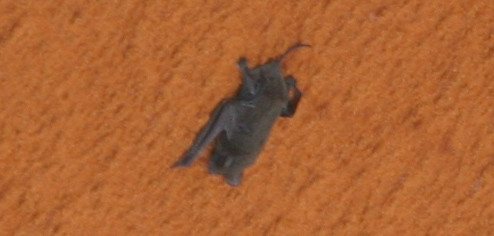
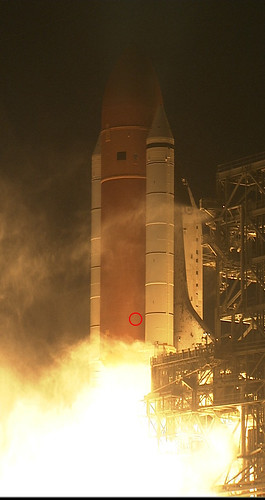
A bat that was clinging to space shuttle Discovery’s external fuel tank during the countdown to launch the STS-119 mission remained with the spacecraft as it cleared the tower, analysts at NASA’s Kennedy Space Center concluded.

Based on images and video, a wildlife expert who provides support to the center said the small creature was a free tail bat that likely had a broken left wing and some problem with its right shoulder or wrist. The animal likely perished quickly during Discovery’s climb into orbit.

Because the Merritt Island National Wildlife Refuge coexists inside Kennedy Space Center, the launch pads have a number of measures available, including warning sirens, to deter birds and other creatures from getting too close. The launch team also uses radar to watch for birds before a shuttle liftoff.

Nevertheless, the bat stayed in place and it was seen changing positions from time to time.

Launch controllers spotted the bat after it had clawed onto the foam of the external tank as Discovery stood at Launch Pad 39A. The temperature never dropped below 60 degrees at that part of the tank, and infrared cameras showed that the bat was 70 degrees through launch.

The final inspection team that surveys the outside of the shuttle and tank for signs of ice buildup observed the small bat, hoping it would wake up and fly away before the shuttle engines ignited.

It was not the first bat to land on a shuttle during a countdown. Previously, one of the winged creatures landed on the tank during the countdown to launch shuttle Columbia on its STS-90 mission in 1998.


Alas, poor batstronaut, I knew him well.


Furious Euros


"The commission process, if it goes ahead, is likely to set an ugly precedent that will ultimately destroy the fabric of international satellite communications and co-operation that has taken several decades to evolve," one satellite operator said. "What is to stop the Russians or other nations in Africa from unilaterally authorising their own systems to provide global coverage without co-ordinating with neighbouring countries? If all nations followed the commission process, then the end result is likely to be such interference that no satellite will be capable of operating."

That quote, from The Guardian, sums it up. If there’s one process all satellite operators respect in the satcom business, it’s making sure frequency coordinations are done properly and honestly. There’s speculation the former Luxembourg Parliament’s social committee president was behind this, so as to strengthen the EU’s regulatory powers.

Chris Forrester reports in Rapid TV News the winners will be Solaris Mobile and Inmarsat, and it could get ugly:

Today (March 18) the EU is expected to announce that Dublin-based Solaris Mobile (a j-v between SES Astra and Eutelsat) and London-based Inmarsat will each receive a slice of S-Band satellite bandwidth which will enable Europe-wide services like DVB-SH mobile TV. But there’s already controversy over the decision, with the powerful ITU arguing that the EU’s decision sets a dangerous precedent.

The ITU is responsible, amongst other things, for ensuring safe and interference-free coordination of various satellite operators and their terrestrial broadcasting counterparts. The complaint raised by the ITU argues that there’s nothing to stop other similar players, like Russia, or African or Middle East groupings now issuing their own – uncoordinated – ‘permissions to operate’.

"We see the EU as an unnecessary level [of regulation]," said Aarti Holla-Maini, secretary general of the European Space Operators Association. The allegation is that the decisions have not been reached fairly and may be uncompetitive, favouring European-based businesses.

You’re not surprised, are you? TerreStar and ICO Global, both U.S.-based, will likely litigate this, and Solaris Mobile has Luxembourg-based SES backing it up. Relationships do matter in business and government.

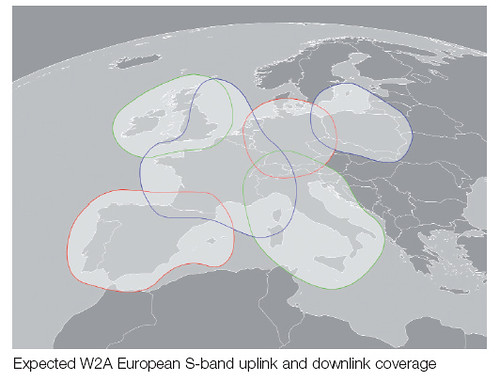
Solaris Mobile will use the S-band payload on Eutelsat’s W2A spacecraft. Launch preparations are in full swing, and the S-band coverage is mostly western Europe…


Go for GOCE

The ESA’s gravity spacecraft couldn’t get off the ground yesterday, but it’s a "go" for today:

Attempt One Issue:

“The doors on the launch service tower did not open,” noted ESA. ”Due to this anomaly, the tower was held in position and did not move back as required for a launch.”

I suspect some people around the St. Patrick’s Day parade in New York will be dealing with gravity issues today. More about GOCE:

Clarified by Isaac Newton in the 17th century, gravity is a fundamental force of nature. Everything that has mass is pulled by gravity. As Earth is not a perfect sphere and its interior has layers and zones of different density, gravity varies around the globe.
 
Gravity and its variation in space are fundamental for every dynamic process on Earth’s surface and in its interior. Improving our knowledge of how gravity affects the interaction between these processes has practical benefits in today’s changing world.

An accurate gravity map – the geoid – is also crucial for geodesy applications and for defining a sea surface height reference model with which to accurately survey ocean circulation patterns and sea-level changes.


Satellite News Bits


For the week ending 13 March 2009, courtesy of Bill McDonald:

Inmarsat reports 20% jump in revenue, representative of strong earnings being reported by the world’s largest satellite-services companies, apparently unaffected by current economic climate. [Wall Street Journal – 03/13/2009]

North Korea notifies international agencies that it plans to launch a satellite between April 4 and April 8; U.S. and south Korea say there are signs North Korea may test a missile capable of reaching Alaska. [Bloomberg – 03/12/2009]

Japan warns North Korea, saying it can legally shoot down any threatening object if it falls toward its territory. [New York Times – 03/13/2009]

Five years since last its reboot, Odyssey’s backup systems are restored by a restart, and other systems may also be restored. [SatNews – 03/13/2009]

Arianespace and European Space Agency elect to postpone launch of Herschel and Planck satellites to perform additional ground segment checks. [SatNews – 03/13/2009]

Astronauts evacuate International Space Station as a piece of space debris is expected to pass close to the station. [SatNews – 03/12/2009]

The U.S. Air Force will launch the second Wideband Global Satellite Communications satellite aboard an Atlas V rocket on March 14. [Patrick AFB News – 03/12/2009]

Iridium places backup satellite in service for satellite lost in collision with Russian satellite over Siberia in February. [msnbc – 03/12/2009]

W3C satellite commissioned by Eutelsat, to be built by Thales Alenia Space, a rapid satellite order following the decision in January not to integrate W2M into its fleet due to a major anomaly which occurred during its transfer to its operating orbit position. [SatNews – 03/12/2009]

Networkfleet, Inc. uses high-resolution satellite and hybrid maps to observe vehicles in a real-world setting with 3-D Earth imagery. [SatNews – 03/12/2009]

SpaceX completes full mission firing of Merlin vacuum engine. [Satellite today – 03/12/2009]

Financially struggling Sirius XM Radio plans to stream its subscription radio service to the iPhone and iPod Touch devices from Apple this spring. [CED Magazine – 03/12/2009]

AsiaSat will deregister from U.S. Securities and Exchange Commission and terminate its reporting obligations. [Satellite Today – 03/12/2009]

The Society of Satellite Professionals International will induct five new members into its Satellite Hall of Fame on March 25. [SatNews – 03/11/2009]

SES Astra will move Astra 2C satellite from 28.2 degrees East to 31.5 degrees East to take over mission of Astra 5A, which is no longer in service. [Satellite Today – 03/11/2009]

France’s Orange Business Services deploys customized satellite communications system for Bourbon marine services group vessels. [Businesswire – 03/11/2009]

Thales Alenia Space gets contract with JSC "Iss – Reshetnev Company" to build payload for Telkom-3 communications satellite for Indonesian operator PT Telekomunikasi Indonesia TdK. [SatNews – 03/11/2009]

International Launch Services gets contract to launch the ViaSat-1 satellite, to be highest capacity North American satellite with 10 times capacity of other Ka band satellites, under construction by Space Systems Loral, on an ILS Proton in the first half of 2011.  [SatNews – 03/11/2009]

SWE-DISH and Saab announce new on-the-move satellite solution designed for both land and marine applications with close to world-wide coverage using Ku band for up to 10 Mbps broadband communications. [Satellite TMCnet – 03/10/2009]

The European Defence Agency announces plan to set up procurement cell to coordinate EU member states’ orders of commercial satellite communications services to improve access at competitive prices. [DefenseNews – 03/09/2009]

NASA’s planet-hunting telescope, Kepler, was launched into space Friday night, March 6, on a mission to search for planets similar to Earth in the far reaches of the Milky Way. [R&D – 03/09/2009]

Satellite and cable TV providers seek to increase profit margins by promoting pay-per-view pornography. [AdvertisingAge – 03/09/2009]

Connecticut satellite and cable TV providers pursue customers who may lose signal as switch from analog to digital TV broadcasting takes place there. [Harford Courant – 03/08/2009]


Get The Shovel Ready


I don’t know whether this new service announced by CTC and AlphaStar is a project that’s as "shovel ready" as the economic stimulus package requires — or whether we should get the shovel out to bury it.

Here’s the pitch:

AlphaStar International, Inc. and Computers & Tele-Comm, Inc., (CTC) announced today a unique joint venture to provide very high speed WiMAX 4G services for any area anywhere across the entire USA. According to CTC President, Graeme Gibson, "The Digital Divide just got smaller. Today with this announcement, rural areas with no access to broadband fiber finally have a solution to getting connected at 4G speeds. Our mutually developed hybrid model takes advantage of the AlphaStar Teleport, a facility originally built by the U.S. government as part of President Reagan’s Star Wars initiative. AlphaStar (tour) can track any area of the USA including Hawaii and US territories to deliver true 4G speeds. Costs are contained by using the satellite primarily for the backhaul of Internet bandwidth." Bandwidth is then relayed by ground based WiMAX transmitters although the system can also serve to supply Metro WiFi systems or be used for mobile and maritime applications as well as Disaster Recovery and homeland security purposes. Low cost radios can be used rather than a two-way satellite receiver at customer locations. The Teleport can also deliver video and audio streaming. By caching the AV streams and large portions of the internet locally at the WiMAX transmitter performance is dramatically improved at affordable cost.

Great idea and I hope the pricing is right, but I’ve got my doubts. AlphaStar uses AMC-6 (according to their less-than-ideal Web site), which does not cover Alaska and Hawaii. Perhaps my old friends at Americom can persuade them to use AMC-21, which does cover all 50 states (and the Caribbean, which is a bonus).

Excellent combination of technologies for rural broadband and I hope it works out for them.


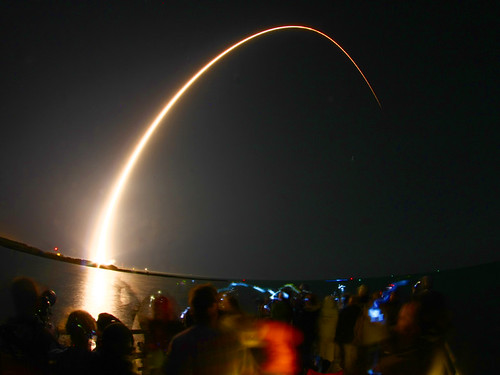
STS-119 Launch