DIY Friday: iToad


Very cool: the iToad:

 i-Toad: Domestic toad, eats dust and bits of this and that. Works independently, requiring no supervision or instructions.

So appealing, it’s tempting to put a collar and leash on him and head for the outdoors….

Materials: felted Romney and Jacob wool, glass eyes, a ‘Roomba’ base.
i-Toad’s sensors are fully functional with windows for vision designed in the wool body.

 Does it really work? Check it out in this video:


Great Advertising


Is that what the Iridium CEO said after one of his spacecraft collided with a Russian one? Oh, you bet he did:

The dramatic collision of one of Iridium Satellite LLC’s telecommunications satellites with an old Russian military satellite had one main business impact, according to Iridium’s CEO: "Great advertising."

At the same time, Matt Desch called for improved international efforts to monitor the positions of satellites and potentially dangerous space debris.

The collision "didn’t really have any financial impact" on privately held Iridium because it had a spare satellite ready to take over and there was little service disruption, he said.

But the highly reported incident did bring Iridium’s relatively low-profile service into the public orbit.

"I’d say that was some of the best advertising I could have gotten, though I wouldn’t do that again if I could help it," Desch said in an interview.

Desch said the event could generate business for Iridium, which has 66 satellites in orbit providing telecom services to governments and businesses like shipping companies that need communications in remote parts of the world.

One possible opportunity would be to lease out capacity in its next generation of satellites to hold cameras for organizations and governments to help keep better track of other satellites and ever-increasing amounts of space junk.

The Russian satellite involved in the collision with Iridium’s was no longer active.

"We clearly would like to see some better information about satellite positions," he said.

"(We hope) this incident will provide impetus for the international space community to find better ways to do that."

Desch said he expected talks to take place between scientists, governments and satellite companies in coming months about ways to improve and share information.

While the U.S. government does some monitoring, Desch said that tracking every satellite and every piece of debris in space would be a "very very complex, expensive task."

No single entity has that responsibility today, he noted.

"Our satellites are in an interesting orbit to be able to monitor the area around them," he said.

"Perhaps there’s opportunities for secondary payloads in future … to provide a better view of space," he said. "There have been discussions around that."

Desch said he expected Iridium to become part of a publicly traded company through its planned purchase of GHL Acquisition Corp, an affiliate of Greenhill & Co, in the second quarter.

Iridium LLC was initially backed by Motorola Inc but changed hands early 2001 after a group of investors, bought its assets after it filed for bankruptcy in December 2000.


OCO No Mo’


NASA’s Taurus launch of the Orbiting Carbon Observatory did no go well last night. Lost it:

NASA’s Orbiting Carbon Observatory satellite failed to reach orbit after its 4:55 a.m. EST liftoff Feb. 24 from California’s Vandenberg Air Force Base.

Preliminary indications are that the fairing on the Taurus XL launch vehicle failed to separate. The fairing is a clamshell structure that encapsulates the satellite as it travels through the atmosphere.

The spacecraft did not reach orbit and likely landed in the ocean near Antarctica, said John Brunschwyler, the program manager for the Taurus XL.


Bummer. Here’s the launch video:


Green Comet


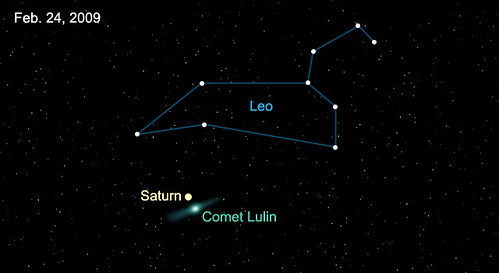
Comet Lulin‘s closest approach to Earth is today:

The comet makes its closest approach to Earth (0.41 AU) on Feb. 24, 2009. Current estimates peg the maximum brightness at 4th or 5th magnitude, which means dark country skies would be required to see it. No one can say for sure, however, because this appears to be Lulin’s first visit to the inner solar system and its first exposure to intense sunlight. Surprises are possible.

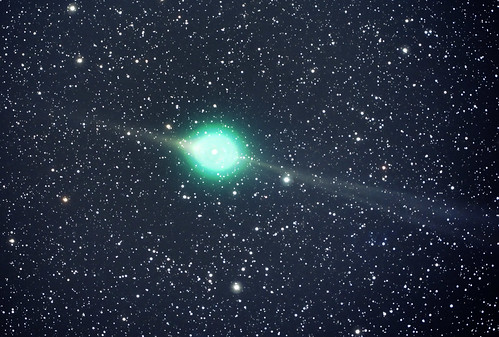
Lulin’s green color comes from the gases that make up its Jupiter-sized atmosphere. Jets spewing from the comet’s nucleus contain cyanogen (CN: a poisonous gas found in many comets) and diatomic carbon (C2). Both substances glow green when illuminated by sunlight in the near-vacuum of space.

Can’t get out or can’t see? No worries: Gregg Ruppel of St. Louis has some great images.


Hello, Chief?


Yo, Rocco’s back. Lots of interesting stories since I last blogged here. Last week’s item almost had me blogging. Now that RRS has a new editor, I’m back as the lead blogger.

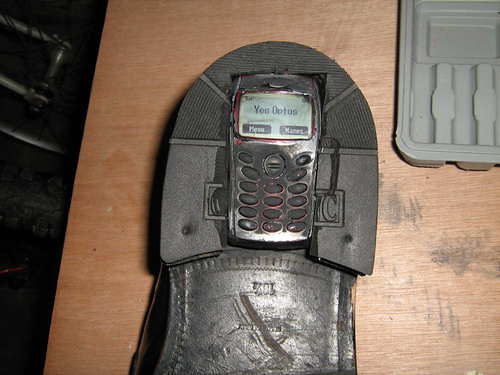
First, there was the working bluetooth shoe. Now we’ve elevated the technology to a working shoe phone:

The entire world has been waiting for decades with baited breath for the arrival of real, working shoe phone technology. You find that hard to believe? Would you believe that someone, somewhere, has been occassionally thinking about shoe phones? Well, the shoe phone finally lives, as you will discover below, and as you can hear for your self, here or here, or listen to an ABC interview which gets interrupted by the shoe phone ringing.

Listen to a radio interview conducted by shoe-phone!

The attention the shoe phone has generated has been quite flattering, including the production of shoe phones by others, resulting in an instructibles article and the first shoe phone on ebay. Perhaps what is most surprising is that noone had actually made a working shoe phone before. But now that cat has been let out of the bag …

Remote Patient Care: The Serious Side Of Shoe Phones

A significant part of the shoe phone project is the potential medical applications, as summarised in this television report:


DIY Friday: Pumpkin-carving Robots


Every Halloween, I have grand plans for pumpkin carving. I make sketches. I pick out the perfect pumpkin with all the right proportions. And, inevitably, it ends up looking like a kindergartener’s craft project. Well, not this year! Why, you ask? One word: Robots.

For a more traditional pumpkin, you can take the lead of the robotics experts at the Detroit Science Center, who made the cut at extremepumpkins.com thanks to their innovations in halloween hardware. (I have to note their tagline here: "Pumpkin carving has been reborn. This time it is a little bit deformed."…maybe this IS the perfect site to showcase my skills…)

If you’re going for something a bit more advanced – with a kind of headless horseman vibe – check out this guy’s robot, which he used to carve a rather disturbing likeness of himself.


Of course, if you’re looking for more of a chill-out-on-the-couch-while-eating-candy-and-pretend-not-to-hear-the-trick-or-treaters-at-the-door kind of Halloween, virtual pumpkin carving might be more your speed.

To illustrate the extent of my artistic skills, here’s my creation:

Picture 3

Happy Halloween!

Live Via WiMAX


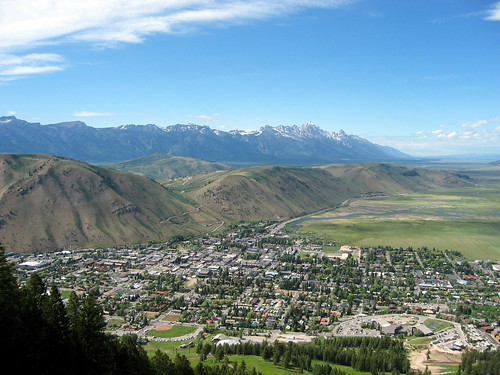
Atop Snow King mountain in Idaho, sits a new radio tower providing Internet access using new WiMAX technology. But it can do more than that.

KIFI-TV announced back in May a pioneering way of electronic news gathering that doesn’t use microwave or satellite to get the live feed back to the studio:

KIFI News Group calls it WiNG or Wireless Internet News Gathering. KIFI News Group General Manager, Mark Danielson, says, "The WiNG project is based on using the Internet to send content (video and sound) from the scene of a news event back to the station for LIVE broadcast on its television stations and web sites. Danielson says, “The breakthrough is the ability for KIFI field crews to send near Broadcast Quality LIVE shots over wireless Internet."

Danielson says, "WiNG allows KIFI News Group the capability to bring its customers breaking news and information from locations that have never been accessible to routine live news gathering. What KIFI News Group has developed with DigitalBridge Communications has the potential to revolutionize news gathering.” As WiMAX is deployed across the country, Danielson says he expects ordinary news vehicles to turn into fleets of Wireless Internet News Gathering vehicles – allowing for more aggressive coverage of late breaking news and weather events. Danielson says, “In the end, consumers will win as their hunger for breaking news and weather is satisfied by faster access to breaking news from aggressive media companies like his.”

TVNewsday filed this report earlier today on how this could truly be the new scheme for live reports, especially for stations on a tight budget:

Pioneering work on adapting WiMAX for ENG is now underway at KIFI, News-Press & Gazette’s ABC affiliate in Idaho Falls, Idaho.

And so far the fourth-generation wireless broadband access service is showing a lot of promise.

"This opens up a whole new world," says Mark Danielson, general manager of the KIFI News Group, who has dubbed its system Wireless Internet News Gathering or, simply, WING.

Unlike so-called third-generation, high-speed mobile technologies like EVDO, WiMAX can provide enough upstream bandwidth for live video.

It’s not the best, but it is "definitely acceptable," says Danielson. "Most viewers probably couldn’t tell you we’re doing anything different."

Danielson can tell you about the difference in cost. Satellite is out of the question for the nation’s 163rd largest market. Outfitting a microwave truck costs about $200,000.

But KIFI spent just $12,000 to equip a Toyota Highlander SUV with the necessary hardware and software to send video via WiMAX.

"Plus, I don’t have to have any receive sites," Danielson says. "I just have to be in a place where WiMAX exists with Digital Bridge."

Digital Bridge Communications is the local WiMAX service provider, with which KIFI has been closely working. Its BridgeMaxx service covers much of the same ground as KIFI: Idaho Falls, Pocatello, Twin Falls, Rexburg and a number of towns in Sun Valley.

"This is a unique product that was developed for them," says Doug Smith, Digital Bridge’s CIO. "This was a first for both of us and one of the first, if not the first, instances of doing broadcast over WiMAX in the U.S. that I’m aware of."

Broadcasters elsewhere may soon be able to experiment with live video via WiMax.

Using spectrum mostly in the 2.5 GHz band, WiMAX is just getting started in the United States, and it is expected to pop up in markets across the country over the next few years.

The big player is (or will be) Clearwire Corp., a planned joint venture that will include some of the biggest names in telecom and high tech: Sprint Nextel, Comcast, Time Warner Cable, Bright House, Google and Intel.

Sprint Nextel, which will own 51 percent of the venture, is folding in its Xohm WiMax unit, which launched a commercial service in Baltimore just last month.

If it all comes together, Clearwire expects to roll out WiMAX service in markets covering about 140 million people by 2010.

But what works in one place may not work in another.

In Idaho, KIFI and Digital Bridge worked out a "special priority service" that guarantees KIFI 2 Mbps upstream throughput when needed for a live shot.

A guaranteed upload speed of 2 Mbps is unusual for broadband wireless service providers. Typically, they offer such speeds only for downloads and much slower upstream bit rates for keystrokes, e-mail and occasional peer-to-peer traffic.

A news operation, of course, works the other way. It needs only small swaths of downstream bandwidth and huge chunks for sending video back to the studio.

Cutting a deal for the fat upstream pipe may not be possible everywhere.

As the service becomes popular, it will be more difficult for a station to set up the sort of sweetheart deal that KIFI has with Digital Bridge. Even in Idaho Falls, the priority service is only available for regularly scheduled newscasts.

"My verbal agreement with them is around news time," said Danielson. "We’re learning that their peak time also happens to be around 4 in the afternoon. It’s become complicated for them, but they’ve been able to deliver."

A wireless service provider could be forced to choose between the larger group of customers — some of whom are corporate and paying huge fees — and a steady paycheck from a news operation.

Raycom Media, the station group based in Montgomery, Ala., is intrigued by the KIFI experiment.

David Folsom, vice president-CTO at Raycom Media, says he will probably give it a try in Lubbock, Texas, the only Raycom market where WiMAX is going to be available. A company called Xanadoo is building a system there using licensed 2.5 GHz spectrum.

"The biggest hang-up at the moment is that nobody has created the glue yet for it," says Folsom. "You have a modem and a laptop and a camera but that doesn’t necessarily make a remote facility. You need all the parts and pieces."

Nobody knows that better than KIFI, which had to assemble its system form parts and pieces.

Key pieces come from Steambox, a Seattle-based company that specializes to pushing video over IP networks. It’s supplying the software that runs on a laptop and encodes and compresses the video for WiMAX transmission as well as the decoder that receives and processes the signal for broadcast back at the station.

"It really became a three-way partnership between us, Digital Bridge and Streambox constantly modifying and make this technology work," says Danielson. "There really are no blueprints for doing what we’re doing yet."

"We’ll see long term whether the QoS [quality of service] holds up," says Folsom. "The people in the field are not IT people; they’re reporters. The issue is the human interface part and we’re working on that right now."

Danielson maintains that using WiMAX is not that tough, even for the non-technical types.

"They have a camera, a BridgeMAXX modem, a converter box … and a laptop computer with the Streambox encoder software. You look at the truck and go, ‘That’s it?’ There’s nothing to it. It’s simple. There’s no 40-foot mast to worry about."

Aside from the quality of the signal, Danielson’s biggest worry is latency of about three interminable seconds in the talk-back between the studio and the remote site.

"We compensate by cueing the reporter about a second-and-a-half before the anchor is done talking," Danielson says. "As far as having audio and video in sync, we have not had any of those issues."

In any event, Danielson and Folsom agree that WiMAX is a step up from EVDO, a widely available wireless access service that has been adopted by many broadcasters for sending video, but only when satellite and microwave isn’t possible.

Folsom says he doesn’t depend on EVDO for live shots. "We use it for those circumstances in which there’s no other way we can do it because we’re out of our normal microwave footprint or there’s some other overriding reason like the weather.

"I don’t suggest for a minute that EVDO is competing with WiMAX at all, but since WiMAX’s footprint is so tiny right now and EVDO is everywhere, we’re using Verizon EVDO+ and it’s been fairly decent for us," says Folsom. "I don’t have a lot of complaints."

While EVDO is improving, Danielson won’t go that way again. EVDO can’t promise bandwidth, he says, noting that an upstream throughput of 1 Mbps is considered a stretch.

At least for the present, KIFI sees WiMAX as a complement to microwave, not as a substitute.

"We still rely heavily on microwave for our primary system. The only downside with microwave is it’s line-of-sight to your receive towers," he says.

Eastern Idaho is mountainous so there are many spots that are out of microwave range of the station. That’s where WiMAX can help. "BridgeMAXX is more like cellular technology where any place you’re within a radius of a WiMAX tower you have the ability to send," says Tory Willmer, KIFI’s IT manager.

That Eastern Idaho is also sparsely populated helps, Danielson adds.

Even though its spectrum is licensed, WiMAX, like any radio service, is susceptible to interference, he says. So the more remote the place, the less the chance of interference.

WiMAX is one of two fourth-generation mobile wireless technologies. LTE, or Long Term Evolution, is coming on the heels of EVDO and other third generation services and, while still several years away, promises a more ubiquitous coverage and faster upstream service.

But WiMAX is here now.

"It’s a great application for broadcast," says Danielseon. "I predict this is going to be the way things are done in the future. You could have a fleet of WING vehicles with WiMAX at a fraction of the cost of a couple satellite trucks or live trucks."



Mars Lander Hits the Snooze Button

We were all jazzed about NASA’s Mars Lander back in May, when the Lander successfully navigated a complicated descent sequence onto the Red Planet.


But since touching down, the Lander has been beset by problems, and now it looks like the end may be near for the mission:

NASA’S Phoenix Mars Lander entered safe mode late yesterday in response to a low-power fault brought on by deteriorating weather conditions. While engineers anticipated that a fault could occur due to the diminishing power supply, the lander also unexpectedly switched to the "B" side of its redundant electronics and shut down one of its two batteries.

During safe mode, the lander stops non-critical activities and awaits further instructions from the mission team. Within hours of receiving information of the safing event, mission engineers at NASA’s Jet Propulsion Laboratory, Pasadena, Calif., and at Lockheed Martin in Denver, were able to send commands to restart battery charging. It is not likely that any energy was lost.

Weather conditions at the landing site in the north polar region of Mars have deteriorated in recent days, with overnight temperatures falling to -141F (-96C), and daytime temperatures only as high as -50F (-45C), the lowest temperatures experienced so far in the mission. A mild dust storm blowing through the area, along with water-ice clouds, further complicated the situation by reducing the amount of sunlight reaching the lander’s solar arrays, thereby reducing the amount of power it could generate. Low temperatures caused the lander’s battery heaters to turn on Tuesday for the first time, creating another drain on precious power supplies.

Science activities will remain on hold for the next several days to allow the spacecraft to recharge and conserve power. Attempts to resume normal operations will not take place before the weekend.

The shut down is not unexpected:

"This is a precarious time for Phoenix," said Phoenix Project Manager Barry Goldstein of JPL. "We’re in the bonus round of the extended mission, and we’re aware that the end could come at any time. The engineering team is doing all it can to keep the spacecraft alive and collecting science, but at this point survivability depends on some factors out of our control, such as the weather and temperatures on Mars."

The Arizona Daily Star has more:

If Phoenix is able to bounce back from the power failure, it’s not clear what the lander will be able to do, as engineers already have shut down heaters that warm the robotic arm and the oven-like science instrument known as the Thermal and Evolved Gas Analyzer.
 
It won’t be long before Phoenix reaches a state in which it requires more energy to stay alive than it can take in through its solar arrays.
 
The forecast for Mars? More dust and cold.
 
You can keep up to date on the continuing developments at the Mars Lander Blog.


Venezuelan Satellite Launched in China


Simon Bolivar (or VENESAT-1, the ITU designation) launched Wednesday (16:53 UTC) via a Chang Zheng-3B (CZ3B-11) launch vehicle from the Xichang Satellite Launch Center in Sichuan Province. The news, via China Daily:

Carried by a Long March 3II rocket, the satellite was launched from the Xichang Satellite Launch Center located in southwest China’s Sichuan Province.

The satellite was produced by China Aerospace Science and Technology Corporation with an all-up weight of 5,100 kg and an designed longevity of 15 years.

The orbiter, named as Venezuela 1 Telecom Satellite, is the first telecom satellite of Venezuela which will be used in broadcasting, tele-education and medical service by coving the most regions of South America and the Caribbean region.

It will of great importance to improve living standards of the people living in the country’s remote areas.

Here’s the video…


Spitzer Spots Spock’s Planet


Star Trek fans may remember Spock’s home star, Epsilon Eridani. Now, with the help of the Spitzer Space Telescope, the discovery of asteroid belts within the nearby system (10.5 light years away) is prompting new comparisons to our own system — and perhaps a planet Vulcan:

NASA’s Spitzer Space Telescope has detected two asteroid belts around Epsilon Eridani, the planetary system closest to ours and home to Star Trek’s fictitious First Officer Spock, the space agency reported yesterday.

A planet near the inner asteroid belt was identified eight years ago. The newly spotted planet is in the vicinity of the outer belt.

Epsilon Eridani is around 10 light-years, or 62 trillion miles (98 trillion kilometers), away from Earth’s solar system and, at a mere 850 million years old, is considered a younger, similar version of our own 4.5- billion-year-old system. Star Trek creators made it the home of Vulcan, and it’s possible that there are as-yet-unseen Earth-like planets between the star system and its inner ring, astronomer Massimo Marengo of the Harvard–Smithsonian Center for Astrophysics told McClatchy Newspapers.

"We certainly haven’t seen it yet, but if its solar system is anything like ours, then there should be planets like ours," Marengo told USA Today.


Naturally, this prompted an active discussion on Slashdot, with several citations to literary fiction. More serious discussions abound.

The update from the Harvard-Smithsonian Center for Astrophysics doesn’t mention Mr. Spock or Vulcans, just what it means to scientists:

Epsilon Eridani and its planetary system show remarkable similarities to our solar system at a comparable age.

"Studying Epsilon Eridani is like having a time machine to look at our solar system when it was young," said Smithsonian astronomer Massimo Marengo (Harvard-Smithsonian Center for Astrophysics). Marengo is a co-author of the discovery paper, which will appear in the Jan. 10 issue of The Astrophysical Journal.

Lead author Dana Backman (SETI Institute) agreed, saying, "This system probably looks a lot like ours did when life first took root on Earth."

Our solar system has a rocky asteroid belt between Mars and Jupiter, about 3 astronomical units from the Sun. (An astronomical unit equals the average Earth-Sun distance of 93 million miles.) In total, it contains about 1/20 the mass of Earth’s Moon. Using NASA’s Spitzer Space Telescope, the team of astronomers found an identical asteroid belt orbiting Epsilon Eridani at a similar distance of 3 astronomical units.

They also discovered a second asteroid belt 20 astronomical units from Epsilon Eridani (about where Uranus is located in our solar system). The second asteroid belt contains about as much mass as Earth’s Moon.

A third, icy ring of material seen previously extends about 35 to 100 astronomical units from Epsilon Eridani. A similar icy reservoir in our solar system is called the Kuiper Belt. However, Epsilon Eridani’s outer ring holds about 100 times more material than ours.

When the Sun was 850 million years old, theorists calculate that our Kuiper Belt looked about the same as that of Epsilon Eridani. Since then, much of the Kuiper Belt material was swept away, some hurled out of the solar system and some sent plunging into the inner planets in an event called the Late Heavy Bombardment. (The Moon shows evidence of the Late Heavy Bombardment – giant craters that formed the lunar seas of lava called mare.) It is possible that Epsilon Eridani will undergo a similar dramatic clearing in the future.


Some of us would like to believe another planet like ours exists, which recalls the power of the Vulcan Mind Meld in convincing people to think otherwise. 

Here’s one of my favorite clips from the original TV series: