Vint Cerf in Space!


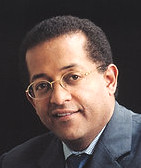
Okay, we don’t mean physically in space. But Father of the Internet Vint Cerf (pictured above) wants to replace the current point-to-point communications infrastructure between spacecraft and earth with an internet-style networking protocol.

Technology Review has more:

Cerf, who is Google’s vice president and chief Internet evangelist, is working with a team at NASA’s Jet Propulsion Laboratory (JPL), where he is also a visiting scientist, and at the MITRE Corporation, based in Washington, DC, to design and implement a revolutionary new scheme for space communication. The project, dubbed the Interplanetary Internet, will be tested aboard the International Space Station (ISS) in 2009, and Cerf hopes that by 2010, new space missions will be designed to use the protocols.

The article features an interview with Cerf:

TR:What are the challenges of building such a network in space? 

VC:We started by working on a set of protocols that could deal with two very important properties of space communication. The first is delay. The distances between the planets are very large. For example, when Earth and Mars are closest together, it still takes 3.5 minutes for a radio signal moving at the speed of light to propagate. If I were on Mars and you were on Earth, it would take seven minutes at best before you heard a response. When Earth and Mars are farthest apart, the round trip takes 40 minutes! The reason we can talk back and forth on Earth so easily is that propagation times are very short by comparison.

The other problem is that the planets and their satellites are in motion, and most are rotating. The rotation of the planets means that if you are talking to something that is on the surface of the planet, it may rotate out of the line of sight so you cannot talk to it anymore, until the device on the surface rotates into view again. The same could be said for some orbiting satellites. You have to develop protocols that will deal with the fact that you cannot always communicate with the other party: the communication is both delayed and potentially disrupted. So that is what we designed: a delay- and disruption-tolerant networking system [DTN]. It will allow us to maintain communications more effectively, getting much more data because we don’t have to be in direct line of sight with the ultimate recipient in order to transfer data. The new protocols will be proposed to serve as a potential international standard for space networking.

TR: Is this going to require putting new infrastructure in space?

VC: The answer is yes and no. For example, the Deep Impact spacecraft [now called EPOXI] is already in orbit around the sun. It was used to launch a probe into a comet to examine its interior. EPOXI is being temporarily repurposed to test the new DTN protocols. The spacecraft has processing, memory, radio equipment, and solar panels for power so we don’t have to put new hardware up. We just have to upload new software. We are lucky to not have to field any new equipment yet, but the DTN protocols eventually have to show up in a fairly significant number of devices in the system to create the kind of network that can serve space-communication needs. Some specialized spacecraft could become store-and-forward routers. Each time a new mission is launched, using the standard bundle protocol, previous mission assets that are still in operation could be used to support the communication requirements of the new mission. In this way, we hope to accrete a kind of interplanetary backbone network.

Cerf is supporting Barack Obama for president because of the latter’s positions on net neutrality, according to CNET. But maybe he’s just gunning for the position of CTO of the United States?

Private Space Flight Carries on Proud Aviation Tradition: Zero Leg-Room

Over the past several years, there has been an explosion of private investment in the space industry. SpaceX may be the best known, with its founder investing $100 Million of his own money and a tremendous amount of time and energy in the hopes of developing a fleet of privately operated rockets. Richard Branson has also entered the fray with his Virgin Galactic space tourism project. And Robert Bigelow, a Las Vegas hotel magnate, has grand plans for a private space station/hotel.


Another player in the commercial space race that you may not have heard of is Copenhagen Suborbitals, which just conducted a successful booster test last week. The test was a major step for the Danish company.


XLR-2 hybrid rocket motor test from Sonny W. on Vimeo.

Copenhagen Suborbitals is currently developing a series of suborbital space vehicles designed to validate and test performance, paving the way for manned space flight on a micro-size spacecraft, or MSC…

Two rocket vehicles are under development: a small unmanned sounding rocket, named Hybrid Atmospheric Test Vehicle, or HATV, and a larger booster rocket named Hybrid Exo Atmospheric Transporter, or HEAT, designed to carry a micro spacecraft into a suborbital trajectory in space.

Both boosters systems will be hybrid rockets using epoxy as solid propellant…

Before the spacecraft goes into a zero gravity parabola, the booster system will be jettisoned. After a while of atmospheric re-entry, the spacecraft will be slowed by two episodes of deployed parachutes. Finally, the spacecraft will touchdown on land.

It will not be possible for the astronaut to move around inside the MSC. Only the arms will be free “to operate a few (backup) systems like grabbing on to handles or a vomit bag, as well as additional oxygen mask and the MSC abort system, if necessary after touchdown.”

It’s that last bit that’s drawn Copenhagen a bit of bad press. In fact, Gizmodo compared the idea to a cruel form of punishment:

How’s this for a nightmare scenario: you’re crammed into a rocket the size of a closet, only large enough for you to stand up in. The top is a clear dome so you can see out, but it’s too small for you to bend your legs, let alone walk around in. You are then launched into space. Aaauuughghghghhh!

It’s also been described as a “one -man Roman candle ride into space”. Though it doesn’t look like an entirely pleasant way to travel, if given the opportunity I’m pretty sure I’d pop a few Valium and try to enjoy the crazy, claustrophobic ride.

Bella Lancio di Razzi


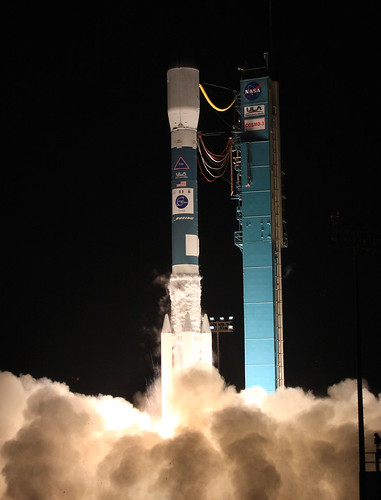
Yes, the Delta rocket is still working. This time for the Italian COSMO/SKYMED-3 and the United Launch Alliance:

A United Launch Alliance Delta II rocket, on behalf of Boeing Launch Services, successfully launched the third Italian-built Constellation of Small Satellites for Mediterranean Basin Observation or COSMO-SkyMed 3 satellite at 7:28 p.m., October 24. ULA successfully launched the first two Cosmo satellites on Delta II vehicles June 7, 2007 and Dec. 8, 2007.

"ULA is pleased to have successfully launched the third of four critical Earth observation systems in this series for Boeing and Thales Alenia Space," said Jim Sponnick, ULA vice president, Delta Product Line. "With this 43rd successful commercial launch, the Delta II system continues its record of mission success, which is unparalleled in the U.S. space industry. This achievement is due to the hard work of our professional engineers and technicians along with the tremendous support we receive from our government, industry, and supplier mission partners. We look forward to many more Delta II launches in the years ahead."

Blasting off from Space Launch Complex 2, it marked the fifth successful Delta II vehicle launch procured by The Boeing Company through its commercial launch business. The ULA Delta II 7420-10 configuration vehicle featured an ULA first stage booster powered by a Pratt & Whitney Rocketdyne RS-27A main engine and four Alliant Techsystems (ATK) strap-on solid rocket boosters. An Aerojet AJ10-118K engine powered the second stage. The payload was encased by a 10-foot-diameter composite payload fairing.

ULA began processing the Delta II launch vehicle in Decatur, Ala., nearly two years ago. In February, the 1st stage arrived from Decatur followed by the 2nd stage in August. The vehicle was erected on its stand at the pad Sept. 16, with solid rocket booster installation completed Sept. 19. Hundreds of ULA technicians, engineers, and management worked to prepare the vehicle for the COSMO-3 mission.

Developed by Thales Alenia Space, Italia for the Italian Space Agency and the Italian Ministry of Defense, COSMO-3 is the third of the four COSMO-SkyMed satellites. Each satellite is equipped with a high-resolution Synthetic Aperture Radar operating in X-band and is one of a constellation of four radar satellites. The overall objective of the program is global Earth observation and relevant data responding to the needs of the military and scientific community, as well as to the public demand for environmental control.

Here’s a nice video:


And here’s one shot on-site, from a distance:


Elliptical C-band Uplink Antennas

Via Doug Lung’s RF Report:

In some cases, it isn’t possible to install an uplink dish that meets the FCC off-axis antenna pattern envelope. In the past, the FCC allowed operation of uplinks with non-compliant antennas upon a showing by the licensee that the effective isotropic radiated power (EIRP) would be reduced enough to keep the energy in side lobes below the level that would have existed using an uplink with a compliant dish at maximum power. This required a detailed engineering showing that often slowed FCC processing.

In the Eighth Report and Order and Order on Reconsideration (FCC 08-246), the FCC adopted an off-axis EIRP envelope approach as one method for applicants to apply for fixed satellite service (FSS) Earth stations using small antennas operating on conventional C and Ku-band frequencies.

It states, "This off-axis EIRP approach gives earth station applicants the flexibility to reduce their power levels to compensate for a small antenna diameter. Thus, using these envelopes as criteria for licensing should enable us to license more earth station applications routinely, expediting the provision of satellite services to consumers and enhancing the types of services available, without increasing the likelihood of harmful interference to adjacent satellite operators or to terrestrial wireless operators."

The Order adopts rules that facilitate the use of elliptical C-band uplink antennas. While the new rules do not specifically state that the major axis of the elliptical antenna be aligned with the geo-stationary orbit plane, the Order notes that "that starting the off-axis EIRP envelope at 1.5 degrees off-axis within the GSO orbital plane, and at 3.0 degrees outside that plane, has the same effect as requiring elliptical antennas to be aligned with the GSO plane in most cases."

The Satellite Industry Association (SIA) claimed that it is not possible to develop an off-axis EIRP envelope for analog video signals because the power density of such signals fluctuates. SES Americom opposed new analog regulations because the current rules are working well. The FCC decided to retain the current regulatory framework for analog services at this time. It dropped plans for eliminating analog video transmission over satellite entirely, noting, "The record in this proceeding has shown convincingly that requiring the transition from analog to digital video transmissions proposed in the Third Further Notice would be unreasonably expensive and burdensome."


DIY Friday: HAM Radio

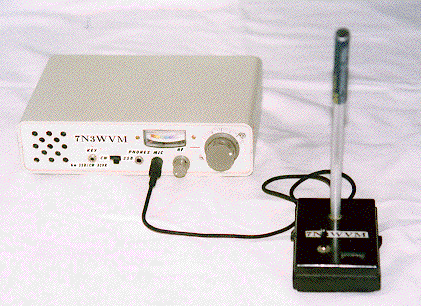
I’m feelin’ a bit old school, so in this week’s DIY Friday we’re tackling a classic: HAM radio.

This site has just about everything you need to know.

Or you can check out this “homebrew receiver”.

Or, if you want to go a bit more hi-tech, you can try this diy radio modem that uses an “iPod” FM Transmitter and a regular FM receiver.

This guy makes HAM radios out of tin cans. (Think SPAM). He even has a miniature one that uses as much power as a Christmas light.

HAM’s have a long tradition of public service. Check out this video (hosted by Walter Cronkite!) about how HAM radio comes through in a disaster.

Whichever project you choose, you’re going to want to build it while watching one of these classic movies featuring HAM radios. Hitchcock was definitely a fan – “Rear Window”, “The Man Who Knew Too Much” and “The Birds” all make the list.


Commercial Launches from Florida

That’s the live view from Cape Canaveral’s Launch Complex 39, where the Space Shuttle will launch from in November.

Meanwhile, lots of activity at Launch Complex 36 this week, too. The U.S. Air Force announced it will soon host civil and commercial payload launches:

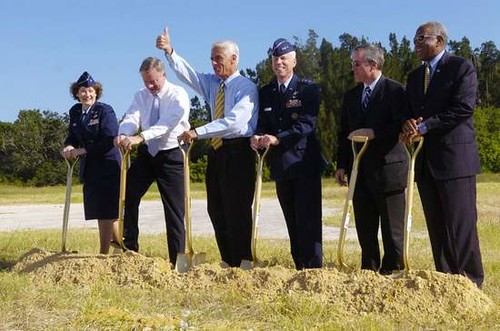
Officials with the Air Force and Space Florida made history during a dedication ceremony held here Oct. 22 when Space Launch Complex 36 officially was made available for operational use by the State of Florida, subject to completion of the environmental impact analysis.

Attending the historic ceremony were Florida Governor Charlie Crist; Florida Lt. Governor Jeff Kottkamp; Space Florida President Steve Kohler; Lt. Gen. William Shelton, 14th Air Force commander; and Brig. Gen. Susan Helms, 45th Space Wing commander.

General Shelton said Air Force leaders supported the initiative because it will make it easier for commercial providers to launch from the U.S.  Having domestic launch options provides the U.S. with solid foundation for national security.

"This is a great partnership that is mutually beneficial to both the Air Force and the state," he said. "We take great pride in helping foster the success of the commercial space sector; I’m confident the spirit of innovation and the cooperation that made this a reality will continue in the years ahead."

Governor Crist also had positive things to say about the agreement.

"Florida has always been home to big ideas. The entrepreneurial spirit is woven into the DNA of Florida’s economy," the governor said. "And thanks to the Air Force’s decision, the door is now open to innovation and space opportunities never seen before. In tough economic times, it is important we do not sit idly by, but that we invest in economic opportunities for the future.

"What a tremendous opportunity to ensure that space exploration is a top priority and that the U.S. remains a leader right here from Florida," he said.

According to Space Florida officials, the reconfiguration of Launch Complex 36 will strengthen not only the state’s aerospace industry but other growing economic sectors such as biotechnology and environmentally friendly energy technology vital to Florida’s future. The launch complex will support light- to medium-lift vehicles that go into low-Earth orbit and beyond.

Space Florida’s president sees this ground-breaking ceremony as a great beginning,  both literally and figuratively.

"The Air Force assignment of Launch Complex 36 is an important next step to extending access to space," said Steve Kohler, Space Florida president.

"We are now making that available to both defense and security initiatives," he said, "with multiple commercial payloads and launch activities for both civil and private space businesses that want to launch from Florida. This direction by the Air Force, together with the tremendous support by the state, opens the door to attracting, supporting and sustaining national and international aerospace business here in Florida."

This effort also is in line with the mission of the 45th SW, according to General Helms.

"Our primary mission here is to assure access to the high frontier," she said. "This proposal better enables us to execute that mission. It’s the ultimate ‘win-win’ situation for both the Air Force and the State of Florida."


Hours later, PlanetSpace announced it is ready to start, spurring Florida Today to report it will generate 350 jobs and a $300 million economic impact:

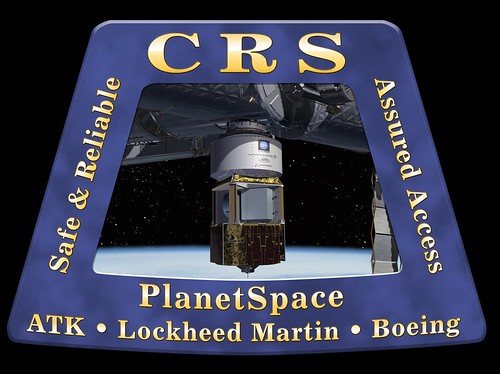
PlanetSpace, a consortium of ATK, Lockheed Martin and Boeing, announced Wednesday a proposal to launch a 158-foot solid-fuel rocket by 2011 from the pad at Cape Canaveral, which the Air Force has agreed to lease to Space Florida. The rocket could carry about 2 metric tons of cargo to the International Space Station.

NASA aims to announce on Dec. 23 whether PlanetSpace, or a competitor, has been chosen to provide the service. The company says its plan would create 350 jobs in Florida, with a potential economic impact of $300 million. PlanetSpace said it has at least two competitors for the NASA award.

Using state money, Space Florida now will start turning the abandoned launch complex into a serviceable launch pad, which it hopes will attract other commercial customers.

"The door is now open to more innovation," said Gov. Charlie Crist, who spoke Wednesday at the groundbreaking of the launch complex upgrade.

Complex 36 is now just a domed bunker beside a concrete slab at Cape Canaveral. The Air Force, which controls the property, intends to lease the site to Space Florida after an environmental impact analysis.

Space Florida, a state economic development agency focused on aerospace projects, then would build a launch facility that could accommodate medium to light rockets. The state plans a commercial launch zone that would reduce bureaucratic requirements and eliminate tariffs, similar to a free trade zone.

"This is a rebirth of a historical launch complex," Space Florida President Steve Kohler said.

Kohler said he is negotiating with several launch companies that may use the pad. The state has appropriated $14.5 million for the project and has bonding authority for another $40 million.

"We hope that the first phase of development could reach $55 million to build it out," Kohler said.

PlanetSpace hopes to be the first to use the new site in 2011. Under NASA’s Commercial Resupply Services program, the group is competing for a $3.1 billion government contract to move 20 metric tons of cargo to the space station with 10 to 12 rocket launches.

We see which bidder will be celebrating on 23 December 2008, with a great big contract under the tree (Solicitation Number: NNJ08ZBG001L).


Russia Invests in Space

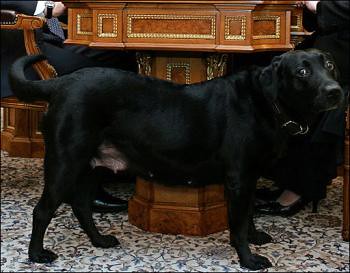
Russian Prime Minster Vladimir Putin’s black Labrador, Connie, has been given a tracking collar linked to the Russian navigation satellite system Glonass, the government website said on Friday.


But Connie’s GPS collar isn’t the only space initiative the Russians are investing in. In fact, Russia is set to spend more that $7 billion on space over the next few years, according to New Scientist Space

The former president, quoted by local news agencies, told a government meeting that Russia, which accounts for 40% of all space launches, would earmark more than 200 billion roubles ($7.68 billion) from the federal budget for development of the space industry from 2009 to 2011.

Russia’s Soyuz crewed spacecraft and Progress cargo vehicles have been the main workhorses serving the International Space Station (ISS) since the space shuttle Columbia disintegrated on atmospheric re-entry in 2003….

NASA plans to mothball its entire space shuttle fleet by 2011.

"Evidently . . . between 2011 and 2016, the United States will not possess a new spaceship to replace the space shuttle," news agencies quoted Anatoly Perminov, the head of Russia’s space agency Roscosmos, as telling Putin.

"So Russian spacecraft will bear the brunt of transportation and maintenance works, as well as replacing [ISS] crews and launching European and Japanese cargo ships from time to time."

Putin said Russia’s group of space satellites had reached more than 100 units and would rise steadily. 

A good place to explore the Russian space program online is RussianSpaceWeb.com

Russia’s next scheduled launch from Baikonur will lift ASTRA-1M into orbit on 3 November 2008.

Is anything else going on that week?


Chandrayaan-1 Launched

ISRO‘s Chandrayaan-1 spacecraft launched:

The Indian Space Research Organization (ISRO) successfully launched the Chandrayaan-1, meaning "moon craft" in ancient Sanskrit, into orbit from a launch facility in southern India.

"It’s a historic moment, as far as India is concerned…  We have started our journey to the moon and the first leg of the journey has gone perfectly well," ISRO president Madhavan Nair said.  "It’s a remarkable performance by the launch vehicle, every parameter was on the dot… Today what we have started is a remarkable journey for the Indian spacecraft to go to the moon and try to unravel the mysteries of the moon."

Chandrayaan-1 will orbit 60 miles above the moon’s surface, while documenting its surface and chemical characteristics.

ISRO hopes this first launch will help the nation launch future lunar missions that can help researchers learn more about the moon and its origin.  ISRO hopes to one day launch a manned mission to the moon, but admitted that it would take years before it is able to develop the necessary technologies.

ISRO hopes to launch another moon mission in 2012, as the space agency continues to develop the necessary infrastructure for a manned moon mission.

"Earlier missions did not come out with a full understanding of the moon and that is the reason scientists are still interested.  This will lay the foundation for bigger missions and also open up new possibilities of international networking and support for planetary programs," the ISRO said in a statement published on its web site.

Here are two videos…


WorldSpace Ch. 11

No, we’re not talking about WorldSpace channel 11 ("Radio Voyager") here. We’re talking about Case Number 08-12412, the Chapter 11 bankruptcy filing by WorldSpace, the pioneering satellite radio service available in Africa and Asia. The board of directors voted unanimously to file for it.


In the U.S., we’ve all heard about Sirius XM Radio and their 18 million subscribers. Turns out WorldSpace has yet to break a million, according to the Wall Street Journal report:

The company, which broadcasts its satellite radio services to more than 170,000 paid subscribers in 10 countries throughout Europe, Africa and Asia, sought Chapter 11 protection in the U.S Bankruptcy Court in Wilmington, Del. It listed assets of $307.4 million and liabilities of $2.12 billion.

The bulk of that debt, some $1.8 billion, is a contingent obligation under a royalty deal if the company’s pretax earnings reach a certain level, according to company spokeswoman Judith Pryor.

In court papers, Chief Executive Noah A. Samara said the company was forced to file for bankruptcy after seeking four forbearance agreements with its noteholders since June.

In addition, WorldSpace has failed to pay some of its workers for two months, causing "significant employee attrition," Mr. Samara said. The company owes 50 "critical employees" $1.35 million in back pay.

"As a result of WorldSpace’s growing concern regarding its inability to make timely payments to critical employees and other essential creditors, WorldSpace determined that it is in its best interests and the best interests of its subsidiaries and stakeholders to file these chapter 11 proceedings," said Mr. Samara, one of the key figures in the early stages of XM Satellite Radio Holdings Inc.

The company, which intends to sell off its assets or recapitalize the business, is seeking court approval of a $13 million bankruptcy loan provided by a group of hedge funds to continue operating while under bankruptcy-court protection.

Worldspace was founded in 1990 with the intent to provide satellite radio services to the emerging markets of Asia and Africa. The company has two satellites currently in orbit and a third in storage.

Among the WorldSpace’s so called first-day motions the company is asking to secure the bankruptcy loan and use some of that funding to pay its employees. The company is also seeking the continued use of its bank accounts.

Without the bankruptcy financing, the remaining critical employees will likely depart, which would "impair" WorldSpace’s ability to operate the satellites and continue as a going concern, Samara said.

Yenura Pte. Ltd., a Singapore-based company controlled by Mr. Samara, is WorldSpace’s largest unsecured creditor, owed $55.2 million. Number 2 is Micronas GmbH, owed $18.2 million, and Fraunhofer Institute for Integrated Circuits, owed $4.4 million.

Mr. Samara is the largest shareholder of the Silver Spring, Md. company, owning 47.15% of the firm. Aletheia Research & Management Inc., owning 37% percent, and Natixis Asset Management Advisor LP, owning 5.25%, are the other major shareholders of WorldSpace.


170,000 subscribers? And they’ve paid to build and launch two satellites? AfriStar launch in 1998, so I’m wondering how they could have kept going for the last ten years on so few paying subscribers.  Probably the dedication of Noah Samara, their CEO and founder. His speech before the African Development Forum in 1999 tells you something about what moved him (it’s so good I need to present it all):

The urgent imperative of our time and of this continent is the creation of an affluent African Information Society. I will speak to this need today. And I will be brief.

Over the past 15 years, we have seen the industrialized world shift its focus from connecting people to connecting nodes of information which people can universally access, share and grow. Focus on convergence technologies has brought unprecedented benefit and wealth resulting from net media or, if you will, information affluence.

In contrast, the developing world has focused on teledensity and lines per 1000 in its quest for universal access. The focus has been universal access to telephony and not to the electronic consciousness of mankind, more popularly known as the Internet. Accordingly, the progress in teledensity has not yielded the corresponding benefits and wealth which information affluence has created for the industrialized world.

Indeed, the information gap between nations is going through a quantum leap. It is volatile and threatens to explode into an irreparable gulf between rich and poor nations.

Developing efficient and effective ways to create information-affluent societies is the need for every need. I have pursued this vision with a sense of purpose and urgency; it animates my being and instructs my energies. Information affluence is, in my humble opinion, the sine-qua-non to development. Have it and wealth and development will follow. Without it, our attempt to alleviate poverty, bring health, wealth and education – indeed our attempt to create a sustainable, compassionate, civilization will be without success.

Information is the predicate to everything we know. It is ubiquitous. It is the building block behind the human DNA, the chair you are sitting on, the building you are in, the car you drive.

Look behind the wealth of nations and of individuals and — again — you will find information. Information about processes, techniques and organizations.

Look behind the poverty of individuals and nations and you will find ignorance.

The state of global information is the best allegory for the state of our planet. The gap between poor and rich has been made starker, not better, by the power of information and communications technologies.

While these technologies have liberated lives, created stock market miracles and improved economies, they have only touched a fraction of the world’s population.

An abyss is in the process of formation.

Nearly 2.5 billion people have never made a phone call; yet Manhattan alone has more phones than all those combined in sub-Saharan Africa. While there is a radio station for every thirty thousand people in most OECD countries, on average there is one radio station for every two million people in most of the developing world. There are more Internet hosts in Estonia than all of sub-Saharan Africa. The hardware disparity between poor and rich nations is not nearly as troubling as the scarcity of information which directly undermines the ability of a nation to not only keep its citizens informed and educated, but to simply keep them alive. 11 million people will die of AIDS this year in Sub-Saharan Africa. 40 million children will be orphaned. Either one of those numbers, by any definition, represents the population of an entire country. This is horror we do not really comprehend.

Asked about concerns he might have at the loss of thousands of citizens, Stalin is said to have once remarked that a single death is a tragedy; but a million a mere statistic.

Stalin was a bad man. We all agree he was ruthless, unmoved by human suffering. But does his comment reflect on him or is his an insight about all of us?

Consider the story of Yaguine Koita and Fode Tounkara – two boys from Guinea, ages 14 and 15. Eight weeks ago they tried to escape the turmoil and poverty of their homeland by sneaking on board the landing gear of a Sabena airliner. They died somewhere between Conakry and Brussels in the unpressurized compartment where the temperature at that altitude is 55 degrees below zero.

A letter they were carrying in their clothing read:

"Help us. We suffer a lot in Africa. We have no rights as children. We have no food. We have war and illness. We have schools but lack education. We want to study so we can be like you, in Africa. "

Their story was carried in every newspaper throughout Europe. It even made the Washington Post where I read about it.

A single death is a tragedy. Eleven million people will die this year from AIDS alone in Africa. How many thousand people do you think died in the few minutes I’ve been standing before you? Does it matter? It is after all a statistic!

But Yaguine and Fode’s death – that is eloquent. To me it is more than poignant.

You see, I was born in Africa and left when I was 17, like Yaguine and Fode, in search of education. I did so weeks before a revolution, a period of terror, in Ethiopia killed many of my close friends.

But for the Grace of God, I could have gone the way of my friends.

Instead, I stand before this august assembly of distinction and achievement to speak on the urgency of creating information affluence for the dispossessed. What can I tell you that the death of Yaguine and Fode has not already conveyed? This is an imperative we must address. It is the same imperative that led me to founding WorldSpace fewer than 10 years ago.

The vision of founding WorldSpace was partly driven by a desire to stem the spread of AIDS in Africa. I felt that an efficient, cost effective system could be developed to deliver a variety of information across a whole continent, clearly and consistently. After sketching this idea, literally, on the back of a napkin, I went to my wife to tell her I was quitting my job as an up and coming legal and business advisor in the communications and satellite industry. "Right, Like hell you will" she said.

I said, no, no, no, no; this is important. I want to launch a satellite over Africa," I told her. She obviously thought I was crazy.

So in the hope of getting her consent, I told her this would be a piece of cake — easy and straightforward. You see all you have to do is:

  • Start a company
  • Apply for licenses
  • Raise capital
  • Get 130 countries to allocate frequencies
  • Get great engineers to design the system
  • Get great companies to build/launch the system
  • Get more companies to make/distribute millions of receivers

Needless to say, it took longer than I thought and it cost more than I thought. But we did start the company; got licenses; got 130 countries to allocate the choicest part of the radio spectrum globally for the service; and raised the money needed to build and launch the system. Starting this month, world brand manufacturers are distributing the receivers throughout Africa.

This is the first satellite ever launched specifically to cover Africa — something I am particularly proud of. The service is also the first of its kind and is being introduced in Africa two years before it gets to America.

The second satellite will be launched in a few months over Asia; soon after a third will cover Latin America in the largest footprint for a direct broadcast service ever created by a single company.

Simply stated, these satellites will broadcast 60 plus channels or radio stations directly to a new generation of receivers. No satellite dish is necessary; just a simple antenna on the receiver.

The receivers can also be connected to a computer to deliver a full-blown, internet-like multimedia content. This is important because the growth of internet-capable PC’s in the developing world is outstripping the capacity of the telephone infrastructure. The WorldSpace system can deliver gigabytes of information to computers without the need of a phone, direct via the receiver.

The service will carry music, information and entertainment. And we are dedicating capacity to carry content addressing women’s issues, environmental initiatives, health advisories and distance education. The system’s data delivery capability can be used to :

  • broadcast the entire school curriculum of a whole nation or an entire continent;
  • reach health professionals on a regular basis with information on pandemics, epidemics and share experiences of successes and failures;
  • telecommute agriculture extension programs;
  • reach women with solutions that address their needs in family planing or entrepreneurial training;
  • reach societies at large to think creatively about their environment and its input on the delicate balance of our planet; and
  • help the youth to reach their counterparts with initiatives, with their dreams.

We believe information is the key to change stark realities that are facing the peoples of the developing world.

WorldSpace is a business with a mission: namely, to create an infrastructure that will provide hundreds of millions of people with access to information. WorldSpace realizes there are 20 million households across Africa that are able to afford and utilize its system for a fee here and a fee there that soon adds up to real money.

But we cannot and will not be oblivious to the fact that more than 350 million people on this continent will not be able to access any information unless we do something about it.

At the end of the day, life is somewhat digital. You have either done something, or you have not. The word trying is a euphemism. In the harsh reality of existence the gray dissipates into a stark relief of black and white. I will not belabor the struggle, the lonliness, the humiliation and the failures we faced at WorldSpace throughout this decade-long journey.

But I can unequivocally tell you that I never doubted – even for an instant – that Africa had to have, indeed deserved, an infrastructure specifically tailored to meet its needs.

In the Book of Ecclesiastes it is written that "The race is not to the swift, nor the battle to the strong, neither yet bread to the wise, nor yet riches to men of understanding." In the end life and what we make of it comes down to human will.

It is in our power to bring information affluence to Africa. It is in our hands to make it happen.

Consider the following proposal: Every constituency in this august hall decides to work on a single initiative and this is the initiative: We put 5 million internet terminals in 5 million villages and neighborhoods in 5 fast-paced years. These terminals will have the capacity to deliver primary-to-college education; teach women to become bread-winners for their homes; teach health professionals how to address the pressing health needs in their areas. Maybe the system might even engender understanding between the variagated peoples of this, our beloved continent. It can be done if we want it so badly that we decide to work tenaciously and with a singularity of purpose.

We are doing just that at WorldSpace. We have embarked on a study with the Ethiopian Media Agency to put receivers in every school and attach these receivers to computers and printers. In addition to delivering the curriculum for each school, the units would address the needs of the other constituencies attached to the schools: like women, health professionals, farmers etc…. Each such unit may thus touch the lives of over 200 people — improving their physical well-being, their mental capabilities and their spiritual lives. We are interested in carrying this initiative to other countries in Africa. I once read that Mother Teresa said, "God doesn’t require us to succeed; He only requires that we try." You know she is right. Because in his boundless mercy, the God of big and small things sees into our hearts and souls and judges us by our intent as well as our actions.

History, by contrast, has no compassion whatsoever. Our attempts, and our intent mean nothing to history. Our well-intentioned efforts will not even earn us a footnote.

I am here to speak for industry at this august opening ceremony. Instead, permit me to speak to industry, to governments and to civil society. My message is simple: creating social and economic development in Africa is not about me and it’s not about you. It’s about getting it done. The Prime Minister hit it on the nail at our opening ceremony: by providing for the future of the dispossessed, we will secure our own and that of our families.

Our technology is digital and so is our task. It’s zero or one; we are either on or off; we have gotten it done or we have not.

Here’s what we might see if we get it done, however. Yaguine and Fode’s death will not happen in the next millennium. They would not have to leave their home in search of education. They would find it in the comfort of their village or their homes.

Why can’t we all come together on an initiative that would put us much closer in saying Yaguine and Fode will not die in the next millennium?

We should agree to act, believing that we have a lot more power to effect change, both individually and collectively. I for one have learned never to underestimate where a napkin, a handful of people and commitment can take you.

The great anthropologist Margaret Mead once said: Never doubt that a small group of thoughtful, committed people can change the world. Indeed, she says, "It is the only thing that ever has."

Rainer Maria Rilke said it differently, beautifully:

Again and again in history some special people wake up
They have no ground in the crowd
They move to broader laws
They carry strange customs with them, demand room
        for bold and audacious actions
The future speaks ruthlessly through them
They change the world!

Change, commitment, resolve all center around the courage that affirms our lives or ideas in spite of all that threatens our lives or ideas! True courage or conviction is neither an opinion nor deterred by one. Rather it is a state of being.

I have no fear to stand alone in my conviction that change towards a compassionate sustainable civilization is not only possible, but inevitable. But I know there is a group of us out there and in this room that are rooted in the conviction that the shortest road to our goal is the creation of an information-affluent African society. Together we will honor our ancestors by creating the greatest of patrimony for our progeny.

The question for you, your excellencies, ladies and gentlemen, is not whether the inevitable will happen; but whether your fingerprint will be among that small group of thoughtful, committed people who actually changed the world.

Just as moving today as it was nearly a decade ago. Let’s hope there’s some way this company can right itself and continue on with its noble mission. Maybe they’ll get some help from O3b Networks.

Ethan Zuckerman called him "…one of the most charming and inspiring men I’ve met in recent years" on his My Heart’s in Accra blog last June.

Gunter’s Space Page tells us more about the spacecraft they use, an Alcatel payload using an Astrium bus:

Broadcasters have access to the satellite, via either a small individual station, or a central hub station. Leading edge techniques are used to transmit the digital and compressed programmes to the satellite. The satellite will send these programs directly to the public. Each satellite carries an innovative payload that implement baseband processing – appearing for the first time in a commercial programme – and a more conventional and "transparent" payload.

The dual payload carried by WorIdSpace satellites has been designed by Alcatel Space at its Toulouse premises to supply the highest possible digital broadcasting performance and the highest level of reliability throughout the satellites lifetime. On board base-band processing Authorizes direct satellite access to a multitude of individual stations on one-third of the planet, without having to contribute to costly links towards an access “hub”. Thus, a small local station in Africa can broadcast throughout the continent. The conventional payload enables major radiobroadcasters to pool their resources and reduce operating costs.

The high L band power is achieved by a pair of 150 watt traveling wave tube amplifiers (TWTA) operating in parallel. The ability to set frequencies, in both reception and transmission, makes the System very flexible. In orbit antenna reconfiguration allows antenna coverage optimization and enables one satellite to replace another whenever necessary.


Korea Set to Enter Space Club Next Summer


"A decade of effort and anxiety all comes down to a single moment next summer when South Korea attempts to launch a satellite into orbit from its brand new spaceport at the southern tip of the peninsula," Korea Times reports:

A successful launch would make Korea the ninth country in the world to launch a home-made satellite from its own soil and mark a huge step forward in national ambitions to have a man on the moon by 2020.

The planned rocket launch is further heightening the public interest toward the country’s space program, which had been hyped since Korea Advanced Institute of Science and Technology (KAIST) biologist Yi So-yeon boarded the Soyuz spacecraft in April to become the second Asian woman ever to travel into outer space. 

Korean scientists recently unveiled a mock-up of the rocket:

The KSLV-1, a carrier rocket designed for transporting satellites, is a joint project with Russia’s Khrunichev State Space Science and Production Center, which is providing the technology for the project and designing the 25.8-meter-long lower assembly that contains the liquid-fueled propulsion system….

The first launch is expected as early as April, and if successful, another rocket will be launched from Naro nine months later. The Russians will provide the technology for a third launch if the first two attempts fail…

The rocket will head straight up for the first 25 seconds before making a “kick-turn” to about 10 degrees east, passing 100 kilometers above Okinawa on the way. The nose cone of the second-stage of the rocket that holds the satellite will split after 225 seconds and the lower assembly of the rocket will fall back to Earth 13 seconds later after burning all of its fuel. 

Construction of the Naro Space Center (built by Hyundai Heavy Industries) is 95% complete. Goheung County, where the Space Center is located, is hoping that the Center will attract additional investment.