Author Archive

Dark Matter

Thursday, May 17th, 2007

Dark matter makes up more than 90% of the universe, yet because it neither emits nor reflects electromagnetic radiation, it cannot be observed directly.

Yet a group of astronomers in Baltimore have used the Hubble Space Telescope "to map the dark matter billowing out from the long-ago collision of two galaxy clusters."

The photo released by NASA is quite extraordinary:


The Baltimore Sun explains: 

They’re calling it the strongest evidence yet of the existence of dark matter, and the first observation to separate it from its associated stars, galaxies and glowing gas.

"What we found is a very peculiar structure – a ring-like structure that surrounds the core of the cluster," said Johns Hopkins University research scientist M. James Jee, lead author on the study that will appear in the June 1 issue of The Astrophysical Journal.

It’s not exactly a ring of dark matter, he said. Rather, it’s a map of where the densest regions of dark matter must be, based on measurements of how that mass and gravity are bending the light streaming by from galaxies far in the background….

Jee likened the ring (in three dimensions actually a flattened spherical shell) to a jam-up of dark matter particles hurled outward from the collision, like commuters headed out of town, backing up behind slowing traffic ahead.

The Sun article notes that there is skepticism among some astronomers, who would like to see the evidence captured from a second source to rule out "peculiarities" in Hubble’s camera. Perhaps the image above is simply the astronomical equivalent of refracted light on film appearing as a "ghost" in your family photographs. Nonetheless, the evidence for dark matter is there, whether we’ve observed it yet or not.

(Also be sure to click here for a related video simulation of two galaxy clusters colliding.) 

Watch this Hubblecast to better understand the significance of this finding.


Here Comes BPL!

Tuesday, May 15th, 2007

"While DirecTV and fellow satellite TV operator EchoStar Communications have managed to keep increasing their subscriber base in the face of stiff competition from cable operators, Wall Street analysts have long questioned what broadband strategy the satellite operators will employ to counter competitive pressures," says USA Today.

The answer to that question may now be visible on the horizon, with the news that DirecTV may test delivering high-speed Internet service through power lines in a major U.S. city in the next year.


USA Today explains:

DirecTV and others are talking to companies that specialize in providing broadband through the electrical grid, Chief Executive Chase Carey said at the Reuters Global Technology, Media and Telecoms Summit in New York.

"We’re not the only ones talking to them," Carey said, in response to a question on whether DirecTV would consider a test in a major city. "I think you’ll see some meaningful tests in this arena."

DirecTV would like to test delivering Internet access on power lines in a "top 50 city where you’re covering at least half the city."

Indeed, DirectTV isn’t the only company exploring Broadband-over-Powerline, or BPL, as it is known. Intellon Corporation, a leading provider of HomePlug-compatible integrated circuits (ICs), will be demonstrating a "HomePlug AV-enabled home entertainment ecosystem" at WinHEC 2007 in Los Angles.

The HomePlug AV standards can move data around the house at up to 200 Mbps — including VOIP and HDTV. Rather than using WiFi or cat 5 cables for networking, the system relies on power sockets for your network connections, thus eliminating the rat’s nest of cables that lie behind most people’s CPUs and TVs.

BPL is also moving into government use: Telekonet just yesterday announced (PDF press release) that they have won a contract with the DoD to deploy their IP-over-powerline LAN (which, for you sticklers, is FIPS 140-2 validated).  

Dense, Dark and Hot

Thursday, May 10th, 2007

Spitzer has done something amazing.

No, not the Governor of New York, although that Spitzer did recently nominate a new Executive Director of the New York State Foundation for Science, Technology and Innovation.

Rather, we’re talking about the first map of an extrasolar planet, HD 189733b, a "hot Jupiter" planet — and the hottest planet yet observed in the universe — which is located approximately 60 light-years from Earth.

The planet is so hot that astronomers believe it’s absorbing almost all of the heat from its star, and reflecting almost no light and thus making its appearance black, as this artist’s rendition of the planet illustrates:


(Live animations of the picture above can be found here.)

NASA explains the mapping project and the resulting discoveries: 

 Roughly 50 of the more than 200 known planets outside our solar system, called exoplanets, are hot Jupiters. Visible-light telescopes can detect these strange worlds and determine certain characteristics, such as their sizes and orbits, but not much is known about their atmospheres or what they look like.

Since 2005, Spitzer has been revolutionizing the study of exoplanets’ atmospheres by examining their infrared light, or heat. In one of the new studies, Spitzer set its infrared eyes on HD 189733b, located 60 light-years away in the constellation Vulpecula. HD 189733b is the closest known transiting planet, which means that it crosses in front and behind its star when viewed from Earth. It races around its star every 2.2 days.

Spitzer measured the infrared light coming from the planet as it circled around its star, revealing its different faces. These infrared measurements, comprising about a quarter of a million data points, were then assembled into pole-to-pole strips, and, ultimately, used to map the temperature of the entire surface of the cloudy, giant planet.

The observations reveal that temperatures on this balmy world are fairly even, ranging from 650 degrees Celsius (1,200 Fahrenheit) on the dark side to 930 degrees Celsius (1,700 Fahrenheit) on the sunlit side. HD 189733b, and all other hot Jupiters, are believed to be tidally locked like our moon, so one side of the planet always faces the star. Since the planet’s overall temperature variation is mild, scientists believe winds must be spreading the heat from its permanently sunlit side around to its dark side. Such winds might rage across the surface at up to 9600 kilometers per hour (6,000 miles per hour). The jet streams on Earth travel at 322 kilometers per hour (200 miles per hour).

"These hot Jupiter exoplanets are blasted by 20,000 times more energy per second than Jupiter," said co-author David Charbonneau, also of the Harvard-Smithsonian Center for Astrophysics. "Now we can see how these planets deal with all that energy." 

As Wired points out,  Spitzer’s technology could be used to map Earth-like planets — like the recently-discovered Gliese 581c, which we wrote about here.

For more on the Spitzer Space telescope, check out this great video found in the motherlode of online video, aka YouTube:

TV at 65 Miles Per Hour

Tuesday, May 8th, 2007

The backseat of the Chevy is now more entertaining than ever.

Echostar Communications Corporation and the DISH Network last week announced the launch of their MobileDISH Programming Packages.


Dallas Daily Business News reports:

[T]he MobileDISH™ in-car satellite service [is] a programming package that combines cutting-edge antenna technology from RaySat™. The MobileDISH™ technology, which was showcased at the 2007 Consumer Electronics Show earlier this year, allows DISH Network customers to watch live satellite television from their vehicles, even while in motion.

“We’re excited to partner with RaySat because we know people today are always on the move and have a need for TV even while on the road,” said Mark Jackson, President of EchoStar Technologies. “The MobileDISH technology is just another example of how we’re providing our extensive line of cutting-edge technology and exceptional programming packages to reach our more than 13 million subscribers everywhere.”

The mobile satellite antenna, designed by RaySat™, mounts to a vehicle’s roof rack and provides hundreds of channels of all-digital DISH Network satellite TV with programming for everyone in the family. The MobileDISH technology is perfect for occupying the kids, monitoring weather and road conditions, keeping up on breaking news and watching movies on long road trips.

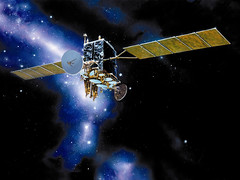
We first wrote about the RaySat antenna system (pictured above) in September.

For sports fans, the MobileDISH service is particularly attractive: just yesterday, it was reported that DISH had added two new HD regional sports networks to its list of channels, and was looking at several more — which could bring a whole new level of connectivity to your local tailgate party.

But how much will it set you back?

New and existing DISH Network customers can choose from a variety of programming packages that start at $29.99/month for the MobileDISH 100 package, and $42.99/month for the MobileDISH 200 package. The Starz Movie Pak can be added to the MobileDISH packages for $12.99/month, and the Encore Movie Pak may also be added to a MobileDISH package for $4.99/month.

Not bad for those who’ve always wanted to watch the game while on the road or in the driveway. 

DIY Friday: HDTV Free-to-Air Box

Friday, May 4th, 2007

So you’ve finished your Quantum Eraser Experiment from last week, and are ready to spend the weekend kicking back and watching a little TV.

But there’s nothing on the cable, and what you really want is to watch your favorite show from overseas.

Enter today’s DIY project — an HDTV Free-to-Air satellite receiver.

Back in September, we wrote about the Lyngbox Free to Air receiver, which promised up to 50,000 storable channels and global functionality:

Most “satellite people” are very familiar with the Lyngsat Web site. It could very well be the world’s most complete database of accurate satellite ladder charts. Pick a satellite and you can view all the channels available for viewing. For example, the AMC-4 satellite carries a number faith-based and international channels in North America. On another site, LyngSat Address, select a country and you can find out which satellites their channels are using for broadcasting – in their home market and internationally. TV Prima Romania, for instance, is using several satellites over Europe, Asia and the Atlantic.

At the time, the Lyngbox seemed imminent, but then we began to hear that they were looking for additional start-up funding and, whatever the case, the Lyngbox has yet to come to market.

Beating them to the punch, however, is the Fortec Star Passion HD Satellite Receiver. And doing-it-yourself (ie, hooking it up) promises to be quite easy: 

 The PASSION HD satellite receiver can connect to your HD-ready television using the HDMI output connection. The component (YPbPr) output can also be used. For analogue connectivity, SCART jacks, composite and S-Video outputs are provided. In addition to the analogue audio RCA jacks, PASSION also provides for digital audio output. For software loading, the USB port can be used. It is conveniently located behind the front panel door next to the two common interface slots.

And this puppy is loaded:

 # MPEG-2, MPEG-4 H.264 HD/SD Digital Video Decoding
# DVB-S2 and DVB-S compatible
# PCMCIA interface (2slots) according to DVB Common Interface standard
# DiSEqC 1.0, 1.2 and USALS (1.3) compatible
# HDMI, Component, Composite, S-Video, Digital Audio (SP/DIF) and SCART outputs
# Multiple output resolution modes: 1080i, 720p, 576p
# 16 bit True color On-Screen Display (OSD)
# Variable Aspect Ratio (4:3, 16:9)
# Multilingual Audio and Menu Text support
# Saves 10,000 channels (TV: 7000 CH, RADIO: 3,000 CH)
# VFD Display (Vacuum Fluorescent Display) for Channel Number, Name and Time
# Full Picture-In-Graphic (PIG) support
# SCPC/MCPC channel receivable from C/Ku band satellites
# Simple Operation through On-Screen Display
# Electronic Program Guide (EPG) for on-screen service information

Fortec is ready to ship, and their website includes a great set of instructional videos, including this explanation of free-to-air channels that is a must-see for anyone who doesn’t understand what it is we’re talking about. (Though we suggest turning down your volume before watching the video, as the music is terrible.)

So what are you waiting for? With cold air in the West, thunderstorms in the MidWest and rain throughout much of the East, this is a fine weekend to stay indoors and watch your favorite TV shows from around the world.


GSA Awards $750m in Satcom II Contracts to 24 Companies

Thursday, May 3rd, 2007

The General Services Administration (GSA) yesterday inked deals with 24 satellite communications companies to deliver the next-generation satellite solutions for government agencies, known as Satcom II.

The Satcom II program is meant "to provide an expanded range of end-to-end satellite solutions for government agencies and serves as the primary replacement vehicle for the highly successful Satellite Services contracts."

Among the service providers are nine small business contractors, according to Washington Technology:

The large contractors are Americom Government Services Inc.; Arrowhead Global Solutions Inc.; Artel, Inc.; AT&T Corp.; DRS Technical Services; EDS Corp.; Global Communications Solutions Inc.; Hughes Network Systems LLC; Intelsat General Corp.; Mackay Communications Inc.; Segovia Inc.; Stratos Mobile Network Inc.; Telecommunications Systems Inc.; Telenor Satellite Services and ViaSat Inc. The small business awardees are CVG Inc.; DasNet Corp.; E&E Enterprises Global; Knight Sky Consulting and Associates LLC; New Orleans Teleport Inc.; Psi Systems Inc.; RiteNet Corp.; Satellite Communication Systems Inc. and Skjei Telecom Inc.

The same story provides details on the Satcom II system:

The Satcom II system will allow federal workers to use hand-held receivers similar to cell phones, as well as access full broadband computer networks, anywhere in the world. It is designed for use in areas where no phone or cable lines exist and to help federal workers fight wilderness wildfires, patrol remote borders and rescue the trapped and injured from hurricanes or tornadoes.

The system also makes possible broadcast services in distance learning for federal customers throughout the world…

The GSA press release notes that the "SATCOM-II program has an estimated value of $750 million over the life of the five-year, indefinite delivery, indefinite quantity contracts, and… offers competitive pricing throughout the life of the contract, as well as flexible ordering and billing."

Computerworld also files a report on the contracts, which, while certainly important to the businesses that inked them, essentially provide basic satcom services. The really cool technological breakthroughs (such as the next-stage C4ISR bandwidth, advanced extremely high frequency satellites and Wideband Global Satcom program) tend to come through military contracts.

Earth-Like Planet Found, But What Does It Mean?

Thursday, April 26th, 2007

By now, most people have heard the news about the discovery by a team of Swiss, French and Portuguese scientists of an earth-like planet just 20.5 light years away from Earth. The news has clearly captured the imagination of scientific writers and people around the world, in no small part because the potential implications of what we might learn about the planet are deep with existential meaning. (This AP title — "Planet-finder says search for alien life next" — exemplifies the anticipatory nature of the coverage.)

But reigning in our imaginations for a moment, what did the scientists truly discover, and how? 


Universe Today offers some good detail on the discovery: 

The host star is called Gliese 581, and it’s one of the 100 closest star to us, located only 20.5 light years away in the constellation Libra. Unlike our Sun, it’s a red dwarf star, emitting much less light and energy. This brings its habitable zone in close and tight to the star. For a planet to be orbiting its parent star within this habitable zone, it’s got to have a really tight orbit.

And this is how the planet was discovered. It was made by measuring the star’s radial velocity, where the planet’s gravity tugs its parent star back and forth (aka, the Wobble Method). Astronomers can measure this velocity with tremendous precision to determine the planet’s mass and orbital period. And the tool for the job is the European Southern Observatory’s HARPS (High Accuracy Radial Velocity for Planetary Searcher) spectrograph connected to the 3.6-m telescope at La Silla, Chile.

The planet is “Earth-like”, but it wouldn’t seem much like home. It’s 50% larger than the Earth, and has about 5 times our planet’s mass. It also completes an orbit every 13 days – it’s 14 times closer to its star than the Earth is to the Sun. Since it’s in the habitable zone, there would very likely be liquid water on its surface.

Unfortunately, the radial method only tells astronomers what the planet’s mass and orbital distance are. They’re not directly observing it. So there’s no way to know if there is actually water on the surface, or even oxygen in the atmosphere that would indicate the presence of life. But future missions, like Darwin, will certainly put it in the cross hairs to get a better look for life.

The discovery was made by a team of astronomers at the European Southern Observatory in Chile. Naturally they are the go-to source for additional information, including this summary video already up on YouTube.

The press release from ESO also tells us that computer models indicate that the planet should be "either rocky — like our Earth — or fully covered with oceans."

The ESA’s Darwin Flotilla (artist’s rendering below; scheduled for launch in 2015) will give scientists additional tools in exploring Gliese 581 and other exoplanets that may harbor life.


And perhaps this discovery will jump start a new, friendly "space race" to discover details about distant exoplanets. As The daily Tribune de Geneve boastfully pointed out, "American scientists recently estimated that the discovery of an exoplanet resembling the Earth would probably take 20 years," it wrote. "The Europeans didn’t wait for them."

Televisa Eyes Satmex

Tuesday, April 24th, 2007


Last week, Rocco pointed in the comment threads to a Wall Street Journal (subscription required) report that Intelsat may be for sale. As Rocco so succinctly put it in the comments:

FOR SALE: Global communications satellite business. Only $11 billion in debt. Good cash flow. Nice office in Bermuda; half-empty building in Washington. Heavy regulatory environment. Price: $6 billion.

We wrote a bit about Intelsat’s history in this post; the Wall Street Journal’s report  (here) has more details on Intelsat’s recent history as a private entity.

Yet Intelsat isn’t the only satcom firm in the midst of (possibly) changing hands. Asiasat yesterday asked to have their stock trading suspended due to a pending announcement, and now come reports that Satmex, too, may be in the sites of a takeover entity.

Variety reports: 

MEXICO CITY — Mexican conglom Televisa is hooking up with the Chinese. VP of broadcasting Jose Baston signed an agreement to distrib state broadcaster CCTV’s international feed in Mexico on Monday. Televisa execs will travel to China in the coming weeks to explore sales of telenovelas and formats to that country…

Net also is considering bids for Endemol and Mexican satellite firm Satmex as possible destinations for its bulging cash reserves.

With Satmex in its fold, Televisa could cut its own international distribution costs as well adding revenue from Satmex’s three birds that cover the American continents. Global sat firms such as PamAmSat also are expected to go after Satmex.

Business News America has greater detail on Televisa’s thinking behind a Satmex buyout:

 Televisa is analyzing what sorts of operational synergies exist between its own operations and Satmex’s coverage, according to de Angoitia….

However, Alberto Moreno, an analyst with corporate ratings firm Fitch Ratings México, downplayed the news saying that it is just one of many investment options that Televisa is weighing up and that it is too early to tell whether the company is a serious contender.

If the company is indeed seriously interested, an official announcement should be made in the short term, Moreno told BNamericas.

Despite the uncertainty, Moreno said that Televisa is looking for new investment opportunities to grow their business particularly to address the US Hispanic market.


Satmex has decent coverage of the Americas with only three satellites. Although Televisa’s recent sale of its stake in Univision was big news, it’s clear from the Satmex reports that Televisa’s interest in the growing U.S. Hispanic market is far from over.


Shields On, Captain!

Thursday, April 19th, 2007


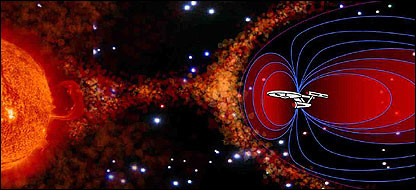
The image above may look like science fiction, but today it’s actually science.

The BBC reports that "British scientists are planning to see whether a Star Trek-style deflector shield could be built to protect astronauts from radiation."

The cancer-causing radiation from cosmic rays and solar flares has always been a danger to astronauts, but that danger has been mitigated by the minimal durations of time that most individual astronauts have spent in space.

Crew members on the International Space Station have a thick-walled room that they can retreat to during times of increased solar radiation:

 But these protective shelters would not be practical on long-duration space journeys, since the "drip-drip" of energised particles is thought to be as harmful to the health of astronauts as large solar storms.  

The harmful particles come from the Sun, in the form of the solar wind, and from sources outside our Solar System.

To create the deflector shield around a spacecraft or on the surface of a planet or moon, scientists need to generate a magnetic field and then fill it with ionised gas called plasma….

"You don’t need much of a magnetic field to hold off the solar wind. You could produce the shield 20-30 kilometres away from the spacecraft," explained Dr Ruth Bamford, from the Rutherford-Appleton Laboratory in Didcot, UK, one of the scientists on the team.

Dr Mike Hapgood, from the Didcot-based research centre, told BBC News: "The nice thing is that magnet technology is really quite evolved here on Earth. The question is can you take it into space?’"

The team from Rutherford-Appleton plans to build an artificial magnetosphere in the laboratory. They would eventually like to fly a test satellite which would test the technology in space…

The idea has been likened to the deflector shields which protect the USS Enterprise and other spacecraft in Star Trek. Like their fictional counterparts, these shields could also be switched on and off….

The idea for the shields draws on technology pioneered in experimental nuclear fusion reactors. Nuclear fusion is not yet a mature technology.

It works on the principle that energy can be released by forcing together atomic nuclei rather than by splitting them, as in the case of the fission reactions that drive existing nuclear power stations.

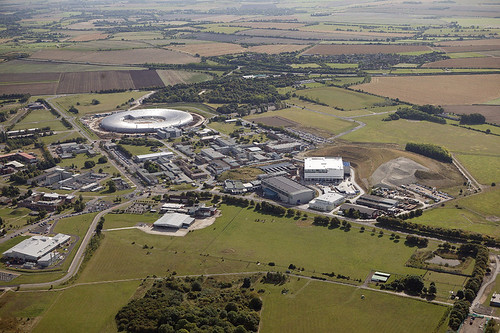
The Rutherford Appleton Laboratory (pictured below), where the research is taking place,  "has a staff of around 1200 who support the work of over 10000 scientists and engineers." Located in Oxfordshire, RAL is one of the largest space research laboratories in Europe.
For more information on magnetic fields and the debate about their effectiveness, check out this active discussion on Slashdot, including this comment:

 The big engineering problems with this approach still have not been solved. (1) If you’re not using superconducting magnet coils, a large, static magnetic field requires a huge power supply to keep it going. That’s not practical for foreseeable, near-future technologies for going to Mars, which will need to use very small payloads. (2) Superconducting magnets are unreliable, finicky beasts, at least from my experience here on earth. You need big, heavy cryostats full of liquified gases. It’s not necessarily a good idea to have a vital piece of safety equipment for your spaceship depend on an inherently high-maintenance, low-reliability technology. (3) Large electric fields are hard to maintain because you get arcing and discharges. I used to work at an electrostatic accelerator that used megavolt potentials, and it would start sparking at the most inopportune times, for reasons like, e.g., someone leaving behind a speck of lint inside the accelerator. When a spark would happen, you could hear it all through the building, and the energy released was equivalent to dropping a VW bug off the roof of a building. Again, low-reliability, high maintenance. (4) Although it’s possible to use tricks to get rid of some of the particles, or channel particles to a place where they’re not as harmful, you still have to deal with the fact that you have particles with both signs of charge, which feel forces in opposite directions from the same field. What repels one attracts the other. Also, if the particles get channeled to a certain place, and impact on something solid, then you get extremely intense secondary radiation at that spot.

Of course, this is pessimistic nonsense. We’ve seen magnetic fields work nearly 80 times


The Great Turtle Race!

Tuesday, April 17th, 2007

Here’s a great story about how the combination of satellite tracking technology and the Internet can be used to raise awareness about conservation efforts around the world.

The Leatherback Sea Turtle is the biggest of all living turtles and the world’s fourth-largest reptile, reaching more than 6 feet in length and weighing up to 2000 lbs. It is also listed as endangered worldwide by the U.S. government, with the global population of female leatherbacks plunging from an estimated 115,000 in 1980 to fewer than 43,000 today.

Ranging throughout the Pacific, Atlantic and Indian oceans, leatherbacks worldwide are threatened not only by coastal development and loss of habitat, but by ocean pollution and "floating plastic bags or sheets which they mistake for jellyfish — a staple of their diet." 90 percent of the leatherbacks have vanished and the species may disappear within 10 years due to illegal poaching of their eggs, according to conservationists.

To draw attention to the plight of the leatherbacks, conservationists yesterday launched the Great Turtle Race.

The AP reports:

Biologists will switch on satellite trackers strapped to the backs of 11 female leatherback turtles on Monday, starting what conservationists have dubbed the "Great Turtle Race" to raise awareness of a species threatened with extinction.

Sponsored by U.S. and Costa Rican environmental groups and businesses, the race will track the turtles on their annual 1,200 mile journey from Costa Rica’s Pacific coast to the Galapagos Islands….

Most of the competing turtles are expected to be in the water by Monday after laying their eggs on the beach at Playa Grande in Costa Rica.

The Web site features virtual trading cards with caricatures of the turtles with names like Freedom, Windy and Stephanie Colburtle after U.S. comedian Stephen Colbert of Comedy Central fame. It also has stats on their egg-laying history…

Ten race sponsors — including Yahoo Inc., Plantronics Inc., Philadelphia’s Drexel University and Dreyer’s Ice Cream — donated $25,000 each to purchase the tracking equipment and protect nesting areas from development.

Leatherbacks aren’t the only sea creatures that are getting tagged with satellite trackers to raise awareness and scientific knowledge about  the world’s oceans. The Census of Marine Life has a great site, Tagging of Pacific Pelagics, where users can track tracking projects of a variety of species and view real time data of the movement of sharks and other animals in the Pacific. And NASA is tracking sea lions to gain a better understanding of the world’s oceans.

For ease of use and entertaining presentation — especially for a younger audience — it’s hard to beat the Great Turtle Race website. Check it  out, because those turtles are, um, making some quick tracks.