Boston Red Sox fans woke up at 6 am this morning to tune in the first pitch of the Major League baseball season opener (held this year in Tokyo) only to find — nothing:
I’ve been getting emails from DirecTV customers, who’ve said that their packages (ESPN2 and NESN) are out. Not sure if this is affecting all customers, or just some, but apparently there are some very unhappy early risers.
It’s been our general experience that it’s best not to anger Red Sox fans first thing in the morning — or any time of the day, for that matter.
The customer service phone line said there was a system outage, according to the comments the Extra Bases blog.
Turns out, the Standard Definition NESN Channel was out but NESN HD continued working. ESPN2HD was out, too, on DirecTV.
It was a dangerous situation, with one Boston fan warning, "I’m gonna go flip some cars."
Bobby Valentine himself thought the timing (of the game, not the outage) was "ludicrous."
The Red Sox ended up defeating Oakland 6-5. No official word yet on what caused the broadcast out(r)age.
The speed with which a great white shark released from Monterey Bay Aquarium last month has made its way down to Mexico is making the news:
The great white shark that was released from the Monterey Bay Aquarium in February definitely knew what it meant to swim and don’t look back. The great white shark has made incredible progress since leaving the aquarium, and has many stunned.
The shark took just six weeks to make it all of the way to Baja.
The shark was a young male and spent 162 days at the aquarium after it was caught by a commercial fisherman in August.
"It’s surprising that he did it as quick as he did," said John O’Sullivan, who oversees the live animal exhibits at the aquarium.
At a speed that’s astonished even longtime researchers tracking his progress through electronic tags, the shark has made it to 40 miles west of Mazatlán and is now the fastest young great white shark on record, O’Sullivan said.
None of the other sharks tagged and released by the aquarium have made it to Mexico with such accuracy and speed.
"It’s exciting to us that this animal has shown this behavior," O’Sullivan said.
Researchers from several institutions, including Stanford University, have joined their efforts in a Census of Marine Life project called Tagging of Pacific Predators (TOPP). Since the project began in 1999, they have attached more than 3,000 tags to sharks, seals, whales, tunas, squids, turtles, albatross and more. For the first time, these TOPP researchers are getting a glimpse of a pelagic ecosystem from the California Current to the North Pacific at daily, seasonal and yearly time scales….
Through tracking the tagged sharks, the TOPP team has found two distant destinations that the sharks favor, both of which they visit on a regular, annual travel timetable. Each winter the white sharks head out from the California coast, with some going to the Hawaiian Islands. Most, however, head to another hotspot, out in the middle of the Pacific Ocean. This second location is roughly 1,300 miles from the mainland—about half the distance to Hawaii—and a few hundred miles to the south of the direct route to the islands. Dubbed "the white shark café" by the researchers, just what the attraction is out there remains something of a puzzle. But what is clear is that all the sharks that summer along the California coast show remarkable fidelity; when they return to the mainland, they head for the same local neighborhoods that they favor every summer.
Let’s just hope the great white released from Monterey Bay doesn’t favor a certain beach off the coast of Long Island. With his speed, he could just make it there by the 4th of July.
Sea Launch yesterday lifted the DIRECTV 11 satellite from its ocean-based platform on the Equator.
Yesteray’s launch marks Sea Launch’s 4th successful launch of a DIRECTV satellite:
A Zenit-3SL rocket lifted off at 3:48 pm PDT (22:48 GMT) from the Odyssey Launch Platform, positioned at 154 degrees West Longitude, precisely on schedule. All systems performed nominally throughout the flight. The Block DM-SL upper stage inserted the 5,923 kg (13,058 lb) DIRECTV 11 satellite into geosynchronous transfer orbit, on its way to a final orbital position at 99.2 degrees West Longitude. Acquisition of the spacecraft’s first signals from orbit is expected in another few hours and will be reported when confirmed….
DIRECTV 11 is one of three recent Boeing 702-model spacecraft built for DIRECTV and is among the largest and most powerful Ka-band satellites built to date. The on-board technology of this direct-to-home satellite will enable DIRECTV to continue to expand its industry-leading lineup of quality high-definition television (HDTV) programming. DIRECTV 11, combined with the DIRECTV 10 satellite already in orbit, will provide DIRECTV with the capacity for 150 national HD channels and will be capable of supporting spot beams carrying 1,500 local HD channels.
Video of the launch can be seen here; a live webcam of the Sea Launch platform is viewable here.
It was just over a year ago that Sea Launch experienced a spectacular failure during its launch of the NSS-8 satellite. (The booster rocket exploded in a fireball during lift-off.) Additional details of that incident (as well as a pretty dramatic photo) can be seen in the comment thread of our blog post on that launch.
DirecTV last week "gave viewers a front row seat to the legendary South By Southwest (SXSW) music festival with DIRECTV SXSW Live, a live broadcast concert series featuring 24 performances broadcast in HD and 5.1 surround sound direct from Austin, Texas."
Along with Miller Lite, DirecTV was also one of the festival’s sponsors. But the festival wasn’t all just punk rock and debauchery (well, depending on where you went); there was a strong element of green responsibility to be seen and heard among all the live acts. The Festival purchased Renewable Energy Credits (RECs) from the City of Austin to negate its carbon footprint of 263 tons generated during the planning and delivery of its 2007 event. For 2008, plans included:
…offering all delegates 24/7 access to biofuel made from cotton seed waste for their vehicles; eliminating all bottled water for staff and volunteers and using municipal water fountains instead; featuring environmental issues in the conference programs and offering tips to delegates on how to have a greener SXSW.
Of course, bands and music performance all around Austin is cool, and indie films are always interesting. But the Interactive Awards presented are what really strike our Really Rocket Science imagination.
The list of finalists alone is worth a good day of web-browsing. From the intriguing World Without Oil to the useful Wikinvest, a person could kill a large part of a Monday (ahem) just perusing the creative websites.
Also noteworthy are the winners and honorees of the Dewey Winburne Community Service Award, honoring the memory of one of the key co-founders of the SXSW Interactive festival.
Finally, we’ve long been fans of the XO Laptop, better known as the $100 (now $200) laptop. In Dallas, the XO users group had their 4th meeting to coincide with the SXSW festival, while at the festival itself, David Seah used his OLPC as a conversation starter to meet new people. (Meanwhile, the city of Birmingham recently inked a $3 million deal to provide XOs to every child in grades 1 through 8.)
Ever want to combine the life of the open road with your interest in satcom? Then checking out this blog on the life of a satellite truck operator is a must-do.
Of course, if you really want to turn the dream into reality, you’ll need a truck. And that can cost some serious dough.
Frontline Communications builds and sells a variety of satellite trucks — but again, it costs a pretty penny.
The low(er) cost solution to living the dream, of course, is to Do It Yourself. Several years ago the Daily Wireless blog did a post on how to build your own satellite truck. Unfortunately, most of the links there are now dead.
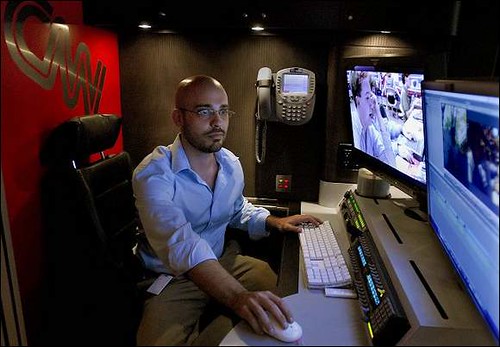
For CNN’s Election Coverage, they decided they needed quite a bit — building their own Election Express vehicle complete with a portable HD studio:
Frontline Communications was the systems integrator and overall project manager for the vehicle. The two-year effort also included another Clearwater, Fla., company, Parliament Coach, a specialist in high-end vehicles….
The bus uses a satellite pool from iDirect Technology, a Herndon, Va.-based developer of satellite broadband systems. The system provides reliable bandwidth for the four video feeds as well as ordinary Internet, telephones and the intercom system.
With their Atlanta area codes, the onboard phones behave just like landlines, said Bohrman.
And the 64×64 RTS Cronus intercom system can connect over iDirect to Atlanta or anywhere else, according to Frontline Project Manager Jeff Steele.
Massive patch panels are on both port and starboard (so the bus can still operate with one side blocked). Two 25 kW diesel generators rumble in the stern—one for the lighting and normal front-end bus operations and one for the racks and racks of TV-related systems in the rear. And if one fails, the other can take over.
A video of the CNN rig can be seen here. Here’s a photo of the interior:
WiFi connectivity and a phased array Intelsat BGAN terminal allow the bus to transmit video while in motion. Two Clearwater, Fla., companies — Frontline Communications and Parliament Coach — spent two years merging the demands of a live satellite truck with a tour bus for the press, making the 45 foot Prevost H-45 bus into a traveling press room, capable of going live virtually anywhere.
However you decide to pimp your satcom ride, don’t forget to get Leslie Nielsen to promote your new rig, as this Sacramento station did back in 1986.
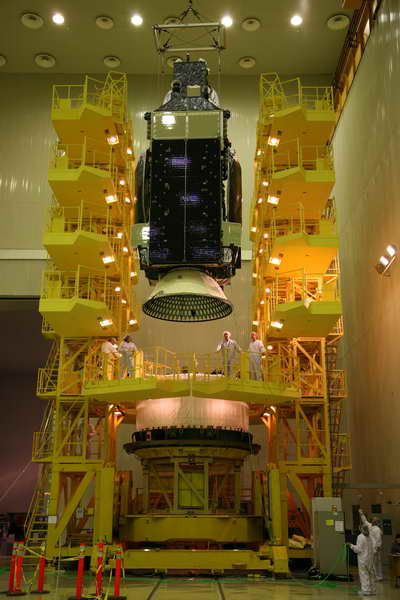
SES-AMERICOM’s AMC-14 launches from Baikonur Cosmodrome in Kazakhstan aboard a Proton M rocket on Friday night.
Local time for the launch is 5:18 a.m. on Saturday 15 March 2008 — or 23:18 GMT on Friday the 14th of March.
What that means is you can watch the launch live in the United States — but if you’re on the East Coast, you may wish to start feeding the kids at 6 o’clock.
The last update from the launch blog (on March 11) tells us:
The roll-out of the fully assembled Proton Breeze M launcher, carrying the AMC -14 spacecraft, to Launch Pad 39 commenced early in this morning (at 6:30 a.m. Baikonur time). By 10 a.m. the rocket was erected in vertical position. Once installed onto the pad, the Proton was enclosed inside a mobile service tower.
AMC-14 was originally part of a grand plan for direct-to-home services. 8.2 KW of power, the spacecraft has an active phased array (APA) payload consisting of a receive mode APA antenna, and the highest levels of redundancy on core components such as amplifiers, receivers, commanding beam and computer control systems. This means coverage can be reshaped while in orbit.
Developed primarily by Lockheed Martin Commercial Space Systems, the APA will be a key satellite technology for future missions.
From the get-go, AMC-14 will provide AMERICOM2Home® services in the United States for EchoStar Communications’ DISH Network.
The trade group says that the results of the testing showed that the WiMAX transmit signal could cause significant problems to a satellite digital signal well in excess of 12 km distance. At the extreme measurement distance, the video program was fully operational with the WiMAX carrier centered on the video carrier. However, the data BER was degraded from a nominal 10-8 to a BER of 10-4. This is an unacceptable quality of service in the digital telecommunications industry….
"The C-band is in many ways the lifeline of the satellite industry and protecting that spectrum from the threat of interference posed by sharing it with Broadband Wireless Access services is of paramount importance," said Robert Ames, SUIRG President. "The tremendous support of the SUIRG member companies and the industry as a whole in making this test a viable platform to aid decision makers at WRC-07 was extremely gratifying. The results of the test are a firm testament to the need for clearly defined spectrum allocation."
That interference has caught the attention of federal officials in the U.S., who worry that WiMAX deployment could interfere with crucial C-Band signals used daily by the Department of Defense and civilian agencies.
Yet in the developing world, WiMAX and Satcom can play nicely together and provide leap-frog technology solutions for bringing the Internet to remote areas.
As we blogged last year, HughesNet in Brazil is combining the long-range wireless solution of WiMAX with Internet Protocol over Satellite (IPoS) to reach the most remote areas of the Amazon basin.
But new solutions bring new competition, and one can get around the C-band interference simply by using the Ku-Band, which Gilat uses extensively.
Broadening its product offering to include WiMAX-based solutions, Gilat will distribute Airspan’s WiMAX solutions globally to its large base of existing customers as well as new customers, leveraging its core competencies including strong global sales, turnkey project delivery and local support capabilities. The new agreement will enable Gilat’s customers to address their broadband wireless access and satellite communications needs through a well integrated ‘one-stop-shop’ solutions provider.
"We are excited to enter into this partnership with Gilat, who has a global reach into the world’s high growth markets and which will allow us to further expand our distribution channels. It’s a win-win situation for both companies and highlights the synergies to be realized between shared customers and similar types of applications. Airspan continues to gain momentum and recognition as a leader in WiMAX in a very competitive market environment," commented Eric Stonestrom, Airspan’s President and CEO.
The space shuttle Endeavour is set to liftoff tomorrow at 2:28 a.m. EDT on the STS-123 mission, which will deliver a key component of the Dextre (short for Special Purpose Dexterous Manipulator) robotic arm as well as the first section of the Japanese-built Kibo laboratory.
A team of space-walking astronauts will assemble Dextre, which weighs about 1,560 kilograms, and attach it to the outside of the space station.
Dextre — 3.7 metres high and 2.4 metres wide — has two multi-jointed arms attached to its torso, a tool holder and a camera/light unit.
"Each arm has seven joints," Swanson said, adding the body can rotate. "It is a complicated arm to operate, but of course it gives you the ability to do all sorts of things with it."
Assembling Dextre will take three space walks of the five scheduled for the 16-day mission, but Swanson said it will take another two months of testing to make the robot fully operational.
Dextre is "is the third and final component of the Mobile Servicing System (MSS) developed by Canada for the International Space Station," the Canadian Space Agency writes on its website.
[W]ith its two arms, Dextre will load and unload objects, use robotic tools, attach and detach covers and install various units of the Space Station. It will either be attached to the end of Canadarm2 or ride independently on the Mobile Base System and have Canadarm2 deliver equipment to it for servicing. It also has four cameras that will provide the crew inside the Station with additional views of the work areas.
Dextre is a huge accomplishment for the Canadian space industry, which has recently been embroiled in controversy over business-related changes to their prime space contractor.
Canada.com called the plans by U.S. firm Alliant Techsystems to purchase MacDonald, Dettwiler and Associates’ space and military assets for $1.325 billion "an affront," while the Ottawa Citizen and others have claimed it is vital to Canadian defence that the country maintain its own ability to launch and control its own satellites. (We’ve blogged about similar concerns about Canadian telecommunications and satellite independence.)
The Endeavour flight is commanded by Dominic Gorie, with Gregory H. Johnson serving as Pilot. The crew also includes Mission Specialists Rick Linnehan, Robert L. Behnken, Mike Foreman, Garrett Reisman and Japanese astronaut Takao Doi.
[A] team from Japan Women’s University has developed "everyday spacewear," to make things more comfortable for astronaut Takao Doi during his stay on the station…
The team… has spent three years developing practical spacewear suited to a weightless environment.
They developed eight items, including long- and short-sleeved polo shirts, shorts, trousers, socks, underwear and a tracksuit top and bottoms….
Perhaps surprisingly, there is a lot of dirt on the space station, which means clothes get grubby easily.
The group created a polyester fiber-cotton blend fabric that allows sweat to be quickly absorbed and dried, which prevents dirt sticking to the garments.
The team also came up with ways to prevent the clothes interfering with electronic instruments onboard, such as interweaving them with a metallic fiber to prevent the buildup of static electricity.
Many of the everyday clothes worn by astronauts staying on the International Space Station are personal items bought from normal stores. But in a weightless environment, the hems and cuffs rise making them uncomfortable to wear–another problem overcome by the new items.
Kibo (meaning "hope" in Japanese) is the first manned facility made by Japan to be added to the ISS. The Pressurized Module of Kibo will be primarily used for experiments in a microgravity environment.
HBO today seems like an old familiar standby, but the channel has a strong history of being the first to adopt new technologies to expand its audience reach.
Way back in 1975, HBO went national using the Satcom 1 satellite, leading in a direction that the rest of the cable programming industry would soon follow:
On September 30, 1975, HBO, affectionately known colloquially as "Home Box", became the first TV network to continuously deliver signals via satellite when it showed the "Thrilla in Manila" boxing match between Muhammad Ali and Joe Frazier. On December 28, 1981, HBO expanded its programming schedule to 24 hours a day, seven days per week. (Cinemax was 24/7 from the day it signed on, and Showtime and The Movie Channel went 24 hours earlier.) In January 1986, HBO also became the first satellite network to encrypt its signal from unauthorized viewing by way of the Videocipher II System and in 1993 became the world’s first digitally transmitted television service. In 1999 HBO became the first national cable TV network to broadcast a high-definition version of its channel.
Fast forward 33 years, and its no surprise to see HBO is among the first networks to start its own channel on YouTube. We’ve seen in the presidential race the incredible reach that YouTube has when quality, entertaining content is made available to users. The pro-Obama music video Yes We Can, for example, has reached more than twice the viewers of the last presidential debate.
Al Gore’s Current TV channel, of course, has been at this nexus between the internet and television for several years, and has embraced its ancillary of user generated content. UGA is likely to further transform the media landscape, especially as the promise of IPTV opens up the possibility of millions of channels — and each of those channels will need to be fed fresh content.
Until then, you can watch the Sopranos at work, which we think is a good thing.
Scoring at the Satellite show in Washington? Maybe at Sunday’s hockey game (the New Jersey Devils beat the Washington Capitals in overtime).
While formally beginning tomorrow, today’s "preday" schedule at the Satellite 2008 conference in DC is chock full of panels and presentations.
As the conference website says, Satellite 2008 is "where the most prominent experts, C-Level executives and thought leaders" in the satellite industry "join forces for YOU."
It’s also a great place to see the formal lifting of the curtain on new technology. Some highlights from a round of press releases provides a virtual stroll through the display booths:
Hughes Network Systems "will showcase the power of broadband services as it highlights its advanced fixed and mobile satellite offerings…Visitors to the booth can experience these services first-hand through interactive demos. From digital signage, to distance learning, to emergency communications and continuity of operations, Hughes is leading the way in bringing broadband to governments, enterprises, small businesses and consumers. Hughes executives will be presenting on several panels throughout the conference, addressing topics ranging from government solutions and hybrid networks, to Ka-Band opportunities and top satellite markets of the next half-decade."
iDirect, which recently tested the commercial version of its DVB-S2 Evolution platform simulating a live customer environment, will have a booth where users can try out the platform’s VoIP, Web browsing and other capabilities. iDirect’s Evolution platform comprises a new line of DVB-S2 remotes and line cards as well as advanced operating and network management software, according to their press release. "During the tests, the platform’s Adaptive Coding and Modulation (ACM) feature successfully enabled iDirect’s Evolution series remote to maintain optimum coding and modulation schemes, operating at 16-APSK during fair weather conditions and shifting to more robust modulation and coding schemes during a simulation of link fade conditions."
MorganFranklin and GATR Technologies will be at booth #1600. "GATR will display its transportable, inflatable, high-bandwidth satellite antenna system (GATR-Com). Its unique inflatable design allows it to be carried into locations where a high-bandwidth (large aperture) dish is required and a satellite truck or trailer cannot be deployed. MorganFranklin will provide the reliable communication infrastructure (satellite, RF and IP network integration) that completes the connections (IP-based phone, Internet, broadcast video/audio and/or data) as needed for challenging communication situations such as mobile emergency communications, remote news gathering and broadcasting, and military applications."
Newtec, a world-leading innovator in the satellite and communications industry, will be displaying ‘Point&Play’, "an innovative capability involving an antenna pointing tool, combined with advanced satellite modem software, which allows the installer, be it a professional installer or the end user, to easily position the antenna correctly. It does not require any computer pointing software, provides correct satellite identification and gives feedback on both signal quality and correct satellite lock."
Undoubtedly, there will be other displays of interest at Satellite 2008. What are you seeing that fires your imagination?