Author Archive

NASA to Close NAIC (and stop thinking about the Future)

Thursday, March 22nd, 2007

So what do you call a space agency with no institute for advanced research? Wait, you can still call it a space agency?

While that’s not much of joke, it reflects the increasingly grim reality at NASA if the recent reports in the New Scientist and WIRED are believed to be true that suggest the NASA Institute for Advanced Concept (NIAC) is being closed due budget constraints. What’s the ironic source of the constraint’s that might put an end to NASA most forward thinking research institution? Why building the next generation space craft set to replace the shuttle after its forced retirement in 2010.

For those who haven’t seen the many different stories we’ve done on all the various projects the NIAC has undertaken since its 1998 founding, NAIC has a far out mission that aims to prepare NASA for humanity’s future in space, from their website:

"NIAC seeks proposals for revolutionary aeronautics and space concepts that could dramatically impact how NASA develops and conducts its missions. It provides a highly visible, recognizable, and high-level entry point for outside thinkers and researchers. NIAC encourages proposers to think decades into the future in pursuit of concepts that will "leapfrog" the evolution of current aerospace systems. While NIAC seeks advance concept proposals that stretch the imagination, these concepts should be based on sound scientific principles and attainable within a 10 to 40-year time frame."

While budget constraints are budget constraints, I’m going to have to agree with the folks over at the NASA Watch when they say eliminating the NIAC is a big mistake.

"This is just plain stupid. Let me repeat this for clarity’s sake, Mike [Griffin, NASA Administrator & "head honcho"], (whoever made it) this is A STUPID DECISION. Advanced spacesuits that will open the surface of the moon – and then Mars- to meaningful and productive human exploration, tethers and other innovative and upmass-saving technologies, and other in-space technologies.

Where are you going to get all of the things you need to put on those Ares rockets so as to allow their crews to carry out their missions, Mike? Or do you "just need a good map"? Explorers without the right tools die – or turn around – and head back home. Wrong answer, Mike."

Right on!

Lots in Alaska for… Free?

Monday, March 19th, 2007


Rocket scientists looking for a cheap place to crash might want to check out the friendly hamlet of a recent AP report, the town is giving away land in a fashion reminiscent of the old Homestead Act of the 1862. Here’s the skinny direct from the city’s web page on the give away:

"The City of Anderson is selling up to twenty-six lots at no costs starting March 19, 2007 at 9:00 AM. Applications will be selected on a first come, first served bases. A $500.00 refundable deposit will be required at the time of application. Applicant will be required to build a residential home within 2 years from date of signed agreement. Other covenants and restrictions apply. Lots are 1.3 acres in size, electrical and phone has been installed. In April, the city council will hold a lot selection meeting for applicants to select their individual lots, based upon the first come, first served criteria. For more information contact the city clerk @ 582-2500 or [email protected]."

Supposedly those who are already up there or proxies in the area are most likely to get access to the lots, since the Post Office doesn’t deliver mail to city offices until after noon.

So why might Rocket Scientists be up for cold (but free) Alaska winters? Well, it seems the Clear Air Force Station is located not too far away from the free lots, making them ideal cheap digs for those looking up and listening to the night sky for Uncle Sam. While it might not be northernmost military base in the US (that honor belongs to Thule Air Base in Greenland), its certainly among the coldest. Hey, at least its neighboring communities are pretty hospitable, right?  Look, residents can even participate in the Nenana Ice Classic (just 20 miles from Clear AFS), that lets people win if they guess when the ice in the Tanana River finally moves out.  Watching ice melt… talk about a good time!

DIY Friday: Build Your Own HDTV on the Cheap

Friday, March 16th, 2007

Last November we told you how to make your own HDTV antenna for next to nothing, but once you get your antenna on the roof you going to need an HD display to get the picture, right?

 

Well, not so much. As we also said in November, the monitors necessary to see the sneaker scuffs on on the boards of your favorite team’s NCAA tournament game (which will no longer includemy alma mater — thank you very much, Villanova) are usually the expensive part of the HDTV conversion, but if you have a spare (decent) PC/Mac lying around you could just make it your required monitor. What we didn’t share with you in November was the number of tuners (super tiny ones at that) that can help you grab the signal coming from your antenna even when your on your laptop.

While the ATI TV Wonder 650 might be considered old faithful, it is, after all, a card designed to be inserted into your PC meaning you’re pretty much stuck watching television on your desktop. If you’re looking for a more mobile experience (and don’t mind watching TV in your hotel room while holding an aerial), you should check out the crazy small Fuji PLUS FD-USB728 USB 2.0 Interface USB HDTV ATSC/NTSC TV Tuner For PC&Notebook (right). Designed specifically for your laptop, the Fuji PLUS seems to be the for anyone looking to see television the way it was meant to be watched from anywhere in the country.

Oh and what if you’re a mac user, like yours truly? Well, have no fear, the four-and-a-half Macworld mouse-rated Miglia TVMini HD is here for your viewing pleasure, complete with Elgato Systems‘ award winning EyeTV 2 software (although if you’re interested in this feature, buy it as fast as you can, because Elgato seems to have just yanked Miglia’s distribution liscense for the software), which lets you schedule recordings and turn your saved shows into DVD and Video iPod-compatible formats.

Facing the Next Katrina with Satellite

Monday, March 12th, 2007

Nearly five and a half years after September 11 and eighteen months since Katrina, the U.S. Department of Homeland Security and many of the country’s public safety agencies and organizations have yet to solve the problem of interoperatable communications. While this might seem pretty nerdy, its the lack of communication system cross compatibility that prevented firefighters from hearing police calls to escape the WTC when its exterior began crumbling and ultimately limited the execution of a full-scale evacuation of the Gulf Region in August 2005.

Fortunately, the U.S. Congress is finally starting to make some headway, albeit after Former DHS head Tom Ridge slammed the government for failing to deal with the problem. In addition to pushing legislation that would modernize the 911 system throughout the country (particularly in rural areas), the Senate recently approved Interoperable Emergency Communications Act (S.385), which according to Senator Ted Stevens (R-Alaska)’s website,

"provides the National Telecommunications and Information Administration (NTIA) with more guidance as it awards $1 billion in interoperable emergency communications grants to police, firemen, and emergency medical personnel… This bill would allow up to $100 million of the expedited $1 billion to be used to establish technology reserves that would assist emergency response agencies in pre-positioning communications equipment in state or regional facilities. These reserves can be activated quickly in the event of a major emergency or natural disaster"

While this has led to Nextel co-founder Morgan O’Brien to suggest (and for Fmr. Sec. Ridge to support) the creation of a national broadband public safety network using "a slice of spectrum in the 700 MHz band that is scheduled for auction in 2008," there is another more immediate and potentially less costly option… satellite. As Satellite Industry Association (SIA) Executive Director David Cavossa recently pointed out in a press release,

"Hurricane Katrina and other recent disasters have shown, satellite communications are uniquely able to provide resilient, redundant, and ubiquitous communications when all other terrestrial-based communications fail."

While its probably not the only solution, it seems that Katrina probably taught us that satellite technology should be included in any robust, interoperatable emergency communication systems solution. Working together with standard radio-based wireless technologies, options built on technology similar to SES-Americom’s REDiSat Network might be just the ticket.

DIY Friday: SXSW & Austin

Friday, March 9th, 2007

This week’s DIY Friday combines two of my real loves – DIY projects and music – by bringing together two of my favorite things: Make Magazine and South By Southwest (aka SXSW). I know all of you have already heard about MAKE (we’ve covered a few of their projects right here in this weekly feature), but, for those who haven’t heard about SXSW, its one of the best general "media" conferences in the world.

Even those who’ve heard about SXSW might not know that it is really three different events rolled into one: The SXSW Music and Media Conference, the SXSW Interactive Festival, and the SXSW Film Conference and Festival. The whole affair begins today and lasts ten days (that’s through the 18th) and features hundreds of musical acts on 50 stages in downtown Austin, dozens of keynote presentations and workshops by leading thinkers and new medias, and a series of films from rising talent that easily rivals Sundance. In short, for those interested in what we’ll be watching, listening to, and thinking about in the next five years, SXSW is the place to be.

While that all might be enough for any dedicated RRS reader, those interested in DIY projects like myself might be excited to learn that the Senior Editor of Make Magazine, Phillip Torrone, will be keynoting with Limor Fried, a DIYing Engineer and Artist in her own right, on Sunday. While its hard to predict what two brilliant DIY minds might get into during the talk, I can assure you it will be interesting.

For those that can’t make it, while you might not be able to see Sunday’s kick ass keynote, you can tune to channel 101 on your DirectTV [fuller descriptions are available at the listings at SXSW Live] and check out many of the festivities (although mostly musical) in the weird, liberal oasis that is Austin, TX.

Oh, and if you missed out on the fun of SXSW like I will you might want to make plans to visit Austin this fall nonetheless, because it looks like Austin will also be the home to one of 2007’s MAKE Faires. While it might not have the hipster cachet of SXSW, you better believe you’ll have the opportunity to see (and make) some cool stuff like the crowds did last year.

Satellite Distributed Movies Set to Emerge in 2007

Monday, March 5th, 2007

While the technology has been talked about for years, many experts are positioning 2007 as the year that digital movies and satellite distribution of box-office blockbusters take flight. Working in conjunction with Warner Bros. Entertainment and Universal Pictures, Digital Cinema Implementation Partners (made up of big name theater companies AMC, Cinemark and Regal) is working to "use satellite and broadband delivery systems to beam digital films directly to theaters, rather than have them copied onto hard drives and delivered by hand, as they usually are now."

While the theater chains and studios are looking at the technology as a great way to decrease the likelihood of piracy (the theory being that encrypted satellite transmissions would mean fewer hands are on the prints), it could also mean improved access to popular films and big screen showings of smaller films that struggle for an audience large enough to usually get them. As the AP article about the technology notes that satelite distribution,

"would give U.S. theater operators the flexibility to put a popular movie on an extra screen as quickly as the demand arises… At the same time, theater operators could stop showing a surprisingly unpopular film and even book an art-house film with a small but devoted audience for a day or two."

While Variety and Hollywood are explicitly concerned with the digital cinema’s implications for the US market, the Hindustan Times points out that the technology may be even more welcome throughout the developing world where, although movie theaters are plentiful (with over 12,500 movie houses throughout India alone), the relatively small number of "prints" (sometimes only 500) available of any given film arbitrarily limits distribution.

Anti-Jamming Technology Goes Commercial

Tuesday, February 27th, 2007

The Times reported yesterday that Boeing is looking to put anti-jamming technology previously reserved only for the military on commercial satellites used by business and the communications industry. According to the article,

"Anti-jamming technology is already used by military and spy satellites, but proposals to install similar protection in the 250 large satellites in commercial operation have been prompted by the threat of disruption.

The successful jamming of video, data, or voice signals by individuals or groups could jeopardise the millions of dollars spent on just a handful of satellites, operators fear.

Such jamming of government navigation satellites has already occurred, according to Lieutenant General Robert Kehler of the US Air Force, ‘as has jamming of commercial telecommunications satellites.’"

Space.com has a great background report on Spy Satellites for those who want to know a little bit more about the technology and the American Military and Intelligence communities uses of the technology. While Spy Satellites have been used for quite a long time, even the latest anti-jamming technologies are unable to prevent detection, the spy satellite holy grail. While satellite project, such as MISTY, have been able to avoid detection by laser and microwave radar, none has been able to completely avoid visible detection, a limitation which has prompted the emergence of a small, but strong spy satellite monitoring enthusiast community.

Oh, and for those of you who might be worried about the commercial anti-jamming technologies making it into the wrong hands, it looks like your not alone. While Boeing seems confident that they’ll win it, the U.S. government does have to approve the use of the "top secret" anti-jamming technology on commercial satellites before the company can start introducing it on products sold to foreign customers.

UN Getting Closer to Space Junk Guidelines

Monday, February 26th, 2007


We all know space debris (or space junk, as I like to call it) is a big problem. While the lost cameras, gloves, and toothbrushes may reenter the atmosphere and burn-up without too much of a problem, the sheer number of spent rocket stages, broken down satellites, and broken off bits and pieces that come along with both pose a real hazards for working satellites, the International Space station, and astronauts on a space-walk. Moreover, the more space junk we create the more we have to watch. Currently, U.S. Strategic Command tracks over 10,000 pieces of space junk to ensure each piece’s reentry is not mistaken for enemy fire from above.

Fortunately, according to Aviation Week, the UN is making some headway in the fight against the floating trash, having secured the support of China for a landmark resolution that would set guidelines for limiting space debris. China’s support for the resolution was less than certain, particularly given its recent testing of anti-satellite weapons technology that generated a fair amount of space junk, itself, in the process. Most likely the Chinese may have felt they were safe from scrutiny, because the new guidelines are designed to curtail unintended space debris.

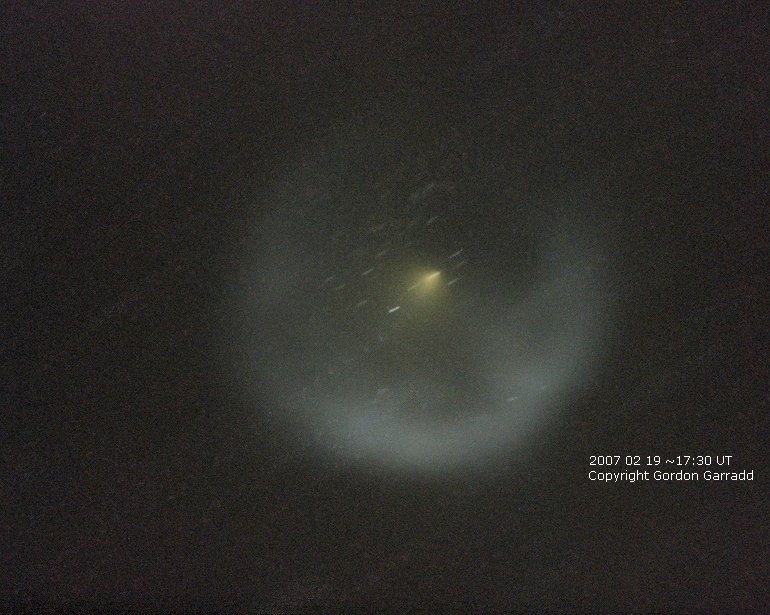
"While the Chinese test, which has been described as the worst debris event in space-flight history, was deliberate, the problem of unintended debris generation was underscored this month by the apparent rupture of a fuel tank on a Russian rocket that malfunctioned during a communications-satellite launch last year."

Above you’ll find one of the better photos of last year’s explosions that we found on Spaceweather.com. We found at least two other photos on the same site.

While it remains to be seen when an actual resolution will emerge from the UN regarding approaches for dealing with the problem of space trash and what (if any) teeth it might have when it’s passed, but its good to hear that someone is making some headway in solving this complicated problem.

Who Owns That Satellite?

Thursday, February 22nd, 2007

According to Channel NewsAsia, things are heating up in Thailand, where concerns about spying may force the country to buy back satellites it sold to a Singapore investment firm, Temasek, last year. As you might expect, things get a little complicated when you viewed up closer:

"[The controversy]… centers around four satellites owned by ShinSat, which is a subsidiary of Shin Corp.

Shin Corp was founded by former [Thai] premier Thaksin Shinawatra, whose family sold a 49 percent stake in the company to Singapore investment firm Temasek in January 2006.

General Sonthi [Boonyaratglin, who led last September’s coup d’état] said the government should buy back these satellites, which transmit encrypted military communications, in the interest of national security.

The estimated price tag is US$294 million."

Most Thai’s on the street believe that the Thailand should reclaim ownership of the old satellite’s for reasons of national security, although many don’t think the country should have to pay for the reacquisition. As one Thai citizen said in an interview:

"Thaksin sold it, so he should buy it back for Thailand. Thai people are already paying taxes to the government, so we shouldn’t use the country’s money to buy it from Singapore."

The problem for Thailand is, however, that such an oddball move with a foreign company would probably inhibit the future foreign direct investment so crucial to their development.

Satellite Broadband Gets to Europe

Wednesday, February 21st, 2007

Looking to go check out the Northern Lights in Europe, but afraid the lack of a solid connection to the net will prevent you from convincing the boss you can work in the Arctic Circle? Well, have no fear, according to CNET UK, it looks like even the farthest reaches of Europe will be wired just in time for a summer roll-out in June and in place in time for next year’s show.

The expansion will, employing Eutelsat’s birds, use ViaSat’s Surfbeam system (the same one SES-Americom started using with enterprise customers a couple of years ago) to bring two-way broadband Internet connections to EU citizens in Germany, Switzerland, Spain & Portugal who live in areas that don’t generally have access to wire and wireless-based broadband.  The hub will be run by Skylogic from the SkyPark teleport in Turin, Italy, home of the 2006 Winter Olympics. The full story can be found in a surprisingly informative press release on ViaSat’s site.

The even better news for those in Europe looking to connect via satellite is that you may not have to pay an arm-and-a-leg or necessarily suffer with dial-up technology for uploads. Wildblue, the company utilizing the two-way satellite broadband technology in the states, has been around for around two years and seems to be charging rates that are comparable to wired-broadband rates in some of the country’s more expensive markets (between $50-80/month) with upload speeds starting at 128Kbps. While equipment fees might eat away at some of the initial savings, the possibility of being able to do your work and watch nature’s greatest light show at the top of the world? Well, that’s priceless.