Author Archive

Predicting Space Weather

Monday, July 21st, 2008

On reading that title, you might be asking yourself “why in the world would I need to predict space weather?” Well, I’ll tell you. Space weather – the range of high-energy radiation, such as X-rays and gamma rays, that constantly bombard the Earth’s atmosphere – affects the performance of some of your favorite gadgets, like GPS and satellite TV.

With this camera, scientists can predict changes is space weather, allowing for communications companies to compensate for electromagnetic interruptions to their signals. Never again will your Planet of the Apes marathon be spoiled by a bad signal. Oh, and it’ll help the military predict and plan for interruptions in their communications too.

The project – the Global-Scale Observations of the Limb and Disk – is known by a catchy acronym: GOLD.

The GOLD Camera will fly on an SES AMERICOM satellite. Physicist Richard Eastes, who leads the GOLD project, says this is the first time that a NASA instrument has flown on a commercial communications satellite.

This is the second “hosted” payload for an AMERICOM spacecraft just this month. The other was for the Air Force’s CHIRP (Commercially Hosted Infrared Payload).

DIY Friday: Solar Death Ray

Friday, July 18th, 2008

It’s another lazy, hot summer weekend…what to do to pass the time?

Crochet a new bathing suit? Nah.

Make a beaded pull for the ceiling fan? No thanks.

Craft some sunglasses out of popsicle sticks and tinted saran wrap? Maybe next week.

I’m looking for something a bit more bold to shake up the summer doldrums: A SOLAR DEATH RAY.

You may have seen the “#1 solar death ray on the Internet” here. But that model was so 2006.

Yes, the competitive world of solar death ray construction has moved well beyond that.

This guy, inspired by the success of the original, bought himself a c-band antenna and made a device capable of generating 13,000 watts. He calls it the “light sharpener” and you can find full instructions on his site to make your own.

The only question is, to what end will you direct the power of your very own light sharpener? The answer, clearly, is remaking the classic American cook-out.


Of course, Really Rocket Science was ahead of the curve on this one…but we have to admit that his is bigger.

EchoStar XI Launch Update

Tuesday, July 15th, 2008

Set for tonight at 10:21pm PST via Sea Launch:

Long Beach, Calif., July 14, 2008 – The Sea Launch team arrived at the launch site in the Equatorial Pacific over the weekend and initiated a 72-hour countdown, in preparation for the launch of the EchoStar XI satellite on Tuesday, July 15. Liftoff is planned at 10:21pm PDT, July 15 (5:21 GMT, July 16), at the opening of a two-hour launch window.

Upon arrival at the launch site, at 154 degrees West Longitude, the team ballasted the Odyssey Launch Platform to launch depth. A final series of tests on all systems is now underway. Prior to fueling operations, the platform will be evacuated, with all personnel safely positioned on the ship, about four miles from the platform. One hour after liftoff, a Zenit-3SL vehicle will insert the 5,511 kg (12,150 lb) EchoStar XI satellite into geosynchronous transfer orbit, on its way to a final orbital location of 110 degrees West Longitude.

Built by Space Systems/Loral (SS/L), the powerful 20-kW spacecraft, carries a Ku-band payload that will support DISH Network’s direct broadcast television service for its customers throughout the United States. This spacecraft is designed for a 15-year service life on orbit. This is the 3rd mission Sea Launch is executing for DISH Network and the 8th mission with a spacecraft built by SS/L.

Check out a live still webcam from the platform here and here. If you’re going to stay up late, you can watch live coverage of the launch here. And Sea Launch has extensive coverage of the mission and satellite here.

With DISH Network promising 130 HD channels by the end of 2008, this satellite launch is, like all of them, very important. And this launch couldn’t be mre timely, as DISH just surpassed 100 channels just a few days ago. And this means that DISH may have just surpassed DirecTV.

Satellite Broadband Gets an Upgrade

Monday, July 14th, 2008

If thoughts of super-fast satellite link-ups from spy movies have you considering satellite broadband service, we have some news you’d like to hear.

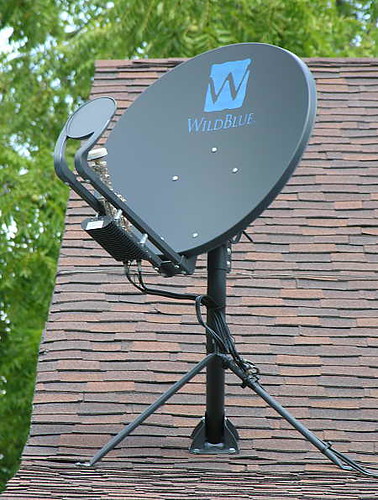
WildBlue, one of the top satellite broadband providers in the US, is upgrading its capacity to allow for 150,000 new customers. How are they doing it? Rather than launching a new bird, they’re upgrading their transmission link hardware and software to allow 50 percent more information bits through the same existing radio link.

Some are skeptical that these upgrades will actually lead to better service. But, if you live in an area where dial-up is your only other option, most reviews say jumping to satellite is worth it.

For those of us who live in urban areas and take it for granted that we can shop around for internet service, we should count ourselves lucky:

WildBlue estimates that there are over 11 million households in areas throughout the United States where DSL or cable broadband services are not available and that over 7.5 million of these households are still accessing the Internet through a traditional dial-up connection.

With WildBlue’s latest upgrades, they seem to be beating out their other major competitor in the satellite broadband space: HughesNet. In fact, in a Consumer Reports review of ISPs, HughesNet got the lowest possible rating in all categories. This customer seems to agree.

First Storm of the Season

Monday, July 7th, 2008


It’s officially hurricane season and Bertha is gearing up to be the year’s first storm.

Whether you might find yourself in the eye of the storm or you’re just intrigued by extreme weather, you’re sure to appreciate the fun tools that the National Weather Service puts out for the public. This one lets you track the storm’s movements. And this one shows wind speeds.

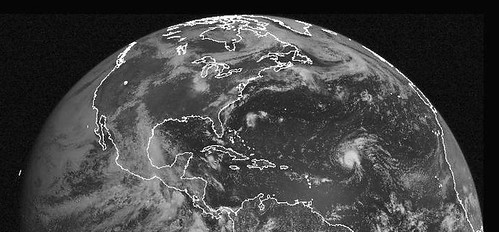
How do they get all the data for these cool images? Why satellites, of course. And the NOAA has a full arsenal. But how does all the information coming from those satellites turn into something we can understand, like this animation of the season’s first hurricane?

With Giovanni it’s simple. And no, that isn’t the name of an Italian tropical storm guru…

Giovanni is actually an acronym for the GES-DISC (Goddard Earth Sciences Data and Information Services Center) Interactive Online Visualization ANd aNalysis Infrastructure.

In other words, it’s a web-based application developed by NASA that is available to anyone with a computer and a bit of spare time. But beware, for those of us who’ve lost hours tooling around on Google Earth, this can become a bit addictive…

Interference in the Ku-band

Monday, June 30th, 2008


Last week a petition that floated up to the FCC prompted multiple meetings between the federal regulatory agency, Global VSAT Forum (GVF), and the European Satellite Operators Association (ESOA). The contents of the petition? A request by the Utilities Telecom Council (UTC) and Winchester Cator, LLC (remember these, we’ll come back to them in a second) to allow shared, secondary terrestrial fixed service (FS) use of the 14.0-14.5 GHz band–a move that would cause harmful interference to fixed and mobile satellite-based services used by millions across the US.

The issue has been simmering for a few weeks now, with letters coming from the Satellite Industry Association since early June

So what dog does the UTC have in this fight? Well, they’re seeking access to the radio spectrum with a petition being circulating to gain support.

It doesn’t stop there, among the signatories of the petition is Winchester Cator, LLC, comprised of Jared Abbruzzese and Raj Singh, both of whom have been making all the wrong kind of news for a while now.

Jared Abbruzzese as been implicated in questionable dealings with Mobile Satellite Ventures (via Business Week), and Raj Singh was one of the owners of Motient, so he’s been at it for a while. Abbruzzese also got himself into some hot water with the New York State Legislature.

This surely won’t be the end of this saga. We’ll be sure to keep you updated.

DIY Friday: Biofuels

Friday, June 27th, 2008

I’m feeling rather confident in my DIY skills at the moment. I just fixed up my bike last night, put up a new shelving unit, and re-wired a lamp. So, I’m thinking I might take on something a bit more challenging. How about solving the world energy crisis by breeding bacteria that eat CO2 and produce fuel? No big deal — I’ve got all weekend.

Hey, Craig Venter is working on it, and all he’s done is decode the human genome. http://www.ls9.com/ is also getting into the bacteria market.

No one would accuse Craig Venter of harboring humble ambitions. In 2000 he decoded the human genome faster than anyone else—and he did it more cheaply than a well-funded government team. More recently he’s set a new goal for himself: to replace the petrochemical industry. In a Maryland lab, he’s manipulating chromosomes in the hopes of creating an energy bug—a bacterium that will ingest CO2, sunlight and water, and spew out liquid fuel that can be pumped into American SUVs.

But if cooking up bacteria in your basement makes you a bit squeamish, you can always go the homemade ethanol route. These guys are developing a DIY kit for just $10,000.

Or you can just follow these step-by-step instructions to get up and running.

You can even get a tax credit for it, as long as your particular brand of fuel qualifies.

Let’s go camping

Thursday, June 26th, 2008

It’s almost the 4th of July, and, if you’re anything like me, you still haven’t figured out what to do with that long weekend.

True, there are usually some good movie marathons on cable, but you could probably use some time in the sun before you start to look like one of those mole-people. (Oh, they exist…I think I saw it on tv somewhere…)

So, why not take a low impact, low cost vacation and go camping? You might even prove that those MacGyver re-runs really were a good use of time.

If you need to brush up on your survival skills before hitting the great outdoors, this weekend is the Great American Backyard Campout. What better place to try to remember your old boy-scout tricks than the safety of your own yard?

If the thought of leaving your high-tech life at home leaves you a bit panicky, have no fear. There are plenty of fun new gadgets to make your camping trip feel a bit more 21st Century.

Pump up an air mattress, and you’ll forget you ever left home.

Or, for the ultimate experience of sleeping under the stars, check out this hammock.

And this GPS system with emergency beacon will ensure that you can escape the great outdoors in the case of a killer bee attack. (I DEFINITELY saw that on tv…)

But, whatever you do, leave the blackberry at home.

Paglen’s Spy Satellites

Tuesday, June 24th, 2008

It’s a bird…it’s a plane…it’s a super secret spy satellite?!

This is the stuff of Ian Fleming, mixed with a bit of high art.

Trevor Paglen has spent years photographing things in the night sky that supposedly don’t exist. Using time-lapse photography, he has captured 1,500 images of mysterious objects.

A small selection of these photos are now on view at the Berkeley Art Museum.

And these photos don’t skimp on political symbolism:

In taking these photos, Paglen is trying to draw a metaphorical connection between modern government secrecy and the doctrine of the Catholic Church in Galileo’s time.

“What would it mean to find these secret moons in orbit around the earth in the same way that Galileo found these moons that shouldn’t exist in orbit around Jupiter?” Paglen says.

Satellites are just the latest in Paglen’s photography of supposedly nonexistent subjects. To date, he’s snapped haunting images of various military sites in the Nevada deserts, “torture taxis” (private planes that whisk people off to secret prisons without judicial oversight) and uniform patches from various top-secret military programs.

…well, at the very least they’re pretty cool. And we’ve been interested in this subject for a while, ever since we learned about the “MISTY” satellite program.

I’m guessing the “powers that be” won’t be too pleased with Paglen’s exhibit, judging by the steps they take to ensure that their programs stay secret. Remember when the DoD shot down the spy satellite to keep information from getting into the wrong hands?

And this exhibit isn’t the first time Paglen has given the world a glimpse into the intriguing world of secret military programs. His book, “I Could Tell You but Then You Would Have to Be Destroyed by Me” offers a rare look inside the Pentagon’s Black Budget, through images of the patches worn by the nation’s stealthy, high-tech warriors.

Keep it comin’ Paglen. With stuff like this, who needs science fiction?

Pool Hopping

Monday, June 23rd, 2008

It’s officially summer, and I’m feeling a bit nostaligic.

Like many kids who grew up in the suburbs, my memories are filled with ice-cream trucks, slip-and-slides, and…oh yeah…petty crime. Before images of vandalism start running through your mind, let me explain. My misdemeanors were of a more innocuous variety, namely pool-hopping:

pool hopping
Hoping from pool to pool; usually done at night, or during the day when people (pool owners) are working. It is the act of running to one neighbours pool jumping in, then running to another pool to jump in,, and continue the cycle.This is all done without getting caught(hopefully).

We all knew which houses in the neighborhood had the best pools, and, after some fence-scaling and other secret-agent-worthy tactics, we’d be cannon-balling into the deep end.

But these days the childhood pasttime is going high-tech. Groups of kids are using Google Earth to find pools and organizing their outings on Facebook.

Call me old-fashioned, but I agree with this guy. Between creating facebook groups and dodging motion detectors, all the technology has taken the fun out of it.