Author Archive

DIY Friday: Bike Trailer

Friday, June 20th, 2008

I’ve been feeling a bit guilty lately about driving around to do errands. I mean, I have my canvas totes for schlepping home the goods, but somehow that doesn’t seem to make up for all the gas I’m guzzling getting to and from the store. (And, ok, I’m also a bit broke, so the high price tagat the pump is also a motivating factor.)

But what’s a guy to do when you don’t want to strap your groceries to your back like a sherpa? Answer: Buy a Bicycle Trailer.

This one’s a bit sporty, and could handle the great outdoors as well as your late night cereal run.

Want to burn a few calories before you party? Use this cart to bring home the beer.

But this is DIY-Friday, after all, so why not build one with this $79 DIY kit.

For DIY-purists, make one from scratch. WikiHow and Make both have instructions.

And of course, no errand run is complete without belting it out to your favorite tunes (or is that just me?). These new portable players from Sirius and XM are guaranteed to keep you entertained while you’re buying the beer.


DIY Friday: Altoids tin headphone amp

Friday, June 13th, 2008

So I got a great new pair of headphones over the holidays last year, and so far they’ve served me well, but lately I’ve been trying to figure out how I can get the most out of the new cans. Audiophiles out there know about some great (and expensive) headphone amps that really help you get the most out of your headphones–to hear every detail of your favorite album or the environment you’ve recorded yourself. Today’s pick, however, will only set you back a few bucks. It’s the DIY Altoids tin headphone amplifier.

This project has been around for a while, but it’s always being adapted and improved. There are a few places online where you can find the step-by-step, but most of them originate from the Chu Moy project posted over at headwize.com.

Here’s what MAKE magazine had to say about the project.

Headphone amps make portable listening good and loud. Commercial audiophile models can cost $200+, or you can build a great-sounding amp inside a mint tin for around $30, following Chu Moy’s popular design. Powered by a 9-volt battery, this amp drives high-impedance headphones to thunderous volumes from even weak sources.

Tangent has a good tutorial on how to assemble the amp. You’ll need to have some basic solder and circuitry knowledge, but the Getting Started guide should help if you’re in the dark.

Without any knowledge going in (not including Altoid eating time and subsequent dentist visits), you’re probably looking at spending a good weekend on this project.

Every once and a while you’ll also find some available to buy… but that wouldn’t be very DIY, would it?

[photo from Tangent]


DIY Friday: Flux Capacitor

Friday, June 6th, 2008

You’ve seen Back to the Future and the De Lorean time machine, but what is a flux capacitor?

It’s the Y-shaped flashing light device (powered by 1.21 jigowatts) that turns a sports car into a time machine. How does/did it work? “Doc” couldn’t even explain it:

It is not described in the films exactly how the flux capacitor worked beyond that of a typical plot device or a typical deus ex machina device, though Doc mentioned at one point that the stainless steel body of the DeLorean has a direct and influential effect on the “flux dispersal”, though he was interrupted before he could finish the explanation. The flux capacitor required 1.21 gigawatts of electricity to operate.

You can make your very own Flux Capacitor (but, PLEASE, do not toss it in your car, cross your fingers, and go 88 mph in a parking lot). Instructables has the instructions. Not a lot of electronics experience is needed, and most of the equipment is available at your local hardware store and Radio Shack. The Flux is housed in an ordinary fuse box.

Too complicated? You can buy one here for $250. A small price to pay for time travel capabilities. And this (more-expensive) dealer will even provide a time-travel, money back guarantee (read closely):

This item may be expensive, but can you place a price on time travel? NOTE: Special return policy: If you are not 100% satisfied, you may return this product for a full refund, in no LESS than 30 days before you purchase it!

Once you have have your Flux, get started on the rest of the De Lorean time machine:

Holy Tripoli

Thursday, June 5th, 2008

Earlier this year, the USS Erie successfully shot down an errant satellite in a real-world mission.

And, later today, the ship and its sea-based missle defense system will get a chance to prove itself again:

The test, off Kauai, is the latest test of the military’s sea-based missile defenses, called the Aegis ballistic missile defense program.

The military will fire a Scud-like missile, which has a range of a few hundred miles, from a decommissioned amphibious assault ship, the USS Tripoli.

USS Lake Erie, a Pearl Harbor-based Navy cruiser, will fire two interceptor missiles at the target with the intention of shooting it down in its final seconds of flight.

If all goes well, the intercept should occur within the Earth’s atmosphere, or within 100 miles of the Earth’s surface.

The Aegis system accomplished a similar task once before: two years ago, the Lake Erie shot down a missile fired from the Pacific Missile Range Facility on Kauai in its final stage of flight.

In February, the ship successfully shot down a U.S. spy satellite in the Aegis’ system’s first real-world mission.

The satellite had lost power and become uncontrollable, creating worries it would break up and spread debris over several hundred miles if it fell to earth.

The Hawaii-based, Star Bulletin has more details.

The Navy said yesterday that on Tuesday the mission, named Stellar Scorpion, was blessed at the Barking Sands missile facility by "Uncle Tom" Takahashi, who named the Lake Erie’s two interceptor missiles "the crashing sound of the ocean" and "the ear of the earth," respectively.

Being a decommissioned helicopter-carrier, the USS Tripoli (photo above) seems like a pretty odd choice to be involved in this exercise. The "Semper Princeps" (Always First), as they call it, has been around since 1964, and decommissioned (but strangely still very active) since 1995:

She was decommissioned in 1995 and as of 2004, she was on loan to the Army, but remained laid up at Mare Island Naval Shipyard. In December 2006, the ship was towed to Pearl Harbor, Hawaii, where it now has a high-tech role as a launch platform with the nation’s developing ballistic missile defense program. Three times the ship was towed some 100 miles off shore and used to launch small ballistic missiles, which are then intercepted by Terminal High Altitude Area Defense Missiles, test-fired from the Pacific Missile Range Facility. The last test in the series was performed October 26, when the ship fired a "scud-like" missile, which was successfully intercepted. The ship will be towed back to the San Francisco Bay Area for the winter. Kaua’i lacks a suitable land-based launch site, and the costs of building one would far exceed the approximately $600,000 per year it costs to use the old warship, so the vessel will return to Pearl Harbor for a second series of tests in late spring 2008.


DIY Friday: Solar Hot Water

Friday, May 30th, 2008

First it was soaring gas prices, then the cost of food – now it appears that the price of natural gas will surge fast.

The consequence? The cost of heating your home will be a lot more expensive next winter (especially if you’re in Wisconsin). What to do?

Well, if you’re in Iceland, just dig a hole. An amazing 90% of homes are heated with geothermal energy. Of course, with my luck, I picked this unheated, sod-roofed backpackers hostel/shack (highly-recommended, btw) on my recent stay in Iceland. Chilly nights.

But, if you’re still States-side, the geothermal option probably won’t work. So beyond simple conservation, let’s start by finding a simple and energy-free way to heat our water – the sun!

Way back in 1984, Mother Earth News brought us the plans for building an integral passive solar water heater (IPSWH):

For the do-it-yourselfer searching for an inexpensive, easy-to-build solar water-heating system, the integral passive solar water heater (IPSWH, pronounced ipswah ) is a dream come true. All you need to get going on this down-to-earth water warmer is a discarded electric water heater tank rescued from the local dump, a homemade plywood box to house it in, a can of flat black paint, a sheet or two of used window glass or clear plastic, a few common plumbing fittings and some pipe and insulation. Combine all that with some spare hours of satisfying sawing, hammering and wrench-turning, and you’ll have an ongoing supply of hot water provided virtually free from that friendly furnace in the sky.

The article gives a good how-to on the building process, and a fairly exhaustive explanation on the different types of active and passive solar water heaters. And just three months ago came Mother Earth’s modern update. Among the findings: the solar water heater payoff could be dramatic, especially considering rising energy costs:

Solar water-heating systems have minimal—sometimes zero—operating costs, and maintenance costs only about $2 per month. When all costs for purchase, installation, maintenance and operation are taken into account, a solar water heater usually pulls even with an electric heater after just eight and a half years, and equals a gas heater in about 15 years. From then on, through the expected 40-year life of the solar system, you’ve got FREE hot water.

When you’re ready to roll-up your sleeves, Instructables has the how-to pictures and directions. Build it Solar posts some other plans, including a pretty wild idea to use the energy from composting to heat water. And this enviro-solution is just a damn good excuse to throw a party (instructions are available here).

But, despite all the fun ideas, this is one of the few DIY projects that I encourage you to get some help. If you really want to save some money, reduce your CO2 output, and keep the system cooking for 40+ years, I’d skip the bottles and buy a system.

Have a great weekend!


The ITAR Controversy

Thursday, May 29th, 2008

As reported in the Wall Street Journal and Aviation Week, among other major publications, China is importing “ITAR-free” satellites and other space technologies from a European company, thereby evading U.S. export controls that are intended to safeguard our national security. China is also developing its Long March 5 rocket that will be capable not only of delivering people to the moon, but also landing nuclear payloads anywhere in the United States.

That’s from a Senate Hearing (webcast) earlier this month. For those unfamiliar, ITAR (International Traffic in Arms Regulations) is a set of regulations that prohibit Americans or American companies from sharing or selling information or materials pertaining to defense and military related technologies. There is a balance to be found here: since lots of American technology is adapted from military technology, it can be difficult to sell non-militay products internationally (like satellite launch vehicles) and to collaborate with International partners on products that include proprietary military technology. Wikipedia does a nice job describing the controversy:

There is an open debate between the Department of State and the industries and academia regulated by ITAR concerning how harmful the regulatory restrictions are for U.S. businesses and higher education institutions. The Department of State insists that ITAR has limited effect and provides a security benefit to the nation that these sectors must bear. Every year the Department of State can cite multiple arrests of ITAR violators by U.S. Immigration and Customs Enforcement agents. However, many companies and institutions within the affected areas argue that ITAR is stifling U.S. trade and science. Companies argue that ITAR is a significant trade barrier that acts as a substantial negative subsidy, weakening U.S. industries’ ability to compete [4]. U.S. companies point to announcements in Europe by EADS and Alcatel promoting their “ITAR-free” satellites and defense items.[5] Higher education institutions argue that ITAR prevents the best international students from studying and contributing in the U.S. and prevents cooperation on international scientific projects.

Currently, officials at the Department of State dismiss the burden on industry and educational institutions as minor compared to the security provided by ITAR. They also view the announcements of “ITAR-free” items as anecdotal and not systemic.

Now that we’ve got the background, back to the Senate hearing: China is importing “ITAR-free” space technology from European countries. It’s a perfect example of the controversy: the U.S., worried about national security implications, limits technology sharing/selling to China. But, when Europe fills the gap, it just cuts at traditional U.S. superiority in the space/satellite technology market. Just this Tuesday, with the Berlin Air Show as the backdrop, OHB presented the European Space Agency with a plan (subscription-only) to develop ITAR-free spacecraft:

BERLIN — European governments have agreed that a new commercial telecommunications satellite design they are financing will permit customers to order a version without U.S.-built parts covered by the now-infamous U.S. technology export regime known as ITAR, government and industry officials said here May 27.

Officials said that while the first Small GEO platform, being tailored for Spanish satellite-fleet operator Hispasat, will feature U.S. parts, future versions that are not subject to ITAR, or U.S. International Traffic in Arms Regulations, will be available upon customer request. ITAR rules treat satellites and many of their components as weapons for export-control purposes and allow the U.S. State Department to veto those who can purchase the satellite, and where it can be launched from.

“Customers will be able to choose which version they want, although the ITAR-free version will be a little bit more expensive,” said Manfred Fuchs, founder and president of OHB System of Bremen, Germany, which is prime contractor for the Small GEO program.

Led by Germany and Spain, nine European Space Agency (ESA) governments — France notably is absent — are contributing 190 million euros ($299 million) to design the Small GEO and develop the first model. Hispasat is the first customer and has agreed to spend more than 50 million euros of its own to pay for the satellite’s launch and insurance. The first Small GEO model, called Hispasat AG1, will be fitted with a Ku- and Ka-band telecommunications payload and is scheduled for launch in 2012. OHB and Hispasat signed a preliminary contract for the satellite May 27 here at the Berlin air show, ILA 2008. A final construction contract is expected to follow in September.

Industry and government officials said OHB presented ESA with a list of components and technologies that would be needed for the Small GEO platform and asked which were available in Europe. All major subsystems will be built by European contractors. But several individual components will be purchased in the United States.

“It was more a matter of cost and time than anything else,” a European industry official involved in the selection said. “This is a new satellite design and we already have enough challenges without adding the complication of making it ITAR-free from the outset.”

European governments have agreed that a new commercial telecommunications satellite design they are financing will permit customers to order a version without U.S.-built parts covered by the now-infamous U.S. technology export regime known as ITAR, government and industry officials said here May 27.

Officials said that while the first Small GEO platform, being tailored for Spanish satellite-fleet operator Hispasat, will feature U.S. parts, future versions that are not subject to ITAR, or U.S. International Traffic in Arms Regulations, will be available upon customer request. ITAR rules treat satellites and many of their components as weapons for export-control purposes and allow the U.S. State Department to veto those who can purchase the satellite, and where it can be launched from.

“Customers will be able to choose which version they want, although the ITAR-free version will be a little bit more expensive,” said Manfred Fuchs, founder and president of OHB System of Bremen, Germany, which is prime contractor for the Small GEO program.

DIY…uhh…Tuesday: Laptop Data Recovery

Tuesday, May 27th, 2008

I woke up this morning in a panic – WHAT DID I FORGET TO DO? DIY-Friday, of course. I started the beer-drinking, BBQ, and pool parties a few hours too early on Friday. My apologies to the readers who were lost without a project this weekend, but, to be honest, who’s going to DIY on Memorial Day weekend?

So, for a very business-like DIY post, fit for a Tuesday, let’s explore laptop-data recovery:

WikiHow offers us two main methods:

Method 1

1. Purchase a “Laptop Hard Drive Adaptor Kit” to allow you to plug your laptop hard drive into a standard PC (2.5 TO 3.5 inch IDE HDD).
2. Find a functioning standard PC that can read the file system that was on the laptop. One would need Windows 2k/XP or a Linux distribution to read an NTFS/FAT file system, whereas only a Linux distribution can read the EXT3 file system.
3. Open up the case and add the laptop drive with adaptor kit as a secondary HDD. Be sure that you have set this drive to either Cable Select, or Slave, depending on the configuration of the system, and the available IDE ports.
4. Copy the data you need from the laptop drive to the main drive of the PC, or consider using removable storage for small files.

Method 2

1. Purchase or cannibalize a 2.5″ USB 2.0 or Firewire drive enclosure.
2. Find a functioning standard PC with an open USB port (or firewire port, as applicable) that can read the file system that was on the laptop. One would need Windows 2k/XP or a Linux distribution to read an NTFS/FAT file system, whereas only a Linux distribution can read the EXT3 file system.
3. Plug it in, wait for the tones (and/or mount it if that is necessary in this system)
4. Copy the data you need from the laptop drive to the main drive of the PC, or consider using removable storage for small files.

Method 1 is probably the more straightforward process. You can buy an adaptor kit for about five bucks on Ebay.

Now, if your situation is really, really bad—and not only is your OS install screwed up, but you actually deleted a partition with data on it—do not despair. If the FBI can recover “deleted data,” so should you. A commenter in this forum, offers a good solution: Stellar Phoenix Recovery Software. There are other good software options out there too.

What about a bum harddrive motor? This is pretty cool:

Loving Pay TV

Thursday, May 22nd, 2008

The results are in for the American Customer Satisfaction Index for cable and satellite television providers (link):

Customer satisfaction among subscribers to cable and satellite television improved three percent to a score of 64 in the first quarter of 2008, according to the American Customer Satisfaction Index.

But, at the same time, Comcast, Charter, and Dish Network are losing ground in the satisfaction of their customers. Comcast is down four percent to 54, an all-time low for the largest cable provider in the country.

Rapid growth may have contributed to difficulties in operations as Comcast continues to add cable subscribers, often through acquisitions of companies in smaller markets, says Professor Claes Fornell, director of the National Quality Research Center at the University of Michigan.

Satellite TV provider Dish Network is down three percent to 65 and Charter is down two percent to 54, sharing the lowest score in the industry with Comcast.

The reason for the industry’s overall uptick is the large improvement among smaller cable TV providers such as Cablevision and RCN, Fornell says.

The category of "all other" cable TV companies is up five percent to lead the industry with an all-time high of 69, well ahead of the large competitors.

DirecTV is, once again, the king:

For the eighth consecutive year, DIRECTV has topped the American Customer Satisfaction Index (ACSI) in the Pay TV category.

DIRECTV is American satellite television service provider, serving more than 17 million customers. It has played a major role in the industry-wide switch to high definition (HD) programming, and currently offers 95 HD channels nationally.

The American Customer Satisfaction Index (ACSI) is an economic indicator that measures the satisfaction of U.S. consumers. It is produced by the National Quality Research Center (NQRC) at the University of Michigan in Ann Arbor, Michigan. The ACSI generally interviews about 80,000 Americans annually and asks about their satisfaction with the goods and services they have consumed.

DIRECTV posted an index score of 68 at the ACSI against the overall cable and satellite industry score of 64. Customers surveyed by the ACSI in the first quarter of 2008 were also asked about such issues such as perceived quality and value, and their expectations prior to making a purchase. The ACSI also measures customer loyalty and retention.

Comcast – not so much, unfortunately:

Customer satisfaction ratings for Comcast Corp. fell this year to an all-time low and rank at the bottom of cable and satellite TV providers, according to a survey released on Tuesday.

Volcanoes

Tuesday, May 20th, 2008

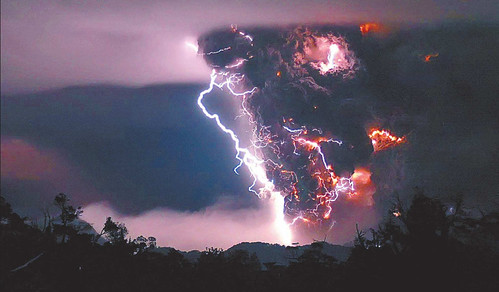
Earlier this month a volcanic eruption in Chile wowed the world, and produced one of the most magnificent natural images ever.

The eruption actually came from a volcanic caldera, Chaitén. The eruption forced the evacuation of nearby towns, merged two massive craters, and increased the possibility of even more activity. You can watch video (in Spanish) of the disaster here.

But beyond YouTube recaps of eruptions, you can discover images of the volcanoes, active and dormant, around the world. The Italian Government has publicly accessible webcams of volcanoes. And this site has mapped, photographed, and documented every volcano in the world (including Chaitén). Pretty amazing.

Satellites are keeping tabs too. This site has satellite images of some of the world’s largest volcanoes, including some very close to home.

But, of course, Volcanoes are not limited to Earth. Jupiter has some of the our galaxy’s more active volcanic activity:

Before the Voyager probes visited Jupiter, if you had described Io to a literary critic it would have been declared overwrought science fiction. Jupiter’s strange moon is literally bursting with volcanoes. Dozens of active vents pepper the landscape with volcanic rings the size of California. The volcanoes themselves are the hottest spots in the solar system with temperatures exceeding 1800 K (1527 C) about 1/3 the temperature of the surface of the Sun. The plumes which rise as much as 500 kilometers into space are so large they can be seen from Earth by the Hubble Space Telescope. Confounding common sense, these high-rising ejecta seem to be made up of, not blisteringly hot lava, but frozen sulfur dioxide. For a world dominated by fiery volcanoes, it’s curious that Io is also very, very cold. The ground just around the volcanic vents is literally sizzling, but most of Io’s surface is 150 degrees or more below 0 C.

What powers the tremendous volcanic activity? Tides! But the tides on Io are not like ocean tides we’re familiar with on Earth. The gravitational fields of Jupiter and its large moons Europa and Ganymede cause tidal bulges in the solid crust of Io that are as high as 100 meters (330 feet). As Io orbits the giant planet, the bulge moves, flexes the crust, and heats Io’s interior like a paper clip bent rapidly back and forth. Infrared observations have shown that the thermal energy released by Io’s hot spots is on the order of 125 trillion watts which is about 2.5 W/m2. By contrast the moon’s outward heat flow is 0.02 W/m2 and the Earth’s average heat flow is 0.06 W/m2.

A year ago, NASA’s New Horizons probe captured a number of amazing images, showing massive plumes of ash, believed to be a result of Volcanic activity.

Beetle Juice

Monday, May 19th, 2008

Yeah, beetle juice. Turns out that the spray of the Bombardier Beetle’s toxic fluid may hold the key to new fuel-injection jet engines. I didn’t expect that.

A beetle’s chemical warfare against marauding ants, birds and frogs has provided the inspiration for a European effort to design more efficient fire extinguishers, reliable pharmaceutical sprays and fuel-injection engines.

The bombardier beetle’s toxic blasts of boiling-hot poison could even provide the impetus for mini rocket boosters to keep a spacecraft on the right trajectory, according to Andy McIntosh, a professor of thermodynamics and combustion theory at University of Leeds in the United Kingdom.

Science Daily explains the biology:

Quantities of hydroquinone and hydrogen peroxide gases build up in the beetle’s abdomen but, when necessary for defence, get mixed together in a connected ‘combustion chamber’ to produce toxic benzoquinone. This hot fluid is then fired off at force in the face of enemy predators.

The key to the beetle’s powerful defensive trick is in its combustion chamber’s inlet (or entry) and exit valves. The inlet valve opens to receive the chemicals, which begin to boil as soon as they meet, and closes when a sufficient amount of gas has been received.

As the gases react together, they generate heat and increase the pressure in the closed chamber. When the pressure reaches a critical point, the end of the exit valve is forced open and the hot fluid is ejected as a powerful burst of toxic steam in a process known as “flash evaporation”.

Once the gas is released, the exit valve closes, the inlet valve opens and the chamber fills again, preparing for the next venomous ejection.

Check out pictures of the process here.

The mechanism has been replicated by a research team at the School of Process, Environmental and Materials Engineering at Leeds University. They were able to spray distances of up to four meters and precisely control the size of the droplets.

In the short term, the technology appears to have the most promise for fire extinguishers and drug delivery tools (like inhalers). But more efficient fuel-injection car engines and, even, precise jet engines are possible in the future.

A species of beetle, that squirts its predators with a high-pressure spray of boiling liquid, could provide the key to significant improvements in aircraft engine design.

The bombardier beetle’s unique natural combustion technique is being studied to see if it can be copied for use in the aircraft industry.

Scientists studying the bombardier beetle’s jet-based defence mechanism hope it will help to solve a problem that can occasionally occur at high altitude – re-igniting a gas turbine aircraft engine which has cut out, when the outside air temperature is as low as minus 50 degrees Centigrade!

Due to start early next year, this innovative 3-year project at the University of Leeds is being funded by the Engineering and Physical Sciences Research Council (EPSRC).

The little bug has got my respect.

Matching all of the beetle’s natural talents could still be a mean feat. “If we can think of a mechanism, nature has already done it, and better,” Eisner said. He’s found, for example, that the beetle can discharge its toxic bursts more than 20 times in a row before depleting its glands. Not that such repeated blasts are usually necessary. “After firing once, he can walk through a crowd of ants, and they just literally part and let him pass,” he said.