Author Archive

DIY Friday: French Fry iPod

Friday, May 9th, 2008

If you watched Juno and are at all like me, you were probably pretty fascinated by, and nostalgic for, Juno’s hamburger phone. Well, beleive it or not, they also make (or made) a french fry phone. But what’s the point in having both hamburger and french fry phones? Use it to make a French Fry iPod:

Our DIY-Friday stand-by, Make, has the not so tasty project plan. You’ll have to find the phone on Ebay. After that, its all about gutting and glue’ing.

i converted a french fry telephone into a carrying case for my video ipod. i had no good reason to, the idea just popped into my head when i was walking about with my ridiculously inconvenient hamburger phone. why not carry an oversized plastic french fry replica to match the equally absurd plastic hamburger. the build out was the same as the hamburger: gut the phone, cut some openings, fit the gadget, and then screw it back together. it actually works great (the case shields the sun, it has it’s own usb cable ready to go), it just doesn’t fit in my pocket anymore.

Smiles via Satellite

Monday, May 5th, 2008

We spend a lot of time here on Really Rocket Science looking at new technology, telling jokes, and covering rocket launches. The human interest stories are rare – but incredibly important:

U.S. soldier Joseph Chavez couldn’t wipe the smile from his face at seeing his daughter Lilliana for the very first time on a video call via satellite uplink from Iraq.

“Oh wow, she’s so pretty,” a beaming Chavez said over and over from Baghdad as his wife Naomi held his sleeping one-day-old daughter up to the camera for him to see.

The video conference, organized by the American non-profit foundation Freedom Calls, was held in the basement of Vancouver’s St. Paul’s Hospital and attended by throngs of media, at least for the first few minutes. Chavez was projected on a large screen, fuzzy but clearly elated.

“Look at her, she’s beautiful,” he said. “She looks happy to be alive right now.”

Naomi, who lives in Vancouver, had talked to her husband after Lilliana’s birth and sent pictures from her computer, but he was still beside himself to see his new wife and even newer daughter live onscreen.

“I saw all the pictures of everyone else getting to hold her,” said Chavez. “I’m very jealous.”

Freedom Calls is the charity behind the very slick effort:

Freedom Calls Foundation uses high technology to keep U.S. soldiers abroad connected with their families.

The signal from Iraq is bounced off a satellite and picked up in Germany, where it is sent by fibre-optic cable to Atlanta, Ga., and then by high-speed Internet to families in the United States — and this time to Canada. The service is slick, with only a 600-millisecond lag, which is noticeable but not enough to scramble conversation.

“We can connect anywhere in the world via satellite, but this is our first-ever call to Canada,” said Freedom Calls spokeswoman Kathryn Hudacek.

“When soldiers go to Iraq they have a habit of leaving a lot of pregnant wives behind,” said Hudacek. “It’s a real deployment phenomenon.”

Freedom Calls organizes 2,000 video conferences a month and at least 200 are dads meeting new babies, she said.

One of these video conferences not only allowed a soldier to see his newborn, but to watch the actual birth. And this isn’t Freedom Call’s only schtick:

Satellite junkies with a conscience and some disposable income may have just found their perfect charity. You can donate here.

DIY Friday: Noise-cancelling Headphones

Friday, May 2nd, 2008

Noise Cancelling Headphones – they appear to be the newest trendy gadget, popping up everywhere in electronic stores and inflight catologs. But, damn, they can be expensive. Before we can get to the do-it-yourself option, let’s take a look at how they work:

Noise-cancelling headphones reduce unwanted ambient sounds (i.e., acoustic noise) by means of active noise control (ANC). Essentially, this involves using a microphone, placed near the ear, and electronic circuitry which generates an “antinoise” sound wave with the opposite polarity of the sound wave arriving at the microphone. This results in destructive interference, which cancels out the noise within the enclosed volume of the headphone.

Howstuffworks has a more detailed explanation, complete with graphics reminiscent of a high school physics course.

Now, if you not only aced that high school physics course, but also kept it going in college, you might be able to build a pair of headphones by following these complicated directions.

For the more modest, you could skip the physics and just hack together a pair using some industrial earmuffs for just $20 dollars:

Jason 2

Thursday, May 1st, 2008

Mrs. Voorhees is dead, and Camp Crystal Lake is shut down, but a camp next to the infamous place is stalked by an unknown assailant. Is it Mrs. Voorhee’s son Jason who didn’t drown in the lake some 30 years before?

No, this post is not about the Friday the 13th / Jason Part 2 horror movie (and April fools day was April, not May 1st). The real story is about the Jason-2 spacecraft and the Ocean Surface Topography Mission to launch on Sunday, June 15th (not Friday, June 13th):

PASADENA, Calif. – A NASA and French Space Agency (CNES) spacecraft designed to continue a long-term survey of Earth’s oceans has arrived at Vandenberg Air Force Base, Calif., for final launch preparations. The new satellite will study ocean circulation and the effect oceans have on weather, climate and how Earth is responding to global climate change.

The Ocean Surface Topography Mission, called OSTM for short, will be flown on the Jason-2 spacecraft, which was transported on April 24 from its manufacturer, Thales Alenia Space, in Cannes, France, to Toulouse, France. It was loaded onto a Boeing 747 aircraft for its trans-Atlantic journey and after refueling in Boston, it arrived April 29 at Vandenberg Air Force Base. Following final tests, it will be integrated onto a United Launch Alliance Delta II launch vehicle in preparation for a planned launch in June.

With the launch of this satellite, the science of precisely measuring and studying the height of the sea surface across Earth’s oceans will come of age. Continuous collection of these measurements began in 1992 with the NASA/CNES Topex/Poseidon mission and continued in 2001 with NASA/CNES’s Jason-1 mission, which is currently providing near-real-time data to a variety of users. The addition of the National Oceanic and Atmospheric Administration (NOAA) and the European Organization for the Exploitation of Meteorological Satellites (EUMETSAT) as partners on OSTM/Jason-2 begins transitioning the responsibility for collecting these data to weather and climate forecasting agencies, which will use them for short-range and seasonal-to-long-range ocean forecasting.

The Ocean Surface Topography Mission/Jason-2 is an international and interagency mission developed and operated as a four-party collaboration among NASA; NOAA; the French Space Agency, Centre National d’Etudes Spatiales; and EUMETSAT.

And this may have one of the more practical applications among NASA projects:

The 15-plus-year climate data record that this mission will continue is the only one capable of addressing how ocean circulation is linked to climate change and how global sea level, one of the most important consequences and indicators of global climate change, is changing.

Satellite observations of Earth’s oceans have revolutionized our understanding of global climate by improving ocean models and hurricane forecasts, and identifying and tracking large ocean/atmosphere phenomena such as El Niño and La Niña. The data are used every day in applications as diverse as, for example, routing ships, improving the safety and efficiency of offshore industry operations, managing fisheries and tracking marine mammals.

After this spacecraft launches, Jason fans can start anticipating their next event – the launch of the next Jason flick. When does it launch? You guessed it – Friday, 13 February 2009.

DIY Friday: Payload into Space

Friday, April 25th, 2008

Maker Faire, arguably the preeminent DIY event of the year, is next weekend in San Mateo, CA. In honor of Maker Faire and Make’s contributions to our Friday segments, let’s bring back one of their best’s – the video space podcast:

Make: is going to space! Have you ever wanted to go up into space? Well, you don’t have to win a golden ticket, be a millionaire, or an astronaut… you can send your own payload into space!

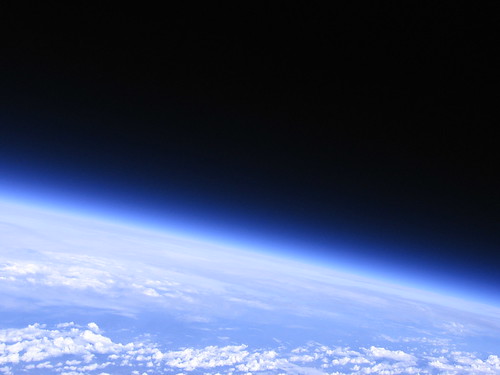
We’re using weather balloons to go up to approximately 100k feet armed with 4 cameras… 20 megapixels of camera! We’ll be taking shots every 7 seconds for two hours and measuring the temperature with the Make: controller and thermistors!

It took 16 people working on this, countless cases of mountain dew, lots of take-out food, and a lot of sleepless nights, and we intend to fly Sunday!

Cloud cover, snow, and mechanical failure may postpone the launch, but we’re ready to give it our best shot this weekend.

In this Make: Video Podcast, you’ll learn all the details of how to put a weather balloon up into space! The weather balloon will make it up to about 100,000 feet. That’s almost 20 miles up and more than twice the height of being in an airplane. It’s high enough that the sky is black and you can see the curvature of the earth.

Not exactly your average, weekend DIY project. From what I can tell from their wiki, they succeeded in getting the balloon to 109,242 feet, but since their batteries died, they have no way to track where the payload landed (and where they can acquire their photos).

Thankfully someone else made a similar trip – and brought back lots of pictures and some great video.

If you actually want to tackle this, start by buying the weather ballon. Then add-on all the gadgets and cameras you want.

Earth Day!

Tuesday, April 22nd, 2008

Since it’s a nice day, I’ve had too much coffee, and I feel like dancing (with my usual lack of rhythm), we’re going to kick off the Earth Day post with a little Kanye West, Earth Day-style:

I’m a big Earth Day fan, maybe because it reaches back to my Wisconsin roots. In September 1969, Gaylord Nelson, a U.S. Senator from the Dairy State, proposed a nationwide demonstration focused on the environment for the following spring. Senator Nelson’s idea to put the environment on the national political agenda means that, today, Earth Day is being observed by millions of people in over 170 countries.

With Global Warming an urgent concern (to me, at least), Earth Day has more significance than ever. NASA reports that 2007 was tied as Earth’s second-warmest year:

Climatologists at the NASA Goddard Institute for Space Studies (GISS) in New York City have found that 2007 tied with 1998 for Earth’s second warmest year in a century.

“It is unlikely that 2008 will be a year with truly exceptional global mean temperature,” said Hansen. “Barring a large volcanic eruption, a record global temperature clearly exceeding that of 2005 can be expected within the next few years, at the time of the next El Nino, because of the background warming trend attributable to continuing increases of greenhouse gases.”

The eight warmest years in the GISS record have all occurred since 1998, and the 14 warmest years in the record have all occurred since 1990.

Goddard Institute researchers used temperature data from weather stations on land, satellite measurements of sea ice temperature since 1982 and data from ships for earlier years.

This year (beyond the Kanye video), lots of attention is being paid to alternative energy options, particularly with rising gas prices. Wired has an article on how eSolar—with backing from Google’s philanthropic foundation, Google.org—is working on using sunlight-reflecting mirrors to generate steam:

For proof, look no further than the fat $130 million investment scooped up by eSolar, a company whose basic solar power strategy — using sunlight-reflecting mirrors to generate steam — was all but abandoned in the 1980s, and has recently recently caught investors’ attention again.

The money, from Google’s philanthropic arm, Google.org, and venture capital firms Idealab and Oak Investment Partners, will go towards the construction of eSolar’s first functioning solar power plant.

“ESolar’s long term is to become a viable replacement for all fossil fuel,” said Robert Rogan, a Cal Tech Ph.D. and eSolar’s executive vice president for corporate development. “The reason Google invested in us is that they saw the potential of this technology to beat the cost of using coal.”

The company’s core technology is an implementation of concentrating solar power, which uses mirrors to turn liquid into steam that drives standard electricity-generating turbines. CSP, also sometimes called solar thermal, is considered a promising replacement for fossil fuel power plants, particularly the coal plants that generate more than half of U.S. electricity. It’s been around for decades, last seeing popularity in the early 1980s, when oil hit an inflation-adjusted price of $82 per barrel. Higher oil prices make fossil fuel plants more costly, making it easier for alternative technologies to compete. (Oil is currently trading for more than $115 a barrel, its highest level ever.)

DIY Friday: Wireless Internet Cantenna

Friday, April 18th, 2008

For those of you who are unaware, a Cantenna is “a directional waveguide antenna for long-range Wi-Fi used to increase the range of (or snoop on) a wireless network.” WiFi antenna designs are almost limitless – you can use a mineral water bottle, a cable antenna, a pringles can, a fire extinguisher, a kitchen steamer, or a cooking strainer and thumbdrive. Leave me a comment if I missed something.

The most common design utilizes a simple tin can, an N-Female chassis mount connector, and some thick wire. Instructions are available here, but the process is fairly simple: “1. Collect the parts; 2. Drill or punch holes in your can to mount the probe; 3. Assemble the probe and mount in can.” If you want to optimize different size cans, the (somewhat complicated) math is described here.

For a good overview of WiFi antennas, check out this excellent episode of Systm:

But, since Really Rocket Science tries to push the DIY-limits (and since we really like satellite dishes), try “hot-rodding” a basic can-Cantenna by adding an old satellite dish. Instructions are available here – let’s just say it takes a fair amount of creative ingenuity. It’s for the DIY-expert.

And, as usual, you could just be lame and buy one.


Submarine Cable Cut Mystery Solved

Monday, April 14th, 2008

Earlier this year we discussed undersea fiber cables being cut in the Mediterranean. The event led to disruptions in 70% of Egypt’s Internet service (and lots of busy SES NEW SKIES sales offices). Now, thanks to satellite imagery, comes the swift hand of telecommunications justice:

Dubai authorities have impounded two ships suspected of damaging undersea telecom cables in the Middle East earlier this year. One of the ships has reportedly been released after paying for the damage. The cable cuts, which disrupted Internet traffic in much of the Middle East, India and Pakistan, sparked a flurry of conspiracy theories that the series of outages in the region were not a coincidence.

Reliance Globalcom, whose FLAG Telecom unit maintains the cables, contacted authorities after studying the satellite images of the ship movements around the area of undersea cable damage. The Hindu reports that Dubai Port Trust officials believe the two ships, MV Hounslow and MT Ann, improperly dropped anchor in the area. The cables then were damaged by "jerks and force of the ship(s)" the port said.

The action was taken after Reliance Globalcom provided details of its analysis of satellite images documenting the ship movements around the area of undersea cable damage. "The matter has been brought to the notice of appropriate authorities which are taking necessary action," the Reliance Globalcom official told The Hindu.

The National Terror Alert reports that a Korean ship was released after an official admitted that the vessel was in the area and made a payment of $60,000 to compensate FLAG Telecom for repairs. The second ship, which belongs to an Iraqi company, is still being held in Dubai, the report said, quoting Dubai police officials.

The news may put to rest a number of conspiracy theories, including the ever-popular Godzilla explanation.

DIY: Beer!

Friday, April 11th, 2008

When I was underage and in college (and with a very weak fake), my roommates and I looked into homemade beer kits for a cheap and reliable source of beer. Ultimately, we figured the stench of yeast might tip-off the dorm supervisor.

In writing this post, I trust I’m encouraging the craft of beermaking, not law aversion. Let’s respect beer.

Instructables gives us the step-by-step instructions, with photos. Most home brews combine four basic ingredients: malt, hops, yeast, and water. For video instructions, check out ExpertVillage. I suggest the how-to guide for my favorite brew – the Indian Pale Ale.

If this is just all too confusing, you could just buy Mr. Beer. It’s on sale!

For whatever process you choose, you can purchase an ingredients kit for your desired variety, but how DIY is that? This Pennsylvanian grew his own hops:

LAST SEASON’S disastrous hops shortage has sparked a run on rhizomes, the planted stems that grow into towering, hop-bearing bines.

Homebrewers and, remarkably, some small breweries are buying up hop rhizomes in a new wave of do-it-yourself farming of one the key ingredients of beer. The plants are becoming so scarce this spring that some would-be growers have resorted to buying them on eBay at marked-up prices.

"There’s definitely a panic out there, because brewers can’t buy the hops they need," said Dave Wills, an Oregon hops supplier who said his rhizome sales increased 400 percent this year.

"Brewers don’t want to be at the whim of big [hops] dealers," Wills said. "So now some of them are looking into growing their own."

In central Pennsylvania, for example, brewers Ryan Richards and Jesse Rotz have spent the past weeks planting 200 hop rhizomes on a family farm near Gettysburg.

"I’m not expecting very many hops in the first year," said Richards, who expects to open Roy Pitz Brewing in Chambersburg in June. "But hopefully after the second year, we’ll have significant yield that we can use for our own beer, plus trade and sell online."

The green, conelike hop flowers are the spice of beer, providing bitterness, flavor and aroma. Their production is controlled mainly by agricultural cartels in several distinct regions around the world, including Germany, the Czech Republic, China and the northwestern United States.

Most of the new generation of hops growers are homebrewers, hobbyists with a bit of backyard space for the sprouts.


And if you want to be super fresh and natural, make a certified organic brew:

As a home brewer you have many choices. Why not choose to brew organic! Your choice will give you clean tasting, fresh organic beer, and your choice will have a positive impact by supporting chemical and GMO* free sustainable agriculture. Organic homebrew might cost slightly more, but it is significantly less expensive than buying organic beer at a store. Plus, the cost is an investment in a better world!

Yi!

Monday, April 7th, 2008

Yi? Why, that’s Korea’s first astronaut. Yi So-yeon is scheduled to lift-off tomorrow, on a Russian Soyuz spacecraft, rolled to its launching pad earlier today. Symbolizing the historic trip, the rocket will depart from the same launch pad that Soviet Yury Gagarin, the first man in space, blasted off on in 1961.

The Russian-Korean crew has already bonded in the usual, Russian fashion – “The White Sun of the Desert”:

As always with Russian space missions, the crew will sit down together before blast off to watch the old Soviet film “The White Sun of the Desert”. The comedy classic boosts morale and is thought to bring the mission good luck.

Yi’s historic stint in space will be very busy:

After a 50-hour flight, the Soyuz spacecraft will dock at the International Space Station on Thursday. There Yi will conduct several experiments until April 18, one day before she returns to Earth. The experiments include studies of the germination, growth and mutation of plants in space, the effects of micro-gravity on eye pressure, the effects of a space environment on the heart, and a study on gravitational effects on aging and genes. Yi will use fruit flies for the latter experiment since their life span is two weeks, making it possible to observe their growth to maturity during her 10-day stay. Having obtained a doctorate in bio and brain engineering from the Korea Advanced Institute of Science and Technology (KAIST) last February, Yi is considered well qualified for experiments involving biology, physics, and electronic engineering.

And Yi isn’t about to conform to the usual NASA/RSA diets during her busy trip:

When it comes to dining, astronauts must live on space food they bring with them. Hundreds of kinds of space foods have been developed in the U.S. and Russia, made by freeze-drying items after they are sterilized by radiation. Yi will bring about a dozen Korean comestibles developed by the Korea Food Research Institute and Korea Atomic Energy Research Institute, including rice, kimchi, red pepper paste, soybean paste soup and instant noodles.