Author Archive

DIY Friday: WiFi Network Detector

Friday, April 4th, 2008

Ever been working on a train, and a “New Network Found” popup hits you everytime you pass through a station or suburb? Of course, you’ll never actually connect as the train whips past the station; it just annoys you 10-15 times until you have enough motivation to disable your network adaptor.

Now, imagine if you could carry that annoyance around with you all the time, only replacing it with a disturbing heart-beat sound. Great, huh? Let’s make a DIY hot-spot detecter:

This project is for a small electronic unit that allows the user to sense the presence and relative signal strength of wireless hotspots. It can be worn as a pendant or carried in a pocket. It is “always on” and communicates the presence and signal strength of an in-range hotspot by way of sequences of pulses – like a heartbeat you can feel. The stronger and faster the “heartbeat”, the stronger the wireless signal detected.

It does not actually authenticate or otherwise interact with a hotspot in any way. It is a 100% passive device, meaning it transmits nothing – it can detect hotspots, but cannot be detected itself.

This project consists of a microcontroller, some custom interface electronics, a small vibe motor, and an off-the-shelf Wi-Fi detector – the one I used is by D-Link and is keychain-sized.

Instructions on building your own are available here. And, in what appears to be a bad remake of the video game Doom, they provided us with a demonstration video.

If you want to be lame you could just purchase a key-chain version for about $20 dollars, but you will lose out on the heart beat. For a little more money, Canary Wireless sells a version that detects not just the signal strength, but the type of authentication – letting you know if you will be able to easily “borrow” a signal. Still no annoying heart beat, though.

Of course, all of this is quite useless if you have an iPhone or wirelessly enabled smart phone.

Hovercraft – they aren’t just for the movies

Thursday, April 3rd, 2008

Hovering is no easy exercise. Remember Star Wars and the X-34 landspeeder? Even the SoroSuub Corporation struggled.

But hovering isn’t just for Sci-Fi movie fans and role-players. Today’s rocket scientists may have found a new way to hover using “magnetic pinning.”

Superconductor technologies designed at Cornell aim to hold space-station modules and satellites in place without tethers or retrorockets by magnetically “pinning” them in place. Using unpowered superconductors and fixed permanent magnets, the Cornell researchers claim a new-age solution to longstanding stability and control problems in space vehicles.

Cornell hopes to prove the concept of magnetic pinning using unpowered superconductors for NASA spacecraft that must assemble themselves in orbit without the help of astronauts.. Within six months, the researchers plan to have a working test bed in place to verify that unpowered superconducting architectures can stabilize and control spacecraft.

“We believe that magnetic pinning with superconductors will enable much more stable space platforms to be constructed and held together without physical connections,” said Cornell University professor Mason Peck. “Modules that are magnetically pinned will also have a built-in bumper that prevents them from accidentally bumping into each other, potentially preventing the kind of damage that is hard to repair in space.”

This type of hovering may very well be utilized in the next year – but how will it work?

Magnetic pinning works by placing two space modules—one with an unpowered, but supercooled, superconducting coil and the other with an ordinary permanent magnet—near each other. The permanent magnet induces a current in the superconductor that is persistent and exactly opposite to the field of the magnet. In essence, one essentially “grips” the other with an invisible magnetic glove.

“When you bring a permanent magnet near a superconductor, it induces a current that stays there and exactly opposes the magnet’s own field–these are tiny current loops at the quantum level,” said Peck. “This in effect links the two objects with equal, opposing magnetic fields that keep them hovering next to each other indefinitely without supplying any external power. Even when external forces perturb them, they will maintain both their rotational and translational position.”

Of course, hovercraft are not new. Hell, Minnesota is using a much simpler version for ice rescues on Lake Minnetonka:

The department recently purchased the 16-foot vehicle that, using pressurized air power, travels above the ground, ice or water. It is perfect for when the ice is too thin to support another vehicle but too thick for a boat.

“The suits, the crawling – we were putting the victims and the firefighters in more danger,” said Dana George, assistant fire chief.

“This is not only a safer but a quicker way to reach people.”

At just $34,000, I can’t help but wonder why I can’t buy a hovercraft and go cruising. Or maybe I can:

Mars Colony

Tuesday, April 1st, 2008

Screw $200,000 sub-orbital flights, when you can go to Mars. You heard me right – Mars:

Earth has issues, and it’s time humanity got started on a Plan B. So, starting in 2014, Virgin founder Richard Branson and Google co-founders Larry Page and Sergey Brin will be leading hundreds of users on one of the grandest adventures in human history: Project Virgle, the first permanent human colony on Mars.

Using their massive combined wealth, Branson, Page, and Brin will begin settling Mars in 2014. Worried by the coming climate crisis and aided by dramatic advances in spacecraft development and new Mars discoveries, the team is convinced the project is doable in the next 6-8 years. The team’s scientists have already chosen a location:

Our landing site is located on Lunae Planum on the northwest side of Kasei Valles. Lunae Planum marks the transition between the high Tharsis rise, a giant volcanic bulge, and the northern lowland plains. This region shows many signs of significant crustal deformation and other structures that are likely caused by ice. Scientists have hypothesized that this area’s valleys and ridges (called "fretted terrain") may have developed as icy debris flowed onto the northern plains eons ago, during the great Martian flood epoch. It’s an ideal place for our settlement, because of the likelihood of both subsurface water and nearby lava tubes and pits; mild weather (in Martian terms) due to its proximity to the equator; and proximity to Kasei Valles, which, after terraformation, will be highly attractive shorefront property. The Virgle 1 should settle down not far from Chryse Planitia, the Plains of Gold, where the Viking 1 spacecraft landed on July 20, 1976.

Watch Branson’s introductory video:

In other news, G-Mail announced a much anticipated custom time feature, TechCrunch is suing Facebook, and today marks the 500th anniversary of a major holiday.

Cassini Tastes Organic Material

Thursday, March 27th, 2008

This isn’t a Whole Foods ad. NASA’s Cassini spacecraft “tasted” a surprising composition of organic materials erupting from Saturn’s moon, Enceladus, during a close flyby on March 12:

New heat maps of the surface show higher temperatures than previously known in the south polar region, with hot tracks running the length of giant fissures. Additionally, scientists say the organics “taste and smell” like some of those found in a comet. The jets themselves harmlessly peppered Cassini, exerting measurable torque on the spacecraft, and providing an indirect measure of the plume density.

“A completely unexpected surprise is that the chemistry of Enceladus, what’s coming out from inside, resembles that of a comet,” said Hunter Waite, principal investigator for the Cassini Ion and Neutral Mass Spectrometer at the Southwest Research Institute in San Antonio. “To have primordial material coming out from inside a Saturn moon raises many questions on the formation of the Saturn system.”

“Enceladus is by no means a comet. Comets have tails and orbit the sun, and Enceladus’ activity is powered by internal heat while comet activity is powered by sunlight. Enceladus’ brew is like carbonated water with an essence of natural gas,” said Waite.

The Ion and Neutral Mass Spectrometer saw a much higher density of volatile gases, water vapor, carbon dioxide and carbon monoxide, as well as organic materials, some 20 times denser than expected. This dramatic increase in density was evident as the spacecraft flew over the area of the plumes.

The food metaphors don’t stop with “Whole Foods.” Apparently we have a “recipe for life:”

“Enceladus has got warmth, water and organic chemicals, some of the essential building blocks needed for life,” Dennis Matson, Cassini project scientist at NASA’s Jet Propulsion Laboratory in Pasadena, California, said in the statement. “We have quite a recipe for life on our hands, but we have yet to find the final ingredient, liquid water.”

Saturn’s moons have long been of interest to scientists, who say the largest, Titan, may resemble an early version of Earth, providing clues to how the planet developed. Enceladus, the sixth-largest moon, had already surprised scientists when in 2005 they detected a “significant atmosphere.”

DIY Friday: Flat Panel TV

Friday, March 21st, 2008

No, I’m not suggesting you build your own television. Having you mess with a capacitor would get me sued in no time. But, when you buy yourself that sleek, flat-panel HDTV for some improved March Madness’ing, you don’t necessarily need to pay for an expensive installation.

One of the major appeals of flat panel TVs such as plasmas and LCDs is the space savings they create by hanging on the wall, out of the way. But do you need a pro to get that clean on-the-wall look? Not if you’re handy with a screwdriver, drill and know how to draw a straight line. We walk you through the steps of a typical flat panel install and highlight some of the areas where home owners may get “hung up.”

Before you get started drilling or bolting anything, you must carefully select the location. This is a much more serious decision than just picking a good place for a TV. Once you mount your plasma, the design of the entire room must be planned around it, and there’s no going back–you can’t just move the TV to another wall without remounting it, patching holes and repainting. Pick a location where the TV will be easily viewed by all seats in the room, which will also accommodate your speakers and can be conveniently connected to the rest of your components. If you want to put your TV on one wall and your components on the other side of the room, you’ve just seriously complicated your job. Also consider the placement of electrical outlets and lines. Although you will need to add a new outlet for the TV, having other outlets nearby makes the job easier. Also consider the height. While eye level is often ideal for TV viewing, large plasma TVs look better if placed a few inches above eye level, but not high enough to cause neck strain. A plasma mounted above a fireplace may look cool, but running wires behind and around a brick fireplace is a big job, and the height of the TV will hurt your neck after prolonged viewing.

Complete instructions are here. In short: find the wall studs, draw where the tv will go, bolt in the mounting rails, and attach the tv.

But what about all those wires?

Aesthetically, running cables through a wall yields the best results. Yet from a practical perspective, this requires substantial DIY skills, and a lot of effort especially when retrofitting a room. Furthermore, should you decide to hire a professional installer, the whole job can turn out to be pretty expensive – costing several hundred dollars – and often complicated to manage.

In addition, once cables are installed in walls and access holes closed, it would not be easy to replace any faulty cables, nor pass extra cables later.

Equally important, burying cables in walls as a wiring solution is invasive in nature. It requires expensive patching should the day come when you decide to move that flat panel TV elsewhere.

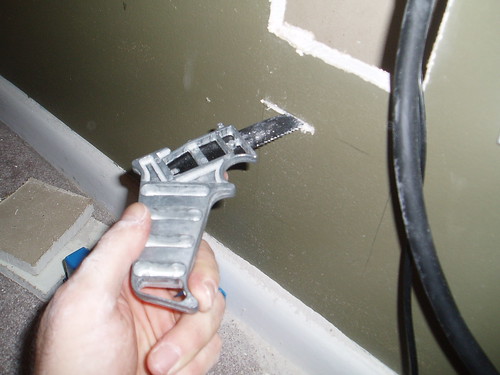
Some old-fashioned wire camouflage might be your best bet. But if you want to brave the behind-the-wall strategy, try these instructions. (NOTE: flickr photo notes are perfect for DIY instructions.)

If you’re feeling discouraged because your tax rebate is still in the mail—because you’re still stuck with a clunky 27 inch rear-projection television—do not worry. Just make it flat-screen, hillbilly-style:

Turns out all you need to turn that bulky old clunker of a TV into a slick-looking flat panel is a little extra closet room! I bet your wheels are turning now, aren’t they — thinking up all the other cool things you could embed into your walls. I should warn you, however, that console TVs don’t look quite as nice as the newer model televisions.


Weightless Markets

Tuesday, March 18th, 2008

Unemployment up. Stock market down. Recession looming. For financial security, maybe you should enter the space plane business. EADS thinks the market will boom:

Aerospace giant EADS says it will need a production line of rocket planes to satisfy the space tourism market.

The European company’s Astrium division, makers of the Ariane rocket, has plans for a commercial vehicle to take ticketed passengers above 100km.

Its market assessment suggests there would be 15,000 people a year prepared to part with some 200,000 euros (£160,000) for the ride of a lifetime.

Astrium anticipates it be will be producing about 10 planes a year.

“To satisfy the market you will need more planes than you think, because once there is regular operation, the price will decrease which means there will be more customers,” Robert Laine, chief technical officer (CTO) of the pan-European company, told BBC News.

For more info on the EADS’ take on space tourism, watch Robert Laine, EADS’ CTO’s speech to the Institution of Engineering and Technology last week.

While Astrium proceeds according to plan, Virgin Galactic and its partner, Scaled Composites, appear to be in the space tourism race lead. And it looks like they are confirming Laine’s prediction for increased production:

Virgin Galactic, billionaire Richard Branson’s space travel venture, plans to order five more spaceships and aims to turn a profit in five years from its commercial launch in 2010, an official told Reuters on Thursday.

Prospective space travelers have so far placed deposits totaling more than $31 million for tickets that cost $200,000 each and would give them five minutes in space, said Alex Tai, the firm’s group director.

“In the short term, we have firm orders for five spaceships and options for seven … We believe there is a very strong market,” Tai said in an interview at the Singapore Airshow.

If you want the weightless experience but can’t pony-up 200k, drop 4k and hop on a 727 parabolic flight – G-Force One:

Zero Gravity Corporation (www.GoZeroG.com) is a privately held space entertainment and tourism company whose mission is to make the excitement and adventure of space accessible to the public. ZERO-G is based in Las Vegas and Florida and is the first and only FAA-approved provider of commercial weightless flight to the general public, as well as the entertainment and film industries, corporate and incentive market, non-profit research and education sectors, and government. The experience offered by ZERO-G is the only commercial opportunity on Earth for individuals to experience true “weightlessness” without going to space. This is the identical weightless flight experience used by NASA to train its astronauts and used by Ron Howard and Tom Hanks to film Apollo-13. The ZERO-G Experience consists of a brief training session for passengers followed by a 90-minute flight aboard G-Force-One, during which parabolic maneuvers are performed. The controlled ascent and descent of the plane allows Flyers to experience Martian gravity (1/3-gravity), Lunar gravity (1/6-gravity), and zero gravity. The ZERO-G Experience provides its Flyers with twice the amount of weightless time achieved in a typical sub-orbital flight into space. ZERO-G operates under the highest safety standards as set by the FAA (Part-121) with its partner Amerijet International of Ft. Lauderdale Florida. Aircraft operations take place under the same regulations set for large commercial passenger airliners.

DIY Friday: Component Cable

Friday, March 7th, 2008

Have an amplifier and speakers and just need some speaker wire to start the party? Instead of dropping $50-$100 bucks on Monster Cable, you might just want to bend a couple coat hangers into place:

Not only does it work, but there doesn’t seem to be an audio quality drop-off:

I’m so sorry, but I do not buy into 90% of the hype brought to us audiophiles by the commercial sector of our hobby and the home entertainment industry at large. My brother, an audio engineering whiz kid has proven to me what is real and what is not. Let me rehearse with you an example of how he does this.

We gathered up a 5 of our audio buddies. We took my “old” Martin Logan SL-3 (not a bad speaker for accurate noise making) and hooked them up with Monster 1000 speaker cables [ed. Monster Ultra Series THX 1000 Audio Interconnects] (decent cables according to the audio press). We also rigged up 14 gauge, oxygen free Belden stranded copper wire with a simple PVC jacket. Both were 2 meters long. They were connected to an ABX switch box allowing blind fold testing. Volume levels were set at 75 Db at 1000K Hz. A high quality recording of smooth, trio, easy listening jazz was played (Piano, drums, bass). None of us had heard this group or CD before, therefore eliminating biases. The music was played. Of the 5 blind folded, only 2 guessed correctly which was the monster cable. (I was not one of them). This was done 7 times in a row! Keeping us blind folded, my brother switched out the Belden wire (are you ready for this) with simple coat hanger wire! Unknown to me and our 12 audiophile buddies, prior to the ABX blind test, he took apart four coat hangers, reconnected them and twisted them into a pair of speaker cables. Connections were soldered. He stashed them in a closet within the testing room so we were not privy to what he was up to. This made for a pair of 2 meter cables, the exact length of the other wires. The test was conducted. After 5 tests, none could determine which was the Monster 1000 cable or the coat hanger wire. Further, when music was played through the coat hanger wire, we were asked if what we heard sounded good to us. All agreed that what was heard sounded excellent, however, when A-B tests occurred, it was impossible to determine which sounded best the majority of the time and which wire was in use. Needless to say, after the blind folds came off and we saw what my brother did, we learned he was right…most of what manufactures have to say about their products is pure hype. It seems the more they charge, the more hyped it is.

But some alert audophiles make a good point in this blog’s comments sections: if you are using cheap speakers and a cheap amplifier, high-quality speaker wire will have little effect. The audio snob mantra goes, “the sound quality of your system will never be stronger than its weakest link.”

If you join the monster-cables-are-a-rip-off crowd but aren’t ready to start bending your coathangers, try building your own component cables. Directions are here or just watch the guys at Systm tackle the project:

DISA Big Contract

Thursday, March 6th, 2008

The Defense Information Systems Agency (DISA), the communications support agency for the Department of Defense, has a pretty big RFP out there – $500 million/year for a new satellite services contract:

The Defense Information Systems Agency has kicked off a follow-on procurement for commercial satellite services that could be worth $500 million a year and may attract a large field of bidders, ranging from small businesses to large systems integrators.

The procurement, which could directly effect operations in Iraq and Afghanistan, is expected to be a pretty competitive process – continuing what they beleive to be an efficient public-private partnership:

The Defense Department has mandated that all the military services use DSTS-G, Cowen-Hirsch said, which leverages the department’s buying power. DISA’s cost for satellite services is 25 percent below the industry average. The agency said in its request for information for the Future Commercial Satellite Services Acquisition that it wants to maintain this "price competition, while ensuring maximum effectiveness by considering lessons learned, market evolution and anticipating future DoD needs."

It appears that a large pool of vendors stand ready to meet these requirements, and not just the small businesses that won the DSTS-G contracts in 2001. Eaton estimated that about 50 bidders submitted written responses to the new RFI, including his company and the two other DTTS-G incumbents, Artel Inc. and Spacelink, acquired by DRS Technolgies in 2006.

Rebecca Cowen-Hirsch is the director of DISA’s program executive office for satellite communications. In a recent interview before the follow-up procurement was announced, she was eager to defend the agency’s commercial partnerships:

There has been much debate over the advantages or perceived disadvantages of our primary contract vehicle for acquiring commercial SATCOM services. And yet it remains an incredibly successful tool in acquiring fixed satellite services, bandwidth for our customers. It continues to provide the warfighters great flexibility at some of the best prices in the industry. In fact, we have shown that the DSTS-G contract has provided service globally tailored to the unique needs of the warfighters with prices that are on average 25 percent lower than market averages. This value is derived principally by openly competing COMSATCOM requirements across the commercial marketplace and leveraging the benefits of competition, DoD’s buying power, and DISA’s strong partnership with the commercial satellite industry. We are able to procure very short duration leases, say on the order of a few days or a month, or long multiyear leases. The competition created by our vendors has been very beneficial to the department. Additionally, we have been able to add within the scope of our existing contract capabilities the warfighter values such as protection, access to commercial X-Band, portability, responsiveness and additional flexibilities.

While DSTS-G has been very effective is supporting the DoD, it will come to the end of its life cycle in 2011 [with all options exercised]. We are actively strategizing for our future services acquisition to build on our past experiences and to put in place the DoD’s next generation of commercial SATCOM services. We will continue to rely on DSTS-G while we plan for the future.

Despite the large-scale increase in capacity, some vendors think the procurement should be more expansive:

Tom Eaton, president of Arrowhead Global Solutions, one of the three vendors on DISA’s current Defense Information System Network Satellite Transmission Service-Global (DSTS-G) contract, said his company intends to bid on the follow-on procurement, known as the Future Commercial Satellite Services Acquisition. He said DISA should widen the scope of the procurement to include mobile satellite services as well as the fixed satellite services covered in the current contract, which expires in 2011.

Eaton said DISA also should consider bundling satellite terminal hardware into the Future Commercial Satellite Services Acquisition, along with mobile services, to cut down on administrative overhead and consolidate all commercial satellite communications requirements into one contract vehicle.

Eaton said that demand for satellite communications bandwidth far outstrips the capacity of military systems, a gap that can be filled by commercial satellite services.

DISA, by the way, is constructing a new building at Fort Meade in Maryland. The design contract was almost as much as this satellite procurement—$370 million—but it looks like the design firm knows what they’re doing.

Digital Test Drive

Tuesday, March 4th, 2008

If—somehow—you have not seen the deluge of trade group tv ads, here’s the deal: millions of analog TV sets will no longer display broadcast TV signals unless they are connected to cable, satellite, or to a converter. Millions are being spent in easing this transition, including a free converter coupon program. Still, nervousness is spreading.

FCC Commissioner (and apparent theater fan) Michael Copps wants to schedule a practice:

"Broadway shows open on the road to work out the kinks before opening night," he wrote. "The DTV transition deserves no less."

Copps noted that other countries, like the United Kingdom, have made the shift in stages and that the "single transition date does not afford us the luxury of a built-in learning curve."

Martin, in a reply letter, said Copps had presented some "interesting ideas that I am in favor of pursuing, including switching a small number of test markets to all-digital service before February 17, 2009."

On Feb. 18, all full-power broadcast television stations will stop transmitting an analog signal. Viewers with cable or satellite television will not be affected. Over-the-air viewers will need a converter box, which the government will help pay for.

A test run would present challenges, Martin noted. It would require the "voluntary participation of an entire community or market." Martin said he will ask the agency’s digital transition task force to begin exploring how such field tests could be done.

Those annoying commercials have done their job – in the past year "2009 transition" awareness has almost doubled from 41 to 74 percent of consumers. But the education efforts are not over:

Washington — The Federal Communications Commission (FCC) on Monday issued a DTV Consumer Education Order requiring television broadcasters, multichannel video programming distributors (MVPDs), telecommunications carriers, retailers and manufacturers to promote awareness of the nation’s transition to digital television.

The FCC also said it will assist the National Telecommunications and Information Administration in ensuring that retailers are getting digital-to-analog TV converter boxes on shelves.

The mandated activities and reporting procedures for those efforts come after increased pressure from some members of Congress who want to ensure that consumers are aware of the upcoming analog TV broadcasting cutoff in time to make necessary adjustments. Previously, FCC chairman Kevin Martin had encouraged voluntary industry education efforts.

Britain – a space power?

Monday, March 3rd, 2008

Well, sort of. With a little investment, the Brits could be an important player in space exploration and business:

Britain can play an important role in space exploration by exploiting its skills in the satellite sector rather than joining the competition in manned space flights, according to David Williams, head of Avanti, a satellite communications company. "There aren’t unlimited resources – we have to prioritise in areas where we have an economic advantage," he said.

Britain should be creating the communications infrastructure that will be needed as exploration expands deeper into space, he said. Countries such as the US, China, India and Russia, as well as the European Space Agency, are working on deep-space exploration. "If mankind is going to exploit the resources of the solar system, you are going to have to travel over very long distances and you are going to have to communicate over very long distances and you will need a network of data-relay satellites. The UK has a big advantage. We have the opportunity to control the space internet, which is going to be this network of data-relay satellites."

As The Guardian explains, these hopes are part of the government’s space strategy, drawn up by the British National Space Centre, which aims to double the number of British companies involved in the space business by 2012. Unfortunately, a trip to the moon is NOT part of the plan:

However, many space enthusiasts will be disappointed to learn that the plan has little to say about long-held aspirations for a British astronaut, though officials are to launch a review of the costs and possible benefits of human spaceflight.

In the 1960s ministers opted out of all crewed space missions, a stance governments have maintained since, but last year several key groups of experts, including the Commons science committee and a panel commissioned by the BNSC, warned that Britain risked being left behind if it did not end its long-standing opposition.

The failure to back a British astronaut dismayed some experts who believe Britain has missed any chance of being involved in European and Nasa plans to send humans back to the moon.

"There’s no commitment at all from this strategy. We’re the only developed nation that doesn’t have an astronaut, despite the fact that we’re the fifth largest economy," said Nick Spall of the British Interplanetary Society, who has been leading a campaign for a British astronaut.

"The government has missed a huge trick in terms of being able to offer inspiration to young people. In particular the chances of the UK contributing to a return to the moon, from a human spaceflight point of view, are very limited now. If we don’t have an astronaut with spaceflight experience we won’t get a look in on either of those missions."

Instead of "catching up" with other national manned space programs, Britain is going to try to conquer what it beleives to be an emerging focus of space research – climate change and disaster warning/relief:

The threat of climate change to planet Earth is to become the cornerstone of Britain’s role in the heavens, following an extensive review of space policy. British experts will develop satellites and other sophisticated technology capable of gazing back at Earth and taking the pulse of the planet from orbit, by monitoring melting ice sheets, dying rainforests and violent storms, under plans to be published by the government today.

The satellites will help create an early warning system for natural disasters, including hurricanes and tsunamis, and help to police international carbon-cutting agreements, such as pledges to avoid deforestation in some of the world’s environmental hotspots.

The move is at the heart of the government’s space strategy, drawn up by the British National Space Centre, which aims to double the number of British companies involved in the space business by 2012.

Under the plans Britain will become home to a major new European Space Agency facility based at Harwell in Oxfordshire. It will be dedicated to understanding climate change from space and developing robotics for space exploration. Britain is the only major contributor to the ESA that does not yet have its own facility.

According to BNSC officials, Earth observation from space is prioritised to help Britain become a hub for expertise in environmental science and disaster relief. During the 1990s natural disasters killed half a million people and caused £380bn of damage. Some 80% of those disasters were weather related, the report states.

It says: "Global satellite-based monitoring systems underpin our understanding of the health of the planet, alert us to dangers and speed up our responses. Satellites have a significant role in accurately assessing changes in sea [level] and temperature, the melting ice caps, and the effects of solar activity on the Earth and its environment."