Author Archive

DIY Friday: Spacecraft

Friday, February 29th, 2008

So, you’re sitting at your desk thinking about the sci-fi movie you watched last night or a fantasy outerspace adventure. If you can’t wait for the weekend to make your futuristic dreams a reality (sort-of), start by building an Office Supplies Starship Enterprise. From your employer’s supply cabinet, grab one wall clip, two small paperclips, one large paperclip, one small pinch clip, some tape, and a black Sharpie. With a little ingenuity, you have a passable replica for some afternoon day-dreaming.

Now, for tomorrow’s task – build a cardboard spaceship out of two washer/dryer boxes. With a little paint it sure can look good — too bad it can’t fly.

Alfie Carrington, a construction worker from Michigan is a little more ambitious:

The construction worker spends his free time inside a rented storage garage in Clinton Township, Mich., where he broods over a 14-foot-wide, carbon fiber, fiberglass vessel.

Thirty years ago, when Carrington was 27 and obsessed with science fiction, he set out to build a UFO look-alike. Despite his lack of engineering experience, Carrington pored over books, magazines and studies about aviation and spent nearly $60,000 for some of the materials needed for this saucer.

Carrington does it because he believes he has discovered a simple design for an aircraft that aeronautical engineers have spent countless millions trying to build.

Carrington has two patents on the design and a company called Vertex Aerospace. His work caught the attention of NASA, which invited him to a conference in the mid-1990s where engineers scratched their heads when he confessed he knew nothing about computers.

His own version of Anti Gravity Technology Propulsion: His idea is to fire up the vessel with a rotary engine to stimulate a magnetic levitation system to rotate the ship’s two discs. The discs would draw air into propeller blades.

A (very entertaining) video of the project is below. But before you take up a similar design, a word of warning:

“Things spinning at those speeds are worrisome because of the stress from centrifugal force,” explained Cornelis van Dam, professor of mechanical and aeronautical engineering at the University of California-Davis, a leading aviation school. “If it’s not properly designed and built, it will rip itself apart. I wouldn’t want to stand next to it when it gets up to speed.”

If you’re a little timid about centrifugal destruction, maybe we should keep the saucer on the ground. For the kids, build a saucer fort built from two discarded microwave transmitter dishes and $75 bucks worth of supplies. And if you want more than a little tree-house, you should buy this house in Tennessee. You can see it from space:


View Larger Map

If the static house isn’t good enough and you’re still scared of Alfie’s saucer, buy an individual flying vehicle for a pricey 50k. Or, better yet, just fake it:
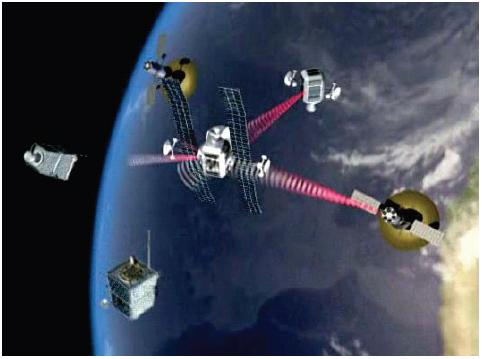
Fractionated Spacecraft

Thursday, February 28th, 2008

Orbital was awarded a contract for the initial development of an advanced space technology for the Department of Defense:

Orbital Sciences Corporation (NYSE: ORB), a world leader in smaller-sized civil government and national security satellites, announced today that it has been selected by the Defense Advanced Research Projects Agency (DARPA), Arlington, VA, to develop a Phase 1 concept for System F6 (Future Fast, Flexible, Fractionated, Free-Flying Spacecraft united by Information eXchange). DARPA is the central research and development organization for the Department of Defense (DoD).

They could only come up with six "F’s"? Come on.

To simplify (sort-of), the concept is called "fractionated spacecraft," which is described in this 2006 paper (pdf):

We note that the everlarger monolithic spacecraft of today are notoriously unresponsive. We then suggest a novel architectural paradigm, which we call fractionated spacecraft, whereby a satellite is decomposed into a set of similar or dissimilar component modules which interact wirelessly while in cluster orbits.

How is fractionated spacecraft more responsive than their larger, monolithic mainstays? (link)

According to DARPA such a virtual satellite effectively constitutes a "bus in the sky" – wherein customers need only provide and deploy a payload module suited to their immediate mission need, with the supporting features supplied by a global network of infrastructure modules already resident on-orbit and at critical ground locations. In addition, there can be sharing of resources between various "spacecraft" that are within sufficient range for communication.DARPA said the within the F6 network all subsystems and payloads can be treated like a uniquely addressable computing peripheral or network device.

Orbital is pretty excited:

“F6 has the potential to be a game-changing event in the history of military space systems in the same way that the internet revolutionized data communications,” stated Mr. Gregg Burgess, Orbital’s Vice President for National Security Systems in the Advanced Programs Group. “DARPA and Orbital have had a long and productive partnership leading to major innovations such as the Pegasus launch vehicle and numerous advanced small satellites. System F6 could transform today’s military space architecture to create a truly networked system of systems in space.”

DIY Friday: GPS Tracking

Friday, February 22nd, 2008

GPS systems appear to be the newest must-have gadget. They were flying off the shelves in December:

Personal navigation devices are a hot gift to give this holiday season. Unit sales of GPS systems rose 488% over last year, according to the latest point-of-sale information from market research firm NPD Group.

And GPS providers are not planning to sit on this past year’s successes. Forbes.com list GPS chipsets as one of five "emerging technologies" of 2008:

GPS chipset provider, SiRF Technology Holdings is the company to beat in the personal navigation device space, with over 50% market share. The company is one of several gearing to battle it out for a piece of the next-generation cellular handset market.

Mobile phones are only starting to emerge as a high-growth market for GPS chipsets, which include the basic radio-frequency (RF) and GPS base-band chips. True, most handsets already incorporate the technology, but it goes largely unused because most network operators have been slow to roll out location-based services with broad consumer appeal.

The other reason GPS chipset suppliers have ignored the current generation of mobile handsets is Qualcomm, which has been packaging GPS capability into its mobile phone chips for the last seven years. The industry, however, is shifting from today’s global system for mobile communications and CDMA network standards toward 3G, or W-CDMA standards, and next generation-compatible handsets are forecast to see a compound annual growth rate of 22% over the next five years.

But you don’t need to wait for the market to marry GPS and cell-phone handsets. Turn your cell-phone into a GPS tracking device:

DIY GPS tracking with "disposable" phones – Mod a GPS enabled Nextel and fauxjack yourself…or your car, or your kid, or a big dog, or an elephant. We really, really want to track an elephant. Mologogo is a free service that will track a "friends" GPS enabled cell phone from another phone(gps not required) or on the web. It currently works on pretty much any Nextel phone with Java and GPS – even a $60 no-contract Boost Mobile phone.

Using any GPS-enabled phone with java and a supported provider (Nextel, Sprint, or Boost), you can install a free service called Mologogo and turn your phone into a tracking device.

What can Mologogo do?

From your phone or the web, Mologogo shows you where you and your friends are at any moment. If you are on the go, Mologogo can alert you when friends are close, search around for points of interest, and keep you updated with local traffic and weather. Mologogo even supports mobile chat, so you can reach out to your nearby friends instantly. If you are on your PC, you can see all of your friends – locations, sign up new friends, bookmark locations, and show your Mologogo location on your own web page or blog.

You control who can see your location – anything from the entire Mologogo community to a few select friends. The applications for this are endless: track your kid; use an old phone and a prepaid data plan to track your car or a package; see where friends are in a city; or track mobile employees. (I’m smelling a good marketing opportunity for a quick-delivery pizza chain.)

If you don’t have a Mologogo-capable phone, you can buy one for $80 bucks, maybe less. And, unlike some stand-alone commercial tracking solutions, the service is free (as long as your cell-phone has a data plan).

And the locator works very, very fast, as one MAKE commenter explains:

As for the phones: The reason you get GPS lock so quickly (which might make you think it’s fake) is that the tower gives the phone a breath-of-life packet, containing the current satellite almanac and possibly even the position of the PRN sequences, so the GPS chip can achieve lock almost instantly.

You can test this by taking the phone to an area with no Nextel towers (Montana and Mississippi work well) and telling it to acquire a GPS fix. It’ll take much longer (30-50 seconds typically), just like your Garmin, because it’s not getting help from a tower. But even in the complete absence of towers and service, the phone’s GPS chip does work just fine, and will happily feed NMEA 0183 data over the serial cable for your laptop’s mapping software.

Virginia is for Launches

Thursday, February 21st, 2008

In a big boost to Virginia’s aeronautical and space industries (and economy), NASA has awarded a contract to Northern Virginia’s Orbital Sciences Corporation to resupply the International Space Station.

The federal space agency on Tuesday said it will provide Orbital Sciences Corp. as much as $170 million to demonstrate its capability to resupply the space station.

Orbital officials say they plan to team with NASA’s Wallops Flight Facility and the state’s Mid-Atlantic Regional Spaceport to demonstrate a new launch rocket in late 2010. If they succeed, the Eastern Shore could become a key outpost for commercial space operations, bringing jobs and investment to the region.

"This is a real opportunity to see that happen," said Billie Reed, executive director of the Virginia Commercial Spaceflight Authority and head of the spaceport, known as MARS. "This is significant."

Since December 2006, the fledging spaceport has hosted two successful launches into low-Earth orbit for Pentagon customers, and both featured a Minotaur I rocket developed by Orbital.

This isn’t just a boom for Orbital; it could mean significant investment in Virginia’s space industry and its Wallops infrastructure:

To handle cargo missions to the space station, Orbital is developing a much bigger rocket, called the Taurus II. It would be the largest rocket ever launched from Wallops, said Barry Beneski, an Orbital spokesman.

Because of that, the launch facilities at MARS would have to be upgraded to accommodate the larger vehicle. If those improvements aren’t made, Orbital would have to look elsewhere, probably in Florida, for a launch site, Beneski said.

"We’re supporters of Wallops, and we’re supporters of developing the space industry in Virginia," Beneski said, "but infrastructure development is really the key."

Reed said state leaders plan to meet with Orbital executives this week to discuss the needs. "It’s not a show-stopper," he said, adding that the spaceflight authority is empowered to issue bonds to finance improvements. "We can find ways to do this."

NASA Wallops provides mission control and logistics support to MARS. The Eastern Shore launch site is considered ideal. Its latitude is aligned to the space station’s orbit, reducing fuel expenses, and rockets quickly travel over the ocean, limiting risks to populated areas.

"This shows the industry that what we have to offer here is real," said Keith Koehler, spokesman for the flight facility. "We’re excited."

Besides NASA’s investment, Orbital plans to pitch in $150 million of company money to the effort, known as COTS, for commercial orbital transportation services. NASA’s aim is to contract with private aerospace companies to resupply the station after the agency retires the space shuttle program in 2010.

Orbital is still flying high after the announcement. Shares are up more than 50 cents and profit is expected to rise by as much as 25 percent.

DIY Friday: Snowmaking

Friday, February 15th, 2008

China plans to halt rain for Olympics – I didn’t beleive the headline when I read it the first time, but I guess this isn’t a pipe dream:

The Chinese are among the world’s leaders in what is called "weather modification," but they have more experience creating rain than preventing it. In fact, the techniques are virtually the same.

Cloud-seeding is a relatively well-known practice that involves shooting various substances into clouds, such as silver iodide, salts and dry ice, that bring on the formation of larger raindrops, triggering a downpour. But Chinese scientists believe they have perfected a technique that reduces the size of the raindrops, delaying the rain until the clouds move on.

The weather modification would be used only on a small area, opening what would be in effect a meteorological umbrella over the 91,000-seat Olympic stadium. The $400-million stadium, nicknamed the "bird’s nest" for its interlacing steel beams, has no roof.

This isn’t that unusual, apparently. Idaho, Utah, Nevada, and Wyoming have all experimented with cloud seeding this winter, mostly to relieve draught conditions.

And, of course, people have been playing with weather for years. Take Hunter Mountain in NY – they were one of the first places to use snowmaking technology, and the first to have 100% coverage.

So in honor of Hunter Mountain and my planned weekend ski-trip there (if I ever get this post done), I bring you DIY-Snowmaking. MAKE links to a this site with a number of free plans. There are two main options:

Internal mix snow makers operate by mixing compressed air and water inside the plumbing of the snow maker. This design does work but it has its drawbacks. One of the issues with this design is maintaining the air and water pressure balance to keep an even flow of water coming out the snowmaker, this issue causes a reduction in efficiency. Another problem is the likelihood of having water back into the airline and doing permanent damage to your air compressor. Choose from one of the Internal mix designs below.

External mix snow makers mix air and water outside the body of the snowmaker. This design eliminates most of the problems associated with internal mixing. External mixing completely eliminates the issue of water entering the air line because they are not connected. External mixing also utilizes the water and air more efficiently (less energy}.

Don’t be intimidated. A ten-year-old, frustrated by the lack of snow, built one:

WEST LINN, Ore. – Talk about ingenuity – a 10-year-old boy built his own snow machine and filled his backyard with enough snow to make it look like a blizzard had blown through.

"It was just hypnotizing," said Forest Pearson, who built the snow machine out of a 30-gallon air compressor that he got for Christmas, a pressure washer and a whole lot of research.

Or just buy a machine. Backyard Blizzard has the goods (for $2,400) and the New York Times has a story on your options.

Hurling?

Monday, February 11th, 2008

What is Hurling? Other than being “some old Irish game“, most Americans have no clue. Too bad, because the game is pretty cool. Here’s the gist: it is a field sport, similar to field hockey or rugby; players carry wooden axe-shaped sticks (called a hurley). The object of the game is to hit (or “hurl”) a small ball between goal posts for one point or in the keeper-guarded goal for the equivalent of three points.

YouTube has you covered:

Don’t resist watching (in awe) some more hurling highlights. Also, check out “What is Hurling” parts one, two, and three for a little more background.

Hooked, yet? You’ll need Setanta Sports to keep up with the action (which we blogged about before). Satellite TV makes it possible to watch hurling and other great European/Commonwealth sports: rugby, Aussie football, cricket, and British soccer, to name a few. Setanta is available on Dish Network and DirecTV.

The network was formed by a couple of Irish guys in the Bronx who were looking for a way to watch these sports in the U.S. They started a channel distributed in bars and pubs; the company rapidly grew; and now the whole enterprise may pay-off:

Sports broadcaster Setanta Sports has received takeover approaches from several large media companies and is evaluating whether to conduct an auction, a source familiar with the matter confirmed today.

The company is discussing its next move with financial adviser Goldman Sachs, added the source. Both Setanta and Goldman Sachs declined to comment.

Reports say the firm has received offers of over €1.3 billion for the company. It is also believed to have received the unsolicited approach from an unnamed European media company before Christmas.

Setanta is understood to be looking for a valuation in excess of €1.3 billion, even though the company has yet to make a profit.

Among those that may express an interest are BT, ITV, Virgin Media and Disney – the owner of sports network ESPN. ESPN executives have made it clear that they are interested in breaking into the lucrative UK football rights industry.

The company, which in 2006 agreed to pay €500m over three years to share live Premiership football coverage with BSkyB, hopes to break even by the end of the year.

€1.3 – not bad for a couple Gaelic-bronxite-fanatics, but it didn’t all happen by accident. In addition to being advised by Goldman Sachs (who is advising Yahoo! to reject Microsoft’s bid) and JP Morgan, Setanta saved millions by moving part of its operations to Luxembourg:

PAY-TELEVISION broadcaster Setanta Sports has slashed at least £17m from its tax bill by setting up a subsidiary in Luxembourg. The windfall will boost the firm’s valuation as speculation increases that a sale of the company is likely.

Over 1m British and Irish subscribers pay into Setanta’s new Luxembourg subsidiary called Setanta Sports Sarl.

Setanta pays “super reduced” Vat of only 3% on subscriptions routed through the grand duchy against 17.5% charged in the UK and 21% in Ireland.

Setanta has also set up subsidiaries to support its entry into the Canadian and Australian markets this year. Its ultimate parent company remains in Ireland, where more than half of its 450 staff are employed.

Let’s just hope Setanta’s content doesn’t disappear. Cork’s hurling and football teams are on strike.

DIY Friday: USB Guitar

Friday, February 8th, 2008

Shredding Guitar Hero I, II, 80s, and Legends to its raging, satanical death? Maybe its time to stop the make-believe rocking and pick-up a real guitar.

You could pick-up a late 60’s Gibson Les Paul. Hell, Jimmy Page has one. The price tag? $12,500. Ouch.

How about Eric Clapton’s axe, a Fender Stratocaster? Ditto on the cost – looks to be pushing 20k.

Better just find a cheap electric guitar. But don’t stop there – integrate Guitar-Hero-like features into a real instrument. Build a USB Guitar:

Why would you want a USB port in an electric guitar? The answer is simple: convenience. By putting a small USB port and audio codec in a guitar, you’re adding an extra sound board. So when you record, your guitar is digitized locally and the signal is transmitted to your computer over a USB cable. The guitar retains all its standard analog capabilities but outputs to USB as well. Now you can rock steady until your hard drive is full. Here’s how to do it.

The full instructions are here. After purchasing a guitar and a Micro USB interface, measure, cut, and plug:

Here’s an approximation of the jack and module layout. The Micro USB module fits easily into the control cavity. The topmost jack is the normal guitar analog output. I’ll change the stock jack (very inexpensive) to a rugged Switchcraft jack. The second jack was intended to be an auxiliary input jack, but that didn’t work out, because it wasn’t -technically feasible to add a second jack for a microphone or another guitar. The third jack is a stereo headphone jack. For durability, I used a 1/4-inch jack. The female USB jack is from L-Com. It’s the smallest panel jack I could find, and I liked the chromed plastic shell. A mini USB connector wouldn’t be rugged enough, so I went with a full-size A-style connector.

Too complicated? You can buy an off-the-shelf guitar for about $400. Check out the demo:

Now that you have the equipment, better learn how to play (if Guitar Hero hasn’t already prepped you).

“Space is important for what the Army does…”

Thursday, February 7th, 2008

Well, duh. Ever since Adm. William Owens’ 1996 paper and Vice Admiral Arthur K. Cebrowski and John Gartska’s 1998 public paper (.doc) on Network-centric warfare, space guided military operations have been central to the military’s long term planning. What is network centric warfare?

Network-Centric Warfare derives its power from the strong networking of a well-informed but geographically dispersed force. The enabling elements are a high-performance information grid, access to all appropriate information sources, weapons reach and maneuver with precision and speed of response, value-adding command-and-control (C2) processes–to include high-speed automated assignment of resources to need–and integrated sensor grids closely coupled in time to shooters and C2 processes. Network-centric warfare is applicable to all levels of warfare and contributes to the coalescence of strategy, operations, and tactics. It is transparent to mission, force size and composition, and geography.

As front-lines and trench warfare are forgotten, innovation in satellite-military technology is constantly shaping our military’s future:

New satellites, radar sites, laser technology and missile defense locations overseas are among initiatives planned by the Army’s Space and Missile Defense Command that will help warfighters in the next five years, according to Lt. Gen. Kevin T. Campbell.

The SMDC commander spoke at the Association of the U.S. Army’s Land Warfare Forum Breakfast in Washington on November 8, providing an overview of his command’s wide-ranging operations from Army astronaut Col. Doug Wheelock returning to earth Wednesday on the Space Shuttle Discovery to National Guard troops manning Ground- Based Missile Defense systems at Fort Greely, Alaska.

"Space is important for what the Army does," said Lt. Gen. Campbell, who also heads up the U.S. Army Forces Strategic Command "and it’s going to be more important." He explained that SMDC provides commanders in Iraq and Afghanistan satellite imagery, intelligence and reconnaissance, and communications capabilities.

Space-based communications were bolstered last month when the first Wideband Global SATCOM satellite was launched. Lt. Gen. Campbell said the new satellite has up to 10 times the capacity of older ones in the Defense Satellite Communications System. He said more of these new satellites will be launched in the next few years to replace the "legacy" system.

"We want to be responsive to (Joint Task Force) commanders – not commanders in Washington, but in the field – that’s where we want to go with this," Lt. Gen. Campbell said of SMDC initiatives.

He said the command is looking at ways to provide "coherent change detection" to support warfighters and route reconnaissance. Such initiatives might better detect improvised explosive devices in the future along convoy routes.

SMDC is also experimenting with new ways to provide early warning to troops, Lt. Gen. Campbell said. He wants to better integrate a global Ballistic Missile Defense System.

The Network Centric Operations Industry Consortium (NCOIC), a not-for-profit association committed to the rapid global deployment of network-centric applications, has been a big part of this innovation. They recently received an award for their development of a tool-kit for the development of network-centric systems:

The developers’ kit includes a company and industry-neutral set of NCW principles, processes, best practices and tools that are available free of charge at http://www.ncoic.org/. The Consortium’s online resources can help developers assure that a new system will advance interoperability; determine how a legacy system can bridge the gap between current and desired levels of net-centricity; and adapt systems to meet evolving interoperability and NCW requirements.

In accepting IDGA’s award, NCOIC chairman emeritus Harry Raduege said, "We salute IDGA for its efforts to advance net-centricity and for recognizing the Consortium’s contributions. Our tool kit enables the military to identify gaps between existing and planned systems’ ability to support NCW as well as their ability to operate within a network. It is part of a suite of deliverables that represents some of the best collaboration and thinking of industry, government and academia."

Among NCOIC’s other material is an explanation (.pdf) of how and why to develop Fly-Away-Kits (FLAK) to support Hastily Formed Networks(HFN) in the event of Complex Humanitarian Disasters (CHDs). *Exhale* Oh, and this is just a little too deep/complex to be tomorrow’s DIY post.

Nice demo video from Analytical Graphics:


DIY Friday: LED Pegboard

Friday, February 1st, 2008

We’re all about holidays here at ReallyRocketScience. Yesterday, we commemorated the Explorer 1 launch 50 years ago. Today, we celebrate the DIY-Friday from one year ago – LED light shirts. The beauty of LED’s is that they never burn out. My cheesy shirt is still functioning perfect for the occasional ugly sweater theme party.

Now LED’s are hitting Saks Fifth Avenue – on the store’s facade, not the clothes racks:

This Christmas, Royal Philips Electronics (PHG) is vividly displaying its dominance in the lighting market. It supplied the 50 giant illuminated snowflakes that festoon the front of the flagship Saks Fifth Avenue (SKS) store in New York. The flakes are aglow with light-emitting diodes, or LEDs–semiconductor devices that produce bright beams of light using a fraction as much electricity as incandescent bulbs. The 40,000-plus LEDs in the display sip about the same amount of power as three toaster ovens.

Philips also will provide the lights for the New Year’s Eve Times Square Ball in New York. Instead of 600 incandescent and halogen bulbs, the ball will be fitted with more than 9,500 LEDs, which burn twice as brightly and can create a palette of 16 million colors. Depending on their hue, they’ll be up to 98% more energy-efficient than the bulbs they replace.

The demonstration is a symbolic blow to its main LED rival – GE:

Philips’ latest LED installations give the company much-coveted green bragging rights. Lighting accounts for about one-fifth of all electricity used, in part because, with traditional incandescent bulbs, most of the energy is wasted in heat. LEDs burn cooler and last much longer. So the company that leads in this area can claim to be helping planet earth.

General Electric (GE), Philips’ biggest rival in lighting, has spent millions to bolster its own environmental credentials in a high-profile campaign whose slogan is "ecomagination." But it hasn’t matched the billions of dollars Philips has spent on LEDs and other energy-efficient lighting systems. This year alone, Philips has paid $4.2 billion to acquire five companies in the lighting sector, including the Nov. 26 purchase of Genlyte (GLYT) in Louisville, the No.2 U.S. maker of lighting fixtures. As a result, Philips has vaulted past GE as the leading supplier of lights and fixtures in the all-important U.S. market.

Over the next ten years, as much of the world makes the transition to LED lights, Philips’ lead over GE is expected to grow. "A building contractor can go to Philips and get everything he wants," says Janardan Menon, a financial analyst at Dresdner Kleinwort in London. The same, he argues, is not true for GE.

It won’t be long before LED’s cross-over from Fifth Avenue to the home. Get started by buying some LED candles.

Or, better yet, take up our DIY-challenge: construct "Peggy," a light emitting pegboard kit:

Our light-emitting pegboard display, affectionately known as "Peggy," provides a quick, easy, powerful and efficient way to drive a lot of LEDs– up to 625– in a big matrix covering almost a square foot of area. You can make an LED sign for your window, a geeky valentine for your sweetie, one bad-ass birthday card, or freak the holy bejesus out of Boston. Your call. It’s a versatile, high-brightness display. How you configure it and what you do with it is up to you.

The display can run off batteries (3 ‘D’ cells) or an optional ac adapter, and is designed to drive as many green/blue/white/violet LEDs as you care to solder into the holes, all with excellent brightness. The board can accommodate LEDs in several common sizes: 3mm, 5 mm (standard T-1 3/4 size), and 10 mm. A photosensor is provided that can automatically turn off the display in bright daylight or incandescent light.

Instructions are available here. The good news is you have two weeks to construct your Valentine’s Day surprise creation. Or build a LED-shirt, version 2 – I’m sure he/she will love the gesture. I told you we liked holidays here at ReallyRocketScience.

Credit Crisis Threatening Intelsat Deal?

Tuesday, January 29th, 2008

The current credit crisis isn’t just hitting the housing market. Last June, BC Partners agreed to buy satellite operator Intelsat. Now, BC Partners is requesting an "unusual" exception, asking "existing lenders to finance the purchase instead of selling a new financing in the open market." The current credit conditions make it very difficult to sell loans.

If Credit Suisse’s proposal is accepted, it would be relieved of the task of refinancing the bank loans for Intelsat and PanAmSat. New financing would still be required to finance the purchase, but the amount needed would be much smaller than the $5.1 billion commitment, as lenders would have agreed to roll the existing credit agreement into the new company.

The terms of Credit Suisse’s proposal are unusual in that the bank is asking lenders to loosen the definition of a "change of control" clause in the existing credit agreement. Usually, this clause will trigger a repayment of bank debt, but under the current proposal, a change of control would not be triggered.

For some background on Intelsat:

Intelsat, a global satellite network set up in 1965 by the national telecom operators of several Western countries, is being sold by a group of four buyout funds. Apax Partners, Permira, Apollo Management and Madison Dearborn Partners bought the company for about $3.1 billion in 2004. They added PanAmSat, a rival operator, for $3.2 billion in 2005.

Intelsat, based in Washington, operates 51 satellites used by cable companies, broadcast networks and governments for distributing video programming. It leases capacity to television companies rather than providing content itself.

The company has about 35 per cent global market share and last year reported $1.7 billion in revenues and adjusted earnings of $1.3 billion. Just under half its business is in North America, with 15 per cent of profits driven by Europe and 17 per cent from the Middle East and Africa.

Despite the credit conditions and the uncertainty surrounding the Intelsat transaction , BC Partners remains upbeat:

BC Partners, the international private equity group have today said they are anticipating returns in excess of 20% on the group’s sub-prime linked investment portfolio, despite the ongoing unrest in the global credit marketplace, according to a top executive today.

Stefan Zuschke of the group’s German operation said that the group was still looking forward to returns of as much as a fifth from its portfolio, despite the collapse of the sub-prime sector which left many banks and investment firms heavily out of pocket and forced to take severe writedowns against their balance sheets.

Whilst it was said that the credit crunch made for difficult times for investment firms, given increasing reluctance from banks to put up the cash for acquisitions and buy-outs at the same rate as before, he added that 2008 would see a return to the previous levels of spending and somewhere in the region of the same level of market confidence and optimism.