Everyone is talking about the iPod – music, web browser, email, and phone all in one device. What else would you need? But when I get home from a long day of rocket science, I wanna lay on my couch and watch a 32 inch plasma, not stare at a 3 inch cell-phone.
That said, we don’t have to resign ourselves to the past. Consider a Home Theater PC system. The benefits are numerous: storage scalability, superior DVD playback, and easy content cataloging.
Microsoft is getting into the game. Vista’s Windows Media Center lets you view slide shows set to music, browse music by cover art (blatantly copied from Apple), and, with a TV tuner, utilize Microsoft’s tivo-like features (rewind live tv and schedule recordings).
But to capably take advantage of all of these features (including HD), you’re going to need a pretty powerful PC. You’re probably going to want 2 gb of RAM and a ton of hard drive space (400G gets you about 88 hours of HD recording). For a reasonably priced and very effective system, check out the Gigabyte H971 entertainment PC.
If you’re an anti-Microsoft/establishment snob or are just wary of new Microsoft OS’s (I’m still stubbornly using 2000 on one of my ThinkPads), go Linux. This barebones Linux system includes a DVD image with opensource TV tuner software. You’ll need to install a processor, memory, hard drive, and MythTV, personal video recorder software. Its magical:
Without breaking a sweat, MythTV meets our specifications for a HTPC. Using a TV tuner card, MythTV can pause and rewind live television, schedule recordings, and excise commercials during playback. If you intend to record multiple shows at once or watch another channel while something is recording in the background, you’ll need a second TV tuner card – which MythTV will handily support. You’ll get picture-in-picture that way, too.
If your video card has an output compatible with your TV (S-Video is the best bet), it’s also fairly easy to get TV-out working on Linux these days. That applies to all the software discussed here, not just MythTV.
Much of MythTV’s functionality is provided by plugins. Most of the modules discussed here are "official" add-ons and will be included with MythTV by default, depending upon who packaged your installation.
On a cloudy day when the mist hung heavily in the air, India’s Polar Satellite Launch Vehicle, PSLV-C10, successfully put the Israeli satellite Tecsar into orbit. It was a textbook launch with the “core-alone” configuration of the PSLV lifting off on time from the first launch pad at Sriharikota at 9.15 a.m. on Monday and injecting Tecsar into its precise orbit 19 minutes and 45 seconds after the lift-off. Tecsar, weighing 300 kg, is a remote-sensing satellite that can take pictures of the earth 365 days of the year, 24 hours of the day, through rain, clouds, day and night. It has a one-metre resolution. It was earlier known as Polaris.
Top Indian Space Research Organization (ISRO) engineers called this one "one of the very best launches" of the PSLV and "an excellent performance with a perfect injection of the satellite into orbit." But the road to launch wasn’t so smooth. Iran gave sabatoge a shot:
The successful launch on Monday of an advanced Israeli satellite was delayed in recent months by Iranian sabotage, The Jerusalem Post has learned from Western sources.
The TecSar satellite – developed and manufactured by Israel Aerospace Industries (IAI) – was supposed to be launched in September, on the heels of the June launch of the Ofek-7 spy satellite.
Its deployment will dramatically increase Israel’s intelligence-gathering capabilities regarding the Islamic Republic’s nuclear program, since the satellite can transmit images in all weather conditions, a capability that Israel’s existing satellites lacked.
According to assessments recently received, Iran learned of the TecSar’s planned deployment from the media and has since applied heavy pressure through Indian opposition parties – particularly the Muslim and Communist political factions – to prevent the launch.
Teheran’s attempts to sabotage the operation may demonstrate concerns over Israel’s advancing intelligence capabilities. "The Iranians are scared of the potential this new satellite will bring Israel," a Western defense official had said earlier. "They are doing everything they can to prevent its launch."
IAI, the Israeli manufacturer of TECSAR, has more information on the aircraft here (and in the YouTube video, below). And, the ISRO engineers shouldn’t party too long – they’ve got a busy launch schedule this year.
No, politicos, we’re not talking about a "free trade agreement." This is rocket scientist shorthand for "free-to-air" satellite – free, unencrypted satellite television broadcasts.
Downlinkers looking for specialized content are the common customers – especially ex-pats looking for hometown TV.
There is nothing ticky or illegal here. Just buy a dish and receiver (or satellite pc card), look up a station, find its signal, and enjoy free-to-air’ing. You will also want an antenna motor if you wish to receive channels from more than one satellite.
More information is available here and here. Details on each satellite, including a list of all free HDTV channels, are available here.
Today’s SkyREPORT revisits EchoStar’s split. The division will result in two companies: DISH Networks (DISH), which provides direct-to-home satellite service, and EchoStar (SATS) which does…well…pretty much everything else – designs set-top boxes, provides fixed satellite services, and develops Sling Media technology.
The satellite service provides capacity on nine owned and leased in-orbit satellites, and includes a network of seven full-service digital broadcast centers and leased fiber PoPs in 150 cities. Here at SES, we’re looking forward to launching a new satellite for EchoStar.
How’s this split faring on Wall Street?
In a note released last week, William Kidd of Wedbush Morgan lowered his price target on DISH shares (stock that represents the new DISH Network DBS split) from $48 to $37. The move was made given that DISH shares solely represent the pay-TV assets.
While the bulk of the adjustment represents the split, Kidd also said $2 of the change is the result of the company’s recent decision not to raise prices for subscribers this year.
The two stocks are slightly down so far this year. (But what stock isn’t these days?).
The move allows EchoStar to sell its products externally:
Last week, Ergen said that the company is aggressively planning to sell products — from Sling Media-enabled modems to set-tops — to Dish Network’s video rivals, namely cable operators and phone companies.
Ergen and Blake Krikorian, co-founder and chairman of Sling Media, both described the efforts of the spinoff company, EchoStar Holding, to seek buyers for its products beyond the Dish direct-broadcast satellite service.
“As a set-top manufacturer, EchoStar will certainly try to build products and sell them to the cable industry,” Ergen said at a CES press conference.
And this gives the company a way to "better highlight the value of some of its lesser-known technology assets." That publicity definitely hit last week’s CES 2008 convention:
It’s HD DVR, the TR-50, won CNET’s "best in show" for home video:
If you think everybody has cable or satellite, you couldn’t be more wrong. In fact, if you live in an area that’s well-served by digital broadcasters, now’s a better time than ever to get your TV over the air (or "OTA," as the cool kids say): yeah, you get only a handful of channels, but they’re in crystal-clear digital quality–DVD quality at "worst," uncompressed high-definition at best. The problem–as we’re reminded by many an e-mailer–is that there just isn’t a good DVR solution for the rabbit-ears crowd, especially if you prefer high-def. (You can opt for a TiVo HD, but you’d still have to pay a monthly fee for their programming guide.) But that may finally be changing, thanks to the EchoStar TR-50. For all intents and purposes, the TR-50 takes many of the features found on Dish Networks’ excellent satellite DVRs (such as the ViP622 and 722) and brings them to antenna-based TV viewers.
This past week at CES, Sling Media demonstrated its SlingPlayer Mobile on a BlackBerry Pearl at the technology expo; up until now, SlingPlayer Mobile and BlackBerry haven’t played nice together. Sling Media hasn’t given a firm date on when the new player will be available, but states that it’ll be introduced "later this year" for $29.99.
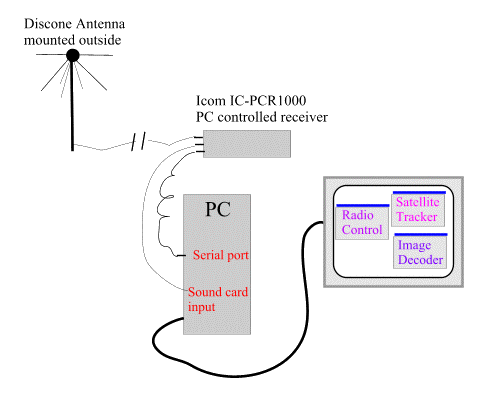
Setting-up a weather satellite station is remarkably simple: Connect a discone antenna ($50-100) to a PC-controlled receiver (HobbySpace used a ICOM – PCR1000 – now a 1500). The receiver includes software to receive the audio signal. You will need software to decode the audio to obtain the weather image. HobbySpace used WXSat (freeware). More advanced station designs are available here.
You can use WinOrbit to track when and where a polar satellite will pass. By the way, these polar satellites work a little different than your typical weather satellites that show weather patterns moving across the country on your local news:
The NOAA polar satellites orbit at 850km and pass within view of all areas on earth at least twice day. The satellite carries a number of instruments including cameras for both visible and Infrared light.
The cameras scan back and forth at right angles to the ground path, like a broom sweeping side-to-side as you walk forward, taking picture strips that cover an area 3000km wide. The satellite thus makes a continuous picture as if it was a tape reeling out from an endless roll.
The image, however, is not recorded on the satellite. Each image strip is immediately broadcast to the ground at a frequency just above 137MHz. The satellite will be in range for up to 12min as the satellite passes from horizon to horizon.
The broadcast uses the APT (Automatic Picture Transmission) analog format for the imagery. (A digital format – High Resolution Picture Transmission (HRPT ) signal is also transmitted but it is more difficult to receive and decode and we did not try to receive it in this project.)
Want the whole shebang? Build an ethernet weather station to collect temperature and air pressure readings, then feed the data through its very own web server.
And, if you’re looking for a location for your new venture, consider my old stomping grounds – southern Wisconsin. Among the bizarre events in the past few weeks: first Severe Thunderstorm Warning in 14 years during the month of January; numerous rivers exceeding flood stage…in JANUARY; and record high January temperatures throughout the area. Crazy. We’ll save the global warming debate for a different day. Let me just say I’m glad I did my cross-country skiing in December and not January.
Not the news any of us wanted as we ease out of our holiday break. Benazir Bhutto was a brave, courageous woman, with a vision for a better Pakistan — a Pakistan that could democratize, that has greater respect for human rights, that has an eye towards modernization and economic progress. Despite repeated exiles, death threats, and assasination attempts, she always returned to her country with the well-being of Pakistan paramount.
Bhutto beleived in the democratizing force of information and media. She condemned Musharraf’s crackdown on Pakistan’s emerging independent television stations, including the government’s import ban on satellite dishes. As we discussed last month and Bhutto was shrewdly aware of, the rise of Satellites and the Internet has made state control much trickier for autocrats.
Bhutto will be missed by Pakistan and by the world.
Mobile TV is starting to take off. As networks get faster, phones get smarter, and consumers become more demanding, mobile tv may become the central front in the mobile market wars. So, not surprisingly, the Consumer Electronics Association Conference in Vegas next month will be a hot show on this subject.
ICO Global and Alcatel-Lucent will demonstrate a new standard in mobile broadcasting – Digital Video Broadcasting, satellite to handhelds (DVB-SH).
In the demonstration, ICO and Alcatel-Lucent will deliver mobile high-resolution live television programming to display terminals located in a moving vehicle outfitted with DVB-SH receivers. In addition, ICO will demonstrate high-resolution DVB-SH video reception by delivering pre-encoded content to portable monitors in ICO’s exhibit suite at the Venetian hotel. ICO and Alcatel-Lucent will also be demonstrating at the CES “ShowStoppers” press event on Monday, January 7 from 6:00 until 10:00 pm at the Wynn Hotel.
These standards-based demonstrations are the first displays of the cutting-edge solution being developed for the ICO alpha trial of mobile interactive media (mim) services, which will take place in 2008 in Las Vegas, Nevada and Raleigh-Durham, North Carolina.
The ICO mim™ product is a converged mobile media service that addresses a wide variety of consumers’ entertainment, information, and two-way communication needs: live and stored mobile TV in vehicles, interactive navigation, and roadside assistance, all with nationwide coverage. ICO mim will provide multiple channels of high-quality mobile video to portable, larger-screen (4.5 to 10 inch) user devices.
Last spring, ICO announced agreements with Alcatel-Lucent and Hughes Network Systems (Hughes) to develop key architecture and technology for use in ICO’s alpha trial based on ICO’s next-generation geostationary satellite (ICO G1) and the deployment of an Ancillary Terrestrial Component (ATC) using the mobile multimedia DVB-SH open standard. ICO G1 is scheduled for launch in March 2008, and the alpha trial will take place in Raleigh-Durham and Las Vegas after the launch of ICO G1.
SES AMERICOM’s IP-PRIME service is providing the programming for this test, along with another test at the Las Vegas conference—Hiwire—this one using Digital Video Broadcasting to handheld (DVB-H, see image). This will utilize the 700mhz spectrum through Aloha Partners – the largest licensee of this spectrum in the country. It promises to have “the largest channel lineup of high-quality multicast television mobile TV ever trialed with consumers anywhere around the globe. The trial will also deliver up to three times as many channels as any similar mobile TV network in the United States, giving consumers the depth of programming that satisfies their appetite for TV.” The programming:
Hiwire will leverage Aloha Partners’ sizable 700 MHz spectrum capacity to deliver this unprecedented channel lineup of high-quality, full-frame rate TV to consumers. The channel lineup, procured by SES AMERICOM, includes top, leading programmers and networks, with seven channels from Discovery Communications (including Discovery Channel, Animal Planet, TLC, Discovery Kids and Discovery’s dedicated mobile network, Discovery Mobile), six channels from MTV Networks (including CMT, COMEDY CENTRAL, MTV, Nickelodeon, Spike TV and VH1), two channels from Turner Broadcasting – CNN Mobile Live and Cartoon Networks/Adult Swim Mobile, Anime Network, E!, Fox News Channel, Travel Channel, The Weather Channel, MavTV and AccuWeather.com. The parties are in discussions to add other programming services as well which will be finalized prior to the consumer launch, scheduled to begin this month.
So, should carriers move towards DVB-SH or DVB-H? Europe is already having the debate:
But can DVB-SH gain traction? It has struggled to find support among handset vendors, especially as DVB-H, the only globally used mobile TV standard, is backed by an industry consortium that includes Nokia (NYSE: NOK) and Motorola. In a controversial move, the EU has also recently endorsed DVB-H as its mobile TV tech standard of choice and has placed the technology on its list of “official standards.” Starting in February, member states will be required to support its use and implementation—though this doesn’t mean they have to ban other standards.
There’s also a question on whether its use may be more costly. As Reuters (NSDQ: RTRSY) reports, in Europe there is a current shortage of spectrum for mobile TV, which means the telecoms industry—just as Alcatel Luncent has done—has been looking at higher frequencies. DVB-SH sits just above current 3G airwaves. But these higher frequencies are usually costlier since the higher the frequency, the shorter the distance radio signals travel, meaning operators have to build denser networks. Rival DVB-H standard uses much lower frequencies, the same as traditional television’s UHF band.
This will be just part of the fun at the CES show next month. Check out the “March of the CES Press Releases.” Perhaps a clip from Laurel & Hardy’s “March of the Wooden Soldiers” is appropriate:
Backup satellite solutions are being increasingly implemented, to prepare for a landline network failure. Yesterday, cement manufacturer/distributor ESSROC inked a deal with HughesNet:
Hughes Network Systems, LLC (HUGHES) today announced that it is providing ESSROC, a leading North American cement producer, with HughesNet Access Continuity, a diverse path backup solution that ensures communications continuity. By the end of the year, Hughes will have equipped all thirty-three North American ESSROC offices with the backup satellite broadband service.
ESSROC’s entire business relies on broadband connectivity to efficiently manufacture, package, and distribute cement throughout North America, connecting manufacturing plants, corporate offices, shipping terminals, and almost 1000 employees. ESSROC turned to Hughes to provide a back-up satellite broadband solution after realizing that the redundant landline network purchased from its primary network provider also went down if the provider’s central office had problems.
"When you back up a landline network with another landline network, it is vulnerable to the same problems as the primary network," said Ted Fritchlee, senior network engineer, ESSROC. "We previously used an ISDN to backup our MPLS wide area network, but after the local phone company had an outage at its central office, we approached Hughes and went non-terrestrial."
ESSROC runs all accounting, processing, email, bulk loading, time and attendance, safety, and compliance data over its network. HughesNet Access Continuity uses satellite broadband technology to create a truly diverse path to the primary landline network, ensuring that all ESSROC’s mission-critical applications stay up and running on the network if the primary MPLS network fails.
"Without an access continuity solution, we have to turn to manual processes to keep our business moving," explains Fritchlee. "We can get by, but we’re not as effective or efficient. In short, without HughesNet, a landline network outage can seriously disrupt our business."
In case you were wondering, ESSROC is the number one cement producer in North America. In other words, if their network goes down, its bad news for a lot of people. Also, they are developing some pretty cool cements:
Essroc’s TX Active technology will impact concrete construction in several ways. Through photocatalysis, TX Arca reduces the maintenance requirements for concrete structures or buildings by destoying most organic and inorganic pollutants that come into contact with the concrete surface and cause discoloration. In addition to this self-cleaning benefit, TX Aria effectively destroys airborne pollutants, which are responsible for urban organic pollution.
While we’re discussing satellite backup, Cabela’s, the world’s largest mail order, retail and Internet outdoor outfitter, also signed-up for HughesNet Access Continuity Service:
“At Cabela’s, the availability of information is an important part of our successful relationship with our customers,” said Nick Stafford, Enterprise Infrastructure project manager, Cabela’s. “Our customers depend on us to provide them with up-to-date product information, accurate inventory, and field expertise that is second to none. The HughesNet Access Continuity Service completes a critical link in the technology infrastructure that we depend on to provide our customers with an industry leading customer service experience. With the HughesNet Access Continuity Service, each retail store can service several million customers a year, comfortable with the knowledge that critical information remains available, even during terrestrial outages.”
Cabela’s selected HughesNet Access Continuity Service to ensure that they could continue to serve in-store customers, fulfill online and catalog orders, and transport goods within the organization without having to rely solely on terrestrial providers for connectivity. Without the communications diversity provided by HughesNet, Cabela’s critical business applications, such as point-of-sale and inventory management, could be rendered unavailable in the event of a terrestrial network outage.
Just in time for hunting season (or to buy a GPS device as a holiday gift).
When we blogged about the Vanco Arctic Survey—a detailed survey about the health of the North Pole cap in a climate of rapid melting—we had no idea that we’re in the middle of the International Polar Year. In that spirit, let’s head south and check-in on Antarctica:
The Landsat Image Mosaic of Antarctica (LIMA) brings "the coldest continent on Earth alive in greater detail than ever before through [a] virtually cloudless, seamless, and high resolution satellite view of Antarctica." According to NASA, by piecing together more than a thousand images from three years of Landsat satellite observations, the new map provides a realistic look at the continent in 10 times greater detail than ever before and offers the most geographically accurate, true-color, and high-resolution views of the continent possible." NASA is so excited that they argue the map will "revolutionize research of the continent’s frozen landscape."
These four frames show the evolution from the old imagery (MODIS) to the new (LIMA):
Pan to view the continent and zoom in to see the stunning detail of this Natural-Color, Pan-Sharpened LIMA (bands 3, 2, 1). LIMA covers the entire continent except from the South Pole at 90 degrees south to 82.5 degrees south latitude, where Landsat has no coverage because of its near-polar orbit. To provide a continental view, the image above has LIMA 3, 2, 1 overlaying the MODIS Mosaic of Antarctica (MOA).
The opening view includes McMurdo Station, the largest research base in Antarctica. Located at the tip of Hut Point Peninsula on Ross Island, McMurdo has been continually operated by the United States of America since 1956. Ross Island is roughly 45 miles across. The flat, white areas are the Ross Ice Shelf and other sea ice off the coast of Antarctica. Also visible are the Erebus Glacier Tongue, Koettlitz and Ferrar Glaciers, and the Royal Society Range.
If your browser is giving you troubles, download the poster to view an overview map and detailed, up-close panels. Or, better yet, watch the pretty amazing HD fly-over videos that are available here.
China’s Chang’e 1, its first lunar orbiter, has captured its first lunar image:
China’s Premier, Wen Jiabao didn’t miss the opportunity to extra-emphasize the picture’s importance:
"It showcases eloquently that the Chinese people have the will, the ambition and the capability to compose more shining new chapters while ascending the science and technology summit."
and
Citing a letter from an overseas Chinese, Wen said that the farther the China-made satellite flew, the higher would the overseas Chinese hold their heads.
and
"The success shows it’s completely possible for China to make breakthroughs in priority projects and win decisive battles in the competition of new high technologies."
Whew. He didn’t mention, however, that the Japanese had just returned their own lunar images — but in high-definition. We discussed those last month.
Building on its success, will China venture into manned moon missions (excuse my alliteration)? Rumors have been flying, but it appears they are not true:
The head of China’s space agency has confirmed that his country has no plans to put a man on the Moon.
Sun Laiyan, chief of the China National Space Administration, said that the hurdles to manned space exploration are too great for the time being, and that his agency will concentrate on mechanical exploration.
"I have read reports by foreign media saying that China would carry a manned Moon landing in 2020, but I do not think there has been such a plan," Sun told the state run Xinhua News Agency at a press conference in Beijing.
"So far, our Moon mission only includes unmanned probes. But I believe one day China will send its own astronauts to land on the Moon. I hope I can see it happen."
But it appears China does have plans to launch a lunar rover:
"The success of the Chang’e-1 project has helped us train a professional team and will support the mission’s next aim of landing a rover on the moon," he said.
A remote controlled Moon rover will land in 2012 and a second mission in 2017 will try to bring back rock samples.
China has big plans for remote exploration of space. The country is building a new space centre on the island province of Hainan in the South China Sea, and in 2005 became the third nation to put astronauts into space.


 No, politicos, we’re not talking about a "free trade agreement." This is rocket scientist shorthand for