Archive for the ‘Astronomy’ Category

Work on Warp Drive

Friday, September 21st, 2007
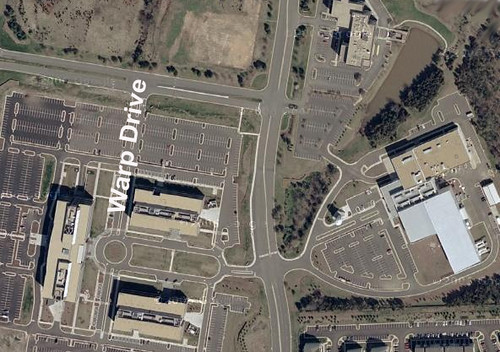
 

We blogged about getting a space job before, but now it looks like a few hundred can call their new business address "Warp Drive." That’s right: Warp Drive is an "inside" street name on the corporate campus Orbital Sciences, a company that’s about to expand in Northern Virginia, according to the Washington Post:

Orbital Sciences, a rocket and space technology manufacturer for the government and military, is embarking on a major expansion of its headquarters in Dulles, adding as many as four buildings and about 600 jobs to its campus.

The company’s 77-acre campus along Route 28 employs 1,500 workers. More than 100 employees work at leased office space a few miles down the road, and Orbital continues to grow. To date, the company said it has $4 billion worth of backlogged contracts.

"Orbital’s business is doing extremely well and growing quite rapidly," said Barron Beneski, a company spokesman.

The buildings — totaling 140,000 square feet — will house office, engineering and manufacturing space on an undeveloped tract of land adjacent to the campus. Construction on the first building has been approved by Loudoun County and is scheduled to begin in early 2008. The first new employees could occupy the space in 2009.

"The next several years we will build buildings as the need arises," Beneski said.

The federal government is Orbital Sciences’ biggest customer. The satellite company has contracts with the Defense Department and military intelligence agencies.

Space flight, in particular, is fueling much of Orbital Sciences’ growth, Beneski said. In 2010 NASA plans to retire the Space Shuttle. The company is part of a team led by Lockheed Martin that is producing the next generation of manned spacecraft to launch astronauts to the moon and beyond. The company stands to make $450 million to $500 million over the next 12 years from its role in the program.

Orbital also manufactures commercial communication satellites for companies such as Intelsat and SES Global.
"In the Washington area, there’s not a whole lot of manufacturing going on," Beneski said. "Consultants and IT people produce a lot of paper and gigabytes. We actually produce real stuff." 

 

SeaMobile Testing VSAT Over Atlantic

Wednesday, September 19th, 2007

We’ve written before about the growing market for maritime satcom for large ships. Now, SES NEW SKIES is teaming up with SeaMobile’s Maritime Telecommunications Network (MTN) product group for extensive field tests of new miniaturized VSAT antennas, which will enable an array of satellite-based communications services for small vessels:

SeaMobile and SES NEW SKIES will test two new 60cm VSAT antennas, that set new standards with respect to size and weight of VSAT installations: the heavy-duty “Ruggidized” for fishing, work boats and oceangoing support vessels, and the lighter “Sure Lock”, which at less than 90lbs addresses more specifically the sailing, yachting and power boat markets. Both antennas use iDirect Spread Spectrum technology, allowing for small-sized, lightweight antennas which are effectively shielded against adjacent satellite interference. SES NEW SKIES is providing Ku-band capacity for the Spread Spectrum Technology demonstrations on its NSS-7 satellite at the orbital location of 338° East….

States Scott Sprague, Senior Vice President Global Sales of SES NEW SKIES: “Small-sized and light-weight VSAT antennas open up completely new markets for small vessel broadband connectivity, be it for professional use, navigation support, safety services or pure leisure/entertainment. The SES NEW SKIES global satellite fleet is particularly well positioned to support communications on the move, be it maritime, land- or air-based.”


As you can see from this map, SeaMobile currently has extensive MTN satellite coverage, and they’ve just signed their first commercial shipping customer:

SeaMobile Enterprises, a provider of at-sea communications and connectivity, announced Tuesday that it has reached a service agreement with Global Marine Systems, an independent, undersea cable installation and maintenance company. Terms of the three-year contract were not disclosed. SeaMobile said it will provide its Maritime Telecommunications Network satellite services aboard three Global Marine vessels. SeaMobile said it has already installed its MTN VSAT satellite services on two of the ships and expects to address the third later this month. Global Marine Systems is based in Chelmsford, England. SeaMobile is headquartered in Seattle and provides broadband and satellite services for more than 300 maritime vessels.

Stratos has also recently entered the maritime satcom marketplace, while Schlumberger is working to build a model that integrates land and sea.  


Google’s X-Prize

Friday, September 14th, 2007

My senior year of High School I read the newly released book Longitude, which detailed the scientific quest for an accurate and durable method for determining longitude at sea. The prize: the equivalent of 12 million in today’s currency. I couldn’t help wonder why our scientific innovation wasn’t promoted in the same way. Sure, government and university grants are great for scientific progress but so is a little healthy competition and the prospect of massive wealth.

Imagine my excitment when I read about the X-Prize, announced at about the same time as the publication of Longitude. In 2004, the X Prize awarded its first prize of $10 million to Burt Rutan and Paul Allen for developing the first non-government, reusable manned spacecraft that was launced into space twice within two weeks.

The X-Prize Foundation lives, offering prizes for a number of contests from genome sequencing technology to building a 100-mpg vehicle.

Now, Google is getting into the game. The Google Lunar X-Prize will offer $20 million to the first team that constructs autonomous rovers that can land on the moon, travel at least three-tenths of a mile, and send video, images and data back to Earth. Google is running the project in conjunction with the X-Prize foundation. MSNBC has the details:

The first team to succeed would win $20 million – that is, if the job is done by 2012. After that, the prize drops to $15 million, and if no one is successful by the end of 2014, the money could be withdrawn. If a second team succeeds before the deadline, $5 million would be given as a runner-up prize. Another $5 million would be reserved for bonus tasks – for example, roving for longer distances, taking pictures of old lunar spacecraft, finding water ice or surviving the long lunar night.

The imagery and other data beamed back from the moon would be shared with the world via the Google Lunar X Prize’s Web site.

“By working with the Google team, we look forward to bringing this historic private space race into every home and classroom,” Peter Diamandis, chairman and chief executive officer of the California-based X Prize Foundation, said in a prepared statement. “We hope to ignite the imagination of children around the world.”

Watch the promotional video, find an extremely wealthy sponsor and some rocket scientists, then get to work, folks.

Nothing like reverting to early 18th Century contests to solve the technological challenges of the 21st Century and beyond.

Com in Africa: A Changing Marketplace

Wednesday, September 12th, 2007

Here at the Americom Business Network Blog, we’ve written about expanding telecom needs in Africa and about the role satcom plays in furthering the development of Africa’s oil reserves.

African development continues to be a hot topic in the world of sat- and tele-com, with a debate currently taking place about Telkom’s SAT-3 undersea cable and the countries it does (and doesn’t) serve: 

The biggest problem with Telkom’s SAT-3 undersea cable is that it never went bankrupt, said Johan Meyer, Telkom’s group executive for global capacity service.

Meyer, who has been intimately involved in the SAT-3 West Coast cable, which is SA’s primary undersea link for telecommunications and Internet connectivity with the rest of the world, said: “If SAT-3 had gone bankrupt, then we would have had a very different scenario to what we have today, and may even have found ourselves in a similar position to the North Atlantic cables.”

He was responding yesterday to comments made during a debate on pan-African connectivity at the Capacity Africa 2007 Conference, in Cape Town.

Wessel van der Vyver, GM of international business for Telecom Namibia, opened the discussion by saying that Telkom was one of the key impediments to his company lowering its own broadband and interconnectivity costs.

“Essentially, Nambia is a landlocked country in terms of undersea cable because SAT-3 lands in Angola and in SA. We were hoping to get a landing in Namibia, but this hasn’t happened.”

Later, Van der Vyver said Telecom Namibia was also “disappointed” that the proposed undersea cables being planned by the South African government’s new broadband infrastructure supplier, Infraco, was also ignoring his country.

“It would be a pity if another cable is built and it leaves us in the same situation.”

During the discussion, the lack of satellite capacity came under the spotlight.

Pedro Camacho, CEO and owner of Blue Sky Satellite Communications, said satellite capacity was at a premium, with a long waiting list.

Need some background on the SAT-3 cable? Look here:

SAT3/WASC/SAFE is a historic Achievement made possible by the participation of 36 nations, the majority of the landings are in African states. Together they have fully funded the undersea cable system costing more than US$600 million and will own and operate it for the next 25 years. This results in much of the revenue it generates being ploughed back into the continent. This is a major departure from the current scenario, where many African countries rely on foreign operators to route their international traffic which results in revenue generated in Africa, leaving Africa. 

Meanwhile, Telkom and HCI are expanding South Africa’s pay TV market:

South Africa’s communications authority granted fixed-line operator Telkom’s media unit, Telkom Media, and leisure and media group Hosken Consolidated Investments licences along with two smaller operators — On Digital Media and Walking on Water.

Entry of new operators is expected to stimulate the market, with more money being pushed to marketing pay-TV services, portfolio manager Khulekani Dlamini at Renaissance Specialist Fund Managers said.

Chief Executive Officer Nolo Letele of Naspers’ local pay-TV operation MultiChoice SA said the unit had been gearing up for competition.

"We will have to fight that much harder for the disposable rand in people’s pockets," Letele said after the announcement of the winning bidders.

With increasing demand continent-wide for better broadband, television, and voice connections, the communications landscape in Africa is sure to remain fluid for many years. We’ll keep you updated on the latest developments. 

Go India, Go!

Monday, September 3rd, 2007


India’s ISRO had a great launch yesterday, via Hindustan Times:

After more than two hours of tension, space launcher GSLV on Sunday successfully placed in orbit the communication satellite INSAT-4CR. Weighing 2,130 kg, it is the heaviest payload to be placed in orbit by an Indian launcher.

With the failure of the last GSLV mission in July 2006 on their minds, Indian Space Research Organisation scientists had readied the present launch in a record 13 months. But the GSLV-F04 kept them on their toes well beyond the planned schedule time. The launch was delayed by a day due to a sudden change in weather. On Sunday, 15 seconds before lift-off at 4.21 p.m., the launch was once again put on hold. It wasn’t till two hours later that the problem—a failed communication link between the third cryogenic stage and ground link — was rectified and the space vehicle soared in a darkening sky.

The drama wasn’t over yet. Thirteen minutes into the flight path, mission control lost contact with the vehicle. Thankfully, it came back on and a hugely relieved ISRO chairman G. Madhavan Nair was heard muttering “thank god”.

Seventeen minutes after blast-off, as the satellite injected into the slotted transfer orbit, the smiles were back on the faces of the ISRO brass. “It was a dramatic mission with a lot of anxiety but something that gave us immense satisfaction when everything went off successfully. Team ISRO has done it,” said Nair.

B.N. Suresh, director of Vikram Sarabhai Space Centre, which designed the vehicle, said: “It was a small communication glitch.”

Nair said that though mission control had the option of postponing the launch by 48 hours, they were confident the launch sequence was in place. “The perfect and precise launch confirmed our confidence in the system and our team.”

This launch marks the third by ISRO in 2007 with two more scheduled.

Here’s the quick CNN/IBN report:


And here’s the full 5+ minute highlight reel:

A.P. Looks at Virgin Galactic’s Lowered Profile

Monday, August 27th, 2007

Few space stories have captured the public’s imagination (and the press’ attention) more than the efforts of Virgin Galactic to bring the nascent space tourism business to the (well-heeled) masses via the Burt Rutan-designed SpaceShipTwo.


While the attention is surely a boon to Virgin Galactic (and probably a source of resentment for its competitors), it can be problematic when things go wrong, as when an explosion at the factory of Scaled Composites (which made the first private trip into space with SpaceShipOne) killed three people in July during testing of a propellant system.

Today, the Associated Press looks at how the accident has impacted Virgin Galactic’s public profile: 

The accident at the remote site run by famed aerospace designer Burt Rutan rattled the fledgling space tourism industry, which has enjoyed a honeymoon period since 2004 when Rutan launched SpaceShipOne, the first private manned rocket into space.

It also offered insight into how two pioneering companies that forged an unlikely partnership two years ago to fly civilians to space reacted to the tragedy. In a reversal of roles, Richard Branson’s publicity-seeking Virgin Galactic kept a low profile while its usually silent partner, Rutan’s Scaled Composites LLC, took to the Internet to mourn its workers.

Some space experts believe Virgin Galactic is following the right strategy because the accident was of an industrial nature and not directly related to spaceflight. But eventually customers and the public will demand answers, they say.

While Virgin Galactic kept a low public profile after the accident, the company did reach out privately to reassure its "founding" customers, who have already paid $200,000 to be the first to go up in SpaceShipTwo, according to the AP report.

It was Virgin Galactic’s partner, Scaled Composites, that was forced into the limelight following the accident:

Before the accident, hardly anything was known about Scaled’s progress on its suborbital spaceship program. Afterward, Rutan acknowledged for the first time the company was testing a propellent system for SpaceShipTwo, the successor to SpaceShipOne. Many details about the program are still unknown, including how far along Scaled is….

Scaled has since shed some of its stoic image. Its technical Web site was transformed into a virtual shrine for the three rocket workers killed in the line of duty. It set up a memorial fund, posted poignant online remembrances and gave updates on funeral arrangements and conditions of the injured, who are expected to survive.

Scaled also sought outside experts to determine what went wrong and vowed to share lessons learned with the industry to prevent another accident.

"Burt is taking it hard because it’s the first time he’s lost people. There is a feeling of shock that some of his friends died," said space business consultant Thomas Matula.

The Personal Spaceflight Federation, made up of more than a dozen private space companies, has vowed to plow ahead despite the tragedy in Mojave, according to the article. 

Netcom Africa

Friday, August 24th, 2007

Telecommunications has always been a struggle in Nigeria. Outside of Abuja, the nation’s young capital, Nigeria’s infrastructure is "unpredictable," at best. Nigeria’s power supply is insufficient, forcing many hotels, businesses, and homes to own multiple generators. Within this context, it is no surprise that, like many other third world countries, Nigeria’s telecommunications is largely confined to mobile phone networks (1.25 million landline phones versus over 30 million mobile subscribers).

Nigeria’s infrastructure challenges are equally daunting in expanding Internet service throughout the country. Yet, a number of ISP’s are entering this rapidly growing market.

One company, Netcom Africa Ltd, is making especially noticable strides. First it raked in two big awards:

Netcom Africa has emerged as a winner of the ‘Best ISP of the year’ and also won the recognition award for ‘Best Broadband Company of the Year’ at the annual Nigeria Telecom Awards organised by Nigeria Telecom Magazine in Lagos.

Other Internet Service Providers nominated for best ISP of the year award included Swift Networks and Direct on PC.

The Nigeria Telecoms Award recognises leadership, innovation and excellence in services. "We are delighted to be recognised by the industry and receive not one, but two additional prestigious awards this year," stated Lolade Shonubi, Netcom’s marketing manager.

She continues: "As an IP communications provider of satellite and wireless products, Netcom is determined to continue to lead the market with innovative solutions that meet the challenging criteria of our customers, the public and judges."

And now Netcom has acquired one of its main rivals:

Netcom Africa has acquired rival ISP Accelon Africa for an undisclosed price. South Africa’s Dimension Data also made a bid to buy Accelon but was beaten to the punch by Chinese-backed Netcom, which offers satellite broadband services in Nigeria under the MyNetcom banner. Accelon, set up by South African investors in 2002, has operations in Nigeria and Ghana.


Satcom Success at WildBlue

Thursday, August 23rd, 2007

"Dude, I can’t handle dial-up anymore," is probably what people without broadband are saying. I know I can’t. For me, it’s either broadband or nothing at all.

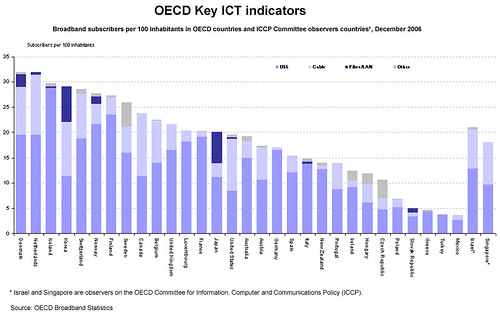
And the number of broadband subscribers keeps growing. According to the OECD (Organization for Economic and Co-operative Development), the U.S. has the most households with broadband, but doesn’t rank in the top 10 in terms of penetration:


Seems the battle is being waged between cable and DSL providers. But what about people who are rural or ex-urban? Yes, WiMAX is building a following, notably via Clearwire. But satcom remains a viable option, with Hughes (HughesNet) and Spacenet (Starband) grabbing the early lead in providing national service. Now here comes WildBlue. Since launching their own spot-beam Ka-band satellite, they’ve been booking 1,000 and 1,500 new subscribers every week.


They’ve been so successful, in fact, that they’ve been turning away business in some coverage areas. Check this out, via SkyREPORT.com:

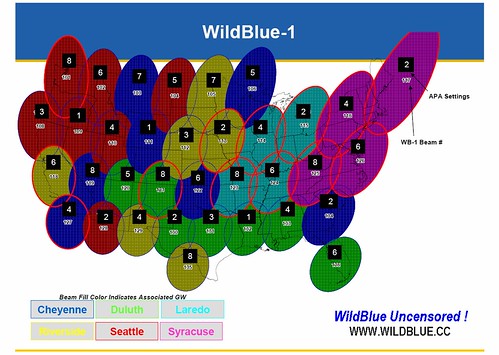
Satellite broadband provider WildBlue Communications is suspending sales across several beams due to capacity constraints. In a letter written to dealers this week, the company said it would begin to halt sales on three spot beams beginning Sept. 1.

According to the WildBlue’s Beam Sales Suspension Notice, sales of the company’s satellite broadband product have continued at a "record-breaking pace" since the launch of its new satellite, WildBlue-1. As a result, the company said, WildBlue is experiencing new capacity constraints in certain areas of the U.S.

The beams in question are 131, 132 and 133, which, the company said, are 85 percent full. "Because of this overwhelming demand for WildBlue broadband service, and in order to maintain maximum performance for all of our customers, we are unfortunately left with no choice but to begin our first WildBlue-1 beam suspensions," the company said. The beams in question cover much of eastern Texas and the majority of both Louisiana and Alabama.

WildBlue told its dealers that beginning Sept. 1 the company will suspend all marketing and will not take any new orders in these particular beams. The company also said it has prioritized the portion of the country served by these beams for the next software and hardware upgrades, and it would notify dealers in advance of any additional capacity as it becomes available.

"In an effort to continue to provide the highest quality service for all of our valued WildBlue customers, we carefully monitor and manage the capacity on each of our spot beams throughout the country," the company told SkyREPORT. "As a normal course of business we may from time to time decide to suspend new sales in certain areas of the country, again, so that we can maintain the high quality service that our customers have come to expect from WildBlue."


Wow. Even before the launch, I heard they were selling out some capacity on Anik-F2 over the Ohio River Valley. Now new capacity is being sold out. Good for WildBlue, I say.

SNG Costs Less With BGAN

Thursday, August 16th, 2007

We’ve seen live or near-live video news reports on CNN or the BBC where a journalist uses an inexpensive terminal to uplink to a satellite — alone. No truck, camera operator, teleprompter or boom microphone. At first the frame rate was less than perfect, but hey, it’s live and very cheap. Packs up quickly, too.

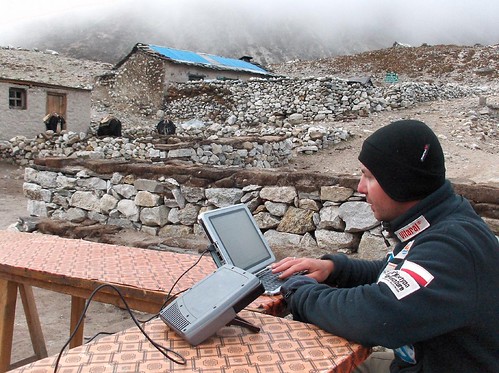
Inmarsat’s BGAN service is getting better now. Upgraded equipment on the ground, and in orbit. Traditionally, they’ve promoted themselves by helping extremely remote locations connect, like this Polish expedition on Mt. Everest.


As with the Slingbox Traffic Web Cam in San Francisco, TV news people are getting more creative in using this new technology. We read in Broadcasting & Cable last week how WDIV in Detroit covered the Bayview-Mackinac Yacht Race from Lake Huron:

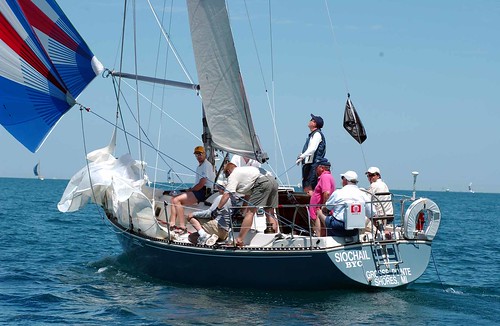
When WDIV Detroit covered the Bayview-Mackinac yacht race last month, it didn’t rely on traditional microwave or satellite equipment to pull live video from the middle of Lake Huron.

Instead, the Post-Newsweek NBC affiliate used a combination of IP-based streaming technology and wireless EVDO and broadband satellite transmitters to provide live broadcast and Website coverage of the four-day race, which drew more than 250 competing yachts.

WDIV is one of a growing number of news organizations to use the Streambox from Seattle-based Streambox Inc., an IP-based streaming device designed with broadcasters in mind. Costing around $20,000, the system includes a laptop loaded with proprietary compression software that is used to encode and stream images and a rack-mounted receive device that features professional video connections and is designed to interface with conventional broadcast equipment.


$20,000? Even the smallest SNG Trucks cost much more than that. How long before Streambox and NewTek’s "truck-in-a-box" change the game? Probably sooner than we think.

Yahsat Means Billions

Wednesday, August 8th, 2007


First, Dubai rises from the desert seemingly overnight to become a first-class economic center. Haliburton’s CEO is moving his office there. It’s becoming a major airline hub. It’s building huge, jaw-dropping buildings and developments. Today we learned they’re ready to spend $1.66 billion to get into the satellite business.


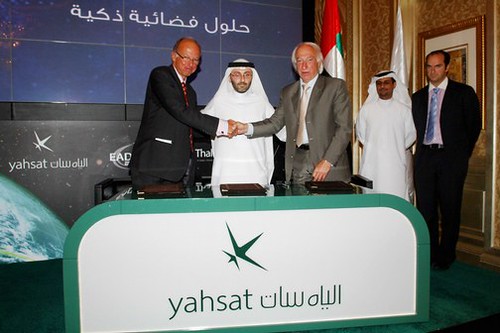
$1.66 billion.  That’s a nice big bag of money. And a consortium of Thales Alenia Space and EADS Astrium are getting it. Abu Dhabi’s Al Yah Satellite Communications Company (Yahsat) announced a contract for the consotium to build a new satellite system, via Gulf News:

Two satellites and an earth station will comprise the system that will serve military and commercial communication purposes, providing broadcasting, tele-communication and broadband services.

"The system initially will serve the Middle East, Africa, most of Europe, and South East Asia regions," Jasem Mohammad Al Za’abi, Yahsat’s chief executive officer, said.

Sixty-five per cent of the financing will be through a syndicated loan, and the remaining 35 per cent will be through Yahsat, 100 per cent owned by Abu Dhabi’s Mubadala Development Company, according to Waleed Ahmad Al Mokarrab, Yahsat’s chairman, and Mubadala’s chief operating officer.


Not a bad idea, considering how the oil market is behaving. Take the money and invest it in something that will last for generations: satcom, baby!  The people who run Yahsat-backers Mubadala seem to know what they’re doing.