In preparation for this weekend’s festivities, we bring you three Do-It-Yourself BBQ ideas—from the useful to the absurd.
Can-in-Can Grill
Originally designed as an efficient wood stove for developing countries (see: Vesto Stove), one DIY’er pulls together a similar version using household trash: 2 empty paint cans of differing sizes and a handful of rivets.
The complete step-by-step directions for this high-efficiency BBQ are here but the process is remarkably simple.
Find two paint cans, one slightly smaller than the other—providing enough space to create an air chamber that will pre-heat the incoming air to increase the efficiency of the fire.
Drill vent holes on the sides.
Construct a top that the small can can be mounted to, allowing for an air chamber below the smaller can but within the larger can. This is done by taking the larger can’s lid, cutting out an inner circle about an inch smaller than the dimensions of the smaller can, then folding-in the excess material to attach the smaller can to.
A grill with an IP-Address
Rock’s BBQ has developed a piece of hardware that will monitor the temperature of your grill or smoker, including a probe to monitor the temperature of your meat. The hardware connects to fan that can throttle the temperature to your desired level. But what if you are slow smoking a pork leg for 17 hours and need to go to work?
Simple: monitor the BBQ "vitals" on the Internet. The "Stroker" has a built-in ethernet connection and web server that lets you control your grill from anywhere you have Internet access (see: large image).
Since this is DIY-Friday, try connecting the Stroker to a homemade smoker built from an inexpensive terracotta flower pot. Directions on building the pot-smoker are here and you can learn how to get your pot "online" here.
Now for the absurd: a USB BBQ
For the nerdiest of carnivores: by connecting 30 USB cords to a hotplate you can grill without ever needing to leave your desk or cubicle! The complete directions are in Japanese but you can read the translated page. And if you can stomach it, check out the video.
There is something oddly compelling about doomsday scenarios in which an asteroid or comet tumbles to earth and destroys an entire civilization. Maybe it is the religious element or the “hero that saves the world” drama we see in movies (there are a lot of flicks out there).
So what better place to discuss a sexy topic like this than the beach paradise of Acapulco?
This week, geologists will convene at the American Geophysical Union’s Joint Meeting in Acapulco to discuss a controversial new theory: that an extraterrestrial impact, possibly a comet, impacted North America nearly 13,000 years ago, setting off a 1,000-year-long cold spell and wiping out entire species.
The evidence comes from layers of sediment at more than 20 sites across North America.
These sediments contain exotic materials: tiny spheres of glass and carbon, ultra-small specks of diamond – called nanodiamond – and amounts of the rare element iridium that are too high to have come from Earth.
All, they argue, point to the explosion 12,900 years ago of an extraterrestrial object up to 5km across.
No crater remains, possibly because the Laurentide Ice Sheet, which blanketed thousands of sq km of North America during the last Ice Age, was thick enough to mask the impact.
Another possibility is that it exploded in the air.
Researchers have for some time proposed that a reversal in the world’s ocean currents and a corresponding global cooling was responsible for the rapid geological change that led to the extinction of multiple species of animals and the end of the Clovis Culture. A comet could explain the shift:
According to the new idea, the comet would have caused widespread melting of the North American ice sheet. The waters would have poured into the Atlantic, disrupting its currents. This, they say, could have caused the 1,000 year-long Younger Dryas cold spell, which also affected Asia and Europe.
This geological rap session may be just sexy enough to keep the scientists from laying on the beach all-day.
First, let’s set the mood. (Click the button to play .)
Next, let’s set the scene.
That’s right — it’s Monday, and we don’t feel like working, so we’re going to fantasize for a bit about surfing and the freedom of the endless summer that is almost upon us.
This idle day dreaming, to be clear, is prompted by this news report of a series of huge waves that struck Reunion Island in the Indian Ocean (as well as parts of Indonesia, the Maldives, Thailand and Western Australia) on Saturday.
There was no official warning about the freakish waves that killed at least one person, damaged hundreds of homes and displaced thousands of people across Indonesia. Homes and fishing boats were also damaged in Thailand and the Maldives.
Weather officials said the waves were the result of an accumulation of winds in one spot on the ocean, but were looking at why they were so intense.
The origin and movement of waves reaching up to 11 metres that devastated France’s Reunion Island in the Indian Ocean on Saturday evening have been detected with ESA’s Envisat satellite.
The waves that thrashed the southern port of Saint Pierre, leaving two fishermen missing, causing several piers to collapse and flooding several homes and businesses, originated south of Cape Town, South Africa, and travelled northeast for nearly 4000 km over a period of three days before slamming into Reunion Island.
Dr Bertrand Chapron of IFREMER, the French Research Institute for Exploitation of the Sea, and Dr Fabrice Collard of France’s BOOST Technologies in Brest located and tracked the swells using standard processed Synthetic Aperture Radar (SAR) ESA products…
Chapron and Collard are working on a project that will make data for global swells available to scientists and users by the end of the year as a demonstration. The products will be useful for weather centres to complement the accuracy of their sea forecast models.
Envisat is equipped with an advanced version of the SAR instrument, Advanced Synthetic Aperture Radar (ASAR), flown on the ERS-1 and ERS-2 missions. Its wave mode acquires 10 by 5 km small images, or ‘imagettes’, of the sea surface every 100 km along the satellite orbit. These small ‘imagettes’, which depict the individual wave heights, are then mathematically transformed into averaged-out breakdowns of wave energy and direction, called ocean-wave spectra, which ESA makes available to scientists and weather centres.
A typical SAR satellite images a swath of 400 km, enough to capture complete ‘mesoscale’ phenomena such as tropical storms. While optical satellite images show the swirling cloud-tops of a hurricane, a SAR image pierces through the clouds to show the sea surface roughness and its modulation through the combination of wind wave and currents….
As part of the Global Monitoring for Environment and Security (GMES), a joint initiative of the European Commission and ESA, the space agency has undertaken the development of Sentinel-1, a European polar-orbiting satellite system for the continuation of SAR operational applications. The Sentinel-1 SAR instrument will have a dedicated wave mode allowing the Near Real Time tracking and forecasting of swell for European users.
No need to wait for the Europeans to get their act fully together, however. Thanks to publicly-available information from the U.S. Navy’s Fleet Numerical Meteorology and Oceanography Center, surfers can already plan their vacations according to where the waves are, dude. Using the WaveWatch III model, FNMOC provides computer-generated models of global wave height and direction (such as this global model).
Proving, as we well know as we sit at our desks this morning daydreaming, that the surf’s up, dude. Somewhere.
THE SRI LANKAN EMBASSY in Washington has complained to the US Justice Department, State Department and the Federal Bureau of Investigation (FBI) against Washington based Intelsat Ltd., for reneging its promise of removing the National Television of Tamil Eelam (NTT) channel and Pulikalin Kural radio from the Intelsat 12 satellite transponder and for continuing to facilitate and broadcast terrorist propaganda.
Before lodging the complaint, the Sri Lankan Embassy brought to the communication satellite company’s notice that despite its assurance that it has removed both channels from its transponder, it continues to broadcast National Television of Tamil Eelam, and Pulikalin Kural (Voice of Tigers radio) the official television and radio of the LTTE.
Intelsat Ltd., according to sources, laid down conditions to the Sri Lanka Embassy that talks with them should not be publicised or divulged to anyone which the Embassy refused even to consider.
Subsequently, the Sri Lankan Embassy alleged that the satellite provider is violating US law by continuing to broadcast the propaganda television and radio services of the foreign terrorist organisation LTTE, through the satellite they own despite public assurances given ago to the contrary.
National Television of Tamil Eelam, the official television channel of the LTTE is a free-to-air channel to Asia and an encrypted channel to Europe.
The four-hour daily programme of the NTT channel broadcasts propaganda material of the LTTE, a terrorist organisation banned in United States of America, Canada, India and in European Union countries.
The illegal transmission of the NTT channel of the LTTE was for the first time brought to Intelsat Ltd’s notice by Asian Tribune on March 10.
Dianne VanBeber, Intelsat Ltd Vice President in charge of Investor Relations and Corporate Communication, told ‘Asian Tribune’ that the LTTE is pirating the Intelsat’s 12 bandwidth without the company’s knowledge.
"Intelsat has notified the original customer for the capacity that they are in violation of their contract, and Intelsat has informed them to cease transmissions," VanBeber said.
Asked to identify the original customer of Intelsat, VanBeber refused to disclose the service provider’s name who has accommodated the LTTE’s media without Intelsat Ltd’s knowledge.
Asked whether Intelsat was not aware that the LTTE’s National Television of TamilEelam was using the Intelsat 12 satellite bandwidth since 2005, she clarified that Intelsat Ltd acquired PanAmSat only on July 3, 2006, and LTTE’s National Television of Tamil Eelam might have come to quietly share the Intelsat 12 satellite.
She said: "We are taking action to cease their transmission soon." Subsequently this issue was taken up by Bernard Goonetilleke, Sri Lanka’s Ambassador in Washington with Intelsat’s General Counsel, Phillip Spector.
A press statement was released by the Intelsat after the meeting.
In a press statement dated April 10 Intelsat Corporation said: "Intelsat officials, including its technical experts, met with Sri Lanka’s Ambassador to the United States, Bernard Goonetilleke, on April 10 to discuss the steps Intelsat is taking to address the unauthorised use of one of its satellites by the LTTE.
During the meeting, Intelsat’s General Counsel, Phillip Spector, said:’ "Intelsat does not tolerate terrorists or others operating illegally on its satellites. Since we first learned of the LTTE’s signal piracy, we have been actively pursuing a number of technical alternatives to halt the transmissions. We are clear in our resolve to ending this terrorist organisation’s unauthorised use of our satellite’."
Later, the Sri Lankan embassy revealed that Intelsat Ltd., stated that during April 21-22 they switched off the transponder of the free to air NTTE channel beamed to Asia and the encrypted channel beamed to Europe.
The Lyngsat site confirms that both the television and radio broadcasts were up and running on 29 April 2007 — nearly three weeks after we first blogged it. The program can be found every day, from 18:00 to 21:30 GMT, on Intelsat 12, transponder 2 (downlink frequency: 11,504 Vertical; symbol rate: 2894; FEC: 3/4).
How did that happen? If you read ToTheCenter.com, you’d think it was indeed turned off:
INTELSAT INFORMS SRI LANKA EMBASSY IN WASHINGTON IT SWITCHED OFF LTTE BROADCASTS FROM THEIR SATELLITE
( By Walter Jayawardhana)
Sri Lanka’s envoy in Washington, D.C. said his office had been given an assurance by Washington based Intelsat Corporation that they have switched off the transponder used by the Liberation Tigers of Tamil Eelam (LTTE) to broadcast its propaganda, during the last weekend.
“We were told last evening by Intelsat executive Phillip Spector that the transponder used by the LTTE was switched off during the weekend,” Bernard Goonetileke, Washington, D.C.’s Sri Lankan Ambassador told this correspondent.
However, Goonetileke said he was still not sure whether the banned terrorist group has made some other arrangements with a European satellite company to carry on with the broadcasts continually.
He said inquiries are made to check whether LTTE is continuing its broadcasts and whether they are doing it through another channel, suspected to be Globe Cast satellite of a European company.
A press release issued by the Washington, D.C. Embassy of Sri Lanka said, “Intelsat Ltd., a U.S. based satellite company has terminated the “unauthorized” use of one of its satellites, Intelsat12, by the Sri Lanka based terrorist organization, the Liberation Tigers of Tamil Eelam (LTTE), for its TV and radio transmissions to Europe and Asia.”
The Executive Vice President and General Counsel of Intelsat Ltd., Mr. Phillip Spector, confirmed to Rajika Jayatilake, Counselor (Information) at the Sri Lanka Embassy in Washington, D.C., that Intelsat Ltd. had, over the April 21/22 weekend, shut down the transponder, which the LTTE had used for its transmissions, the press release said further.
Whatever new channel the LTTE is using will have to be advertised through some means since the viewers and listeners of its propaganda have to be informed about the changes in the broadcasting frequencies. So far, no such advertisement has been found.
Following the meeting with Ambassador Goonetileke on April 10, 2007, Mr. Phillip Spector, of Intelsat Ltd., stated that the LTTE transmissions were “unauthorized.” Countering the position taken by Intelsat Ltd., speaking from Sri Lanka’s north to wire services in Colombo, the LTTE denied it was using the satellite services illegally. “We are accessing it legally and there is no signal piracy,” said an LTTE spokesman.
However, inquiries by this correspondent could not find out any evidence to confirm the statement of Phillip Spector, that the LTTE was a pirate of the satellite.
The Embassy press statement traced the history of the LTTE-INTELSAT connection as follows: “Since March 2005, the LTTE had been transmitting TV and radio programs through Europe Star 1 satellite owned by French satellite provider, Alcatel. PanAmSat, a satellite operator headquartered in Wilton, Connecticut in the U.S., acquired Europe Star 1 satellite in July 2005. In July 2006, Intelsat Ltd. acquired PanAmSat, following which, Europe Star 1 satellite was renamed Intelsat12. The programs that the LTTE had been transmitting through Europe Star 1, thus continued uninterrupted even after Intelsat Ltd. acquired the satellite.”
It is believed that it was the intense pressure used by the Washington Embassy of Sri Lanka and the U.S. State Department and the Department of Justice, together with press publicity, that was adversely affecting Intelsat that finally brought an end of the deal.
The Sri Lanka Embassy said, the U.S. Department of State and the Department of Justice had both been informed that a terrorist group designated by the U.S. as a Foreign Terrorist Organization (FTO), was using a satellite owned by a U.S. based satellite company to transmit their TV and radio programs to Europe and Asia. (EOM)
Back in September, we wrote about the Lyngbox Free to Air receiver, which promised up to 50,000 storable channels and global functionality:
Most “satellite people” are very familiar with the Lyngsat Web site. It could very well be the world’s most complete database of accurate satellite ladder charts. Pick a satellite and you can view all the channels available for viewing. For example, the AMC-4 satellite carries a number faith-based and international channels in North America. On another site, LyngSat Address, select a country and you can find out which satellites their channels are using for broadcasting – in their home market and internationally. TV Prima Romania, for instance, is using several satellites over Europe, Asia and the Atlantic.
At the time, the Lyngbox seemed imminent, but then we began to hear that they were looking for additional start-up funding and, whatever the case, the Lyngbox has yet to come to market.
The PASSION HD satellite receiver can connect to your HD-ready television using the HDMI output connection. The component (YPbPr) output can also be used. For analogue connectivity, SCART jacks, composite and S-Video outputs are provided. In addition to the analogue audio RCA jacks, PASSION also provides for digital audio output. For software loading, the USB port can be used. It is conveniently located behind the front panel door next to the two common interface slots.
And this puppy is loaded:
# MPEG-2, MPEG-4 H.264 HD/SD Digital Video Decoding # DVB-S2 and DVB-S compatible # PCMCIA interface (2slots) according to DVB Common Interface standard # DiSEqC 1.0, 1.2 and USALS (1.3) compatible # HDMI, Component, Composite, S-Video, Digital Audio (SP/DIF) and SCART outputs # Multiple output resolution modes: 1080i, 720p, 576p # 16 bit True color On-Screen Display (OSD) # Variable Aspect Ratio (4:3, 16:9) # Multilingual Audio and Menu Text support # Saves 10,000 channels (TV: 7000 CH, RADIO: 3,000 CH) # VFD Display (Vacuum Fluorescent Display) for Channel Number, Name and Time # Full Picture-In-Graphic (PIG) support # SCPC/MCPC channel receivable from C/Ku band satellites # Simple Operation through On-Screen Display # Electronic Program Guide (EPG) for on-screen service information
Fortec is ready to ship, and their website includes a great set of instructional videos, including this explanation of free-to-air channels that is a must-see for anyone who doesn’t understand what it is we’re talking about. (Though we suggest turning down your volume before watching the video, as the music is terrible.)
So what are you waiting for? With cold air in the West, thunderstorms in the MidWest and rain throughout much of the East, this is a fine weekend to stay indoors and watch your favorite TV shows from around the world.
By now, most people have heard the news about the discovery by a team of Swiss, French and Portuguese scientists of an earth-like planet just 20.5 light years away from Earth. The news has clearly captured the imagination of scientific writers and people around the world, in no small part because the potential implications of what we might learn about the planet are deep with existential meaning. (This AP title — "Planet-finder says search for alien life next" — exemplifies the anticipatory nature of the coverage.)
But reigning in our imaginations for a moment, what did the scientists truly discover, and how?
Universe Today offers some good detail on the discovery:
The host star is called Gliese 581, and it’s one of the 100 closest star to us, located only 20.5 light years away in the constellation Libra. Unlike our Sun, it’s a red dwarf star, emitting much less light and energy. This brings its habitable zone in close and tight to the star. For a planet to be orbiting its parent star within this habitable zone, it’s got to have a really tight orbit.
And this is how the planet was discovered. It was made by measuring the star’s radial velocity, where the planet’s gravity tugs its parent star back and forth (aka, the Wobble Method). Astronomers can measure this velocity with tremendous precision to determine the planet’s mass and orbital period. And the tool for the job is the European Southern Observatory’s HARPS (High Accuracy Radial Velocity for Planetary Searcher) spectrograph connected to the 3.6-m telescope at La Silla, Chile.
The planet is “Earth-like”, but it wouldn’t seem much like home. It’s 50% larger than the Earth, and has about 5 times our planet’s mass. It also completes an orbit every 13 days – it’s 14 times closer to its star than the Earth is to the Sun. Since it’s in the habitable zone, there would very likely be liquid water on its surface.
Unfortunately, the radial method only tells astronomers what the planet’s mass and orbital distance are. They’re not directly observing it. So there’s no way to know if there is actually water on the surface, or even oxygen in the atmosphere that would indicate the presence of life. But future missions, like Darwin, will certainly put it in the cross hairs to get a better look for life.
The discovery was made by a team of astronomers at the European Southern Observatory in Chile. Naturally they are the go-to source for additional information, including this summary video already up on YouTube.
The press release from ESO also tells us that computer models indicate that the planet should be "either rocky — like our Earth — or fully covered with oceans."
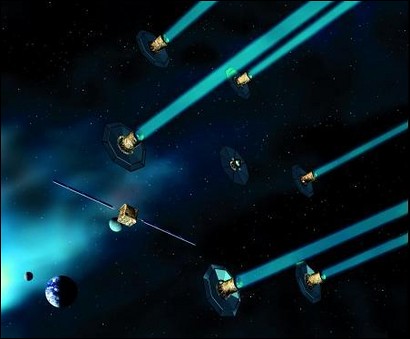
The ESA’s Darwin Flotilla (artist’s rendering below; scheduled for launch in 2015) will give scientists additional tools in exploring Gliese 581 and other exoplanets that may harbor life.
And perhaps this discovery will jump start a new, friendly "space race" to discover details about distant exoplanets. As The daily Tribune de Geneve boastfully pointed out, "American scientists recently estimated that the discovery of an exoplanet resembling the Earth would probably take 20 years," it wrote. "The Europeans didn’t wait for them."
Last week, Rocco pointed in the comment threads to a Wall Street Journal (subscription required) report that Intelsat may be for sale. As Rocco so succinctly put it in the comments:
FOR SALE: Global communications satellite business. Only $11 billion in debt. Good cash flow. Nice office in Bermuda; half-empty building in Washington. Heavy regulatory environment. Price: $6 billion.
We wrote a bit about Intelsat’s history in this post; the Wall Street Journal’s report (here) has more details on Intelsat’s recent history as a private entity.
Yet Intelsat isn’t the only satcom firm in the midst of (possibly) changing hands. Asiasat yesterday asked to have their stock trading suspended due to a pending announcement, and now come reports that Satmex, too, may be in the sites of a takeover entity.
MEXICO CITY — Mexican conglom Televisa is hooking up with the Chinese. VP of broadcasting Jose Baston signed an agreement to distrib state broadcaster CCTV’s international feed in Mexico on Monday. Televisa execs will travel to China in the coming weeks to explore sales of telenovelas and formats to that country…
Net also is considering bids for Endemol and Mexican satellite firm Satmex as possible destinations for its bulging cash reserves.
With Satmex in its fold, Televisa could cut its own international distribution costs as well adding revenue from Satmex’s three birds that cover the American continents. Global sat firms such as PamAmSat also are expected to go after Satmex.
Business News America has greater detail on Televisa’s thinking behind a Satmex buyout:
Televisa is analyzing what sorts of operational synergies exist between its own operations and Satmex’s coverage, according to de Angoitia….
However, Alberto Moreno, an analyst with corporate ratings firm Fitch Ratings México, downplayed the news saying that it is just one of many investment options that Televisa is weighing up and that it is too early to tell whether the company is a serious contender.
If the company is indeed seriously interested, an official announcement should be made in the short term, Moreno told BNamericas.
Despite the uncertainty, Moreno said that Televisa is looking for new investment opportunities to grow their business particularly to address the US Hispanic market.
Satmex has decent coverage of the Americas with only three satellites. Although Televisa’s recent sale of its stake in Univision was big news, it’s clear from the Satmex reports that Televisa’s interest in the growing U.S. Hispanic market is far from over.
The BlackBerry wireless e-mail service from Research In Motion Ltd. appears to have suffered a widespread outage that started last night in the U.S.
Customers on the BlackBerry Forums discussion board complained of having no service starting at about 5.15 p.m. PDT yesterday.
Callers to the BlackBerry U.S. technical support line were still greeted with the following message early this morning: "We are currently experiencing a service interruption that is causing delays in sending or receiving messages. We apologize for the inconvenience and will provide updates as soon as they become available."
New York television news channel NewsChannel4 reported last night that the problem affected "all users in the Western hemisphere."
However, comments from operators in Asia and Europe, as well as postings to the BlackBerry Forums, suggested that the problem may be limited to North America.
"Officials with RIM said they are trying to reset the system and told NewsChannel4 that they are concerned that the backlog of data, which will rush through when it comes back on line, could cause a bigger problem," the news channel reported on its Web site.
RIM officials advised people who use Blackberry as a major way of communications to make back-up plans, the channel reported.
A RIM official contacted in France was unaware of the problems, and said she had received messages sent to her BlackBerry as normal. Other RIM officials did not return calls seeking comment.
The outage may have been cause by one of RIM’s Network Operating Centers (NOC) going down, according to Emma Mohr-McClune, principal analyst with Current Analysis Inc. "This has happened before," she said.
RIM operates two NOCs, both located in Canada, according to Mohr-McClune. The company has considered locating additional NOCs outside of Canada, she said.
Companies that provide BlackBerry service connect their mail servers to a BlackBerry Enterprise Solution (BES) server located on their premises, which in turn is linked to one of RIM’s NOCs, according to Mohr-McClune. "All data slides to Canada and back," she said.
RIM may have been fortunate that the outage began at about 5 p.m. Pacific Time, because it would have been after the busiest part of the U.S. work day. Engineers were likely scrambling through the night to bring the service back online before the start of the U.S. workday today.
Other parts of the world appeared to have been unaffected. A representative for Taiwan Mobile Ltd., RIM’s BlackBerry partner for the island, said the problem is limited to North America, and that users would not be affected unless they are sending or receiving e-mail through a BlackBerry server there.
"RIM has not communicated with Taiwan Mobile about when this problem might be fixed," said the representative, April Hong.
NTT DoCoMo Inc. in Tokyo said its BlackBerry users in Japan were also unaffected. And In Europe, a spokesman for T-Mobile Deutschland GmbH was unaware of any problems, and Blackberry users in Germany and France reported no interruption of service.
The problems come at a time of continued rapid growth for the company, based in Waterloo, Ontario. It added 1.02 million subscribers in the quarter ended March 3, for a total of approximately 8 million BlackBerry subscribers worldwide. Revenue for the quarter was $930.4 million, up 66% from a year earlier. Net income for the quarter before adjustments was $187,928, the company said.
Wish they had built-in satellite connectivity. Thuraya phones have it.
How do you target audio video content? Will this system use sophisticated algorithms for "mass personalization?" Will phonetics work? They might: came across this Scoble interview with an executive from Nexidia, a company that’s using phonetics to enhance contextual searches. Very interesting. Here’s the short demo version:
Add localization and you’ve got a pretty interesting propostion for advertisers. I recently downloaded Google apps for my mobile and I’ve gotta tell you, they work great. Need a Chinese restaurant where you are? Google it using Maps. It worked for me.
VentureBeat is hearing that Google is negotiating an advertising deal with DirecTV, the nation’s largest satellite broadcast service with 16 million subscribers.
Dish, the nation’s second largest satellite TV company, announced a deal with Google last week. (VentureBeat was first to report the Dish deal a month ago).
This is just the latest move by Google to sew up the entire advertising world. Google is pushing into newspapers, magazines, radio, cable and now satellite.
The DirecTV deal is taking more time than Dish’s to close because DirectTV is managing the ownership change announced last last year (when News Corp said it would sell its ownership stake to Liberty). More details on DirecTV here. The deal with Google will go through eventually, says a source who wants to remain anonymous. [Update: Google says “no comment,” and DirecTV says: “We are always looking for ways to increase our ad sales revenue but we have nothing to comment regarding any new partnerships.”]
If you think about it, a Google deal with DirecTV would give advertisers reach into more than 25% of U.S. TV households. Honk the horn on Madison Avenue like some truck is double-parked and you can’t get through: Google is a player in TV advertising. Yes, the household count is greater than Comcast on paper, but how effective will it be? Here’s a clue: interactivity. EchoStar and DirecTV have national interactive TV advertising capabilities in place and are actively working with advertisers to deploy them — especially automotive and financials. Stay tuned.




 So you’ve finished your