Archive for the ‘Cool Stuff’ Category

Real Danger Of Early Daylight Savings: Mistimed Coffee Brewing

Wednesday, February 28th, 2007

Los Alamos Highlights Real Danger Of Early Daylight Savings: Mistimed Coffee Brewing

from the batten-down-the-hatches dept

The upcoming early arrival of Daylight Savings Time continues to make some headlines, even if there really isn’t a whole lot to worry about. The latest story looks at how the Los Alamos National Laboratory is coping with the change, and things seem fine, as its IT director is apparently most concerned about people who use calendar programs showing up for meetings on time. The lab’s newsletter, though, had some more pressing advice for employees: make sure things like the clocks on their coffee pots are set correctly, as clearly it would be a significant problem if their coffee wasn’t ready as expected on March 11. Perhaps when we repackage our Y2K preparedness kits and bunkers, we should make sure they include coffee pots that don’t contain a clock.
Anti-Jamming Technology Goes Commercial

Tuesday, February 27th, 2007

The Times reported yesterday that Boeing is looking to put anti-jamming technology previously reserved only for the military on commercial satellites used by business and the communications industry. According to the article,

"Anti-jamming technology is already used by military and spy satellites, but proposals to install similar protection in the 250 large satellites in commercial operation have been prompted by the threat of disruption.

The successful jamming of video, data, or voice signals by individuals or groups could jeopardise the millions of dollars spent on just a handful of satellites, operators fear.

Such jamming of government navigation satellites has already occurred, according to Lieutenant General Robert Kehler of the US Air Force, ‘as has jamming of commercial telecommunications satellites.’"

Space.com has a great background report on Spy Satellites for those who want to know a little bit more about the technology and the American Military and Intelligence communities uses of the technology. While Spy Satellites have been used for quite a long time, even the latest anti-jamming technologies are unable to prevent detection, the spy satellite holy grail. While satellite project, such as MISTY, have been able to avoid detection by laser and microwave radar, none has been able to completely avoid visible detection, a limitation which has prompted the emergence of a small, but strong spy satellite monitoring enthusiast community.

Oh, and for those of you who might be worried about the commercial anti-jamming technologies making it into the wrong hands, it looks like your not alone. While Boeing seems confident that they’ll win it, the U.S. government does have to approve the use of the "top secret" anti-jamming technology on commercial satellites before the company can start introducing it on products sold to foreign customers.

UN Getting Closer to Space Junk Guidelines

Monday, February 26th, 2007


We all know space debris (or space junk, as I like to call it) is a big problem. While the lost cameras, gloves, and toothbrushes may reenter the atmosphere and burn-up without too much of a problem, the sheer number of spent rocket stages, broken down satellites, and broken off bits and pieces that come along with both pose a real hazards for working satellites, the International Space station, and astronauts on a space-walk. Moreover, the more space junk we create the more we have to watch. Currently, U.S. Strategic Command tracks over 10,000 pieces of space junk to ensure each piece’s reentry is not mistaken for enemy fire from above.

Fortunately, according to Aviation Week, the UN is making some headway in the fight against the floating trash, having secured the support of China for a landmark resolution that would set guidelines for limiting space debris. China’s support for the resolution was less than certain, particularly given its recent testing of anti-satellite weapons technology that generated a fair amount of space junk, itself, in the process. Most likely the Chinese may have felt they were safe from scrutiny, because the new guidelines are designed to curtail unintended space debris.

"While the Chinese test, which has been described as the worst debris event in space-flight history, was deliberate, the problem of unintended debris generation was underscored this month by the apparent rupture of a fuel tank on a Russian rocket that malfunctioned during a communications-satellite launch last year."

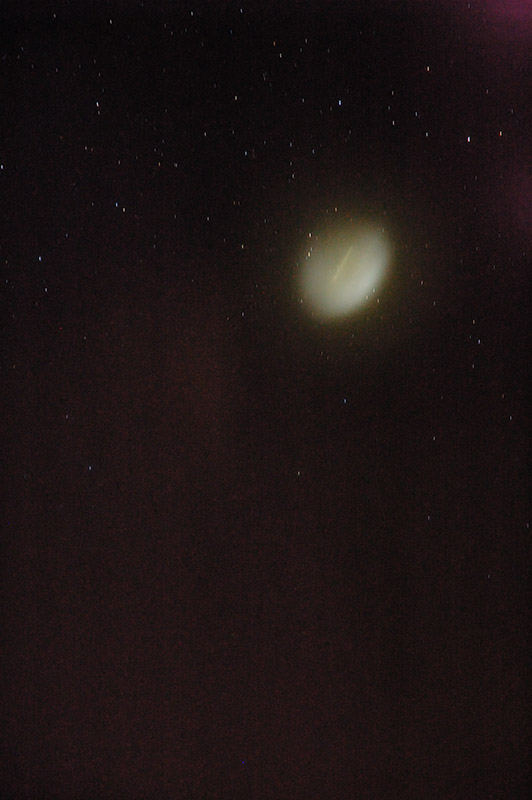
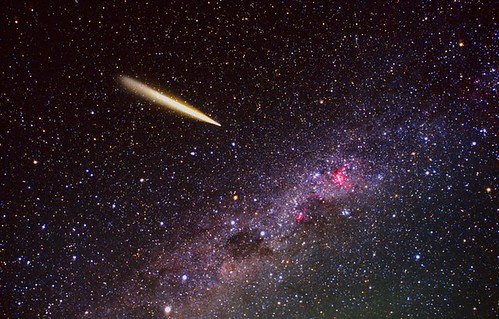
Above you’ll find one of the better photos of last year’s explosions that we found on Spaceweather.com. We found at least two other photos on the same site.

While it remains to be seen when an actual resolution will emerge from the UN regarding approaches for dealing with the problem of space trash and what (if any) teeth it might have when it’s passed, but its good to hear that someone is making some headway in solving this complicated problem.

DIY Friday: Sun Outage Calculator

Friday, February 23rd, 2007

There is no greater tool for DIY enthusiasts than the Internet, and today’s DIY activity is just a click away: a sun outage calculator!

But wait — what’s a sun outage? Now’s a good time to ask.

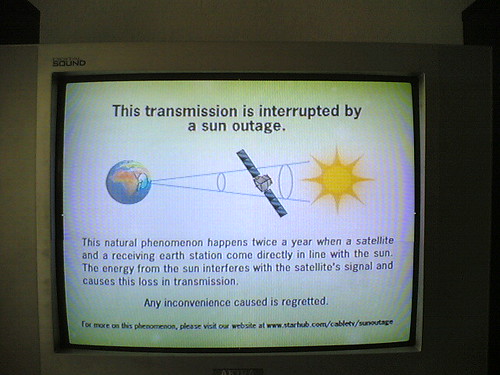
Sun outage is a natural phenomenon, which occurs twice a year (in the spring and fall) when the sun appears to be passing directly behind the satellite as seen from a receiving earth station.

Since the sun is a potent source of radio frequency energy, the earth station’s receivers are overwhelmed by the sun’s “noise” output and reception becomes impossible for a brief period of time, usually less than 10 minutes.

An observer at the earth station will notice that the antenna feed’s shadow will fall exactly in the center of the reflector during the peak of the sun outage period.  This indicates that the antenna, the satellite and the sun are in direct alignment.  At this point in time, the sun’s radio signals are being focused directly into the antenna’s receive feed.  This results in a temporary degradation in the signal to noise ratio of the signal being received from the satellite and a consequent degradation in Eb/N0 (Energy per bit over Noise referenced to zero) in digital systems.

Sun outage generally occurs between 9 AM and 3 PM for locations in the continental United States.  The duration and intensity of the outage will begin as a slight degradation in signal, increasing to a peak level over several days and will then begin to reduce in intensity and duration over a similar period.  These outages pose no danger to earth station equipment and they are not related to sunspot activity.

So how do you predict when the sun is going to mess up your signal? This sun outage calculator gives you predictions based upon the satellite you’re receiving from, your location on earth, and the time and date.

SES also offers a bunch of charts (good luck with that). Intelsat also offers marginally useful maps of sun outages for spacecraft — but they let you input your exact location. I like that.

Satellite 2007 Blog Feed

Tuesday, February 20th, 2007

Click here for the latest blog posts from the official Satellite 2007 blog.

Making Money on the Moon

Tuesday, February 20th, 2007


Want to get in on the ground floor of the moon?

As NASA moves forward with its $100 billion plan to start human settlement of the moon by 2030, it is making room for private enterprise on our original satellite.

Alan Boyle at MSNBC explains: 

The prospects for private enterprise on the moon  — ranging from astronomical telescopes to gee-whiz television to medical isotopes and fusion fuel — were listed during a weekend session at the annual meeting of the American Association for the Advancement of Science….

The first thing that anyone’s going to make money off of, from the moon, is probably going to be information of some kind," [Paul Spudis, a planetary scientist at Johns Hopkins University’s Applied Physics Laboratory,] said. That could take the form of interactive television, virtual-reality tours or remote control of lunar probes, leading to "a huge entertainment/educational market that will develop around the lunar return," Spudis said.

Worden touted the idea of lunar surface observatories: "There is already a reasonable investment that’s been made by a private group for putting telescopes on the moon for scientific purposes, much in the way that private investors have built many of the large telescopes in the world," he said.

That group is the International Lunar Observatory Association, which is still being organized by Space Age Publishing’s Steve Durst. The concept calls for sending a 10-foot-high (3-meter-high) probe, equipped with a radio dish antenna as well as communication and power-generating equipment, to the lunar surface. In a telephone interview, Durst told MSNBC.com that the likeliest site would be Malapert Mountain near the lunar south pole.

Based on two feasibility studies conducted by California-based SpaceDev, the mission could be done for $50 million, with a target date in the 2010 time frame, Durst said. A "founders’ meeting" for potential funders is being planned for this November, he said….

As the pace of NASA’s plans accelerates, Durst hopes the International Lunar Observatory will serve as a relay for communications traffic between Earth and the moon. "We’re looking at commercializing that capability," he told MSNBC.com.

What I’m waiting for — though admittedly I’ll be waiting a long time — is the first scheduled Virgin Galactic flight to the moon, as I’ve always wondered what spring really is like on Jupiter and Mars.

DIY Friday: USB Charger Kit

Friday, February 16th, 2007

No matter how cool gadgets get — and whether you buy them or make them yourself — battery life is still the barrier that reminds us that cool stuff only remains cool so long as the juice is flowing.

Unfortunately, toting around all the different chargers that one needs to keep cameras, MP3 players, cell phones and other gadgets going can be a pain in the posterior.

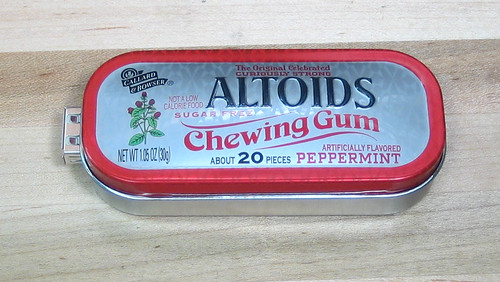
And so for today’s edition of DIY Friday, we present to you…. (drumroll)….. a tin of Altoids!

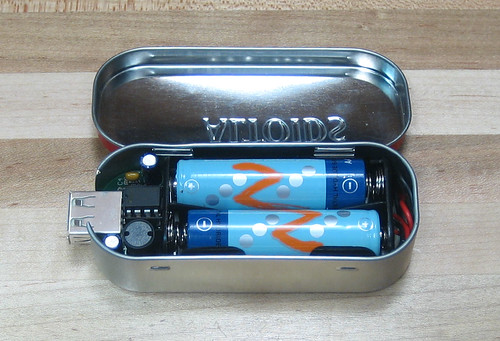
Ok, not quite. Close observers will notice that little USB port over on the left. Open up the tin, and this is what you’ll find:

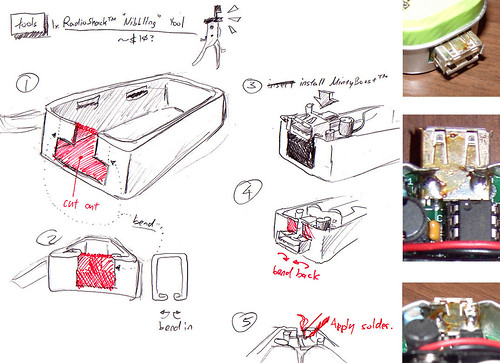
The inner workings of a DIY USB Charger Kit, made from this schematic:

What’s that? Need more detail, you say? Complete details on how to make your own USB charger kit for your personal gadgets — with or without the handsome Altoids case — can be found here. An even quicker way to jumpstart your weekend project is to buy this kit from Make magazine. For only $20 plus shipping and a few hours of your time, you can have your own portable way of recharging your gadgets without towing around a bevy of chargers and cords.


Logging On at Mach 6

Monday, February 12th, 2007

Bringing new, potential meaning to the term, space pirate, is Fayetteville, AR-based aerospace firm Space Photonics who, according to the Northwest Arkansas Morning News, is working to up the bandwidth on military/government space and aircraft using optical technology. Check out the powerpoint slide below to get a better idea of how communication "turrets" would connect with satellites to get high-speed ‘net (and other communications) connections through to fast moving targets.


While the technology might mean that future Maverick’s can pirate copies of The Fast and the Furious VII: Golfcarts of Doom on their forays into the wild, blue yonder, the real excitement its stirring up centers around the potential it opens up for "synchronized communication lines between satellites." While the Morning News seems to think that this might translate into synchronized satellite orbiting competitions, its more likely to change communications in other more important ways.

DIY Friday: Get a Space Job!

Thursday, February 8th, 2007

Believe it or not, this is Hawaii, and you could be there. Read below to find out how. 


Here’s the ultimate Do-It-Yourself project for the space buff who’s already created their own Mooninite shirt, created a PlayDoh radio, and souped up their WiFi receiver: get a space job!

You may think that only a certain type of 1960s nerd can become a rocket scientist, but in truth, the space industry is incredibly diverse, and talented people from all walks of life can make successful careers within it.

And your colleagues may be more cheerful than you’d ever imagine. 

So how does one go from dreaming of space, to working on projects related to space?

Astroplace has a huge collection of links; two less-imposing places to start are at Spacejobs.org and Space-Careers.com.

Space.com also has a job board powered by CareerBuilder.com, which — while we’re working this sub-theme of American sports — happened to have one of the better ads during the Superbowl.

Ok, so now that we’ve looked at SI cheerleaders and funny ads on TV, where were we?

Oh yeah: we were trying to get a job. What’s out there?

Well, looking at the jobs posted at the Smithsonian, they need an astrophysicist at the Smithsonian Observatory near Boston, but this job is based in (hello!) Hilo, Hawaii. 

Hard to top that that. But if you miss the deadline and want another great place to work, be sure to check out the job opportunities right here at SES-Americom— especially our Associate Program, which is designed to accelerate your career through a 24-month program in which DIY-minded people like you are assigned four challenging rotations, including an international assignment. Rotations provide exposure in selected functions of our business, including Sales and Marketing, Finance, Space and Operations and Business Development.

So put down the PlayDoh radio, and drop us a note.

Dodging Junk in Space

Tuesday, February 6th, 2007

 
Question: How much junk is in the Earth’s trunk — er, orbit?

Answer: A lot. And a lot more since China knocked down an aging weather satellite last month.

Evidence: Check out this graphic from the New York Times, which shows the thousands of pieces of small debris that are now in orbit. 

The accompanying article explains: 

 For decades, space experts have worried that a speeding bit of orbital debris might one day smash a large spacecraft into hundreds of pieces and start a chain reaction, a slow cascade of collisions that would expand for centuries, spreading chaos through the heavens….

Early this year, after a half-century of growth, the federal list of detectable objects (four inches wide or larger) reached 10,000, including dead satellites, spent rocket stages, a camera, a hand tool and junkyards of whirling debris left over from chance explosions and destructive tests.

Now, experts say, China’s test on Jan. 11 of an antisatellite rocket that shattered an old satellite into hundreds of large fragments means the chain reaction will most likely start sooner. If their predictions are right, the cascade could put billions of dollars’ worth of advanced satellites at risk and eventually threaten to limit humanity’s reach for the stars.

Indeed, the destruction of the satellite by China forced the International Space Station to move (see the video above) to avoid debris from the destroyed satellite, which the U.S. military is tracking.