Archive for the ‘Front Page’ Category

DIY Friday: Surveillance System

Friday, September 25th, 2009


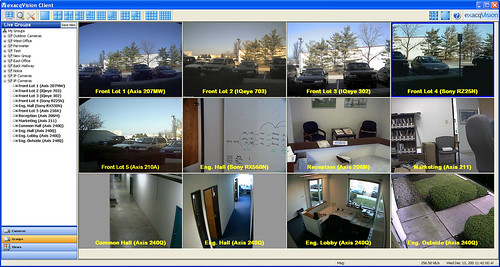
Sure, you can put together your own home surveillance system using webcams and the Internet. Dedicated IP cameras help, but is there a cheaper way to put it all together? And why is it so complicated?

Enter Ugolog (featured on VentureBeat), a very simple service:

Without requiring you to buy or install any software or hardware other than simple web cameras, Ugolog lets you keep an eye on any place you want from the comfort of your own computer. The footage captured by the cameras (and any brand or make will work) is channeled directly to Ugolog’s servers, allowing you to watch the recordings from anywhere, anytime with any browser.

This type of easy, more casual surveillance clearly has many applications — many of them not as nefarious as one would think. You can check in on your pets while you’re on vacation, on your sleeping baby from another room. You can survey your home if you’re on vacation, or make sure your employees are hard at work when you’re out of the office.

 CNET did a piece on these solution, and Ugolog got good reviews there, too. If you get burglarized, you know you’re PC/Mac/laptop may vanish. So will your recorded video of the perpetrator, so having it stored on a remote server is probably a good idea.

 Or get creative, as these students at UT Austin did with a remote control tank…

Amateur Astronomer

Friday, September 18th, 2009


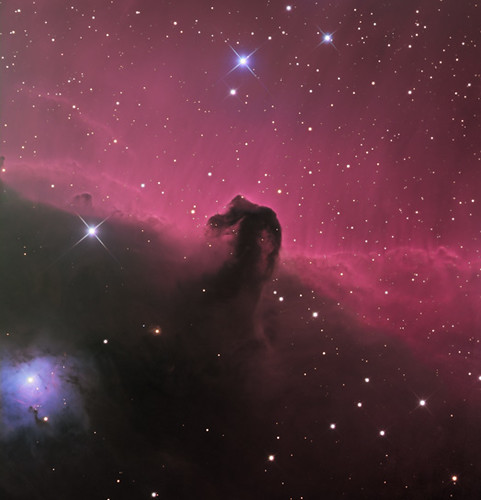
The Telegraph (U.K.) published an image gallery featuring Astronomy Photograph of the Year Martin Pugh, who happens to be an amateur.


A few words from the photographer: ‘An extremely popular imaging target, it was an absolute “must do” for me. My objective was to produce a high-quality, high-resolution image, blending in Hydrogen-Alpha data to enhance the nebulosity. If I could change something about this photograph I would expand the frame to include the Flame Nebula, and then expand it further to pick up the Great Orion Nebula to create a superlative wide-field vista of this region.’

What’s in the picture: The Horsehead Nebula, is a dark cloud of gas and dust. The gas, dust and other materials condense to form dense knots, which will eventually become stars and planets. New stars have already formed inside part of the dust cloud, as can be seen on the bottom left.

Equipment: SBIG STL11000 CCD camera guided with adaptive optics; 12.5-inch RC Optical Systems Ritchey-Chrétien telescope; Software Bisque Paramount ME mount; 19 hours of exposures

What competition judge Chris Lintott thought: ‘I think this is the perfect deep-sky image; perfectly composed, it grabs your attention straight away. When you look closer, the detail is absolutely stunning, whether it’s the fine structure in the curtain behind the horse or the subtle details on the edge of the dark nebula itself.’

Check out the others on Flickr. Good stuff.

Near-Space Photos

Thursday, September 17th, 2009


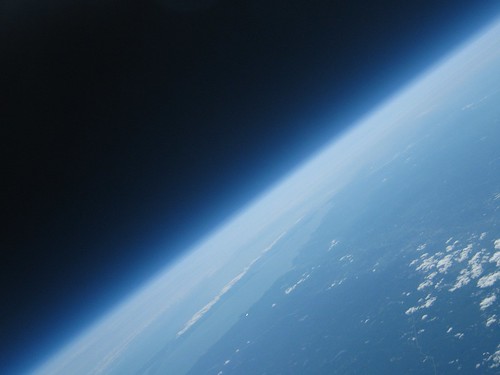
Students at MIT sent a weather balloon up with a camera. It reached 93,000 feet. That’s cool.

It cost them less than $150. That’s dope.

The summary, via Wired:

Meet the $150 (almost to) Space Camera.

Bespoke is old hat. Off-the-shelf is in. Even Google runs the world’s biggest and scariest server farms on computers home-made from commodity parts. DIY is cheaper and often better, as Justin Lee and Oliver Yeh found out when they decided to send a camera into space.

The two students (from MIT, of course) put together a low-budget rig to fly a camera high enough to photograph the curvature of the Earth. Instead of rockets, boosters and expensive control systems, they filled a weather balloon with helium and hung a styrofoam beer cooler underneath to carry a cheap Canon A470 compact camera. Instant hand warmers kept things from freezing up and made sure the batteries stayed warm enough to work.

Of course, all this would be pointless if the guys couldn’t find the rig when it landed, so they dropped a prepaid GPS-equipped cellphone inside the box for tracking. Total cost, including duct tape? $148.

Great photos, too. Here’s a video…


DIY Friday: Satellite Bowl

Friday, September 4th, 2009

Ever see the "satellite bowl" in New York’s Museum of Modern Art? A small one costs $38, and $48 for the large, via the MoMA shop.


We’ve got a better idea. Look at what the folks at Design without Reach came up with: 6 pair of chopsticks and a rubber band…


Now go enjoy the Labor Day weekend. Check out yesterday’s spacewalk…


String It

Friday, August 28th, 2009


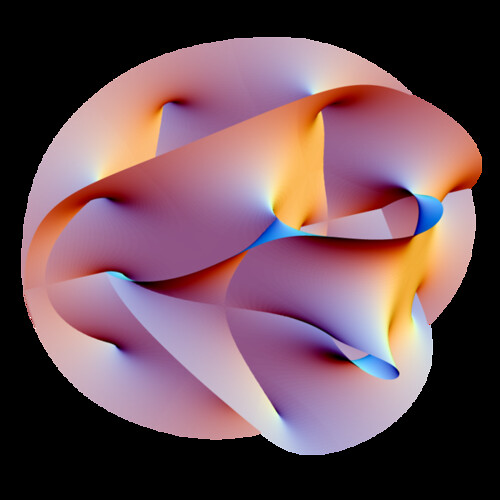
Once you get in to String Theory, it is positively mind-boggling — especially when you begin considering multiple dimensions. New Scientist did a small piece on multiple dimension (more than three).

I like the TED clip myself…


Some of this stuff will help us travel the galaxy — and beyond.

DIY Friday: Laser Lighter

Friday, August 14th, 2009

Live dangerously: smoke. Oh, and light up with via a laser, via Instructables


 WARNING: This kind of laser can cause permanent damage to eyesight in less than a second. NEVER look into the beam or reflection of ANY laser including this one

Drone Control? There’s An App For That

Tuesday, August 11th, 2009

Great piece in Wired’s Danger Room on a new iPhone app developed at MIT:

Her crew of 30 grad students and undergrads is chasing a number of new ideas and technologies, all aimed at easing the sometimes unwieldy interactions between machines and their human masters. As an example, she refers to the complex, suitcase-sized controller that soldiers must haul around to control hand-thrown Raven unmanned aerial vehicles, or UAVs. Cummings wants something simpler. And what could be simpler than an iPhone?

Actually, using an iPhone was her undergrads’ idea — because experimenting with it as a basis for a new robot controller meant she’d have to buy them all iPhones of their own. “We had the idea in June,” Cummings told Danger Room. “In six weeks, we went from the idea to a real flight test,” using MIT’s indoor robot range. (See video.) The total cost? $5,000 for a new, commercially available, quad-rotor robot — plus the cost of iPhones for her crew.

The iPhone bot controller is basically just an app, like any other. It relies on only the iPhone’s existing gear, and the phone can still be used for regular calls, web-browsing, texting, etc. HAL’s bot-wrangling app sends GPS coordinates to the robot, which navigates around using its own, built-in “sense-and-avoid” capabilities. Along the way, the bot can stream video or snapshots back to the iPhone.

 Yeah, there’s a video…


Jet Pack

Friday, August 7th, 2009

For your next summer vacation adventure, check out Canadian company Jetlev:

Our first production model JETLEV-FLYER is undergoing final testing by MS Watersports GmbH, our German licensee, and results will be available soon. There will be two versions, one with a 155 HP engine and the other with 215 HP. Top speed of the 215 HP model is expected to easily exceed 40 mph (64 km/h), and flight ceiling will still be restricted to 28 feet (8.5 m) for safety reasons. Specifications are subject to change and will be announced after final testing has been completed.

For performance and duration records and other special applications, future versions of JETLEV-FLYER could reach speeds in excess of 50 mph (80 km/h), altitudes of 50 feet (15 m), cruise duration of 5 hours, range exceeding 180 miles (300 km), and carry payloads in excess of 1000 lbs (454 kg). Ultimately, it is largely safety considerations, not technical limitations that will dictate the limits of design.

Besides the obvious recreational and entertainment applications, there are many potential practical applications of Jetlev technology including beach patrol, search-and-rescue, offshore services, marine/bridge inspection and maintenance, maritime safety, harbor security, anti-piracy missions, and the military. Interested parties are encouraged to explore joint ventures with or license the technology from Jetlev Development Corporation in Canada.


Here’s the Fox News report:


Speeding Stars in Space

Thursday, August 6th, 2009


Can’t drive 55? Try 1 million MPH:

Stars in a distant galaxy move at stunning speeds — greater than 1 million mph, astronomers have revealed.

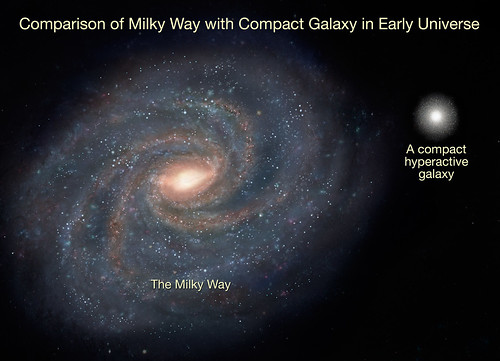
These hyperactive stars move at about twice the speed of our sun through the Milky Way, because their host galaxy is very massive, yet strangely compact. The scene, which has theorists baffled, is 11 billion light-years away. It is the first time motions of individual stars have been measured in a galaxy so distant.

While the stars’ swiftness is notable, stars in other galaxies have been observed to travel at similarly high speeds. In those situations, it was usually because they were interlopers from outside, or circling close to a black hole.

But in this case, the stars’ high velocities help astronomers confirm that the galaxy they belong to really is as massive as earlier data suggested.

Bizarre, indeed

The compact nature of this and similar galaxies in the faraway early universe is puzzling to scientists, who don’t yet understand why some young, massive galaxies are about five times smaller than their counterparts today.

"A lot of people were thinking we had overestimated these masses in the past," said Yale University astronomer Pieter van Dokkum, leader of the new study. "But this confirms they are extremely massive for their size. These galaxies are indeed as bizarre as we thought they were."

Scientists used the new velocity measurements, conducted with the Gemini South telescope in Chile and the Hubble Space Telescope, to test the mass of a galaxy identified as 1255-0. The same way that the sun’s gravity determines the orbiting speed of the Earth, the galaxy’s gravity, and thus its mass, determines the velocities of the stars inside it.

That’s awesome. Check the NASA site for details.

Astronomers confess that it is a difficult riddle to explain how such compact, massive galaxies form, and why they are not seen in the current, local universe. “One possibility is that we are looking at what will eventually be the dense central region of a very large galaxy,” explains team member Marijn Franx of Leiden University in the Netherlands. “The centers of big galaxies may have formed first, presumably together with the giant black holes that we know exist in today’s large galaxies that we see nearby.”

To witness the formation of these extreme galaxies astronomers plan to observe galaxies even further back in time in great detail. By using the Wide Field Camera 3, which was recently installed on the Hubble Space Telescope, such objects should be detectable. “The ancestors of these extreme galaxies should have quite spectacular properties as they probably formed a huge amount of stars, in addition to a massive black hole, in a relatively short amount of time,” says van Dokkum.

This research follows recent studies revealing that the oldest, most luminous galaxies in the early universe are very compact yet surprisingly have stellar masses similar to those of present-day elliptical galaxies. The most massive galaxies we see in the local universe (where we don’t look back in time significantly) which have a mass similar to 1255-0 are typically five times larger than a young compact galaxy. How galaxies grew so much in the past 10 billion years is an active area of research, and understanding the dynamics in these young compact galaxies is a key piece of evidence in eventually solving this puzzle.


 Looking back in time, 10 billions ago. A million mile per hours. This astronomy stuff can be so mind-boggling.
DIY Friday: Vortex Cannon

Friday, July 31st, 2009

This is pretty awesome: a vortex cannon demonstration, seen on BBC One:


Can I make one myself? You bet: Instructables has it for you.

This one is so easy to make and gives great results. You will need a fog machine to generate the rings for both of these projects.

What You Need…

1. 32 Gallon Plastic Trash Can
2. Heavy Duty Trash Bag
3. Golf Ball
4. 2 Bunjee Cords
5. Tape
6. Box cutter


Who’s afraid of the big bad wolf?