Archive for the ‘Front Page’ Category

Predicting Space Weather

Monday, July 21st, 2008

On reading that title, you might be asking yourself “why in the world would I need to predict space weather?” Well, I’ll tell you. Space weather – the range of high-energy radiation, such as X-rays and gamma rays, that constantly bombard the Earth’s atmosphere – affects the performance of some of your favorite gadgets, like GPS and satellite TV.

With this camera, scientists can predict changes is space weather, allowing for communications companies to compensate for electromagnetic interruptions to their signals. Never again will your Planet of the Apes marathon be spoiled by a bad signal. Oh, and it’ll help the military predict and plan for interruptions in their communications too.

The project – the Global-Scale Observations of the Limb and Disk – is known by a catchy acronym: GOLD.

The GOLD Camera will fly on an SES AMERICOM satellite. Physicist Richard Eastes, who leads the GOLD project, says this is the first time that a NASA instrument has flown on a commercial communications satellite.

This is the second “hosted” payload for an AMERICOM spacecraft just this month. The other was for the Air Force’s CHIRP (Commercially Hosted Infrared Payload).

DIY Friday: Solar Death Ray

Friday, July 18th, 2008

It’s another lazy, hot summer weekend…what to do to pass the time?

Crochet a new bathing suit? Nah.

Make a beaded pull for the ceiling fan? No thanks.

Craft some sunglasses out of popsicle sticks and tinted saran wrap? Maybe next week.

I’m looking for something a bit more bold to shake up the summer doldrums: A SOLAR DEATH RAY.

You may have seen the “#1 solar death ray on the Internet” here. But that model was so 2006.

Yes, the competitive world of solar death ray construction has moved well beyond that.

This guy, inspired by the success of the original, bought himself a c-band antenna and made a device capable of generating 13,000 watts. He calls it the “light sharpener” and you can find full instructions on his site to make your own.

The only question is, to what end will you direct the power of your very own light sharpener? The answer, clearly, is remaking the classic American cook-out.


Of course, Really Rocket Science was ahead of the curve on this one…but we have to admit that his is bigger.

GPS Beats Speeding Ticket

Friday, July 18th, 2008


Rocky Mountain Tracking‘s device is accurate. So good, in fact, it beat a police radar in court:

Eighteen-year-old Shaun Malone has a few people to thank for being able to plead "Not Guilty" to a speeding offence – his parents, who installed a GPS device in his car, and Rocky Mountain Tracking, the service provider of that device.
 
"Because of our GPS tracking data, Malone and his parents can protest the imposition of an unfair speeding ticket," says Brad Borst, Founder and President of Rocky Mountain Tracking, and who is also a former Police Officer.

A police radar had found Malone driving at 62 mph in a 45-mph zone. However, Malone’s parents, who had installed the Rocky Mountain Tracking GPS device in his car to monitor his driving, found that the device tracked him driving at, and not above, the speed limit.

The most telling testament to the accuracy of the Rocky Mountain Tracking Rover GPS tracking device came, ironically, from a GPS expert who originally helped find Malone guilty in a trial-by-affidavit. Dr. Stephen Heppe, the expert, had written a report affirming that, going by the GPS data, Malone had to have been traveling faster than 45 mph.

Read their blog for more detail. And Hot Hardware gets more from the expert:

While the police clocked him going 62-mph, the GPS’s data in fact showed him driving at the 45-mph speed limit. In an initial trial-by-affidavit, Malone was found guilty of speeding. GPS expert, Dr. Stephen Heppe wrote a report that essentially said that the GPS data was not accurate enough to contest the accuracy of the radar gun. Malone appealed the decision and had his day in court. At trial, things played out differently:

"However, when he took the stand to begin his testimony, Dr. Heppe corrected that written report, saying that the Rocky Mountain Tracking device was "very" accurate, to within a couple of meters on location and to within 1 mph on speed. Dr. Heppe also pointed out that the GPS device released instantaneous data, and not data averaged over a distance."

Needless to say, with Dr. Heppe’s revised testimony, Malone was found innocent of speeding.


Teenagers. Some learn about the danger of speeding the hard way, some know better before they start driving. Check out this kid in Kentucky:

Landon Wilburn, 11, grew tired of speeders zipping through his subdivision, so after growing hoarse shouting at them, he decided to take matters into his own hands.

The youngster, who used to shout at speeders to slow down as they drove through the Stone Lakes subdivision in Louisville, now has taken matters into his own hands.

Dressed in a reflective vest, wearing a bicycle helmet and armed with an orange Hot Wheels brand radar gun, he points and records the actual speed of passing traffic.

Landon also carries a flashlight with a built-in siren.

"When I saw it happening, I got the biggest kick out of it," said resident George Ayers, 61. "People were locking up their brakes when they saw him."


You can hack these toy radar guns, or you could really have some fun as-is.

Let’s go camping

Thursday, June 26th, 2008

It’s almost the 4th of July, and, if you’re anything like me, you still haven’t figured out what to do with that long weekend.

True, there are usually some good movie marathons on cable, but you could probably use some time in the sun before you start to look like one of those mole-people. (Oh, they exist…I think I saw it on tv somewhere…)

So, why not take a low impact, low cost vacation and go camping? You might even prove that those MacGyver re-runs really were a good use of time.

If you need to brush up on your survival skills before hitting the great outdoors, this weekend is the Great American Backyard Campout. What better place to try to remember your old boy-scout tricks than the safety of your own yard?

If the thought of leaving your high-tech life at home leaves you a bit panicky, have no fear. There are plenty of fun new gadgets to make your camping trip feel a bit more 21st Century.

Pump up an air mattress, and you’ll forget you ever left home.

Or, for the ultimate experience of sleeping under the stars, check out this hammock.

And this GPS system with emergency beacon will ensure that you can escape the great outdoors in the case of a killer bee attack. (I DEFINITELY saw that on tv…)

But, whatever you do, leave the blackberry at home.

DIY Friday: Bike Trailer

Friday, June 20th, 2008

I’ve been feeling a bit guilty lately about driving around to do errands. I mean, I have my canvas totes for schlepping home the goods, but somehow that doesn’t seem to make up for all the gas I’m guzzling getting to and from the store. (And, ok, I’m also a bit broke, so the high price tagat the pump is also a motivating factor.)

But what’s a guy to do when you don’t want to strap your groceries to your back like a sherpa? Answer: Buy a Bicycle Trailer.

This one’s a bit sporty, and could handle the great outdoors as well as your late night cereal run.

Want to burn a few calories before you party? Use this cart to bring home the beer.

But this is DIY-Friday, after all, so why not build one with this $79 DIY kit.

For DIY-purists, make one from scratch. WikiHow and Make both have instructions.

And of course, no errand run is complete without belting it out to your favorite tunes (or is that just me?). These new portable players from Sirius and XM are guaranteed to keep you entertained while you’re buying the beer.


DIY Friday: Altoids tin headphone amp

Friday, June 13th, 2008

So I got a great new pair of headphones over the holidays last year, and so far they’ve served me well, but lately I’ve been trying to figure out how I can get the most out of the new cans. Audiophiles out there know about some great (and expensive) headphone amps that really help you get the most out of your headphones–to hear every detail of your favorite album or the environment you’ve recorded yourself. Today’s pick, however, will only set you back a few bucks. It’s the DIY Altoids tin headphone amplifier.

This project has been around for a while, but it’s always being adapted and improved. There are a few places online where you can find the step-by-step, but most of them originate from the Chu Moy project posted over at headwize.com.

Here’s what MAKE magazine had to say about the project.

Headphone amps make portable listening good and loud. Commercial audiophile models can cost $200+, or you can build a great-sounding amp inside a mint tin for around $30, following Chu Moy’s popular design. Powered by a 9-volt battery, this amp drives high-impedance headphones to thunderous volumes from even weak sources.

Tangent has a good tutorial on how to assemble the amp. You’ll need to have some basic solder and circuitry knowledge, but the Getting Started guide should help if you’re in the dark.

Without any knowledge going in (not including Altoid eating time and subsequent dentist visits), you’re probably looking at spending a good weekend on this project.

Every once and a while you’ll also find some available to buy… but that wouldn’t be very DIY, would it?

[photo from Tangent]


Boatloads of iPhones

Saturday, June 7th, 2008


Hundreds of shipping containers have been arriving from China to ports all over this planet, presumably packed with new iPhones

Don’t miss your boat: Apple’s announcing a new iPhone on Monday, 9 June 2008 at 17:00 GMT — tape your "go away" signs to your doors and follow it on Engadget, which reported firmware details last night:

    • Infineon PMB6952 / S-GOLD3 six-band UMTS / HSDPA transceiver (as we’d heard)
    • Murata LMRX3JCA-479 tri-band amplifier (we’re assuming for the 3G)
    • Sony SP9T antenna switch for GSM / UMTS dual mode
    • ARM 1176JZF-S – Main CPU (same as in 1st gen iPhone)
    • Skyworks 77427 chip – UMTS / HSDPA tx 1900MHz, rx 2100MHz
    • Skyworks 77414 chip – UMTS / HSDPA 1900MHz Skyworks 77413 chip – UMTS / HSDPA 850MHz
    • Internal build model number: n82ap (1st gen iPhone was model m68ap)
    • UMTS Power Saving option – on or off
    • Hooks for Global Locate Library (GLL), software that handles A-GPS related commands for the host processor


Otherwise, we have no shortage of rumors. Check Engadget, Gizmodo and FierceWireless. There are sure to be some surprises, and I’m hoping for live TV reception via A-VSB. Getting DVB-H, DVB-T or DVB-SH may be a stretch, but maybe next year.

I’ll be watching/following the Apple WWDC any way I can. MacWorld reports this is one of the most important in years:

“This is a hugely significant WWDC for Apple because they are bringing out a new platform,” said Michael Gartenberg, vice president and research director at research firm JupiterResearch. “This is the coming out party for the iPhone.”


DIY Friday: Flux Capacitor

Friday, June 6th, 2008

You’ve seen Back to the Future and the De Lorean time machine, but what is a flux capacitor?

It’s the Y-shaped flashing light device (powered by 1.21 jigowatts) that turns a sports car into a time machine. How does/did it work? “Doc” couldn’t even explain it:

It is not described in the films exactly how the flux capacitor worked beyond that of a typical plot device or a typical deus ex machina device, though Doc mentioned at one point that the stainless steel body of the DeLorean has a direct and influential effect on the “flux dispersal”, though he was interrupted before he could finish the explanation. The flux capacitor required 1.21 gigawatts of electricity to operate.

You can make your very own Flux Capacitor (but, PLEASE, do not toss it in your car, cross your fingers, and go 88 mph in a parking lot). Instructables has the instructions. Not a lot of electronics experience is needed, and most of the equipment is available at your local hardware store and Radio Shack. The Flux is housed in an ordinary fuse box.

Too complicated? You can buy one here for $250. A small price to pay for time travel capabilities. And this (more-expensive) dealer will even provide a time-travel, money back guarantee (read closely):

This item may be expensive, but can you place a price on time travel? NOTE: Special return policy: If you are not 100% satisfied, you may return this product for a full refund, in no LESS than 30 days before you purchase it!

Once you have have your Flux, get started on the rest of the De Lorean time machine:

Holy Tripoli

Thursday, June 5th, 2008

Earlier this year, the USS Erie successfully shot down an errant satellite in a real-world mission.

And, later today, the ship and its sea-based missle defense system will get a chance to prove itself again:

The test, off Kauai, is the latest test of the military’s sea-based missile defenses, called the Aegis ballistic missile defense program.

The military will fire a Scud-like missile, which has a range of a few hundred miles, from a decommissioned amphibious assault ship, the USS Tripoli.

USS Lake Erie, a Pearl Harbor-based Navy cruiser, will fire two interceptor missiles at the target with the intention of shooting it down in its final seconds of flight.

If all goes well, the intercept should occur within the Earth’s atmosphere, or within 100 miles of the Earth’s surface.

The Aegis system accomplished a similar task once before: two years ago, the Lake Erie shot down a missile fired from the Pacific Missile Range Facility on Kauai in its final stage of flight.

In February, the ship successfully shot down a U.S. spy satellite in the Aegis’ system’s first real-world mission.

The satellite had lost power and become uncontrollable, creating worries it would break up and spread debris over several hundred miles if it fell to earth.

The Hawaii-based, Star Bulletin has more details.

The Navy said yesterday that on Tuesday the mission, named Stellar Scorpion, was blessed at the Barking Sands missile facility by "Uncle Tom" Takahashi, who named the Lake Erie’s two interceptor missiles "the crashing sound of the ocean" and "the ear of the earth," respectively.

Being a decommissioned helicopter-carrier, the USS Tripoli (photo above) seems like a pretty odd choice to be involved in this exercise. The "Semper Princeps" (Always First), as they call it, has been around since 1964, and decommissioned (but strangely still very active) since 1995:

She was decommissioned in 1995 and as of 2004, she was on loan to the Army, but remained laid up at Mare Island Naval Shipyard. In December 2006, the ship was towed to Pearl Harbor, Hawaii, where it now has a high-tech role as a launch platform with the nation’s developing ballistic missile defense program. Three times the ship was towed some 100 miles off shore and used to launch small ballistic missiles, which are then intercepted by Terminal High Altitude Area Defense Missiles, test-fired from the Pacific Missile Range Facility. The last test in the series was performed October 26, when the ship fired a "scud-like" missile, which was successfully intercepted. The ship will be towed back to the San Francisco Bay Area for the winter. Kaua’i lacks a suitable land-based launch site, and the costs of building one would far exceed the approximately $600,000 per year it costs to use the old warship, so the vessel will return to Pearl Harbor for a second series of tests in late spring 2008.


Toys in Space

Monday, June 2nd, 2008


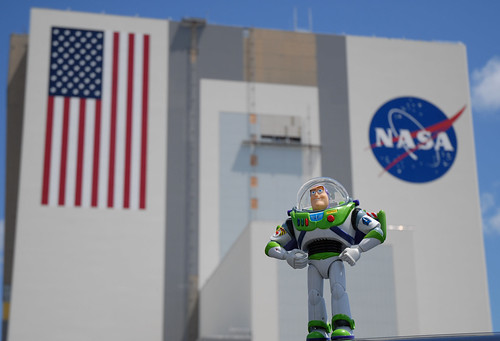
With the launch of STS-124, a great site for kids from NASA, featuring Buzz Lightyear, is up. And Buzz Lightyear’s in space, too:

Seven astronauts who will fly into orbit aboard space shuttle Discovery will have comfortable seats for the climb into space. An eighth space ranger won’t have a seat at all. In fact, he will be packed tight inside a box and won’t even get to enjoy the ride up.

But it’s nothing veteran spaceman Buzz Lightyear can’t overcome.

The good news is that he’ll have some sports shows to listen to, along with a host of jerseys that have been to the Champs Elysees in Paris for the Tour de France and to the Super Bowl.

More accustomed to soaring among the galaxies on fold-out wings and a backpack rocket, Lightyear will take to space on Discovery’s STS-124 mission stowed inside a locker in Discovery’s crew compartment. The 12-inch-tall action figure is flying as part of a partnership between NASA and Disney Parks to encourage students to pursue studies in science, technology and mathematics, one of NASA’s main educational goals.

Disney’s Youth Educational Series and NASA have developed an online program known as the Space Ranger Education Series. It includes fun educational games for students, as well as materials for educators to download and integrate into their classroom curriculum.

And the interview with Buzz Aldrin is priceless.