i-Toad: Domestic toad, eats dust and bits of this and that. Works independently, requiring no supervision or instructions.
So appealing, it’s tempting to put a collar and leash on him and head for the outdoors….
Materials: felted Romney and Jacob wool, glass eyes, a ‘Roomba’ base. i-Toad’s sensors are fully functional with windows for vision designed in the wool body.
Yo, Rocco’s back. Lots of interesting stories since I last blogged here. Last week’s item almost had me blogging. Now that RRS has a new editor, I’m back as the lead blogger.
The entire world has been waiting for decades with baited breath for the arrival of real, working shoe phone technology. You find that hard to believe? Would you believe that someone, somewhere, has been occassionally thinking about shoe phones? Well, the shoe phone finally lives, as you will discover below, and as you can hear for your self, here or here, or listen to an ABC interview which gets interrupted by the shoe phone ringing.
The attention the shoe phone has generated has been quite flattering, including the production of shoe phones by others, resulting in an instructibles article and the first shoe phone on ebay. Perhaps what is most surprising is that noone had actually made a working shoe phone before. But now that cat has been let out of the bag …
Remote Patient Care: The Serious Side Of Shoe Phones
A significant part of the shoe phone project is the potential medical applications, as summarised in this television report:
Every Halloween, I have grand plans for pumpkin carving. I make sketches. I pick out the perfect pumpkin with all the right proportions. And, inevitably, it ends up looking like a kindergartener’s craft project. Well, not this year! Why, you ask? One word: Robots.
For a more traditional pumpkin, you can take the lead of the robotics experts at the Detroit Science Center, who made the cut at extremepumpkins.com thanks to their innovations in halloween hardware. (I have to note their tagline here: "Pumpkin carving has been reborn. This time it is a little bit deformed."…maybe this IS the perfect site to showcase my skills…)
If you’re going for something a bit more advanced – with a kind of headless horseman vibe – check out this guy’s robot, which he used to carve a rather disturbing likeness of himself.
Of course, if you’re looking for more of a chill-out-on-the-couch-while-eating-candy-and-pretend-not-to-hear-the-trick-or-treaters-at-the-door kind of Halloween, virtual pumpkin carving might be more your speed.
To illustrate the extent of my artistic skills, here’s my creation:
Or, if you want to go a bit more hi-tech, you can try this diy radio modem that uses an “iPod” FM Transmitter and a regular FM receiver.
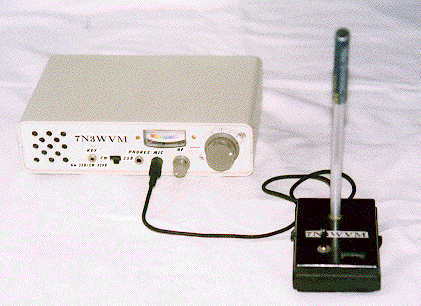
This guy makes HAM radios out of tin cans. (Think SPAM). He even has a miniature one that uses as much power as a Christmas light.
HAM’s have a long tradition of public service. Check out this video (hosted by Walter Cronkite!) about how HAM radio comes through in a disaster.
Whichever project you choose, you’re going to want to build it while watching one of these classic movies featuring HAM radios. Hitchcock was definitely a fan – “Rear Window”, “The Man Who Knew Too Much” and “The Birds” all make the list.
Posted in Front Page | Comments Off on DIY Friday: HAM Radio
Sirius Satellite Radio subscribers have the priviledge to listen via Internet audio streams. It was only a matter of time before an iPhone app was created: uSirius.
Boring commute and a weekend to spend in the shop? Try your hand at building your own self-balancing Segway.
Or, if you aren’t exactly Dean Kamen, try this slightly scaled down version built, along with a couple LEGO motors, on the open-source Arduino platform. Using relatively simple programming techniques, a huge community of enthusiasts, and a generous selection of tutorials and info, this little guy—dubbed “Arduway”—is one of the community’s newest creations.
MIT set out to build their Segway clone for less than $1,000 and to weigh around 50 lbs. They ended up with a finished product that is functionally identical to a genuine Segway and even includes cupholders!
The Segway folks are even billing the real thing, which comes in around $5,000, as the green alternative to fuel-powered automobiles (segway.com/nogas), citing the fractional cost of ownership and maintenance compared to cars.
Finally, if your DIY juices are really flowing, channel visions of Marty McFly as you take a look at Minnesota’s Segskate project—described simply as, “like Segway but it is a skateboard.” The video speaks for itself.
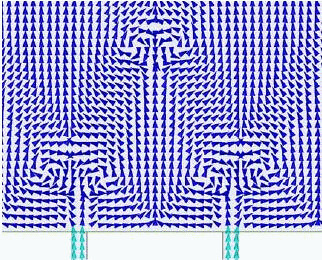
What if you could design a satellite dish or microwave antenna with the feed horn behind the reflector instead of in front of it? That may be possible, thanks to research by Cesar Monzon, a senior scientist at Enig Associates presented in the paper Anomalous Power Flow and ‘Ghost’ Sources published in Physical Review Letters (payment required to view the full paper).
The abstract describes the effect this way:
"It is demonstrated that EM radiation from complex sources can result in real power in restricted regions of space flowing back towards the sources, thereby mimicking ‘ghost’ sources. This counterintuitive mechanism of radiation does not rely on backward waves, as ordinary waves carry the power. Ways to harness the effect by making it directional are presented, together with selected applications, of which deception is a prime example due to the nature of the phenomenon."
It goes on to say that this concept could be to such areas as mechanics, acoustics and others with technology that is already available.
The article In radiation ‘ventriloquism,’ electromagnetic waves travel backwards on Physorg.com describes how the waves are generated and listed some of the possible applications. Obviously hiding transmitters and radar emitters is desirable in military environments.
Physorg.com quotes Monzon describing how the technology could be used with dish antennas: "On the case of satellite antenna feeds, the theory indicates it may be possible to build these behind the main reflector dish, which will offer a clear field of view without blocking or the disadvantages derived from feed offsetting. The same principle applies to both transmit and receive antennas."
I recall a paper from the mid-80s published in the Ukrainian Physics Journal (by O.S. Ilenko of the Kyivskii Politekhnicheskii Institut). The abstract, translated from the original Russian:
The diffusion of cylindrical electromagnetic waves and electromagnetic energy oscillations in the near field of a radiator is analyzed based on the physical principles of Huygens (1935). It is shown that the surface of a moving electromagnetic wave which conforms to the Huygens principle will be either spherical or planar in free space. Deviations from the planar or spherical forms can lead to the development of reverse electromagnetic waves. The geometry of the wave surfaces is illustrated.
Thank you, Japanese taxpayers, for subsidizing the development of what we’ll expect to see in about ten years. 16 times better than today’s HDTV.
NHK’s Super Hi-Vision provides 7,680 x 4,320 pixel (32 million pixels) images at 60 progressive frames a second, with 22.2 channel immersive audio. By contrast, today’s HDTV offers 2 million pixels in 1,920 x 1,080 scanning system.
They had a live feed from London to the IBC show in Amsterdam earlier this week. What was the reaction? "Dude, I need a bigger wall!" The Hollywood Reporter used the word "agog" in their headline:
NHK’s developing Super Hi-Vision system was the subject of a stunning demonstration Monday at the IBC. SHV offers 8K resolution — 16 times that of HDTV — with a 22.2 channel surround sound system.
Delegates waited in long lines for a glimpse at the scenic images, which were broadcast to Amsterdam’s RAI Convention Center in two ways: From a live camera in London over a fiber connection and from a server in Torino, Italy, via satellite.
What kind of set-up/config are we talking here? Big broadband, accoriding to EE Times:
In London, the camera and audio mixing is operated by SIS Live (formerly BBC Outside Broadcasts). Siemens IT Solutions and Services, the BBC’s technology partner, has built a control room that includes a bank of 16 MPEG-2 encoder channels which compress the native 24Gb/s of Super Hi-Vision to 600 Mb/s.
Siemens carries this, without any modulation, together with data, communications and reverse video and audio feeds, to Cable&Wireless, which is providing a gigabit Ethernet fiber connection from London to Amsterdam.
Besides the output of a live camera and microphone array in London transmitted over fiber optics connection, the BTF group is also showing content from a local server located in Torino, delivered to Amsterdam live over satellite.
RAI and Eutelsat provided Super Hi-Vision material live, using DVB-S2 modulation with "a channel efficiency that approaches closely theoretical limits," according to the group.
The Super Hi-Vision video and the 22.2 multichannel audio are coded using H.264 and AAC respectively. The 140 Mbits per second coded signal is then carried over two satellite transponders, using 8PSK 5/6 modulation.
Two transponders? Cool. Maybe they’ll start using the Kizuna satellite for these broadcasts.
Japan Inc. magazine gives a unique perspective, noting HD in Japan is nothing new:
“The public and private sector cooperation has been such that ordinary Japanese people don’t necessarily think of HDTV as anything special,” says NHK engineer Kenji Terada, noting that 93% of Japanese households already receive HDTV broadcast signals, thanks mainly to the country’s BS satellite service (BS-hi), which came online in 2000. The One-Seg system for mobile receivers (cell phones and car navigation systems, and so on) has been up since 2006.
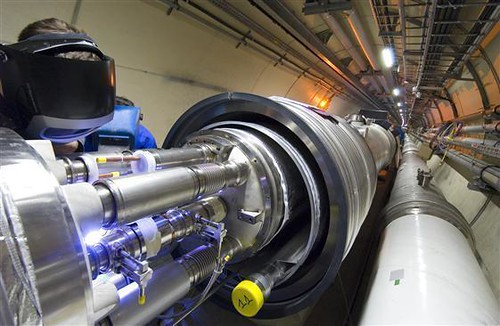
The Large Hadron Collider (LHC) is a gigantic scientific instrument near Geneva, where it spans the border between Switzerland and France about 100 m underground. It is a particle accelerator used by physicists to study the smallest known particles – the fundamental building blocks of all things. It will revolutionise our understanding, from the minuscule world deep within atoms to the vastness of the Universe.
Two beams of subatomic particles called ‘hadrons’ – either protons or lead ions – will travel in opposite directions inside the circular accelerator, gaining energy with every lap. Physicists will use the LHC to recreate the conditions just after the Big Bang, by colliding the two beams head-on at very high energy. Teams of physicists from around the world will analyse the particles created in the collisions using special detectors in a number of experiments dedicated to the LHC.
There are many theories as to what will result from these collisions, but what’s for sure is that a brave new world of physics will emerge from the new accelerator, as knowledge in particle physics goes on to describe the workings of the Universe. For decades, the Standard Model of particle physics has served physicists well as a means of understanding the fundamental laws of Nature, but it does not tell the whole story. Only experimental data using the higher energies reached by the LHC can push knowledge forward, challenging those who seek confirmation of established knowledge, and those who dare to dream beyond the paradigm.
An international collaboration of scientists today sent the first beam of protons zooming at nearly the speed of light around the world’s most powerful particle accelerator—the Large Hadron Collider (LHC)—located at the CERN laboratory near Geneva, Switzerland. The U.S. Department of Energy (DOE) and the National Science Foundation (NSF) invested a total $531 million in the construction of the accelerator and its detectors, which scientists believe could help unlock extraordinary discoveries about the nature of the physical universe.
Celebrations across the U.S. and around the world mark the LHC’s first circulating beam, an occasion more than 15 years in the making. An estimated 10,000 people from 60 countries have helped design and build the accelerator and its massive particle detectors, including more than 1,700 scientists, engineers, students and technicians from 94 U.S. universities and laboratories supported by DOE’s Office of Science and NSF.
“As the largest and most powerful particle accelerator on Earth, the LHC represents a monumental technical achievement,” said U.S. Department of Energy Undersecretary for Science Raymond L. Orbach. “I congratulate the world’s scientists and engineers who have made contributions to the construction of the accelerator for reaching this milestone. We now eagerly await the results that will emerge from operation of this extraordinary machine.”
"Together they [the LHC and the space program] cost less than one tenth of a per cent of world GDP. If the human race can not afford that, then it doesn’t deserve the epithet ‘human’."
Longtime DIY Friday fans may remember that we’ve provided plans for an at-home weather station before.
So are we repeating ourselves? Running out of ideas? Not really. The previous DIY Friday weather project was pretty sophisticated, relying on a satellite tracker, antenna, and PC-controlled receiver to deliver the forecast to you.
But the folks over at Expert Village have put together a nice video series (aimed at kids) on How to Predict the Weather. Here’s the first episode:
The series inspired us to track down some good family-friendly DIY weather projects. After all, it’s almost August — time to make some memories (not to mention barometers) with the kids before they get back into school.
There are two places we recommend starting.
Disney’s Family Fun has a good set of DIY instructions on building your own weather station, suitable for kids age 6-12:
Making instruments for a weather station is a great rainy day activity. Weather is on the mind of any kid trapped indoors on a summer day: A rain gauge can be put to immediate use and a barometer is best set up when air pressure is low. To hold everyone’s interest over the long run, you and your kids can set up a weather station and update it each day for a couple of weeks or you can visit the station when big weather happenings are in store….
A basic station starts with a wind vane, barometer, rain gauge, and a maximum/minimum thermometer. If you want a deluxe weather station you can add an anemometer to measure wind speed, a nephoscope to track cloud movement, and a psychrometer to measure relative humidity (directions are in most kids’ weather books).
All of the devices can be built with simple household tools and easily-acquired materials; the barometer, for example, requires a clear, straight-neck glass bottle, a clear glass jar, some food coloring, and a rubber band.
In other words, even the clumsiest mom and dad can lead their brilliant kids through this project. Or vice versa, as the case often is.
Also check out Franklin’s Forecast for another family-friendly guide to building your weather station.
So check the forecast, find a rainy day, get your tools and materials together — and enjoy a day with the kids. We predict that you’ll have fun.
Posted in Front Page | Comments Off on DIY Friday: Build Your Own Weather Station







 Boring commute and a weekend to spend in the shop? Try your hand at building your own self-balancing
  The Segway folks are even billing the real thing, which comes in around $5,000, as the green alternative to fuel-powered automobiles (