Archive for the ‘Front Page’ Category

DIY Friday: Solar Hot Water

Friday, May 30th, 2008

First it was soaring gas prices, then the cost of food – now it appears that the price of natural gas will surge fast.

The consequence? The cost of heating your home will be a lot more expensive next winter (especially if you’re in Wisconsin). What to do?

Well, if you’re in Iceland, just dig a hole. An amazing 90% of homes are heated with geothermal energy. Of course, with my luck, I picked this unheated, sod-roofed backpackers hostel/shack (highly-recommended, btw) on my recent stay in Iceland. Chilly nights.

But, if you’re still States-side, the geothermal option probably won’t work. So beyond simple conservation, let’s start by finding a simple and energy-free way to heat our water – the sun!

Way back in 1984, Mother Earth News brought us the plans for building an integral passive solar water heater (IPSWH):

For the do-it-yourselfer searching for an inexpensive, easy-to-build solar water-heating system, the integral passive solar water heater (IPSWH, pronounced ipswah ) is a dream come true. All you need to get going on this down-to-earth water warmer is a discarded electric water heater tank rescued from the local dump, a homemade plywood box to house it in, a can of flat black paint, a sheet or two of used window glass or clear plastic, a few common plumbing fittings and some pipe and insulation. Combine all that with some spare hours of satisfying sawing, hammering and wrench-turning, and you’ll have an ongoing supply of hot water provided virtually free from that friendly furnace in the sky.

The article gives a good how-to on the building process, and a fairly exhaustive explanation on the different types of active and passive solar water heaters. And just three months ago came Mother Earth’s modern update. Among the findings: the solar water heater payoff could be dramatic, especially considering rising energy costs:

Solar water-heating systems have minimal—sometimes zero—operating costs, and maintenance costs only about $2 per month. When all costs for purchase, installation, maintenance and operation are taken into account, a solar water heater usually pulls even with an electric heater after just eight and a half years, and equals a gas heater in about 15 years. From then on, through the expected 40-year life of the solar system, you’ve got FREE hot water.

When you’re ready to roll-up your sleeves, Instructables has the how-to pictures and directions. Build it Solar posts some other plans, including a pretty wild idea to use the energy from composting to heat water. And this enviro-solution is just a damn good excuse to throw a party (instructions are available here).

But, despite all the fun ideas, this is one of the few DIY projects that I encourage you to get some help. If you really want to save some money, reduce your CO2 output, and keep the system cooking for 40+ years, I’d skip the bottles and buy a system.

Have a great weekend!


Unfurling a Big Antenna in Space

Wednesday, May 28th, 2008

The ICO G1, launched last month, is referred to as the "world’s largest" by manufacturer Space Systems/Loral:

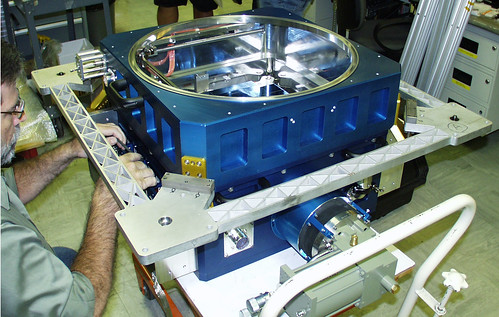
ICO G1 is a Loral-designed spacecraft that incorporates a 12-meter antenna reflector designed and built by Harris Corporation. The reflector utilizes a gold-plated mesh reflective surface and a unique new Harris design that allows a very large antenna reflector to stow safely and easily on the Loral 1300 satellite platform. The reflector size enables the increased performance typically required for mobile interactive media services.

ICO G1 is the largest commercial satellite launched to date, weighing nearly 15,000 pounds at liftoff, and measuring more than 27 feet high and over 100 feet wide, following solar array deployment.

Here’s the animation simulating deployment:


Yves Rossy: Fusion Man

Monday, May 19th, 2008

"I feel fantastically happy." 

That’s what Yves Rossy said after his flight. We remember Jet ManSpiegel Online writes he set a new personal flight record:

…he jumped out of a plane above the Swiss town of Bex and took flight using a jetpack he created.

The five-minute flight was the first public demonstration of Rossy’s one-of-a-kind device, which took him five years to create.

The inventor brings years of more conventional experience to his death-defying feats. He is a former Swiss military pilot and has been a co-pilot and captain for Switzerland’s two national airlines, Swissair and Swiss.

Dressed in a white flight suit, wearing a white helmet and strapped to his black device, Rossy was dropped from an airplane 2,348 meters above the Earth. He first unfolded the rigid, eight-foot wings strapped to his back, then fired up four tiny jet engines originally intended to power model aircraft.

A helicopter flew nearby to document his five minutes of glory, and an airplane followed to measure his speed. Rossy reached speeds of 300 kilometers per hour (186 miles per hour).

"The flight was excellent," Rossy told reporters gathered at the airfield where he touched down. Rossy wears a heavy, heat-resistant flying suit, similar to those worn by race car drivers and firefighters, to protect himself from the jet engines’ exhaust.

The report from the Today Show:


Here’s a cool video edit:


DIY Friday: Noise-cancelling Headphones

Friday, May 2nd, 2008

Noise Cancelling Headphones – they appear to be the newest trendy gadget, popping up everywhere in electronic stores and inflight catologs. But, damn, they can be expensive. Before we can get to the do-it-yourself option, let’s take a look at how they work:

Noise-cancelling headphones reduce unwanted ambient sounds (i.e., acoustic noise) by means of active noise control (ANC). Essentially, this involves using a microphone, placed near the ear, and electronic circuitry which generates an “antinoise” sound wave with the opposite polarity of the sound wave arriving at the microphone. This results in destructive interference, which cancels out the noise within the enclosed volume of the headphone.

Howstuffworks has a more detailed explanation, complete with graphics reminiscent of a high school physics course.

Now, if you not only aced that high school physics course, but also kept it going in college, you might be able to build a pair of headphones by following these complicated directions.

For the more modest, you could skip the physics and just hack together a pair using some industrial earmuffs for just $20 dollars:

DIY Friday: Payload into Space

Friday, April 25th, 2008

Maker Faire, arguably the preeminent DIY event of the year, is next weekend in San Mateo, CA. In honor of Maker Faire and Make’s contributions to our Friday segments, let’s bring back one of their best’s – the video space podcast:

Make: is going to space! Have you ever wanted to go up into space? Well, you don’t have to win a golden ticket, be a millionaire, or an astronaut… you can send your own payload into space!

We’re using weather balloons to go up to approximately 100k feet armed with 4 cameras… 20 megapixels of camera! We’ll be taking shots every 7 seconds for two hours and measuring the temperature with the Make: controller and thermistors!

It took 16 people working on this, countless cases of mountain dew, lots of take-out food, and a lot of sleepless nights, and we intend to fly Sunday!

Cloud cover, snow, and mechanical failure may postpone the launch, but we’re ready to give it our best shot this weekend.

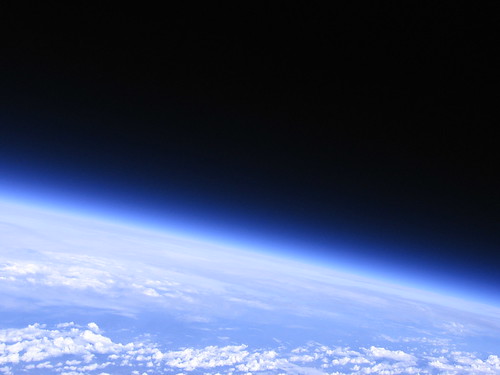
In this Make: Video Podcast, you’ll learn all the details of how to put a weather balloon up into space! The weather balloon will make it up to about 100,000 feet. That’s almost 20 miles up and more than twice the height of being in an airplane. It’s high enough that the sky is black and you can see the curvature of the earth.

Not exactly your average, weekend DIY project. From what I can tell from their wiki, they succeeded in getting the balloon to 109,242 feet, but since their batteries died, they have no way to track where the payload landed (and where they can acquire their photos).

Thankfully someone else made a similar trip – and brought back lots of pictures and some great video.

If you actually want to tackle this, start by buying the weather ballon. Then add-on all the gadgets and cameras you want.

DIY Friday: Wireless Internet Cantenna

Friday, April 18th, 2008

For those of you who are unaware, a Cantenna is “a directional waveguide antenna for long-range Wi-Fi used to increase the range of (or snoop on) a wireless network.” WiFi antenna designs are almost limitless – you can use a mineral water bottle, a cable antenna, a pringles can, a fire extinguisher, a kitchen steamer, or a cooking strainer and thumbdrive. Leave me a comment if I missed something.

The most common design utilizes a simple tin can, an N-Female chassis mount connector, and some thick wire. Instructions are available here, but the process is fairly simple: “1. Collect the parts; 2. Drill or punch holes in your can to mount the probe; 3. Assemble the probe and mount in can.” If you want to optimize different size cans, the (somewhat complicated) math is described here.

For a good overview of WiFi antennas, check out this excellent episode of Systm:

But, since Really Rocket Science tries to push the DIY-limits (and since we really like satellite dishes), try “hot-rodding” a basic can-Cantenna by adding an old satellite dish. Instructions are available here – let’s just say it takes a fair amount of creative ingenuity. It’s for the DIY-expert.

And, as usual, you could just be lame and buy one.


Black Holes & Taxes

Wednesday, April 16th, 2008


Paid my taxes the other day — yes, I had to pay. The forthcoming golden goose from the U.S. Treasury will act as a counter-balance, but I’m still paying up. Where does my money go?

The U.S. Defense Budget dwarfs hundreds of other counties’ budgets combined — in fact, the DoD overspent by $295 billion last year, reports the Christian Science Monitor.  Does that include the "black budget?" The New York Times did a great piece on it on April Fools Day:

The classified budget of the Defense Department, concealed from the public in all but outline, has nearly doubled in the Bush years, to $32 billion. That is more than the combined budgets of the Food and Drug Administration, the National Science Foundation and the National Aeronautics and Space Administration.

Those billions have expanded a secret world of advanced science and technology in which military units and federal contractors push back the frontiers of warfare. In the past, such handiwork has produced some of the most advanced jets, weapons and spy satellites, as well as notorious boondoggles.

Budget documents tell little. This year, for instance, the Pentagon says Program Element 0603891c is receiving $196 million but will disclose nothing about what the project does. Private analysts say it apparently aims at developing space weapons.

More than the FDA, NSF and NASA budget combined? Dude, that’s a black hole, which some find interesting. Hey, I’m all for space research and development, but a cure for cancer would be better 


More interesting, in my opinion, was the news from the ESA press release yesterday about a "certified monster" black hole:

A team of Japanese astronomers using ESA’s XMM-Newton, along with NASA and Japanese X-ray satellites, has discovered that our galaxy’s central black hole let loose a powerful flare three centuries ago.
 
The finding helps resolve a long-standing mystery: why is the Milky Way’s black hole so quiescent? The black hole, known as Sagittarius A-star (A*), is a certified monster, containing about 4 million times the mass of our Sun. Yet the energy radiated from its surroundings is thousands of millions of times weaker than the radiation emitted from central black holes in other galaxies.

"We have wondered why the Milky Way’s black hole appears to be a slumbering giant," says team leader Tatsuya Inui of Kyoto University in Japan. "But now we realise that the black hole was far more active in the past. Perhaps it’s just resting after a major outburst."

The observations, collected between 1994 and 2005, revealed that clouds of gas near the central black hole brightened and faded quickly in X-ray light as they responded to X-ray pulses emanating from just outside the black hole. When gas spirals inward toward the black hole, it heats up to millions of degrees and emits X-rays. As more matter piles up near the black hole, the X-ray output becomes greater. 
 
These X-ray pulses take 300 years to traverse the distance between the central black hole and a large cloud known as Sagittarius B2, so the cloud responds to events that occurred 300 years earlier.

Read more about the XMM-Newton.


DIY: Beer!

Friday, April 11th, 2008

When I was underage and in college (and with a very weak fake), my roommates and I looked into homemade beer kits for a cheap and reliable source of beer. Ultimately, we figured the stench of yeast might tip-off the dorm supervisor.

In writing this post, I trust I’m encouraging the craft of beermaking, not law aversion. Let’s respect beer.

Instructables gives us the step-by-step instructions, with photos. Most home brews combine four basic ingredients: malt, hops, yeast, and water. For video instructions, check out ExpertVillage. I suggest the how-to guide for my favorite brew – the Indian Pale Ale.

If this is just all too confusing, you could just buy Mr. Beer. It’s on sale!

For whatever process you choose, you can purchase an ingredients kit for your desired variety, but how DIY is that? This Pennsylvanian grew his own hops:

LAST SEASON’S disastrous hops shortage has sparked a run on rhizomes, the planted stems that grow into towering, hop-bearing bines.

Homebrewers and, remarkably, some small breweries are buying up hop rhizomes in a new wave of do-it-yourself farming of one the key ingredients of beer. The plants are becoming so scarce this spring that some would-be growers have resorted to buying them on eBay at marked-up prices.

"There’s definitely a panic out there, because brewers can’t buy the hops they need," said Dave Wills, an Oregon hops supplier who said his rhizome sales increased 400 percent this year.

"Brewers don’t want to be at the whim of big [hops] dealers," Wills said. "So now some of them are looking into growing their own."

In central Pennsylvania, for example, brewers Ryan Richards and Jesse Rotz have spent the past weeks planting 200 hop rhizomes on a family farm near Gettysburg.

"I’m not expecting very many hops in the first year," said Richards, who expects to open Roy Pitz Brewing in Chambersburg in June. "But hopefully after the second year, we’ll have significant yield that we can use for our own beer, plus trade and sell online."

The green, conelike hop flowers are the spice of beer, providing bitterness, flavor and aroma. Their production is controlled mainly by agricultural cartels in several distinct regions around the world, including Germany, the Czech Republic, China and the northwestern United States.

Most of the new generation of hops growers are homebrewers, hobbyists with a bit of backyard space for the sprouts.


And if you want to be super fresh and natural, make a certified organic brew:

As a home brewer you have many choices. Why not choose to brew organic! Your choice will give you clean tasting, fresh organic beer, and your choice will have a positive impact by supporting chemical and GMO* free sustainable agriculture. Organic homebrew might cost slightly more, but it is significantly less expensive than buying organic beer at a store. Plus, the cost is an investment in a better world!

Bosnian Phenomena

Thursday, April 10th, 2008


"Meteori padaju!!" That’s what Radivoje Lajic has been saying for months (that’s Croatian for "the meteors are falling"). The news item, via Daily News & Analysis:

A Bosnian man whose home has been hit an incredible five times by meteorites believes he is being targeted by aliens.

Experts at Belgrade University have confirmed that all the rocks Radivoje Lajic has handed over were meteorites. They are now investigating local magnetic fields to try and work out what makes the property so attractive to the heavenly bodies.

But Lajic, who has had a steel girder reinforced roof put on the house he owns in the northern village of Gornja Lamovite, has an alternative explanation.

He said: “I am obviously being targeted by extraterrestrials. I don’t know what I have done to annoy them but there is no other explanation that makes sense.”

The Daily Mail is reporting he thinks he’s being targeted by aliens. What are the odds of five meteorites hitting the same house? Must be astronomical. Although he’s got rock-solid evidence, could his neighbors be playing tricks on him?  Consider also the idea of the Bosnian Pyramids:

Inhabitants in Visoko have been fascinated by the hill for thousands of years. Anthropologists discovered that Visoko has a rich history and that it was the center of organized human settlements in the Middle Ages. German and Bosnian archeologists found 24 000 Neolithic artifacts which are 7 000 years old.

Visocica hill is 2120 ft (650 m) high and has a triangular form. Back in time, the medieval fortress was constructed by Bosnian kings at the top of the hill. The fortress was built over an old Roman Empire observation post which was made over the ruins of a prehistoric settlement. In other words, the hill can be used as a typical illustration of cultures building on top of other cultures.

There are no records of any civilizations in Europe attempting to build pyramids. Local and international experts dispute the theory about Bosnian pyramids. They claim that ancient civilizations in Bosnia were not capable of constructing colossal structures as the Bosinan pyramids.

However, Mr. Osmanagic claims that the hill has 4 perfectly formed slopes pointing toward the cardinal points, a plane top and an entrance complex (not yet discovered). 

Could have been built by extraterrestrials? Is Bosnia littered with space rocks? If you find this intriguing, attend the International Scientific Conference for the Bosnian Valley of the Pyramids this August, in Sarajevo.


1400-megapixel Camera to Change View of Universe

Wednesday, April 9th, 2008


How many pixels? 1400-megapixel? That’s 1.4 billion pixels, shutterbugs. And it won’t fit in your pocket.

The camera is part of the Panoramic Survey Telescope and Rapid Response System (Pan-STARRS), which promises to change our view of the Universe, producing the largest and most detailed map of the heavens ever produced. Defense Industry Daily reports the project is about to get $8 million in funding from the U.S. Air Force:

Kirkland AFB, NM recently gave the University of Hawaii of Honolulu, Hawaii a modified contract for $8 million for the Panoramic Survey Telescope and Rapid Response System (PanSTARRS) multi-year program. The initial effort to develop and deploy a telescope data management system was awarded via a Grant to the University of Hawaii (considered a Minority Institute) and “as the various phases progressed, the Air Force determined that a Cooperative Agreement would be the more appropriate instrument as now we would be substantially involved.” At this time all $8 million has been committed (FA9451-06-2-0338, P00002).

Located on top of a dormant volcano in Hawaii, the Pan-STARRS telescope will survey the visible sky, taking up to 1,000 exposures per night. In fact, this one telescope may be able to discover up to five times as many near-Earth asteroids as all present survey telescopes combined.


 Check out this page for a comparison of what other observation platforms/systems can see: Hubble, Subaru, Pan-STARRS and Palomar Sky Survey. This is an amazing telescope, with 400 times the sensitivity of the Palomar Sky Survey.