Archive for the ‘Front Page’ Category

DIY Friday: WiFi Network Detector

Friday, April 4th, 2008

Ever been working on a train, and a “New Network Found” popup hits you everytime you pass through a station or suburb? Of course, you’ll never actually connect as the train whips past the station; it just annoys you 10-15 times until you have enough motivation to disable your network adaptor.

Now, imagine if you could carry that annoyance around with you all the time, only replacing it with a disturbing heart-beat sound. Great, huh? Let’s make a DIY hot-spot detecter:

This project is for a small electronic unit that allows the user to sense the presence and relative signal strength of wireless hotspots. It can be worn as a pendant or carried in a pocket. It is “always on” and communicates the presence and signal strength of an in-range hotspot by way of sequences of pulses – like a heartbeat you can feel. The stronger and faster the “heartbeat”, the stronger the wireless signal detected.

It does not actually authenticate or otherwise interact with a hotspot in any way. It is a 100% passive device, meaning it transmits nothing – it can detect hotspots, but cannot be detected itself.

This project consists of a microcontroller, some custom interface electronics, a small vibe motor, and an off-the-shelf Wi-Fi detector – the one I used is by D-Link and is keychain-sized.

Instructions on building your own are available here. And, in what appears to be a bad remake of the video game Doom, they provided us with a demonstration video.

If you want to be lame you could just purchase a key-chain version for about $20 dollars, but you will lose out on the heart beat. For a little more money, Canary Wireless sells a version that detects not just the signal strength, but the type of authentication – letting you know if you will be able to easily “borrow” a signal. Still no annoying heart beat, though.

Of course, all of this is quite useless if you have an iPhone or wirelessly enabled smart phone.

WOW, On My BlackBerry

Wednesday, April 2nd, 2008


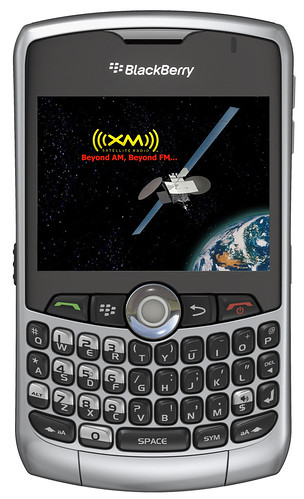
I knew this would happen. Adding satellite radio reception to smartphones is very cool. I subscribe to Sirius, so I’m a little jealous to hear XM will be offered on some BlackBerry models, according to TWICE:

XM Satellite Radio today became available on BlackBerry devices from all leading carriers, broadening the availability of XM’s Radio Mobile service.

Previously XM Radio Mobile, which offers a selection of XM channels, was available only on select phones using the Alltel and AT&T networks.

Research in Motion BlackBerry devices will carry a selection of 20 XM channels on models including the Pearl, Curve, 8700 and 8000 series for a fee of $7.99 per month.

The service is enabled across many carriers through the OpenVideo platform from QuickPlay Media, a leading provider of mobile TV and video solutions. It will operate on BlackBerry devices using the Verizon, AT&T, Sprint Nextel and T-Mobile networks, said an XM spokesman.

The select XM music and comedy channels are accessed via a downloadable application. They appear in a user interface with graphical icons and the software lets users see the song title, artist and album of a song that’s playing as well as the songs playing in real-time on other XM Radio Mobile channels. Subscribers can also listen to XM while performing other BlackBerry tasks.

Does this now open the door for Apple’s iPhone to begin offering the competing satellite radio service? If you read Apple’s patent application from two years ago ("Mobile Me"), it does include satellite reception.

Cool: it includes "The Virus" — the channel featuring O&A. Here’s the channel line up. It might be worth $8 a month after all. Get the download here.


Mars Colony

Tuesday, April 1st, 2008

Screw $200,000 sub-orbital flights, when you can go to Mars. You heard me right – Mars:

Earth has issues, and it’s time humanity got started on a Plan B. So, starting in 2014, Virgin founder Richard Branson and Google co-founders Larry Page and Sergey Brin will be leading hundreds of users on one of the grandest adventures in human history: Project Virgle, the first permanent human colony on Mars.

Using their massive combined wealth, Branson, Page, and Brin will begin settling Mars in 2014. Worried by the coming climate crisis and aided by dramatic advances in spacecraft development and new Mars discoveries, the team is convinced the project is doable in the next 6-8 years. The team’s scientists have already chosen a location:

Our landing site is located on Lunae Planum on the northwest side of Kasei Valles. Lunae Planum marks the transition between the high Tharsis rise, a giant volcanic bulge, and the northern lowland plains. This region shows many signs of significant crustal deformation and other structures that are likely caused by ice. Scientists have hypothesized that this area’s valleys and ridges (called "fretted terrain") may have developed as icy debris flowed onto the northern plains eons ago, during the great Martian flood epoch. It’s an ideal place for our settlement, because of the likelihood of both subsurface water and nearby lava tubes and pits; mild weather (in Martian terms) due to its proximity to the equator; and proximity to Kasei Valles, which, after terraformation, will be highly attractive shorefront property. The Virgle 1 should settle down not far from Chryse Planitia, the Plains of Gold, where the Viking 1 spacecraft landed on July 20, 1976.

Watch Branson’s introductory video:

In other news, G-Mail announced a much anticipated custom time feature, TechCrunch is suing Facebook, and today marks the 500th anniversary of a major holiday.

DIY Friday: Flat Panel TV

Friday, March 21st, 2008

No, I’m not suggesting you build your own television. Having you mess with a capacitor would get me sued in no time. But, when you buy yourself that sleek, flat-panel HDTV for some improved March Madness’ing, you don’t necessarily need to pay for an expensive installation.

One of the major appeals of flat panel TVs such as plasmas and LCDs is the space savings they create by hanging on the wall, out of the way. But do you need a pro to get that clean on-the-wall look? Not if you’re handy with a screwdriver, drill and know how to draw a straight line. We walk you through the steps of a typical flat panel install and highlight some of the areas where home owners may get “hung up.”

Before you get started drilling or bolting anything, you must carefully select the location. This is a much more serious decision than just picking a good place for a TV. Once you mount your plasma, the design of the entire room must be planned around it, and there’s no going back–you can’t just move the TV to another wall without remounting it, patching holes and repainting. Pick a location where the TV will be easily viewed by all seats in the room, which will also accommodate your speakers and can be conveniently connected to the rest of your components. If you want to put your TV on one wall and your components on the other side of the room, you’ve just seriously complicated your job. Also consider the placement of electrical outlets and lines. Although you will need to add a new outlet for the TV, having other outlets nearby makes the job easier. Also consider the height. While eye level is often ideal for TV viewing, large plasma TVs look better if placed a few inches above eye level, but not high enough to cause neck strain. A plasma mounted above a fireplace may look cool, but running wires behind and around a brick fireplace is a big job, and the height of the TV will hurt your neck after prolonged viewing.

Complete instructions are here. In short: find the wall studs, draw where the tv will go, bolt in the mounting rails, and attach the tv.

But what about all those wires?

Aesthetically, running cables through a wall yields the best results. Yet from a practical perspective, this requires substantial DIY skills, and a lot of effort especially when retrofitting a room. Furthermore, should you decide to hire a professional installer, the whole job can turn out to be pretty expensive – costing several hundred dollars – and often complicated to manage.

In addition, once cables are installed in walls and access holes closed, it would not be easy to replace any faulty cables, nor pass extra cables later.

Equally important, burying cables in walls as a wiring solution is invasive in nature. It requires expensive patching should the day come when you decide to move that flat panel TV elsewhere.

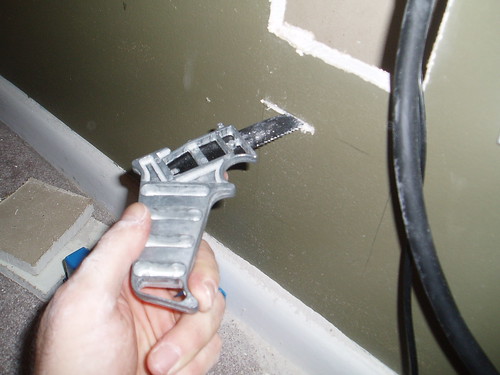
Some old-fashioned wire camouflage might be your best bet. But if you want to brave the behind-the-wall strategy, try these instructions. (NOTE: flickr photo notes are perfect for DIY instructions.)

If you’re feeling discouraged because your tax rebate is still in the mail—because you’re still stuck with a clunky 27 inch rear-projection television—do not worry. Just make it flat-screen, hillbilly-style:

Turns out all you need to turn that bulky old clunker of a TV into a slick-looking flat panel is a little extra closet room! I bet your wheels are turning now, aren’t they — thinking up all the other cool things you could embed into your walls. I should warn you, however, that console TVs don’t look quite as nice as the newer model televisions.


“How I Lost a Billion Dollars in My Spare Time”

Tuesday, March 18th, 2008

Typically well done obituary in Wednesday’s New York Times:

Arthur C. Clarke, Premier Science Fiction Writer, Dies at 90

By GERALD JONAS

Published: March 19, 2008

Arthur C. Clarke, a writer whose seamless blend of scientific expertise and poetic imagination helped usher in the space age, died early Wednesday in Colombo, Sri Lanka, where he had lived since 1956. He was 90.

Rohan de Silva, an aide, confirmed the death and said Mr. Clarke had been experiencing breathing problems, The Associated Press reported. He had suffered from post-polio syndrome for the last two decades.

The author of almost 100 books, Mr. Clarke was an ardent promoter of the idea that humanity’s destiny lay beyond the confines of Earth. It was a vision served most vividly by “2001: A Space Odyssey,” the classic 1968 science-fiction film he created with the director Stanley Kubrick and the novel of the same title that he wrote as part of the project.

His work was also prophetic: his detailed forecast of telecommunications satellites in 1945 came more than a decade before the first orbital rocket flight.

Other early advocates of a space program argued that it would pay for itself by jump-starting new technology. Mr. Clarke set his sights higher. Borrowing a phrase from William James, he suggested that exploring the solar system could serve as the “moral equivalent of war,” giving an outlet to energies that might otherwise lead to nuclear holocaust.

Mr. Clarke’s influence on public attitudes toward space was acknowledged by American astronauts and Russian cosmonauts, by scientists like the astronomer Carl Sagan and by movie and television producers. Gene Roddenberry credited Mr. Clarke’s writings with giving him courage to pursue his “Star Trek” project in the face of indifference, even ridicule, from television executives.

In his later years, after settling in Ceylon (now Sri Lanka), Mr. Clarke continued to bask in worldwide acclaim as both a scientific sage and the pre-eminent science fiction writer of the 20th century. In 1998, he was knighted by Queen Elizabeth II.

Mr. Clarke played down his success in foretelling a globe-spanning network of communications satellites. “No one can predict the future,” he always maintained. But as a science fiction writer he couldn’t resist drawing up timelines for what he called “possible futures.” Far from displaying uncanny prescience, these conjectures mainly demonstrated his lifelong, and often disappointed, optimism about the peaceful uses of technology — from his calculation in 1945 that atomic-fueled rockets could be no more than 20 years away to his conviction in 1999 that “clean, safe power” from “cold fusion” would be commercially available in the first years of the new millennium.

Popularizer of Science

Mr. Clarke was well aware of the importance of his role as science spokesman to the general population: “Most technological achievements were preceded by people writing and imagining them,” he noted. “I’m sure we would not have had men on the Moon,” he added, if it had not been for H. G. Wells and Jules Verne. “I’m rather proud of the fact that I know several astronauts who became astronauts through reading my books.”

Arthur Charles Clarke was born on Dec. 16, 1917, in the seaside town of Minehead, Somerset, England. His father was a farmer; his mother a post office telegrapher. The eldest of four children, he was educated as a scholarship student at a secondary school in the nearby town of Taunton. He remembered a number of incidents in early childhood that awakened his scientific imagination: exploratory rambles along the Somerset shoreline, with its “wonderland of rock pools”; a card from a pack of cigarettes that his father showed him, with a picture of a dinosaur; the gift of a Meccano set, a British construction toy similar to American Erector Sets.

He also spent time, he said, “mapping the moon” through a telescope he constructed himself out of “a cardboard tube and a couple of lenses.” But the formative event of his childhood was his discovery, at age 13 — the year his father died — of a copy of Astounding Stories of Super-Science, then the leading American science fiction magazine. He found its mix of boyish adventure and far-out (sometimes bogus) science intoxicating.

While still in school, he joined the newly formed British Interplanetary Society, a small band of sci-fi enthusiasts who held the controversial view that space travel was not only possible but could be achieved in the not-so-distant future. In 1937, a year after he moved to London to take a civil service job, he began writing his first science fiction novel, a story of the far, far future that was later published as “Against the Fall of Night” (1953).

Mr. Clarke spent World War II as an officer in the Royal Air Force. In 1943 he was assigned to work with a team of American scientist-engineers who had developed the first radar-controlled system for landing airplanes in bad weather. That experience led to Mr. Clarke’s only non-science fiction novel, “Glide Path” (1963). More important, it led in 1945 to a technical paper, published in the British journal Wireless World, establishing the feasibility of artificial satellites as relay stations for Earth-based communications.

The meat of the paper was a series of diagrams and equations showing that “space stations” parked in a circular orbit roughly 22,240 miles above the equator would exactly match the Earth’s rotation period of 24 hours. In such an orbit, a satellite would remain above the same spot on the ground, providing a “stationary” target for transmitted signals, which could then be retransmitted to wide swaths of territory below. This so-called geostationary orbit has been officially designated the Clarke Orbit by the International Astronomical Union.

Decades later, Mr. Clarke called his Wireless World paper “the most important thing I ever wrote.” In a wry piece entitled, “A Short Pre-History of Comsats, Or: How I Lost a Billion Dollars in My Spare Time,” he claimed that a lawyer had dissuaded him from applying for a patent. The lawyer, he said, thought the notion of relaying signals from space was too far-fetched to be taken seriously.

But Mr. Clarke also acknowledged that nothing in his paper — from the notion of artificial satellites to the mathematics of the geostationary orbit — was new. His chief contribution was to clarify and publicize an idea whose time had almost come: it was a feat of consciousness-raising of the kind he would continue to excel at throughout his career.

A Fiction Career Is Born

The year 1945 also saw the start of Mr. Clarke’s career as a fiction writer. He sold a short story called “Rescue Party” to the same magazine — now re-titled Astounding Science Fiction — that had captured his imagination 15 years earlier.

For the next two years Mr. Clarke attended King’s College, London, on the British equivalent of a G.I. Bill scholarship, graduating in 1948 with first-class honors in physics and mathematics. But he continued to write and sell stories, and after a stint as assistant editor at the scientific journal Physics Abstracts, he decided he could support himself as a free-lance writer. Success came quickly. His primer on space flight, “The Exploration of Space,” became an American Book-of-the-Month Club selection.

Over the next two decades he wrote a series of nonfiction bestsellers as well as his best-known novels, including “Childhood’s End” (1953) and “2001: A Space Odyssey” (1968). For a scientifically trained writer whose optimism about technology seemed boundless, Mr. Clarke delighted in confronting his characters with obstacles they could not overcome without help from forces beyond their comprehension.

In “Childhood’s End,” a race of aliens who happen to look like devils imposes peace on an Earth torn by Cold War tensions. But the aliens’ real mission is to prepare humanity for the next stage of evolution. In an ending that is both heartbreakingly poignant and literally earth-shattering, Mr. Clarke suggests that mankind can escape its suicidal tendencies only by ceasing to be human.

“There was nothing left of Earth,” he wrote. “It had nourished them, through the fierce moments of their inconceivable metamorphosis, as the food stored in a grain of wheat feeds the infant plant while it climbs towards the Sun.”

The Cold War also forms the backdrop for “2001.” Its genesis was a short story called “The Sentinel,” first published in a science fiction magazine in 1951. It tells of an alien artifact found on the Moon, a little crystalline pyramid that explorers from Earth destroy while trying to open. One explorer realizes that the artifact was a kind of fail-safe beacon; in silencing it, human beings have signaled their existence to its far-off creators.

Enter Stanley Kubrick

In the spring of 1964, Stanley Kubrick, fresh from his triumph with “Dr. Strangelove or: How I Learned to Stop Worrying and Love the Bomb,” met Mr. Clarke in New York, and the two agreed to make the “proverbial really good science fiction movie” based on “The Sentinel.” This led to a four-year collaboration; Mr. Clarke wrote the novel and Mr. Kubrick produced and directed the film; they are jointly credited with the screenplay.

Many reviewers were puzzled by the film, especially the final scene in which an astronaut who has been transformed by aliens returns to orbit the Earth as a “Star-Child.” In the book he demonstrates his new-found powers by detonating from space the entire arsenal of Soviet and United States nuclear weapons. Like much of the plot, this denouement is not clear in the film, from which Mr. Kubrick cut most of the expository material.

As a fiction writer, Mr. Clarke was often criticized for failing to create fully realized characters. HAL, the mutinous computer in “2001,” is probably his most “human” creation: a self-satisfied know-it-all with a touching but misguided faith in his own infallibility.

If Mr. Clarke’s heroes are less than memorable, it’s also true that there are no out-and-out villains in his work; his characters are generally too busy struggling to make sense of an implacable universe to engage in petty schemes of dominance or revenge.

Mr. Clarke’s own relationship with machines was somewhat ambivalent. Although he held a driver’s license as a young man, he never drove a car. Yet he stayed in touch with the rest of the world from his home in Sri Lanka through an ever-expanding collection of up-to-date computers and communications accessories. And until his health declined, he was an expert scuba diver in the waters around Sri Lanka.

He first became interested in diving in the early 1950s, when he realized that he could find underwater, he said, something very close to the weightlessness of outer space. He settled permanently in Colombo, the capital of what was then Ceylon, in 1956. With a partner, he established a guided diving service for tourists and wrote vividly about his diving experiences in a number of books, beginning with “The Coast of Coral” (1956).

Of his scores of books, some like “Childhood’s End,” have been in print continuously. His works have been translated into some 40 languages, and worldwide sales have been estimated at more than $25 million.

In 1962 he suffered a severe attack of polio. His apparently complete recovery was marked by a return to top form at his favorite sport, table tennis. But in 1984 he developed post-polio syndrome, a progressive condition characterized by muscle weakness and extreme fatigue. He spent the last years of his life in a wheelchair.

Clarke’s Three Laws

Among his legacies are Clarke’s Three Laws, provocative observations on science, science fiction and society that were published in his “Profiles of the Future” (1962):

¶“When a distinguished but elderly scientist states that something is possible, he is almost certainly right. When he states that something is impossible, he is very probably wrong.”

¶“The only way of discovering the limits of the possible is to venture a little way past them into the impossible.”

¶“Any sufficiently advanced technology is indistinguishable from magic.”

Along with Verne and Wells, Mr. Clarke said his greatest influences as a writer were Lord Dunsany, a British fantasist noted for his lyrical, if sometimes overblown, prose; Olaf Stapledon, a British philosopher who wrote vast speculative narratives that projected human evolution to the farthest reaches of space and time; and Herman Melville’s “Moby-Dick.”

While sharing his passions for space and the sea with a worldwide readership, Mr. Clarke kept his emotional life private. He was briefly married in 1953 to an American diving enthusiast named Marilyn Mayfield; they separated after a few months and were divorced in 1964, having had no children.

One of his closest relationships was with Leslie Ekanayake, a fellow diver in Sri Lanka, who died in a motorcycle accident in 1977. Mr. Clarke shared his home in Colombo with his friend’s brother, Hector, his partner in the diving business; Hector’s wife, Valerie; and their three daughters.

Mr. Clarke reveled in his fame. One whole room in his house — which he referred to as the Ego Chamber — was filled with photos and other memorabilia of his career, including pictures of him with Yuri Gagarin, the first man in space, and Neil Armstrong, the first man to walk on the moon.

Mr. Clarke’s reputation as a prophet of the space age rests on more than a few accurate predictions. His visions helped bring about the future he longed to see. His contributions to the space program were lauded by Charles Kohlhase, who planned NASA’s Cassini mission to Saturn and who said of Mr. Clarke, “When you dream what is possible, and add a knowledge of physics, you make it happen.”

At the time of his death he was working on another novel, “The Last Theorem,” Agence France-Presse reported. “ The Last Theorem’ has taken a lot longer than I expected,” the agency quoted him as saying. “That could well be my last novel, but then I’ve said that before.” 


On to the next dimension, Sir Arthur.


Weightless Markets

Tuesday, March 18th, 2008

Unemployment up. Stock market down. Recession looming. For financial security, maybe you should enter the space plane business. EADS thinks the market will boom:

Aerospace giant EADS says it will need a production line of rocket planes to satisfy the space tourism market.

The European company’s Astrium division, makers of the Ariane rocket, has plans for a commercial vehicle to take ticketed passengers above 100km.

Its market assessment suggests there would be 15,000 people a year prepared to part with some 200,000 euros (£160,000) for the ride of a lifetime.

Astrium anticipates it be will be producing about 10 planes a year.

“To satisfy the market you will need more planes than you think, because once there is regular operation, the price will decrease which means there will be more customers,” Robert Laine, chief technical officer (CTO) of the pan-European company, told BBC News.

For more info on the EADS’ take on space tourism, watch Robert Laine, EADS’ CTO’s speech to the Institution of Engineering and Technology last week.

While Astrium proceeds according to plan, Virgin Galactic and its partner, Scaled Composites, appear to be in the space tourism race lead. And it looks like they are confirming Laine’s prediction for increased production:

Virgin Galactic, billionaire Richard Branson’s space travel venture, plans to order five more spaceships and aims to turn a profit in five years from its commercial launch in 2010, an official told Reuters on Thursday.

Prospective space travelers have so far placed deposits totaling more than $31 million for tickets that cost $200,000 each and would give them five minutes in space, said Alex Tai, the firm’s group director.

“In the short term, we have firm orders for five spaceships and options for seven … We believe there is a very strong market,” Tai said in an interview at the Singapore Airshow.

If you want the weightless experience but can’t pony-up 200k, drop 4k and hop on a 727 parabolic flight – G-Force One:

Zero Gravity Corporation (www.GoZeroG.com) is a privately held space entertainment and tourism company whose mission is to make the excitement and adventure of space accessible to the public. ZERO-G is based in Las Vegas and Florida and is the first and only FAA-approved provider of commercial weightless flight to the general public, as well as the entertainment and film industries, corporate and incentive market, non-profit research and education sectors, and government. The experience offered by ZERO-G is the only commercial opportunity on Earth for individuals to experience true “weightlessness” without going to space. This is the identical weightless flight experience used by NASA to train its astronauts and used by Ron Howard and Tom Hanks to film Apollo-13. The ZERO-G Experience consists of a brief training session for passengers followed by a 90-minute flight aboard G-Force-One, during which parabolic maneuvers are performed. The controlled ascent and descent of the plane allows Flyers to experience Martian gravity (1/3-gravity), Lunar gravity (1/6-gravity), and zero gravity. The ZERO-G Experience provides its Flyers with twice the amount of weightless time achieved in a typical sub-orbital flight into space. ZERO-G operates under the highest safety standards as set by the FAA (Part-121) with its partner Amerijet International of Ft. Lauderdale Florida. Aircraft operations take place under the same regulations set for large commercial passenger airliners.

Spitzer’s New Look

Monday, March 10th, 2008

This is not about my governor.

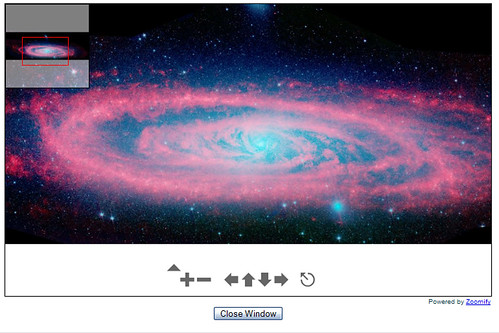
We’re talking about one of our favorite space instruments, the Spitzer Space Telescope. They’ve got a new feature on their site, one where you can zoom in and pan on some very cool space images.


Be sure the check out some of the animations. I like "Spitzer’s Delicate Ring Flower:"

NASA’s Spitzer Space Telescope finds a delicate flower in the Ring Nebula, as shown in this animation. The outer shell of this planetary nebula looks surprisingly similar to the delicate petals of a camellia blossom. A planetary nebula is a shell of material ejected from a dying star. Located about 2,000 light years from Earth in the constellation Lyra, the Ring Nebula is also known as Messier Object 57 and NGC 6720. It is one of the best examples of a planetary nebula and a favorite target of amateur astronomers.

The "ring" is a thick cylinder of glowing gas and dust around the doomed star. As the star begins to run out of fuel, its core becomes smaller and hotter, boiling off its outer layers.

Spitzer’s infrared array camera detected this material expelled from the withering star. Previous images of the Ring Nebula taken by visible-light telescopes usually showed just the inner glowing loop of gas around the star. The outer regions are especially prominent in this new image because Spitzer sees the infrared light from hydrogen molecules. The molecules emit infrared light because they have absorbed ultraviolet radiation from the star or have been heated by the wind from the star.

NASA called it a celestial valentine.

The candles are lit, the champagne is on ice. All you need now are flowers and a ring. This Valentine’s Day, NASA’s Spitzer and Cassini spacecraft provide you with both, in two engaging new images.

NASA’s Cassini-Huygens mission and Spitzer Space Telescope have captured images of Saturn’s rings and the Ring Nebula, respectively, to bring home spectacular views of two of the most looked-at objects in the sky. The Cassini image shows a detailed color mosaic of Saturn’s shimmering rings. Spitzer imaged the outer shell of the Ring Nebula, which looks surprisingly similar to the delicate petals of a camellia blossom. 


DIY Friday: Component Cable

Friday, March 7th, 2008

Have an amplifier and speakers and just need some speaker wire to start the party? Instead of dropping $50-$100 bucks on Monster Cable, you might just want to bend a couple coat hangers into place:

Not only does it work, but there doesn’t seem to be an audio quality drop-off:

I’m so sorry, but I do not buy into 90% of the hype brought to us audiophiles by the commercial sector of our hobby and the home entertainment industry at large. My brother, an audio engineering whiz kid has proven to me what is real and what is not. Let me rehearse with you an example of how he does this.

We gathered up a 5 of our audio buddies. We took my “old” Martin Logan SL-3 (not a bad speaker for accurate noise making) and hooked them up with Monster 1000 speaker cables [ed. Monster Ultra Series THX 1000 Audio Interconnects] (decent cables according to the audio press). We also rigged up 14 gauge, oxygen free Belden stranded copper wire with a simple PVC jacket. Both were 2 meters long. They were connected to an ABX switch box allowing blind fold testing. Volume levels were set at 75 Db at 1000K Hz. A high quality recording of smooth, trio, easy listening jazz was played (Piano, drums, bass). None of us had heard this group or CD before, therefore eliminating biases. The music was played. Of the 5 blind folded, only 2 guessed correctly which was the monster cable. (I was not one of them). This was done 7 times in a row! Keeping us blind folded, my brother switched out the Belden wire (are you ready for this) with simple coat hanger wire! Unknown to me and our 12 audiophile buddies, prior to the ABX blind test, he took apart four coat hangers, reconnected them and twisted them into a pair of speaker cables. Connections were soldered. He stashed them in a closet within the testing room so we were not privy to what he was up to. This made for a pair of 2 meter cables, the exact length of the other wires. The test was conducted. After 5 tests, none could determine which was the Monster 1000 cable or the coat hanger wire. Further, when music was played through the coat hanger wire, we were asked if what we heard sounded good to us. All agreed that what was heard sounded excellent, however, when A-B tests occurred, it was impossible to determine which sounded best the majority of the time and which wire was in use. Needless to say, after the blind folds came off and we saw what my brother did, we learned he was right…most of what manufactures have to say about their products is pure hype. It seems the more they charge, the more hyped it is.

But some alert audophiles make a good point in this blog’s comments sections: if you are using cheap speakers and a cheap amplifier, high-quality speaker wire will have little effect. The audio snob mantra goes, “the sound quality of your system will never be stronger than its weakest link.”

If you join the monster-cables-are-a-rip-off crowd but aren’t ready to start bending your coathangers, try building your own component cables. Directions are here or just watch the guys at Systm tackle the project:

DIY Friday: Spacecraft

Friday, February 29th, 2008

So, you’re sitting at your desk thinking about the sci-fi movie you watched last night or a fantasy outerspace adventure. If you can’t wait for the weekend to make your futuristic dreams a reality (sort-of), start by building an Office Supplies Starship Enterprise. From your employer’s supply cabinet, grab one wall clip, two small paperclips, one large paperclip, one small pinch clip, some tape, and a black Sharpie. With a little ingenuity, you have a passable replica for some afternoon day-dreaming.

Now, for tomorrow’s task – build a cardboard spaceship out of two washer/dryer boxes. With a little paint it sure can look good — too bad it can’t fly.

Alfie Carrington, a construction worker from Michigan is a little more ambitious:

The construction worker spends his free time inside a rented storage garage in Clinton Township, Mich., where he broods over a 14-foot-wide, carbon fiber, fiberglass vessel.

Thirty years ago, when Carrington was 27 and obsessed with science fiction, he set out to build a UFO look-alike. Despite his lack of engineering experience, Carrington pored over books, magazines and studies about aviation and spent nearly $60,000 for some of the materials needed for this saucer.

Carrington does it because he believes he has discovered a simple design for an aircraft that aeronautical engineers have spent countless millions trying to build.

Carrington has two patents on the design and a company called Vertex Aerospace. His work caught the attention of NASA, which invited him to a conference in the mid-1990s where engineers scratched their heads when he confessed he knew nothing about computers.

His own version of Anti Gravity Technology Propulsion: His idea is to fire up the vessel with a rotary engine to stimulate a magnetic levitation system to rotate the ship’s two discs. The discs would draw air into propeller blades.

A (very entertaining) video of the project is below. But before you take up a similar design, a word of warning:

“Things spinning at those speeds are worrisome because of the stress from centrifugal force,” explained Cornelis van Dam, professor of mechanical and aeronautical engineering at the University of California-Davis, a leading aviation school. “If it’s not properly designed and built, it will rip itself apart. I wouldn’t want to stand next to it when it gets up to speed.”

If you’re a little timid about centrifugal destruction, maybe we should keep the saucer on the ground. For the kids, build a saucer fort built from two discarded microwave transmitter dishes and $75 bucks worth of supplies. And if you want more than a little tree-house, you should buy this house in Tennessee. You can see it from space:


View Larger Map

If the static house isn’t good enough and you’re still scared of Alfie’s saucer, buy an individual flying vehicle for a pricey 50k. Or, better yet, just fake it:

Lunar Eclipse APOD

Friday, February 22nd, 2008

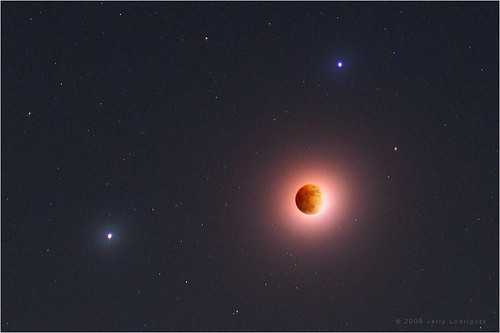
Great image from the Astronomy Picture of the Day:

 Total Lunar Eclipse