Archive for the ‘Front Page’ Category

Ready, Aim

Tuesday, February 19th, 2008
usa-193_notam_plot

We’ve been following this story for a few weeks now, and it is astounding how much attention has been paid to it. A top-secret U.S. observation satellite that’s out of control is set to be shot out of the sky precisely so it brings no harm to the public. Over the Pacific Ocean, for example, would be a good location. Now the U.S. Navy has issued a "notice to airmen," signaling just that:

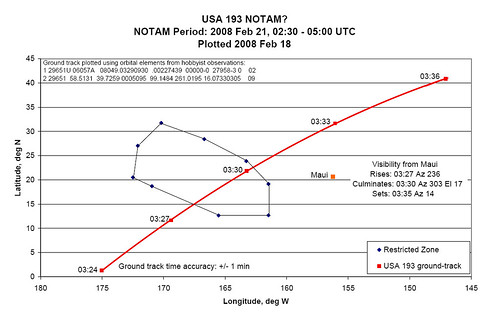
02/062 (A0038/08) – AIRSPACE CARF NR. 90 ON EVELYN STATIONARY RESERVATION WITHIN AN AREA BNDD BY 3145N 17012W 2824N 16642W 2352N 16317W 1909N 16129W 1241N 16129W 1239N 16532W 1842N 17057W 2031N 17230W 2703N 17206W SFC-UNL. 21 FEB 02:30 2008 UNTIL 21 FEB 05:00 2008. CREATED: 18 FEB 12:51 2008

The Register explains what this means:

A "CARF" (Central Altitude Reservation Function) designation indicates a NOTAM intended to keep commercial and private flights clear of military operations, and SFC-UNL means the height band of this warning zone reaches from the surface to "unlimited" altitude – in other words all the way into space. The UTC time referred to is the same as UK time, so the zone exists from 0230 to 0500 on Thursday morning for British readers.

As will be evident, the barred area is a cool 1,400 miles long and nearly 700 miles wide at the surface, giving the US Navy plenty of elbow room to fire their interceptor missiles up into the descending spacecraft’s path.

Reports have it that three US Aegis air-defence warships, the cruiser Lake Erie and the destroyers Decatur and Russell, will be waiting for the satellite west of Hawaii. Each ship carries a specially modified Standard SM-3 interceptor, originally intended for defence against lower-flying ballistic missile warheads. The three interceptors are on separate ships in case of a technical issue with the Aegis radar and fire-control system.

As it passes over the firing area, the satellite will be approximately 3,000 miles and ten minutes out from the western coast of Canada, the next land it will pass over. The satellite has much more mass than the soaring "exo-atmospheric kill vehicle" it will smack into, so this gives some idea of the onward track the wreckage might follow in the event of a hit.

Google Earth kmz file by Alan Clegg is worth a look.

What can we expect on Thursday? Take a look at this Japanese test from last December:


DIY Friday: Snowmaking

Friday, February 15th, 2008

China plans to halt rain for Olympics – I didn’t beleive the headline when I read it the first time, but I guess this isn’t a pipe dream:

The Chinese are among the world’s leaders in what is called "weather modification," but they have more experience creating rain than preventing it. In fact, the techniques are virtually the same.

Cloud-seeding is a relatively well-known practice that involves shooting various substances into clouds, such as silver iodide, salts and dry ice, that bring on the formation of larger raindrops, triggering a downpour. But Chinese scientists believe they have perfected a technique that reduces the size of the raindrops, delaying the rain until the clouds move on.

The weather modification would be used only on a small area, opening what would be in effect a meteorological umbrella over the 91,000-seat Olympic stadium. The $400-million stadium, nicknamed the "bird’s nest" for its interlacing steel beams, has no roof.

This isn’t that unusual, apparently. Idaho, Utah, Nevada, and Wyoming have all experimented with cloud seeding this winter, mostly to relieve draught conditions.

And, of course, people have been playing with weather for years. Take Hunter Mountain in NY – they were one of the first places to use snowmaking technology, and the first to have 100% coverage.

So in honor of Hunter Mountain and my planned weekend ski-trip there (if I ever get this post done), I bring you DIY-Snowmaking. MAKE links to a this site with a number of free plans. There are two main options:

Internal mix snow makers operate by mixing compressed air and water inside the plumbing of the snow maker. This design does work but it has its drawbacks. One of the issues with this design is maintaining the air and water pressure balance to keep an even flow of water coming out the snowmaker, this issue causes a reduction in efficiency. Another problem is the likelihood of having water back into the airline and doing permanent damage to your air compressor. Choose from one of the Internal mix designs below.

External mix snow makers mix air and water outside the body of the snowmaker. This design eliminates most of the problems associated with internal mixing. External mixing completely eliminates the issue of water entering the air line because they are not connected. External mixing also utilizes the water and air more efficiently (less energy}.

Don’t be intimidated. A ten-year-old, frustrated by the lack of snow, built one:

WEST LINN, Ore. – Talk about ingenuity – a 10-year-old boy built his own snow machine and filled his backyard with enough snow to make it look like a blizzard had blown through.

"It was just hypnotizing," said Forest Pearson, who built the snow machine out of a 30-gallon air compressor that he got for Christmas, a pressure washer and a whole lot of research.

Or just buy a machine. Backyard Blizzard has the goods (for $2,400) and the New York Times has a story on your options.

Power Pants

Monday, February 11th, 2008


We told you how to "put a rocket in your pocket" a while back by downloading an authentic Atlas rocket launch countdown ringtone to your mobile phone. Now we’ll show you how generating electricity for that phone — or other device — can be as easy as a walk in the park.

Researchers at the Simon Fraser University (S.F.U.) Locomotion Laboratory in Burnaby, British Columbia, now think they can put some power in your pants, via Scientific American:

Exercise may soon do more for you than tighten up your sagging muscles. Advances in biomechanical engineering could use energy generated while walking, hiking or running to power any device requiring portable power, including night-vision goggles and other battery-operated devices used by soldiers as well as robotic prosthetic limbs, cell phones and computers in remote locations where no other energy sources are available.

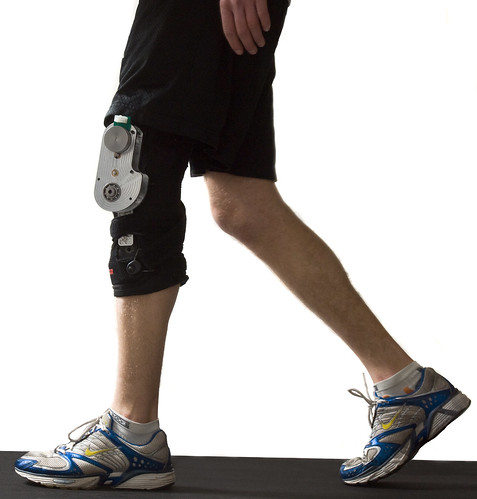
A team of researchers at the Simon Fraser University (S.F.U.) Locomotion Laboratory in Burnaby, British Columbia, are studying the amount of energy that can be generated by 3.5-pound (1.6-kilogram) aluminum and steel knee braces worn while walking or running. Volunteers, wearing a brace strapped on each leg, generated about five watts of electricity per person during a recent experiment, enough power, researchers say, to run 10 cell phones concurrently and twice that needed to keep a computer running (something useful in developing regions of Africa where electricity is scarce). They report that one brace-wearing subject generated 54 watts of power by running in place.

The best area to place a device for harnessing human energy is near a joint, because this is where the muscles—the body’s power source—work hardest, says Max Donelan, Locomotion Lab director and an assistant professor at S.F.U.’s School of Kinesiology. "There’s a long history of human power generation using hand cranks and bikes, but these require your dedicated attention, so you don’t do it for very long." The key to energy harvesting is extracting the energy from the body’s natural movement and, aside from breathing, very few unconscious muscle movements are more automatic than the action of walking.

Donelan and his team of researchers targeted a particular part of the stride, halfway through the swing of the lower leg after it has left the ground (when the hamstring comes to life to make sure you don’t have uncontrolled extension) through the time the foot returns to the ground. The brace designed to capture this energy features gears, a clutch, a generator and a computerized control system that monitors the knee’s angle to determine when to engage and disengage power generation.

The specific amount of energy generated from Donelan’s device depends upon the weight of the wearer, the difficulty of the terrain, the speed of the person’s gait and how long the device is used. In the prototype, energy generated is dissipated into resistors, although future models could include an onboard battery for energy storage. The researchers hope to be able to test their device within a year on Canadian soldiers at a field site.

Another effort underway to convert motion into energy relies on the Faraday law of induction, named after English chemist and physicist Michael Faraday, which holds that the movement of a conductor (such as a metal wire) through a magnetic field produces a voltage in that conductor proportional to the speed of movement. M2E Power, Inc., in Boise, Idaho, has developed a system of magnets and coils that, when moved, generates energy that can be used to power their host device. M2E’s technology originated at the Idaho National Laboratory, a Department of Energy–funded research group.

A good example of this would be walking with a cell phone in your front pocket or attached to your belt. The phone’s movement would cause the magnet and coil to generate energy that could be transferred to a bank of ultracapacitors that charge the phone’s battery when a certain voltage level is reached. "Think of it as a minigenerator whose power comes from movement," says Regan Warner-Rowe, M2E’s director of business development. "Because power management is such a critical issue for cell phones, we have been in discussions with handset companies." (Warner-Rowe declined to name them.)

Another goal of M2E’s research and development is to develop technology that could be used by the U.S. military. (The Australian army is working with contractors to develop its own wearable, rechargeable battery system, as well.) Much like Donelan’s work, the objective is to eliminate several pounds of weight that soldiers must lug around in the form of spare batteries. M2E has done some work developing prototype energy-rechargeable "D" cell batteries.

I like it: power walking. Very cool.


Hurling?

Monday, February 11th, 2008

What is Hurling? Other than being “some old Irish game“, most Americans have no clue. Too bad, because the game is pretty cool. Here’s the gist: it is a field sport, similar to field hockey or rugby; players carry wooden axe-shaped sticks (called a hurley). The object of the game is to hit (or “hurl”) a small ball between goal posts for one point or in the keeper-guarded goal for the equivalent of three points.

YouTube has you covered:

Don’t resist watching (in awe) some more hurling highlights. Also, check out “What is Hurling” parts one, two, and three for a little more background.

Hooked, yet? You’ll need Setanta Sports to keep up with the action (which we blogged about before). Satellite TV makes it possible to watch hurling and other great European/Commonwealth sports: rugby, Aussie football, cricket, and British soccer, to name a few. Setanta is available on Dish Network and DirecTV.

The network was formed by a couple of Irish guys in the Bronx who were looking for a way to watch these sports in the U.S. They started a channel distributed in bars and pubs; the company rapidly grew; and now the whole enterprise may pay-off:

Sports broadcaster Setanta Sports has received takeover approaches from several large media companies and is evaluating whether to conduct an auction, a source familiar with the matter confirmed today.

The company is discussing its next move with financial adviser Goldman Sachs, added the source. Both Setanta and Goldman Sachs declined to comment.

Reports say the firm has received offers of over €1.3 billion for the company. It is also believed to have received the unsolicited approach from an unnamed European media company before Christmas.

Setanta is understood to be looking for a valuation in excess of €1.3 billion, even though the company has yet to make a profit.

Among those that may express an interest are BT, ITV, Virgin Media and Disney – the owner of sports network ESPN. ESPN executives have made it clear that they are interested in breaking into the lucrative UK football rights industry.

The company, which in 2006 agreed to pay €500m over three years to share live Premiership football coverage with BSkyB, hopes to break even by the end of the year.

€1.3 – not bad for a couple Gaelic-bronxite-fanatics, but it didn’t all happen by accident. In addition to being advised by Goldman Sachs (who is advising Yahoo! to reject Microsoft’s bid) and JP Morgan, Setanta saved millions by moving part of its operations to Luxembourg:

PAY-TELEVISION broadcaster Setanta Sports has slashed at least £17m from its tax bill by setting up a subsidiary in Luxembourg. The windfall will boost the firm’s valuation as speculation increases that a sale of the company is likely.

Over 1m British and Irish subscribers pay into Setanta’s new Luxembourg subsidiary called Setanta Sports Sarl.

Setanta pays “super reduced” Vat of only 3% on subscriptions routed through the grand duchy against 17.5% charged in the UK and 21% in Ireland.

Setanta has also set up subsidiaries to support its entry into the Canadian and Australian markets this year. Its ultimate parent company remains in Ireland, where more than half of its 450 staff are employed.

Let’s just hope Setanta’s content doesn’t disappear. Cork’s hurling and football teams are on strike.

DIY Friday: USB Guitar

Friday, February 8th, 2008

Shredding Guitar Hero I, II, 80s, and Legends to its raging, satanical death? Maybe its time to stop the make-believe rocking and pick-up a real guitar.

You could pick-up a late 60’s Gibson Les Paul. Hell, Jimmy Page has one. The price tag? $12,500. Ouch.

How about Eric Clapton’s axe, a Fender Stratocaster? Ditto on the cost – looks to be pushing 20k.

Better just find a cheap electric guitar. But don’t stop there – integrate Guitar-Hero-like features into a real instrument. Build a USB Guitar:

Why would you want a USB port in an electric guitar? The answer is simple: convenience. By putting a small USB port and audio codec in a guitar, you’re adding an extra sound board. So when you record, your guitar is digitized locally and the signal is transmitted to your computer over a USB cable. The guitar retains all its standard analog capabilities but outputs to USB as well. Now you can rock steady until your hard drive is full. Here’s how to do it.

The full instructions are here. After purchasing a guitar and a Micro USB interface, measure, cut, and plug:

Here’s an approximation of the jack and module layout. The Micro USB module fits easily into the control cavity. The topmost jack is the normal guitar analog output. I’ll change the stock jack (very inexpensive) to a rugged Switchcraft jack. The second jack was intended to be an auxiliary input jack, but that didn’t work out, because it wasn’t -technically feasible to add a second jack for a microphone or another guitar. The third jack is a stereo headphone jack. For durability, I used a 1/4-inch jack. The female USB jack is from L-Com. It’s the smallest panel jack I could find, and I liked the chromed plastic shell. A mini USB connector wouldn’t be rugged enough, so I went with a full-size A-style connector.

Too complicated? You can buy an off-the-shelf guitar for about $400. Check out the demo:

Now that you have the equipment, better learn how to play (if Guitar Hero hasn’t already prepped you).

DIY Friday: LED Pegboard

Friday, February 1st, 2008

We’re all about holidays here at ReallyRocketScience. Yesterday, we commemorated the Explorer 1 launch 50 years ago. Today, we celebrate the DIY-Friday from one year ago – LED light shirts. The beauty of LED’s is that they never burn out. My cheesy shirt is still functioning perfect for the occasional ugly sweater theme party.

Now LED’s are hitting Saks Fifth Avenue – on the store’s facade, not the clothes racks:

This Christmas, Royal Philips Electronics (PHG) is vividly displaying its dominance in the lighting market. It supplied the 50 giant illuminated snowflakes that festoon the front of the flagship Saks Fifth Avenue (SKS) store in New York. The flakes are aglow with light-emitting diodes, or LEDs–semiconductor devices that produce bright beams of light using a fraction as much electricity as incandescent bulbs. The 40,000-plus LEDs in the display sip about the same amount of power as three toaster ovens.

Philips also will provide the lights for the New Year’s Eve Times Square Ball in New York. Instead of 600 incandescent and halogen bulbs, the ball will be fitted with more than 9,500 LEDs, which burn twice as brightly and can create a palette of 16 million colors. Depending on their hue, they’ll be up to 98% more energy-efficient than the bulbs they replace.

The demonstration is a symbolic blow to its main LED rival – GE:

Philips’ latest LED installations give the company much-coveted green bragging rights. Lighting accounts for about one-fifth of all electricity used, in part because, with traditional incandescent bulbs, most of the energy is wasted in heat. LEDs burn cooler and last much longer. So the company that leads in this area can claim to be helping planet earth.

General Electric (GE), Philips’ biggest rival in lighting, has spent millions to bolster its own environmental credentials in a high-profile campaign whose slogan is "ecomagination." But it hasn’t matched the billions of dollars Philips has spent on LEDs and other energy-efficient lighting systems. This year alone, Philips has paid $4.2 billion to acquire five companies in the lighting sector, including the Nov. 26 purchase of Genlyte (GLYT) in Louisville, the No.2 U.S. maker of lighting fixtures. As a result, Philips has vaulted past GE as the leading supplier of lights and fixtures in the all-important U.S. market.

Over the next ten years, as much of the world makes the transition to LED lights, Philips’ lead over GE is expected to grow. "A building contractor can go to Philips and get everything he wants," says Janardan Menon, a financial analyst at Dresdner Kleinwort in London. The same, he argues, is not true for GE.

It won’t be long before LED’s cross-over from Fifth Avenue to the home. Get started by buying some LED candles.

Or, better yet, take up our DIY-challenge: construct "Peggy," a light emitting pegboard kit:

Our light-emitting pegboard display, affectionately known as "Peggy," provides a quick, easy, powerful and efficient way to drive a lot of LEDs– up to 625– in a big matrix covering almost a square foot of area. You can make an LED sign for your window, a geeky valentine for your sweetie, one bad-ass birthday card, or freak the holy bejesus out of Boston. Your call. It’s a versatile, high-brightness display. How you configure it and what you do with it is up to you.

The display can run off batteries (3 ‘D’ cells) or an optional ac adapter, and is designed to drive as many green/blue/white/violet LEDs as you care to solder into the holes, all with excellent brightness. The board can accommodate LEDs in several common sizes: 3mm, 5 mm (standard T-1 3/4 size), and 10 mm. A photosensor is provided that can automatically turn off the display in bright daylight or incandescent light.

Instructions are available here. The good news is you have two weeks to construct your Valentine’s Day surprise creation. Or build a LED-shirt, version 2 – I’m sure he/she will love the gesture. I told you we liked holidays here at ReallyRocketScience.

DIY Friday: Home Theater PC

Friday, January 25th, 2008

Everyone is talking about the iPod – music, web browser, email, and phone all in one device. What else would you need? But when I get home from a long day of rocket science, I wanna lay on my couch and watch a 32 inch plasma, not stare at a 3 inch cell-phone.

That said, we don’t have to resign ourselves to the past. Consider a Home Theater PC system. The benefits are numerous: storage scalability, superior DVD playback, and easy content cataloging.

Microsoft is getting into the game. Vista’s Windows Media Center lets you view slide shows set to music, browse music by cover art (blatantly copied from Apple), and, with a TV tuner, utilize Microsoft’s tivo-like features (rewind live tv and schedule recordings).

But to capably take advantage of all of these features (including HD), you’re going to need a pretty powerful PC. You’re probably going to want 2 gb of RAM and a ton of hard drive space (400G gets you about 88 hours of HD recording). For a reasonably priced and very effective system, check out the Gigabyte H971 entertainment PC.

If you’re an anti-Microsoft/establishment snob or are just wary of new Microsoft OS’s (I’m still stubbornly using 2000 on one of my ThinkPads), go Linux. This barebones Linux system includes a DVD image with opensource TV tuner software. You’ll need to install a processor, memory, hard drive, and MythTV, personal video recorder software. Its magical:

Without breaking a sweat, MythTV meets our specifications for a HTPC. Using a TV tuner card, MythTV can pause and rewind live television, schedule recordings, and excise commercials during playback. If you intend to record multiple shows at once or watch another channel while something is recording in the background, you’ll need a second TV tuner card – which MythTV will handily support. You’ll get picture-in-picture that way, too.

If your video card has an output compatible with your TV (S-Video is the best bet), it’s also fairly easy to get TV-out working on Linux these days. That applies to all the software discussed here, not just MythTV.

Much of MythTV’s functionality is provided by plugins. Most of the modules discussed here are "official" add-ons and will be included with MythTV by default, depending upon who packaged your installation.

Enjoy!

Bigfoot Found on Mars

Wednesday, January 23rd, 2008

One of the Mars rovers’ images from a few years ago shows what looks like Bigfoot or Sasquatch, according to the Mars Life blog.

Here’s the video clip from the Telegraph (U.K.):

See for yourself by downloading the original image from NASA’s JPL site — then try finding it. Fun for the whole family.

The Bigfoot Field Researchers Organization will be looking into this one, as will the folks of Willow Creek, California: the Bigfoot Capital of the World.

Satellite Split

Monday, January 14th, 2008

Today’s SkyREPORT revisits EchoStar’s split. The division will result in two companies: DISH Networks (DISH), which provides direct-to-home satellite service, and EchoStar (SATS) which does…well…pretty much everything else – designs set-top boxes, provides fixed satellite services, and develops Sling Media technology.

The satellite service provides capacity on nine owned and leased in-orbit satellites, and includes a network of seven full-service digital broadcast centers and leased fiber PoPs in 150 cities. Here at SES, we’re looking forward to launching a new satellite for EchoStar.

How’s this split faring on Wall Street?

In a note released last week, William Kidd of Wedbush Morgan lowered his price target on DISH shares (stock that represents the new DISH Network DBS split) from $48 to $37. The move was made given that DISH shares solely represent the pay-TV assets.

While the bulk of the adjustment represents the split, Kidd also said $2 of the change is the result of the company’s recent decision not to raise prices for subscribers this year.

The two stocks are slightly down so far this year. (But what stock isn’t these days?).

The move allows EchoStar to sell its products externally:

Last week, Ergen said that the company is aggressively planning to sell products — from Sling Media-enabled modems to set-tops — to Dish Network’s video rivals, namely cable operators and phone companies.

Ergen and Blake Krikorian, co-founder and chairman of Sling Media, both described the efforts of the spinoff company, EchoStar Holding, to seek buyers for its products beyond the Dish direct-broadcast satellite service.

“As a set-top manufacturer, EchoStar will certainly try to build products and sell them to the cable industry,” Ergen said at a CES press conference.

And this gives the company a way to "better highlight the value of some of its lesser-known technology assets." That publicity definitely hit last week’s CES 2008 convention:

It’s HD DVR, the TR-50, won CNET’s "best in show" for home video:

If you think everybody has cable or satellite, you couldn’t be more wrong. In fact, if you live in an area that’s well-served by digital broadcasters, now’s a better time than ever to get your TV over the air (or "OTA," as the cool kids say): yeah, you get only a handful of channels, but they’re in crystal-clear digital quality–DVD quality at "worst," uncompressed high-definition at best. The problem–as we’re reminded by many an e-mailer–is that there just isn’t a good DVR solution for the rabbit-ears crowd, especially if you prefer high-def. (You can opt for a TiVo HD, but you’d still have to pay a monthly fee for their programming guide.) But that may finally be changing, thanks to the EchoStar TR-50. For all intents and purposes, the TR-50 takes many of the features found on Dish Networks’ excellent satellite DVRs (such as the ViP622 and 722) and brings them to antenna-based TV viewers.

And, after months of delays and questions, the company announced a SlingPlayer mobile version for the Blackberry:

This past week at CES, Sling Media demonstrated its SlingPlayer Mobile on a BlackBerry Pearl at the technology expo; up until now, SlingPlayer Mobile and BlackBerry haven’t played nice together. Sling Media hasn’t given a firm date on when the new player will be available, but states that it’ll be introduced "later this year" for $29.99.

Race for Mobile TV Platform Entering Final Lap

Wednesday, January 9th, 2008

We’ve written before about mobile TV, and about Samsung’s video chipset for mobile TV technology. Now, the race is on to determine which mobile digital television technology will become the standard — with PC Magazine calling the competition a war.

"The battle between Blu-ray and HD DVD may be settling down at last, but in the mobile TV arena another competition is just getting under way," reports the Ecommerce Times:

 Two different mobile digital television technologies will enter testing this year, each backed by a different set of vendors. In one camp, there’s the A-VSB platform developed by Samsung Electronics Latest News about Samsung and Rohde & Schwarz; in the other, it’s the MPH (Mobile-Pedestrian-Handheld) platform, jointly developed by LG Electronics Latest News about LG Electronics and Harris.

Both have performed well in preliminary technical trials conducted by members of the Open Mobile Video Coalition industry alliance, the group said. Ultimately, however, only one will be chosen by the Advanced Television Systems Committee standards-setting body as the official U.S. standard for mobile digital TV, Gerry Kaufhold, principal analyst with In-Stat, told TechNewsWorld.

LG just unveiled its Mobile Pedestrian Handheld (MPH) in Las Vegas:

Woo Paik, LGE president and chief technology officer, said that since the development of the digital broadcast system began, broadcasters have sought a system with the capability of delivering programming to mobile viewers.

LG, which holds the patents to the 8-VSB modulation scheme used in the ATSC television broadcast system, developed MPH to provide broadcast quality video receivable by devices moving at speeds of up to 140 miles per hour. The system will also be capable of working with the current ATSC DTV broadcast standard, LG said.

Here’s Mahalo Daily’s Veronica Belmont at LG’s booth at CES:


Samsung’s technology, meanwhile, is heading for national trials:

The trial will use SES Americom’s IP PRIME facility in Vernon Valley, N.J., and satellite capacity to beam national signals to A-VSB transmitters in local markets, which will also be inserting local content into an A-VSB "in-band" stream that will broadcast within stations’ existing digital spectrum.

Rohde & Schwarz and Samsung are supplying the local transmission technology, Nokia Siemens is providing back-end service management and MobiTV will handle the service’s interactive features. SES Americom will provide overall integration of the project.

Here’s Samsung’s demo from last year’s NAB:


Finally, there are rumors that Apple might announce mobile TV next week at MacWorld. We’ll see on Tuesday.