Archive for the ‘Front Page’ Category

Mission to Iapetus

Thursday, September 13th, 2007

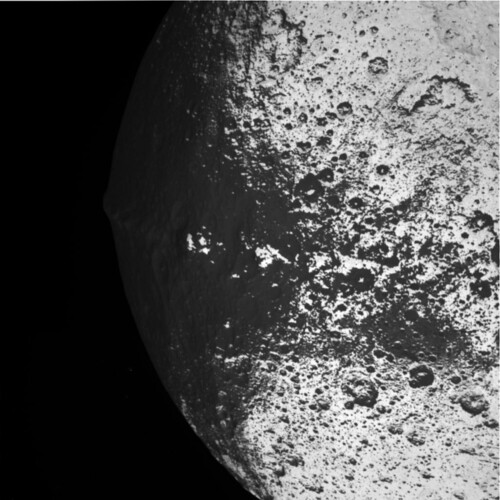
After "a solid state power switch that was tripped due to a galactic cosmic ray hit", the Cassini-Huygens spacecraft went into safe mode earlier this week. It’s recovered since and the fly-by was very cool:


NASA’s JPL got a nice surprise, according to the AP via MSNBC, from Sir Arthur:

Mission controllers have since sent commands for Cassini to resume normal transmission, and scientists recovered all the data from the moon flyby despite a nearly 12-hour delay. The spacecraft was expected to be fully functional by week’s end.

Iapetus, the third-largest Saturnian moon, gained science fiction fame in Clarke’s mind-bending novel "2001: A Space Odyssey," that was developed in concert with Stanley Kubrick’s 1968 movie by the same name.

Clarke, who lives in Sri Lanka, surprised the Cassini team with a five-minute video played Tuesday during an internal meeting at NASA’s Jet Propulsion Laboratory. In it, Clarke told scientists he looked forward to viewing photos from the flyby.

Even before Clarke’s taped greeting, scientists waxed poetic about Cassini’s encounter with Iapetus and the fictional Discovery spaceship’s rendezvous with Japetus, as the Saturn moon is known in Clarke’s book.

We don’t have the video to show you, but we do have the transcript, via Emily Lakdawalla at Planetary Society:

Video greeting to NASA JPL to mark the Iapetus flyby of Cassini spacecraft: 10 September 2007

by Arthur C. Clarke


Hello! This is Arthur Clarke, joining you from my home in Colombo, Sri Lanka.

I’m delighted to be part of this event to mark Cassini’s flyby of Iapetus.

I send my greetings to all my friends – known and unknown – who are gathered for this important occasion.

I only wish I could be with you in person, but I’m now completely wheelchaired by Polio and have no plans to leave Sri Lanka again.

Thanks to the World Wide Web, I have been following the progress of Cassini-Huygens mission from the time it was launched several years ago. As you know, I have more than a passing interest in Saturn…

And I was really spooked in early 2005, when the Huygens probe returned sound recordings from the surface of Titan. This is exactly what I had described in my 1975 novel Imperial Earth, where my character is listening to the winds blowing over the desert plains overhead.

That was perhaps just a foretaste of things to come! On September 10, if everything goes according to plan, Cassini would give us our closest look at Iapetus – one of Saturn’s most interesting moons.

Half of Iapetus appears as dark as asphalt, and the other half is as bright as snow. When Giovanni Cassini discovered Iapetus in 1671, he could only see its bright side. We had a better glimpse when Voyager 2 flew past in August 1981 – but that was from almost a million kilometres away.

In contrast, Cassini is going to come within a little over one thousand kilometres of Iapetus.

This is a particularly exciting moment for fans of 2001: A Space Odyssey – because that’s where the lone astronaut Dave Bowman discovers the Saturn monolith, which turns out to be a gateway to the stars. Chapter 35 in the novel is titled ‘The Eye of Iapetus’, and it contains this passage:
"Iapetus was approaching so slowly that it scarcely seemed to move, and it was impossible to tell the exact moment when it made the subtle change from an astronomical body to a landscape, only fifty miles below. The faithful verniers gave their last spurts of thrust, then closed down forever. The ship was in its final orbit, completing a revolution every three hours at a mere eight hundred miles an hour – all the speed that was required in this feeble gravitation field."

After more than 40 years, I cannot remember why I placed the Saturn monolith on Iapetus. At that time, in the early days of the Space Age, earth-based telescopes couldn’t show much details of this celestial body. But I have always had a strange fascination for Saturn and its family of Moons. By the way, that ‘family’ has been growing at a very impressive rate. When Cassini was launched, we knew of 18 moons. I understand it is now 60 – and counting…I just can’t resist the temptation to say:

My God, it’s full of moons!

But in the movie, Stanley Kubrick decided to place all the actions at Jupiter, not Saturn. Why this change? Well, for one thing it made a more straightforward storyline. And more importantly, the special effects department couldn’t produce a Saturn that Stanley found convincing.

That was just as well…because if they had done so, the movie would have been badly dated by the Voyager missions, which showed Saturn’s rings to be far more implausible than anyone had ever imagined.

I have seen enough instances where Nature imitates art, so I’m going to keep my fingers crossed on what Cassini discovers at Iapetus.

I want to thank everyone associated with this mission and the overall Cassini-Huygens project. It may lack the glamour of manned spaceflight, but science projects are tremendously important for our understanding of the Solar System. And who knows, one day our survival on Earth might depend on what we discover out there…

This is Arthur Clarke, wishing you a successful flyby.

Images from Cassini-Huygens are continuously updated.

Apple’s Own TV Channel

Monday, September 10th, 2007


We’ve blogged about the spectrum auction coming up and we see many more interesting ways of how it could play out. Today, via Business Week, we might some day tune our iPhone or iPodTouch to a TV channel being broadcast using UHF frequencies:

Apple Eyes the Wireless Auction

Steve Jobs & Co. consider joining the FCC’s auction of wireless spectrum, and a win would give Apple many intriguing options—for the iPhone and more

by Peter Burrows

Talk of the government’s pending auction of valuable wireless spectrum has focused largely on one intriguing newcomer to the bidding: Google (GOOG). But another tech powerhouse has considered joining the bidding as well: Apple (AAPL).

Two sources tell BusinessWeek that Steve Jobs & Co. have studied the implications of joining the auction, which will be held Jan. 16. The winners will get rights to use the spectrum that analog TV broadcasters are handing back to the government in 2009, given their mandated move to digital television.

Dubbed "beachfront property" by the Federal Communications Commission, it’s the last swathe of wireless spectrum likely to become available that would have the attributes necessary for a new mainstream broadband network (BusinessWeek.com, 8/1/07). Signals at the 700Mhz spectrum, for example, could provide far faster Internet access than today’s cellular or even Wi-Fi networks, and the signals can easily pass through buildings and work glitch-free, even in lousy weather.

Risk for Apple’s Margins
At this point, says one of the sources, Apple is leaning against participating in the auction. It’s not the money. With nearly $14 billion in cash, the company can clearly afford the $4.6 billion minimum bid required by the government, and could probably come up with the $9 billion that’s expected to win a portion of the spectrum to be made available for a nationwide network. There will assuredly be stiff competition from phone companies and other potential bidders such as Google, DirecTV (DTV), and eBay (EBAY), which owns Skype’s Net calling software.

Rather, the risk for Apple is in entering the generally low-margin, hardscrabble world of running a massive-scale network. Rather than focus all of Apple’s entrepreneurial instincts on creating the next innovative gizmo, the company would be on the hook for the massive operational headaches that go with provisioning traffic, activating new subscribers, and fielding their angry calls when service glitches occur.

As with Google, becoming a network operator would drag down Apple’s margins—and could pose a cultural drag on an innovative company. And other than iTunes, Apple has not stood out for its Internet services. Only 1.7 million people pay the $99 annual fee for its .Mac service, disappointing given Apple’s success in so many other areas. "Even for companies like Google, the economics [of owning a network] are barely intelligible," says Amol Sarva, chief executive of Txtbl, a mobile e-mail company. "For Apple, this seems highly implausible."

iPhone Network Solution
Still, even the possibility of an Apple bid is intriguing. For starters, it would mean Apple would no longer need to rely on a phone company to deliver songs, TV shows, and other digital fare purchased at its iTunes Music Store. As it is, the major complaint of iPhone shoppers isn’t with the phone, but with the pokey Net access from Apple’s exclusive U.S. partner, AT&T (T).

If it owned its own spectrum, Apple could provide the network service itself, possibly for far less than the $1,440 iPhone owners must now fork out over the course of the cheapest two-year contract. For example, Apple could hold down costs by letting users choose a Net telephony program such as Skype rather than develop its own voice software, say analysts.

Apple might even be able to give away network service for free, and make its money off services such as iTunes and possibly by selling subscribers advertising space. "With the kind of cash position they have and the kind of push they just made into the handset space [with the iPhone, and now with the iPod touch, which also has Apple’s Safari Web browser built in], it makes a lot of sense for them," says one former Apple executive.

Major Strategy Change?
Indeed, cutting out the carrier would probably be in sync with Steve Jobs’ view of the world. Before striking the iPhone deal with AT&T, he publicly dissed phone companies as little more than "orifices"—good only for providing dumb pipes to deliver more innovative companies’ more innovative services.

"Apple is the most anti-carrier company there is," says the former Apple executive. "They’re probably already frustrated with AT&T. If they put a few billion behind this, they could build a kick-ass network." Indeed, on Sept. 5, Apple announced a new iTunes Wi-Fi Music Store so consumers can buy songs at wireless hotspots, something they can’t do on AT&T’s network. And Jobs made a point of noting Wi-Fi is faster not only than the so-called 2.5G EDGE network, but also than 3G cellular networks.

The fact Jobs was interested enough to investigate bidding for the spectrum opens up the possibility of a major strategy change for Apple. Today, Apple’s approach is built on the idea of the PC—preferably a Mac—being the "hub of the digital lifestyle." If you want content on your iPod or iPhone, or on your TV via an Apple TV settop box, you download it to your PC or Mac, and then sync it with those other devices.

From Devices to Services
But if it had its own network, Apple could conceivably move to a "cloud computing" approach, where it would store customers’ files, music, movies, e-mails, and other content on servers in its own data centers, and dole it out directly to whatever device a customer is using at any given time. If you wanted to purchase the latest Pixar flick from iTunes, you wouldn’t need to schlep over to the Mac to do it; it could be delivered straight to the Apple TV—or even to an Apple TV at the ski house miles away from that Mac.

Taken to its extreme, some experts suggest Apple could one day move to making its money on selling such services, rather than on the devices themselves. "At some point, they’re going to tap out the percentage of people who still need to buy an iPod," says one telecom executive who requested anonymity. "Maybe their strategy is to get into the services business, and switch to getting nice, recurring revenues" from subscribers. Indeed, Apple has already changed its accounting for the Apple TV and for the iPhone. Rather than book revenue when the cash register rings, Apple books the sale over 24 months.

To be sure, Apple has given no hints of any such makeover of its hugely successful strategy. Still, most analysts think this Net-centric model of computing will dominate in the future. Following the success of Google, Yahoo! (YHOO), and others, Microsoft (MSFT) is already signaling it will follow suit. And Apple would have some unique advantages should it head in this direction, particularly the Mac OS. For starters, it’s based on the battle-tested Unix operating system, considered far more reliable and powerful than Microsoft’s Windows.

Superior ‘Walled Garden’
And since the Mac OS lies at the core of the data centers that host the iTunes store as well as almost all of Apple’s commercial products (except for the iPod shuffle, nano, and classic), it could provide a level of glue to help Apple provide a superior experience for its customers. With such a common foundation of software, Apple could more easily ensure that Pixar movie is sent in the proper resolution, whether it’s to be viewed on a large-screen, high-definition TV or on an iPhone. Also, Apple could simplify the job of syncing various devices.

When a new appointment is entered into an iPhone, the network could make sure to update the calendars on the customers’ Mac or laptop, or even the iPod in their car. Says one longtime Net executive: "Apple’s current architecture forces you to designate a Mac as your server where you stream to Apple TV or sync your iPhone. This is really klutzy. So what is the answer? Well, one is to have your media in the cloud. If the performance is there, it would be a superior model."

In a sense, Apple would have created a new kind of "walled garden." Normally, this term refers to Net offerings that limit where consumers can go on the Web. Think about the limited browsing available from most TV cable boxes. But Apple’s walled garden would be defined not by what it limits you from doing, but by the fact it’s tuned to work best with Apple’s own hardware. For Apple fans, they’d only have to be familiar with one user interface. And since Apple’s products all rely on the same set of software—Safari Web browser, the iTunes Music Store, the Quicktime Media player—they wouldn’t have to deal with the many incompatibilities that plague Net users.

Also, Apple includes a wireless networking technology called Bonjour in every download of iTunes that lets any Apple product automatically spot other Apple products within range. Here’s one possibility: An iPhone owner could be able to use the device like a handheld media server, to move movies or songs or files out in the cloud among those devices.

Grunt Work for a Partner
The hardware cost of building out the network would probably not be that huge, measured in hundreds of millions, possibly, rather than billions. And if Apple went to a voice-is-free approach or to a flat fee, many of the administrative tasks—bill tracking, or detailed call data, for example—would be largely unnecessary. And since no lawns would need to be dug up to make way for new fiber cables, Apple could connect homes for less than $300, compared with more than $800 for fiber, say experts.

Of course, there would be enormous complexity in running such a network, given rules set by the FCC. That’s why most sources think Apple would sign up a partner to handle the grunt work—say, an equipment provider such as Ericsson (ERIC) or Alcatel (ALU), or a consulting firm such as EDS (EDS). Even then, skeptics such as Txtbl’s Sarva doubt Apple could ever figure a way to make a return on its network investment.

The rules approved by the FCC on Aug. 31 make the job more difficult as well. Thanks in large part to pressure from Google and other Net companies, owners of the spectrum will be required to allow any device or application to run. Such "open access" rules are an attempt to break the ability of phone companies and cable providers to limit which cell phones or other devices consumers can use, or to prevent them from using competing services for downloading music or playing games. That means Apple would have to think not only about enhancing the use of Apple products, but also take on the gargantuan task of making sure the network also supports competing hardware and software, from Microsoft’s Zune music player to Amazon’s (AMZN) Unbox movie service.

And Jobs might have to beat out Google CEO Eric Schmidt, an Apple director, in a bidding war (BusinessWeek.com, 7/20/07).

Schmidt has said Google, come January, will likely bid.
 

iCar?

Thursday, September 6th, 2007

Like many people, the iPhone shook my perspective on technology. It’s no longer about the best laptop, best mp3 player, or best phone. It’s about technological fusion — forging devices that can do it all.

So, why not an iCar? While you can’t carry it in your front pocket, there is no reason you don’t want your car to have the best technological capabilites. A radio is no longer good enough (a sad realization for a ’94 Geo Prism driver). CNET has all the nerd-gossip:

Apple and Volkswagen are reported to be in talks about an "iCar" or car integration system, according to reports from German magazine Capital and the Associated Press.

Apple CEO Steve Jobs and Audi Chairman Martin Winterkorn, who heads the Audi brand group that includes Volkswagen, met recently in California to discuss ideas, but no concrete plans, a Volkswagen representative told the Associated Press.

"We wouldn’t comment on rumors and speculation," said Tom Neumyar, senior manager for iPod and iTunes at Apple.

Volkswagen of America would neither confirm nor deny the reports.

While its currently all speculation, just imagine the possibilities: navigation system, iTunes synching, integrated touchscreens, chatting among back-seat passengers, integrated bluetooth, etc.. LAPTOP Magazine details some more wishlist items (some not-so-serious):

Dashboard on the Dashboard
We can’t wait to slip into our silver, leather-interior car and control everything–from the air conditioning to the gears–via a strictly touch-sensitive dashboard that’s void of any buttons or control wheels. Our fingers will manipulate everything on the panel with simple finger strokes and taps. In keeping with Apple’s current Mac OS X Dashboard, we’re demanding customizable Widgets with everything from Google Maps to current gas prices.

Click Wheel As Steering Wheel
It’s going to take some getting used to, or even a retake of your driver’s test, but replacing the olden-day steering wheel with an iPod-like Click Wheel will make it easier to turn the corner; you’ll merely have to slide your hand over the touch-sensitive plastic wheel. Bonus: A simple push of the center button emits a loud honk that sounds like a Leopard purr.
[…]

Smart Playlists
Using live traffic updates, your music playlists will be automatically generated by the amount of congestion. When you’re about to enter areas with heavy traffic, you’ll be soothed by the mellowest tracks in your collection. When all that’s in front of you is open highway, the bounciest and raciest pop and punk tracks will move to the top of the list. Your iCar will even customize your library based on where you are. If you’re cruising down the Jersey Turnpike, for example, you’ll hear Lynyrd Skynyrd’s "That Smell" blaring through the Apple Hi-Fi sound system.

AirPort Antennas
Pull into the garage and you’ll be able to download iTunes movies over the air to the backseat monitors for the kids to watch, or sync videos, photos, and music with your Apple TV. We’re also excited about the possibility of swapping playlists with other iCar owners via Wi-Fi while you’re at a stoplight-provided they have DRM-free tracks.

Critical to this dream iBeetle (or iPassat) will be Internet-access. What will this iPhone iCar do without the requisite AT&T signal? Perhaps Qualcomm’s Omnivision Mobile Platform can be integrated. Using OmniTracs and OmniExpress, this mobile platform can connect one’s vehicle through satellite and wireless networks.

A Geo driver can dream, right?

On an even lighter note, imagine Microsoft’s retaliation, as one CNET reader jokes:

God help us if Microsoft attempts anything similar. Considering the hackability of their operating system, we’d be in HUGE trouble…

Great Photoshop contest on Fark.com, like this "Zune Buggy:"

DIY Friday: Greenhouse

Friday, August 31st, 2007

Labor Day weekend is not my favorite time of the year. The extended weekend and numerous BBQ’s (solar or traditional) are nice. But the lingering sense of disappointment kills me — no more swimming pools, no more long summer nights, no more backyard gardening. Yes, even rocket scientists enjoy these things.

This week’s DIY edition will explore bringing summer inside — it’s time to build a greenhouse. If you’re like me, enjoying fresh veggies for only two months a year, just doesn’t seem right. BuildEazy.com has the plan. You might not finish it over the long-weekend but you should beat the first freeze. If it seems too complicated, consider buying a kit

DIY TV, delivered on DirecTV channel 220 or Dish Network channel 111, has a similar story up about one man’s custom greenhouse:

The temperature outside was close to zero Fahrenheit, but inside Jay Stanton’s greenhouse it was close to tropical. This winter day stood as a testament to Jay’s thoughtful planning and design, which took nearly four years of research. “I talked to a lot of experts,” explains Jay. “I went to an agricultural college and did a field trip to Longwood Gardens, and asked a lot of questions.”

Once you have something constructed (hopefully in less than four years), try making your greenhouse passive-solar:


Killer Space Rocks!

Wednesday, August 29th, 2007

Two weeks ago the Perseids lit up the night sky, delighting astronomy buffs with a fireworks display of meteors.

But what would happen if a true grand finale was coming our way in the form of an asteroid that could change life on Earth as we know it?

That’s a question posed in the latest issue of Popular Science.  


From the article

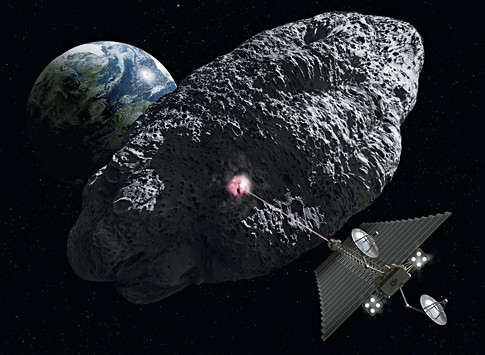
There are between one and two million near-Earth objects (NEOs)—chunks of space rock whose orbits may pass within 30 million miles of Earth—that pose a significant impact threat to the planet. Of the 4,535 NEOs detected and tracked (704 of which are real whoppers), none are on a definite collision course, but there could be millions more, many of them potentially lethal, lurking in the cosmos.

Detection
Who’s Watching? Most spotting is done by half a dozen optical telescopes in the U.S., Italy, Japan and Australia, coordinated by such programs as the Lincoln Near-Earth Asteroid Research (LINEAR) project, a NASA-funded collaboration between MIT’s Lincoln Laboratory and the U.S. Air Force tasked solely with the detection and cataloging of potential NEOs. Amateur astronomers worldwide also aid the effort. Collectively, the programs discover a new NEO every few days.

What’s the Plan? Since 1998, NASA has funded Spaceguard, a consortium of observatories working to find 90 percent of the half-mile-plus NEOs by 2008; the group has found three quarters of the predicted 1,100 NEOs in this size class. Spaceguard’s next step is to find 90 percent of NEOs measuring 460 feet or larger—potentially up to 12,000 objects—by 2020, but funding has not been secured. Larger wide-field scopes should come online in Hawaii, Arizona and Chile in the next decade, greatly speeding detection.

Our knowledge of asteroids and the early formation of our solar system is likely to increase dramatically in the coming decade, thanks to this fall’s launch of NASA’s Dawn mission

[T]he Dawn mission will study the asteroid Vesta and dwarf planet Ceres, celestial bodies believed to have accreted early in the history of the solar system. The mission will characterize the early solar system and the processes that dominated its formation…

Vesta is a dry, differentiated object with a surface that shows signs of resurfacing. It resembles the rocky bodies of the inner solar system, including Earth. Ceres, by contrast, has a primitive surface containing water-bearing minerals, and may possess a weak atmosphere. It appears to have many similarities to the large icy moons of the outer solar system.

By studying both these two distinct bodies with the same complement of instruments on the same spacecraft, the Dawn mission hopes to compare the different evolutionary path each took as well as create a picture of the early solar system overall. Data returned from the Dawn spacecraft could provide opportunities for significant breakthroughs in our knowledge of how the solar system formed.

Where’s the best place to watch the Dawn, er, rise? Apparently, Australia:

A team of four personnel from the United States Air Force will visit Tennant Creek in the Northern Territory to monitor the launch …

The US team will arrive at Alice Springs and travel to Tennant Creek where they will establish a small temporary ground station. Tennant Creek was selected as it affords the best view of the crucial booster separation phase of the launch. As part of the same mission a United States Air Force NKC-135 aircraft will be operating out of Perth International Airport from mid-September and flying over northwest Australia. The launch from Cape Canaveral is planned for between 19 September and 15 October depending on weather and atmospheric conditions.

If you’re more interested in dusk, as it were, be sure to check out Popular Science’s excellent slideshow of past asteroid collisions with our home planet.


Googling the Universe

Wednesday, August 22nd, 2007

Without a doubt, Google Earth has put the functional utility of satellite imaging at the fingertips of millions, rekindling for many the shear wonder of what satellites can do to improve our lives.

Now Google’s virtual "satellites" (which aren’t really satellites, of course, but rather "the superimposition of images obtained from satellite imagery, aerial photography and GIS 3D") are doing what no single satellite has yet been designed to do: they’re turning their gaze from the Earth to the Heavens with today’s release of Google Sky:


With Sky, users can now float through the skies via Google Earth. This easy-to-use tool enables all Earth users to view and navigate through 100 million individual stars and 200 million galaxies. High resolution imagery and informative overlays create a unique playground for visualizing and learning about space.

To access Sky, users need only click "Switch to Sky" from the "view" drop-down menu in Google Earth, or click the Sky button on the Google Earth toolbar. The interface and navigation are similar to that of standard Google Earth steering, including dragging, zooming, search, "My Places," and layer selection….

"Never before has a roadmap of the entire sky been made so readily available. Anyone interested in exploring the wonders of our universe can quickly see where the stunning objects photographed by Hubble actually dwell in the heavens. Sky in Google Earth will foster and initiate new understanding of the universe by bringing it to everyone’s home computer," said Dr. Carol Christian of STScI, who co-led the organization’s Sky team with Dr. Alberto Conti.

Google Sky features seven layers, including Hubble Space Telescope Imagery, Constellations, the Moon and Planets, a "Users Guide to Galaxies" and a "Life of a Star" layer, as well "The Backyard Astronomer," which "is useful for the amateur astronomer who may benefit from a comprehensive, organized way to reference fragments of the night sky."

"The Sky imagery was stitched together from more than one million photographs from scientific and academic sources, including the Sloan Digital Sky Survey, the Palomar Observatory at the California Institute of Technology and the NASA-financed Hubble," according to the New York Times.

The BBC also has some good video of the new release. 

To get Google Sky, simply download the latest version of Google Earth.

DIY Friday: Satellite Gazebo

Friday, August 17th, 2007

Have an old, extra satellite dish? We’ve put them to good use in the past, consructing a wifi directional antenna and, better yet, a solar cooker. But where are you going to point the antenna and enjoy the BBQ (if that’s what you call a solar-baked entree)?

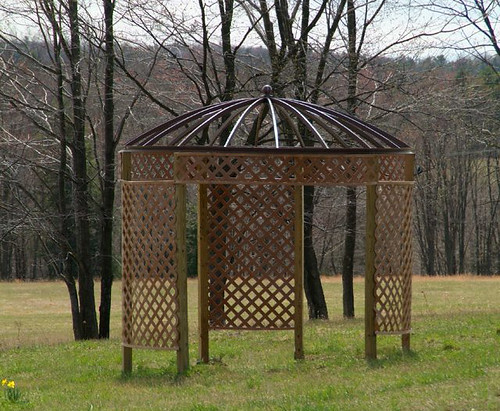
How about a satellite gazebo? These DIY’ers converted a vintage satellite dish (or a "BUD," big-ugly-dish, as they described it) into a surprisingly attractive gazebo.

The plan: Remove the satellite base, dig 2ft holes for six (or four or eight) 4×4 uprights, secure with concrete, mount dish with nails and wire, then nail lattice sides. The result:

Not bad. Not bad, at all.


Perseids Light Up The Sky

Wednesday, August 15th, 2007

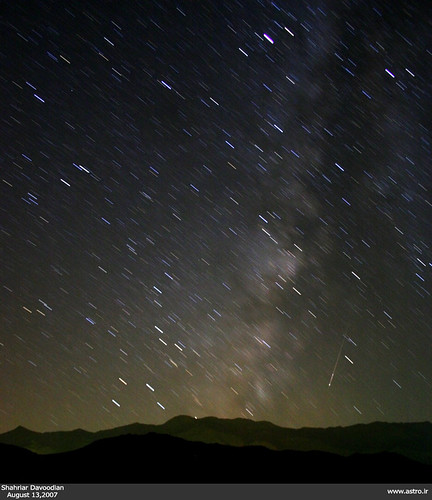
Astronomy buffs throughout the Northern Hemisphere have been staying up late recently to view the Perseids meteor shower, which peaked on August 12th during the new moon.

Spaceweather.com has a fine collection of photographs of the meteor shower. (The photo above is taken from their collection.)  

At its peak Sunday night, the Perseids awed observers with up to 80 meteors per minute visible in a clear sky.

We’ve been fans of the Perseids since the early 1990s, when the comet Swift-Tuttle — the parent body of the Perseid meteor cloud — made its closest pass to earth since Abe Lincoln was president. The proximity of Swift-Tuttle meant that the Perseids were particularly spectacular during our salad days of 1993.

None of us, however, are likely to be around for the comet’s next perihelion passage in August of 2126 (when it may be as bright as Hale-Bopp), but until then the Perseids’ peak — usually August 12th — remains one of the best nights of the year to set up an astronomy date.

Several years ago, Space.com published a great article featuring the Top 10 Perseid Meteor Shower facts. Among them:

 1. Perseid meteoroids (which is what they’re called while in space) are fast. They enter Earth’s atmosphere (and are then called meteors) at roughly 133,200 mph (60 kilometers per second) relative to the planet. Most are the size of sand grains; a few are as big as peas or marbles. Almost none hit the ground, but if one does, it’s called a meteorite.

2. Comet Swift-Tuttle, whose debris creates the Perseids, is the largest object known to make repeated passes near Earth. Its nucleus is about 6 miles (9.7 kilometers) across, roughly equal to the object that wiped out the dinosaurs.

3. Back in the early 1990s, astronomer Brian Marsden calculated that Swift-Tuttle might actually hit Earth on a future pass. More observations quickly eliminated all possibility of a collision. Marsden found, however, that the comet and Earth might experience a cosmic near miss (about a million miles) in 3044.


Check out the complete article (and 7 other interesting facts) here

The Bourne Satellites

Monday, August 6th, 2007

We haven’t yet seen The Bourne Ultimatum, but at least some of us here at Really Rocket Science are counting the hours until we can sit in the darkness with our bucket of buttered popcorn and soda for the final installment of the series, loosely based on the Robert Ludlum novels.   

This is work-related, we tell ourselves, because of the extensive use of satcom in the film to drive the plot, which centers around rogue baddies in the intelligence community tapping into video surveillance networks (think of our Slingbox webcam on steroids) to track the film’s hero:

The plot goes something like this: London journalist Simon Ross (Paddy Considine) has stumbled onto a hyper-secret CIA black op code named Blackbriar.

It’s so sensitive the whisper of it on Ross’ cellphone sends sinister surveillance technology abuzz an ocean away in midtown Manhattan.

There, the Blackbriar leak may as well be a blot of blood in shark-infested waters, sparking the attention and ire of a Bush-league spook (David Strathairn) and Pam Landry (Joan Allen), the honourable but tough-as-nails CIA bureaucrat from 2004’s Supremacy who, in the last moments of that film, told Bourne his birth name.

Thing is, that still hasn’t happened yet — Ultimatum actually kicks off in Moscow following Bourne’s confession to a young Russian girl whose parents he murdered. Still racked by flashbacks to his vicious past — more replete with post-9/11 imagery than ever before — Bourne’s search for his identity leads him to Ross and, consequently, to Strathairn’s thinly-veiled Republican stooge.

From here, Greengrass piggybacks jaw-dropping set piece upon jaw-dropping set piece. When the ever-resourceful Bourne sets up a meet with Ross at London’s Waterloo Station, he puppeteers the reporter through corridors and crowds to evade a rapidly-constricting network of operatives and video surveillance cameras linked via satellite to Strathairn’s hi-tech hub.

Here’s the trailer:

And here’s the breathless review (one of many) from the Winnipeg Sun

Go ahead and ascribe an adjective — breathtaking, heart-stopping, head-spinning — the fact is no stream-of-consciousness thesaurusizing (pulse-pounding, nerve-rattling, spellbinding) does justice to the experience of this fastest, fiercest Bourne yet….

The best action movie of the summer? Try of a generation.

Director Paul Greengrass hasn’t manufactured a sequel — he’s written code for a template all future Bonds, Ryans and whoever-the-hell-else will have to match or stumble and die trying.

Given that the film brought in more than $70 million in its opening weekend, we suspect we’re not the only fans anxious to get into the theater this week.  What of you? Have you seen the film? What did you think of the director’s use of satcom technology as an integral part of the film?

DIY Friday: Lemon Battery!

Friday, August 3rd, 2007

We’ve had some nifty DIY Friday projects since the series began: projects that are truly luxury items (the card-dealing robot and the beer-launching fridge); projects that improve upon the latest in tech gadgetry (the slingbox webcam and tivo on your phone); and projects that allow you to save a few bucks on your latest consumer technology upgrade (such as building your own HDTV antenna).

Most of these projects, we readily admit, require some basis of knowledge in electronics and science. Which has us thinking: where and when did we get excited by the realization that a little bit of creativity, some spare time and a sodder gun could create hours of enjoyment?

For ourselves, that answer goes back to 4th grade, and some of those basic science experiments that, while not particularly useful in an commercial sense, revealed to us that the world of science — and indeed the world itself — was full of wonder.

With that in mind, we present to you a DIY Friday project that truly brings us back to our roots: your very own lemon battery!

Th folks at ScienceOnline produced this fine video. It’s mesmerizing in the unique way that only elementary-school documentaries are. Enjoy it — and, if you have kids, consider doing today’s DIY Friday project with them. You may just unlock a world of wonder.