Archive for the ‘Front Page’ Category

Rolling Out the Big Gun

Monday, July 30th, 2007

If you ever read Jules Verne’s From the Earth to the Moon, you’ll recall that it’s the story of three wealthy members of a gun club who build a huge cannon and shoot themselves to the moon.

In writing the novel, Verne did a number of calculations to determine how a space gun would work. Although his figures proved to be surprisingly accurate, space guns have since been ruled as a means of manned space flight because the accelerating forces (up to 2,000 Gs!) are too powerful for any living thing to survive.

But now, a group of graduate students and academics hopes to use a similar concept to launch low-cost satellites into orbit.
 

Space Review reports: 

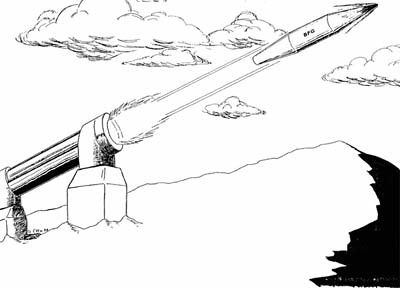
Ben Joseph, a 25-year-old aerospace engineering graduate of MIT, and a team of students and professors are resurrecting [the space gun idea… with] a radically new kind of impulsive launch technology known as the “ram accelerator.”

Joseph and his colleagues have formed a company called Ballistic Flight Group, with the goal of commercializing the space gun launch concept for satellites:

A typical artillery weapon uses a large explosive force at the base of a gun to propel a shell down a rifled metal tube, which is angled to provide the projectile with its trajectory.

In the space gun launcher being promoted by BFG this cannon type of firing is merely the first step in the process. The main step is the ram accelerator, a technology invented and developed by faculty and staff at the University of Washington in Seattle, where Ben Joseph studied as an undergraduate. After a pre-launcher gun (e.g., light gas or gunpowder propelled) accelerates the projectile up to speeds of over 500 meters per second, the projectile enters the ram accelerator by passing through a breakable diaphragm and entering another tube, this one filled with a more volatile propellant, such as oxygen and methane. Because the projectile enters this second tube at supersonic speeds, it interacts with the tube wall to produce a ramjet–like effect inside the barrel. This ramjet effect forces the projectile to combust the fuel behind it, increasing its acceleration through the tube. The projectile exits the barrel with a muzzle velocity of around 8 kilometers per second. An upper stage rocket would circularize the trajectory of the payload (approximately one third of the projectile’s 2,000-kilogram mass) to a low Earth orbit of around 800 kilometers….

So that’s the technology, as envisioned. What about the cost? 

What makes the ram accelerator so appealing is its economic potential. BFG estimates that the accelerator could be built for an estimated $157 million, a price tag that includes the launch tube and its supports, the pre-launcher gun for initial acceleration, and propellant handling system for the oxygen, hydrogen, and methane gases for the ram accelerator portion of the launch system. This price tag is astonishingly low—cheaper than some expendable rockets—and it could be fired hundreds or thousands of times. Depending on the gun’s final muzzle velocity, prices for payloads could drop to nearly $500 per kilogram, a drastic reduction from current market prices…

During Joseph’s presentation on the commerce track of the International Space Development Conference, he concentrated on the most obvious markets for the ram accelerator: commercial satellite launches. BFG has taken particular interest in the Iridium and Globalstar constellations, which were financial failures but technically viable. Those satellites are nearing the end of their service life, and the ram accelerator would reduce the costs launching new satellites to nearly one tenth of their projected value. At those prices, a large LEO constellation becomes financially competitive with a high-bandwidth satellite chain in geosynchronous orbit. This does not change the economics of human spaceflight, but it does represent the order-of-magnitude cost improvement NASA and the private sector has sought for over 20 years.

Whether a space gun or BFG’s efforts can deliver on the dream of low(er) cost satellite launches remains to be seen. We’ll keep you posted. 


DIY Fridays: Portable Satellite Radio

Friday, July 20th, 2007

Satellite radio is becoming somewhat commonplace while traveling: its a good move if you drive in rural places, many car rental companies offer XM or Sirius standard or as an upgrade, car dealerships throw in satellite radios as promotions, and even airlines are offering satellite content.

It’s even starting to show up in homes, with home receivers and antennas being stacked right next to amps, cd-players, and turntables.

But while iPod’s seem to be taking over, you rarely see someone sporting portable satellite radio. Why not enjoy Bluegrass Junction, XM Cafe, or Sirius Classic Soul in between car-trips and living room lounging? Of course, you could purchase a device, but that wouldn’t be any fun.

Make has the instructions (subscription only):

The basic prescription is to mount a Terk XMicro antenna on headphones and connect to a Delphi roady. There are a few complicated steps:

Modifying the antenna: You need to alter the antenna by…

removing the pink plastic connector shroud. I used a small screwdriver to get between the white and pink plastic and gently extracted the white plastic looking piece. Then I heat-shrank a "strain relief" over the top of the connector and the exposed wire from breaking. This rubber "shrinky dink" tubing will contract tightly over the wires once you apply heat from a hair dryer to it.

Create a power supply: Connect a battery-pack with five AA batteries to the Delphi using a RadioShack Adaptaplug "Type B" tip. This should generate six to nine volts.

Turning it on:

Using the power button to turn the unit on will turn on the display’s LEDs, eating up battery power. Instead, input the sequence "232" into the keypad and then push in the scroll wheel on the side.

Enjoy the tunes!


Cleveland Art Festival Utilizes IPTV for Digital Film Fest

Thursday, July 19th, 2007

Hello Cleveland!

Tonight marks the kickoff of the three-day Open Student Television Network (OSTN) / Internet 2 Film Festival, which is being run as part of the Ingenuity Festival at Cleveland State University.

OSTN features the only 24/7 worldwide IPTV channel devoted exclusively to student programming, and boasts 41 million subscribers at 4,500 universities in 36 countries. Internet 2 is a higher education research consortium delivering advanced networking capabilities to its members. And the Ingenuity Festival is 4 days of cool creativity — including "opera, theater, ballet, step dancing, breakdancing, contemporary dance," and "cutting-edge, art-and-technology collaborations and integrations" — in Cleveland’s Playhouse Square.

But here at Really Rocket Science, we’re particularly intrigued by the IPTV delivery of the OSTN/Internet 2 Film Festival:

The collaboration between the Open Student Television Network and Internet2 create the perfect mesh for the Ingenuity Festival, combining both technology and media in the ultimate medium – a premiere channel for student produced work. The Internet2 network acts as a backbone for the OSTN channel’s delivery to colleges and universities all over the country, and allows the channel to deliver streaming NTSC quality video through fiber. The OSTN Channel is available to Cleveland State University, Case Western Reserve University, John Carroll University, the University of Akron and other surrounding Intenet2 member schools.

The organizers have used IP at every stage of the festival:

The student directors and producers will use Internet2 technologies to both submit and screen their films, the organizers said. A variety of media formats will be showcased, including short films, documentaries and student television shows.

Digital programming from diverse sources will be shown, including the work of students the University of Southern California, Brown University, Duke University, Oberlin College, John Carroll University, and the University of Akron.

Not in Cleveland? No worries. Each night of the festival (which lasts from 7-9 pm Eastern) is being webcast (schedule here). You can check out the films being shown here. We’re impressed by the high quality of the submissions, with Feedback Fred (pictured above) of particular note — there’s something about it that perfectly captures the vibe of the Berlin art scene as we remember it  from a visit  to Germany nearly 18 years ago.


Slim and Sleek in Your New Spacesuit

Wednesday, July 18th, 2007

Back in March, we wrote about the efforts of scientists to build the next generation of spacesuits, and their goal of halving the 300-lb weight of current spacesuits and increasing mobility.

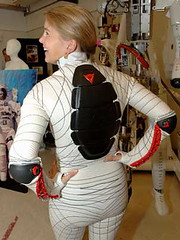
Now, however, Dava Newman, a professor of aeronautics and astronautics and engineering systems at MIT, has a new "Biosuit" design that not only meets those requirements — but adds the all-important element of style.

 MIT News explains:

Newman is working on a sleek, advanced suit designed to allow superior mobility when humans eventually reach Mars or return to the moon. Her spandex and nylon BioSuit is not your grandfather’s spacesuit–think more Spiderman, less John Glenn….

Newman’s prototype suit is a revolutionary departure from the traditional model. Instead of using gas pressurization, which exerts a force on the astronaut’s body to protect it from the vacuum of space, the suit relies on mechanical counter-pressure, which involves wrapping tight layers of material around the body. The trick is to make a suit that is skintight but stretches with the body, allowing freedom of movement.

Over the past 40 years, spacesuits have gotten progressively heavier, and they now weigh in at about 300 pounds. That bulk — much of which is due to multiple layers and the life support system coupled with the gas-pressurization — severely constrains astronauts’ movements. About 70 to 80 percent of the energy they exert while wearing the suit goes towards simply working against the suit to bend it.

Working in a three hundred pound suit is only possible in a low-gravity environment. But if humans ever step foot on Mars, they’ll need lighter suits such as the one designed by Newman:

Key to their design is the pattern of lines on the suit, which correspond to lines of non-extension (lines on the skin that don’t extend when you move your leg). Those lines provide a stiff "skeleton" of structural support, while providing maximal mobility….

The suits could also help astronauts stay fit during the six-month journey to Mars. Studies have shown that astronauts lose up to 40 percent of their muscle strength in space, but the new outfits could be designed to offer varying resistance levels, allowing the astronauts to exercise against the suits during a long flight to Mars.

Perhaps most amazing is the Biosuit’s safety aspect:

[I]f a traditional spacesuit is punctured by a tiny meteorite or other object, the astronaut must return to the space station or home base immediately, before life-threatening decompression occurs. With the BioSuit, a small, isolated puncture can be wrapped much like a bandage, and the rest of the suit will be unaffected.

To get a full perspective of the complex requirements that must be met for a spacesuit to function safely in the hostile environment of space, check out this entry from Wikipedia. 


STS-117 Mission Video

Monday, July 9th, 2007

Very cool video by Andrewwski, courtesy of NASA SpaceFlight.com Six minutes of entertainment. They put this up on a server over at the Johnson Space Center and the crew viewed the video and loved it.

These are the kind of video edits NASA TV should be broadcasting!


DIY Friday: High-Powered Mountainbike Light

Friday, July 6th, 2007

Summer’s got you in the mood for some adventure, and the mountain bike in the garage is calling you to get outdoors and blaze some new trails with your handheld GPS.  But the weather forecast is for hot. Heiß. Caliente. If only you could mountain bike after dark, you think….

Which brings us to this week’s DIY Friday project: a high powered LED headlight for your mountain bike helmet.


The folks over at Singletrack provide the instructions, and a list of materials you’ll need:

  • A 7.2v 1400mAh Ni-Cad battery 
  • A 150mA trickle charger
  • Some 2 core mains cable
  • A White luxeon star V LED 
  • A collimating lens
  • A 22mm pipe cli
  • A AMD heatsink
  • Some thermal paste
  • A re-usable zip-tie
  • Some small zip ties and electrical tape
  • A DPDT sub-min toggle switch
  • A 1 Ohm resistor and a 0.47 Ohm one, both rated at 3W

Singletrack provides a list of suppliers for the above materials in the UK; a little bit of Googling (DIY style) should turn up suppliers for our U.S. readers. (Tools required consist solely of a junior hacksaw, a file, some glue and a soldering iron.)

Still need more illumination than the light that is now attached to your helmet? Race Day Nutrition provides the plans for a bike light (that you can attach to the handlebars) using three 3W Luxeon LEDs.


For additional ideas — more illumination, as it were — check out the DIY LED Bike Lighting Guide, which makes the case for LED over halogen for a variety of factors, from more acceptable battery drain to lighter weight and less heat.

Now get pedaling. 

Fireworks

Tuesday, July 3rd, 2007

In honor of our Nation’s birthday tomorrow, I bring you "space fireworks" — or the best space can do to mimic illegal fireworks:

From the Hubble Telescope:


Google and Apple Partnerships

Friday, June 29th, 2007

Google CEO says "expect more announcements over time" in this clip from the BBC:


DIY Friday: Solar-powered WiFi Extender

Friday, June 29th, 2007

WiFi is meant to be liberating. Drop the cords, forget the desktop computer, and just work or surf from your couch, kitchen, or backyard—that is, if the signal will reach beyond your walls. To solve this—and to avoid having to lay a wire down the middle of your backyard—build a solar-powered extender/repeater.

Popular Science lays out the formula:

It uses a Linksys Wi-Fi range expander ($100; linksys.com) modified with an omnidirectional 9dBi antenna ($58; pacwireless.com). To avoid unsightly extension cords in the flower bed, I added a lead-acid battery ($22; radioshack.com) and a 10-watt solar panel ($119; sundancesolar.com) to charge it.

Wire the Antenna
1. Open the expander by removing its rubber feet and the screws underneath them.
2. Remove the brown and blue power plugs and the brown power-supply board.
3. Desolder the existing antenna and replace it with an antenna mount.

Add the Battery
4. Install a fuse holder and a 10-amp fuse near the negative terminal of the battery.
5. Connect the negative lines, and separately the positive lines, from the cigarette-lighter socket, solar panel and battery.

Attach the Panel
6. Solder red and black leads from the circuit board to the DC-to-DC converter, and plug the converter into the lighter socket.
7. Stuff everything into a weatherproof box and mount it at head height, with the solar panel at a 45-degree angle.

If you want to extend the range beyond 200-300 feet, try using a directional antenna to broadcast the signal towards a specific area (your outdoor patio, perhaps), or add another extender/repeater.

Meraki, an intriguing company that develops hardware and software for community networks, recently announced it will be selling a product similar to this DIY-contraption.

Priced at just $99, Meraki Outdoor can send a signal up to 700 feet. Paired with Meraki’s existing indoor $49 Mini, the Meraki Outdoor repeater can power access for dozens of households sharing one high speed connection. Meraki Outdoor can be easily installed on a wall or even a pole outside the house. It marks another step forward in Meraki’s efforts to change the economics of Wi-Fi access, driving the cost per household of high speed connections to $1 to $2 a month.

Adding the Meraki Solar accessory kit will allow the repeater to broadcast a signal without being connected to any electrical source, making it an ideal solution for any community, even emerging markets where electricity is scant or unreliable. Once connected, Meraki Solar’s power usage can be distributed throughout the day and managed by the Meraki Dashboard service ensuring the repeater is powered during peak usage times. The Meraki Dashboard is a web-hosted management tool designed to make monitoring, configuring, and monetizing a Meraki Network easy and is included with all Meraki products for no additional charge. The solar kit includes a solar panel, battery pack and an outdoor Ethernet cable.

The Meraki Outdoor repeater is for sale on their website. The solar kit is not yet available (so you’ll have to stick with PopSci’s DIY instructions, for now).

The most obvious use of this technology would be for a small neighborhood to purchase a T-1 and distribute it around the neighborhood using a series of repeaters. In the past, this would require a high-level of network engineering (optimal routing paths, back-up routes, various nodes, complex software, etc.). These new products simplify the task.

As the software becomes simpler and the hardware more compact and durable, the implications of this technology could be far reaching. In places with unreliable power service and scarce network engineers (think the Developing World), this technology could be especially useful, extending access to broadband and lowering costs. Green Wifi is doing this, distributing out-of-the-box, solar-powered, WiFi routers and repeaters.

Remembering Roswell

Monday, June 25th, 2007

Rancher W.W. "Mack" Brazel woke-up early one morning after a night of intense storms to check-on his ranch, about 70 miles North of Roswell, NM, and clean-up some debris. What he found started more than 60 years of intense discussion. Conspiracy or cover-up, the debate continues.

We all know the story: Mack couldn’t explain the debris, called the local Sheriff but didn’t make too much of the incident. He told the Roswell Daily Record that he and his son saw a "large area of bright wreckage made up of rubber strips, tinfoil, a rather tough paper and sticks." The Sheriff called the local Air Field who sent military officers. The U.S. military first said it was a flying saucer, then backtracked and said it was a weather balloon. Was this flip-flop a cover-up or simply a communications blunder?

A crowd, mostly of the "cover-up" opinion, will gather in Roswell in early July to "celebrate" (if that’s the right word) the 60th anniversary of this landmark event in UFO history. City officials expect the Roswell Festival could attract 50,000 people to the area, which has developed into a sort-of theme park for flying saucers and aliens, complete with a museum, gift shop, "Alien Zone," and, soon, a roller-coaster.

While the UFO theories didn’t resonate in the reality-based population until Roswell (1947), people were writing about flying saucers much earlier in the century. From claims of "Deros," a race of freaks living under the Earth’s crust, to stories of spaceship kidnappings, pseudo-Science journals tapped into the imaginations of thousands of Americans, from creative teenagers to paranoid-schizophrenics. For many, Roswell confirmed their dreams/conspiracies/nightmares.

No, I do not believe aliens are stalking humans or that the Roswell debris was anything but a downed weather balloon. But I still appreciate what the Roswell incident contributed to American culture. Without sounding too cheesy, it forced all Americans (not just the Paranoid) to consider the limits of our planet and space. It forced Americans to think big, to explore our solar system, to look up at the stars and consider our possibilities. Perhaps—just maybe—we wouldn’t have had the will to land on the moon had it not been for the collective imagination brought on by Roswell. I have little doubt that Roswell spawned generations of space-enthusiasts, scientists, and astronomers that continue to innovate and explore—much of which we discuss here on ReallyRocketScience.