Archive for the ‘Front Page’ Category

DIY Friday: Your 100-MPG Microcar!

Friday, October 26th, 2007

Longtime readers of Really Rocket Science know we’re huge fans of the X-Prize, and we’ve been especially intrigued by the potential of an automotive X-Prize, whose objective is to promote the design of "viable, clean and super-efficient cars that people want to buy."

But what about design viable, clean and super-efficient cars that people want to DIY?


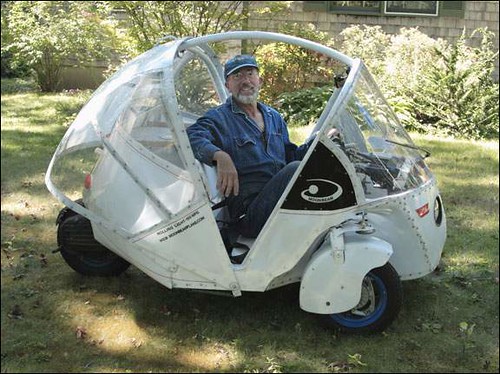
Jory Squibb of Camden, Maine put together Moonbeam (both pictured above), "a three-wheeled microcar that he built with $2,500 in parts and 1,000 hours of his labor, product of a mechanical engineering degree at Yale and a childhood growing up in Detroit as son of a General Motors man," according to the Nashua Telegraph:

Squibb says Moonbeam gets 85 mpg in the city and 105 mpg on the open road (it’s not fast enough for the interstate), despite the lack of a high-tech power plant.

It’s powered by an ordinary four-stroke, water-cooled engine, taken from a 150CC Honda motorscooter. He attributes the mileage largely to minimalism: Moonbeam only weighs 400 pounds, barely more than a decked-out Hummer’s hubcaps.

Squibb… knows Americans won’t abandon their F-150s for something that looks like a gunner’s ball turret from a World War II bomber. He regards Moonbeam as inspiration for other tinkerers, and perhaps a bit of comic relief in the important job of remaking our transportation system….

[A]s Squibb acknowledges, it will be just about impossible to give up oil, he thinks technology can greatly cut our use of it.

That’s why he has also joined the hunt for the Automotive X Prize.

This is an Earthbound version of the $10 million contest that prodded the first private spaceflight in 2004. (The X Prize Foundation also has a $10 million genomics contest for the first team to sequence 100 human genomes in 10 days.)

Details are still being worked out, but the idea is that a big-bucks Automotive X Prize will spur invention of a super-efficient, super-clean and super-marketable car – no concept vehicles, please.

Squibb is psyched, and he’s also psyched by signs the major companies are getting seriously involved in electric and alternative-fuel vehicles.

Luckily for us DIY fanatics, Squibb has his own website in which he describes how an average Joe (or Joette) can build their very own Moonbeam, and explains the reasoning behind some of his decisions in the design of the car — including the question of why three wheels instead of four, which we found rather edifying:

We pioneers and prototype makers are, to some degree, trapped with three wheels.   We want to go beyond two wheels for reasons of stability, enclosure, year-round use, and user friendliness.  Yet we are blocked from four wheels by the large amount of safety regulations of such cars.   And yet, for a prototype to be tested, seen, and thereby enter vehicle evolution, it needs to roll on the roads, and therefore be licensed, insured, and inspected.  A four wheel car will need dual brake systems, safety glass windows, air bags, impact bumpers, etc.

These requirements are based on safety, which is good.  It’s not that we are sleazes who want to build death-traps!   Rather, we need a little slack to try something new, something which in eventual production will have more safety refinements.  Building three wheelers,  which are classified as motorcycles, we have that breathing space.

There are also links to some cool videos of the Moonbeam in action, er, motion: 

Squibb and about 20 of his fellow visionaries from Down East have formed a team to compete in the Automotive X-Prize — but Moonbeam is not among them. Still, for $2,500 and 1,000 hours of labor, you can be cruising on in your very own Moonbeam by this spring. And with oil at $91 a barrel and rising, you can recoup that cost quickly!


Lightsaber Aboard the I.S.S.

Thursday, October 25th, 2007

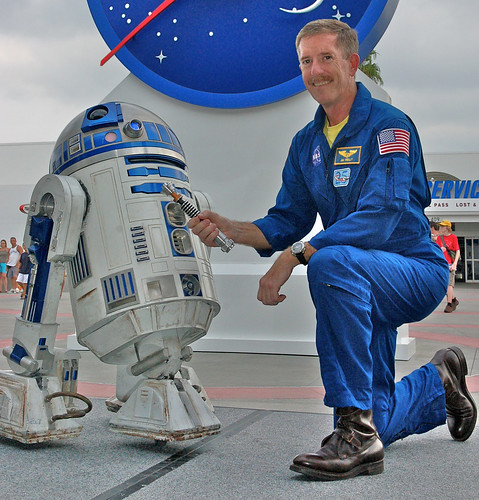
The original prop used as Luke Skywalker’s lightsaber in "Return of the Jedi" (watch the trailer from 1983) is aboard the International Space Station, marking 30 years since the release of the first Star Wars movie in 1977. It’s not the first time historical items have made the trip into space, according to NASA (podcast):

The Wright Flyer got only a few feet off the ground during its maiden flight in 1903, but traveled to the moon 66 years later.

A lead cargo tag that took months to cross the Atlantic Ocean from England to the nascent colony at Jamestown recently made the same crossing in minutes.

Now a plastic handle whose sole role was to make the fictional world of Star Wars look realistic is ready to take a real trip to the stars aboard space shuttle Discovery for mission STS-120.

From pieces of history to articles of pop culture, the assortment of items astronauts have taken with them into space is as varied as the world the artifacts represent.

Most of the objects find esteemed homes when they return, such as a stuffed teddy bear that STS-116 Commander Mark Polansky took into orbit. The bear was a replica of one owned by a Holocaust survivor. The astronaut returned the replica to a museum after the flight for its collection.

For the Star Wars prop, a lightsaber handle that was used by Luke Skywalker, even the send-off was celebrated. Actors dressed as characters including Chewbacca and X-wing pilots escorted the item to an airport in California for the flight to NASA’s Johnson Space Center in Houston, where it was packed into a shuttle locker and taken to NASA’s Kennedy Space Center in Florida for loading aboard Discovery.

Astronaut Jim Reilly, who flew three missions and has conducted eight spacewalks, said there is a symbolic tie between the lightsaber and the real-life work NASA does in space.

"There’s a kind of a fine line between science fiction and reality as far as what we do and it’s only just time really because a lot of what we’re doing right now was science fiction when I was growing up," he said. "I think it’s a neat link because it combines two space themes all at one time."

The lightsaber will spend 14 days in orbit on mission STS-120, but is not expected to leave the locker during the flight. It will be returned to Star Wars creator George Lucas’ film company after the mission.

It will not be the first time a Star Wars-related item has gone into orbit, though. Reilly said astronauts have taken small Star Wars toys into space with them when asked.

"Toy mementos, things like a Star Wars toy that might have meant something in their life, so there are any number of things that might be just a little out of the ordinary," he said.

More solemn markers have also accompanied astronauts. For example, Reilly’s STS-117 mission carried a medal earned by a World War II pilot who died in the war.

Patches, flags and medallions are routinely carried by the dozens or more on each flight, with some going on display and many going as awards to shuttle workers and VIPs.

"I think it makes it real," astronaut Rick Arnold said. "I lived in several countries and I think it’s nice to be able to present one of the flags that flew on our mission to those host countries as a thank you."

Arnold has been picked to fly aboard STS-119 in 2008, and is just starting to contemplate what to take with him to mark the occasion.

"There’s not a lot of room for personal items," he said.

Wedding rings and other small tokens are often taken into orbit. They are small enough to fit and large enough to have meaning. Each crew member is allowed to take about two pounds of mementos on their flight, but they must fit in a comparatively tiny area.

Astronaut Stephanie Wilson is taking a sheet of music from the Boston Symphony Orchestra onboard Discovery for mission STS-120. The music comes from Beethoven’s "Ode to Joy," a favorite in the orchestra’s extensive repertoire. Wilson worked at one time in a music store in Tanglewood, Mass., which is the summer home of the orchestra.

Some items never leave space, notably mission emblems like those stuck to the walls inside the International Space Station.

Another example is a golf ball astronaut Alan Shepard carried to the moon on Apollo 14 and hit with an improvised club.

Moonwalker Charles Duke left a portrait of his family on the lunar surface.

Thousands of signatures have also gone into the solar system in the form of computer codes imprinted on compact discs.

Whether they go into space to stay or to be appreciated anew back on Earth, the artifacts manage to find a unique home.

"When you get the chance to deliver that stuff back to your family and friends, they’re really excited about it," Reilly said.

Our favorite bring-along was the dried elk, crispbread and gingerbread by Swedish astronaut Crister Fuglesang.

Here’s the memorable lightsaber duel from that movie:

Space Diving

Tuesday, October 23rd, 2007


That’s Captain Joe Kittinger jumping out of a helium balloon in 1960, at a altitude of 20 miles. According to his Wikipedia entry, he actually made three jumps:

The first, from 76,400 feet (23,287 m) in November, 1959 was a near tragedy when an equipment malfunction caused him to lose consciousness, but the automatic parachute saved him (he went into a flat spin at a rotational velocity of 120 rpm; the G factor at his extremities was calculated to be over 22 times that of gravity, setting another record). Three weeks later he jumped again from 74,700 feet (22,769 m). For that return jump Kittinger was awarded the Leo Stevens parachute medal.

On August 16, 1960 he made the final jump from the Excelsior III at 102,800 feet (31,330 m). Towing a small drogue chute for stabilization, he fell for 4 minutes and 36 seconds reaching a maximum speed of 614 mph before opening his parachute at 18,000 feet (5,500 m). Pressurization for his right glove malfunctioned during the ascent, causing his hand to swell. He set records for highest balloon ascent, highest parachute jump, longest drogue-fall (14 min) and fastest speed by a man through the atmosphere. [1]

The jumps were made in a "rocking-chair" position, descending on his back, rather than the usual delta familiar to skydivers, because he was wearing a 60-lb "kit" on his behind and his pressure suit naturally formed that shape when inflated, a shape appropriate for sitting in an airplane cockpit.

For the series of jumps, Kittinger was decorated with an oak leaf cluster to his D.F.C. and awarded the Harmon Trophy by President Dwight Eisenhower.

A flat spin at 120 RPM, 22 G’s at his extremities? Would you pay to do something like this? While some are looking to profit from a new extreme sport, others see very practical research objectives, according to the Telegraph (U.K.):

Forget about bungee jumping and hang gliding. The next adrenaline pumping daredevil stunt will be hurtling back to Earth by "space diving," if entrepreneurs and extreme sports enthusiasts have their way.

They are preparing skydives from the edge of space to beat a record set by Captain Joe Kittinger of the US Air Force in 1960, who jumped from an altitude of 20 miles, reaching a speed of around 700 miles per hour in his 13 minute descent to the ground.

They aim to start with a jump from 22 miles to break Kittinger’s record, then build up to 57 miles, which would be the first true space jump. If everything works as planned, paying customers might be able to start their fiery descent from space as early as 2009.

Instead of jumping from the gondola of a helium balloon, as Kittinger did, New Scientist reports today that they will be bailing out from the nose-cone of a rocket ship, one of half dozen or so being developed to loft paying passengers into the heavens for a few minutes of weightlessness and a spectacular view of the Earth.

However, there is a serious underlying purpose since space jumpers will rely on the kind of gear that will be needed in case of emergencies if commercial space travel is ever to become routine.

advertisementThat is the driving force of one of the pioneers, Jonathan Clark, a former Nasa flight surgeon and military high-altitude parachutist, whose wife Laurel was killed during the disintegration of the shuttle Columbia in 2003 during reentry.

Developing space diving as a sport for thrill-seekers is the first step towards equipment that may spare future space travellers the same fate. "It’s almost a passion for me," says Clark, who works at the Space Biomedical Research Institute at Baylor College of Medicine in Houston, Texas.

Armadillo Aerospace of Mesquite, Texas, has been developing a computer controlled vertical take-off, vertical-landing spacecraft for the tourist trade, and the Space Diver team thinks the craft could offer the perfect jumping-off point.

The diver would trigger an airbag, springloaded seat, or a small parachute to move away from the spacecraft as fast as possible, so as to avoid a collision as he tumbled into the abyss. Then it would be up to the spacesuit to make sure the he copes with frigid temperatures and near vacuum to return safely.

Space promoter Rick Tumlinson, who has created the company Space Diver with Clark and others, also founded Orbital Outfitters, Los Angeles, to design, manufacture and lease spacesuits (motto: "Have space suit – will travel").

At an altitude of 20 miles, the air is so thin that there will be no rushing of air and little impression of falling. Gradually, as the air becomes denser, pressure against the diver’s body will increase and air friction will heat the suit, which will contain a circulating liquid cooling system.

One problem under study is how to prevent divers from going into a spin, which could leave them unconscious.The team is still debating whether a head-first posture or the traditional spreadeagled horizontal position is likely to work best. Once within a mile or so of the ground, the main parachute will deploy automatically.

Armadillo’s craft will be commanded from the ground, so after the diver has ejected it will return to Earth automatically. By early next year, Space Diver aims to begin low-altitude tests with dummies, then people, starting at a modest altitude of about two miles. "We need to show that we can leave the vehicle safely," Tumlinson tells New Scientist.

Ultimately, Tumlinson aims to develop technology to allow astronauts to bail out of orbiting craft and return safely to Earth, for instance in small inflatable "lifeboats".

If you can’t wait until 2009, there’s human gliding in the Alps:


Black Hole Sun

Thursday, October 18th, 2007

The Chandra X-Ray Observatory, run by the Smithsonian Astrophysical Observatory in Cambridge, MA, helped astronomers find a huge black hole orbiting a buddy star. Image above: artist’s representation of M33 X-7, a binary system in the nearby galaxy M33 (Credit: Illustration: NASA/CXC/M.Weiss; X-ray: NASA/CXC/CfA/ P.Plucinsky et al.; Optical: NASA/STScI/SDSU/J.Orosz et al.). Check out the Chandra blog, too.

Here’s the NASA release:

Astronomers have located an exceptionally massive black hole in orbit around a huge companion star. This result has intriguing implications for the evolution and ultimate fate of massive stars.

The black hole is part of a binary system in M33, a nearby galaxy about 3 million light years from Earth. By combining data from NASA’s Chandra X-ray Observatory and the Gemini telescope on Mauna Kea, Hawaii, the mass of the black hole, known as M33 X-7, was determined to be 15.7 times that of the Sun. This makes M33 X-7 the most massive stellar black hole known. A stellar black hole is formed from the collapse of the core of a massive star at the end of its life.

"This discovery raises all sorts of questions about how such a big black hole could have been formed,” said Jerome Orosz of San Diego State University, lead author of the paper appearing in the October 18th issue of the journal Nature.

M33 X-7 orbits a companion star that eclipses the black hole every three and a half days. The companion star also has an unusually large mass, 70 times that of the Sun. This makes it the most massive companion star in a binary system containing a black hole.

"This is a huge star that is partnered with a huge black hole," said coauthor Jeffrey McClintock of the Harvard-Smithsonian Center for Astrophysics in Cambridge, Mass. "Eventually, the companion will also go supernova and then we’ll have a pair of black holes."

The properties of the M33 X-7 binary system – a massive black hole in a close orbit around a massive companion star – are difficult to explain using conventional models for the evolution of massive stars. The parent star for the black hole must have had a mass greater than the existing companion in order to have formed a black hole before the companion star. Such a massive star would have had a radius larger than the present separation between the stars, so the stars must have been brought closer while sharing a common outer atmosphere. This process typically results in a large amount of mass being lost from the system, so much that the parent star should not have been able to form a 15.7 solar-mass black hole.

The black hole’s progenitor must have shed gas at a rate about 10 times less than predicted by models before it exploded. If even more massive stars also lose very little material, it could explain the incredibly luminous supernova seen recently as SN 2006gy. The progenitor for SN 2006gy is thought to have been about 150 times the mass of the Sun when it exploded.

"Massive stars can be much less extravagant than people think by hanging onto a lot more of their mass toward the end of their lives," said Orosz. “This can have a big effect on the black holes that these stellar time-bombs make."

Coauthor Wolfgang Pietsch was also the lead author of an article in the Astrophysical Journal that used Chandra observations to report that M33 X-7 is the first black hole in a binary system observed to undergo eclipses. The eclipsing nature enables unusually accurate estimates for the mass of the black hole and its companion.

"Because it’s eclipsing and because it has such extreme properties, this black hole is an incredible test-bed for studying astrophysics," said Pietsch.

The length of the eclipse seen by Chandra gives information about the size of the companion. The scale of the companion’s motion, as inferred from the Gemini observations, gives information about the mass of the black hole and its companion. Other observed properties of the binary were used to constrain the mass estimates.


This animation sequence begins with a wide-field optical image from Kitt Peak of M33, a spiral galaxy about 3 million light years from Earth, and then zooms into a view from the Gemini telescope on Mauna Kea, Hawaii. Next, the view zooms into an even smaller field, from the Hubble Space Telescope, that includes M33 X-7, the most massive known black hole to be formed from the collapse of a star. The final image is a composite of the region around M33 X-7 that contains both the Chandra and Hubble data.
(Credit: Kitt Peak: NOAO/AURA/NSF/T.A.Rector; Gemini: AURA/Gemini Obs./SDSU/J.Orosz et al.; HST: NASA/STScI/SDSU/J.Orosz et al.; Chandra: NASA/CXC/CfA/P.Plucinsky et al.)

Love the Laptop

Friday, October 5th, 2007


The One Laptop Per Child project is set to take orders to the general public beginning 12 November 2007 with its "Give 1, Get 1" initiative. Great idea: you pay $400 for two laptops, one for you and one for donation.

Loved David Pogue’s piece in yesterday’s New York Times, who thinks it’s worth the price:

Laptop With a Mission Widens Its Audience

By DAVID POGUE

4 october 2007

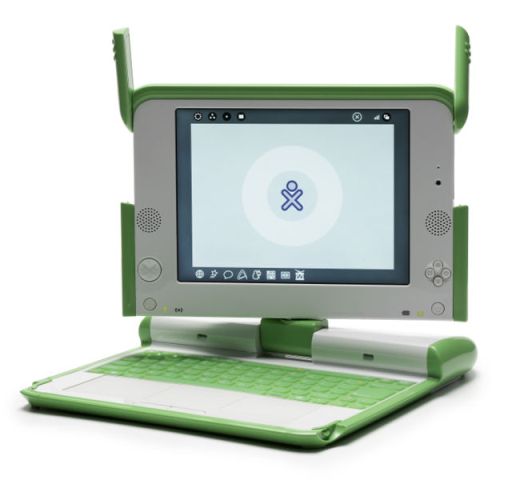
In November, you’ll be able to buy a new laptop that’s spillproof, rainproof, dustproof and drop-proof. It’s fanless, it’s silent and it weighs 3.2 pounds. One battery charge will power six hours of heavy activity, or 24 hours of reading. The laptop has a built-in video camera, microphone, memory-card slot, graphics tablet, game-pad controllers and a screen that rotates into a tablet configuration.

And this laptop will cost $200.

The computer, if you hadn’t already guessed, is the fabled “$100 laptop” that’s been igniting hype and controversy for three years. It’s an effort by One Laptop Per Child (laptop.org) to develop a very low-cost, high-potential, extremely rugged computer for the two billion educationally underserved children in poor countries.

The concept: if a machine is designed smartly enough, without the bloat of standard laptops, and sold in large enough quantities, the price can be brought way, way down. Maybe not down to $100, as O.L.P.C. originally hoped, but low enough for developing countries to afford millions of them — one per child.

The laptop is now called the XO, because if you turn the logo 90 degrees, it looks like a child.

O.L.P.C. slightly turned its strategy when it decided to offer the machine for sale to the public in the industrialized world — for a period of two weeks, in November. The program is called “Give 1, Get 1,” and it works like this. You pay $400 (www.xogiving.org). One XO laptop (and a tax deduction) comes to you by Christmas, and a second is sent to a student in a poor country.

The group does worry that people might compare the XO with $1,000 Windows or Mac laptops. They might blog about their disappointment, thereby imperiling O.L.P.C.’s continuing talks with third world governments.

It’s easy to see how that might happen. There’s no CD/DVD drive at all, no hard drive and only a 7.5-inch screen. The Linux operating system doesn’t run Microsoft Office, Photoshop or any other standard Mac or Windows programs. The membrane-sealed, spillproof keyboard is too small for touch-typing by an adult.

And then there’s the look of this thing. It’s made of shiny green and white plastic, like a Fisher-Price toy, complete with a handle. With its two earlike antennas raised, it could be Shrek’s little robot friend.

And sure enough, the bloggers and the ignorant have already begun to spit on the XO laptop. “Dude, for $400, I can buy a real Windows laptop,” they say.

Clearly, the XO’s mission has sailed over these people’s heads like a 747.

The truth is, the XO laptop, now in final testing, is absolutely amazing, and in my limited tests, a total kid magnet. Both the hardware and the software exhibit breakthrough after breakthrough — some of them not available on any other laptop, for $400 or $4,000.

In the places where the XO will be used, power is often scarce. So the laptop uses a new battery chemistry, called lithium ferro-phosphate. It runs at one-tenth the temperature of a standard laptop battery, costs $10 to replace, and is good for 2,000 charges — versus 500 on a regular laptop battery.

The laptop consumes an average of 2 watts, compared with 60 or more on a typical business laptop. That’s one reason it gets such great battery life. A small yo-yo-like pull-cord charger is available (one minute of pulling provides 10 minutes of power); so is a $12 solar panel that, although only one foot square, provides enough power to recharge or power the machine.

Speaking of bright sunshine: the XO’s color screen is bright and, at 200 dots an inch, razor sharp (1,200 by 900 pixels). But it has a secret identity: in bright sun, you can turn off the backlight altogether. The resulting display, black on light gray, is so clear and readable, it’s almost like paper. Then, of course, the battery lasts even longer.

The XO offers both regular wireless Internet connections and something called mesh networking, which means that all the laptops see each other, instantly, without any setup — even when there’s no Internet connection.

With one press of a button, you see a map. Individual XO logos — color-coded to differentiate them — represent other laptops in the area; you connect with one click. (You never double-click in the XO’s visual, super-simple operating system. You either point with the mouse or click once.)

This feature has some astonishing utility. If only one laptop has an Internet connection, for example, the others can get online, too, thanks to the mesh network. And when O.L.P.C. releases software upgrades, one laptop can broadcast them to other nearby laptops.

Power users will snort at the specs of this machine. It has only one gigabyte of storage — all flash memory — with 20 percent of that occupied by the XO’s system software. And the processor is feeble by conventional standards. Starting up takes two minutes, and switching between programs is poky.

Once in a program, though, the speed is fine; it turns out that a light processor is plenty if the software is written compactly and smartly. (O.L.P.C. points out that despite gigantic leaps in processing power, today’s business laptops don’t feel any faster than they did a few years ago. The operating systems and programs have added so much bloat that they absorb the speed gains.)

The built-in programs are equally clever. There’s a word processor, Web browser, calculator, PDF textbook reader, some games (clones of Tetris and Connect 4), three music programs, a painting application, a chat program and so on. The camera module permits teachers, for the first time, to send messages home to illiterate parents.

There are also three programming environments of different degrees of sophistication. Incredibly, one keystroke reveals the underlying code of almost any XO program or any Web page. Students can not only study how their favorite programs have been written, but even experiment by making changes. (If they make a mess of things, they can restore the original.)

There’s real brilliance in this emphasis on understanding the computer itself. Many nations in XO’s market have few natural resources, and the global need for information workers grows with every passing day.

Most of the XO’s programs are shareable on the mesh network, which is another ingenious twist. Any time you’re word processing, making music, taking pictures, playing games or reading an e-book, you can click a Share button. Your document shows up next to your icon on the mesh-network map, so that other people can see what you’re doing, or work with you. Teachers can supervise your writing, buddies can collaborate on a document, friends can play you in Connect 4, or someone across the room can add a melody to your drum beat in the music program. You’ve never seen anything like it.

The pair of laptops I reviewed had incomplete power-management software, beta-stage software and occasional cosmetic glitches. But O.L.P.C. and its worldwide army of open-source (volunteer) programmers expect to polish things by the time the assembly line starts to roll in November.

No, the biggest obstacle to the XO’s success is not technology — it’s already a wonder — but fear. Overseas ministers of education fear that changing the status quo might risk their jobs. Big-name computer makers fear that the XO will steal away an overlooked two-billion-person market. Critics fear that the poorest countries need food, malaria protection and clean water far more than computers.

(The founder, Nicholas Negroponte’s, response: “Nobody I know would say, ‘By the way, let’s hold off on education.’ Education happens to be a solution to all of those same problems.”)

But the XO deserves to overcome those fears. Despite all the obstacles and doubters, O.L.P.C. has come up with a laptop that’s tough and simple enough for hot, humid, dusty locales; cool enough to keep young minds engaged, both at school and at home; and open, flexible and collaborative enough to support a million different teaching and learning styles.

It’s a technological breakthrough, for sure. Now let’s just hope it breaks through the human barriers.


Here’s his video with the laptop.

And here’s a news report from Australia:

Anders Mogensen, the co-founder of Seismonaut heads to Nigeria to visit the first school testing the laptop. Note the VSAT next to the school:
DIY Friday: Place-shifting

Friday, September 28th, 2007

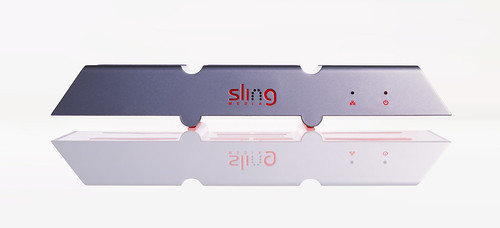
Heard about Sling Media recently? They were recently acquired by EchoStar. Their product is really cool – stream video content, including live and recorded TV (in HD too!), to your laptop or cell phone anywhere you can get an internet connection. You buy a "Slingbox" – any one of three models – and it connects to your TV, Computer, DVD Player, etc… and allows you to access it over the internet.

This place-shifting functionality is starting to catch on. Microsoft recently announced the addition of functionality to Windows Media Center PCs allowing users to view TV schedules, manage recordings and view some content – although it does not appear to offer full streaming of all content like SlingBox.

Don’t have a Sling Box or a Windows Media Center PC? Well, you can do all of this now with your existing PC and some free software from the internet (this one is Windows only – OSX and Linux users will have to wait for another DIY post). The key is a cool piece of software called "Orb" (get it here). "Orb" runs on your PC and keeps a (configurable) record of your music, photos and videos. It "creates a secure media portal to your home PC" that you can access from any computer, cell phone or PDA connected to the internet. (More from the info page here)

Even better, Orb has a detailed guide for creating and installing widgets on computers, start pages and blogs – so you can show your favorite media to your friends and keep up to date with your latest content. You can even view your Orb content on your Wii, as this YouTube video shows. For that matter, you can also you your Wii and Orb to view your Webcam.

Orb is a really cool piece of software – and it’s hard to believe so much useful functionality is free! Definitely check this out.

And one last thing. We also liked the Slingbox alternative described by "wasteotime" on Instructables.com. Read the whole article for specific details, but it basically involves routing the audio from your radio or TV into your computer, then calling your computer via Skype to listen into the audio in real time. Compared to Slingbox and Orb, it’s only a realistic alternative for a very limited use case. But our favorite part of this is how you change the channel – just call someone at the house and have them do it!

So now your content can follow you wherever you go. Start watching!


“Yes!” For YES2 Mission

Thursday, September 27th, 2007


The second Young Engineers Satellite (YES2), involving nearly 500 university students from Australia, Japan, Europe and North America, launched on 14 September 2007 and came down safely in Kazakhstan on the 26th. The ESA’s Education Office is calling the mission a success:

The reentry capsule for the Foton-M3 spacecraft, which has been in low-Earth orbit for the last 12 days, successfully landed this morning in an uninhabited area 150 km south of the town of Kustanay in Kazakhstan, close to the Russian border, at 09:58 CEST, 13:58 local time.
 
The unmanned Foton spacecraft, which was launched on 14 September from Baikonur Cosmodrome, in Kazakhstan, carried a payload of 43 European experiments in a range of scientific disciplines – including fluid physics, biology, crystal growth, radiation exposure and exobiology.

The mission was intensively monitored throughout by 65 engineers and scientists located at ground stations at Esrange, in Kiruna, Sweden, and at the Russian flight control centre, TsUP, in Moscow, Russia. Thanks to a close cooperation with the Canadian Space Agency, ground stations in St. Hubert and Saskatoon were also used to receive data from the spacecraft. 
 
“I am extremely pleased with the success of the Foton-M3 mission,” says Josef Winter, Head of ESA’s Payload and Microgravity Platform Division. “All operations during the mission were flawless. The hard work and dedication of all involved has contributed to make this mission a success. I would like to congratulate our Russian counterparts and thank them for their outstanding cooperation.”

Helicopters were immediately at the landing site to start recovery operations, including the retrieval of experiment hardware. The European experiments will now be returned to the labs at ESA’s research and technology centre, ESTEC, in Noordwijk, the Netherlands, tomorrow evening. After further inspection at ESTEC the experiments will be returned to the scientific institutions where the data will be analysed over the coming months.
 
Only in-depth analysis will reveal the full extent of the scientific return of the mission, although data received during the flight already shows promising results – the Italian and US team responsible for the GRADFLEX (GRADient-Driven Fluctuation EXperiment) experiment received preliminary confirmation of a 10-year-old fluid science theory.

A further highlight of the mission was yesterday’s deployment of a small reentry capsule from the outside of the Foton spacecraft. The Second Young Engineers’ Satellite (YES2) experiment saw the release of the beachball-sized Fotino capsule from the end of a tether to demonstrate the smart possibility of returning small payloads to Earth.

"I am extremely satisfied that we could fly a very high number of experiments during the Foton-M3 mission and that they all worked out well. Some of them will even be further elaborated onboard the International Space Station," says Martin Zell, ESA’s Head of Research Operations for the Directorate of Human Spaceflight, Microgravity and Exploration.

 The experiment was some coverage in the almost-science press this week. Wired, for example:

The students’ critical moment came today, and so far it’s a qualified success. The payload, a small capsule dubbed “Fotino” was intended to be let out on a 18.6 mile, fishing line-thin tether before being released. But the process went more slowly than projected, and the little test capsule was cut loose by a preprogrammed command after just 5.2 miles.

European Space Agency scientists are currently tracking the little device to figure out where and how its parachute will bring it back to earth.

The mishaps may mean that the students’ tether system won’t find its way immediately into adoption for critical satellite or other launches. But the test gives space programs around the world new data on an innovative and potentially money-saving technique for orbital deployments.

They’re right about how cool this mission was. Here’s their animation:


Still no word on whether the prog-rock group Yes is comtemplating a copyright infringement complaint.

Personal Distant Locals via Satellite TV

Tuesday, September 25th, 2007


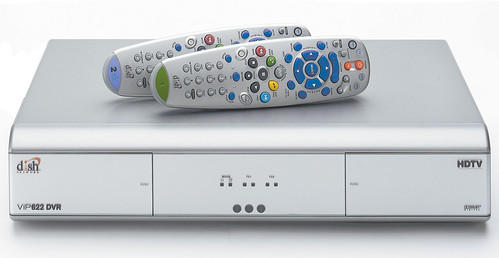
Us rocket scientists love our Slingboxes. Whether at 35,000 feet, at a baseball game or hooked up as a traffic webcam. Our friends at Dish Network like them enough to buy them for $380 million, according to Transmitter News:

EchoStar Communications Corporation has agreed to acquire Sling Media, Inc., a privately-held digital lifestyle products company. EchoStar, through its DISH Network®, is the third largest pay-TV provider in the United States. The transaction values Sling Media at approximately $380 million and is payable in cash and EchoStar options. The transaction is subject to customary closing conditions, and is expected to close in the fourth quarter of 2007.

Established in 2004, Sling Media has been a leading innovator in the digital lifestyle space through the introduction of the internationally-acclaimed, Emmy award-winning Slingbox™ and SlingPlayer™ software. Sling Media’s product line is distributed in over 5,000 retail stores in 11 countries.

In 2006, Sling Media created the Sling Entertainment Group with the mission of developing entertainment experiences and business models that reach beyond the Slingbox. The group also fosters and manages relationships with content creators and owners. Its first initiative, Clip+Sling™, dramatically changes the way consumers socialize around TV by enabling users to clip and share limited segments of their favorite television programming.

“As an early investor in Sling Media, EchoStar has been pleased with the progress and commitment the company has made establishing Sling Media and the Slingbox as powerful and beloved digital media brands,” said Charlie Ergen, CEO and co-founder of EchoStar. “With today’s increasingly mobile lifestyle, EchoStar’s acquisition of Sling Media will allow us to offer innovative and convenient ways for our customers to enjoy their programming on more displays and locations, including TVs, computers and mobile phones, both inside and outside of the home. This combination paves the way for the development of a host of new innovative products and services for our subscribers, new digital media consumers and strategic partners.”

“We are psyched to make this announcement. We have worked closely with EchoStar for more than two years, and have come to realize that both companies have similar entrepreneurial cultures and mutual dedication and passion for creating empowering experiences that benefit the consumer and the media industry,” said Blake Krikorian, co-founder, chairman and CEO of Sling Media. “By combining strategies, resources and technologies with EchoStar, Sling Media will be able to rapidly expand our open multi-platform product offerings, not only for DISH Network subscribers, but for digital media enthusiasts around the globe.”

Scott Greczkowski is asking the right questions: 

Last night’s late announcement that Echostar is acquiring Sling Media did not come as a big surprise to me. And while it did not surprise me it did set off a few flags in my head.

1)      Will DISH Network keep Sling as a separate company or would they bring the technology and the company in house?

2)      Sling Media is a Partner with DIRECTV and the NFL for delivering the NFL Sunday Ticket online, how will this deal affect this setup?

3)      There are a number of other companies who are invested in Sling Media including the soon to be parent company of DIRECTV, Liberty Media. How does this deal affect them?

4)      What is going to happen to unreleased products such as the Sling Catcher?

5)      When will we see the first receiver from Echostar that has built in Slingbox functionality?

I personally hope that DISH continues to allow Sling Media to be Sling Media, a separate company, a company with some amazing thoughts and ideas.

I personally own 3 Slingbox units and I honestly consider it to be the best consumer electronics device made so far in the 21st century! No matter where  I am at I can watch and I can control all of my satellite receivers, I can even watch and control things on my PDA/Phone. Having a 4 year old, the Slingbox has been a godsend, especially when you’re out at a restaurant and your child is being loud. When this happens I pull out my cell phone, log into one of my Slingbox units change the channel to Noggin and give the phone to my son, and now a noisy child is a quiet happy child.

Echostar to spin off?

As I was writing this column I got a press release from Echostar saying that they were considering spinning off its hardware division. The question is what does this mean?

Now I am not a stock guy (and I should state for the record that I own no stock in any satellite company) but what this signals to me is that sometime in the future we could see Echostar selling off it’s Dish Network service to another company, all while continuing to make equipment for Dish Network and while retaining ownership of the Echostar satellite fleet.

Is this what they are planning? Your guess is as good as mine. But it does make you go hmm.


Brazilian Observation Satellite Launched by Chinese

Thursday, September 20th, 2007


There are a lot of happy rocket scientists in Brazil today: 

CBERS-2B é lançado com sucesso da base chinesa de Taiyuan 

Exatamente às 00h26min desta quarta-feira (19) foi lançado com sucesso o CBERS-2B, terceiro satélite da parceria entre Brasil e China. O evento foi comemorado tanto no Centro de Controle de Satélites do INPE, em São José dos Campos (SP), como no Centro de Lançamento de Satélites de Taiyuan. O diretor do INPE, Gilberto Câmara, assistiu ao lançamento na base chinesa e, junto com os engenheiros Ricardo Cartaxo e Jânio Kono, respectivamente coordenador geral e coordenador do Segmento Espacial do Programa CBERS, transmitiu todas as informações aos técnicos e convidados que acompanharam da sede do Instituto.

“É uma emoção muito grande. É o resultado de um grande trabalho feito por brasileiros e chineses. Estamos todos muito orgulhosos”, disse o diretor Gilberto Câmara.

Chefe do Centro de Controle de Satélites do INPE, Pawel Rosenfeld manteve contato constante com Jânio Kono, coordenador do Segmento Espacial do Programa CBERS, que da base comandou as operações junto com os técnicos chineses.

O foguete Longa Marcha 4B cumpriu perfeitamente todas as etapas previstas para colocação do satélite em órbita. O tempo total de vôo até a injeção do CBERS em órbita foi de 12,5 minutos. O CBERS-2B é lançado com seus transmissores ligados permitindo assim que a estação de rastreio de Nanning, na China, mantenha contato com o satélite desde antes de sua separação do último estágio do veículo lançador, até aproximadamente um minuto e meio após a abertura dos painéis solares, que aconteceu cerca de 14 minutos após o lançamento.

The spacecraft is capable of producing images such as this beauty of Manaus:

Here’s the explanation, in English, via SpaceFlightNow.com:

A joint mission developed by China and Brazil was shot into an orbit circling Earth’s poles to snap detailed images of the globe during an early Wednesday launch from China’s northeastern space base.

A Long March 4B rocket launched with the international satellite at 0326 GMT Wednesday (11:26 p.m. EDT Tuesday) from the Taiyuan space center in China’s Shanxi province, according to the state-run Xinhua news agency.

The booster’s three liquid-fueled stages accurately deposited the third China-Brazil Earth Resources Satellite into a Sun-synchronous orbit about 12 minutes after liftoff.

CBERS 2B was left in a nearly circular orbit with an average altitude of approximately 462 miles, Xinhua reported. The Long March 4B was shooting for an orbital inclination of 98.5 degrees.

Wednesday’s launch marked the 60th consecutive success for China’s Long March rocket fleet. It was also the 8th space launch for China so far this year.

CBERS 2B will spend the next few weeks undergoing systems tests and preparations for an operational mission expected to last at least two years.

The 3,200-pound satellite was ordered by Chinese and Brazilian officials in 2004 to bridge the gap between older spacecraft and next-generation satellites, which should begin launching in 2009.

The craft’s predecessors, CBERS 1 and CBERS 2, were launched by Chinese rockets in 1999 and 2003, respectively. Both outlived their baselined two-year missions, according to Brazil’s National Institute for Space Research, a co-sponsor of the program.

The China Academy of Space Technology was in charge of the Chinese contribution to the mission, Xinhua reported.

CBERS 2B carries three primary imaging cameras to take a wide range of pictures of locations scattered throughout the world.

A low-resolution camera with a 60-degree field of view will specialize in capturing images of large swaths of the planet. Another camera will be capable of taking pictures with a resolution of about 65 feet.

Unlike its forerunners, CBERS 2B includes a high-resolution black-and-white camera able to produce images showing objects as small as 2.5 meters, or about eight feet. CBERS 1 and CBERS 2 each carried an infrared scanning instrument instead.

Scientists expect to use data from the project in environmental monitoring, crop planning and managing water resources. Images can also be used to identify types of vegetation and in soil surveys. Pictures could also end up in geography textbooks, according to Brazilian space officials.

Images from the new high-resolution camera will also be useful in urban planning and military intelligence applications for China and Brazil.

China has a 70 percent stake in the 19-year-old program, while Brazil controls about 30 percent of the project. Users in both nations have access to the satellite imagery.

Pictures from the spacecraft have been distributed online since 2004, and more than 15,000 users have downloaded about 320,000 images since the Internet campaign began, according to Brazilian officials.

Two more satellites with four cameras each will be launched in 2009 and 2011. The program extension was approved in 2002, and China and Brazil will equally split responsibility for the new project.

Here’s a video about the Brazilian Space Agency:

And here’s a little Brazilian space center tribute video set to Brazilian metal (mind the volume):


DIY Friday: Burning Man

Friday, September 14th, 2007

When you think of Burning Man, a six-day festival held in the middle of the Black Rock Desert in Nevada, you think of eccentric art—sculptures, paintings, artistic contraptions of all kind. Burning Man hits the limits of self-expression. Even more amazing, though, is Burning Man’s commitment to self-reliance. As one essayist puts it:

You’re here to survive. What happens to your brain and body when exposed to 107 degree heat, moisture wicking off your body and dehydrating you within minutes? You know and watch yourself. You drink water constantly and piss clear. You’ll want to reconsider drinking that alcohol (or taking those other substances) you brought with you — the mind-altering experience of Burning Man is its own drug. You slather yourself in sunblock before the sun’s rays turn up full blast. You bring enough food, water, and shelter because the elements of the new planet are harsh, and you will find no vending.

You’re here to create. Since nobody at Burning Man is a spectator, you’re here to build your own new world. You’ve built an egg for shelter, a suit made of light sticks, a car that looks like a shark’s fin. You’ve covered yourself in silver, you’re wearing a straw hat and a string of pearls, or maybe a skirt for the first time. You’re broadcasting Radio Free Burning Man — or another radio station.

But when 50,000 people descend onto a spot in the desert, they need energy — no matter how environmentally-conscious they may be. Enter solar power — there is plenty of that in the desert.

These folks may not be rocket scientists, but they sure have engineering prowess. While some shows, like the Control Burn fire act, use 650 gallons of fuel a night, there is some carbon-free entertainment out there. More demonstrated free energy, thanks to a trebuchet:

This year’s event was held August 27th through September 3rd, drawing almost 50,000 people around the theme “Green Man” (environment). Responding to this inspiration, Cooling Man is a project aiming to make “Black Rock City” carbon-neutral through carbon-offset purchases and energy reduction. For just a six-day event, it is pretty fascinating how much of a civilization is created.

Next year we will look into what sort of sat-coms they have — no landlines available in Black Rock City, I imagine.