Archive for the ‘Front Page’ Category

Google offers FREE residential Broadband Service!!!!!!

Sunday, April 1st, 2007

Welcome to Tisp

Sign up for our free in-home wireless broadband service

Sick of paying for broadband that you have to, well, pay for?

Introducing Google TiSP (BETA), our new FREE in-home wireless broadband service. Sign up today and we’ll send you your TiSP self-installation kit, which includes setup guide, fiber-optic cable, spindle, wireless router and installation CD.

Get Started with Google TiSP


TiSP in-home wireless broadband is:

  • Free, fast and highly reliable

  • Easy to install — takes just minutes

  • Vacuum-sealed to prevent water damage

Look out below!!!

Wednesday, March 28th, 2007


Flaming space junk from a Russian satellite narrowly missed hitting a Chilean airliner over the Pacific Ocean, reports said Wednesday.

The pilot of a LAN Chile Airbus A340 en route to New Zealand told air traffic controllers he had seen pieces of flaming space junk falling about eight kilometres (four miles) in front of the plane and behind it, TV3 said.

The aircraft was not struck by any of the debris and later landed safely in Auckland.

Airways New Zealand, which manages New Zealand’s air traffic, said it had been warned by Russian authorities that an obsolete satellite was due to fall into the Pacific Ocean on Wednesday.

But the debris had apparently fallen into the area 12 hours earlier than the time advised by the Russians.

A spokesman for the Civil Aviation Authority, which is responsible for air safety, said it would launch an inquiry after it was advised of the details of the incident.

DIY Friday: Your Own Home Theater System!

Friday, March 23rd, 2007

For today’s Do It Yourself activity, all you need is some wood, carpeting, a TV set with DVD and a surround sound system, and… oh, yeah…. an indoor pool.
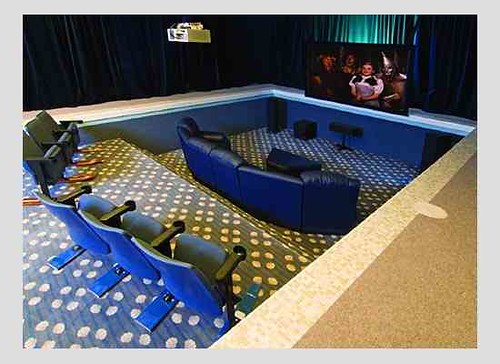
 

Electronic House provides the details: 

Swimming pools, even indoor ones, just aren’t all that tempting in regions where the mercury rarely reaches above 80 degrees.

So when the owners of this Wisconsin home purchased their residence, they decided to convert the indoor in-ground pool that came with the property into a fully functional home theater. Flooring and carpeting were added to the concrete bottom of the 20-by-40-foot area, and draperies were hung over the room’s windows and metal walls to soften up the space. However, not all signs of the building’s former life were removed. Wiring for the audio and video components was pulled through the pool’s existing plumbing systems, and the slope of the pool floor was maintained to create a stadium-style seating arrangement.

The concrete sides of the pool precluded speakers from being built in, so the homeowners opted for Klipsch floorstanding models. The 106-inch Draper screen was suspended from the room’s existing rafters using aircraft cabling and secured at the edge of the pool to keep the material taut. Last but not least, the Marantz video projector was mounted to the ceiling, and the audio and video components were stowed inside an equipment rack at the back of the room.

Sound like too much work for a simple DIY Friday project? Or, more to the point — don’t have a high-falutin’ indoor pool? 

Well, luckily there are options for the more proleteriat among us.

DIY Home Theater Design provides a good run down of all your different options, walking you through the pros and cons of LCD, DLP and LCOS screens, as well as a summary of what you’ll want in your sound system:

 The basic surround sound setup consists of 5 speakers plus a subwoofer, known as 5.1 surround. The center speaker, called the center channel, is positioned just above or below the television and is intended to handle dialog. A pair of left and right speakers are placed to the sides of the television about 6 to 8 feet apart; wider if you have a very large screen. The left and right speakers handle the heavy lifting of the soundtrack like music and sound effects. A pair of satellite speakers are placed on each side of the viewing audience to add atmospheric sound effects like the sound of a crowd or bullets whizzing by. The "point one" in 5.1 is for the subwoofer. The sub handles low frequency sound and adds emphasis to explosions or to a dramatic music score.

The only bad advice from DIY Home Theater Design comes when they advise: "Don’t let the new terms and acronyms spook you because it’s really not rocket science."

We, of course, beg to differ. It is rocket science.

An even cheaper mini-home theater system can be created using your existing television components and a Mac (details here), but if you really want to combine your computer and home theater system into one seamless operation (and solve the "last 50 feet" problem that must be overcome before non-rocket-scientists really start to embrace the nexus of IP and broadcast technology) and chuck the whole DIY concept out the window in the process, then check out the just-released Apple TV.

The New York Times has a good review:

So what is Apple TV? Basically, it’s an iPod for your TV. That is, it copies the iTunes library (music, podcasts, TV shows, movies) from one Mac or Windows PC on your wired or wireless home network to its 40-gigabyte hard drive and keeps the copy updated.

The drive holds about 50 hours’ worth of video or 9,000 songs; if your iTunes library is bigger than that, you can specify what subset you want copied — only unwatched TV episodes, for example.

At this point, you can play back videos, music and photos even if the original computer is turned off or (if it’s a laptop) carried away. (Photo playback requires iPhoto on the Mac, or Photoshop Album or Photoshop Elements on Windows.)

A tiny white remote control operates Apple TV’s stunning high-definition white-on-black menus, which are enlivened by high-resolution album covers and photos. You can see the effect at apple.com/appletv.

The integration of iPod, iTunes and Apple TV offers frequent payoffs. For example, if you paused your iPod partway through a movie, TV show or song, Apple TV remembers your place when you resume playing it on your TV. Cool.

Cool indeed.

Falcon 1 Rocket Launch OK, then…

Tuesday, March 20th, 2007


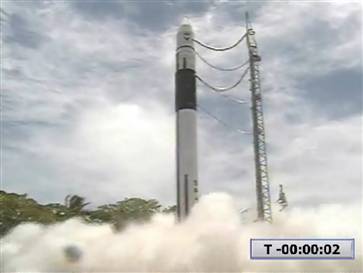
SpaceX’s second demo flight was a success, reaching 300 km in altitude. The first stage went well, but then contact was lost. As always, SpaceFlightNow.com gave us the news as it unfolded:

Some quotes from the media briefing with Elon Musk following tonight’s launch:

Question: what is the fate of the second stage?

"We didn’t achieve the desired orbit. But at this point I don’t exactly know the fate of the second stage. We got to 300 km. That’s about all I know at this point."

"All that I can say for sure right now is it’s not in the intended orbit. The likelihood is that it re-entered after probably half an orbit or so."

"The roll-control anomaly did cause the second stage to shut off prematurely. So that’s not achieving the intended orbit. However, I would say we’ve retired probably in excess of 90 percent of risk associated with the rocket. And it is worth noting, this was a test launch not a satellite launch."

Elon Musk‘s brother said it best via this blog post. More photos here.


He’s right: entering space is a success — all the riskiest aspects were well done. They’ll probably learn much from this experience and the next one will be perfect. Hey, they might even be able to recover the first stage and use it again!


Lots in Alaska for… Free?

Monday, March 19th, 2007


Rocket scientists looking for a cheap place to crash might want to check out the friendly hamlet of a recent AP report, the town is giving away land in a fashion reminiscent of the old Homestead Act of the 1862. Here’s the skinny direct from the city’s web page on the give away:

"The City of Anderson is selling up to twenty-six lots at no costs starting March 19, 2007 at 9:00 AM. Applications will be selected on a first come, first served bases. A $500.00 refundable deposit will be required at the time of application. Applicant will be required to build a residential home within 2 years from date of signed agreement. Other covenants and restrictions apply. Lots are 1.3 acres in size, electrical and phone has been installed. In April, the city council will hold a lot selection meeting for applicants to select their individual lots, based upon the first come, first served criteria. For more information contact the city clerk @ 582-2500 or [email protected]."

Supposedly those who are already up there or proxies in the area are most likely to get access to the lots, since the Post Office doesn’t deliver mail to city offices until after noon.

So why might Rocket Scientists be up for cold (but free) Alaska winters? Well, it seems the Clear Air Force Station is located not too far away from the free lots, making them ideal cheap digs for those looking up and listening to the night sky for Uncle Sam. While it might not be northernmost military base in the US (that honor belongs to Thule Air Base in Greenland), its certainly among the coldest. Hey, at least its neighboring communities are pretty hospitable, right?  Look, residents can even participate in the Nenana Ice Classic (just 20 miles from Clear AFS), that lets people win if they guess when the ice in the Tanana River finally moves out.  Watching ice melt… talk about a good time!

DIY Friday: Build Your Own HDTV on the Cheap

Friday, March 16th, 2007

Last November we told you how to make your own HDTV antenna for next to nothing, but once you get your antenna on the roof you going to need an HD display to get the picture, right?


Well, not so much. As we also said in November, the monitors necessary to see the sneaker scuffs on on the boards of your favorite team’s NCAA tournament game (which will no longer includemy alma mater — thank you very much, Villanova) are usually the expensive part of the HDTV conversion, but if you have a spare (decent) PC/Mac lying around you could just make it your required monitor. What we didn’t share with you in November was the number of tuners (super tiny ones at that) that can help you grab the signal coming from your antenna even when your on your laptop.

While the ATI TV Wonder 650 might be considered old faithful, it is, after all, a card designed to be inserted into your PC meaning you’re pretty much stuck watching television on your desktop. If you’re looking for a more mobile experience (and don’t mind watching TV in your hotel room while holding an aerial), you should check out the crazy small Fuji PLUS FD-USB728 USB 2.0 Interface USB HDTV ATSC/NTSC TV Tuner For PC&Notebook (right). Designed specifically for your laptop, the Fuji PLUS seems to be the for anyone looking to see television the way it was meant to be watched from anywhere in the country.

Oh and what if you’re a mac user, like yours truly? Well, have no fear, the four-and-a-half Macworld mouse-rated Miglia TVMini HD is here for your viewing pleasure, complete with Elgato Systems‘ award winning EyeTV 2 software (although if you’re interested in this feature, buy it as fast as you can, because Elgato seems to have just yanked Miglia’s distribution liscense for the software), which lets you schedule recordings and turn your saved shows into DVD and Video iPod-compatible formats.

Google Selling Ads on Dish Network

Monday, March 12th, 2007

We blogged about what Google may have up its sleeve before, so naturally we were intrigued by what VentureBeat.com picked up from The Wall Street Journal last Saturday:

Google is about to sign a deal with Dish Network, the nation’s second largest satellite TV company, to deliver ads for Dish’s network, VentureBeat is hearing.

We haven’t been able to confirm the rumor (Google has not yet responded to a request for comment).

In an effort to extend its growing advertising empire to television, Google has already started a pilot project in Concord, Calif. to deliver ads to cable television subscribers, it was revealed in yesterday’s WSJ.

The latest reports are significant because they suggest Google may be on its way to cracking the huge television market, to deliver a very different kind of ad to peoples’ living rooms. Dish is the nation’s leader in high definition and interactive TV programming. Google’s TV ads, like the ones Google distributes already to Internet sites, would be delivered more efficiently — targeted more closely to the content of the TV programming being watched, and more relevant to the people actually watching it — or at least, that is Google’s intent.

The Mountain View search engine is already making more than $10 billion from online ads. The U.S. television advertising market is about $55 billion, and so is a juicier target than even the Web.

According to the WSJ Saturday, Google has begun a test run serving up TV commercials to cable subscribers of Astound Broadband in Concord, Calif. In this deal, as in the one with Dish, Google is expected to purchase TV spots in advance, and then insert its own advertising — supplied by its advertising clients — so that it looks much like it does today. The difference is, Google would be the powerbroker.

It is unclear, however, how Google would access information about TV households in order to target its ads, without raising significant privacy concerns. But a Dish partnership is notable because of how interactive the Dish experience has become. Users already use keywords to search for programming, choose themes they like and create custom guides — all indicators of personal taste. Dish and Google might be able to obtain permission from users to exploit such information. Google could then work with any number of technology providers to help it automatically insert relevant ads into the programming.

Read more about this concept of "mass personalization" on the ITVT blog. Once you get into the details, I think you’ll agree this is not Spotrunner, which sounds more like a buying agency.

Insat 4B and Skynet 5A Launched by Ariane 5

Sunday, March 11th, 2007

The news from Arianespace

Coup double pour Arianespace / Mission réussie pour Skynet 5A et Insat 4B

Dans la nuit du dimanche 11  au lundi 12 mars 2007, Arianespace a mis en orbite de transfert géostationnaire deux charges utiles : le satellite de télécommunications militaires Skynet 5A pour le Ministère britannique de la Défense (MoD) et le satellite de télécommunications civiles Insat 4B pour l’Agence Spatiale Indienne (ISRO).

Trente-et-unième lancement d’Ariane 5, dix-septième succès d’affilée.


Sounds a lot better than the English translation:

Arianespace begins its 2007 mission activity with a successful dual-payload launch

Ariane 5 underscored its mission capability and operational maturity with tonight’s successful dual-passenger mission, which placed the Skynet 5A and INSAT 4B satellites into geostationary transfer orbit.

The March 11 mission was Ariane 5’s 31st liftoff from the Spaceport and the launch vehicle’s 17th consecutive success.

Lifting off from the Spaceport in French Guiana, the Ariane 5 deployed Skynet 5A at 26 minutes into the mission, followed four minutes later by INSAT 4B.

"With this first launch of the year 2007, Arianespace has once again demonstrated its leadership," said CEO Jean-Yves Le Gall. "The satisfaction of every customer is our keyword, offering the best possible Service & Solutions to each one."

Time Travel?

Tuesday, March 6th, 2007


Read on slashdot.org this morning:
PreacherTom writes
"Scientists at the NEC Research Institute in Princeton, NJ are reporting that they have broken the speed of light. For the experiment, the researchers manipulated a vapor of laser-irradiated atoms, causing a pulse that propagates about 300 times faster than light would travel in a vacuum. The pulse seemed to exit the chamber even before entering it."
This research was published in Nature, so presumably it was peer-reviewed. It’s impossible from the CBC story to determine what is being claimed. First of all they get the physics wrong by asserting that Einstein’s special relativity only decrees that matter cannot exceed the speed of light. Wrong. Matter cannot touch the speed of light in vacuum; energy (e.g. light) cannot exceed it; and information cannot be transferred faster than this limit. What exactly the researchers achieved, and what they claim, can only be determined at this point by subscribers to Nature.

Satellite Distributed Movies Set to Emerge in 2007

Monday, March 5th, 2007

While the technology has been talked about for years, many experts are positioning 2007 as the year that digital movies and satellite distribution of box-office blockbusters take flight. Working in conjunction with Warner Bros. Entertainment and Universal Pictures, Digital Cinema Implementation Partners (made up of big name theater companies AMC, Cinemark and Regal) is working to "use satellite and broadband delivery systems to beam digital films directly to theaters, rather than have them copied onto hard drives and delivered by hand, as they usually are now."

While the theater chains and studios are looking at the technology as a great way to decrease the likelihood of piracy (the theory being that encrypted satellite transmissions would mean fewer hands are on the prints), it could also mean improved access to popular films and big screen showings of smaller films that struggle for an audience large enough to usually get them. As the AP article about the technology notes that satelite distribution,

"would give U.S. theater operators the flexibility to put a popular movie on an extra screen as quickly as the demand arises… At the same time, theater operators could stop showing a surprisingly unpopular film and even book an art-house film with a small but devoted audience for a day or two."

While Variety and Hollywood are explicitly concerned with the digital cinema’s implications for the US market, the Hindustan Times points out that the technology may be even more welcome throughout the developing world where, although movie theaters are plentiful (with over 12,500 movie houses throughout India alone), the relatively small number of "prints" (sometimes only 500) available of any given film arbitrarily limits distribution.