Archive for the ‘Front Page’ Category

DIY Friday: Beer Launching Fridge!

Friday, March 2nd, 2007

Real rockets scientists are obsessed with launches. There’s something about cylindrical metal objects flying through the sky that captures our imagination.

Beer captures our imagination, too, which is why today’s DIY Friday combines two great obsessions into one lazy invention: the Robotic Beer Launching Refridgerator!

John W. Cornwell, a student at Duke University, invented this contraption — which we are certain history will rank alongside the printing press and the remote control for its impact in changing our lives for the better. He writes

Have you ever gotten up off the couch to get a beer for the umpteenth time and thought, "What if instead of ME going to get the BEER, the BEER came to ME???" Well, that was how I first conceived of the beer launching fridge. About 3 months and several hundred dollars later I have a fully automated, remote controlled, catapulting, man-pit approved, beer launching mini-fridge. It holds 10 beers in its magazine with 14 more in reserve to store a full case. It is controlled by a keyless entry system. Pressing unlock will start the catapult rotating and when it is aiming at your target, pressing unlock again will stop it. Then the lock button can be pressed to launch a beer in the selected direction….

To everybody who is asking about price, the BLF took me at least a hundred hours to build, as well as several hundred dollars worth of parts. I would put the price at about $2500 to build ONE.

The photos posted on Cornwell’s website reveal pure engineering genius, though for a while we puzzled why the the "magazine" only holds 10 cans of beer when they are sold in 12 packs.

The answer, of course, is that you and your buddy drink one while you load the fridge with beer.

Wok TV System

Thursday, March 1st, 2007

Love this story about Kiwi ingenuity from the New Zealand Herald:
$10 wok keeps TV station on air

Why pay $20,000 for a commercial link to run your television station when a $10 kitchen wok from the Warehouse is just as effective?

This is exactly how North Otago’s newest television station 45 South is transmitting its signal from its studio to the top of Cape Wanbrow, in a bid to keep costs down.

45 South volunteer Ken Jones designed the wok transmitter in his spare time last year when he wanted to provide wireless broadband to his Ardgowan home.

"A group of us wanted to connect our computers to each other and then we worked out a way to get of getting the signal between two points," he said.

He discovered satellite dishes were between $100 to $400 retail and that smaller dishes, the same size as a wok, were $80.

Mr Jones thought he could do better.

Along with friend Murray Bobbette they worked out mathematical equations to prove the curved metal face of a wok would have the same effect as a small satellite dish.

"We have spent a lot of time getting it right — the first time we installed one we had it up a pole with the handle still on the end of the wok," he said.

"We had it connected to the woolshed and initially you couldn’t get a signal the width of the paddock and now it can reach up to 20km."

When the television station 45 South (UHF channel 41) started up in September last year, Mr Jones thought the same technique could be applied.

"The $20,000 for a commercial link was just money we didn’t have, so we bought several woks from The Warehouse instead which was convenient and cheap," he said.

Pre-recorded clips at the studio are fed through a computer and beamed to Cape Wanbrow where they are relayed off to television sets around North Otago.

The classic case of Kiwi ingenuity has made its way onto the internet and the technique has been posted by an American website, Mr Jones said.

"People wanted to know all the details about how to make their own, so it is now all publicly documented," he said.

One of the issues they had to deal with was making the pole that the wok sits on high enough to clear the Kingsgate Brydone Hotel.

Of course, this story found it’s way to Make a day after it was published.

To Pluto at 52,000 MPH

Wednesday, February 28th, 2007

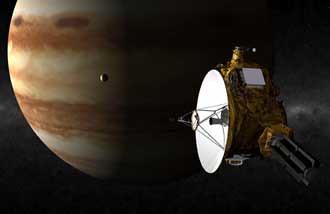
The New Horizons spacecraft used Jupiter’s gravitational pull to increase its speed by 9,000 MPH to a total of 52,000 MPH, as reported by Alex DeMetrick at WJZ in Baltimore:

Heading To Pluto With Help From Jupiter

LAUREL, Md. There are all kinds of test drives, but only one at 52,000 miles per hour.

That’s the speed scientists here in Maryland are aiming for and as Alex DeMetrick reports, the test track is Jupiter.

Man’s first journey to Pluto left a little over a year ago. But for the New Horizons Spacecraft to get there, it’s difficult.

"There’s this little keyhole the spacecraft must reach," Dr. Hal Weaver from the Hopkins Applied Physics Lab said.

That little keyhole just happens to be the biggest planet in the solar system. Jupiter is the spacecraft’s turbo charger, guided by controllers at Hopkins Applied Physics Lab in Laurel.

"We’re using Jupiter as a catapult. By passing fairly close to Jupiter, it’s going to sling-shot us faster toward Pluto. We’re gaining 9,000 miles per hour," Weaver said.

It’s man’s fastest vehicle. While passing by, instruments will be checked out, observations made, including a ride down the planet’s massive magnetic tail.

New Horizons will train its instruments on Pluto in a fly-by in 2015. That’s a long time, but scientists hope it will get there thanks to Jupiter’s assistance.

Not only will New Horizons provide scientists with their first close look at Pluto, the spacecraft will also continue on into the Kuyper belt in search of other Pluto-type objects.


That spacecraft was speeding from the moment it was launched. Watch this launch video and you’ll see the camera operator had trouble keeping up with it:

Anti-Jamming Technology Goes Commercial

Tuesday, February 27th, 2007

The Times reported yesterday that Boeing is looking to put anti-jamming technology previously reserved only for the military on commercial satellites used by business and the communications industry. According to the article,

"Anti-jamming technology is already used by military and spy satellites, but proposals to install similar protection in the 250 large satellites in commercial operation have been prompted by the threat of disruption.

The successful jamming of video, data, or voice signals by individuals or groups could jeopardise the millions of dollars spent on just a handful of satellites, operators fear.

Such jamming of government navigation satellites has already occurred, according to Lieutenant General Robert Kehler of the US Air Force, ‘as has jamming of commercial telecommunications satellites.’"

Space.com has a great background report on Spy Satellites for those who want to know a little bit more about the technology and the American Military and Intelligence communities uses of the technology. While Spy Satellites have been used for quite a long time, even the latest anti-jamming technologies are unable to prevent detection, the spy satellite holy grail. While satellite project, such as MISTY, have been able to avoid detection by laser and microwave radar, none has been able to completely avoid visible detection, a limitation which has prompted the emergence of a small, but strong spy satellite monitoring enthusiast community.

Oh, and for those of you who might be worried about the commercial anti-jamming technologies making it into the wrong hands, it looks like your not alone. While Boeing seems confident that they’ll win it, the U.S. government does have to approve the use of the "top secret" anti-jamming technology on commercial satellites before the company can start introducing it on products sold to foreign customers.

DIY Friday: USB Charger Kit

Friday, February 16th, 2007

No matter how cool gadgets get — and whether you buy them or make them yourself — battery life is still the barrier that reminds us that cool stuff only remains cool so long as the juice is flowing.

Unfortunately, toting around all the different chargers that one needs to keep cameras, MP3 players, cell phones and other gadgets going can be a pain in the posterior.

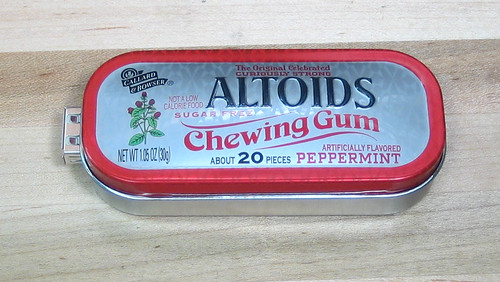
And so for today’s edition of DIY Friday, we present to you…. (drumroll)….. a tin of Altoids!

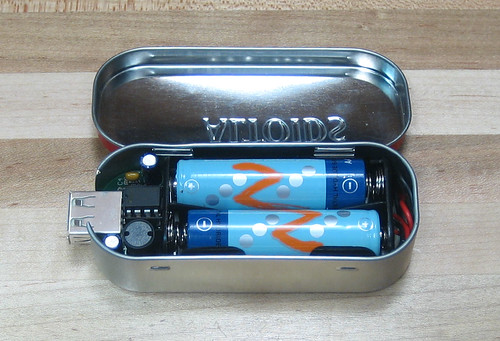
Ok, not quite. Close observers will notice that little USB port over on the left. Open up the tin, and this is what you’ll find:

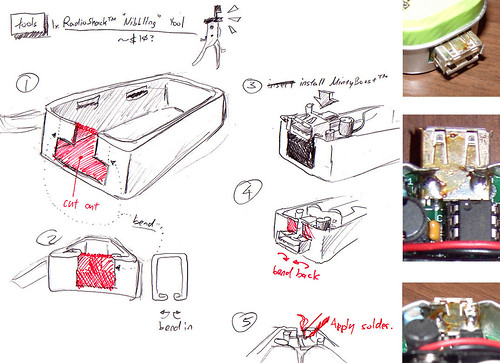
The inner workings of a DIY USB Charger Kit, made from this schematic:

What’s that? Need more detail, you say? Complete details on how to make your own USB charger kit for your personal gadgets — with or without the handsome Altoids case — can be found here. An even quicker way to jumpstart your weekend project is to buy this kit from Make magazine. For only $20 plus shipping and a few hours of your time, you can have your own portable way of recharging your gadgets without towing around a bevy of chargers and cords.


Detecting Debris in Space

Tuesday, February 13th, 2007


Just last week we wrote about the International Space Station needing to manuever to dodge junk in space — or, specifically, the debris from the disused satellite that the Chinese recently shot down in a military experiment.

Thus it’s a bit ironic, as NewScientistSpace points out, to learn that the "only experiment designed to survey and trace the origin of space debris too tiny to be tracked by radar has been cancelled:"

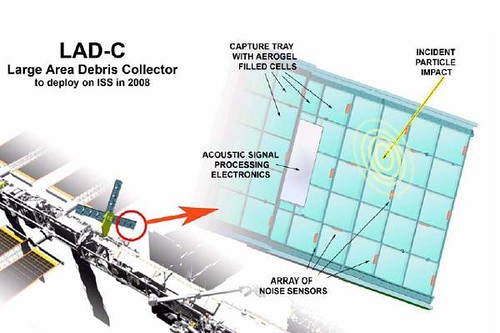
An international team of scientists had been planning to capture and catalogue this dust from outside the International Space Station with an experiment called LAD-C (Large Area Debris Collector). Meant to be launched on a shuttle in 2008, LAD-C was going to catch the debris in a sponge-like aerogel mounted on a 10-square-metre aluminium grid.

When a piece of space debris hit the aerogel, it would have sent vibrations along the metal grid, where piezo sensors similar to the ones in electronic drum kits would have picked up the signal.

A computer would have registered the location, impact speed and timing of the strike, and based on the orientation of the space station, this would have given the particle’s orbital trajectory. Researchers would then know whether it came from space junk, an asteroid or a comet, and would be able to study its composition when the experiment was brought back to Earth in 2009…

The cancellation of LAD-C collector (additional details of which can be found here, in this PDF) comes at a strange time, NewScientist argues:

The cancellation coincides with the most dangerous orbital debris event in the history of space launches. On 11 January, China destroyed one of its own weather satellites with a ground-launched ballistic missile, creating more than 900 objects larger than 10 cm across and an estimated 35,000 smaller objects spanning at least 1 cm. The debris spread throughout low-Earth orbit, from altitudes of 200 to nearly 4000 kilometres, and is expected to stay in space for hundreds of thousands of years. 

Without the LAD-C, how will rocket scientists keep up with all the debris in space?

Why, by reading the Orbital Debris Quarterly, of course.

Meanwhile, this rockets scientist has been told by his supervisor (at home, not in the office) that our own personal LAD-C is operational and should in fact be deployed. 

Sofa Surfing on IPTV

Monday, February 5th, 2007

WebTV sucked and still sucks today despite being re-branded as MSNTV. Sure, it can get Grandma and Grandpa on the net and emailing the little Emma and Jack, but a new PC could do 20 times as much for just twice the price, making the sweetness of surfing on your big screen a little less logical. At $199.99 before service charges, WebTV may feel like a deal, but when Gramps gets frustrated by the limitations of the tiny device you’re going to have to get him a PC anyway, so why not bite the bullet and start things off right?

Well, even in light of the limits of WebTV and its Redmond-designed demon offspring, it isn’t to say that it wouldn’t be useful from time-to-time to surf the net from the comfort of your La-Z-Boy on your big screen.

Just imagine yesterday’s gridiron festivities with the aid of some Internet: Don’t really know what SalesGenie.com does judging from its cheesy ad? Just click the web button on your remote and — zip — there you are, visiting the site that’s set to bring spamming and direct dial marketing to anyone willing to pony up a couple hundred bucks a month.

Seems like a touchdown for me and my laziness (look, Mom, no laptop!) and even bigger boon for advertisers looking to get (and tracK) results from expensive ad buys. But can such a service be found?

The short answer is, yes, the technology’s already here, although you may need to wait a couple of years until it reaches your own plasma, HD display. This technological valhalla of laziness, known as IPTV, is new-ish, Internet Protocol-based (thus IP-tv) technology that seeks to transmit your favorite television channels over same thick, broadband pipe that you already get your Internet and maybe even your telephone service through.

While you can already get IPTV in a select number of markets in the US (e.g. some areas in Chicago, some schools in California), most are saying the US transition isn’t coming fast enough, with France with nearly 600,000 and Hong Kong with over 700,000 subscribers to IPTV-based services easily wining the competition for market penetration of the new technology. That said, some our saying America’s delay might be a good thing for certain big-name American networking firms, such as Cisco Systems, who stand to do extremely well, as broadband Internet providers start needing to upgrade their network infrastructure to handle the millions of gigabytes IPTV’s video will demand. Just check out the Robert Scoble’s interesting interview with the networking technology company’s CEO, John Chambers.

While it’s currently uncertain how this new technology will make its way into the market, as it competes with some of the older, television delivery formats, the full-scale launch will definitely be something interesting to watch.

SES & Cisco Help Reach the Last Mile

Monday, February 5th, 2007

The news is just starting to filter out, but today SES-Americom announced a major partnership with Cisco Systems to bring affordable television and video content to the millions of citizens in rural America using the Internet through the National Rural Telephone Cooperative. The video coursing through this new service will be provided by SES own IP-PRIME, of course. This is exciting news (and not just because we’re directly affiliated with SES), representing a real step-forward in getting Internet services down to infamous "last mile" consumers that often don’t get access to the communication services that many of us take for granted in more urban areas.

Some of the largest adopters of satellite television technology, man "country folk" around the US have been left out of the explosion in high speed, two-way internet services that are de rigueur in the our cities and suburbs. While satellite Internet technology is available, its speed is often hampered by dial-up upload speeds (which include telling your browser where you want to go) ultimately limiting its speed. Advancements in IPTV and joint-ventures like this deal provide additional incentive to get high-speed, wired internet connections to those who often feel isolated, geographically and socially, from the rest of the country and ultimately ensures that everyone, whether they live on the island of Manhattan or in Manhattan, KS, gains speedy access to the network that’s changing our lives.

For more infromation, you might want to check out blogger Robert Scoble’s interview with Cisco CEO John Chambers about the IPTV below or, via Networkworld, see how the system demoed in Europe last week.

Head Off to Titan!

Thursday, February 1st, 2007

If you’re looking for cool images from space on the web today, there’s probably no more interesting place to be than the Cassini-Huygens homepage, which has newly-released images of a huge cloud system covering the north pole of Titan.

The images can also be seen on the Visual and Infrared Mapping Spectrometer instrument homepage, which also has detailed information on the technology behind Cassini’s observations:

VIMS has several unique capabilities. It is able to identify the chemical composition of a surface, atmosphere, or Satrun’s rings by measuring the visible and infrared energy. VIMS is, in essence, a color camera that takes pictures in 352 different wavelengths between 300 nm and 5100 nm. This range, coupled with the ability to discern different wavelengths (called spectral resolution), allows the VIMS instrument to be able to very accurately quantify the light it detects.

It’s also well worth checking out the flash animation that NASA’s Jet Propulsion Laboratory has up on their website, summarizing what is known about Titan, largely throught the observations of Cassini.


EGOGRAM 2007

Wednesday, January 31st, 2007

Friends, Earthlings, ETs — lend me your sensory organs!

I send you greetings and good wishes at the beginning of another year. I’ll be celebrating (?) my 90th birthday in December – a few weeks after the Space Age completes its first half century.

When the late and unlamented Soviet Union launched Sputnik 1 on 4 October 1957, it took only about five minutes for the world to realise what had happened. And although I had been writing and speaking about space travel for years, the moment is still frozen in my own memory: I was in Barcelona attending the 8th International Astronautical Congress. We had retired to our hotel rooms after a busy day of presentations when the news broke — I was awakened by reporters seeking comments on the Soviet feat. Our theories and speculations had become reality!

Notwithstanding the remarkable accomplishments during the past 50 years, I believe that the Golden Age of space travel is still ahead of us. Before the current decade is out, fee-paying passengers will be experiencing sub-orbital flights aboard privately funded passenger vehicles, built by a new generation of engineer-entrepreneurs with an unstoppable passion for space (I’m hoping I could still make such a journey myself). And over the next 50 years, thousands of people will gain access to the orbital realm – and then, to the Moon and beyond.

During 2006, I followed with interest the emergence of this new breed of ‘Citizen Astronauts’ and private space enterprise. I am very encouraged by the wide-spread acceptance of the Space Elevator, which can make space transport cheap and affordable to ordinary people. This daring engineering concept, which I popularised in The Fountains of Paradise (1978), is now taken very seriously, with space agencies and entrepreneurs investing money and effort in developing prototypes. A dozen of these parties competed for the NASA-sponsored, US$ 150,000 X Prize Cup which took place in October 2006 at the Las Cruces International Airport, New Mexico.

The Arthur Clarke Foundation continues to recognise and cheer-lead men and women who blaze new trails to space. A few days before the X Prize Cup competition, my old friend Walter Cronkite received the Foundation’s Lifetime Achievement Award. I have known Walter for over half a century, and my commentary with him during the heady days of the Apollo Moon landings now belong to another era. A space ‘pathfinder’ of the Twenty First Century, Bob Bigelow, was presented the Arthur C. Clarke Innovator Award for his work in the development of space habitats. With the successful launch of Bigelow Aerospace’s Genesis 1, Bob is leading the way for private individuals willing to advance space exploration with minimum reliance on government programmes.

Meanwhile, planning and fund raising work continued for the Arthur C. Clarke Center "to Investigate the Reach and Impact of Human
Imagination", to be set up in partnership with the University of Nevada, Las Vegas. Objective: to identify young people with robust imagination, to help their parents and teachers make the most of that talent, and to accord imagination as much regard as high academic grades in the classroom – anywhere in the world.  The Board members of the Clarke Foundation, led by its indefatigable Chairman Tedson Meyers, have taken on the challenge of raising US$ 70 million for this project. I’m hopeful that the billion dollar communications satellite industry I founded 60 years ago with my Wireless World  paper (October 1945), for which I received the astronomical sum of £15, will be partners in this endeavour.

I’ve only been able to make a few encouraging noises from the sidelines for these and other worthy projects as I’m now very limited in time and energy owing to Post Polio. But I’m happy to report that my health remains stable, and I’m in no discomfort or pain. Being completely wheel-chaired helps to concentrate on my reading and writing – which I can once again engage in, with the second cataract operation restoring my eyesight.

During the year, I wrote a number of short articles, book reviews and commentaries for a variety of print and online outlets. I also did a few carefully chosen media interviews, and filmed several video greetings to important scientific or literary gatherings in different parts of the world.

I was particularly glad to find a co-author to complete my last novel, The Last Theorem, which remained half-written for a couple of years. I had mapped out the entire story, but then found I didn’t have the energy to work on the balance text. Accomplished American writer Frederik Pohl has now taken up the challenge. Meanwhile, co-author Stephen Baxter has completed First-born, the third novel in our collaborative Time Odyssey series, to be published in 2007.

Members of my adopted family — Hector, Valerie, Cherene, Tamara and Melinda Ekanayake — are keeping well. Hector has been looking after me since 1956, and with his wife Valerie, has made a home for me at 25, Barnes Place, Colombo. Hector continued to rebuild the diving operation that was wiped out by the Indian Ocean Tsunami of December 2004. Sri Lanka’s tourist sector, still recovering from the mega-disaster, weathered a further crisis as the long-drawn civil conflict ignited again after more than three years of relative peace and quiet. I remain hopeful that a lasting solution would be worked out by the various national and international players engaged in the peace process.

I’m still missing and mourning my beloved Chihuahua Pepsi, who left us more than a year ago. I’ve just heard that dogs aren’t allowed in Heaven, so I’m not going there.

Brother Fred, Chris Howse, Angie Edwards and Navam Tambayah look after my affairs in England. My agents David Higham Associates and Scovil, Chichak & Galen Literary Agency deal with rapacious editors and media executives. They both follow my general directive: No reasonable offer will even be considered.

I am well supported by my staff and take this opportunity to thank them all:
Executive Officer: Nalaka Gunawardene
Personal Assistant: Rohan De Silva
Secretary: Dottie Weerasooriya
Valets: Titus, Saman, Chandra, Sunil
Drivers: Lalith & Anthony
Domestic Staff: Kesavan, Jayasiri & Mallika
Gardener: Jagath

Let me end with an extract from my tribute to Star Trek on its 40th anniversary – this message is more relevant today than when the series first aired in the heady days of Apollo: “Appearing at such a time in human history, Star Trek popularised much more than the vision of a space-faring civilisation. In episode after episode, it promoted the then unpopular ideals of tolerance for differing cultures and respect for life in all forms – without preaching, and always with a saving sense of humour.”

Colombo, Sri Lanka
28 January 2007