Archive for the ‘NASA’ Category

Rugby Fever

Monday, October 15th, 2007

This might be a stretch topic for this blog, but after Saturday’s game I just can’t stop thinking about Rugby. England had an improbable win over France on Saturday to reach the finals:

Even though it was achieved by five points this time, the England rugby team’s victory over France in Saturday’s semi-final was every bit as racked with nerve-shredding tension as last weekend’s two-point scramble over Australia.

By the end, there was barely enough energy left in the collective spirit to wander out into the street outside the pub and salute the triumph with a verse of Jerusalem. And if everyone was as drained as this just by watching, imagine how the players must have felt.

Actually, they must have felt wonderful. Exhausted, but vindicated; there can be no better combination for the sportsman than knowing that all that effort has reward.

Never in English sporting history can there have been a turnaround like theirs: a month ago, in defeat by South Africa, they were dismissed as hopeless and hapless, now they are mean and magnificent. Their self-belief has apparently been forged from tungsten.

The highlights:

I’m not the only person that is excited. ThisLondon describes the scene in England as the “The Great Ticket Scrum.” Tickets are going for “between £1,000 and £4,000 each – up to 13 times their face value.” The Eurostar train to Paris is sold-out and hotels rooms for Saturday’s final (the few that remain) are “advertised at between four and ten times their usual rates.”

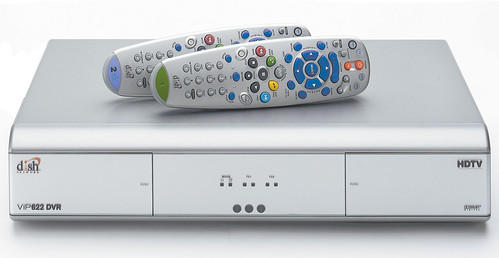
Do you have the fever, yet? If yes — and if you don’t want to enter the ticket-scrum or rely on YouTube highlights, you better explore your pay-per-view options for Saturday’s final against South Africa. Dish Network and DirecTV will both offer the game for $25 and $30, respectively. iN DEMAND is offering the game for Cable subscribers. The fees will depend on you local provider.

Normally, European rugby games can be seen on Setanta Sports, a small but rapidly growing network. For this most-epic of games, Setanta will only be offering a tape-delayed broadcast on its network, plus a live pay-per-view web-stream. Setanta has an interesting story:

Setanta Sports was formed due to the football passion of its co-founders Michael O’Rourke and Leonard Ryan. Living in London and frustrated at the lack of live coverage in London of the Ireland v Holland World Cup clash in 1990, the two negotiated broadcasting rights and put the event on in Ealing. A thousand like-minded fans turned up and Setanta Sports was born. The word ‘Setanta’ is taken from one of Ireland’s great heroes, ‘Cúchulainn’, which means the ‘hound of Cullan’. As a child, this great hero’s name was ‘Setanta’ meaning ‘the little’. He was given the name Cúchulainn when he killed the fearsome watchdog of the smith Cullan, by hitting a sliotar (the small ball used in hurling) down the animal’s throat. Having killed the watchdog, he undertook to guard Cullan’s house in place of the hound.

With all this buzz, these broadcasters are cashing in. According to Jim McDonald, head of broadcast at MPG, the media planning agency, ITV (the network airing the games in London) has already boosted its income by about £2m.

“As for the final itself, I should think we are looking at £5m-£6m potentially in the additional value of the air time. ITV’s predictions were very conservative and were based on the England team only reaching as far as the quarter finals.”

Enjoy the game.

See You: Entavio Ads on TV

Friday, October 5th, 2007


The new Entavio ads running in Germany remind me of the Mac vs. PC ads in the U.S. Here’s a collection of 15 ads from Apple, spliced together in one video:


Entavio was officially introduced at the IFA show in Berlin. And now the Entavio ads. Although it’s in German, I get the message.

1. BluCom

2. Smartvest

3. Hotline

4. Receiver

Drop The Puck: Here Comes the Hockey Channel

Thursday, October 4th, 2007


The NHL opens its season tonight, with my team, the New York Rangers, taking on the Florida Panthers at Madison Square Garden. The MSG channel will have it in HD, but it would be cool if Dish Network carried the new NHL channel.

Here’s the news, via Multichannel News:

NHL Scores First Carriage Deal

Time Warner Cable to Launches Network on Sports Tier

By R. Thomas Umstead — Multichannel News, 10/4/2007 1:45:00 PM

The National Hockey League has finally joined the three other major pro sports leagues in distributing its own 24-hour sports network.

Time Warner Cable announced Thursday that is offering the NHL Network on its sport tier. The deal marks the first time the network, which launched in Canada in 2001, will be offered to U.S. cable subscribers.

The network will offer 50 live regular-season games, in addition to classic games, documentaries, instructional shows, highlights and more.

NHL executives could not be reached for comment to determine if any other MSOs are expected to launch the service, which officially launched in the U.S. Oct. 1.

The NHL joins the National Football League’s NFL Network, the National Basketball Association’s NBA TV and Major League Baseball’s soon-to-be launched MLB Channel as leagues with 24-hour sports services.


Hockey may be criticized for fighting, but it’s an honorable system. Take this one, for example:


AT&T Buying EchoStar

Friday, September 28th, 2007

What, again? It’s been mentioned before, but according to TheStreet.com, AT&T will eventually get the deal done and end up buying EchoStar:

AT&T’s (T) long-running discussions with EchoStar (DISH) seem to be heating up.

The most recent talks have AT&T offering $55 a share with EchoStar hoping to hold out for $65 a share, say people familiar with the companies. Sensing a deal in the works, Oppenheimer analyst Tom Eagan raised his rating on the Dish satellite broadcaster to a buy, speculating in a research note Thursday that AT&T would likely pay about $56 a share for the TV service.

AT&T didn’t comment, and EchoStar declined to comment.

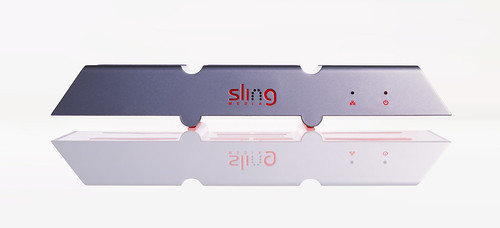
On Tuesday, EchoStar said it would pay $380 million for TV-over-the-Internet device maker Slingbox and possibly split the company into two publicly traded units. One operation would be the consumer TV service that AT&T is interested in, and the second would be EchoStar’s wholesale satellite transmission service.

The Slingbox device would be part of the consumer service and could be a key offering down the road as new radio wave spectrum becomes available to so-called open standard devices, says one person familiar with the companies.

The move would also help AT&T bolster its disappointing video effort. Project Lightspeed, a fiber optic network expansion plan to deliver a triple play of TV, Net and phone service under the U-verse brand, has been plagued by technology glitches including slow channel changing speeds. AT&T says its channel-changing speed is "fast" and "gets high marks" from users.

AT&T has partnered with EchoStar to offer satellite TV as part of a product bundle to battle cable companies that compete with triple play offerings of their own.

Dish shares rose 56 cents to $44.03 and AT&T was up 6 cents to $42.89 in early trading Thursday.

Click here to watch the video.

Personal Distant Locals via Satellite TV

Tuesday, September 25th, 2007


Us rocket scientists love our Slingboxes. Whether at 35,000 feet, at a baseball game or hooked up as a traffic webcam. Our friends at Dish Network like them enough to buy them for $380 million, according to Transmitter News:

EchoStar Communications Corporation has agreed to acquire Sling Media, Inc., a privately-held digital lifestyle products company. EchoStar, through its DISH Network®, is the third largest pay-TV provider in the United States. The transaction values Sling Media at approximately $380 million and is payable in cash and EchoStar options. The transaction is subject to customary closing conditions, and is expected to close in the fourth quarter of 2007.

Established in 2004, Sling Media has been a leading innovator in the digital lifestyle space through the introduction of the internationally-acclaimed, Emmy award-winning Slingbox™ and SlingPlayer™ software. Sling Media’s product line is distributed in over 5,000 retail stores in 11 countries.

In 2006, Sling Media created the Sling Entertainment Group with the mission of developing entertainment experiences and business models that reach beyond the Slingbox. The group also fosters and manages relationships with content creators and owners. Its first initiative, Clip+Sling™, dramatically changes the way consumers socialize around TV by enabling users to clip and share limited segments of their favorite television programming.

“As an early investor in Sling Media, EchoStar has been pleased with the progress and commitment the company has made establishing Sling Media and the Slingbox as powerful and beloved digital media brands,” said Charlie Ergen, CEO and co-founder of EchoStar. “With today’s increasingly mobile lifestyle, EchoStar’s acquisition of Sling Media will allow us to offer innovative and convenient ways for our customers to enjoy their programming on more displays and locations, including TVs, computers and mobile phones, both inside and outside of the home. This combination paves the way for the development of a host of new innovative products and services for our subscribers, new digital media consumers and strategic partners.”

“We are psyched to make this announcement. We have worked closely with EchoStar for more than two years, and have come to realize that both companies have similar entrepreneurial cultures and mutual dedication and passion for creating empowering experiences that benefit the consumer and the media industry,” said Blake Krikorian, co-founder, chairman and CEO of Sling Media. “By combining strategies, resources and technologies with EchoStar, Sling Media will be able to rapidly expand our open multi-platform product offerings, not only for DISH Network subscribers, but for digital media enthusiasts around the globe.”

Scott Greczkowski is asking the right questions: 

Last night’s late announcement that Echostar is acquiring Sling Media did not come as a big surprise to me. And while it did not surprise me it did set off a few flags in my head.

1)      Will DISH Network keep Sling as a separate company or would they bring the technology and the company in house?

2)      Sling Media is a Partner with DIRECTV and the NFL for delivering the NFL Sunday Ticket online, how will this deal affect this setup?

3)      There are a number of other companies who are invested in Sling Media including the soon to be parent company of DIRECTV, Liberty Media. How does this deal affect them?

4)      What is going to happen to unreleased products such as the Sling Catcher?

5)      When will we see the first receiver from Echostar that has built in Slingbox functionality?

I personally hope that DISH continues to allow Sling Media to be Sling Media, a separate company, a company with some amazing thoughts and ideas.

I personally own 3 Slingbox units and I honestly consider it to be the best consumer electronics device made so far in the 21st century! No matter where  I am at I can watch and I can control all of my satellite receivers, I can even watch and control things on my PDA/Phone. Having a 4 year old, the Slingbox has been a godsend, especially when you’re out at a restaurant and your child is being loud. When this happens I pull out my cell phone, log into one of my Slingbox units change the channel to Noggin and give the phone to my son, and now a noisy child is a quiet happy child.

Echostar to spin off?

As I was writing this column I got a press release from Echostar saying that they were considering spinning off its hardware division. The question is what does this mean?

Now I am not a stock guy (and I should state for the record that I own no stock in any satellite company) but what this signals to me is that sometime in the future we could see Echostar selling off it’s Dish Network service to another company, all while continuing to make equipment for Dish Network and while retaining ownership of the Echostar satellite fleet.

Is this what they are planning? Your guess is as good as mine. But it does make you go hmm.


Apple’s Own TV Channel

Monday, September 10th, 2007


We’ve blogged about the spectrum auction coming up and we see many more interesting ways of how it could play out. Today, via Business Week, we might some day tune our iPhone or iPodTouch to a TV channel being broadcast using UHF frequencies:

Apple Eyes the Wireless Auction

Steve Jobs & Co. consider joining the FCC’s auction of wireless spectrum, and a win would give Apple many intriguing options—for the iPhone and more

by Peter Burrows

Talk of the government’s pending auction of valuable wireless spectrum has focused largely on one intriguing newcomer to the bidding: Google (GOOG). But another tech powerhouse has considered joining the bidding as well: Apple (AAPL).

Two sources tell BusinessWeek that Steve Jobs & Co. have studied the implications of joining the auction, which will be held Jan. 16. The winners will get rights to use the spectrum that analog TV broadcasters are handing back to the government in 2009, given their mandated move to digital television.

Dubbed "beachfront property" by the Federal Communications Commission, it’s the last swathe of wireless spectrum likely to become available that would have the attributes necessary for a new mainstream broadband network (BusinessWeek.com, 8/1/07). Signals at the 700Mhz spectrum, for example, could provide far faster Internet access than today’s cellular or even Wi-Fi networks, and the signals can easily pass through buildings and work glitch-free, even in lousy weather.

Risk for Apple’s Margins
At this point, says one of the sources, Apple is leaning against participating in the auction. It’s not the money. With nearly $14 billion in cash, the company can clearly afford the $4.6 billion minimum bid required by the government, and could probably come up with the $9 billion that’s expected to win a portion of the spectrum to be made available for a nationwide network. There will assuredly be stiff competition from phone companies and other potential bidders such as Google, DirecTV (DTV), and eBay (EBAY), which owns Skype’s Net calling software.

Rather, the risk for Apple is in entering the generally low-margin, hardscrabble world of running a massive-scale network. Rather than focus all of Apple’s entrepreneurial instincts on creating the next innovative gizmo, the company would be on the hook for the massive operational headaches that go with provisioning traffic, activating new subscribers, and fielding their angry calls when service glitches occur.

As with Google, becoming a network operator would drag down Apple’s margins—and could pose a cultural drag on an innovative company. And other than iTunes, Apple has not stood out for its Internet services. Only 1.7 million people pay the $99 annual fee for its .Mac service, disappointing given Apple’s success in so many other areas. "Even for companies like Google, the economics [of owning a network] are barely intelligible," says Amol Sarva, chief executive of Txtbl, a mobile e-mail company. "For Apple, this seems highly implausible."

iPhone Network Solution
Still, even the possibility of an Apple bid is intriguing. For starters, it would mean Apple would no longer need to rely on a phone company to deliver songs, TV shows, and other digital fare purchased at its iTunes Music Store. As it is, the major complaint of iPhone shoppers isn’t with the phone, but with the pokey Net access from Apple’s exclusive U.S. partner, AT&T (T).

If it owned its own spectrum, Apple could provide the network service itself, possibly for far less than the $1,440 iPhone owners must now fork out over the course of the cheapest two-year contract. For example, Apple could hold down costs by letting users choose a Net telephony program such as Skype rather than develop its own voice software, say analysts.

Apple might even be able to give away network service for free, and make its money off services such as iTunes and possibly by selling subscribers advertising space. "With the kind of cash position they have and the kind of push they just made into the handset space [with the iPhone, and now with the iPod touch, which also has Apple’s Safari Web browser built in], it makes a lot of sense for them," says one former Apple executive.

Major Strategy Change?
Indeed, cutting out the carrier would probably be in sync with Steve Jobs’ view of the world. Before striking the iPhone deal with AT&T, he publicly dissed phone companies as little more than "orifices"—good only for providing dumb pipes to deliver more innovative companies’ more innovative services.

"Apple is the most anti-carrier company there is," says the former Apple executive. "They’re probably already frustrated with AT&T. If they put a few billion behind this, they could build a kick-ass network." Indeed, on Sept. 5, Apple announced a new iTunes Wi-Fi Music Store so consumers can buy songs at wireless hotspots, something they can’t do on AT&T’s network. And Jobs made a point of noting Wi-Fi is faster not only than the so-called 2.5G EDGE network, but also than 3G cellular networks.

The fact Jobs was interested enough to investigate bidding for the spectrum opens up the possibility of a major strategy change for Apple. Today, Apple’s approach is built on the idea of the PC—preferably a Mac—being the "hub of the digital lifestyle." If you want content on your iPod or iPhone, or on your TV via an Apple TV settop box, you download it to your PC or Mac, and then sync it with those other devices.

From Devices to Services
But if it had its own network, Apple could conceivably move to a "cloud computing" approach, where it would store customers’ files, music, movies, e-mails, and other content on servers in its own data centers, and dole it out directly to whatever device a customer is using at any given time. If you wanted to purchase the latest Pixar flick from iTunes, you wouldn’t need to schlep over to the Mac to do it; it could be delivered straight to the Apple TV—or even to an Apple TV at the ski house miles away from that Mac.

Taken to its extreme, some experts suggest Apple could one day move to making its money on selling such services, rather than on the devices themselves. "At some point, they’re going to tap out the percentage of people who still need to buy an iPod," says one telecom executive who requested anonymity. "Maybe their strategy is to get into the services business, and switch to getting nice, recurring revenues" from subscribers. Indeed, Apple has already changed its accounting for the Apple TV and for the iPhone. Rather than book revenue when the cash register rings, Apple books the sale over 24 months.

To be sure, Apple has given no hints of any such makeover of its hugely successful strategy. Still, most analysts think this Net-centric model of computing will dominate in the future. Following the success of Google, Yahoo! (YHOO), and others, Microsoft (MSFT) is already signaling it will follow suit. And Apple would have some unique advantages should it head in this direction, particularly the Mac OS. For starters, it’s based on the battle-tested Unix operating system, considered far more reliable and powerful than Microsoft’s Windows.

Superior ‘Walled Garden’
And since the Mac OS lies at the core of the data centers that host the iTunes store as well as almost all of Apple’s commercial products (except for the iPod shuffle, nano, and classic), it could provide a level of glue to help Apple provide a superior experience for its customers. With such a common foundation of software, Apple could more easily ensure that Pixar movie is sent in the proper resolution, whether it’s to be viewed on a large-screen, high-definition TV or on an iPhone. Also, Apple could simplify the job of syncing various devices.

When a new appointment is entered into an iPhone, the network could make sure to update the calendars on the customers’ Mac or laptop, or even the iPod in their car. Says one longtime Net executive: "Apple’s current architecture forces you to designate a Mac as your server where you stream to Apple TV or sync your iPhone. This is really klutzy. So what is the answer? Well, one is to have your media in the cloud. If the performance is there, it would be a superior model."

In a sense, Apple would have created a new kind of "walled garden." Normally, this term refers to Net offerings that limit where consumers can go on the Web. Think about the limited browsing available from most TV cable boxes. But Apple’s walled garden would be defined not by what it limits you from doing, but by the fact it’s tuned to work best with Apple’s own hardware. For Apple fans, they’d only have to be familiar with one user interface. And since Apple’s products all rely on the same set of software—Safari Web browser, the iTunes Music Store, the Quicktime Media player—they wouldn’t have to deal with the many incompatibilities that plague Net users.

Also, Apple includes a wireless networking technology called Bonjour in every download of iTunes that lets any Apple product automatically spot other Apple products within range. Here’s one possibility: An iPhone owner could be able to use the device like a handheld media server, to move movies or songs or files out in the cloud among those devices.

Grunt Work for a Partner
The hardware cost of building out the network would probably not be that huge, measured in hundreds of millions, possibly, rather than billions. And if Apple went to a voice-is-free approach or to a flat fee, many of the administrative tasks—bill tracking, or detailed call data, for example—would be largely unnecessary. And since no lawns would need to be dug up to make way for new fiber cables, Apple could connect homes for less than $300, compared with more than $800 for fiber, say experts.

Of course, there would be enormous complexity in running such a network, given rules set by the FCC. That’s why most sources think Apple would sign up a partner to handle the grunt work—say, an equipment provider such as Ericsson (ERIC) or Alcatel (ALU), or a consulting firm such as EDS (EDS). Even then, skeptics such as Txtbl’s Sarva doubt Apple could ever figure a way to make a return on its network investment.

The rules approved by the FCC on Aug. 31 make the job more difficult as well. Thanks in large part to pressure from Google and other Net companies, owners of the spectrum will be required to allow any device or application to run. Such "open access" rules are an attempt to break the ability of phone companies and cable providers to limit which cell phones or other devices consumers can use, or to prevent them from using competing services for downloading music or playing games. That means Apple would have to think not only about enhancing the use of Apple products, but also take on the gargantuan task of making sure the network also supports competing hardware and software, from Microsoft’s Zune music player to Amazon’s (AMZN) Unbox movie service.

And Jobs might have to beat out Google CEO Eric Schmidt, an Apple director, in a bidding war (BusinessWeek.com, 7/20/07).

Schmidt has said Google, come January, will likely bid.


SNG Costs Less With BGAN

Thursday, August 16th, 2007

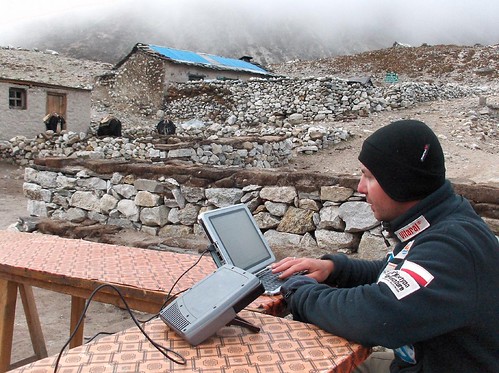
We’ve seen live or near-live video news reports on CNN or the BBC where a journalist uses an inexpensive terminal to uplink to a satellite — alone. No truck, camera operator, teleprompter or boom microphone. At first the frame rate was less than perfect, but hey, it’s live and very cheap. Packs up quickly, too.

Inmarsat’s BGAN service is getting better now. Upgraded equipment on the ground, and in orbit. Traditionally, they’ve promoted themselves by helping extremely remote locations connect, like this Polish expedition on Mt. Everest.


As with the Slingbox Traffic Web Cam in San Francisco, TV news people are getting more creative in using this new technology. We read in Broadcasting & Cable last week how WDIV in Detroit covered the Bayview-Mackinac Yacht Race from Lake Huron:

When WDIV Detroit covered the Bayview-Mackinac yacht race last month, it didn’t rely on traditional microwave or satellite equipment to pull live video from the middle of Lake Huron.

Instead, the Post-Newsweek NBC affiliate used a combination of IP-based streaming technology and wireless EVDO and broadband satellite transmitters to provide live broadcast and Website coverage of the four-day race, which drew more than 250 competing yachts.

WDIV is one of a growing number of news organizations to use the Streambox from Seattle-based Streambox Inc., an IP-based streaming device designed with broadcasters in mind. Costing around $20,000, the system includes a laptop loaded with proprietary compression software that is used to encode and stream images and a rack-mounted receive device that features professional video connections and is designed to interface with conventional broadcast equipment.


$20,000? Even the smallest SNG Trucks cost much more than that. How long before Streambox and NewTek’s "truck-in-a-box" change the game? Probably sooner than we think.

DirecTV Driving Satellite HDTV Expansion

Tuesday, August 14th, 2007

With a huge subscriber base and plenty of existing HD content, DirecTV has been a major force in bringing HD to millions of people through various programming offerings. And it’s about to get even bigger.

About a month ago, DirecTV launched a new satellite to allow them to expand their HD content. So far it’s "going well" and they are on track to rollout a 70-plus HD channel package by the end of 3Q 2007 and build to 100 HD channels by the end of the year, according to notes from a recent investor call. Combined with the lowering costs of HD DVRs also mentioned on the call, the end of 2007 is shaping up to be the beginning of a new HD era for DirecTV.

A large factor driving DirecTV’s current HD success is its "NFL Sunday Ticket" package. DirecTV offers fans the chance to watch every single NFL game live, many in High Definition, making for very busy Sundays in the fall for many NFL fans. With the launch of the "Superfan" package in 2005, fans have been able to watch up to 9 games in HD and can watch games online over a broadband connection and see highlights and clips on their video-enable mobile phones. DirecTV’s new satellite launch and significant HD expansion will make the service even better, possibly increasing the number of available HD games and increasing the available bandwidth to deliver NFL content.

"NFL Sunday Ticket" has no doubt been a huge success for DirecTV. It currently has over 2 million subscribers and has successfully won over many DirecTV subscribers in areas where basic cable fails to meet the demands of NFL fans. The big takeaway here though is that DirecTV’s programming has pushed the industry as a whole to offer more HD content. As Scott Greczkowski from Multichannel News explains:

…I still feel that DirecTV deserves credit for waking up the industry, which is helping to accelerate the rollout of many new high definition channels on all providers. No matter who your cable or satellite provider is ultimately you can thank DirecTV for all the new HD content you will be seeing this fall.

More HD programming means better options for consumers. And in this area, DirecTV is clearly leading the way.


Stay tuned for more on NFL satellite programming later this week. Also, download the MP3 attached to this post for a quick football fix from our favorite sports song.

DIY Friday: Installing a Satellite Dish

Friday, July 27th, 2007

On Monday, YouTube took over the Democratic Debate. Today, YouTube takes over DIY-Friday. Thank you, user generated content.

The first video explains how to mount a satellite dish using a simple satellite signal meter available for $15 bucks here.

A more detailed installation guide (although some of the connectors are a bit out-dated):

Not working right? Call a professional or just blow it up:

The Internet is Dead

Thursday, July 26th, 2007


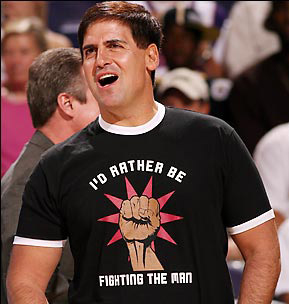
Satellite and Cable systems now have the upper hand. According to Mark Cuban, via Television Week:

Forget the Internet, the Future Is the ‘Intranet’

At CTAM: HDNet Founder Mark Cuban on Why VOD Will Rule

By Andrew Hampp, AdAge

You can’t have a Mark Cuban speech without at least one contrarian statement. In the past year alone, the HDNet founder has sounded off on everything from YouTube ("A million people watching three-minute clips of Lonelygirl is critical mass?" he said during Advertising Week) to local newspapers ("They’re trying to grow like they’re internet companies in 1999," he told Esquire). His latest target? The web. Did you hear? It’s dead.

Speaking at the Cable Telecommunications Association for Marketing (CTAM) Summit in Washington yesterday, Mr. Cuban declared "the Internet is dead" in an otherwise subdued panel that included executives such as ESPN President George Bodenheimer and Time Warner Cable CEO Glenn Britt.

‘Neighborhood feel’
The real growth medium is the "intranet," otherwise defined as the on-demand and digital video-recording platforms provided by cable companies. "There’s less restriction on the intranet, it’s like your own corporate network for all the cable networks and even wireless," he elaborated in an interview after the panel. "It’s all locally driven anyways. It has a true neighborhood feel. If I’m in Dallas and I’m on Time Warner Cable, I want localized content."

Mr. Cuban views the TV as the real computer, citing the decline in sales of desktop computers as a direct result of where media consumption is moving. "All that [content] is moving to the TV. What’s the difference between a PC and a TV? Nothing." Social networking and user-generated content are all the rage for Web 2.0, but there’s "nothing on the horizon" from a content perspective, he said (apparently glossing over the looming launches of NBC and News Corp.’s NewCo web-video venture and Joost). Broadband video, according to Mr. Cuban, has "stopped growing."

"Before the internet, people were doing whatever they were doing, thinking this was the end-all, be-all. I thought by 2007 the pipes would be so huge [for the web], you could do HD content and all that. And everything just didn’t turn out. I was wrong," he said.

Premium price for TV ads
Advertising for TV will also come with more of a premium price tag in the future, Mr. Cuban said. "There will be fewer commercials that cost more. The bang for your buck will become the same."

But not everyone was quite as bullish as Mr. Cuban is on the growth of TV. Debora Wilson, CEO of the Weather Channel, listened to Mr. Cuban’s internet rant and interjected a few thoughts of her own on what she still considers to be a viable medium.

"The internet is still in day two; there’s so much flexibility," she said. "The other opportunities on TV are still in a slow phase. I’ve been in the market for 15 years and we’re still waiting for that tipping point."


A little more detail, via Multichannel News:

Cuban: The Internet Is Dead

HDNet Chairman, Mavericks Owner Who Made Fortune from Web Speaks at CTAM Summit Closing Session

By Tom Steinert-Threlkeld — Multichannel News, 7/25/2007 7:35:00 PM

Washington — The archetype of the Internet-bred billionaire Wednesday declared, “The Internet’s dead. It’s over.”

The speaker was Mark Cuban, who sold Broadcast.com to Internet portal Yahoo in 1999 for $5.7 billion. He is currently the owner of the National Basketball Association’s Dallas Mavericks and HDTV programmer HDNet. He is also considering buying Major League Baseball’s Chicago Cubs, out of his pocket, for about $1 billion.

The venture that made his fortune, Broadcast.com, was the outfit that legally streamed programming from 420 radio stations and networks; 56 TV stations and cable networks; and game broadcasts and other programming for more than 450 college and professional sports teams over the Internet.

And Cuban made his comments to operators of a set of high-bandwidth alternatives to the Internet, known as cable systems.

Speaking on the closing panel of the CTAM Summit here, Cuban declared, “The Internet’s for old people.”

His basic point: The Internet has gone stagnant. The only “new application” on the World Wide Web of recent vintage was, in his view, YouTube — which, unlike Cuban’s Broadcast.com, ripped off the creative content of intellectual-property owners to build its video-based business.

Sour digits aside, Cuban’s view, as repeated in a group interview after the panel with Multichannel News and CableFax Daily, is that cable and satellite networks are now superior to the Internet as platforms for building complex, interactive services.

This is in direct counterpoint to his contention, when he built Broadcast.com a decade ago, that the Internet would — in 10 years’ time — have the bandwidth that would make it a superior home for the development and distribution of video programming.

“I was wrong,” he said.

Networks built by telephone companies, like Verizon Communications, and cable companies, like Comcast, do not easily talk to each other, stymieing development of services (like HD video) that require smooth, seamless transport of lots of digital stuff, he said.

By contrast, so-called clustered collections of cable networks provide an enclosed environment that allows high-bandwidth, complex applications to thrive. Developers will figure this out and develop applications to match. If, for instance, a developer wanted to build suites of office applications, he said, the better environment would be servers on local cable systems. Users would have faster response and better experiences. Such developers could “outgoogle Google,” in effect.

Google, the dominant search engine, is developing and providing a series of office applications for writing and making calculations that operate on the open Internet.

In effect, Cuban said, cable networks are “intranets,” which, by their nature, operate more efficiently than the Internet. Cable-system operators can control the quality of service they supply and the amount of bandwidth that developers can use. Plus, there is no friction in transporting services and data within their networks.

His contention harkens back to @Home, the ill-fated offspring of the cable industry that tried to create a “private” Internet that operated at higher speeds and with greater quality than the “open” Internet, which made “best-efforts” attempts to transfer information, whether text or video or other.

Using standards such as the OpenCable specifications and cooperative efforts to interlink their networks, cable-system operators, he added, could create a high-bandwidth nationwide alternative to the Internet that would attract developers of applications that needed and took advantage of greater capacity and speed of transmission.