Archive for the ‘NASA’ Category

Go Sat, Go!

Thursday, May 3rd, 2007
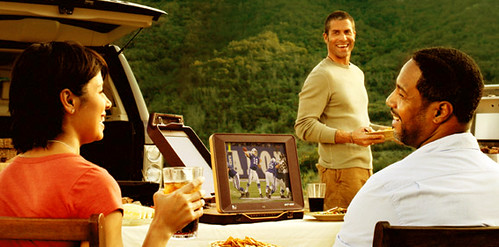
From the man who created CHiPS, an idea we blogged in January is finally here: Sat-Go:

  • Integrated 17-inch LCD monitor and satellite receiver with two speakers
  • Compact and portable flat antenna and satellite receiver
  • DIRECTV® programming accessed through a platform based on DIRECTV’s D11 set top box
  • Small profile IR remote
  • Component and composite A/V inputs
  • Composite A/V out
  • Satellite in connection
  • Phone Jack
  • USB connection
  • AC and DC capable (cigarette lighter adapter included)
  • Rechargeable, replaceable, laptop-style battery

All this for US$1,500. Today’s press release:

Just in time for the summer travel season, DIRECTV, Inc., the nation’s leading satellite television service provider, is launching DIRECTV(R) Sat-Go ("Satellite-to-Go"), the world’s first portable satellite TV system.

Beginning today, the DIRECTV(R) Sat-Go unit, created by DIRECTV and TV producer/writer, Rick Rosner, is available to DIRECTV customers for $1,499. DIRECTV customers who are interested in purchasing a DIRECTV Sat-Go unit can call 1-800-DIRECTV. The DIRECTV Sat-Go will be available at participating retail locations across the country soon.

"DIRECTV’s digital satellite technology enables us to do what no cable service can, offer consumers TV programming that they can watch wherever they are," said Eric Shanks, executive vice president, DIRECTV Entertainment. "DIRECTV Sat-Go is the perfect companion for a summer road trip and the ultimate tailgating accessory for any sporting event. Since we unveiled a prototype of the unit in January, the DIRECTV Sat-Go has created an exciting buzz in the marketplace and we are thrilled to make it available now to DIRECTV customers across the country."

The DIRECTV(R) Sat-Go is specifically designed to be compact and highly portable. The unit comes in an easy-to-carry, briefcase-like design that includes a 17-inch LCD monitor with integrated DIRECTV Receiver, flat antenna and replaceable/rechargeable lithium-ion battery. The unit also includes AC/DC adaptors for home and car.

Once the DIRECTV Sat-Go unit is opened, there is no installation necessary. It’s quick and simple setup makes it easy for customers to find line-of-sight with DIRECTV satellites and receive DIRECTV(R) programming within minutes (provided the user is within range of the DIRECTV signal).

When not being used as a portable/ travel unit, the DIRECTV Sat-Go can also be utilized as an additional in-home DIRECTV Receiver and television. The LCD TV screen has a built-in DIRECTV Receiver, which can be separated from the DIRECTV Sat-Go antenna casing and connected to a customer’s existing DIRECTV Satellite Dish.


Enter The HDTV Challenge

Wednesday, May 2nd, 2007


I’ve heard people argue that standard-definition reception from an old backyard C-band dish is still better than today’s highly-compressed HD available from direct-to-home services in the U.S.

Now comes this via Television Week:

Comcast Enters HD Quality Dispute
This week Comcast launched a major ad campaign that opened a new battlefront in the HD service provider war: comparative picture quality.
Touting a study by Frank N. Magid Associates, Comcast took out full-page newspaper ads in 15 markets claiming its HD picture quality is superior to satellite competitors DirecTV and Dish.

"We always knew we offered more HD choices, and we always thought we had more convenient HD service and better HD picture quality, but now we can prove it by a fairly overwhelming margin," said Page Thompson, senior VP and general manager of video services at Comcast.

Though Comcast said the study has been long planned, the ads could be seen as a response to DirecTV’s ongoing television campaign featuring celebrities touting the satellite provider’s HD service as better than cable. Cable operator Time Warner has filed lawsuits over the DirecTV ads, claiming they’re false advertising.

"They’re talking about service they’ll have in the future because the product they have today doesn’t compare," Mr. Thompson said.

When DirecTV’s campaign started late last year, the satellite provider initially claimed to have a superior HD picture quality. But a New York federal judge upheld Time Warner’s objection to the seemingly unverifiable claim in February and the ad was changed. Current DirecTV ads claim the satcaster will "soon" have more HD channels than cable, a boast that has withstood a legal challenge.

But while Time Warner was busy filing lawsuits, Comcast commissioned a study to try to prove, once and for all, who has the best picture.

The study was conducted in March, with 309 subjects showed side-by-side images from DirecTV, Dish and Comcast on identical TV sets. To eliminate set bias, the HD signals were rotated among the sets. Subjects were shown various genres of programming from different networks.

To help protect the study from legal challenges, Comcast tapped Magid to conduct the test; Accenture, a technology consulting company, to oversee the technical aspects; and Loeb & Loeb, a national law firm, for legal guidance on the survey process.

The result: 66 percent preferred Comcast to DirecTV, and 70 percent preferred Comcast to Dish.

A DirecTV spokesman questioned the validity of the results, noting there are several ways picture quality could be skewed: the equipment used, instructions given to subjects, the content chosen and whether the Comcast signal at the test location was representative of the cable operator’s markets as whole.

"There’s not much substance here," spokesman Robert Mercer said. "While they’re making claims about their signal clarity, the methodology of the survey seems questionable at best."

Mr. Mercer added that an independent company surveyed home theater installers last year, who said, by a 4-to-1 margin, that DirecTV had the best signal quality.

As for whether DirecTV will take the Time Warner route and file a lawsuit to halt the picture-quality claim, Mr. Mercer said, "We’re evaluating our options."

A Dish Network representative had no comment.

In addition to the newspaper ads, Comcast plans a radio and online ad campaign to tout the results of its study.

The Comcast ads were greeted with cheers from HD online fan communities-even from satellite subscribers-who are pleased that top-notch HD picture quality is becoming a point of contention among service providers.

For years HD fans have debated the picture quality of HD providers. As bandwidth-strapped providers have added more HD networks to remain competitive, some sharp-eyed viewers claim signal compression is causing visible quality degradation.

Though fans definitely want more HD channels, some say they do not want content at the expense of what made them fall in love with HD in the first place: its startling, lifelike images. Dismissive statements by service providers that all HD is the same, or that, as one DirecTV executive once put it, "Viewers don’t watch the back of their TVs," have further frustrated fans.

With Comcast, the country’s largest cable operator, making picture quality a battleground issue, fans hope its competitors will soon follow suit.

"I think it’s outstanding Comcast did this," said one poster on AVS Forum.

"As a DirecTV customer, this makes me very happy," enthused another.

Comcast still must contend with DirecTV’s planned barrage of 100 HD channels by the end of the year, though Mr. Thompson reiterated that quality matters more than quantity.

"Our plan is to launch every HD channel that really matters to our customers," he said. "To put out an arbitrary number of HD channels without regard for the quality of the channels seems like a strange strategy.

"In addition to the channels, we have 100 HD video-on-demand hours. We’ll double that by the end of the year and double again by the end of next year."

Ariane Launching ASTRA 1L Satellite

Wednesday, May 2nd, 2007


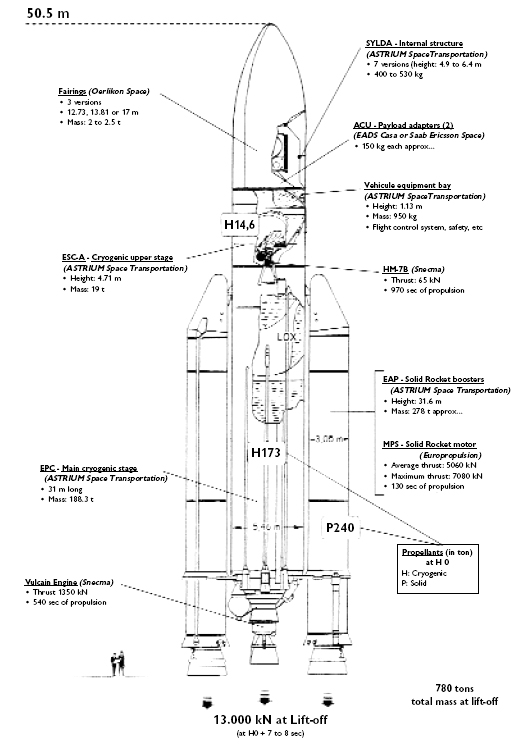
We have a potentially record-setting launch coming up on Thursday, 3 May 2007, from the jungles of French Guiana. We’re talking some heavy payload here. The news via L’Express

La fusée européenne Ariane 5 doit décoller jeudi soir de Kourou pour mettre en orbite une masse sans précédent constituée de deux satellites de communication.

La masse totale – celle des deux satellites Astra 1L et Galaxy 17 et des interfaces – s’élève à 9,4 tonnes, un record mondial pour un lancement sur orbite géostationnaire, rapporte Arianespace, l’exploitant du lanceur.

Le décollage est prévu à 19h29 (22h29 GMT) du Centre spatial guyanais, la base de l’Agence Spatiale Européenne.

Il s’agit du 176e lancement d’Ariane, du 32e vol d’une Ariane 5 et du 10e d’une Ariane 5 ECA, modèle le plus puissant de la gamme, qui peut mettre jusqu’à dix tonnes sur orbite.

Le satellite Astra 1L doit être placé sur orbite 27 minutes après le décollage et Galaxy 17 cinq minutes plus tard.

Construit par l’industriel américain Lockeed Martin Commercial Space Systems en Californie, Astra 1L a une masse au décollage de 4,1 tonnes, selon Arianespace.

Il sera positionné au-dessus de l’Europe continentale, d’où il assurera la diffusion de chaînes de télévision de haute définition (HD) pour le compte de SES Astra, société du groupe Société Européenne des Satellites (SES), basée au Luxembourg.


I’m making plans to watch it myself. The launch window opens at 22:29 GMT and closes at 23:13 GMT on 3 May 2007. Local time in French Guiana is right after dinner (between 19:29 and 08:13 on 3 May 2007), but I doubt anyone will be able to eat beforehand. Here are some local times:

New York: 18:29 to 19:13 on 3 May 2007

Luxembourg: 00:29 to 01:13 on 4 May 2007

Singapore: 06:29 to 07:13 on 4 May 2007

Live television broadcast begins at 21:50 GMT (17:50 EDT; 23:50 CET): 

  • In Europe, the launch will also be broadcast live via ASTRA satellite from the orbital position 19.2° East (downlink frequency: 12.5515 GHz, vertical polarization, service ID 12122, service name ASTRA Vision 2).
  • In North America, lock your antenna on Galaxy 3 at 95 West (transponder 22, C-band; Format: digital 9 MHZ, 4126.5 Vertical, FEC: 3/4, Symbol Rate: 6.1113).
  • Click here to watch the live webcast.

According to our friends at ASTRA, the satellite will be performing a critical mission:

ASTRA 1L will be located at 19.2° East, ASTRA’s prime orbital position for delivering broadcast services to continental Europe, where it will also transmit the increasing number of HDTV channels. The new satellite will allow SES ASTRA to move its satellite ASTRA 2C from 19.2° East to 28.2° East, in order to meet the high demand for capacity from the U.K. and Irish markets. It will also extend the ASTRA coverage from the Canary Islands in the West to the Russian border in the East and further strengthen SES ASTRA`s unique in-orbit back-up scheme.


The launcher itself is described in great detail on the ESA Web site.

DIY Friday: Getting Started with HDTV

Friday, April 20th, 2007


Just because its going to be a beautiful weekend through much of the country doesn’t mean you have to spend the days outdoors — after all, there’s a lot of TV you’d be missing if you did. The fact is, even if you are planning on spending the next weekend as a couch potato, if you don’t have HDTV you’re missing the big picture… literally.

The problem is, for most of us, while we know HDTV could give us a better viewing experience, purchasing a television that operates under the new standard is a rather daunting task. HD-Ready, HD-Card-Ready, HD-TV Receiver reuired? Ugh! What does it all mean?

Fortunately, for you, we’ve dug up a few sources of information, on this week’s DIY Friday, that will help you answer your most pressing questions about choosing and setting up the right HDTV selection for you.

The best place to start is this awesome How-to over at ZD, "Don’t by an HDTV without reading this first" that takes you through the pros and cons of the different types of displays (LCD, Rear Projection, and Plasma) and helps you avoid some of the common mistakes first time HDTV buyers make. An example? How about the Monster Cable rip-off:

"Consumers need to get the concept of "monster cables" out of their minds since they DO NOT apply to the digital world. There is zero difference in quality between the cheapest $12 HDMI to DVI cable versus the $100 gold-plated "monster cable." Monster cables are a holdover from the analog era, where signal leakage results in a degraded image or sound. In the digital world, a data cable either works 100% or it doesn’t work at all, and there is no degraded middle ground. Since nearly all digital cables work (return the rare ones that don’t), there isn’t a shred of difference between the cheap cable or the expensive monster cable. If you can’t find an HDMI to DVI cable for less than $30 in a retail store, you can google "HDMI to DVI cable" and there will be plenty online vendors selling them for $12-$16 plus shipping. Don’t be shocked to find HDMI cables that cost $60 to $150 in a typical retail outlet; just don’t fall for it. The only place monster cables have any use is for the transmission of analog signals, such as the connection between your amplifier and your speakers."

Talk about money saving advice.

Those who are purchasing their new idiot box with their refund from the IRS and looking to write off the purchase as business expense next year might want to check out the HDTV Tutorial at Hardware Secrets (a great little site for electronic hardware geeks like myself) which demystifies the process of hooking your television to your computer.

Finally, if you recognize the irony of purchasing a new television to watch the HD-presentation of Planet Earth on a beautiful day like Sunday and are planning, like me, to get outdoors this weekend, don’t worry, you can have your cake and eat it to: Just buy yourself one of those new HD Tivos and get HD glory whenever you want it.

Contextual Search Using Phonetics

Tuesday, April 17th, 2007

We knew this was coming last summer when we wrote about how Google will soon be selling ads against audio and video content. We didn’t think so much was going to happen so quickly. They buy YouTube, become ad reps for Dish Network, are about to sign DirecTV, and now we hear about Google selling ads for Clear Channel and other radio stations (up to 1,600 so far).

How do you target audio video content? Will this system use sophisticated algorithms for "mass personalization?" Will phonetics work? They might: came across this Scoble interview with an executive from Nexidia, a company that’s using phonetics to enhance contextual searches. Very interesting. Here’s the short demo version:


Add localization and you’ve got a pretty interesting propostion for advertisers. I recently downloaded Google apps for my mobile and I’ve gotta tell you, they work great. Need a Chinese restaurant where you are? Google it using Maps. It worked for me.

I Love You, C-band

Monday, April 16th, 2007

This may not be the same love as the backyard-dish people were feeling 20 years ago, but these folks are digging IP-PRIME, which is carried nationally via AMC-9’s C-band payload in the U.S.:

“We have an extraordinary partnership with SES AMERICOM and with the launch of IP-PRIME we can now reach out securely and effectively to IPTV viewers across the country who will be able to access their favorite NBCU programs,” commented Henry Ahn, executive vice president, NBC Universal TV Networks Distribution.

“Showtime Networks is excited about the ability of SES AMERICOM to securely and reliably deliver all of our networks to the telcos with video initiatives, using enabling technologies such as MPEG4,” said Michael Tas, Senior Vice President, Distribution and Sales Strategy for Showtime Networks. “SES AMERICOM has been a proven partner of Showtime Networks for decades now and we look forward to extending the relationship well into the future.”

“We are sensitive to the costs of getting into the distribution business and are happy IP-PRIME is in place to fill the technology gap for small operators,” said Karen Byko, executive vice president of operations for Turner Network Sales.

“Consumers want alternatives in how they spend their entertainment dollars,” said Mike Biard, Senior Vice President, Affiliate Sales, Fox Cable Networks. “IP-PRIME will deliver Fox’s networks securely to a new generation of distributors, and we are delighted to be working with SES AMERICOM to do so.”

"We’re excited to be a part of SES AMERICOM’s new IP-PRIME programming lineup," said Mark Cuban, chairman and co-founder, HDNet. "By including HDNet and HDNet Movies, SES AMERICOM is making sure IPTV viewers receive the highest quality HD programming, including our acclaimed movies, original programming, investigative news, popular series and sports.”

Multichannel News followed up with a question on ESPN, of course.

Will this revive the backyard dish market? I can almost imagine a DTH service using C-band. I want my IPTV!

Canadian Condo Dish Discrimination Case Dismissed

Thursday, April 12th, 2007

A Halifax man who asserted that his condo board’s ordering him to take down his satellite dish amounted to discrimination has had his case dismissed by the Nova Scotia Human Rights Commission, the CBC reports.
A report from the hearing in August gives us the background information on Ahmed Assal’s case:

Assal, a condo owner in Clayton Park, is a Muslim originally from Egypt. Through his satellite dish, he gets 18 channels of religious and cultural programming in Arabic.

Without it, he says his children could not get the programs essential to their education.

"I have a family, I have children, and the serious matter is that it is for culture, religion, language," he told reporters after the hearing.

Assal acknowledges he knew about the condominium board’s bylaw that prohibits satellite dishes before he bought the condo.

The dismissal came down last week: 

Board chairman Royden Trainor said he wasn’t satisfied that Assal met the necessary burden of proof to show he was discriminated against.

Trainor concluded that the absence of satellite service would not have the same impact on the family’s faith and cultural identity as being denied traditional ethnic food, for example.

"The [Assal] family’s ongoing devotion to the practices and tenets of their faith and cultural identity will continue unimpeded, uninterrupted and undiminished with or without access to a particular satellite dish and service," he wrote in his April 3 decision.

We’re not familiar enough with the Nova Scotia Human Rights Commission to say definitively what sort of presidence this would set for other condo owners in Canada. Other cases have gone the other way when condo boards and dish owners have locked horns; this case, for example, is a good reminder of the need for specific language when HOAs try to control exterior modifications to condos. We will suggest, however, Canada’s most famous condo lawyer as counsel if you find yourself in a legal snafu, trapped between your desire for satellite TV and a pesky HOA constraint.

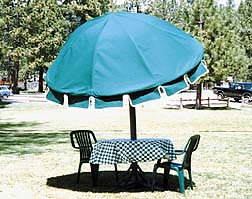
Here in the United States, the FCC has declared that Federal law supercedes any local or HOA zoning constraint. But you can avoid many of these legal hassles simply by following our DIY Friday guide to disguising your dish (especially this one for condos). As the photo above illustrates (yes, that’s a satellite dish acting all incognito), all you need is a patio and some patio furniture, and the next thing you know you’re surreptiously watching your favorite satellite shows and keeping the neighbors happy.

Next: Google Selling Ads for DirecTV

Wednesday, April 11th, 2007

Another scoop via VentureBeat:

VentureBeat is hearing that Google is negotiating an advertising deal with  DirecTV, the nation’s largest satellite broadcast service with 16 million subscribers.

Dish, the nation’s second largest satellite TV company, announced a deal with Google last week. (VentureBeat was first to report the Dish deal a month ago).

This is just the latest move by Google to sew up the entire advertising world. Google is pushing into newspapers, magazines, radio, cable and now satellite.

The DirecTV deal is taking more time than Dish’s to close because DirectTV is managing the ownership change announced last last year (when News Corp said it would sell its ownership stake to Liberty). More details on DirecTV here. The deal with Google will go through eventually, says a source who wants to remain anonymous. [Update: Google says “no comment,” and DirecTV says: “We are always looking for ways to increase our ad sales revenue but we have nothing to comment regarding any new partnerships.”]

Here’s our blog post + comments on the Google deal with Dish Network.


If you think about it, a Google deal with DirecTV would give advertisers reach into more than 25% of U.S. TV households. Honk the horn on Madison Avenue like some truck is double-parked and you can’t get through: Google is a player in TV advertising. Yes, the household count is greater than Comcast on paper, but how effective will it be? Here’s a clue: interactivity. EchoStar and DirecTV have national interactive TV advertising capabilities in place and are actively working with advertisers to deploy them — especially automotive and financials. Stay tuned.

Anik F3 Launch Update

Monday, April 9th, 2007


As you probably know those of us here at Really Rocket Science love a good launch, especially that of a big GEO satellite.

The Anik F3 will be launching tonight (04:54 April 10 Baikonur, 22:54 April 9 GMT, 18:54 April 9 EDT) this from launch pad 39 of the Baikonur Cosmodrome in Kazakhstan. You can, of course, catch the launch live via streaming, although hopefully we’ll be able to find on YouTube sometime tomorrow for those looking to beat a wicked case of the Mondays by heading to Happy Hour early.

Those nerdier than us might want to catch a live feed of the launch via satellite or over the phone at the following locations.

Live Broadcast
North America: Telstar 6 @ 93° West, transponder C11, downlink 3920 MHz (vertical), analog NTSC. Test signals start at 18:00 EDT.

Live Broadcast
Europe: NSS-7 @ 338° East, transponder WHL4/EUH3 CH1, Ku-band, 338 degrees West downlink 11098.9 MHz (horizontal), digital PAL symbol rate 6.1113, fec: 3/4. Test signals start at 22:00 GMT.

U.S. domestic Launch Hotline at 1-800-852-4980.

What does Anik F3 do? Basically its a comm sat for Telsat Canada, but since you asked:

"Multipurpose communications satellite with payloadsin Ku-, C- and Ka-band. The Ku- and C-bands will carry a wide range of broadcasting, telecommunications, business and Internet-based services throughout North America"

See you at the launch!

Google Selling Ads on Dish Network

Monday, March 12th, 2007

We blogged about what Google may have up its sleeve before, so naturally we were intrigued by what VentureBeat.com picked up from The Wall Street Journal last Saturday:

Google is about to sign a deal with Dish Network, the nation’s second largest satellite TV company, to deliver ads for Dish’s network, VentureBeat is hearing.

We haven’t been able to confirm the rumor (Google has not yet responded to a request for comment).

In an effort to extend its growing advertising empire to television, Google has already started a pilot project in Concord, Calif. to deliver ads to cable television subscribers, it was revealed in yesterday’s WSJ.

The latest reports are significant because they suggest Google may be on its way to cracking the huge television market, to deliver a very different kind of ad to peoples’ living rooms. Dish is the nation’s leader in high definition and interactive TV programming. Google’s TV ads, like the ones Google distributes already to Internet sites, would be delivered more efficiently — targeted more closely to the content of the TV programming being watched, and more relevant to the people actually watching it — or at least, that is Google’s intent.

The Mountain View search engine is already making more than $10 billion from online ads. The U.S. television advertising market is about $55 billion, and so is a juicier target than even the Web.

According to the WSJ Saturday, Google has begun a test run serving up TV commercials to cable subscribers of Astound Broadband in Concord, Calif. In this deal, as in the one with Dish, Google is expected to purchase TV spots in advance, and then insert its own advertising — supplied by its advertising clients — so that it looks much like it does today. The difference is, Google would be the powerbroker.

It is unclear, however, how Google would access information about TV households in order to target its ads, without raising significant privacy concerns. But a Dish partnership is notable because of how interactive the Dish experience has become. Users already use keywords to search for programming, choose themes they like and create custom guides — all indicators of personal taste. Dish and Google might be able to obtain permission from users to exploit such information. Google could then work with any number of technology providers to help it automatically insert relevant ads into the programming.

Read more about this concept of "mass personalization" on the ITVT blog. Once you get into the details, I think you’ll agree this is not Spotrunner, which sounds more like a buying agency.