Archive for the ‘NASA’ Category

Dish Network & DirecTV Team Up with Google, Intel, Skype and Yahoo!

Tuesday, March 6th, 2007

Very interesting twist to the upcoming spectrum auctions. Breaking story via Multichannel News:

DirecTV and EchoStar Communications formed an alliance with Google, Intel, Yahoo and Skype in support of a national licensing plan for a pending federal spectrum auction expected to take in at least $10 billion, according to draft of the plan obtained by Multichannel News Tuesday. The formation of the alliance doesn’t mean that the companies are going to bid together in the auction, which, by law, has to begin by Jan. 28, 2008. Instead, each alliance member has an interest in seeing that the Federal Communications Commission permits bidders to aggregate enough licenses to cover substantially all of the United States. The 60 megahertz of spectrum up for auction is returning to the FCC as a result of TV broadcasters’ transition to digital-only transmission. Broadcasters won’t require the same amount of bandwidth in total because digital signals are spectrally more efficient than analog airwaves.

Every full-power TV station is required to terminate analog TV service no later than Feb. 17, 2009. The analog cutoff would also allow public-safety entities to obtain 24 MHz of former analog-TV spectrum.


Wok TV System

Thursday, March 1st, 2007

Love this story about Kiwi ingenuity from the New Zealand Herald:

$10 wok keeps TV station on air

Why pay $20,000 for a commercial link to run your television station when a $10 kitchen wok from the Warehouse is just as effective?

This is exactly how North Otago’s newest television station 45 South is transmitting its signal from its studio to the top of Cape Wanbrow, in a bid to keep costs down.

45 South volunteer Ken Jones designed the wok transmitter in his spare time last year when he wanted to provide wireless broadband to his Ardgowan home.

"A group of us wanted to connect our computers to each other and then we worked out a way to get of getting the signal between two points," he said.

He discovered satellite dishes were between $100 to $400 retail and that smaller dishes, the same size as a wok, were $80.

Mr Jones thought he could do better.

Along with friend Murray Bobbette they worked out mathematical equations to prove the curved metal face of a wok would have the same effect as a small satellite dish.

"We have spent a lot of time getting it right — the first time we installed one we had it up a pole with the handle still on the end of the wok," he said.

"We had it connected to the woolshed and initially you couldn’t get a signal the width of the paddock and now it can reach up to 20km."

When the television station 45 South (UHF channel 41) started up in September last year, Mr Jones thought the same technique could be applied.

"The $20,000 for a commercial link was just money we didn’t have, so we bought several woks from The Warehouse instead which was convenient and cheap," he said.

Pre-recorded clips at the studio are fed through a computer and beamed to Cape Wanbrow where they are relayed off to television sets around North Otago.

The classic case of Kiwi ingenuity has made its way onto the internet and the technique has been posted by an American website, Mr Jones said.

"People wanted to know all the details about how to make their own, so it is now all publicly documented," he said.

One of the issues they had to deal with was making the pole that the wok sits on high enough to clear the Kingsgate Brydone Hotel.

Of course, this story found it’s way to Make a day after it was published.

Opening General Session at Satellite 2007

Wednesday, February 21st, 2007

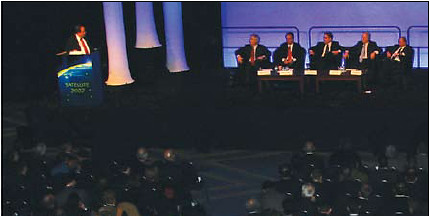
Here’s the write up of Tuesday’s Opening General Session by Mark Holmes in the Satellite 2007 Daily:

FSS operators Seek Ways To Capitalize on Growth Patterns

The satellite industry finds itself in a strong position, top executives said at the SATELLITE 2007 opening session, but there was an undercurrent of caution in their comments.

Overall, the panel was increasingly optimistic about the growth prospects for the satellite industry. “I think we see an industry that is healthier every day,” said Intelsat CEO David McGlade.. We see economies improving around the world. It is a great time to be in the industry. In 2004, the industry was not as healthy as it was today. It is improving even in areas like Asia.”

There was also a sense of renewed optimism in traditional market segments such as broadcasting with new direct-to-home (DTH) operators springing up throughout the world as well the move to high definition (HD) which is increasing capacity demands.
 
“People are going back to basics,” said Giuliano Berretta, CEO of Eutelsat. “TV is picking up very strongly. There is a resurgence in the TV business. For example, I think SES is becoming more traditional when you look at their recent divestments. In our most recent results, 70 percent mof revenues were derived from broadcasting. There are new countries which want pay TV.”

The optimism also extended to new market opportunities and the opportunities for satellites to play an increased role in areas such as mobilebroadcasting, broadband and other areas. McGlade spoke of the need of making “small, smart, bets” when going into new areas. “When you see a take-up you grow with it. You have to seed some new activities. I feel there is the right kind of climate for responsible growth. Huge bets have been taken before, but we won’t be doing that again.”

Romain Bausch, CEO of SES Global, said there are strong growth opportunities for satellite manufacturers and launch providers, but admitted the industry “could be in trouble” if companies do not move quickly when attacking new markets and consolidating positions in existing markets.

Bausch admitted he was concerned of the impact players such as Deutsche Telekom (DT) could have on satellite players. “We need to make sure the satellite solution is developed further to compete with terrestrial solutions,” he said. “You look at someone like DT who is going into the video business, this may be dangerous for us, because of the vertical integration of such players.”

Changing landscape

The satellite landscape has changed since these CEOs gathered at SATELLITE 2006. In recent weeks, Eutelsat has announced new shareholders, SES has done a deal with GE to divest certain assets and repurchase stock, Loral and Telesat have hooked up. Unsurprisingly, all the executives painted a bright picture of these moves.

Bausch made the point that divesting certain assets was almost as important as acquiring new assets. “When we bought New Skies, we got new assets in Asia and Latin America. It allowed us to divest in minority of assets such as AsiaSat and StarOne,” he said. “Divestiture is also a key trend. It is removing the overhang and having a currency to use in the future. It is a rationalization of assets. It is clear with overlapping footprints you have to rationalize. From a strategic perspective, we are now built on three 100 percent-owned companies. This will allow us to be more aggressive and in control of our developments.”

McGlade said Intelsat believed in a different approach. “I do not believe as much as the regional entities standing alone,” he said. “We have put more people out into the field. I think the integration process has transformed us and been a tool to bring us forward. There are many areas of growth. I think broadband will continue to grow. We have an investment in WildBlue and that has done well. When I look at video, HDTV has reached an inflexion point. Once that trend starts to accelerate you will see many programmers go to HD both for offensive and defensive reasons. There are new DTH platforms being launched. As we see liberalization of regulatory regimes there are growth opportunities in every sector.”

Michael Targoff, CEO of Loral Space & Communications, said his company’s acquisition of Telesat was vital for the operator to be a long-term player in the market and would help Loral compete more effectively with the big guns in the industry.

“You need to offer the customer a sense of capability,” Targoff said. “It was clear to Loral when we sold assets to Intelsat we did not have a sustainable position in the long term. By buying Telesat, we believe we can compete. We are comfortable it provides us with the mass to compete. I don’t just see it as a step along the way.”

In terms of how he views new opportunities for Loral and other operators, “We will be using satellites to deliver video to handheld nphones,” Targoff said. “We will use satellites to deliver broadband where there is not broadband infrastructure. There will be a role of satellites. While there is clear strength in the traditional services, it is also clear the future the role of satellites is how we participate in the way people access content now.”

Besides competing with the other satellite players, Berretta called for more cooperation within the satellite industry as they look to compete against other infrastructures and operators.

His views were shared by McGlade. “I think an association together could make a lot of sense and add a lot of value,” he said. “… “We are such a small fish in the media and telecoms pond. We need to look at how we can spur growth. We can do more. When we look overall, we have to look at what is happening with customers as well as our competitors. We are moving the industry forward, but we could do more. We are not doing enough.”

Mobile satellite services

Andy Sukawaty, CEO of Inmarsat and the lone Mobile Satellite Services (MSS) representative, told the session that some of the plans being offered by the low-Earth orbit (LEO) operators are “deeply flawed”.

Sukawaty warned that the investment community may not have learned from its previous efforts in funding LEO constellations if investors believe there was so much money to be made from the MSS industry. “In the 1990s, $15 billion was lost by investors that invested in this business,” he said. “We have instilled a capital discipline. It is capital intensive business. I think that is where investors need to focus. If you look at the fund raising at the MSS sector people are looking to raise $12 billion over the next five years. I don’t think there is $12 billion of business out there.”

Sukawaty saved his strongest comments for some of the LEO operators. He said in a blistering attack on some of the players, “To spend $2 billion on a LEO constellation will not work. They have a distinct competitive disadvantage. That thinking is deeply flawed. That cannot compete against GEO systems.”

However, Sukawaty was optimistic about his own company’s growth prospects. While price erosion on the voice side means revenue growth is difficult despite volume growth, data applications could be the key to a successful future for the operator. “Historically, we have had targeted a 3 percent growth rate, but now we want to accelerate that to 6 [percent] to 8 percent growth,” he said. “That will be driven by data applications. Data applications will provide double digit growth. The question is who captures that double-digit growth."


PBS HD on Satellite TV

Monday, February 12th, 2007


We read today in TVPredictions.com satellite TV operators may soon need to carry the Public Broadcasting Service’s HDTV feeds:

Public Broadcasting officials say satellite TV operators should be required to carry their High-Definition signals.

PBS executives from across the country are coming to Washington this week to urge Congress to change the Communications Act to include a must-carry provision.

"DIRECTV and EchoStar use scarce public airwaves to beam their signals to and from satellites," says John Lawson, president and CEO of the Association of Public Television Stations (APTS). "They use highly valuable international orbital slots for these satellites. It’s outrageous that they won’t carry the new digital channels from local public stations, but find a way to carry the big four commercial network stations."

DIRECTV and EchoStar have expanded their local HD service over the last year, but do not offer the PBS high-def signal in most cities.

APTS says the Communications Act should state that the satcasters must carry PBS’ "entire multicast digital programming," which would include the high-def signal and other digital feeds.

Satellite TV services are required to carry the analog feed of the local PBS station under the Satellite Home Viewer Improvement Act.

APTS says DIRECTV is considering carriage of PBS digital feeds, but talks are at an early stage. EchoStar, the group says, is refusing to carry the PBS digital feeds.

In January 2005, the PBS group signed an agreement with the National Cable and Telecommunications Association for carriage of all PBS digital signals on large cable TV systems. APTS says it hopes to sign a similar agreement with smaller cable systems in the near future.

The Association of Public Television Stations Web site gets into the details:

Specifically, APTS seeks to amend Section 338 of the Communications Act to make clear that the digital signals of Public Television stations are subject to the carry-one carry-all provisions related to carriage of local broadcast signals via satellite. This action would clarify that the entire multicast digital programming transmitted by a Public Television station is subject to mandatory carriage.


Gotta love Variety’s witty headlines:

Public broadcasters lobby on carriage

Networks plea to Congress for satellite TV signal

By WILLIAM TRIPLETT

Local pubcasters are set to launch a lobbying blitz to convince Congress to mandate carriage of all their digital signals by satcasters DirecTV and EchoStar.

As the Assn. for Public Television Stations hosts its "Capitol Hill Day" this week, reps from local noncommercial broadcasters from around the country will converge on Congress to express their frustration that "the high-definition signals of commercial stations are carried by satellite distributors, while public television stations’ new digital signals are kept off," according to an APTS statement.

They will therefore ask in the coming days that Congress support legislation requiring that DirecTV and EchoStar carry all local pubcasters’ HD and other digital programming during the transition to all-digital TV and after it is completed in February 2009.

Sofa Surfing on IPTV

Monday, February 5th, 2007

WebTV sucked and still sucks today despite being re-branded as MSNTV. Sure, it can get Grandma and Grandpa on the net and emailing the little Emma and Jack, but a new PC could do 20 times as much for just twice the price, making the sweetness of surfing on your big screen a little less logical. At $199.99 before service charges, WebTV may feel like a deal, but when Gramps gets frustrated by the limitations of the tiny device you’re going to have to get him a PC anyway, so why not bite the bullet and start things off right?

Well, even in light of the limits of WebTV and its Redmond-designed demon offspring, it isn’t to say that it wouldn’t be useful from time-to-time to surf the net from the comfort of your La-Z-Boy on your big screen.

Just imagine yesterday’s gridiron festivities with the aid of some Internet: Don’t really know what SalesGenie.com does judging from its cheesy ad? Just click the web button on your remote and — zip — there you are, visiting the site that’s set to bring spamming and direct dial marketing to anyone willing to pony up a couple hundred bucks a month.

Seems like a touchdown for me and my laziness (look, Mom, no laptop!) and even bigger boon for advertisers looking to get (and tracK) results from expensive ad buys. But can such a service be found?

The short answer is, yes, the technology’s already here, although you may need to wait a couple of years until it reaches your own plasma, HD display. This technological valhalla of laziness, known as IPTV, is new-ish, Internet Protocol-based (thus IP-tv) technology that seeks to transmit your favorite television channels over same thick, broadband pipe that you already get your Internet and maybe even your telephone service through.

While you can already get IPTV in a select number of markets in the US (e.g. some areas in Chicago, some schools in California), most are saying the US transition isn’t coming fast enough, with France with nearly 600,000 and Hong Kong with over 700,000 subscribers to IPTV-based services easily wining the competition for market penetration of the new technology. That said, some our saying America’s delay might be a good thing for certain big-name American networking firms, such as Cisco Systems, who stand to do extremely well, as broadband Internet providers start needing to upgrade their network infrastructure to handle the millions of gigabytes IPTV’s video will demand. Just check out the Robert Scoble’s interesting interview with the networking technology company’s CEO, John Chambers.

While it’s currently uncertain how this new technology will make its way into the market, as it competes with some of the older, television delivery formats, the full-scale launch will definitely be something interesting to watch.

SES & Cisco Help Reach the Last Mile

Monday, February 5th, 2007

The news is just starting to filter out, but today SES-Americom announced a major partnership with Cisco Systems to bring affordable television and video content to the millions of citizens in rural America using the Internet through the National Rural Telephone Cooperative. The video coursing through this new service will be provided by SES own IP-PRIME, of course. This is exciting news (and not just because we’re directly affiliated with SES), representing a real step-forward in getting Internet services down to infamous "last mile" consumers that often don’t get access to the communication services that many of us take for granted in more urban areas.

Some of the largest adopters of satellite television technology, man "country folk" around the US have been left out of the explosion in high speed, two-way internet services that are de rigueur in the our cities and suburbs. While satellite Internet technology is available, its speed is often hampered by dial-up upload speeds (which include telling your browser where you want to go) ultimately limiting its speed. Advancements in IPTV and joint-ventures like this deal provide additional incentive to get high-speed, wired internet connections to those who often feel isolated, geographically and socially, from the rest of the country and ultimately ensures that everyone, whether they live on the island of Manhattan or in Manhattan, KS, gains speedy access to the network that’s changing our lives.

For more infromation, you might want to check out blogger Robert Scoble’s interview with Cisco CEO John Chambers about the IPTV below or, via Networkworld, see how the system demoed in Europe last week.

EGOGRAM 2007

Wednesday, January 31st, 2007

Friends, Earthlings, ETs — lend me your sensory organs!

I send you greetings and good wishes at the beginning of another year. I’ll be celebrating (?) my 90th birthday in December – a few weeks after the Space Age completes its first half century.

When the late and unlamented Soviet Union launched Sputnik 1 on 4 October 1957, it took only about five minutes for the world to realise what had happened. And although I had been writing and speaking about space travel for years, the moment is still frozen in my own memory: I was in Barcelona attending the 8th International Astronautical Congress. We had retired to our hotel rooms after a busy day of presentations when the news broke — I was awakened by reporters seeking comments on the Soviet feat. Our theories and speculations had become reality!

Notwithstanding the remarkable accomplishments during the past 50 years, I believe that the Golden Age of space travel is still ahead of us. Before the current decade is out, fee-paying passengers will be experiencing sub-orbital flights aboard privately funded passenger vehicles, built by a new generation of engineer-entrepreneurs with an unstoppable passion for space (I’m hoping I could still make such a journey myself). And over the next 50 years, thousands of people will gain access to the orbital realm – and then, to the Moon and beyond.

During 2006, I followed with interest the emergence of this new breed of ‘Citizen Astronauts’ and private space enterprise. I am very encouraged by the wide-spread acceptance of the Space Elevator, which can make space transport cheap and affordable to ordinary people. This daring engineering concept, which I popularised in The Fountains of Paradise (1978), is now taken very seriously, with space agencies and entrepreneurs investing money and effort in developing prototypes. A dozen of these parties competed for the NASA-sponsored, US$ 150,000 X Prize Cup which took place in October 2006 at the Las Cruces International Airport, New Mexico.

The Arthur Clarke Foundation continues to recognise and cheer-lead men and women who blaze new trails to space. A few days before the X Prize Cup competition, my old friend Walter Cronkite received the Foundation’s Lifetime Achievement Award. I have known Walter for over half a century, and my commentary with him during the heady days of the Apollo Moon landings now belong to another era. A space ‘pathfinder’ of the Twenty First Century, Bob Bigelow, was presented the Arthur C. Clarke Innovator Award for his work in the development of space habitats. With the successful launch of Bigelow Aerospace’s Genesis 1, Bob is leading the way for private individuals willing to advance space exploration with minimum reliance on government programmes.

Meanwhile, planning and fund raising work continued for the Arthur C. Clarke Center "to Investigate the Reach and Impact of Human
Imagination", to be set up in partnership with the University of Nevada, Las Vegas. Objective: to identify young people with robust imagination, to help their parents and teachers make the most of that talent, and to accord imagination as much regard as high academic grades in the classroom – anywhere in the world.  The Board members of the Clarke Foundation, led by its indefatigable Chairman Tedson Meyers, have taken on the challenge of raising US$ 70 million for this project. I’m hopeful that the billion dollar communications satellite industry I founded 60 years ago with my Wireless World  paper (October 1945), for which I received the astronomical sum of £15, will be partners in this endeavour.

I’ve only been able to make a few encouraging noises from the sidelines for these and other worthy projects as I’m now very limited in time and energy owing to Post Polio. But I’m happy to report that my health remains stable, and I’m in no discomfort or pain. Being completely wheel-chaired helps to concentrate on my reading and writing – which I can once again engage in, with the second cataract operation restoring my eyesight.

During the year, I wrote a number of short articles, book reviews and commentaries for a variety of print and online outlets. I also did a few carefully chosen media interviews, and filmed several video greetings to important scientific or literary gatherings in different parts of the world.

I was particularly glad to find a co-author to complete my last novel, The Last Theorem, which remained half-written for a couple of years. I had mapped out the entire story, but then found I didn’t have the energy to work on the balance text. Accomplished American writer Frederik Pohl has now taken up the challenge. Meanwhile, co-author Stephen Baxter has completed First-born, the third novel in our collaborative Time Odyssey series, to be published in 2007.

Members of my adopted family — Hector, Valerie, Cherene, Tamara and Melinda Ekanayake — are keeping well. Hector has been looking after me since 1956, and with his wife Valerie, has made a home for me at 25, Barnes Place, Colombo. Hector continued to rebuild the diving operation that was wiped out by the Indian Ocean Tsunami of December 2004. Sri Lanka’s tourist sector, still recovering from the mega-disaster, weathered a further crisis as the long-drawn civil conflict ignited again after more than three years of relative peace and quiet. I remain hopeful that a lasting solution would be worked out by the various national and international players engaged in the peace process.

I’m still missing and mourning my beloved Chihuahua Pepsi, who left us more than a year ago. I’ve just heard that dogs aren’t allowed in Heaven, so I’m not going there.

Brother Fred, Chris Howse, Angie Edwards and Navam Tambayah look after my affairs in England. My agents David Higham Associates and Scovil, Chichak & Galen Literary Agency deal with rapacious editors and media executives. They both follow my general directive: No reasonable offer will even be considered.

I am well supported by my staff and take this opportunity to thank them all:
Executive Officer: Nalaka Gunawardene
Personal Assistant: Rohan De Silva
Secretary: Dottie Weerasooriya
Valets: Titus, Saman, Chandra, Sunil
Drivers: Lalith & Anthony
Domestic Staff: Kesavan, Jayasiri & Mallika
Gardener: Jagath

Let me end with an extract from my tribute to Star Trek on its 40th anniversary – this message is more relevant today than when the series first aired in the heady days of Apollo: “Appearing at such a time in human history, Star Trek popularised much more than the vision of a space-faring civilisation. In episode after episode, it promoted the then unpopular ideals of tolerance for differing cultures and respect for life in all forms – without preaching, and always with a saving sense of humour.”

Colombo, Sri Lanka
28 January 2007
 

DIY Friday: Removing Snow from Your Satellite Dish

Friday, January 26th, 2007
With flurries beginning to frequent the Washington (finally!), I felt like it might be a good idea to figure out how to get that snow off my satellite dish. Sure, I could just wait for it to melt (let’s call that Spektor method of choice numero uno), but there seem to be enough DIY (and commercial) options that I shouldn’t have to worry about getting snow on my screen when it snows outside. Overall, there appear to be three main methods for ensuring picture quality on even the snowiest nights: spray it, block it, or zap it.


Spray it. Spraying some Pam cooking spray on your dish at the start of winter is usually the traditional way of avoiding signal-destroying, satellite dish snow build-up. While this tends to work OK, if you’re dish is inconveniently located (on your roof, let’s say) it can get a little treacherous to reapply it if you’re having a particularly snowy winter. Alternatively, you could always pick up the commercial WX2100 super hydrophobic dish & radome coating, which promises to do the same thing but, you know, way better and stuff.


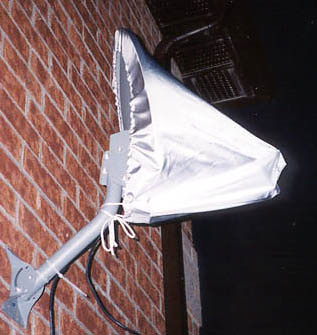
Block it. While some friends of mine have tried the old stand-by – the black plastic bag – to keep the picture free of fuzzies in the rain and the snow, most have had bad luck with signal loss for one reason or another (your milage may, of course, vary). The commercial option here, the WedgieCover, promises to do the same as a black plastic bag in the snow and the rain (not to mention "protect your privacy" although I’m not sure how) without the signal loss and comparatively easy installation… which means no twistee-ties. Score!


Zap it. The bad-ass, Tim Allen approach, however requires "more power," creating the option to melt it off. Particularly good for very cold climates who have to worry about long-term ice formation, the Ice Zapper seems to be the industry standard for metal dishes, although Montana Satellite has a few other options as well. DIY options for satellite heaters? While I’m sure its possible, I’d probably recommend finding a commercial option and staying away from any modifications unless you really are a regular Tim "The Toolman" Taylor. And, even if you are, we all know how well that tended to work out.

GA_googleFillSlot(“481_336x280”);


Beware the Chinese Satellite Killer

Thursday, January 18th, 2007

Read the Reuters report via the Irish Examiner earlier today and was relieved to see the target satellite they smacked into was only 500 miles away, prompting the U.S. to object:

"The U.S. believes China’s development and testing of such weapons is inconsistent with the spirit of cooperation that both countries aspire to in the civil space area," National Security Council spokesman Gordon Johndroe said. "We and other countries have expressed our concern regarding this action to the Chinese."

Using a ground-based medium-range ballistic missile, the test knocked out an aging Chinese weather satellite about 537 miles above the earth on January 11 through "kinetic impact," or by slamming into it, Johndroe said.

For those of us who watch TV, we need not be alarmed. Communications satellites that provide video services, either direct-to-home or to cable systems, operate in the geosynchronous or Clarke orbit. That’s 22,236 miles up. Can’t smack that down.

DIY Friday: Paint That Satellite Dish

Friday, January 12th, 2007

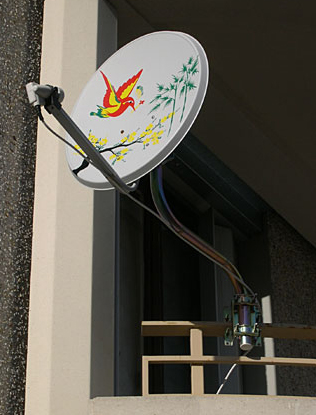
We’ve blogged about unobtrusively installing your own dish — but most satellite TV customers rarely decorate their antennas by painting them.

After coming across this site, showing beautifully painted and decorated satellite antennas in North Africa, we may want to reconsider.

Before we run out and start painting, we need to keep in mind the reflector serves a purpose, and never paint the LNB. Check ehow.com for details.