Two Ottawa-based satellite companies have awarded a total of 12 licences by the federal government to launch new satellites to improve broadcasting and telecommunications services to Canadian entrepreneurs and customers.
The Honourable Maxime Bernier, Minister of Industry, today announced the results of a licensing initiative to authorize the development of new Canadian satellites that will increase and improve broadcasting and telecommunications services to Canadian entrepreneurs and consumers. The first satellites are expected to provide services as early as 2010.
"Canada needs to increase its satellite capacity to keep pace with the ever-increasing demand for satellite services," said Minister Bernier. "By awarding these new licences, we are helping the expansion of satellite capacity and services that will benefit Canadians for years to come. We’re helping to foster an environment that will bring all the benefits of competition, including increased product and service offerings, choice in supplier, competitive prices and export revenues."
Canadian satellite operators Ciel Satellite LP and Telesat Canada have indicated their intention to invest several billion dollars in building and launching new Canadian satellites, which will provide the capacity needed to fully implement high-definition television in Canada and carry important new and advanced telecommunications services such as satellite Internet. These new satellites will also help connect all regions of Canada, especially in the North, where satellites are the vital link to providing public safety, national security and government services. This process represented the largest spectrum licensing initiative ever undertaken in Canada and will lead to Canadian consumers and businesses gaining access to emerging satellite broadcasting and telecommunications services such as high-definition TV, Internet Protocol Television (IPTV), satellite broadband and multimedia consumer applications.
I had a feeling this was going to happen. Apple introduced the iPhone and Apple TV earlier this year. The iPhone is shipping at the end of this month, but Apple TV became available in March. We liked the iPhone right away — as did millions of others. Both products have intriguing capabilities, we thought. Watch Mossberg interviewing Jobs at the D: All Things Digital Conference:
How are they reading this rumor in Redmond? If AT&T’s U-Verse, which inherited BellSouth’s Microsoft IPTV middleware, is talking to Apple, will they also provide an X-Box 360 as an option?
Wait a minute: AT&T, Apple TV, iPhone. I see media convergence. The "triple play" is buying voice, data and video services from one provider. The cable guys are selling it, so the telcos need to start selling video — and fast. Add mobile phone service and you’ve got a interesting proposition: a "quad play." According to the San Francisco Chronicle, this is sure to grow:
For consumers, the quad play means they can buy all four services from one provider and pay for it on one bill, increasingly at a reduced price. But the companies say it’s not only about the convenience and savings from one-stop shopping.
They see the new mega-bundles as a collection of services that will increasingly work together, giving you a new level of access and interaction with your entertainment and communications services. The cell phone will play a pivotal role as a portal to receive television or personal content from home, access home voice mail and e-mail, and program digital video recorders.
The move to the quad play is the latest escalation of a battle that’s been building between phone and cable companies, who, because of deregulation, are allowed to compete on each other’s traditional turf. The two industries have cranked up the competition recently, with cable entering the phone market while telecom companies have started to provide television services.
Both sides see the quad play as a way to hold onto customers, who are even more prized and valuable if they can be made to pay for four services.
Can Apple’s iPhone become the ultimate portable TV receiver? Think about that for a minute.
As we’ve mentioned before, Google is sure to play a role in the new IPTV ecosystem. The lifeblood of this new ecosystem will be advertising. According to Accenture’s latest IPTV Monitor, advertising revenue is key, but keeping customers from bolting is more important:
For although 52% of content providers believe targeted advertising will be the principal source of revenue for those in the IPTV industry, 7% also foresee subscription fees for premium content providing a major source of income, as do 41% of network operators. Yet for many telecom operators IPTV’s initial purpose is not to increase revenue. Instead it is both a defensive measure to stem the defection of customers to alternative broadband access providers and a means to increase sales of broadband access.
Where does that leave the two dominant satellite TV players? You can find some clues at the FCC, where Dish Network, DirecTV, Intel, Google, Yahoo!, and Skype are teaming up to bid for some of the spectrum becoming available once TV goes all digital in 2009. Could a WiMAX-style play developing here.
I still think advertising is where the action will be. As IP is inherently two-way communications, and the addressability can come down to the set-top box, the short-, mid- and long-term possibilities are very intriguing. Yesterday’s op-ed piece in Forbes was especially interesting. Enter "Television 2.0," bring together new possibilities. I especially like the idea of targeting two different IP addresses in the same house:
The convergence of TV with the Internet is transforming a technology that has gone largely unchanged for 60 years–a one-way, TV signal broadcast to a screen, whether that screen is a TV, PC or cellphone. Television is on the verge of becoming completely personalized, interactive and enjoyed on-demand.
Imagine a news broadcast where you as the viewer pre-select the types of stories you want to watch; television programming with interactive multiplayer gaming; personalized viewer-specific content and advertising embedded within national television broadcasts; highly localized and efficient Emergency Broadcast System and Amber alerts; viewing and interacting with the vast and growing catalog of high-quality, user-generated content.
By combining the interactivity of Web services and the Internet with the trend toward on-demand and anywhere viewing, the world of television is about to radically change in ways that will dwarf the changes to the Internet referred to as Web 2.0. We’re calling this change "Television 2.0."
These changes are important. Fueled by the (sometimes reluctant) acceptance of open standards and technology advances, the newly amalgamated television, telecommunications and Internet industries are jointly forging new paths to innovation. What’s in store for all of us is nothing short of exciting.
Think back just a few years to how you received television, telephone and Internet services. Chances are it involved separate providers for television and phone service, one of which might have provided broadband Internet service. And just how fast was the Internet connection then compared with now?
Today an increasing number of households are getting "triple play" service–one provider delivering phone and television services over the same "pipe" that brings Internet into the home. This is a hugely important trend, which from the very beginning enables three disparate communications systems to work together increasing the functionality and utility of all three.
Whereas once interacting with the television set meant using the remote control to change channels or adjust the volume, today you can record multiple shows simultaneously and set user preferences. Tomorrow you’ll be able to apply rules regarding those preferences to your entire home communications system.
Who wants to be interrupted by a phone call during a favorite television program or movie? Simply instruct your system that you do not want to be disturbed and all your calls are delivered to voicemail while you’re watching TV. But what if it’s an emergency call from a family member? You can instruct the system to only pass along calls from people you allow.
Caller ID already helps us screen calls, and Television 2.0 will let us select which voicemail greeting to play for denied callers: serious for the boss or fun and personal for friends. Since your phone is now tied to your TV, why can’t all phone calls become video calls? These are enhanced functionalities we can all use, but we’re just scratching the surface.
Also, when television is delivered as a digital signal over an Internet connection, the program stream itself can be manipulated. When television was delivered over the air to antennas, each station was limited to one macro broadcast. What you watched was exactly the same as what your friend across town watched.
With the advent of digital television delivered to set top boxes, the paradigm shifted. Particularly important for advertisers, content can be targeted based on geography. You and your friend can still watch the same program, but now the ads are different, based on where in town each of you reside. This is no small market. Kagan Research says that in 2006, local ads sold by U.S. cable companies exceeded $4.3 billion.
In the Television 2.0 world, targeting gets personal. Not only are the commercials different for you and your friend across town, the commercial viewed by parents on the downstairs on one TV will be different than the commercial seen by the kids watching TV upstairs in the same house. With Internet Protocol (IP) set top boxes, demographic targeting is already upon us.
One key difference between the television of today and Television 2.0 is that it is delivered over an IP connection. Unlike television delivered over the air, IP connections are bidirectional. Soon the individual television experience will exploit this bidirectionality.
If advertising can be targeted to individual set top boxes, why can’t programming? Think of the news program referenced earlier. Consider how much news is taped for local and national broadcasts every day. Television 2.0 will make it possible to watch any of it. If you’ve relocated from a different part of the country, Television 2.0 will let you see the sports news about your old home team during your new local news program.
If such programming can be done with the news, it can be done with anything. Look forward to seeing more personal selections of sports, music and other entertainment programming. Programming can become interactive too. Instead of merely watching your favorite big city detectives solve crimes, you can lend a hand.
Many universities are adopting distance learning programs. Want the best education? Why not create a hybrid curriculum from the top universities around the world and attend classes from the comfort of your living room? Television 2.0 makes that possible.
Arguably the best part of Television 2.0 is that all these advances are happening independently from the TV itself. So, none of the investment in your state-of-the-art home theater system went to waste. Television 2.0 will just make that home theater all the more spectacular.
In Television 2.0, the possibilities are endless, and largely because the technology companies behind all these innovations are learning to play nicely together. The acceptance of open standards is the fuel powering these innovations. Between the television network and your television set lies the equipment and networks of many different companies all playing a different but complementary role in the Television 2.0 ecosystem.
Fo ‘shizzle: this is not the old TV we grew up with.
Let’s hope this one turn out better than Sinosat-2 did. Here’s the news report, via IHT:
China launched a new communications satellite into orbit early Friday [1 June 2007] to provide broader radio and television signal coverage across the country, state media reported.
The Long March-3A rocket lifted off from the Xichang launching center in southwestern China eight minutes after midnight (1608 GMT) and separated from the SinoSat-3 satellite 24 minutes later, the Xinhua News Agency said.
The long-scheduled launch follows the failed deployment last October of another communications satellite, SinoSat-2, whose solar panels and communications antennae did not operate properly, Xinhua said.
China has spent decades building an indigenous space program and is trying to attract customers from abroad, after a series of failed launches in the 1990s dampened demand for Chinese launch services.
Both the rocket and the satellite used Friday were mainly developed and manufactured domestically, Xinhua said.
The satellite deployed Friday was not developed as a replacement for the inoperable SinoSat-2, Xinhua said, though Sino Satellite Communications Co., the satellite’s operators, may use SinoSat-3 to replace part of the service the other satellite was to have provided.
Xinhua quoted a company spokesman as saying that a substitute satellite would take at least three years to develop.
Picture it: you’re at a baseball game and are fighting with your buddy about whether or not the last hit was fair or foul. The away team’s manager is screaming at the ump and the home team isn’t showing the replay on the scoreboard to avoid controversy. You are stuck guessing — and your honor is on the line.
The solution: pull out your mobile phone, connect to your home’s TiVo, rewind the recording, then force your friend to buy you a beer for getting the call wrong. It’s possible!
An innovative blogger pulled off a very useful mashup by connecting his PPC-6700 mobile phone to a Slingbox, and the Slingbox to his TiVo. A Slingbox is a TV streaming device that enables viewers to remotely view content.
After connecting your TiVo to the Slingbox, download the appropriate player for your mobile phone. Currently there are versions for Windows Mobile 2003, Windows Mobile Version 5.0 for Smartphone, and Palm OS.
While many users find the ability to easily record shows to be most important, I’m intrigued by the convenience of having vast amounts of mobile content. The screen size on the 6700 or the Q is not much different than on an iPod and this mashup avoids hard drive space limitations and the trouble of having to download content, then add it to the iPod. By streaming from your TiVo, you are guaranteed a steady selection of fresh media—both live and recorded.
From early user reviews, the quality appears to be more-than-sufficient. Here is a video from a Motorola Q (skip to 3:30 to watch the Chappelle Show):
Don’t have a Slingbox or TiVo but still want to stream TV on your phone? Try a free service called Orb. While it let’s your home computer be a hub that streams all types of media—music, photos, and videos—to any Internet-connected device, its tv feature may be most useful. Simply connect your tv or set-top box to your computer’s tv tuner card (instructions on buying one are here), then install Orb’s free software. Your computer becomes a server distributing your tv’s content. Orb includes DVR technology, allowing you to (like the TiVo mashup) remotely record programming.
According a local news agency, Kazakhstan Today, DirecTV’s new HD-dedicated satellite won’t be launched until next month:
Launch of space vehicle DirecTV-10 planned for June 20 has been postponed at the cosmodrome Baikonur. Federal space center Baikonur press service informed the agency.
According to the press service, the launch date of the American telecommunication satellite DirecTV-10 has been shifted for July. "The date transfer has been done due to the request of foreign manufacturers of the satellite and is connected with the terms of preparation of a space satellite and its delivery to the cosmodrome," the press service informed.
The exact date of the satellite launch by means of a carrier rocket Proton-M will be defined later after delivery of the satellite to the cosmodrome and will depend on the degree of readiness of foreign partners.
This was indeed confirmed by DirecTV’s press guy, via SatelliteGuys.us:
here’s a statement i just received from bob mercer, directv’s director of public relations:
“The launch date of D10 has slipped to july 7. there were some late processing issues in the Boeing factory but they have been resolved and we are moving forward.”
he sent me a follow-up email from his blackberry to clarify the date:
“that’s actually july 6 in the US.”
Back in January, DirecTV promised up to 70 national HD channels via this and another new satellite in 2007. This is a key launch for them.
If this post’s title doesn’t confuse you, EchoStar’s legal battles sure will.
While other Cable and Satellite operators that use DVR technology (including Time Warner, Comcast, and DirectTV) settled with Forgent Networks, which owns a patent on a specific DVR-playback technology, EchoStar didn’t back down. And, last week, EchoStar won:
A team of Morrison & Foerster attorneys and their co-counsel have won dismissal of a patent infringement case brought against client EchoStar Communication Corp. after a Texas jury took just over an hour to find the plaintiff’s patent invalid. It was only the second time on record that a jury in the Eastern District of Texas had handed down a defense win in a patent case by finding the patent at issue invalid.
The court ruled that Forgent’s patent claims against EchoStar were all invalid as anticipated, obvious, and lacking proper written description. The jury instructions describe the legal parameters for "obviousness," but Forgent’s CEO, Richard Snyder, summarizes it best in his company’s recent earnings call: "The outcome of many of these events relating to intellectual property are complex and uncertain."
"Complex" is right. For clarification I turn to Wikipedia: "The inventive step and non-obviousness reflect a same general patentability requirement present in most patent laws, according to which an invention should be sufficiently inventive, i.e. non-obvious, in order to be patented." It appears Forgent’s computer controlled video system that allows playback during recording is not valid for a patent as it is an obvious extension of existing technology. If we have any lawyers in our community, please weigh-in.
By not settling, EchoStar took a big risk. The company faced the prospect of over $200 million in damages if it lost and it’s legal arena was daunting. The Denver Post describes the case’s context:
EchoStar’s hard-line approach isn’t surprising, given its history. The company is known as being litigious, and only rarely does it back down from a legal fight. Founder Charlie Ergen bet the company on a lawsuit in 1997, when he sued Rupert Murdoch’s News Corp. for $5 billion over a failed merger of satellite-TV operations. News Corp. settled.
Drapkin and others called the Forgent verdict an unusual outcome in the Eastern District of Texas, known as the "Rocket Docket" for the speed with which patent cases are handled.
"It’s rare that a defendant would win a jury case in that district … particularly a large company," said Kirstin Stoll-DeBell, of Merchant & Gould in Denver, who represented a client there who settled a patent case. "I think jurors down there are biased against corporate America."
Where does this leave other cases in the DVR-patent war, mainly the TiVo/EchoStar saga which is currently pending in the Federal Circuit Court of Appeals? (Until it considers the case, the court gave EchoStar a stay on an earlier injunction that would force it to turn-off all of its customers’ DVR capabilities.) To be true to this post’s theme, I would have to say…well…unclear.
EchoStar and TiVo both see the light after this Texas ruling and a recent regulatory review of TiVo’s patents. Last week, as part of an ongoing lawsuit filed by TiVo against EchoStar, the U.S. Patent and Trademark Office reviewed 61 of TiVo’s patents and ruled that most (as many as 59), but not all, were valid.
"We are pleased that the United States Patent and Trademark Office yesterday rejected many of TiVo’s patent claims as invalid. That re-examination ruling, together with the favorable decision from the Court of Appeals earlier this month…are steps in the right direction as we prepare our response to TiVo’s recently filed injunction motion,"
TiVo’s CEO, Tom Rogers, argues that their case against EchoStar is:
moving closer to resolution at the Federal Circuit Court of Appeals. AT&T recently attempted to file an Amicus brief [which was denied] supporting EchoStar which speaks to how others perceive the importance of this case. We are actually pleased with EchoStar’s recent victory in another patent case, the Forgent litigation. I say pleased because EchoStar cited as a key defense one of TiVo’s important patents.
Still a little confused? Me too. We will keep you updated as this legal mess unravels in the courts.
The list of cable channels keeps growing and they all need to find a way to get it to the top 100 cable systems. Since 1976, the best way to get your cable channel distributed is by satellite — it is the technology that made HBO and CNN what they are today.
First step is to secure a lease on a C-band satellite that cable systems are already "looking at" (have a downlink antenna assigned to it). CED Magazine’s series of wall charts include the annual "Orbital Arc Chart" (link launches PDF), which shows you a snapshot of all the cable channels and which satellites they’re on. Want more detail? Check Lyngsat for each satellite’s ladder chart.
Getting space segment in a high-value "cable neighborhood" is not cheap. For a start-up, viable alternatives to going it alone include origination and uplink centers such as Comcast Media Center (CMC) in Colorado and Crawford Communications in Georgia.
CMC uplinks the entire HITS ("headend in the sky") platform, which carries a ton of channels.
Broadcast Newsroom just ran a piece on Crawford setting a record for new channel uplinks: 14 new channels so far this year. overall, they uplink 135 full time cable channels. I like their new video tour:
THE SRI LANKAN EMBASSY in Washington has complained to the US Justice Department, State Department and the Federal Bureau of Investigation (FBI) against Washington based Intelsat Ltd., for reneging its promise of removing the National Television of Tamil Eelam (NTT) channel and Pulikalin Kural radio from the Intelsat 12 satellite transponder and for continuing to facilitate and broadcast terrorist propaganda.
Before lodging the complaint, the Sri Lankan Embassy brought to the communication satellite company’s notice that despite its assurance that it has removed both channels from its transponder, it continues to broadcast National Television of Tamil Eelam, and Pulikalin Kural (Voice of Tigers radio) the official television and radio of the LTTE.
Intelsat Ltd., according to sources, laid down conditions to the Sri Lanka Embassy that talks with them should not be publicised or divulged to anyone which the Embassy refused even to consider.
Subsequently, the Sri Lankan Embassy alleged that the satellite provider is violating US law by continuing to broadcast the propaganda television and radio services of the foreign terrorist organisation LTTE, through the satellite they own despite public assurances given ago to the contrary.
National Television of Tamil Eelam, the official television channel of the LTTE is a free-to-air channel to Asia and an encrypted channel to Europe.
The four-hour daily programme of the NTT channel broadcasts propaganda material of the LTTE, a terrorist organisation banned in United States of America, Canada, India and in European Union countries.
The illegal transmission of the NTT channel of the LTTE was for the first time brought to Intelsat Ltd’s notice by Asian Tribune on March 10.
Dianne VanBeber, Intelsat Ltd Vice President in charge of Investor Relations and Corporate Communication, told ‘Asian Tribune’ that the LTTE is pirating the Intelsat’s 12 bandwidth without the company’s knowledge.
"Intelsat has notified the original customer for the capacity that they are in violation of their contract, and Intelsat has informed them to cease transmissions," VanBeber said.
Asked to identify the original customer of Intelsat, VanBeber refused to disclose the service provider’s name who has accommodated the LTTE’s media without Intelsat Ltd’s knowledge.
Asked whether Intelsat was not aware that the LTTE’s National Television of TamilEelam was using the Intelsat 12 satellite bandwidth since 2005, she clarified that Intelsat Ltd acquired PanAmSat only on July 3, 2006, and LTTE’s National Television of Tamil Eelam might have come to quietly share the Intelsat 12 satellite.
She said: "We are taking action to cease their transmission soon." Subsequently this issue was taken up by Bernard Goonetilleke, Sri Lanka’s Ambassador in Washington with Intelsat’s General Counsel, Phillip Spector.
A press statement was released by the Intelsat after the meeting.
In a press statement dated April 10 Intelsat Corporation said: "Intelsat officials, including its technical experts, met with Sri Lanka’s Ambassador to the United States, Bernard Goonetilleke, on April 10 to discuss the steps Intelsat is taking to address the unauthorised use of one of its satellites by the LTTE.
During the meeting, Intelsat’s General Counsel, Phillip Spector, said:’ "Intelsat does not tolerate terrorists or others operating illegally on its satellites. Since we first learned of the LTTE’s signal piracy, we have been actively pursuing a number of technical alternatives to halt the transmissions. We are clear in our resolve to ending this terrorist organisation’s unauthorised use of our satellite’."
Later, the Sri Lankan embassy revealed that Intelsat Ltd., stated that during April 21-22 they switched off the transponder of the free to air NTTE channel beamed to Asia and the encrypted channel beamed to Europe.
The Lyngsat site confirms that both the television and radio broadcasts were up and running on 29 April 2007 — nearly three weeks after we first blogged it. The program can be found every day, from 18:00 to 21:30 GMT, on Intelsat 12, transponder 2 (downlink frequency: 11,504 Vertical; symbol rate: 2894; FEC: 3/4).
How did that happen? If you read ToTheCenter.com, you’d think it was indeed turned off:
INTELSAT INFORMS SRI LANKA EMBASSY IN WASHINGTON IT SWITCHED OFF LTTE BROADCASTS FROM THEIR SATELLITE
( By Walter Jayawardhana)
Sri Lanka’s envoy in Washington, D.C. said his office had been given an assurance by Washington based Intelsat Corporation that they have switched off the transponder used by the Liberation Tigers of Tamil Eelam (LTTE) to broadcast its propaganda, during the last weekend.
“We were told last evening by Intelsat executive Phillip Spector that the transponder used by the LTTE was switched off during the weekend,” Bernard Goonetileke, Washington, D.C.’s Sri Lankan Ambassador told this correspondent.
However, Goonetileke said he was still not sure whether the banned terrorist group has made some other arrangements with a European satellite company to carry on with the broadcasts continually.
He said inquiries are made to check whether LTTE is continuing its broadcasts and whether they are doing it through another channel, suspected to be Globe Cast satellite of a European company.
A press release issued by the Washington, D.C. Embassy of Sri Lanka said, “Intelsat Ltd., a U.S. based satellite company has terminated the “unauthorized” use of one of its satellites, Intelsat12, by the Sri Lanka based terrorist organization, the Liberation Tigers of Tamil Eelam (LTTE), for its TV and radio transmissions to Europe and Asia.”
The Executive Vice President and General Counsel of Intelsat Ltd., Mr. Phillip Spector, confirmed to Rajika Jayatilake, Counselor (Information) at the Sri Lanka Embassy in Washington, D.C., that Intelsat Ltd. had, over the April 21/22 weekend, shut down the transponder, which the LTTE had used for its transmissions, the press release said further.
Whatever new channel the LTTE is using will have to be advertised through some means since the viewers and listeners of its propaganda have to be informed about the changes in the broadcasting frequencies. So far, no such advertisement has been found.
Following the meeting with Ambassador Goonetileke on April 10, 2007, Mr. Phillip Spector, of Intelsat Ltd., stated that the LTTE transmissions were “unauthorized.” Countering the position taken by Intelsat Ltd., speaking from Sri Lanka’s north to wire services in Colombo, the LTTE denied it was using the satellite services illegally. “We are accessing it legally and there is no signal piracy,” said an LTTE spokesman.
However, inquiries by this correspondent could not find out any evidence to confirm the statement of Phillip Spector, that the LTTE was a pirate of the satellite.
The Embassy press statement traced the history of the LTTE-INTELSAT connection as follows: “Since March 2005, the LTTE had been transmitting TV and radio programs through Europe Star 1 satellite owned by French satellite provider, Alcatel. PanAmSat, a satellite operator headquartered in Wilton, Connecticut in the U.S., acquired Europe Star 1 satellite in July 2005. In July 2006, Intelsat Ltd. acquired PanAmSat, following which, Europe Star 1 satellite was renamed Intelsat12. The programs that the LTTE had been transmitting through Europe Star 1, thus continued uninterrupted even after Intelsat Ltd. acquired the satellite.”
It is believed that it was the intense pressure used by the Washington Embassy of Sri Lanka and the U.S. State Department and the Department of Justice, together with press publicity, that was adversely affecting Intelsat that finally brought an end of the deal.
The Sri Lanka Embassy said, the U.S. Department of State and the Department of Justice had both been informed that a terrorist group designated by the U.S. as a Foreign Terrorist Organization (FTO), was using a satellite owned by a U.S. based satellite company to transmit their TV and radio programs to Europe and Asia. (EOM)
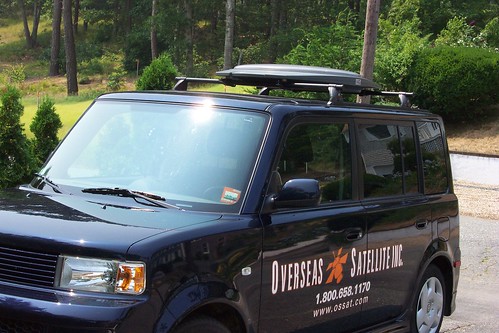
[T]he MobileDISH™ in-car satellite service [is] a programming package that combines cutting-edge antenna technology from RaySat™. The MobileDISH™ technology, which was showcased at the 2007 Consumer Electronics Show earlier this year, allows DISH Network customers to watch live satellite television from their vehicles, even while in motion.
“We’re excited to partner with RaySat because we know people today are always on the move and have a need for TV even while on the road,” said Mark Jackson, President of EchoStar Technologies. “The MobileDISH technology is just another example of how we’re providing our extensive line of cutting-edge technology and exceptional programming packages to reach our more than 13 million subscribers everywhere.”
The mobile satellite antenna, designed by RaySat™, mounts to a vehicle’s roof rack and provides hundreds of channels of all-digital DISH Network satellite TV with programming for everyone in the family. The MobileDISH technology is perfect for occupying the kids, monitoring weather and road conditions, keeping up on breaking news and watching movies on long road trips.
We first wrote about the RaySat antenna system (pictured above) in September.
For sports fans, the MobileDISH service is particularly attractive: just yesterday, it was reported that DISH had added two new HD regional sports networks to its list of channels, and was looking at several more — which could bring a whole new level of connectivity to your local tailgate party.
But how much will it set you back?
New and existing DISH Network customers can choose from a variety of programming packages that start at $29.99/month for the MobileDISH 100 package, and $42.99/month for the MobileDISH 200 package. The Starz Movie Pak can be added to the MobileDISH packages for $12.99/month, and the Encore Movie Pak may also be added to a MobileDISH package for $4.99/month.
Not bad for those who’ve always wanted to watch the game while on the road or in the driveway.