Archive for the ‘Satellite TV’ Category

Al-Jazeera’s Yugo-Nostalgia

Tuesday, March 29th, 2011


A new regional news operation is opening up in the Balkans, with an interesting business plan. The story, via AFP:

The Al-Jazeera pan-Arab satellite channel says it will begin airing a Balkans programme in September, hoping to to establish itself as a regional news hub in the ethnically divided region.
With powerful public television divided along ethnic lines across the region and dozens of private channels mostly focusing on entertainment, Al-Jazeera Balkans hopes to fill the void for a regional news broadcast.

“In the region there are currently more than 100 stations that broadcast news,” said Goran Milic, 65, a prominent Croatian journalist who will be responsible for Al-Jazeera’s Balkans operation.
“We cannot compete with them on the level of local news and won’t be able to for a long time,” he added, Instead, he said, Al-Jazeera could offer the regional approach abandoned in the 1990s due to war and the emotions that it sparked.

In the 1990s, the former Yugoslavia broke up into six separate states (Bosnia, Croatia, Macedonia, Montenegro, Serbia and Slovenia) and the disputed territory of Kosovo.

But Milic argued that many people across the region “are still interested in what is going on on the other side of the border.

“No local television dares to make a regional programme treating topics relating to bordering countries, for fear of being accused of “Yugo-nostalgia,” he noted.

“Our advantage will be also to compare information on an event in one country with a similar situation in an another,” he explained.

Media analysts however question whether Al-Jazeera can succeed since several previous attempts over the past 16 years to set up Balkans broadcasters with support of the international community failed because of lack of interest.

“They were political concepts aimed at breaking down the walls that arose during the conflicts and to push reconciliation,” Bosnian media analyst Zoran Udovicic told AFP.

After 20 years of various state media repeating the official line, it is hard to get people interested in what is happening in neighbouring countries, he added.

“(Al-Jazeera) can focus on the languages that are similar or the same and even on the feelings that people still have about the (Yugoslav) period before the wars … but they will also need to work to spark people’s interests in their neighbours,” Udovicic said.

Al-Jazeera’s best bet, he noted, would be to steer clear of the war-torn past and focus its programming on the present and the future of the region.

Serbian journalism lecturer Zoran Cirjakovic also saw problems ahead for the Balkans branch of the Qatar-based company.

“The audience in various parts of the Western Balkans has a different understanding not only of the past but also of the present,” he warns.

“The audience in all countries (in the region) have radically different interests in political topics,” he told AFP.

“They are more easily united in topics like art, culture and entertainment,” he added, citing examples of successful regional entertainment such as music and reality shows.

“My students, born in the late 1980s or early 1990s do not remember Yugoslavia… for them it is another planet, another world,” he explained.

So Al-Jazeera Balkans will be put to the test when it starts broadcasting in what was once called Serbo-Croat, which is universally understood in Croatia, Serbia, Bosnia and Montenegro.

Together with Al-Jazeera Turkey, it will be one of the first regional offices to broadcast in languages other than Arab or English.

The Pan-Arab channel has invested more than 20 million dollars (14 million euros) in the Balkans project.

Initially launched in 1996 as an Arabic news and current affairs satellite TV channel, Al-Jazeera has since expanded into a network with several outlets, including the Internet.

Al-Jazeera Balkans will employ some 100 people, including around 60 journalists and cameramen.
It will have correspondents in all the countries that once made up the former Yugoslavia and in several world capitals.

And it will tap a regional audience of over 20 million people as well as an important diaspora from each of the six former Yugoslav republics, particularly in Western Europe.

I don’t think they’ve figured out what satellite they’ll be on. Al-Jazeera is carried by quite a few satellites around the world, but they’ll likely select one that’s popular in the Balkan region. However, the either Astra or Eutelsat would be be a good choice as well.
Lock & Load With DISH Network

Sunday, March 27th, 2011

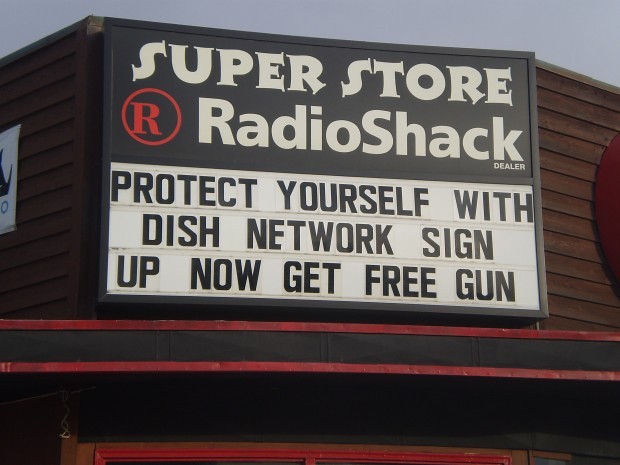
The folks who run the Radio Shack in Hamilton, Montana, really know their customers. Their “free firearm” promotion is working well. The story, via the Billings Gazette

When driving down U.S. Highway 93 through Hamilton, there’s no need to do a double-take when you see the sign hanging above the Radio Shack Super Store.

You read it right. Customers who buy Dish Network will be rewarded with a firearm.”I think it really, really fits the Bitterroot Valley,” said Steve Strand, who has owned Hamilton’s Radio Shack for about seven years.

Strand, along with store manager Fabian Levy, wanted to generate more foot traffic at their location. So far, the gun giveaway has worked like a charm.

“It’s been really successful,” Levy said.

According to Strand, it has tripled his business since the promotion started last October. And, he said, easily hundreds of people have stopped in to see what the sign is all about. “Protect yourself with Dish Network. Sign up now, get free gun,” the sign reads.”We have people literally stop in to take pictures of the sign,” Levy said.

Qualifying customers have the choice between a Hi Point 380 pistol or a 20-gauge shotgun.The deal is only good for new Dish Network customers and they must buy a certain amount of equipment to qualify for the free gun.

After the customer signs a service contract and sets up an install date, they are given a gift certificate for their gun. They can also opt for a $50 gift card from Pizza Hut if they prefer, Strand said. And customers who purchase new Dish Network service that don’t qualify for a firearm are still given the Pizza Hut gift card.

The gift certificate is good at Frontier Guns & Ammo, located north of Hamilton on Sheafman Creek Road. They are then put through a background check, also free with the promotion, before receiving their gun.

“We’re not just giving guns to felons,” Levy said.

The idea for the promotion wasn’t anything scientific. A friend of Strand’s made the suggestion and, “I thought, ‘Why don’t we?’ ” Strand said.

With all the interest his promotion has garnered, there was one trend.

“You’d be surprised how many women are interested in guns,” Strand said, noting he has had many women in their 60s and 70s drop in to learn about the promotion. “I was quite surprised,”Strand said.
Strand said since starting the promotion, he has gotten good feedback. “We’ve received a tremendous amount of positive reactions,” Strand said.

He said of the hundreds of people who have stopped by because of the sign, only one person reacted negatively. “They didn’t understand how it works,” he said.

Strand also said that other Radio Shack owners he has talked to across the state, in places like Havre and Malta, are too scared to try similar promotions.

“There is a risk involved,” Strand said.

Dish Network allots advertising dollars to the store to promote Dish, but the gun promotion has made them skittish.

“They’ve never had a gun promotion before, so they’re a little nervous about it,” Strand said. “It’s been an uphill battle with Dish.”

After a few months of volleying with the company, however, Strand was given the go-ahead to start advertising.

“If we can get that promotion out there, things could go crazy,” Strand said.

They aren’t sure how much longer they will continue the promotion, but they will be doing the same deal next month with Direct TV packages.

“I kind of thought this promotion was a joke at first, but as things picked up, I realized it was working,” Levy said.

Satellite TV Going Local

Tuesday, March 22nd, 2011


Is this what we’re about to see on our satellite TV systems? If the deal between DirecTV and NDS is any indication, you can count on it.

NDS will deliver key elements of its NDS Dynamic suite of advanced advertising solutions including local DVR video ad insertion and advertising audience measurement capabilities.

The NDS Dynamic components delivered to DIRECTV will be deployed on DIRECTV’s SD DVRs allowing seamless insertion of household addressable ads into both live and recorded video content from the DVR hard drive.

The implementation for DIRECTV will also see the extension of their existing audience measurement capabilities, already supported by NDS Dynamic. DIRECTV will now be able to collect data on local ad insertion events. This data will support the revenue-generating potential of addressable advertising on the DIRECTV platform with the ability to generate solid feedback on the ads that have been viewed.

DirecTV is after the local cable companies’ ad sales market, which had a pretty good year in 2010.


Air Traffic From Space

Friday, August 6th, 2010


This is a 24 hour observation of all of the large aircraft flights in the world, condensed down to 1:11. From space we look like a bee hive of activity. What you will see is a video showing air traffic around the world for 24 hours taken from a satellite. You won’t believe this! The yellow dots are airplanes in the sky during a 24 hour period. Stay with the picture. You will see the light of the day moving from the east to the west, as the Earth spins on it’s axis. Also you will see the aircraft flow of traffic leaving the North American continent and traveling at night to arrive in the UK in the morning. Then you will see the flow changing leaving the UK in the morning and flying to the American continent in daylight. You can tell it was spring time in the north by the sun’s foot print over the planet. You could see that it didn’t set for long in the extreme north, and it didn’t quite rise in the extreme south. I have never seen this before. We are taught about the earth’s tilt and how it causes summer and winter, and we have had to imagine just what is going on. With this 24 hour observation of aircraft travel on the earth’s surface we get to see the daylight pattern move as well. Remember watch the day to night. Day is over in Australia when it starts.

Here Comes The Flood

Wednesday, May 5th, 2010


Excellent review of Peter Gabriel’s performance at Radio City Music Hall last night. "Here Comes The Flood," from his first solo album, was not part of the playlist, but Randy Newman’s "I Think It’s Going To Rain Today" was. I like his approach, doing all covers on his new "Scratch My Back" album.

Think songwriting, and Nashville comes to mind. It’s not called "Music City" for nothing. I’m expecting somebody to write a song on the terrible flooding of the past few days.

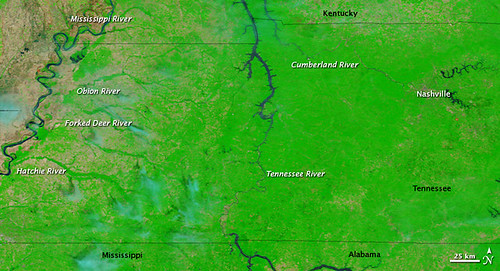
NASA’s Earth Observatory site has published satellite imagery showing before & after pics…

 …before, on 29 April 2010…


…and after, on 4 May 2010…


 Record-breaking rain triggered severe and widespread flooding across Tennessee starting on May 1, 2010. This false color image provides a cloud-free view of the region’s swollen rivers as seen by the Moderate Resolution Imaging Spectroradiometer (MODIS) on NASA’s Terra satellite on May 4, 2010. Terra MODIS acquired the lower image on April 29, 2010, just two days before the storm.

The images combine infrared and visible light to increase the contrast between water and land. Water is black or blue, while plant-covered ground is bright green. Bare earth around the Mississippi River is tan, and clouds are pale blue.

A comparison between the two images reveals flooding on nearly every river system. The landscape is marbled blue from countless swollen streams that aren’t normally visible. The Tennessee River and Cumberland Rivers and their tributaries are wider on May 4 than they were on April 29. In the west, the Obion, Forked Deer, and Hatchie Rivers are also notably swollen.

Flooding across middle Tennessee was at record or near-record levels, said the National Weather Service. The Cumberland River crested at 51.86 feet in Nashville on May 3, the river’s highest level since the Cumberland River dam system was built in the early 1960s. Four other Tennessee Rivers also reached record highs, said the National Weather Service. By May 4, when this image was taken, the rivers had started to slowly recede.

FAA NextGen: Now Landing in Philly

Wednesday, April 28th, 2010


Yes, Philadelphia. The hometown of W.C. Fields, who was alleged to have said "Philadelphia, wonderful town, spent a week there one night," is one of four cities to have the FAA’s NextGen system installed. The others are Houston, Louisville and Juneau. The system does it all: navigation, surveillance, and communication.

Of course, they use satellite technology.  The Philadelphia Inquirer did a nice piece on it yesterday:

"Philadelphia is a pioneer site," said Federal Aviation Administration vice president Victoria Cox, announcing that Philadelphia controllers now have the capability to track planes equipped with the technology, known as Automatic Dependent Surveillance Broadcast, or ADS-B.

It’s part of a nationwide aviation overhaul – called Next Generation, or NextGen – that the FAA hopes will be largely operational by 2018.

By 2020, all aircraft flying in U.S. airspace must have the ADS-B devices in their cockpits.

Philadelphia is a demonstration site because United Parcel Service is here and has equipped 100 aircraft with satellite-technology. US Airways Group Inc. is in the process of equipping some of its planes, the FAA said.

Philadelphia controllers also use a computer system, called STARS, that takes information, including the ADS-B signals, and translates it to the screens controllers look at.

In addition, Philadelphia was selected to get some of the first satellite-surveillance radios because of its location in congested East Coast air space. The other test sites are Louisville, Ky., where UPS is based; Houston; and Juneau, Alaska.

Seven ground radios – each about the size of two refrigerators – have been installed around Philadelphia, including two on airport property. They will be part of a network of 813 radios by 2013, the FAA said.

Once airplanes get specialized GPS devices in cockpits, pilots will transmit via satellite to ground radios, which will bounce information to control towers. Controllers, in turn, will transmit to the radios, which will broadcast up to the cockpit.

The new technology will allow pilots, for the first time, to see what controllers see: other aircraft in the sky around them, bad weather and terrain, and information such as temporary flight restrictions.

 Need more detail? Check out the FAA’s NextGen Implementation Plan (84-page PDF). There are basically five elements to this system:

  1. Automatic dependent surveillance-broadcast (ADS-B). ADS-B will use the Global Positioning System (GPS) satellite signals to provide air traffic controllers and pilots with much more accurate information that will help to keep aircraft safely separated in the sky and on runways. Aircraft transponders receive GPS signals and use them to determine the aircraft’s precise position in the sky. This and other data is then broadcast to other aircraft and air traffic control. Once fully established, both pilots and air traffic controllers will, for the first time, see the same real-time display of air traffic, substantially improving safety. The FAA will mandate the avionics necessary for implementing ADS-B.
  2. System Wide Information Management (SWIM). SWIM will provide a single infrastructure and information management system to deliver high quality, timely data to many users and applications. By reducing the number and types of interfaces and systems, SWIM will reduce data redundancy and better facilitate multi-user information sharing. SWIM will also enable new modes of decision making as information is more easily accessed.
  3. Next Generation Data Communications. Current communications between aircrew and air traffic control, and between air traffic controllers, are largely realised through voice communications. Initially, the introduction of data communications will provide an additional means of two-way communication for air traffic control clearances, instructions, advisories, flight crew requests and reports. With the majority of aircraft data link equipped, the exchange of routine controller-pilot messages and clearances via data link will enable controllers to handle more traffic. This will improve air traffic controller productivity, enhancing capacity and safety.
  4. Next Generation Network Enabled Weather (NNEW). Seventy percent of NAS delays are attributed to weather every year. The goal of NNEW is to cut weather-related delays at least in half. Tens of thousands of global weather observations and sensor reports from ground-, airborne- and space-based sources will fuse into a single national weather information system, updated in real time. NNEW will provide a common weather picture across the national airspace system, and enable better air transportation decision making.
  5. NAS Voice Switch (NVS). There are currently seventeen different voice switching systems in the NAS, some in use for more than twenty years. NVS will replace these systems with a single air/ground and ground/ground voice communications system. 

Yeah, there’s a video…

50 Years of Tracking Weather From Space

Thursday, April 1st, 2010


Nice piece in today’s Star-Ledger, marking the 50th anniversary of the TIROS spacecraft, designed and built by RCA Astro-Electronics in East Windsor, NJ:

WALL — It didn’t get the respect of Sputnik or a hit song like Telstar, but 50 years ago today TIROS redefined the space race.

For the 78 days it functioned, this engineering marvel proved America could not only put a satellite into outer space but — in a giant leap beyond the Soviet satellites — take pictures once it got there.

"It was huge. Massive. It not only did radically change the study of meteorology, but it gave us the upper hand in the Cold War by showing the Russians we could spy on them from outer space," said historian Fred Carl. "How cool is that?"

Way cool. And impossible without New Jersey’s contribution, which may be why the state appears to be the only place celebrating TIROS’s big anniversary, according to NASA officials.
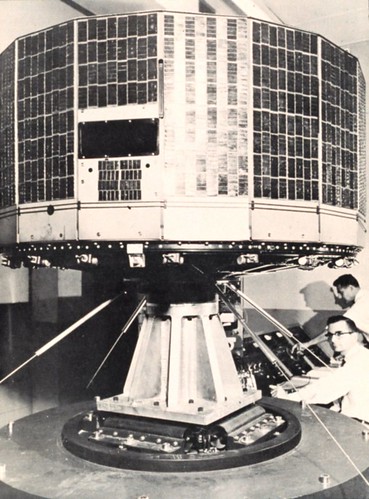
TIROS-satellite2.jpgPhoto by Carolyn Russo/NASMIn 1960, TIROS I became the world’s first successful imaging weather satellite. Nine more TIROS series spacecraft followed, and they revolutionized weather monitoring and prediction. This prototype of TIROS I and II was used for ground testing.
Granted, the festivities are not exactly on par with Columbus Day.

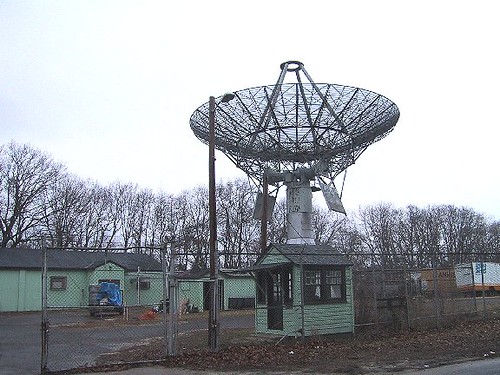
In Princeton, the party will start Saturday with a program featuring some of the scientists who worked at RCA Astro-Electronics in East Windsor, the birthplace of TIROS. In Wall Township, home of the giant dish that received the first images sent back from TIROS, local officials will gather April 11 to sign an application to put the site on the National Historic Register.

In coming weeks there will be scholarly discussions about the future of space exploration and a dinner dance.

Primarily, however, the TIROS anniversary is an opportunity for aging scientists and engineers to reflect back on when they were there for the dawn of space travel.

"It was a time of national need and TIROS is about how one group of people responded to that need," said George Martch, 73, a retired RCA engineer who is organizing the Princeton celebration. "It’s hard now, when satellite photos are everywhere, to imagine what it was like back then before the technology existed.

"We were making it up as we went along."

Only 40 years earlier, meteorologists were still sending up kites to get weather readings, a practice that routinely caused electrocution. But World War II brought huge technological advances. By the 1950s, the basics were there.

Cameras had already gone briefly into space, attached on the backs of ballistic missiles. The military had put test satellites into brief orbit and NASA, the civilian space agency, was in place, although in its infancy.

The problem was putting it all together.

"What we had was mostly experimental. We had to adapt cameras and find a way to store images, since they could only be sent back under certain conditions," said Martch, adding they also developed a power source, antennas and a way to stabilize the orbit. "You have to remember, there really was no aerospace before this."

It was a time of flux, as systems, structural and electrical engineers, scientists, physicists, and experts in thermal dynamics and propulsion were switched back and forth, depending on the progress of each component, RCA retirees recalled.

There was drama along the way. They learned electronics will fry when subjected to the wrong pressure in a vacuum chamber. There were heated theoretical battles and even romance among two RCA scientists who later married.

The result looked like a giant hatbox and weighed less than a defensive lineman. It was aluminum and stainless steel and covered with 9,200 solar cells.

Launched April 1, 1960, out of Cape Canerval Florida, it stayed in orbit by spinning like a top, traveled 18,000 mph and could circle the earth every 90 minutes at an altitude of about 450 miles.

It was formally known as the Television Infra-Red Observation Satellite and shot 22,962 photographs before a fatal power failure ended its mission.

TIROS was the first satellite to publicly take photos of the earth, although there was a secret project launched by the U.S. military a year earlier. However, only TIROS could send photos back to Earth in real time.

The "Eye in the Sky," as TIROS was also called, needed a way to phone home, and that is where Camp Evans in Monmouth County came in.

The former property of telegraph pioneer Marconi had been absorbed by RCA. It was later sold to the military and the Signal Corps built a radar laboratory there during World War II, said Carl, a former science teacher who is leading a campaign to preserve the site.

A giant receiver that was assembled at Camp Evans, where it still exists. Minutes after TIROS sent back its first picture, it was on a jet to Washington and hand-delivered to President Eisenhower. He sent copies to the Russians and the Chinese as a "gesture of goodwill," noting TIROS busily was taking photos of both countries.

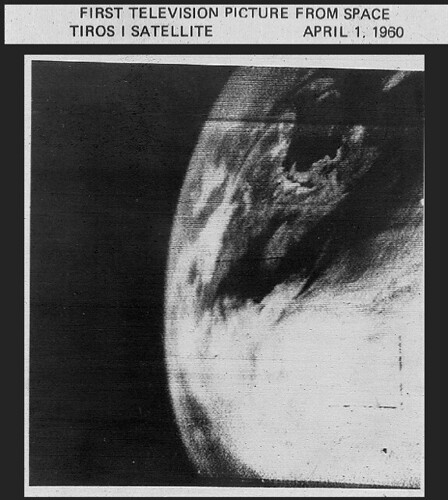
Kicking a little Communist butt at the height of the Cold War was only a side benefit of TIROS. Its real accomplishment came nine days into orbit, when it sent back a photograph of a curious cloud formation with a hole in the middle.

Planes were dispatched to the photo location, in one of the "silent spots" in the South Atlantic where it was formerly impossible to take weather readings. The "hole" was a nascent tropical storm.

Hurricane tracking was born.

"Solar cells, tape recorders, transistor tubes, phone cameras. They all are directly related to TIROS," said Carl. "But with storm tracking, TIROS is responsible for saving millions of lives, yet few people have ever heard of it. Don’t you think it’s time that changed?

The back-up can be found at the Smithsonian’s National Air and Space Museum in Washington, D.C.

The tracking antenna on Marconi Road in Wall, N.J.? Still working…


Our friends at NOAA are marking the anniversary as well…

Fifty years ago today, the world’s first weather satellite lifted off from Cape Canaveral, Fla., and opened a new and exciting dimension in weather forecasting. Top leaders from NOAA and NASA hailed the milestone as an example of their agencies’ strong partnership and commitment to flying the best satellites today and beyond.

The first image from the satellite, known as TIROS-1 (Television Infrared Observation Satellite), was a fuzzy picture of thick bands and clusters of clouds over the United States. An image captured a few days later revealed a typhoon about a 1,000 miles east of Australia. TIROS-1, a polar-orbiting satellite, weighed 270 pounds and carried two cameras and two video recorders. Though the satellite only lasted 78 days, its impact is still visible today.

“This satellite forever changed weather forecasting,” said Jane Lubchenco, Ph.D., under secretary of commerce for oceans and atmosphere and NOAA administrator. “Since TIROS-1, meteorologists have far greater information about severe weather and can issue more accurate forecasts and warnings that save lives and protect property.”

"TIROS-1 started the satellite observations and interagency collaborations that produced vast improvements in weather forecasts," said NASA Administrator Charles F. Bolden, Jr. "It also laid the foundation for our current global view of Earth that underlies all of climate research and the field of Earth system science."

Throughout the 1960s, each TIROS spacecraft carried increasingly advanced instruments and technology. By 1965, meteorologists combined 450 TIROS images into the first global view of the world’s weather.


Outdoors at the Satellite Show

Wednesday, March 17th, 2010


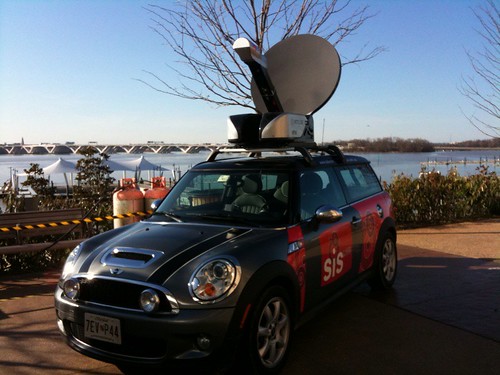
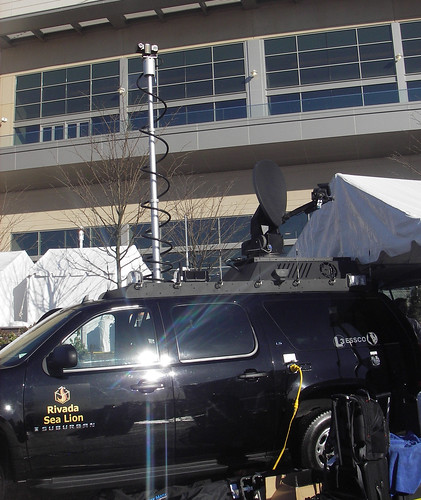
This Mini outfitted with a mobile antenna is pretty cool, although it may not be as practical as the "command vehicle" put together by CAMMS.

CAMMS™ (Command Anywhere Media Management System) was developed to enable a totally secure, scalable mobile mesh (ad hoc) network and provide the necessary tools for Command Anywhere.

The CAMMS™ mobile mesh software program is a patent pending Windows-based program, which provides the foundation for an ad hoc, self-forming / self-healing wireless mobile mesh network.   It provides interoperability and allows real time communications with any others users in the mesh.

Mobile mesh (ad hoc) networks offer many advantages over other types of communications networks.  Chief among these is the ability of the mesh to function independently of a land-based infrastructure.

When communication is linked solely to a land-based infrastructure an acute vulnerability exists.  By utilizing a mesh, the network infrastructure becomes decentralized, avoiding a central point of failure and control.  Command can be located anywhere with hand off from first responder to others when required instantly.

The CAMMS™ mobile mesh software does not require servers or fixed access points (FAP’s) and is compatible with existing mesh AP’s.  The software may be purchased separately to maximize existing communications systems or as part of complete interoperable communications solution that includes software and AP.


WBMSAT Satellite Industry News Bits 03/05/2010

Friday, March 5th, 2010

Orbital Sciences reaches agreement to acquire spacecraft development and manufacturing business of General Dynamic’s subsidiary GD Advanced Information Systems.
[SatNews – 03/05/2010]

Air Force accepts WGS-3 from Boeing.
[UPI – 03/05/2010]

RRsat Global Communications Network signs agreement with ISG Media of India to provide fiber connectivity, playout and distribution for satellite broadcast in Europe and North America.
[SatNews – 03/05/2010]

SatMAX and TLC  Engineering offer SatMAX repeaters to aid Chile.
[CNN Money – 03/05/2010]

GlobecCast’s new Content Acquisition and Distribution division signs agreement with Chinese content provider ZN Animation to deliver content to Video on Demand viewers throughout Europe.
[SatNews – 03/05/2010]


GOES-P satellite, NASA and NOAA’s environmental satellite completing the N -O series,  is successfully launched from Cape Canaveral.
[NASA web site – 03/04/2010]

OmniGlobe Networks EMEA signs Letter of Intent to acquire entire issued share capital and assets of privately-held Sat-Comm Ltd.
[SatNews – 03/04/2010]

Telesat expresses support for Canadian government’s commitment to remove foreign ownership restrictions on Canadian satellite operators.
[SatNews – 03/04/2010]

Iridium provides satellite voice and data communications for 2010 Iditarod sled dog race.
[Market Watch – 03/04/2010]

European Satellite Operators Association representative takes part in  Commercial Satellite Critical Infrastructure Protection workshop with experts working on critical national security and emergency programmes from the European Commission, the US Department of State, and Department of Defense and others.
[SatNews – 03/04/2010]

TiVo wins court ruling against Dish Network and EchoStar for patent infringement with Digital Video Recorder software.
[Business Week – 03/04/2010]

Global VSAT Forum called upon to expand reach of the GVF VSAT Installation & Maintenance Training Programme.
[SatNews – 03/04/2010]

Texas senator proposes bill to extend space shuttle program.
[Space.com – 03/04/2010]

U.S. Air Force investigates electrical mini-thrusters for possible use in satellite propulsion.
[PHYSORG – 03/03/2010]

Secretary of State Clinton delivers satellite phones in Chile following earthquake and tsumani.
[Kaiser Family Foundation – 03/03/2010]

Gilat is chosen by Satcom Systems to deliver SkyEdge II network for broadband internet connectivity in Africa.
[Market Watch – 03/03/2010]

iDirect announces launch of Talia Home by Talia Limited, providing consumer-focused internet and telephone communications service in MENA, using iDirect Evolution technology.
[SatNews – 03/03/2010]

Tachyon Networks announces availability of new end-to-en d fixed and mobile broadband satellit solutions for Southwest Asia using ultra-small aperture terminals.
[SatNews – 03/03/2010].

Earth’s day is shortened by earthquake in Chile.
[Time – 03/02/2010]

UN and Iridium rush satellite phones to Chili to help restore vital communications links.
[PC World – 03/02/2010]

MTN supplies satellite communications system for Oasis Of The Seas, the world’s largest cruise ship.
[Space Daily – 03/02/2010]

Upstar Comunicacoes selects Eutelsat to broadcast ZAP, the new satellite TV bouquet of Angola.
[PR Newswire – 03/02/2010]

New satellite mobile broadband service OverHorizon, based in Arlington, VA, selects Arianespace to launch its first satellite.
[Space News Examiner – 03/01/2010]

Millions of tons of water ice found at North Pole of Moon.
[Space.com – 03/01/2010]

Russia launches 3 navigation satellites.
[Space Daily – 03/01/2010]

NASA announces plans to launch small cube-shaped satellites for educational and not-for-profit organizations.
[Space Daily – 03/01/2010]

SES WORLD SKIES announces plans to join leading broadcaster, programmers, TV makers, and technology providers in series of extensive tests aimed at accelerating delivery of 3DTV.
[SatNews – 03/01/2010]

Soldiers provide communications support in Haiti, working with a variety of networks and satellite links.
[DVIDS – 03/01/2010]

SatMAX receives 2nd U.S. Navy order for its satellite communications repeater system.
[CNN Money – 03/01/2010]

EchoStar to purchase SatMex.
[Multichannel News – 02/28/2010]

TRA grants Al Yah Satellite Communications Company a Satellite Services License.
[WAM – 02/28/2010]

Antarctic satellite broadband project wins funding under Australian Space Research Program.
[Computer World – 03/01/2010]

WBMSAT PS – Satellite Communications Consulting Services

Apps for the Army

Thursday, March 4th, 2010


 It was bound to happen: using an "app phone" in a combat zone. We’ve seen the DishPointer app in use in Aghanistan, and it probably won’t be long before a "tough" unit is out for warfighters in the field. Sure, there must be some proprietary software to keep it secure, but does it have to be so complicated?

Now the U.S. Army is throwing its considerable weight behind it with their "Apps for the Army" program:

Ever since we launched Apps for Democracy for DC’s Office of the CTO back in September 2008 the world has been a-buzz with “Apps for” contests. We recently released a guide for how to create your ownin order to make this kind of innovation method more accessible to people around the world. There are now about a dozen of these innovation contests being run by cities, national governments and various non-profits.

Today I’m happy to announce a new Apps initiative – one which iStrategyLabs has been contracted to create with the Army’s CIO/G6. A special thank you goes out to Tim O’Reilly – who envisioned this program and served as an advisor/connector to make it happen. Below you’ll find full details from the Army’s official media advisory (download as .DOC), and a summary is as follows:

  1. A media and bloggers’ roundtable will take place March 3 at 1:30 pm in the Pentagon, Room  1E462.  Lieutenant General Jeffery Sorenson (Army CIO) will discuss Apps for the Army and take questions. To attend the roundtable in person, or if you plan to call in, please contact: Ms. Ashley McCall-Washington at 703-614-1649 or [email protected]
  2. The competition runs from March 1st to May 15st 2010
  3. There are 40 employee cash awards totaling $30,000 for mobile and web apps
  4. Only 100 initial teams can participate
  5. Awards will be announced in June, with public demonstrations at LandWarNet
  6. Registration forms and other details can be found on AKO: http://www.army.mil/ciog6/armyapps
  7. Forge.mil will serve as a collaborative software repository
  8. RACE – a cloud based development sandbox will be provided. Participants can access a Windows server, Linux server and mobile app emulation software for Android and Blackberry. iPhone apps will need to be developed outside of RACE.
  9. MilBook’s Apps for the Army group will serve as the core collaboration space for all participants
  10. If you’re on twitter, use the hashtag #apps4army to follow the conversation

Video summary…


Cool approach by reaching to developers with real cash prizes.

For more on what’s happening out there, it’s always a good idea to keep up with Wired’s Danger Room:

In the military’s vision of future, the real trick will be getting information down to the individual soldier on the battlefield. Now the Army plans to test a smartphone for soldiers that will have mobile applications that could — in theory — access everything from technical manuals and maintenance records to maps and cultural intelligence.

In a discussion yesterday with reporters, Maj. Gen. Keith Walker, director of the Army’s Future Force Integration Directorate at Fort Bliss, Texas, said that around 200 soldiers would receive an “iPhone-like device” with digital apps installed.

Walker said the devices would have “various apps for system maintenance, instruction manuals — that we can all remotely upgrade. Also, we’re working to allow soldiers to have a distributed way of getting feedback to us on the equipment, where they can do Wikipedia-style upgrades to tactics, techniques and procedures, and comments on performance of hardware and software.”

Further down the road, Walker said he could envision tactical applications, like an app with GPS capability that could pinpoint the user’s location, or a digital tool that would allow troops to analyze terrain.

“This initiative we are moving out on,” Walker said. “We will see this happen this year.”

It’s part of a larger project called Connecting Soldiers to Digital Applications. While there is not yet a definite plan to procure and field a combat iPhone, troops at Fort Bliss will experiment with the handset to test ways that some of these new technologies might actually be integrated into the force.

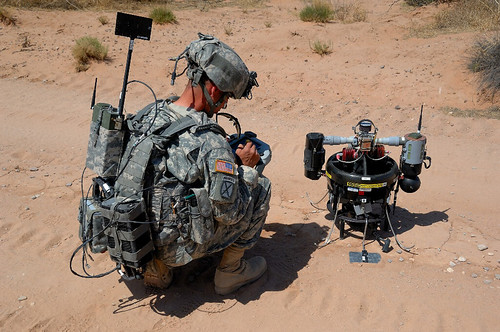
It’s not the only experiment underway at Fort Bliss. Soldiers of the service’s 5th Brigade, 1st Armored Division at Fort Bliss are testing and evaluating pieces of the Army Brigade Combat Team Modernization plan — a more streamlined successor to the service’s now-defunct Future Combat Systems program. Other items being tested include a common controller, a Nintendo-style control that can be used to maneuver both the Small Unmanned Ground Vehicle robot and the Class I Unmanned Aerial Vehicle (affectionately known as the “flying beer keg”).

 Need some imagination? Check out these gadgets and robots…