Archive for the ‘Satellite TV’ Category

Satellite Images Confirm Human Rights Abuses in Myanmar

Tuesday, October 2nd, 2007

The brutal crackdown of nationwide protests in in Myanmar last week has led to strong international condemnation of the military junta in Burma, while images and video of Burmese soldiers attacking Buddhist monks, who led many of the demonstrations that grew to as many as 100,000 before the crackdown began, have gripped the world media.

But the public dispersions of the protests haven’t been the junta’s only violent attempts to crack down on dissent. A new analysis of high-resolution satellite images completed by the American Association for the Advancement of Science (AAAS) "pinpoints evidence consistent with village destruction, forced relocations, and a growing military presence at 25 sites across eastern Burma where eyewitnesses have reported human rights violations," according to the AAAS website:

The research by AAAS, a non-profit, non-partisan organization and the world’s largest general scientific society, offers clear physical evidence to corroborate on-the-ground accounts of specific instances of destruction. It is believed to be the first demonstration of satellite image analysis to document human rights violations in Burma, also known as Myanmar.


AFP has additional details:

Patches of scorched earth corresponding to settlements reportedly destroyed are visible in the high-definition photographs taken by satellites zooming in on the secretive state in late April and analyzed by the Washington-based American Association for the Advancement of Science (AAAS).

Now the group has trained the satellites on Myanmar’s main cities to try and peer through the clouds and see military deployments amid the current unrest, as the crackdown on pro-democracy protests led by monks has turned bloody.

In Karen areas of eastern Myanmar, the group used three commercial satellites to focus on 31 "attack sites" of reported rights violations from mid-2006 to early 2007, AAAS project director Lars Bromley told reporters Friday.

In one picture, a satellite spotted foundations and fence lines with all the structures gone, where a village had stood two years earlier.

The area photographed was the site of a reported military raid on April 22, on Karen villagers accused by the regime of supporting armed rebels. Bromley estimated a dozen people were killed there and the rest fled.

The image on the left, above, shows a settlement adjacent to rice paddies in 2000. The image on the right shows the same area in December 2006. This area was reported attacked in April 2006. Check out this ABC News slideshow for additional photos from AAAS.

Brazilian Observation Satellite Launched by Chinese

Thursday, September 20th, 2007


There are a lot of happy rocket scientists in Brazil today: 

CBERS-2B é lançado com sucesso da base chinesa de Taiyuan 

Exatamente às 00h26min desta quarta-feira (19) foi lançado com sucesso o CBERS-2B, terceiro satélite da parceria entre Brasil e China. O evento foi comemorado tanto no Centro de Controle de Satélites do INPE, em São José dos Campos (SP), como no Centro de Lançamento de Satélites de Taiyuan. O diretor do INPE, Gilberto Câmara, assistiu ao lançamento na base chinesa e, junto com os engenheiros Ricardo Cartaxo e Jânio Kono, respectivamente coordenador geral e coordenador do Segmento Espacial do Programa CBERS, transmitiu todas as informações aos técnicos e convidados que acompanharam da sede do Instituto.

“É uma emoção muito grande. É o resultado de um grande trabalho feito por brasileiros e chineses. Estamos todos muito orgulhosos”, disse o diretor Gilberto Câmara.

Chefe do Centro de Controle de Satélites do INPE, Pawel Rosenfeld manteve contato constante com Jânio Kono, coordenador do Segmento Espacial do Programa CBERS, que da base comandou as operações junto com os técnicos chineses.

O foguete Longa Marcha 4B cumpriu perfeitamente todas as etapas previstas para colocação do satélite em órbita. O tempo total de vôo até a injeção do CBERS em órbita foi de 12,5 minutos. O CBERS-2B é lançado com seus transmissores ligados permitindo assim que a estação de rastreio de Nanning, na China, mantenha contato com o satélite desde antes de sua separação do último estágio do veículo lançador, até aproximadamente um minuto e meio após a abertura dos painéis solares, que aconteceu cerca de 14 minutos após o lançamento.

The spacecraft is capable of producing images such as this beauty of Manaus:

Here’s the explanation, in English, via SpaceFlightNow.com:

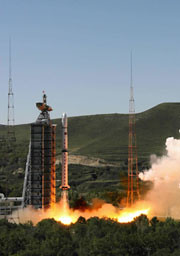
A joint mission developed by China and Brazil was shot into an orbit circling Earth’s poles to snap detailed images of the globe during an early Wednesday launch from China’s northeastern space base.

A Long March 4B rocket launched with the international satellite at 0326 GMT Wednesday (11:26 p.m. EDT Tuesday) from the Taiyuan space center in China’s Shanxi province, according to the state-run Xinhua news agency.

The booster’s three liquid-fueled stages accurately deposited the third China-Brazil Earth Resources Satellite into a Sun-synchronous orbit about 12 minutes after liftoff.

CBERS 2B was left in a nearly circular orbit with an average altitude of approximately 462 miles, Xinhua reported. The Long March 4B was shooting for an orbital inclination of 98.5 degrees.

Wednesday’s launch marked the 60th consecutive success for China’s Long March rocket fleet. It was also the 8th space launch for China so far this year.

CBERS 2B will spend the next few weeks undergoing systems tests and preparations for an operational mission expected to last at least two years.

The 3,200-pound satellite was ordered by Chinese and Brazilian officials in 2004 to bridge the gap between older spacecraft and next-generation satellites, which should begin launching in 2009.

The craft’s predecessors, CBERS 1 and CBERS 2, were launched by Chinese rockets in 1999 and 2003, respectively. Both outlived their baselined two-year missions, according to Brazil’s National Institute for Space Research, a co-sponsor of the program.

The China Academy of Space Technology was in charge of the Chinese contribution to the mission, Xinhua reported.

CBERS 2B carries three primary imaging cameras to take a wide range of pictures of locations scattered throughout the world.

A low-resolution camera with a 60-degree field of view will specialize in capturing images of large swaths of the planet. Another camera will be capable of taking pictures with a resolution of about 65 feet.

Unlike its forerunners, CBERS 2B includes a high-resolution black-and-white camera able to produce images showing objects as small as 2.5 meters, or about eight feet. CBERS 1 and CBERS 2 each carried an infrared scanning instrument instead.

Scientists expect to use data from the project in environmental monitoring, crop planning and managing water resources. Images can also be used to identify types of vegetation and in soil surveys. Pictures could also end up in geography textbooks, according to Brazilian space officials.

Images from the new high-resolution camera will also be useful in urban planning and military intelligence applications for China and Brazil.

China has a 70 percent stake in the 19-year-old program, while Brazil controls about 30 percent of the project. Users in both nations have access to the satellite imagery.

Pictures from the spacecraft have been distributed online since 2004, and more than 15,000 users have downloaded about 320,000 images since the Internet campaign began, according to Brazilian officials.

Two more satellites with four cameras each will be launched in 2009 and 2011. The program extension was approved in 2002, and China and Brazil will equally split responsibility for the new project.

Here’s a video about the Brazilian Space Agency:

And here’s a little Brazilian space center tribute video set to Brazilian metal (mind the volume):


Delta Launches WorldView-1

Wednesday, September 19th, 2007

Google Earth users may soon be enjoying higher-resolution images of our little blue planet, thanks to yesterday’s launch of the Worldview 1 satellite.


The AP gives a summary: 

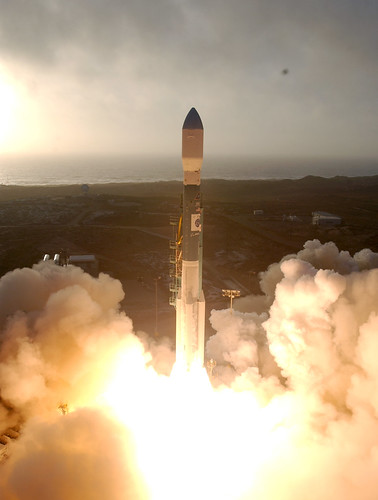
The WorldView 1 satellite, built for DigitalGlobe, which supplies much of Google Earth’s imagery, was lofted into space aboard a Delta 2 rocket [from Vandenberg Air Force Base]. The satellite separated from the rocket about an hour after liftoff and was circling 300 miles (480 kilometers) above Earth.

WorldView 1 was designed to collect up to 290,000 square miles’ (750,000 square kilometers’) worth of imagery a day — an area about the size of Texas. Information gathered by the 5,000-pound (2,270-kilogram) probe can be used by governments and companies to assess damage after a natural disaster or plan escape routes before a catastrophe, the company said.

Images and details about the bird can be found on the DigitalGlobe website. Features include an "ultra-stable platform, high-precision attitude sensors and GPS" that "allows the creation of accurate maps in remote areas, maximizing the utility of whatever resources are available," as well as the "highest commercially available" resolution, with direct downlink of those images available to customer sites using a high-speed 800 Mbps X-band downlink.


The Worldview 1 satellites was built by Ball Aerospace. Check out their online media kit, including high-resolution photos of the satellite.

Worldview 2, also being built by Ball Aerospace, is slated for completion in late 2008. 

Googling the Universe

Wednesday, August 22nd, 2007

Without a doubt, Google Earth has put the functional utility of satellite imaging at the fingertips of millions, rekindling for many the shear wonder of what satellites can do to improve our lives.

Now Google’s virtual "satellites" (which aren’t really satellites, of course, but rather "the superimposition of images obtained from satellite imagery, aerial photography and GIS 3D") are doing what no single satellite has yet been designed to do: they’re turning their gaze from the Earth to the Heavens with today’s release of Google Sky:


With Sky, users can now float through the skies via Google Earth. This easy-to-use tool enables all Earth users to view and navigate through 100 million individual stars and 200 million galaxies. High resolution imagery and informative overlays create a unique playground for visualizing and learning about space.

To access Sky, users need only click "Switch to Sky" from the "view" drop-down menu in Google Earth, or click the Sky button on the Google Earth toolbar. The interface and navigation are similar to that of standard Google Earth steering, including dragging, zooming, search, "My Places," and layer selection….

"Never before has a roadmap of the entire sky been made so readily available. Anyone interested in exploring the wonders of our universe can quickly see where the stunning objects photographed by Hubble actually dwell in the heavens. Sky in Google Earth will foster and initiate new understanding of the universe by bringing it to everyone’s home computer," said Dr. Carol Christian of STScI, who co-led the organization’s Sky team with Dr. Alberto Conti.

Google Sky features seven layers, including Hubble Space Telescope Imagery, Constellations, the Moon and Planets, a "Users Guide to Galaxies" and a "Life of a Star" layer, as well "The Backyard Astronomer," which "is useful for the amateur astronomer who may benefit from a comprehensive, organized way to reference fragments of the night sky."

"The Sky imagery was stitched together from more than one million photographs from scientific and academic sources, including the Sloan Digital Sky Survey, the Palomar Observatory at the California Institute of Technology and the NASA-financed Hubble," according to the New York Times.

The BBC also has some good video of the new release. 

To get Google Sky, simply download the latest version of Google Earth.

Dropping the SpookSat

Tuesday, August 7th, 2007

If you don’t like that headline, try The Register’s leader: "Cheesed-off spooks give up on duff spy-sat."

Reuters explains:

The National Reconnaissance Office has deemed an experimental U.S. spy satellite a total loss and will allow it to slowly drop from orbit and burn up in the atmosphere, two defense officials told Reuters this week.

The classified L-21, built by Lockheed Martin Corp at a cost of hundreds of millions of dollars, was launched on December 14 but has been out of touch since reaching its low-earth orbit, put by satellite watchers at about 220 miles above the earth.

It will now gradually fall out of orbit over the coming decades, said the officials, who asked not to be named. At some later date, it will burn up as it enters the earth’s atmosphere, posing no danger to people below, they said.

We discussed these technology failures earlier in June. Now that the L-21 is a loss, what’s next?

Meanwhile, the Pentagon will likely now have to test aspects of new technologies that were on the L-21 by piggybacking them onto other satellites over the next four to five years, the officials said.

For instance, the military could put the new sensors aboard TacSat 3, the latest in a series of smaller satellites, when it launches later this year.

The NRO could still try to build a new spacecraft to test the technology, but it would take several years to get the funding for such a satellite and build it, one official said.

The U.S. may be lagging behind in this technology race:

The two officials declined to identify what exactly the experimental Lockheed satellite was meant to test, but said its failure was troubling, given that other countries were rapidly plowing ahead with development and launch of new capabilities, especially in the area of synthetic aperture radars.

Synthetic aperture radars offer high-resolution and can pierce darkness and thick clouds to identify targets, even peering below the surface of the ground or peeking into foliage that might obstruct the view of photo-based sensors.

One official said Germany in June launched TerraSAR-X, a sophisticated new satellite armed with a synthetic aperture radar that analysts say marks the start of a new level of quality in the mapping of the earth.

Canada is also working on this technology.

Spy Satellites Wiped Out

Thursday, June 21st, 2007


Yes, the "Misty" satellite program’s next generation will never be seen now. The AP filed this story this afternoon, published in the Seattle Post-Intelligencer, et. al.:

Spy chief scraps satellite program

By KATHERINE SHRADER
ASSOCIATED PRESS WRITER

WASHINGTON — Spy chief Mike McConnell has junked a multibillion-dollar spy satellite program that engineers hoped would someday pass undetected through the space above other nations.

The move from the director of national intelligence comes after several years of congressional efforts to kill the program, known publicly as the next generation of "Misty" satellites. The new satellite was to be a stealthy intelligence spacecraft designed to take pictures of adversaries and avoid detection.

Little is known about the nation’s classified network of satellites, which represent some of the most expensive government programs and receive almost no public oversight. Because of their multibillion-dollar price tags, sensitive missions and lengthy development schedules, spy agencies go to great pains to keep details from becoming public.

McConnell gave no reason for his recent decision. Despite the program’s secrecy, he almost dared further inquiry into it.

Speaking Tuesday to an intelligence conference on workplace diversity, McConnell changed the subject and ended his speech by saying: "I have been advised when I was getting ready for this job, you have to do two things: kill a multibillion-dollar program. Just did that. Word is not out yet. You’ll see soon.

"And fire somebody important. So I’m searching," he added in jest, getting a laugh from the crowd.

Asked during a Q&A session to elaborate on which program he cut, McConnell declined to comment. His spokesman Steve Shaw also declined to comment on Thursday, but he noted that the director had the power to make this type of budget decision.

Loren Thompson, a defense expert with the Lexington Institute, said he was told by an industry source this month that the program to build the Misty satellites was ending. He said the satellite’s true name is not publicly known, but it has been assigned a designation of a letter followed by numbers.

The Associated Press separately confirmed the program was cut.

"People are thinking it is just not worth the huge amount of money it is sucking in," Thompson said.

Speaking generally, Thompson said promises of faster, smaller, cheaper satellites – hopes that became common during the Clinton administration – have been confounded by the laws of physics. The technology simply wasn’t able to meet expectations.

The new generation of Misty satellites was born from the belief that stealth technology would be crucial to deceiving adversaries, since many states are aware when U.S. satellites are passing overhead and can change their behavior accordingly.

Yet the threat has changed in recent years, as the United States became more concerned about difficult-to-track terror cells and underground sites for nuclear programs run by countries such as Iran and North Korea.

"The entire imagery architecture that is in space or under development was conceived prior to 9/11. Changes in the threat have led to a re-evaluation of the threat," Thompson said.

The first satellite launched in the Misty family was disclosed by military and space expert Jeffrey Richelson in his 2001 book, "The Wizards of Langley: Inside the CIA’s Directorate of Science and Technology." That first Misty satellite was launched from the space shuttle Atlantis in March 1990, he wrote.

In an interview, Richelson said a second satellite was launched in 1999. But as insiders debated whether to continue to build the third, some officials didn’t think it was worth the money because other satellites could fulfill the role at less cost, said Richelson, a senior fellow with the National Security Archive.

In 2004, an unidentified government agency asked the Justice Department to open a leaks investigation after The Washington Post reported that the program’s projected cost had almost doubled from $5 billion to nearly $9.5 billion.

Rick Oborn, a spokesman for the tightlipped National Reconnaissance Office, declined to comment on McConnell’s decision. His Northern Virginia-based agency is responsible for designing, building and operating a constellation of U.S. spy satellites.

Those spacecraft are built by American companies contracted by agencies including CIA and NRO and by the Air Force. A spokesman for Lockheed Martin, which is believed to be the lead contractor on this program, declined to comment on McConnell’s decision.

The pricey program has been a source of controversy in Congress.

In the House’s intelligence budget bill approved last month, lawmakers agreed to end a satellite program that they had supported before, according to New Mexico Rep. Heather Wilson, the top Republican on the House Intelligence Committee’s panel on technical intelligence. "We had to make some decisions without a lot of good alternatives," she said in an interview.

The details are in the classified portion of the bill, and Wilson would not confirm that it was a next-generation Misty satellite. But Wilson, a former Air Force officer, said McConnell’s decision was part of ongoing discussions among his advisers, the House committee and the Defense Department. "There was a great deal of communication," she said.

Wilson said the government does not have to walk away from the entire amount sunk into the program. Rather, she said, some of the technology can be harvested and used in other programs. She declined to offer any details.

Wilson praised McConnell’s early moves but said the key factors in his decision to end the program predated his arrival as intelligence chief in February. "I think it is the conclusion that most of the folks involved had come to – based on cost, schedule and performance. It was a conclusion that everyone was coming to at about the same time," she said.

House Intelligence Committee Chairman Silvestre Reyes, D-Texas, could not be reached for comment.

The panel’s top Republican, Rep. Peter Hoekstra of Michigan, said he is not looking for a decision on a single program from McConnell and his advisers. He wants to see leadership.

"I am looking for them to give us a strategy," he said. "This program was there for a reason. What are you going to replace it with? How long is it going to take to develop it? What is the cost for this new program?"

Hoekstra would not identify the program McConnell said was being cut and said he remains doubtful it is truly gone. He said its congressional allies could find a way to bring it back to life through a bill. He also noted that the White House has not sent a revised version of its budget to Congress reflecting McConnell’s change.

Hoekstra also criticized how McConnell made his decision public. "I don’t think the way you go about announcing major policy decision is to make a flippant comment to a group that you are speaking to about diversity," he said.

The Tribe of Google Earth

Tuesday, June 19th, 2007

Google is harnessing the power of satellite imagery to help the people of Amazon.

No, not that Amazon — this one:


The San Francisco Chronicle explains how Amazon Chief Almir Surui reached out to Google for help in ending violent clashes between loggers and miners and members of the Surui tribe: 

During his visit to the Bay Area late last month, Almir, the first Surui to graduate from college, asked the folks at Google Earth for high-quality satellite imagery that would allow the tribe to monitor loggers and miners, who have no legal right to operate on the tribe’s 600,000-acre reserve about 1,600 miles northwest of Rio de Janeiro.

His plea fell on receptive ears with company officials in Mountain View, who are now at work on a plan to let the Surui use Google’s technology to raise awareness of their plight by working with satellite providers to vastly improve image resolution.

"The Amazon rain forest and its indigenous peoples are disappearing rapidly, which has serious consequences both locally and globally," said Google Earth spokeswoman Megan Quinn. "This project can raise global awareness of the Surui people’s struggle to preserve their land and culture by reaching more than 200 million Google Earth users around the world."

Google Earth has already been used to track disappearing gorillas, the humanitarian crisis in Darfur, and the results of mountaintop removal coal mining in Appalachia. 

This isn’t the first convergence of high technology and the Amazon basin, of course. Last September, we wrote about Intel’s efforts to build a digital city in the Amazon; and the One Laptop Per Child initiative (supported by SES-Americom) promises to bring the power of computers and internet communications to people living in remote locations throughout the world.

Atlas Launches (Secret) NRO Payload

Monday, June 18th, 2007

On Friday, a United Launch Alliance Atlas V rocket lifted off from Space Launch Complex 41 at Cape Canaveral, carrying a pair of top-secret spy satellites for the National Reconnaissance Office (NRO).

The NRO designs, builds and operates America’s reconnaissance satellites. According to their website:

The NRO is guided by its vision of being Freedom’s Sentinel in Space: One Team, Revolutionizing Global Reconnaissance. Our Mission: The NRO develops and operates unique and innovative overhead reconnaissance systems and conducts intelligence related activities essential for U.S. National Security.

We’ve uploaded video of the launch:

And here’s a rather beautiful clip of the rocket in the Centaur stage:

One minor glitch: the satellites initially ended up in the wrong orbit:

Two top secret National Reconnaissance Office (NRO) ocean surveillance spacecraft were fired into the wrong orbit June 15 when the 200-foot-tall Atlas V rocket they were riding on stopped firing too early in space following launch from Cape Canaveral, Fla.

The top secret satellites separated safely from the malfunctioning booster, however, and have enough rocket propellant to continue their mission, an official said on background.

The U.S. Air Force, which managed the Atlas V launch, and the NRO have begun an official investigation into the launch and malfunction. The $83 million Atlas V used in the launch is a model 401 with no solid rocket boosters.

"The Atlas V people have a lot of explaining to do," the official said on background. The flight was the first NRO secret mission for the new Atlas V Evolved Expendable Launch Vehicle.

The two spacecraft are critical to tracking ships that may conceal al Qaeda terrorists. The new spacecraft will also track Iranian and Chinese sea-based military operations.

The Lockheed Martin website has a nice diagram of the Atlas V 400 series. The Atlas is used extensively to lift satellites for the U.S. Air Force and other government customers. In fact, the manifest is so full manifest of government projects that  commercial launches are increasingly going to Kazakhstan and French Guiana. 

The NRO also has a website for children; and for those of us adults with a child-like fascination with all things space, be sure to check out this article from Wired, which covers spy satellites — and the amateurs who look for them.


Lancio Bello di Delta II

Tuesday, June 12th, 2007


We have many observation satellites orbiting Earth. Now we have another.

Delta nailed it again, this time from Vandenberg A.F.B in California:
 

"It is very emotional," said a tearful Francesca Sette, Thales Alenia Space-Italia. "We worked very hard for six months on this event; and during the last six months, we began to work 24 hours per day to ensure we completed this project on time."

The group from the Italian launch community used the Pacific Coast Club here to observe the event. An extravagant event, it included everything from 30 plasma screen TVs, to a live broadcast from Rome with a speech by Italian Minister of Defense, Arturo Parisi.

After watching the rocket lifting off the pad during a live broadcast in the PCC, an Italian train of 100 people went hurrying through the door to observe the Delta II rocketing through the sky outside. People were jumping up and down and hugging each other in celebration.

"It was so beautiful," said Mara Midealo, the wife of a Thales Alenia employee. "This was my first launch and it was a great event."

Thales Alenia Space Italia developed the COSMO-Skymed program for Agenzia Spaziale Italiana, using an X-band Synthetic Aperture Radar instrument. More about the mission:

The Cosmo-Skymed satellites are intended to provide monitoring, surveillance and intelligence data during international crisis for military customers, and environmental surveillance of floods, fires, landslides, and oil spill as well as earth topographic mapping, law enforcement for commercial, civilian institutions and scientific communities. Each satellite will be equipped with one X-band multipolarimetric Synthetic Aperture Radar (SAR) that will provide coverage of areas with a maximum width of up to 520 km.

The Cosmo-Skymed satellites will provide high resolution metric and sub-metric imagery through clouds, at night, with a revisit time of few hours. The 4 satellites constellation will acquire and furnish data worldwide.

The SAR sensor can work in four acquisition modes. Using the SPOTLIGHT mode the SAR scans with a resolution of one or less than a meter covering an area of tens of square kilometers. The HIMAGE (stripmap) acquisition mode provides a few meters resolution covering areas featuring a width of several tens of kilometers. The WIDEREGION, also known as ScanSAR, features tens of meters of resolution and swathes areas of hundreds of kilometers. Finally, the HUGEREGION acquisition mode swathes up to 520 km wide areas with a resolution of several tens of meters.

KAGUYA!

Tuesday, June 12th, 2007

Last December, I blogged about satellite-naming being the new new creative gold prize of astronomy —or, as I wrote then, the "new UGG boots of the space agencies" (what was I thinking writing that?). The Japan Aerospace Exploration Agency (JAXA) was planning the launch of their new lunar orbiter (formerly called SELENE), advertised as the the biggest lunar exploration project since the Apollo Project. Who wouldn’t want to name that?

A winner has been chosen! KAGUYA. As LiveScience explains, the name is from an ancient Japanese tale “Taketori Monogatari” – the tale of the Bamboo-Cutter which involves Princess Kaguya, the Moon Princess." (To be clear, KAGUYA is not named after the genetically modified mouse born in 2004 from two parents of the same sex.)

As Space.com explains, the project is perhaps the world’s most extensive current study of the moon (and there are many projects):

SELENE consists of a main orbiting satellite located at about 100km altitude, and two small satellites (Relay Satellite and VRAD Satellite) in polar orbit. The orbiters will carry instruments for scientific investigation of the Moon, on the Moon, and from the Moon.

JAXA claims that SELENE will be the most sophisticated lunar exploration mission in the post-Apollo Era. According to the agency, SELENE will observe the distribution of the elements and minerals on the surface, the surface and sub-surface structure, the gravity field, the remnant of the magnetic field, and the environment of energetic particles and plasma of the Moon. The scientific data will also be used for exploring the possibilities of the future utilization of the Moon. JAXA will also establish the basic technologies for future Moon exploration: lunar polar orbit insertion, 3-axis attitude control and thermal control in lunar orbit. In addition, SELENE will take pictures and movies of Earth-rise from the Moon horizon.

Too bad "Spektor" wasn’t chosen.