Archive for the ‘Satellite TV’ Category

SumbandilaSat Launch via Submarine Scrubbed

Wednesday, May 30th, 2007


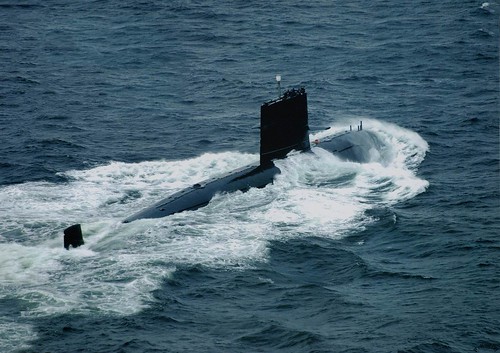
South Africa’s SumbandilaSat, an 81-kg LEO (low-earth orbit) observation/imagery satellite, which was to launch via a Russian submarine in the Barents Sea, has been postponed. The story, via Engineering News (South Africa):

The launch of South Africa’s first government satellite from a Russian submarine next month has been postponed indefinitely, an official said on Tuesday.

"It has been postponed because official documentation still needs to be arranged to issue a decree for the launch," said Nhlanhla Nyide, spokesman for the Department of Science and Technology.

"They are currently working on the process … We will hear from them when they have set a new date for launch," Nyide said.

He told said no additional costs will be incurred and South Africa’s nascent space programme would not be affected because of the cancellation of the launch, which was to have taken place in the Barents Sea near Norway.

The R26-million satellite, intended to orbit some 500 km (310 miles) above earth and have a life-span of three years and longer, would carry high-resolution imaging cameras.

The images from the South African-built satellite would be used across a wide array of applications, from agriculture to land use and infrastructure mapping.

South Africa has pledged millions of rands to build its astronomy and space sector, with the construction of the South African Large Telescope creating a hub for astronomy research in southern Africa.

In July 2006 cabinet approved the establishment of a South African Space Agency as an institutional vehicle to look at space science and technology.


This would have been a cool launch. Back in December, 2006, the satellite was handed off to Russia:

South Africa’s low-earth-orbiting microsatellite, SumbandilaSat, left for Russia on Thursday, ahead of its launch into space off a submarine in early 2007.

The 81-kg SumbandilaSat will generate satellite imagery through its remote sensing camera at 6,25 m ground sampling distance.

Upon arrival in Russia, SumbandilaSat will be taken to the Russian naval base at Murmansk, where the Russian navy will integrate it with a launch rocket. The satellite will then be transported to a submarine at Severemorsk, just off the Russian coast, where it will be launched into space.

The launch window period is between April and May and is strongly dependent on weather conditions at the time. Once in orbit, SumbandilaSat will pass over South Africa mid-morning and mid-evening, at an average orbit altitude of 500 km.

In addition to its earth observation and communications payloads, SumbandilaSat carries five experimental payloads, which will present the scientific community with exciting results in low frequency radio waves, radiation, software defined radio, forced vibrating string and radio amateur transponders.

Speaking at the hand-over ceremony, in Stellenbosch, Science and Technology Minister Mosibudi Mangena said that the development of SumbandilaSat offered South Africa a number of competitive advantages and would support decision-making in natural resource management and sustainable development. He added that the images yielded by the satellite would be used in various applications, which had direct benefits to societies, such as flood and fire disaster management; enhancing food security through crop yield estimation; ensuring better human and animal health through enabling the prediction of the outbreaks of diseases; better monitoring of land cover and use; as well improved capabilities for water resource management.

The actual construction of the SumbandilaSat had been completed at the end of September and had been followed by a battery of trials, including functional testing, space environmental testing, vibration testing and burn-in testing, designed to establish the satellite’s readiness prior to a flight acceptance review.

“The environmental-testing phase determined SumbandilaSat’s ability to withstand extreme variance in temperatures, while the vibration tests verified its ability to endure the shocks it will undergo as it is launched into space. The burn-in testing phase comprised the actual and continual running of the satellite and its systems in order to confirm that all components are fully functional,” the Department of Science and Technology (DST) said.

Sunspace project manager for SumbandilaSat Harry van der Heyden said that the review presentation included an introduction to the hardware produced, as well as the ground support equipment developed for the satellite. “We also conducted demonstrations to illustrate how the satellite communicates with the ground support equipment.”

The birth of SumbandilaSat was initiated by the DST and was given life by numerous stakeholders, including the University of Stellenbosch, Sunspace, the South African Space Council, the Departments of Foreign Affairs, Trade & Industry, and Communications, as well as the Centre for Scientific and Industrial Research.

The launch of SumbandilaSat is envisaged to strengthen South Africa’s technological capability and innovation in space science and technology, as well as reinforce the country’s role in national, regional and international space initiatives.

This is but one aspect of a budding interest in space, as evidenced by South Africa’s National Astrophysics and Space Science Programme. The first "space age school" was established in 2003.

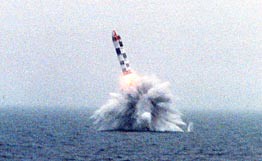
Here’s a clip of U.S. Trident missiles being launched from a sub:


Dark Matter

Thursday, May 17th, 2007

Dark matter makes up more than 90% of the universe, yet because it neither emits nor reflects electromagnetic radiation, it cannot be observed directly.

Yet a group of astronomers in Baltimore have used the Hubble Space Telescope "to map the dark matter billowing out from the long-ago collision of two galaxy clusters."

The photo released by NASA is quite extraordinary:


The Baltimore Sun explains: 

They’re calling it the strongest evidence yet of the existence of dark matter, and the first observation to separate it from its associated stars, galaxies and glowing gas.

"What we found is a very peculiar structure – a ring-like structure that surrounds the core of the cluster," said Johns Hopkins University research scientist M. James Jee, lead author on the study that will appear in the June 1 issue of The Astrophysical Journal.

It’s not exactly a ring of dark matter, he said. Rather, it’s a map of where the densest regions of dark matter must be, based on measurements of how that mass and gravity are bending the light streaming by from galaxies far in the background….

Jee likened the ring (in three dimensions actually a flattened spherical shell) to a jam-up of dark matter particles hurled outward from the collision, like commuters headed out of town, backing up behind slowing traffic ahead.

The Sun article notes that there is skepticism among some astronomers, who would like to see the evidence captured from a second source to rule out "peculiarities" in Hubble’s camera. Perhaps the image above is simply the astronomical equivalent of refracted light on film appearing as a "ghost" in your family photographs. Nonetheless, the evidence for dark matter is there, whether we’ve observed it yet or not.

(Also be sure to click here for a related video simulation of two galaxy clusters colliding.) 

Watch this Hubblecast to better understand the significance of this finding.


Dense, Dark and Hot

Thursday, May 10th, 2007

Spitzer has done something amazing.

No, not the Governor of New York, although that Spitzer did recently nominate a new Executive Director of the New York State Foundation for Science, Technology and Innovation.

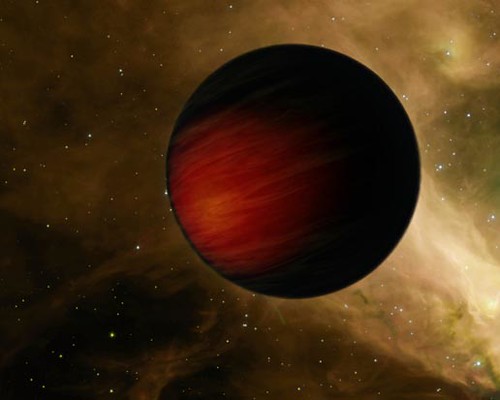
Rather, we’re talking about the first map of an extrasolar planet, HD 189733b, a "hot Jupiter" planet — and the hottest planet yet observed in the universe — which is located approximately 60 light-years from Earth.

The planet is so hot that astronomers believe it’s absorbing almost all of the heat from its star, and reflecting almost no light and thus making its appearance black, as this artist’s rendition of the planet illustrates:


(Live animations of the picture above can be found here.)

NASA explains the mapping project and the resulting discoveries: 

 Roughly 50 of the more than 200 known planets outside our solar system, called exoplanets, are hot Jupiters. Visible-light telescopes can detect these strange worlds and determine certain characteristics, such as their sizes and orbits, but not much is known about their atmospheres or what they look like.

Since 2005, Spitzer has been revolutionizing the study of exoplanets’ atmospheres by examining their infrared light, or heat. In one of the new studies, Spitzer set its infrared eyes on HD 189733b, located 60 light-years away in the constellation Vulpecula. HD 189733b is the closest known transiting planet, which means that it crosses in front and behind its star when viewed from Earth. It races around its star every 2.2 days.

Spitzer measured the infrared light coming from the planet as it circled around its star, revealing its different faces. These infrared measurements, comprising about a quarter of a million data points, were then assembled into pole-to-pole strips, and, ultimately, used to map the temperature of the entire surface of the cloudy, giant planet.

The observations reveal that temperatures on this balmy world are fairly even, ranging from 650 degrees Celsius (1,200 Fahrenheit) on the dark side to 930 degrees Celsius (1,700 Fahrenheit) on the sunlit side. HD 189733b, and all other hot Jupiters, are believed to be tidally locked like our moon, so one side of the planet always faces the star. Since the planet’s overall temperature variation is mild, scientists believe winds must be spreading the heat from its permanently sunlit side around to its dark side. Such winds might rage across the surface at up to 9600 kilometers per hour (6,000 miles per hour). The jet streams on Earth travel at 322 kilometers per hour (200 miles per hour).

"These hot Jupiter exoplanets are blasted by 20,000 times more energy per second than Jupiter," said co-author David Charbonneau, also of the Harvard-Smithsonian Center for Astrophysics. "Now we can see how these planets deal with all that energy." 

As Wired points out,  Spitzer’s technology could be used to map Earth-like planets — like the recently-discovered Gliese 581c, which we wrote about here.

For more on the Spitzer Space telescope, check out this great video found in the motherlode of online video, aka YouTube:

NASA’s AIM Spacecraft Launch via Pegasus XL

Wednesday, April 25th, 2007


Nice launch of the AIM spacecraft, via NASA press release:

During the next two years, AIM scientists will methodically address each of six fundamental objectives that will provide critical information needed to understand cloud formation and behavior.

"This mission has many firsts, including that Hampton University is the first historically black college and university to have the principle investigator and total mission responsibility for a NASA satellite mission," said Program Executive Victoria Elsbernd, NASA Headquarters, Washington.

NASA’s Kennedy Space Center, Fla., is responsible for launch vehicle/spacecraft integration and launch countdown management. NASA’s Goddard Space Flight Center, Greenbelt, Md., is responsible for the overall AIM mission management in collaboration with Hampton University, the University of Colorado, Boulder, and Virginia Polytechnic Institute and State University, Blacksburg. Orbital Sciences Corporation, Dulles, Va., is responsible for providing the Pegasus XL launch service to NASA.

India’s PSLV Launched

Monday, April 23rd, 2007

Via The Times of India:

The Polar Satellite Launch Vehicle-C8 (PSLV-C8) has been launched successfully today from Sriharikota.

PSLV is carrying the Italian Satellite Agile along with it. The countdown progressed smoothly for the first commercial launch of PSLV-C8 with a 352 kg Italian astronomical satellite onboard from Sriharikota spaceport, about 150 kms from Chennai.

“The atmosphere is calm and quiet. Countdown is progressing as per schedule," said an ISRO spokesman.

The launch vehicle lifted off at 1530 hrs.

The 42-hour countdown for the launch of the 11th flight of PSLV-C8 began on Friday evening. It was launched from the second launch pad at the Satish Dhawan Space Centre, SHAR.

Apart from the Italian satellite, Agile, PSLV-C8 would also carry an Advanced Avionics Module (AAM), weighing 185 kg, to test advanced launch vehicle avionics systems like mission computers, navigation and telemetry systems.

A workhorse launch vehicle of ISRO, PSLV has launched nine successful consecutive flights till now since its first launch in 1994. It would also launch India’s first mission to the moon, Chandrayaan-1 in 2008.

Official press release from the ISRO.

These Old Eyes Need New Glasses

Tuesday, March 20th, 2007

An aging satellite that has been in operation for seven years but was expected to last for only five is putting America’s hurricane forecasting ability at risk, according to a story from the Associated Press.


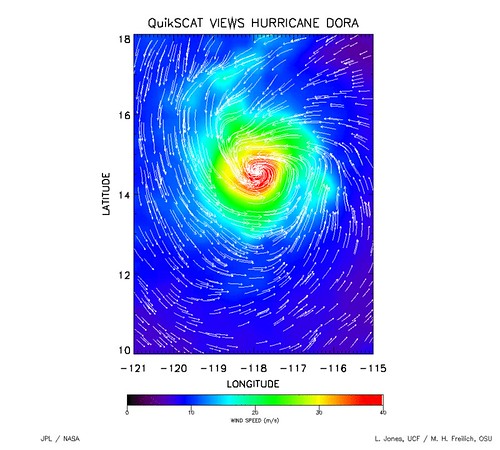
The QuickSCAT satellite "conducts daily surveys of 90 percent of the ice-free oceans, using a so-called radar scatterometer to measure surface wind speed and direction."

The resulting images are not only visually compelling — they provide scientists with fresh information about our planet’s weather patterns.

(For example, this set of images helped scientists understand that the Santa Ana winds that dry out coastal and interior regions of California and help fan the flames of wildfires produce a previously unknown benefit to the region’s fisheries.)

But the cause celebre of QuickSCAT are images like the one above, showing the wind speeds of Hurricane Dora back in 1999.

But scientists may have to attempt hurricane forecasts without the aid of QuickSCAT, according to the AP report:

Certain hurricane forecasts could be up to 16 percent less accurate if a key weather satellite that is already beyond its expected lifespan fails, the National Hurricane Center’s new director said Friday in calling for hundreds of millions of dollars in new funding for expanded research and predictions….

One of Proenza’s immediate concerns is the so-called "QuikScat" weather satellite, which lets forecasters measure basics such as wind speed. Replacing it would take at least four years even if the estimated $400 million cost were available immediately, he said.

It’s in its seventh year of operation and was expected to last five, Proenza said, and it’s only a matter of time until it fails.

Without the satellite providing key data, Proenza said, two- and three-day forecasts of a storm’s path would be affected. The two-day forecast could be 10 percent worse, while the three-day one could be affected up to 16 percent, Proenza said.

That would mean longer stretches of coastline would have to be placed under warnings, and more people than necessary would have to evacuate, he said.

We’ll keep you updated (as we always do) on efforts to replace QuickSCAT and other observation satellites that help bring people the accurate forecasts (we’re not joking here!) that they’ve come to expect.

Sea Launch Investigation Completed

Wednesday, March 14th, 2007

Regarding the Sea Launch failure that destroyed the NSS-8 satellite, Novosti in Russia reports:

An unsuccessful rocket launch under the Sea Launch project in late January was caused by engine failure, the press secretary of Russia’s federal space agency said Tuesday.

A Sea Launch Zenit-3SL rocket carrying a commercial communications satellite exploded shortly after liftoff from an oceangoing platform in the Pacific on January 31.

"The intergovernmental commission comprising representatives of Ukrainian and Russian organizations – the developers of the Zenit-3SL carrier rocket … has completed its work. It has established that the engine failed after a metal particle accidentally went into the engine’s pump," Igor Panarin said.

Panarin said the commission has proposed recommendations whose implementation will provide for the continued use of Zenit-3SL carrier rockets.

Viktor Remishevsky, deputy head of Russia’s federal space agency Roskosmos, earlier said rocket launches under the Sea Launch project would resume in 2007, adding that the Odyssey platform had suffered only minor damage.

The Satellite News Digest (subscription) goes further in its commentary:

Stray particle blamed on Zenit-3SL explosion

According to the Russian Federal Space Agency (Roskosmos), the explosion of a Zenit-3SL in late January was caused by poor workmanship that led to an engine failure.

"The intergovernmental commission comprising representatives of Ukrainian and Russian organisations, the developers of the Zenit-3SL carrier rocket … has completed its work. It has established that the engine failed after a metal particle accidentally went into the engine’s pump," Roskosmos spokesman Igor Panarin said.

He said the commission has proposed recommendations whose implementation will provide for the continued use of Zenit-3SL carrier rockets.

Viktor Remishevsky, deputy head of Roskosmos, earlier said rocket launches under the Sea Launch project would resume in 2007, adding that the Odyssey platform had suffered only minor damage.

It’s a rather surprising that the quality control problems with rockets from the former Soviet Union still persist as they have been known for years. Stray particles in various parts of rockets botched two Proton launches in July and October 1999 as well as a Soyuz-U launch in October 2002. Most recently they affected a Briz-M upper stage which failed to deploy Arabsat 4A into geostationary transfer orbit in February 2006.

An investigation into a Proton failure found piece of asbestos fabric, traces of aluminium and copper, and even sand in defective engines. Among the recommended modifications were additional filters in fuel lines, checking internal cavities for foreign particles as well as the quality of welding seams in the turbo-generators.

[These recommendations may have been applied to Proton but apparently not to other rockets. Some may call this "learning the hard way."–Ed.]

Space Weather Forecast Sees (STEREO) Gain

Tuesday, March 6th, 2007

To the left: An image of a February 25 eclipse taken from NASA’s STEREO-B satellite.
Back in October, we wrote about the successful launch of of NASA’s STEREO mission. (Click here for video of the Delta II launch.)

The STEREO (Solar TErrestrial RElations Observatory) Mission uses stereoscopic 3D vision to construct a complete picture of the sun and the nature of solar flares. Among the uses of such knowledge: protecting future astronauts from the dangerous effects of solar flares and providing better space forecasting.

The Washington Post now gives us an update on STEREO’s progress

The effort to improve space weather capabilities took a major step forward last week with the transmission of never-before-seen images of a solar eruption traveling the 93 million miles from the sun to Earth.

Sent back by the twin satellites of NASA’s newly launched Solar Terrestrial Relations Observatory (STEREO), the video is part of an ambitious new effort to learn more about massive electromagnetic storms on the sun, and the dynamics and characteristics of their eruptions. The sun is a huge furnace of nuclear fusion, in constant turmoil with flares, eruptions, convections and the release of lower-energy solar winds.

The "fronts" produced by coronal mass ejections, as the biggest eruptions are called, are the prime movers of space weather in Earth’s neighborhood, and understanding them better is essential to space weather forecasting.

"With STEREO, we can track the front from the sun all the way to Earth and forecast its arrival within a couple hours," said Russell Howard, principal investigator for STEREO’s most cutting-edge instrument, which will allow researchers to observe the movements of solar eruptions in three dimensions. "The new views from STEREO are like having a curtain lift from our eyes — they are extraordinarily instructive."

They are also pretty amazing, as this video animation taken from STEREO images shows. 

The Washington Post continues: 

STEREO cost NASA and its European partners about $600 million to build and is expected to operate for at least two years. It has already detected somewhat surprising characteristics of the solar eruptions. Researchers have, for instance, located "hot spots" within a solar eruption as it speeds from the sun, and they have seen loops and arcs formed from the hot plasma. They have also begun to measure the velocity of the eruptions, which gradually slow as they collide with other solar matter moving far more slowly in the solar winds.

Like most researchers, STEREO team members say they are looking for solar surprises as much as confirmation of existing hypotheses. The detailed study of space weather is in its infancy, they said, and the opportunity for discovery is vast.

We’ll keep you updated on STEREO’s discoveries as they are reported; in the interem, be sure to check out the STEREO mission homepage for the latest developments. 

Boring Press Releases

Sunday, February 25th, 2007

I’m so glad we have journalists around to make the news interesting. Imagine if we only had press releases.  B-O-R-I-N-G !

Just look at all these releases surrounding the Satellite 2007 show in Washington last week. Open your eyes wide and read these exciting excerpts:

"…released two new software options to their industry leading product lines that extend their already unique ability to…"

"This flexibility makes the product line more accessible to the networking requirements of government, military, and commercial customers who increasingly value high uplink and downlink speeds at a node and desire to blend terrestrial solutions with their satellite backhaul."

"The company’s DVB-RCS/S2 solutions are the only multiple-access satellite solutions capable of delivering data transfer rates of up to 80 Mbps for downloads and up to 8 Mbps for uploads at each remote terminal, or enough bandwidth to support a variety of users such as a small business or battalion unit to an entire community/military base from a single remote terminal."

And this quote is typical from apparently happy customers:

“We are looking forward to working with X on the development of this next generation intelligent network. Significant improvements can be made to future VSAT systems with the addition of artificial intelligence to the network. These capabilities offer the promise of enhanced performance and economic gains which will allow us to offer new and more cost effective services to our customers.”

I think it’s time we put some excitement in our "realeases" and start making some real news. I’ve noticed NASA’s public affairs people are putting some fun into their work and coming up with some very creative angles over the past year or so — just take a look at this "Camping on the Moon" release. Brilliant!

Ed’s “What’s Next?” Speech

Tuesday, February 20th, 2007

SES AMERICOM CEO Ed Horowitz was the guest speaker at the Washington Space Business Roundtable’s Flagship Lunch and Silent Auction on Tuesday, 20 February 2007.

We don’t have a podcast or video available, so here’s the text of the speech:

“What’s Next?”

I appreciate this chance to speak with you today in this beautiful new facility. Not long ago, as many of you remember, this spot was part of a run down community — which has obviously been brought back to life.

It’s changed.

And — in the midst of the good change around us, I feel it is appropriate to ask, “What’s Next” for our  business and for us?

Where will we be in 20 years?

Will we be in 20 years?

I subscribe to Stanford’s “Growth Theory” economist Paul Romer’s view that growth occurs whenever people take resources and rearrange them in ways that are more valuable”.

To know what is “more valuable” is a matter of vision.

At the Twenty-second Communist Party Congress in 1961, Soviet Premier Nikita
Khrushchev’s vision was that within 20 years the Soviet Union would out-produce the United States in all the traditional sectors of industrial might — coal, steel, cement, fertilizer and so on.

In 1981, that vision was indeed fulfilled: that year the Soviet Union outdid America in every one of those industries.

They successfully reproduced a late 19th, century manufacturing based industrial economy…while the US was inventing a 21st Century chip, computer and information based economy.

A new world happened, shaped by a furious and unplanned burst of technological, cultural and economic force. 

The Soviet vision of the future was as over-confident, but more importantly it was simply — over.

Nikita Khrushchev saw the future through the wrong end of a telescope where the moment seemed larger than it was — and the horizon smaller. He believed he could outwit history with a good plan built on dedicated incrementalism which had one gear — sideways.

As we meet today and at other conferences persistently speaking —to each other —my fear is that we might be inclined to use Nikita’s telescope to envision what’s next for us.

The satellite industry, including SES, has dictated broad global changes in other businesses from entertainment to defense; from detection and GPS to secure communication.

Today, the satellite business is producing reliable earnings for our shareholders. But undeniably, there are changes on the horizon dictated, if nothing else, by the changing worlds of our customers…. And they expect us to “get it”. They expect us to anticipate needs.

What the future holds is an exciting mystery. But, we are better off addressing possibilities while we have a chance to invest in them; to own them —-rather than to ignore or possibly be displaced by them. That’s what we will talk about today.

What we know is that the future will be vastly different.

It is estimated that within the next 25 years, science and technology will advance by a factor of 4 – 7x beyond the advancements over the last 25 years.

While we may hear this in stride — it is absolutely stunning in its business and social implications.

It means that where we stand today on the technology and science scale versus where we will be in the next 25 years — is a moment equivalent to being in the year 1650.

Think about it …1650!

Of course the 25 years from 1650 – 1675 saw their own dramatic developments. The English started drinking tea. Cromwell dissolved Parliament, and the first bank note was issued in Sweden.

During this time the world population expanded to 500 million, which is about one-third the size of India today.

Isaac Newton began experiments with gravity and Cheddar Cheese was invented.

The great Plague of London commenced and the English settled in Charlestown, Virginia.

Ice cream was invented and La Grand Vetel, a famous French chef killed himself because Louis the 14th didn’t like the dinner La Grand had prepared.

You could say a lot happened in those 25 Years…But, the world had seen nothing yet.

1650 was 225 years before the phone was invented and…a century and a half before the ratification of the US Constitution.

It was 200 years before Edison was born.  It was 200 years before the US population would reach 23 million and China’s population then — was almost the same number as China Mobile’s cellular customers today (about 350 million).

1650 was 307 years before Sputnik and 315 years before the first satellite.

We are all familiar with the advances made in the satellite industry through compression. Well, get ready for the advances in history made by an unprecedented compression of knowledge in the next 25 years.

We’re about to enter “The Great Compression”.

We are looking at the equivalent change of the last 315 years — about to be compressed into the next 25 years.

What does this mean?

It means — for example — that if you are in the transportation business — the worst four words you could imagine for your business — may actually be heard in the next 25 years…The four words? — “Beam me up Scotty”.

The odds that the massive changes coming in the “Great Compression” will leave the satellite industry untouched — are zero. Change will come to us whatever we choose to do or not to do.

What will we be doing when it comes?

While technology is a “business”, it is also a force not to be controlled even by the best of intentions.

The genie is out of the bottle and the question is whether the genie is working for us or are we working for the genie?

Let’s spend a little time today on some broad issues of concern to our industry and to our customers:

1. U.S. Government business…

2. The commercial and media business…

3. The ramifications of change in both worlds and lastly …

4. I want to discuss a looming talent deficit as we face the  coming “Great Compression”.

The US government business is, as you all know, changing rapidly. Saddam Hussein invaded Kuwait in August, 1990 and the US and Coalition forces liberated it in January of 1991.

During the 5 ½ months between Hussein’s invasion and ours, the American military was caught without the satellite capacity to track and mount the offensive.

They scrambled to acquire the needed transponders and didn’t have time for emergency appropriations to acquire them, so the costs were guaranteed —- by Private Citizen Ted Turner.

It was no coincidence that Turner’s CNN had the best and for a time the only video from Desert Storm.

The US military will never be caught like that again. Six months after our troops landed, DISA was created to make sure it wouldn’t happen again.

In the intervening years between Desert Storm and 9/11, the US military changed. 

When 9/11 came, the military was ready with a system in place to fund $78 million dollars worth of contracts to provide the satellite and communications services needed. The contracts were in large part for bundled solutions in addition to the broadband commodity.

We learned then that in the future we need to leverage what only satellites can provide — advanced mobile communications and high speed internet access — while on the move —-anywhere in the world — via aircraft, boat, humvee or on foot.

What the military needs is megabytes, not megahertz. The military expects a ground and mobile capacity consistently capable of facial recognition.

Increasingly, the US government wants net-centric bundled solutions as well as broadband and they are calling upon us to be creative about it.

There is a demand for specific megabyte capacity per war fighter and we also know that this demand will only grow over time.

Increasing our military business means persistently increasing capacity and solutions.

For example, there is an ever expanding need for video teleconference capability (VTC) — for commanders in the field, in Washington, and for soldiers on the ground.

The invasion of Iraq was witnessed live on multiple screens in the White House Situation Room. Decisions could be made in real time with real data. Before that it was almost like Abraham Lincoln waiting for a telegram telling him that Grant had taken Richmond.

Soldiers on the ground also have growing “human terrain” needs in addition to VTC — also things like  IM and secure chat capability.

Remember, in five years … 50% of the military will be Gen X and Y. They grew up in a digital world. The military has to grow with them – and so do we.

Whenever we speak of high speed mobile communications we must, in the same breath, speak of advanced development of “in-orbit” flexibility and new antennae development.

Satellites must increasingly have capabilities for re-direction and re-programming in space.

We must advance efforts to change frequencies and footprints in orbit.

We look over our shoulders for our competitors and can’t see some of them because they’re in front of us. They may not even be in our business.

For example, let’s look for a moment at the world of Nano-technology, once viewed as science fiction, but today may represent the “key enabling technology” of the 21st century.

Nano- technology is the “purposeful creation, manipulation and use of matter, physical structures and engineered devices with previously unimaginable dimensions”.

Nano-technology is starting to impact chemistry, biology, applied physics and medicine. The inevitable applications to the space and satellite world are just beginning to be imagined.

But, one way to think of it, knowing that a nanometer is one billionth of a meter, is to see every person as a nano-unit in a world with six billion people. That is the level of services and connection we must contemplate.

What are some of the ramifications of these great changes for our customers and for our business?

One ramification could be friction with our current customers and we have to think about that.

Many of our major customers are in the commercial media world — where things are also changing at a furious pace.

You Tube, MP3, file sharing and a host of  other technological and social changes are threatening old business models like “Beam me up Scotty” would threaten transportation.

Our media customers are losing control of their customers who are increasingly less dependent on mass packaged media which we reliably deliver.

User generated and niche media (nano media) are replacing mass media.

Remember the 1998 Jim Carrey movie, “The Truman Show” where an unsuspecting insurance salesman’s life was made into a 24/7 movie for the entertainment of the town’s people?

Everyone in his fabricated town, his mother included, made a fool of him everyday — in their controlled entertainment world.

It was all run out of a network studio from which Truman eventually escaped– heartbroken.

Now think of The Truman Show in reverse where the insurance salesman watches everyone and anyone all day and all night, as he chooses.

Imagine control gone from the entertainment business into the hands of Truman… and the walls of the entertainment and media world come tumbling down.

That’s where we’re headed — along with our customers. User generated content and demand is going to turn the media world upside down.

Control will shift and it will be a new challenge to make an honest buck for the old institutions.

What is the response of the media and entertainment business to this creative destruction threat?

A recent book called “Wikinomics” – gives one example of how the media world is responding in the field of music… and I quote:

“Rather than embracing MP3 and adopting new business models, the industry has adopted a defensive posture. Obsession with control, piracy, and proprietary standards on the part of large industry players has only served to further alienate and anger music listeners…If your invention can be replicated at no cost, why should anyone pay?…Today a new economic model of intellectual property is prevailing”.

What is our response?

In the commercial and media world, let’s look at two business prospects on extreme ends of the continuum.

On one end, is the real prospect for business in the under and un-developed world. Half the world does not participate in the global economy in any way shape or form.

The developed world is increasingly understanding the value of changing this through governmental, private and NGO enterprises. It is not strictly a charitable exercise but a way to grow demand and markets.

The economy cannot be called global until this succeeds on a much greater scale. Central to these prospects are enterprises within our expertise. The sooner undeveloped countries have access to the information and communication revolution which, in many ways we can steer, the sooner there will be unprecedented growth and demand not evident in mature economies.

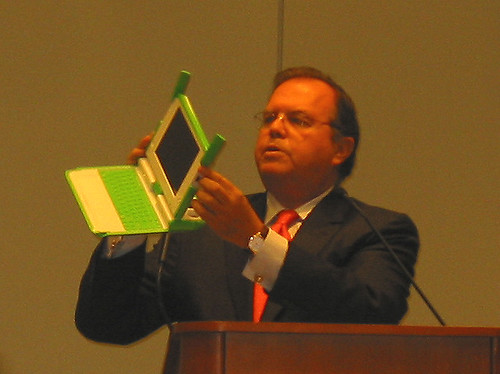
An example of how we extend the reach into being  called “truly global” may be characterized by SES’ support of One Laptop Per Child (OLPC) Initiative.

OLPC is designed to put into the hands of children around the world the capacity of accessing information and connectivity with others ranging from people in their village or nearby villages, anywhere in their country and potentially around the world.

On the other end of the continuum are the possibilities in the media world with the disruption of old models.

But before we go any further, let’s make something clear. When we say “user generated content” we all think of You Tube or something like it. But You Tube makes no money and never has — except for its original creators who profited handsomely when they sold to Google. 

When Google purchased You Tube and was asked how they intended to monetize it, the answer was: “we’ll figure that out later.”

Let’s be honest. You tube content is dominated by really, really bad material —and the most frequently viewed material inclines toward quality production and content.

But, as you have seen, Viacom is now demanding that You Tube remove all of its Viacom material. Others will surely follow. And You Tube’s offerings will begin to diminish.

Then there is Current TV, Vice President Gore’s effort, which is totally user-generated content. But it’s still part of the standard Dish and cable mass media package.

It’s user-generated content but it’s still part of the old business model for the system providers.

From our point of view, the revolution may have little to do with user generated content and everything to do with user “dictated” content.

I’m talking about free enterprise — for real.

Very recently, an outfit called Virtual Digital Cable in Illinois, has started a service to deliver cable programming without cable — by using only the internet.  No trench digging or coaxial cable or fibre placement… no local franchise or fees. Naturally,
the legal challenges to VDC are blocks long but the point is Disruption for our customers and for us — is inevitable.

Product development and innovative bundled Solutions like IP Prime are important targets. But how do we most effectively and most profitably adapt to the new net-centric content world?

One answer is to consider what I called “My Geosynchronous Media” but someone told me that MGM was taken. Then I tried “My TV” but of course, MTV was taken. So for now let’s just call it “My TV Station”.  “MTVS”

MTVS is a niche media for one; a nano niche.

It is the creation of a net-centric and net- neutral, trusted third party content aggregator designed as “My TV Station” which runs exactly what you want, when you want it on whatever device you choose.

The customer pays only for the exact content they want… whether it’s sports or Friends re-runs, all CSI or whatever. MTVS delivers it and pays the content provider — as a trusted 3rd party must.

Unlike cable and traditional satellite mass programming where you pay for things you never watch, MTVS gathers exactly and only what one person wants to watch when they want to watch it.

This direction means we would become a “Relationship Management” business in addition to our conventional business.

It also means we would, to an unavoidable extent, be in competition with our current customers.

Does that matter? Of course it does. But, these are the kinds of questions we need to face now before it’s too late to do anything about it.

My last issue is “People”. Are the Human resources and talent out there? Can we keep what we have and get what we need? What about the Demographic Wall?

Business Week Magazine recently advised new professionals to stay away from the space business because it offered “no future”. The engineering and science expertise that is the fundament of our industry is aging and this means on one hand that many are near retirement with a thin bench of possible replacement.

On the other hand, those who choose to stay in the business, and we need them desperately,  are making it hard for new people we do attract to move up —- and also difficult to make change.

The truth is that as we move forward, this is not your “Father’s Satellite” world.

When it comes to attracting talent, you could say, we have an image problem natural to a maturing industry and …we have an advancement opportunity problem for the ambitious new engineer we do attract.

It is the science and invention that makes us grow. There is a clear shortage on the horizon.  It is also true that as an industry, we have very poor public communication and we tell no exciting stories which we need to attract talent.

Just as the American military will be 50% composed of X and Y Gen soldiers who grew up in a digital world, my fondest hope for our industry is that we can say the same. If we can’t –then the future will be a lot harder to face.

I have shared some things to think about with you today and I appreciate your listening to them. I’m glad to hear your ideas as well — any time.

But for now, I see my time is up so I guess all I can say is Thank You and…“Beam Me Up — Frank ”.

Thank you very much.