Archive for the ‘Satellite TV’ Category

EGOGRAM 2007

Wednesday, January 31st, 2007

Friends, Earthlings, ETs — lend me your sensory organs!

I send you greetings and good wishes at the beginning of another year. I’ll be celebrating (?) my 90th birthday in December – a few weeks after the Space Age completes its first half century.

When the late and unlamented Soviet Union launched Sputnik 1 on 4 October 1957, it took only about five minutes for the world to realise what had happened. And although I had been writing and speaking about space travel for years, the moment is still frozen in my own memory: I was in Barcelona attending the 8th International Astronautical Congress. We had retired to our hotel rooms after a busy day of presentations when the news broke — I was awakened by reporters seeking comments on the Soviet feat. Our theories and speculations had become reality!

Notwithstanding the remarkable accomplishments during the past 50 years, I believe that the Golden Age of space travel is still ahead of us. Before the current decade is out, fee-paying passengers will be experiencing sub-orbital flights aboard privately funded passenger vehicles, built by a new generation of engineer-entrepreneurs with an unstoppable passion for space (I’m hoping I could still make such a journey myself). And over the next 50 years, thousands of people will gain access to the orbital realm – and then, to the Moon and beyond.

During 2006, I followed with interest the emergence of this new breed of ‘Citizen Astronauts’ and private space enterprise. I am very encouraged by the wide-spread acceptance of the Space Elevator, which can make space transport cheap and affordable to ordinary people. This daring engineering concept, which I popularised in The Fountains of Paradise (1978), is now taken very seriously, with space agencies and entrepreneurs investing money and effort in developing prototypes. A dozen of these parties competed for the NASA-sponsored, US$ 150,000 X Prize Cup which took place in October 2006 at the Las Cruces International Airport, New Mexico.

The Arthur Clarke Foundation continues to recognise and cheer-lead men and women who blaze new trails to space. A few days before the X Prize Cup competition, my old friend Walter Cronkite received the Foundation’s Lifetime Achievement Award. I have known Walter for over half a century, and my commentary with him during the heady days of the Apollo Moon landings now belong to another era. A space ‘pathfinder’ of the Twenty First Century, Bob Bigelow, was presented the Arthur C. Clarke Innovator Award for his work in the development of space habitats. With the successful launch of Bigelow Aerospace’s Genesis 1, Bob is leading the way for private individuals willing to advance space exploration with minimum reliance on government programmes.

Meanwhile, planning and fund raising work continued for the Arthur C. Clarke Center "to Investigate the Reach and Impact of Human
Imagination", to be set up in partnership with the University of Nevada, Las Vegas. Objective: to identify young people with robust imagination, to help their parents and teachers make the most of that talent, and to accord imagination as much regard as high academic grades in the classroom – anywhere in the world.  The Board members of the Clarke Foundation, led by its indefatigable Chairman Tedson Meyers, have taken on the challenge of raising US$ 70 million for this project. I’m hopeful that the billion dollar communications satellite industry I founded 60 years ago with my Wireless World  paper (October 1945), for which I received the astronomical sum of £15, will be partners in this endeavour.

I’ve only been able to make a few encouraging noises from the sidelines for these and other worthy projects as I’m now very limited in time and energy owing to Post Polio. But I’m happy to report that my health remains stable, and I’m in no discomfort or pain. Being completely wheel-chaired helps to concentrate on my reading and writing – which I can once again engage in, with the second cataract operation restoring my eyesight.

During the year, I wrote a number of short articles, book reviews and commentaries for a variety of print and online outlets. I also did a few carefully chosen media interviews, and filmed several video greetings to important scientific or literary gatherings in different parts of the world.

I was particularly glad to find a co-author to complete my last novel, The Last Theorem, which remained half-written for a couple of years. I had mapped out the entire story, but then found I didn’t have the energy to work on the balance text. Accomplished American writer Frederik Pohl has now taken up the challenge. Meanwhile, co-author Stephen Baxter has completed First-born, the third novel in our collaborative Time Odyssey series, to be published in 2007.

Members of my adopted family — Hector, Valerie, Cherene, Tamara and Melinda Ekanayake — are keeping well. Hector has been looking after me since 1956, and with his wife Valerie, has made a home for me at 25, Barnes Place, Colombo. Hector continued to rebuild the diving operation that was wiped out by the Indian Ocean Tsunami of December 2004. Sri Lanka’s tourist sector, still recovering from the mega-disaster, weathered a further crisis as the long-drawn civil conflict ignited again after more than three years of relative peace and quiet. I remain hopeful that a lasting solution would be worked out by the various national and international players engaged in the peace process.

I’m still missing and mourning my beloved Chihuahua Pepsi, who left us more than a year ago. I’ve just heard that dogs aren’t allowed in Heaven, so I’m not going there.

Brother Fred, Chris Howse, Angie Edwards and Navam Tambayah look after my affairs in England. My agents David Higham Associates and Scovil, Chichak & Galen Literary Agency deal with rapacious editors and media executives. They both follow my general directive: No reasonable offer will even be considered.

I am well supported by my staff and take this opportunity to thank them all:
Executive Officer: Nalaka Gunawardene
Personal Assistant: Rohan De Silva
Secretary: Dottie Weerasooriya
Valets: Titus, Saman, Chandra, Sunil
Drivers: Lalith & Anthony
Domestic Staff: Kesavan, Jayasiri & Mallika
Gardener: Jagath

Let me end with an extract from my tribute to Star Trek on its 40th anniversary – this message is more relevant today than when the series first aired in the heady days of Apollo: “Appearing at such a time in human history, Star Trek popularised much more than the vision of a space-faring civilisation. In episode after episode, it promoted the then unpopular ideals of tolerance for differing cultures and respect for life in all forms – without preaching, and always with a saving sense of humour.”

Colombo, Sri Lanka
28 January 2007


NASA Says Water Has Flowed on Mars at Least Twice in Last 7 Years

Wednesday, December 6th, 2006


Well, this sure beats Al Capone’s vault.
 The photo to the left shows new deposits of mud, silt or frost on the surface of Mars, which weren’t there several years ago.

As CNN explains:

 "The latest research emerged when the Global Surveyor spotted gullies and trenches that scientists believed were geologically young and carved by fast-moving water coursing down cliffs and steep crater walls.

"Scientists at the San Diego-based Malin Space Science Systems, who operate a camera aboard the spacecraft, decided to retake photos of thousands of gullies in search of evidence of recent water activity.

"Two gullies that were originally photographed in 1999 and 2001 and re-imaged in 2004 and 2005 showed changes consistent with water flowing down the crater walls, according to the study."

The Christian Science Monitor has more: 

For years, evidence from Mars has supported the idea that billions of years ago, large amounts of water flowed on the planet. Surface-penetrating radar on Europe’s Mars Express orbiter has found large ice deposits several kilometers below the surface.

But the strongest evidence for potential watery habitats today had come from NASA’s Galileo orbiter and from the Cassini orbiter, which is currently touring Saturn and its moons. Galileo’s evidence points to a slushy ocean beneath the thick ice crust of Jupiter’s moon Europa.

Cassini tracked watery geysers bursting from Enceladus, suggesting that this moon of Saturn holds reservoirs of liquid water.

But now, Mars is back on the leader board.

"I think they’ve gotten it right," says Bruce Jakosky, director of the Center for Astrobiology at the University of Colorado at Boulder, of the new results.

The presence of liquid water below the Martian surface doesn’t prove that organisms live there, he cautions. But it does change the discussion.

"People have talked about ancient life, given the evidence for ancient liquid water" turned up by orbiters and surface rovers, Dr. Jakosky explains. And evidence continues to mount that liquid water has been present in the red planet’s geologically recent past. "This is the first piece of evidence that says ‘now,’ not ‘a million years ago,’ " he says.

What is your reaction to today’s announcement from NASA? 


The Mysterious Eye of a Saturnian Storm

Tuesday, November 14th, 2006

NASA’s Cassini orbiter has recorded something never before seen on another planet — "a hurricane-like storm at Saturn’s south pole with a well-developed eye, ringed by towering clouds."


(Click on the image above to play a movie of the storm.)

From the NASA press release:

 The "hurricane" spans a dark area inside a thick, brighter ring of clouds. It is approximately 8,000 kilometers (5,000 miles) across, or two thirds the diameter of Earth.

"It looks like a hurricane, but it doesn’t behave like a hurricane," said Dr. Andrew Ingersoll, a member of Cassini’s imaging team at the California Institute of Technology, Pasadena. "Whatever it is, we’re going to focus on the eye of this storm and find out why it’s there."

A movie taken by Cassini’s camera over a three-hour period reveals winds around Saturn’s south pole blowing clockwise at 550 kilometers (350 miles) per hour. The camera also saw the shadow cast by a ring of towering clouds surrounding the pole, and two spiral arms of clouds extending from the central ring. These ring clouds, 30 to 75 kilometers (20 to 45 miles) above those in the center of the storm, are two to five times taller than the clouds of thunderstorms and hurricanes on Earth.

Eye-wall clouds are a distinguishing feature of hurricanes on Earth. They form where moist air flows inward across the ocean’s surface, rising vertically and releasing a heavy rain around an interior circle of descending air that is the eye of the storm itself. Though it is uncertain whether such moist convection is driving Saturn’s storm, the dark "eye" at the pole, the eye-wall clouds and the spiral arms together indicate a hurricane-like system.

Distinctive eye-wall clouds had not been seen on any planet other than Earth. Even Jupiter’s Great Red Spot, much larger than Saturn’s polar storm, has no eye or eye-wall and is relatively calm at the center.

This giant Saturnian storm is apparently different from hurricanes on Earth because it is locked to the pole and does not drift around. Also, since Saturn is a gaseous planet, the storm forms without an ocean at its base. 

 Click here to view a movie of the storm.

DMSP-17 Launched

Sunday, November 5th, 2006

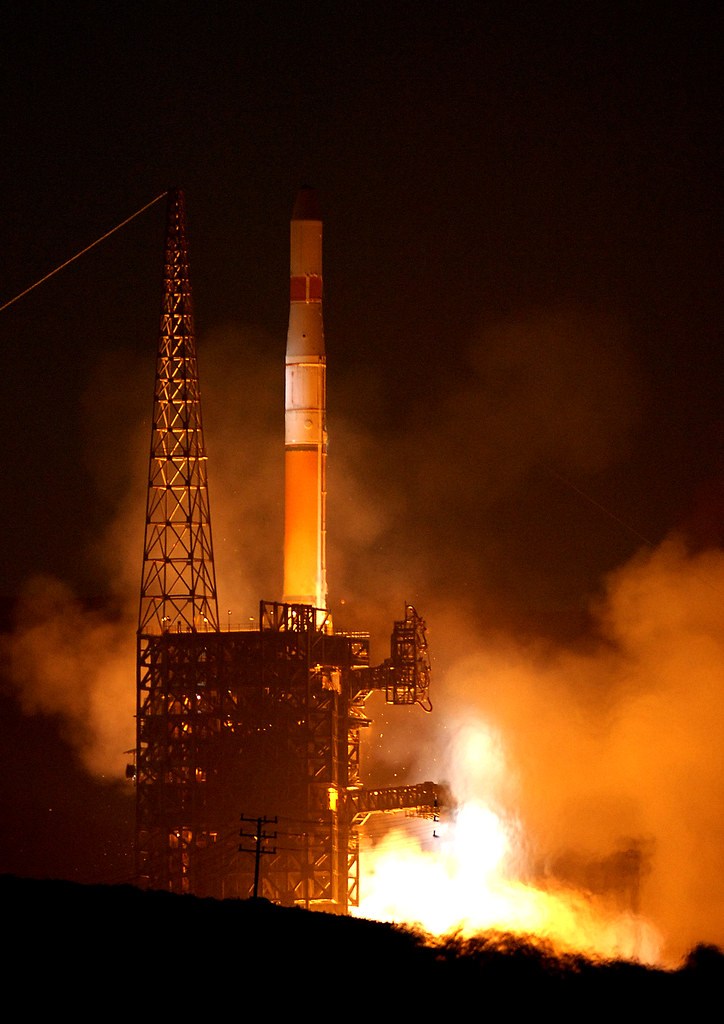
A Delta IV rocket launches at 5:53 a.m. on Nov. 4 from Vandenberg’s Space Launch Complex-6. The rocket carried a Defense Meteorological Satellite Program satellite in to space. The satellite will transition into a polar earth orbit to provide weather forcasts for servicemembers on battlefields around the world. (U.S. Air Force photo/Joe Davila)

DIY Friday: Build Your Own HDTV Antenna

Friday, November 3rd, 2006

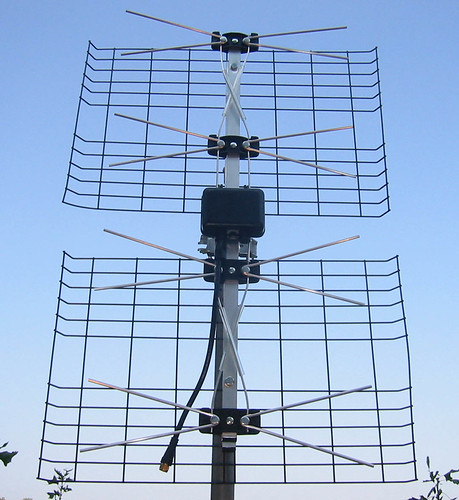
Sure, you just spent $10,000 on a sweet Plasma HDTV Monitor and another $400 on a kick a$$ receiver, but that doesn’t mean you have to break the bank buying a super-expensive HDTV antenna, does it?

Not at all, according to pitman2 over in the Lumenlab 2.1 ("Saving the World from Bad TV") forums, who posted instructions on how to build your very own HD antenna using cardboard, a few hangers, and something called a UHF Matching Transformer. While its not entirely a MacGyver-esque construction (no saliva and papertowel tubes required), it seems to do the job.

"In my un-scientific tests this antenna seems to hold it’s own against the DB2 as an indoor antenna . In outdoor tests it performed almost as well as the DB2. Although I wouldn’t use this one outdoors, being card board and having a solid reflector. One good gust of wind and it’ll fly away. But there is no reason why you can’t build one with higher quality materials to be used outside. Like a cooling rack for a reflector so that it doesn’t catch the wind."

What’s that you say? You haven’t shelled out yet for a new HDTV monitor and receiver yet? You’re waiting for the price of your next generation television to drop below the price of the house your grandparents bought in 1956? Oh, well, have no fear, we hear at RRS have you covered too. Actually, Popular Mechanics has the information, but we’ll link to their how-to on turning your PC into a lean, mean HDTV viewing machine and you can thank us later.

One word of warning on the last bit though: While turning your PC into an HDTV and building your own antenna maybe cheap, explaining to your significant other why you have to watch television under the phosphorescent glow of your computer monitor while coaxial cable from the antenna on the roof dangle overhead… well, that’s priceless.


Satellite-Linked Heineken?

Monday, October 30th, 2006

Well, it looks like the party might soon be over for the generations of euro-tripping backpackers who’ve snuck a few bottles of French wine into Germany or bottle of the illicit green stuff from central europe into Ole’ Blighty… shucks!

Our good friends at vnunet are reporting that Heineken Brewery (makers of Dutch delight drunk around the world), in association with IBM, international shipping company Safmarine, Vrije Universiteit Amsterdam (University of Amsterdam), and customs agencies in the US, UK, and the Netherlands, are beginning a program to track cargo container shipments of Heineken beer from Europe to the United States using satellite and cellular technology.

Called the "Beer Living Lab," the main goal of the project is to create a paperless documentation trail using IBM technology to provide real-time visibility of the product and interoperability through wireless sensors linked to its WebSphere platform.

According to IBM project Manager, Steffan Reidy, the results of this research effort could be used to improve customs processes around the world:

"[It’s] the first step in building the ‘Intranet of Trade’, which will help to substantially improve efficiency and security in the global supply chain."

Or, as Vnunet reported:

"Once accepted and implemented widely, paperless trade will support initiatives that will eliminate most inspections on arrival, thus significantly speeding up ocean freight shipments and improving the profit margins for shippers."

While this might mean it might be a little harder to sneak some booze across the border (especially if and when the technology is combined with RFID tagging of shipped spirits), the potential savings that could be passed down to consumers and improved port security probably evens things out a bit.

Want even more information about the Beer Living Lab? Think about taking a brief sojourn to Amsterdam in the next few days… the lab seems to be having a workshop on the technology on Thursday.

Soyuz Launches MetOp

Friday, October 20th, 2006

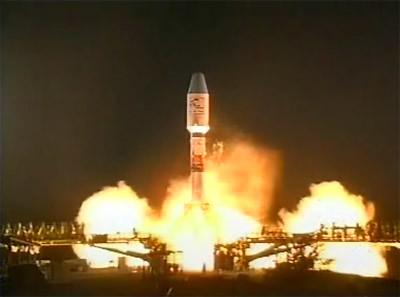
The MetOp satellite was finally launched into polar orbit on 19 October 2006 on a Soyuz rocket:

The Soyuz 2-1a, an enhanced version of the Soyuz launcher, lifted off from the Baikonur Cosmodrome in Kazakhstan right on schedule at 10:28 p.m. local time (04:28 p.m. UTC, 06:28 p.m. in Paris). It is the 1,714th launch of a rocket from the Soyuz family.

Starsem and its Russian partners confirmed that the Fregat orbital stage accurately injected Eumetsat’s MetOp-A satellite into its Sun-Synchronous Orbit (SSO). The Fregat upper stage was ignited twice to place MetOp-A into orbit 1 hour, 8 minutes after lift-off.

The MetOp-A satellite will provide more precise details about atmospheric temperature and moisture profiles, invaluable for weather forecasting and climate monitoring. The MetOp program was jointly established by the European Organisation for the Exploitation of Meteorological Satellites (EUMETSAT) and the European Space Agency (ESA). Their main partners in this co-operative venture are the Centre National d’Etudes Spatiales (CNES) in France and the United States National Oceanic and Atmospheric Administration (NOAA).

For this flight, Starsem used the upgraded Soyuz 2-1a, flown with the new ST fairing. The 2-1a configuration features improved navigation accuracy and control capability provided by a digital control system. The 2-1a configuration also enables Starsem to introduce the ST payload fairing with an external diameter of 4.1 meters and a length of 11.4 meters.

This latest successful launch by Soyuz reflects the industrial capabilities of the Samara Space Center (TsSKB-Progress) and the skills of all the operating teams, working under the authority of the Russian Federal Space Agency (Roscosmos).

Starsem is responsible for the international marketing and operation of Soyuz launchers. Its shareholders are Arianespace, EADS, Roscosmos and the Samara Space Center.

Check out the launch highlights.


A Violent Collision of Stars, or a Marriage?

Thursday, October 19th, 2006

That’s the question many are asking when they see this stunning new image of the merging Antennae galaxies taken by the Hubble Space Telescope:


Reuters explains: 

A seemingly violent collision of two galaxies is in fact a fertile marriage that has birthed billions of new stars, and an image released on Tuesday gives astronomers their best view yet.

The new image of the Antennae galaxies allows astronomers working with the orbiting Hubble Space Telescope to distinguish between new stars and the star clusters that form them.

Most of these clusters, created in the collision of the two galaxies, will disperse within 10 million years but about 100 of the largest will grow into "globular clusters" — large groups of stars found in many galaxies, including our own Milky Way.

The Antennae galaxies, 68 million light years from Earth, began to fuse 500 million years ago.

The image serves as a preview for the Milky Way’s likely collision with the nearby Andromeda Galaxy, about 6 billion years from now.

So if you’ve ever gotten the feeling that everything was heading towards a tremendous smash-up — well, you’re right.

You can zoom in on the above image at the HubbleSite


MetOp Launches Today at 2:28 pm EDT

Tuesday, October 17th, 2006


The BBC reports on Europe’s first polar-orbit satellite:

Europe is set to launch its most sophisticated weather and climate satellite to date.

The MetOp spacecraft will be lofted into its 850km-high polar orbit by a Soyuz-Fregat vehicle from Kazakhstan.

The platform should improve forecasting globally, and give scientists detailed data they can use to refine models describing how Earth’s systems work.

Metop has eight instruments to gather a range of data about the planet’s atmospheric and surface conditions….

Metop is a joint project of the European Space Agency (Esa) and Eumetsat, the intergovernmental organisation charged by European member states with operating a series of orbiting weather observatories….

The new platform weighs more than four tonnes and measures almost 18m (60ft) with its solar wing unfurled.

The Eumetsat website will feature a stream broadcasting the launch live. For more information on the satellite, visit the ESA Portal, or click here for a cool animated video explaining the satellite and its mission.

Dust Devils on Mars

Wednesday, October 11th, 2006

This morning we stumbled across this article in the Columbus Dispatch (written under contract by NASA), and we were reminded again of one of the cooler images to come from our solar system in the last few years.

The image is of a dust devil moving across a Martian plain on a hot spring afternoon a year ago:


The image was caught by NASA’s ‘Spirit’ Mars Rover in April, 2005. 

Both rovers (Spirit and Opportunity) have recently been upgraded with new software that enables them to better understand when a dust devil is moving across the martian surface, and to begin snapping pictures when they sense that movement:

NASA’s Space Technology 6 mission, or ST6, had already proven this "artificial intelligence" software in space. ST6 used it to help an Earth-orbiting satellite take pictures of erupting volcanoes on Earth. So NASA knew the software would help Spirit and Opportunity capture images of dust devils.

ST6 is part of NASA’s New Millennium Program, whose job is to test new technologies in space before putting them on NASA missions of discovery.

Other images and video from Mars can be found on NASA’s Mars Exploration Program website.