Archive for the ‘Satellite TV’ Category

Korean Ping-Pong

Tuesday, October 10th, 2006

As the debate rages in the press as to whether Pyongyang’s 60-year obsession came to fruition on Sunday — or, if, as Drudge is reporting, the North Korean blast was a  "dud" — it’s worth taking a moment to ask: how do we come to conclusions about what really happened?

To do so, it’s worth recounting how the United States learned about the blast.  

Our initial warning that the nuclear test was about to take place came not from a high-tech gizmo, but in a phone call from the Chinese:

The White House said Monday the United States received word from China of North Korea’s intent to conduct a nuclear test minutes ahead of the reported event.

According to spokesman Tony Snow, North Korea had called its ally China to advise them on the imminent explosion at about 9 p.m. EST Sunday. China in turn notified the U.S. Embassy in Beijing, which relayed the message to Washington.

Secretary of State Condoleeza Rice received notification about 9:45 p.m. and notified national security adviser Stephen Hadley. Hadley called President George W. Bush at about 9:52 p.m.

South Korean authorities said they felt the seismic tremor from an apparent explosion in North Korea in about the same time frame of Hadley and Bush being notified.

 In addition to indications on the ground in South Korea, there was the on-the-air announcement in North Korea:

 

Soon thereafter, the USGS and other agencies began to analyze the seismic data to locate the epicenter and identify the magnitude of the tremors that were registered on seismic monitors. In this case, the magnitude was 4.2, and the location was pinned down (though not literally, of course) on the map.

NOAA’s NESDIS satellite likely played a key role in communicating the scientific (non-intelligence) data, and satellite telemetry helped pinpoint the location of the tremor. 

The result? So far, a good deal of doubt on behalf of the West in regards to North Korea’s claims of success:

U.S. officials, speaking on the condition of anonymity, said that seismic readings show that the conventional high explosives used to create a chain reaction in a plutonium-based device went off, but that the blast’s readings were shy of a typical nuclear detonation.
   
"We’re still evaluating the data, and as more data comes in, we hope to develop a clearer picture," said one official familiar with intelligence reports.
   
"There was a seismic event that registered about 4 on the Richter scale, but it still isn’t clear if it was a nuclear test. You can get that kind of seismic reading from high explosives."
   
The underground explosion, which Pyongyang dubbed a historic nuclear test, is thought to have been the equivalent of several hundred tons of TNT, far short of the several thousand tons of TNT, or kilotons, that are signs of a nuclear blast, the official said.

The official said that so far, "it appears there was more fizz than pop."

Without satellites and seismic monitors, however, it would be impossible to say whether it was fizz, pop, or outright propaganda on the part of North Korea.


The Years Fly By

Thursday, October 5th, 2006

MSNBC reports on the most recent Hubble exoplanet discovery:


WASHINGTON – A recently spied planet orbits so close to its star that a new year comes every 10 hours.

Called SWEEPS-10, the planet belongs to a newfound class of zippy exoplanets called ultra-short-period planets that have orbits of less than a day.

The Hubble Space Telescope recently spotted five ultra-short-period planets, all about the size of Jupiter, in a crowded star field near the galactic bulge of our Milky Way galaxy as part of an exoplanet survey called the Sagittarius Window Eclipsing Extrasolar Planet Search, or SWEEPS. A total of 16 planet candidates were found, all with relatively short orbital periods…

"These are the farthest planets detected so far around some of the faintest stars," study leader Kailash Sahu of the Space Telescope Science Institute in Maryland told reporters at a NASA press conference.

Extrapolated to the entire galaxy, the Hubble results suggest the Milky Way contains at least 6 billion Jupiter-sized planets, researchers say.

The findings are detailed in Thursday’s issue of the journal Nature.

More info and images can be found on the HubbleSite.

Japanese Launch Sun Microscope

Tuesday, September 26th, 2006

On Saturday, the Japanese Aerospace Exploration Agency (JAXA) successfully launched  the M-V Launch Vehicle No. 7 (M-V-7) at 6:36 a.m. Japan Standard Time from the Uchinoura Space Center.

Within an hour, JAXA started receiving signals from the rocket’s satellite payload —  the SOLAR-B, a sun observation "microscrope" nicknamed "Hinode" ("sunrise") by JAXA engineers.

The BBC has more
on the SOLAR-B and its mission of studying solar flares, which "release the equivalent of tens of millions of hydrogen bombs in just a few minutes:"

 The probe will attempt to find out more about the magnetic fields thought to power solar flares, and try to identify the trigger that sets them off.

The ultimate goal for scientists is to use the new insights to make better forecasts of the Sun’s behaviour.

Flares can hurl radiation and super-fast particles in the direction of the Earth, disrupting radio signals, frying satellite electronics, and damaging the health of astronauts….

Solar-B is expected to transform our understanding [of solar flares].

It carries three instruments: a Solar Optical Telescope (SOT), an X-ray Telescope and an Extreme Ultraviolet Imaging Spectrometer.

They will make continuous, simultaneous observations of specific solar features, to observe how changes in the magnetic field at the Sun’s surface can spread through the layers of the solar atmosphere to produce, ultimately, a flare.

"Solar-B acts essentially like a microscope, probing the fine details of what the magnetic field is doing as it builds up to a flare," said mission scientist Professor Louise Harra, from the Mullard Space Science Laboratory, UCL, UK.

"What we don’t know is what triggers a flare; we don’t understand the physics of that phase at all. Solar-B will show us how tangled the field is, and how the field lines collide to produce all that energy."

In October, NASA will contribute to the growing understanding of solar flares when it launches its Stereo mission – twin spacecraft that will make 3D observations of the sun.

Better understanding of solar flares is critical, as John Davis, Solar-B project scientist at Nasa’s Marshall Center, told the BBC.

"The information that Solar-B will provide is significant for understanding and forecasting of solar disturbances, which can interfere with satellite communications, electric power transmission grids, and threaten the safety of astronauts travelling beyond the safety of the Earth’s magnetic field," he said.

(Video of the M-V-7 launch can be found here (in the right hand column).) 

All Hail Hale

Tuesday, August 15th, 2006

We found NASA’s Picture of the Day on Sunday to be particularly fascinating.

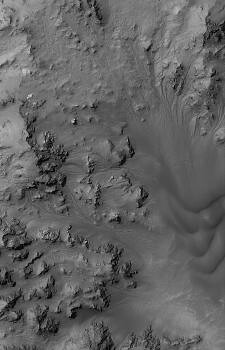
This Mars Global Surveyor (MGS) Mars Orbiter Camera (MOC) image shows dried streambeds—martian gullies— in the mountainous central peak region of Hale Crater. Some scientists have suggested that the fluid which carved these gullies was liquid water, and that it either resulted from ancient snowmelt or from release of groundwater that percolated to the surface in the intensely fractured rock of Hale’s central peak. In either case, the gullies are dry today, and dark sand can be seen as dunes near the right/lower right part of the image.


Heatwave, As Seen From Space

Tuesday, July 25th, 2006

Hot enough for ya? You don’t have to read the news to know there’s a heatwave going on, even though it’s heating up Europe to the point that some people think houses may collapse (due to subsidence if heavy rain causes the bone-dry soil to expand and move buildings as it does so). And things have gotten so hot in the U.S. that blackouts and power outages are happening in California, Missouri, and New York.

All you really have to do is step outside. But if you want the big picture, you can check out Envisat’s satellite pictures of Europe which, according to the BBC, show dramatic increases in land and sea temperatures in the UK.

ENVISAT

The images were generated from data gathered by the European Space Agency’s Envisat and Nasa’s Aura satellites.

John Remedios, head of Earth Observation Science at the University of Leicester, said: "The latest satellite data shows a perspective of the environment in which we live that can only be obtained from space.

"The images show temperature increases and increased pollution for every region in the UK."

Envisat, an advanced polar-orbiting Earth observation satellite, was launched in March 2002 by the European Space Agency and provides measurements of the atmosphere, ocean, land, and ice.


Nix and Hyrda

Monday, June 26th, 2006

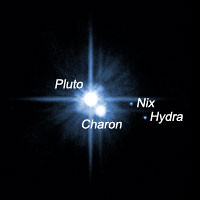
In other Hubble news (see the post below), a pair of small moons orbiting Pluto, first photgraphed by the Hubble Telescope in 2005, now have official names: Nix and Hyrdra.

"Nix and Hydra are roughly 5,000 times fainter than Pluto and are about two to three times farther from Pluto than its large moon, Charon, which was discovered in 1978," according to the official Hubble website.

Hubble’s ACS Camera Offline

Monday, June 26th, 2006

The Hubble Space Telescope’s Advanced Camera for Surveys (ACS) has been offline since June 19, Space.com reports:

ngineers have yet to figure out what caused the Advanced Camera for Surveys (ACS) to go into "safe mode," essentially a sleep state that prevents normal operations. But the outlook is bright.

"We’re very optimistic" that the camera will be fixed, said Ed Ruitberg, associate program manager for Hubble at NASA’s Goddard Space Flight Center.

Ruitberg told SPACE.com that some potential causes have been ruled out and that the problem is likely with a low-voltage power supply interface, something between the batteries and a camera component. If that’s the case, then redundant electronics can be relied on to bypass the problem area.

"We’re still investigating the problem and working on all sorts of contingencies," said Max Mutchler at the Space Telescope Science Institute (STScI) in Baltimore, where Hubble’s science operations are run. "We’re hoping for the best but preparing for other contingencies."

Space Daily also reports on Hubble’s troubles. 

We’ll keep you updated on the efforts to "wake up" the camera….

GeoEye Awarded Airport Mapping Project

Thursday, June 22nd, 2006

There’s little doubt that satellite technology has transformed aviation. From the widespread use of GPS technology to the in-flight weather updates provided to pilots through services like XM Satellite Weather, satellite-delivered content and information has greatly increased the situational awareness of pilots and, in turn, made aviation safer.

Yet any gadget is only as useful as the underlying information, which is why the National Geospatial-Intelligence Agency (NGA) Stereo Airfield Collection program has awarded Dulles-based GeoEye a $3.7 million contract to image 365 airfields and produce Airport Mapping Databases (AMDB) over a 12-month period:

GeoEye is now the world’s largest developer of airport geospatial information support, terrain and obstacle databases with several hundred airfields mapped to date. Matt O’Connell, GeoEye’s president and chief executive officer said, "We are a leader in providing airport geospatial solutions to key customers like the NGA and the USAF at the best price and with the best performance in the industry."

An Airport Mapping Database is a geospatial database that contains significant features of an airport such as runways, taxiways, buildings, obstacles and terrain surrounding an airfield. This information supports the safe movement of aircraft and helicopters on runways and taxiways. These products can also be used to support training, mission or contingency planning and visual simulations for ordinary operations or crisis situations. GeoEye is uniquely positioned to fulfill this contract for North American and international airfields by virtue of its IKONOS satellite’s ability to generate a three-dimensional image from stereo data collected during a single orbital pass. The result is a three-dimensional map-accurate image of an airport that can be quickly and cost effectively acquired.


Taepodong Tease

Tuesday, June 20th, 2006

While the U.S. is in the midst of a major naval exercise in the Pacific, near Guam, North Korea has reportedly fueled up a Taepodong missile and is ready to light the fuse.
Among the three U.S. aircraft carrier groups, 30 warships, 280 aircraft and 22,000 soldiers taking part in the naval exercises is the USS John McCain. The exercises, "Valiant Shield 2006," marks the first time a Chinese delegation is observing.

Now is not the best time to test an ICBM over the Pacific. You know Japan is not happy about it and has made it known. They’re still upset about the 1998 missile test.

As reported by the AP:

This is an Orbview-3 satellite image provided by GeoEye showing the Taepodong missile launch complex in North Korea, called Musudan-ri, in May 2006. North Korea referred to its missile program Monday, June 19, 2006 in its official media for the first time since it apparently began preparations for a test launch, as a U.S. official confirmed the North has completed fueling a missile that is poised to fire.


Staring into the Sun

Thursday, June 15th, 2006

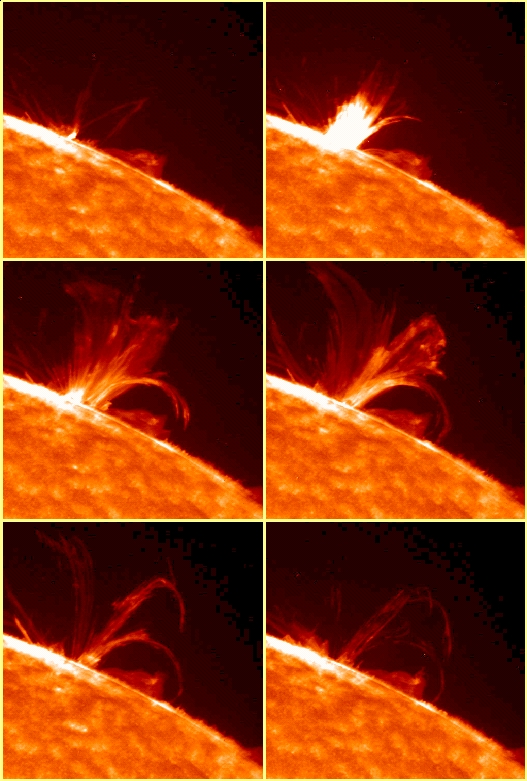
You’ve heard it since high school. Staring into the sun is bad for your eye. Fortunately, you now have a satellite to do it for you, and even take pictures. I happened across this MetaFilter thread about the TRACE, the Transitional Region and Coronal Explorer, and discovered a treasure trove of photographs shot by the satellite. Kinda like this one.

Solar Flair

TRACEBuilt and launched in April of 1998, on a mission to enable scientists to "study the connections between fine-scale magnetic fields and the associated plasma structures on the Sun in a quantitative way by observing the photosphere" (whatever that means) the satellite isn’t exactly new. But it took its millionth picture of the sun back in October of 1999. So it’s a great source of photographs that make great wallpaper for your desktop your IM profile, as well as movies that just make interesting viewing.