Lagos Analysis Corp. (LANCOR) Files Lawsuit Against Nicholas Negroponte and OLPC Association for Patent Infringement. Negroponte’s OLPC Accused of Unauthorized Use of LANCOR’s Multilingual Keyboard Technology Invention in XO Laptops
BOSTON, MA–(Marketwire – November 27, 2007) – Lagos Analysis Corporation, a United States-based Nigerian-owned company with a subsidiary called LANCOR Management Limited, in Nigeria (LANCOR) announces today that it has filed a patent infringement lawsuit in the Federal High Court, Lagos Judicial Division holding at Ikoyi, Lagos, Nigeria against Nicholas Negroponte, One Laptop Per Child Association (OLPC) and its enablers in Nigeria.
The patent infringement lawsuit was filed on November 22nd, 2007 as a result of OLPC’s willful infringement of LANCOR’s Nigeria Registered Design Patent # RD8489 and illegal reverse engineering of its keyboard driver source codes for use in the XO Laptops.
LANCOR is seeking substantial damages as well as a permanent injunction to prevent OLPC from continuing to unlawfully manufacture, sell, distribute or offer for sale the XO Laptop, and any other products infringing on the RD8489 and using the illegally acquired keyboard driver source codes.
LANCOR is a pioneer in the development of advanced physical multilingual keyboard technology using four shift keys and characters with combining properties to allow for direct access typing of accents, symbols and diacritical marks during regular typing. LANCOR’s technology named Shift2 keyboard technology has been used to create a new class of region specific based keyboards called KONYIN Multilingual Keyboards, which are currently on sale globally. (http://www.konyin.com)
LANCOR has retained the law firm of Adedeji & Owotomo a Lagos, Nigeria-based law firm that specializes in intellectual property litigation. Both LANCOR and its legal counsel are extremely confident that LANCOR’s case will be successful.
LANCOR’s lawsuit alleges that OLPC purchased two KONYIN Multilingual Keyboard models (KONYIN Nigeria Multilingual Keyboard and KONYIN United States Multilingual Keyboard) with the express purpose of illegally reverse engineering the source codes for use in OLPC’s XO Laptops. "The willful infringement of our client’s intellectual property is so blatant and self-evident in the OLPC’s XO Laptops," said Solicitor Ade Adedeji, "we will have no problem establishing the facts of our client’s case against OLPC in any court of law."
"LANCOR treats its intellectual property as one of the Company’s most important resources," said Adé G. Oyegbola, chief executive officer of LANCOR. "This patent infringement lawsuit is another step in LANCOR’s continued protection of its intellectual property. LANCOR will continue to take aggressive steps to protect its intellectual property around the world. LANCOR is also in the process of filing a similar lawsuit against OLPC in a United States Federal Court," Oyegbola, added.
Intended to deliver broadcast and broadband services across Europe and Africa, the SIRIUS 4 satellite successfully launched yesterday for SES-Sweden:
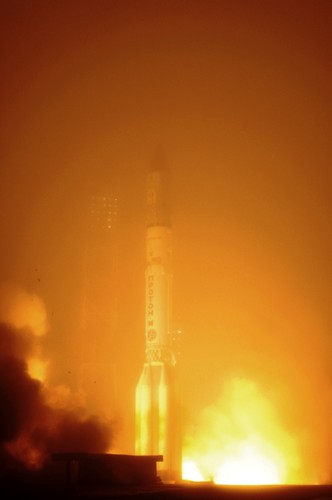
A Proton launch vehicle successfully lifted the SIRIUS 4 satellite into orbit today, marking the fourth mission of the year for International Launch Services (ILS).
The Proton Breeze M vehicle, built by ILS partner Khrunichev Space Center of Moscow, lifted off from Pad 39 at the cosmodrome at 4:39 a.m. today local time (5:39 p.m. EST Saturday, 22:39 GMT Saturday). After a 9-hour-13-minute mission, the launcher released the satellite into geostationary transfer orbit.
The SIRIUS 4 satellite is expected to go into service at the beginning of January at 5 degrees East longitude, where it will deliver broadcast and broadband services across Europe and parts of Africa for SES SIRIUS of Sweden.
“This was an especially important mission for ILS and our customer, SES SIRIUS,” said ILS President Frank McKenna. “ILS and our partner, Khrunichev, continue to focus on performance and on our long-term relationship with the SES group of companies.” This was SES SIRIUS’ first mission with ILS, which has launched 12 other satellites on Proton for sister companies SES ASTRA and SES AMERICOM since 1996.
“We are very proud and satisfied that the SIRIUS 4 mission has been a success,” said Hakan Sjodin, managing director of SES SIRIUS. “SIRIUS 4 will benefit our customers and extend our coverage and service in Eastern Europe. The success of the SIRIUS 4 mission is a milestone in our company history and we would like to express our appreciation of the good cooperation with our launch partners, International Launch Services and Lockheed Martin Commercial Space Systems.”
Lockheed Martin built the SIRIUS 4 spacecraft using its A2100 platform. This was the 10th Proton mission with this type of spacecraft.
The Sirius satellites will be operated by the Swedish Space Corporatoin. Sven Krohn, who from his bio appears to be the Swedish space business superstar, runs their blog.
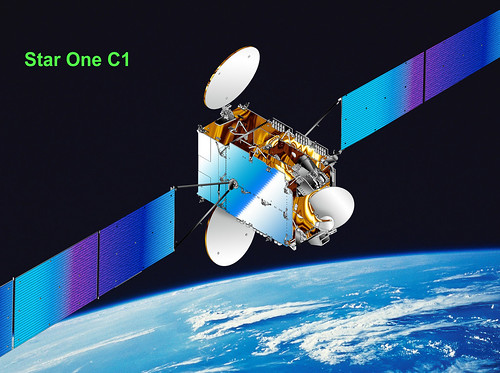
Dans la nuit du mercredi 14 au jeudi 15 novembre 2007, Arianespace a mis en orbite de transfert géostationnaire deux charges utiles : le satellite de télécommunications militaires Skynet 5B d’Astrium Paradigm pour le Ministère britannique de la Défense et le satellite de télécommunications civiles Star One C1 de Thales Alenia Space pour l’opérateur brésilien Star One.
Trente-cinquième lancement d’Ariane 5, vingt-et-unième succès d’affilée et nouveau record de masse en orbite. Ce nouveau succès du lanceur Ariane 5, le cinquième en 2007, confirme que l’offre de Service & Solutions d’Arianespace est la référence pour tous les opérateurs du secteur des télécommunications civiles ou militaires. Depuis le début de 2007, Arianespace a lancé dix des douze satellites commerciaux de télécommunications lancés avec succès vers l’orbite géostationnaire.
Now, in English:
On Wednesday evening, November 14, Arianespace boosted two satellites into geostationary transfer orbit (GTO): the Astrium Paradigm Skynet 5B military communications satellite for the British Ministry of Defence (MoD), and the Star One C1 commercial communications satellite built by Thales Alenia Space for Brazilian operator Star One.
The latest successful launch of an Ariane 5, the fifth in 2007, confirms that Arianespace’s launch Service & Solutions continues to set the standard for all telecom operators worldwide, whether civil or military. Since the beginning of 2007, Arianespace has successfully launched 10 of the 12 commercial telecommunications satellites placed in geostationary orbit. The Ariane 5 ECA launcher set a new record on this mission, orbiting a total payload of more than 8,700 kg.>
This is very cool: a video shot from the jungles of French Guiana. So this is what’s its really like to be there.
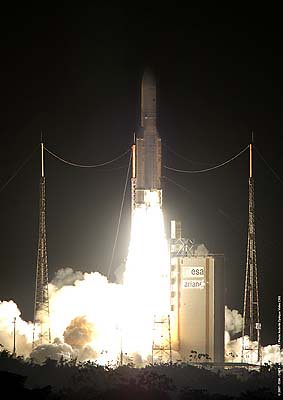
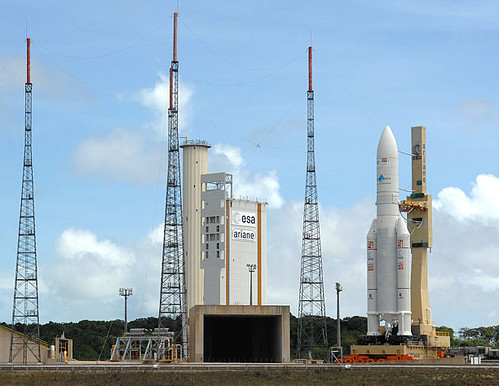
The Ariane 5’s cryogenic, liquid fuelled, main engine was ignited first. Seven seconds later, the solid fuel rocket boosters were also fired, and a fraction of a second after that, the launch vehicle lifted off.
The solid boosters were jettisoned 2 min: 19 sec after main engine ignition, and the fairing protecting the payload during the climb through the Earth’s atmosphere was discarded at 3 min: 10 sec. The launcher’s main engine was shut down at 8 min: 58 sec; six seconds later the main cryogenic stage separated from the upper stage and its payload.
Four seconds after main stage separation, the engine of the launcher’s cryogenic upper stage was ignited to continue the journey. The upper stage engine was shut down at 24 min: 56 sec into the flight, at which point the launch vehicle was travelling at 9377 metres per second (just over 34 800 km/h) at an altitude of 626.1 kilometres and the conditions for geostationary transfer orbit injection had been achieved.
At 27 min: 12 sec after main engine ignition, Skynet 5B separated from the launcher, followed by Star One C1 at 33 min: 47 sec.
What about that payload?
The British Ministry of Defence (MOD) uses the Skynet satellites for communications, with this newest generation provided many times more capacity than the previous series. Interestingly, the MOD doesn’t really own the satellite. They contract with Paradigm Secure Communications to design, build and operate the entire Skynet system. They make sure it’s suitable for military use (hardened, jam-proof, etc.)
Star One C1’s X-band payload will be used by the Brazilian military, but most of the payload will be used for television broadcasting and Internet applicaitons. Representing the third generation of Embratel satllites, Star One C1 was built by Thales Alenia Space and is based on the Spacebus 3000B3 configuration. It will replace Brasilsat B2 at 65° West. The C-band beam will be pretty hot over Brazil, and will be available to commercial teleports in southern Florida, as will the Mercosur Ku-band beam. The Brazilian Ku-band beam will be concentrated over Brazil’s urban centers along the southeast coastal area.
We blogged about Intel helping establish the most remote WiMAX city in the world before, so we’re glad to see Embratel placing an emphasis on bridging the digital divide. The Embratel Institute is their dedicated organization, setting up communications points, digital libraries and distance learning programs throughout Brazil.
"Qualcomm has won a federal contract to provide a satellite-based tracking system for U.S. and Mexican trucks participating in a contentious experiment that opens the border to long-haul commercial traffic," SignOn San Diego reports:
Federal officials said yesterday that the San Diego-based company’s OmniTRACS system will allow the U.S. government to closely monitor trucks from both countries, including compliance with regulations that prohibit truckers from driving more than 11 hours per day.
Although Qualcomm is best-known for its prominent role as a chip-maker in the wireless industry, the company also is a major designer of satellite tracking systems for vehicles.
Qualcomm will provide tracking technology for 100 trucks at a cost of $367,000, officials said.
U.S. transportation officials hope the tracking system will soften congressional opposition to the two-month-old pilot project. Five carriers from Mexico and three from the United States are participating in the program, which is limited to a maximum of 100 carriers from each country.
OmniTRACS uses geosynchronous satellites and "helps fleets improve productivity, reduce operating costs, enhance customer service, and increase security." Features include:
* Automatic satellite vehicle positioning * Two-way text and data communications * Highly reliable message delivery * Customizable reports * AS/400, Windows®, or web-hosted operation * Panic Buttons (available option)
We’re not sure what the Panic Button achieves, but we assume it won’t be ignored like the car alarms that bleet plaintively in our local mall parking lot.
Maptuit NaviGo is a real-time, hybrid in-cab navigation service that provides professional truck drivers and trucking companies with interactive maps for increased routing efficiency and improved driver satisfaction. QUALCOMM plans to offer NaviGo on the OmniVision platform later this year….
The OmniVision mobile computing platform is an integrated system consisting of hardware, software and network infrastructure, enabling delivery of two-way data communications and value-added services to enterprises in a mobile environment.
SIRIUS has announced "Doctor Radio", a "24/7 Health and Wellness Channel" that will launch in early 2008. The new channel will be a collaborative effort from SIRIUS and the NYU Medical Center and will feature content from doctors and medical experts.
To serve Americans’ hunger for health, medical and wellness information, SIRIUS’ Doctor Radio will cover the human condition and the complexities of the bodies we inhabit, as well as entertain a little bit along the way. Doctor Radio will give listeners direct access to the best doctors in every field, breaking down barriers between the medical world and the everyday world, and giving listeners information to make important decisions about their health and well-being. NYU Medical Center doctors will take new medical research and findings and translate them into easy-to-understand advice and knowledge in an innovative and new way to better peoples’ lives.
This announcement comes just five years after GE Medical Systems and NBC launched "The Patient Channel", a television channel that distributes health-related content to US hospitals. NBC also maintains "The Newborn Channel", a similar health-related network that focuses on parenting.
Want to check out these channels but don’t want to visit the hospital? Both channels are carried by AMC-3, transponder 1K – check out Lyngsat for the latest downlink information and tune-in.
On the other side of the content spectrum, XM Radio has just announced the launch of the Led Zeppelin channel this Thursday.
From the site:
A 24/7 celebration of the music and magic of Led Zeppelin. A handcrafted channel dedicated to everything Led Zeppelin, including studio albums, rare and archival concerts, interviews, and listener interaction. A continuous and mystical radio voyage into the past, present, and future of the mighty Led Zeppelin.
This is part of "Whole Lotta Love Week" in America. It also coincides with the release this Tuesday of "Mothership", the newest "greatest hits" album in the Zeppelin catalogue, hand-chosen by the three remaining members of the band and remastered for sonic perfection (read Pitchfork’s review). The band is also re-releasing the live album "The Song Remains the Same", including versions on HD-DVD. But perhaps the biggest news is the release of the entire Led Zeppelin catalogue exclusively on iTunes tomorrow. For $99, you can purchase the "box set", which includes every single Led Zeppelin album. If you don’t already have copies of all albums in vinyl or CD, that’s a fantastic price for an essential part of anyone’s music collection.
Of course all of this recent Led Zeppelin mania has been inspired by their upcoming concert in London this December. For those who are lucky enough to go but already bought your plane tickets, you better call the airline – the concert has been postponed for two weeks because guitarist Jimmy Page broke his finger. I just hope it’s not his left ring finger – the solo on "Stairway" wouldn’t sound the same without those crazy arpeggios at the end.
A la suite d’une anomalie constatée sur l’un des équipements du lanceur Ariane 5, Arianespace a décidé de reporter le lancement prévu le vendredi 9 novembre afin de procéder à des vérifications complémentaires. Une nouvelle date de lancement sera communiquée dès que possible.
Translation: Arianespace has postponed tonight’s Ariane 5 lift-off following the detection of an anomaly on the launch vehicle. Additional verifications on the launcher are being performed. A new launch date will be announced shortly.
Tonight’s Ariane 5 lift-off has been postponed by Arianespace following the detection of an anomaly on the launch vehicle.
Both the launcher and its dual-satellite payload are in a safe mode, and the Ariane 5 is being moved back to the Spaceport’s Final Assembly Building. The electrical anomaly involves a flight support unit on one of the launcher’s two solid propellant boosters, and this unit will be swapped out with a new one.
A new launch date for the mission will be announced shortly. The flight will be Arianespace’s fifth Ariane 5 mission of 2007, and the launcher carries the Skynet 5B and Star One C1 satellites.
Skynet 5B was built by Astrium, and will be delivered in orbit to Paradigm Secure Communications. The spacecraft is to provide military telecommunications services for the United Kingdom’s armed forces, NATO and other countries.
Star One C1 is a Thales Alenia Space-manufactured satellite, which will be used by Brazilian satellite operator Star One for communications, multimedia and broadband Internet services over South America.
When I was a kid in Brooklyn, we never carried backpacks to school. We had bookbags or even brief cases (plastic Samsonite). Sure, I had a backpack as a boy scout and I did find it convenient for hiking and exploring. But for school? We took public transportation. It was easier to let your book bag rest on the floor, between your feet, rather than taking out some 90-year-old woman while you turn around. In fact, I was six years old and getting on a public bus in Brooklyn — by myself. School was a mile away, too.
Things sure have changed since then. Every kid has a backpack now. One of today’s more popular pre-school cartoon characters, Dora the Explorer, has a talking backpack. Parents don’t let little kids out of their sight for a moment. Grown-ups now carry their laptops in backpacks to work. Hikers’ backpack are super high-tech: some generate electricity as you walk.
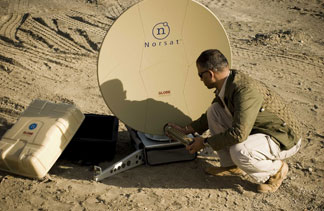
But by far the coolest is a complete satcom terminal — an ultra-portable from Norsat — that fits into two backpacks and can be checked as luggage on most commercial airlines:
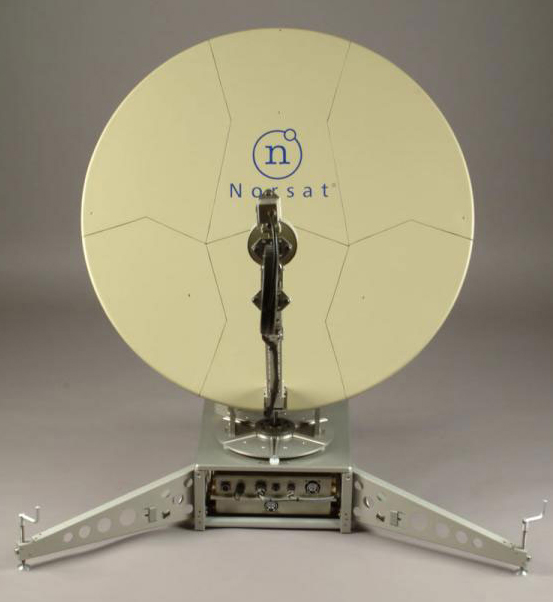
The GLOBETrekker is particularly well suited for "grab-and-go" applications and "temporary situations" — wherein broadband communications need to be initiated quickly and on very short notice or on a temporary basis. Its ergonomically designed backpack and overall "quick-connect" design enables users to transport, assemble, operate and disassemble quickly and discreetly. This is particularly appealing to journalists, disaster relief agencies, the military and first responders — all of which are often given very short notice of an impending assignment. This is also of interest to companies seeking an emergency backup system or VIPs seeking to establish a reliable broadband connection while they are traveling.
The GLOBETrekker is equipped with sophisticated "built-in" intelligence. The GLOBETrekker’s Sensor Driven System Manager is housed in a single board computer, which acts as the nerve center of the entire system. It continuously monitors the internal environment of the system and automatically counters harsh weather elements (extreme temperatures, sand and humidity) by engaging built-in defenses.
This latest addition to Norsat’s product portfolio has been designed to withstand harsh transport and operating conditions. The GLOBETrekker sports three physical layers of protection including a hard shell exterior, shock absorbing foam inserts and shock-mounted baseband.
The GLOBETrekker supports data transmission rates of up to four megabits per second. It is capable of operating on multiple bands, including the Ku, Ka and X bands. The GLOBETrekker is a highly integrated system which includes a 1m carbon fiber antenna, RF electronics, motorized azimuth/elevation superstructure, motorized feed assembly, built-in inclinometer, compass, GPS and a baseband unit with a modem, spectrum analyzer, DVB-S receiver, Ethernet switch, DC-DC converter and shock protected chassis.
The European Patent Office notified the company that it intends to grant the patent for the technology, which reduces the weight and footprint of transmit reject filters, one of several elements of the RF transmit chain.
"This patent award is part of our broader and long-term strategy to establish a leadership role in the design, development and marketing of portable satellite terminals," Amiee Chan, president and CEO, Norsat International, said in a statement. "Our frequency selective surface waveguide filter, protected under this patent, allows the weight of transmit reject filters to be reduced 50-fold, significantly decreasing the occupied volume. This is a function that is especially useful for the next generation of milsatcom terminals."
In Geneva, Switzerland, the World Radiocommunication Conference 2007 is currently underway — and at the center of the discussions is the future of C-Band (known colloquially as the "compromise band").
C-band is characterized by larger antennas and is preferred by a variety of full-time service providers. C-band is a portion of electromagnetic spectrum in the microwave range of frequencies ranging from 4 to 6 GHz — normally downlink 3.7–4.2 GHz, uplink 5.9–6.4 GHz.
During the first week of the World Radiocommunication Conference (WRC-07), administrations from Asia, Africa, and Latin America made clear their broad and deep support for keeping the status quo for satellite services by calling for no change to the current use of the C band. This campaign, which exhorts the Conference not to identify international mobile telecommunications (IMT) systems in C-band has been gathering pace throughout the past year, driven by both national policy imperatives and the satellite industry.
In the weeks prior to the meeting, the number of countries expressing positions in support of protecting C-band for satellite use outnumbered those in favor of identifying C-band for IMT. Since the opening of the conference, support for protection of the whole band for satellite services has increased in strength from an already solid base. Governments have been assisted by the argumentation of regional and international satellite operators, spearheaded by SES Global, Inmarsat and Intelsat as well as regional operators such as Arabsat and Rascom, and network integrators such as Schlumberger, which all attended the WRC to rally their constituencies.
Advocates of no change in C-band allocations have come from many parts of the world, each with their particular reasons for supporting the position. These include concerns based on pre-existing interference between IMT-like technologies and satellite services which have, in some examples, ruptured Interpol’s communications in Gambia and caused severe problems to Bolivia’s direct-to-home satellite services during the 2006 FIFA World Cup. African governments have been at pains to emphasise the importance of C-band in areas that experience rain fade and the risk to satellite services if neighboring countries were to implement IMT. Asian governments, in clear allusions to recent tsunamis, have emphasised the role of satellite communications in disaster and emergency circumstances, as well as the growing demand for those services
Archived audio feeds of the discussion can be found here.
During the first week and a half of the 2007 World Radio Conference in Geneva, some 3000 attendees were given an opportunity to see how Radio Amateurs can provide Emergency and Disaster communications. A van, constructed and manned by German Radio amateurs, was parked in front of the main entrance of the conference centre for delegates to visit. IARU Emergency Communications coordinator Hans Zimmerman F5VKP also participated in the demonstration. The IARU flag was flown at the top of van’s extendable mast.
José Albuquerque, the Senior Director of Spectrum Engineering at Intelsat, also makes the case for C-Band:
Currently, there are some 160 satellites in the geostationary orbit using C-band frequencies for their downlink transmissions (see Figure 1). This is the equivalent of more than 3000 satellite transponders with a 36 MHz bandwidth with the potential for transmitting about 180 Gbit/s at any given instant. This infrastructure represents an investment in excess of USD 30 billion in spacecraft and launch costs alone, without taking into account investment in the ground segment made by users and satellite operators.
Deployment of IMT systems in these frequencies would drastically reduce the benefits that these resources have brought to users around the world, because fixed-satellite services and IMT systems cannot share frequencies in the same geographic area.
C-band frequencies are used for downlink satellite transmissions that provide a wide range of services in developed and developing countries, including critical applications such as distance learning, telemedicine and universal access services; backhaul services (telephony, Internet); very small aperture terminal (VSAT) data links such as bank transactions or corporate networks; distribution of television programmes; mobile-satellite service feeder links, and emergency links, including disaster recovery services and meteorological tracking. These services require the high reliability and broad geographic coverage that can only be delivered in the C-band….
It is not feasible to undertake co-frequency operation of FSS receiving Earth stations and transmitting fixed or mobile stations in IMT systems. ITU–R studies have concluded that separation distances of between tens of kilometres and a few hundred are required to ensure protection of FSS Earth stations. Considering that a typical city covers an area with radius of between 15 and 30 km, sharing between IMT systems and FSS receiving Earth stations is not realistic.
In addition, IMT transmitters can also interfere with FSS Earth stations operating in adjacent bands. Unwanted emissions generated by IMT transmitters falling within the FSS desired signal cannot be filtered and will therefore generate interference. Furthermore, signals generated by an IMT transmitter can be strong enough to saturate the low-noise amplifier (LNA) of the FSS receiver. In view of the significant difference between the levels of the desired signal (originating at the satellite transmitter about 36 000 km away) and the interfering signal (originating at the IMT transmitter only a few kilometres away), filtering the IMT signal to the required levels might become unfeasible.
The adjacent-band interference effects described above highlight the fact that identification of a portion of C-band frequencies for IMT systems, while keeping another contiguous portion for FSS use, is not free of interference problems and does not constitute a desirable approach.
A Chinese satellite successfully entered lunar orbit Monday, a month after Japan put its own probe into orbit around the moon, the AP reports:
Chinese space officials said the Chang’e 1 satellite, part of the country’s ambitious space exploration plans, entered lunar orbit after completing a planned braking operation.
China plans to keep the Chang’e 1 – named after a mythical Chinese goddess who flew to the moon – there for one year, about the same length of time as Japan’s probe. China launched its satellite late last month, while Japan put its into space in September.
The timing of the launches raises the prospect of a space rivalry between the two Asian nations, with India possibly joining in if it carries through on a plan to send its own lunar probe into space in April.
We blogged about the Japanese lunar probe when it launched in September. Meanwhile, back at the 73rd annual meeting of the Indian Academy of Sciences, the lunar probe referenced above is indeed planned for April, 2008, with more missions to follow:
Work on Chandrayaan-1, India’s first lunar probe, was progressing, said J.N. Goswami, Director, Physical Research Laboratory, Ahmedabad. The plan was to launch the spacecraft around April 2008.
Planning for the follow-on mission had started, he said. Apart from an orbiter that would circle the moon, Chandrayaan-2 could also have a soft-lander carrying a robotic rover.
A slide projected by Dr. Goswami during his talk indicated that the Chandrayaan-2 mission could take place around 2011-12.
Wikipedia has some good information on Chandrayaan.
So is this the beginning of an Asian space race? Here’s an opinion piece from Japan, translated into English and published in the China Daily, which argues that China is way ahead of the game:
China already has a high level of space technology. It has launched more than 100 Long March rockets since 1970, while Japan’s H2-A rocket has been launched only 13 times…..
[Now], China’s space development has drastically accelerated. Starting with the launch of the orbiter, China’s lunar exploration program comprises a moon landing and deployment of a moon rover with the retrieval of lunar soil and stone samples. China also aims to advance its technologies for manned spacecraft.
Further, it is moving forward with projects to launch a reconnaissance satellite and another one for its own global positioning system.
In addition, China is launching communication satellites for Venezuela, Brazil and Nigeria, and also received an order from France to launch a communication satellite, showing the commercial success of its program.
China has voiced a strong desire to participate in the International Space Station (ISS) program in which Japan is involved and the United States and Russia play pivotal roles.
Some observers say that in the near future China will become one of the world’s leading nations in the field of space development, equivalent to the United States and Russia.
In contrast, Japan’s space program, despite its successful development of the H2-A rocket, lacks specific targets – including what type of satellite it will launch in the future – due to budget woes.
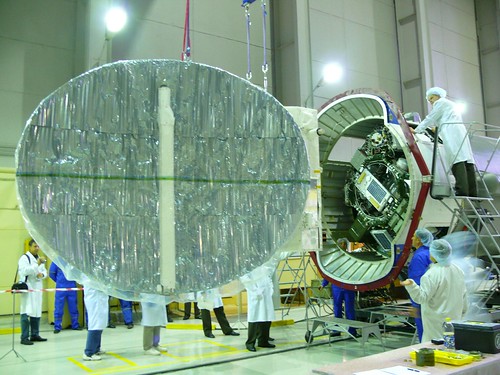
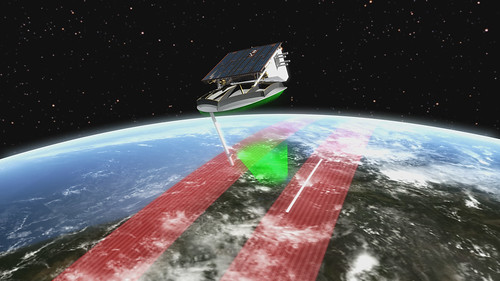
The SAR-Lupe satellite was launched via a Kosmos-3M rocket from the Plesetsk Cosmodrome in Russia earlier this morning. Built by OHB-System AG in Germany ("lupe" is German for magnifying glass; SAR = synthetic aperture radar), the satellite will be used for earth observation, day or night, in any weather condition — according to Wikipedia:
They use an X-band radar with a three-metre dish, providing a resolution of about 50 centimetres over a frame size of 5.5km on a side (‘spotlight mode’, in which the satellite rotates to keep the dish pointed at a single target) or about one metre over a frame size of 8km x 60km (‘stripmap mode’, in which the satellite maintains a fixed orientation over the earth and the radar image is formed simply by the satellite’s motion along its orbit). Response time for imaging of a given area is 10 hours or less.
Satellites as carriers of optical or radar sensors can, unlike aircraft or unmanned aerial vehicles, carry out reconnaissance operations without infringing sovereign rights. They are thus particularly suited to gather information – without escalating effect – about early crisis detection and prevention and about effective crisis management.