Archive for the ‘Observation’ Category

GSM Satellite Backhaul

Thursday, July 26th, 2007

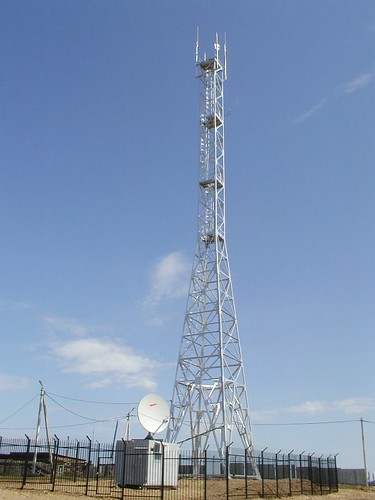
Remote regions and developing nations are seeing a massive expansion in their GSM networks. Nigeria, for example, has only 1.25 million landline phones, but more than 30 million mobile subscribers. This presents a number of challenges: foremost, how do you expand a network to remote places that lack the infrastructure for conventional GSM networks?

The solution: satellites, of course! In Papua New Guinea, SES NEW SKIES signed a contract with the national telecom company, Telikom Papua New Guinea, to provide GSM backhaul services using its NSS-5 spacecraft. Details from Cellular-News:

The NSS-5 satellite capacity will allow Telikom PNG to expand its GSM services into new regions and provide telephone services over mountainous terrain by providing GSM backhaul between a large number of sites around the country back to the capital Port Moresby.

States Scott Sprague, Senior Vice President Global Sales of SES NEW SKIES: "The ubiquitous coverage of the NSS-5 satellite allows Telikom Papua New Guinea to significantly increase its GSM service area across the rugged geography of Papua New Guinea. SES NEW SKIES is proud to assist the country’s premier telecommunications provider to offer vital communications services to widespread, mainly rural populations and across terrains that make it difficult to develop even basic transportation infrastructures."

Remote deployment is only one use of satellite backhaul services. As satellite modem manufacturer Radyne expains, two other uses could prove critical: temporary installations during disaster recovery (when the broadband infrastructure has been damaged) and when a rapid deployment is required.

Communications technology giant Cisco hasn’t ignored this developing industry (abbreviations in description have been expanded):

At the cell site, GSM traffic is compressed and aggregated with [Universal Mobile Telecommunications Service (UMTS)] traffic by the [mobile wireless router]. The result is lower bandwidth aggregated traffic that is routed to the satellite modem and transmitted to the other side. Depending on actual T1/E1 link utilization for both GSM and UMTS, Cisco RAN Optimization can reduce the bandwidth required on the satellite link up to 50 percent, providing significant savings in [operating expenses].

DIY Fridays: Portable Satellite Radio

Friday, July 20th, 2007

Satellite radio is becoming somewhat commonplace while traveling: its a good move if you drive in rural places, many car rental companies offer XM or Sirius standard or as an upgrade, car dealerships throw in satellite radios as promotions, and even airlines are offering satellite content.

It’s even starting to show up in homes, with home receivers and antennas being stacked right next to amps, cd-players, and turntables.

But while iPod’s seem to be taking over, you rarely see someone sporting portable satellite radio. Why not enjoy Bluegrass Junction, XM Cafe, or Sirius Classic Soul in between car-trips and living room lounging? Of course, you could purchase a device, but that wouldn’t be any fun.

Make has the instructions (subscription only):

The basic prescription is to mount a Terk XMicro antenna on headphones and connect to a Delphi roady. There are a few complicated steps:

Modifying the antenna: You need to alter the antenna by…

removing the pink plastic connector shroud. I used a small screwdriver to get between the white and pink plastic and gently extracted the white plastic looking piece. Then I heat-shrank a "strain relief" over the top of the connector and the exposed wire from breaking. This rubber "shrinky dink" tubing will contract tightly over the wires once you apply heat from a hair dryer to it.

Create a power supply: Connect a battery-pack with five AA batteries to the Delphi using a RadioShack Adaptaplug "Type B" tip. This should generate six to nine volts.

Turning it on:

Using the power button to turn the unit on will turn on the display’s LEDs, eating up battery power. Instead, input the sequence "232" into the keypad and then push in the scroll wheel on the side.

Enjoy the tunes!


The New Television Situation in Germany

Monday, July 16th, 2007

We read this news clip couple of weeks ago how the German Federal Cartel Office (offically Bundeskartellamt) has again contradicted itself whether a "positive signal" for the planned entavio platform was ever given. The proposition to convert TV viewers to a digital platform in Germany has be mired in regulatory proceedings for a while.


Now it seems they’re ready to launch in September with Premiere, via press release (in German and French, too):

Pay-TV broadcaster Premiere has signed an agreement to use SES ASTRA’s digital satellite platform entavio in Germany. Starting on September 1, 2007, new Premiere customers will be offered the Premiere programmes also via entavio. With this agreement, entavio wins a first important pay-TV client for its technical services. entavio-enabled receivers will be widely available in the market.

The new agreement also improves SES ASTRA`s ability to offer all broadcasters access to more than 2.5 million Premiere and Premiere-enabled satellite receivers in German TV households. SES ASTRA will continue to offer this access to other programme operators on neutral and transparent terms. SES ASTRA thereby further increases the attractiveness of its service portfolio to broadcasters.

I believe entavio will gradually replace Premiere set-top boxes over time. Broadband TV News tells us we can expect additional pay-TV companies to come aboard:

The new thematic bouquet from German pay TV operator Premiere is taking shape. The platform, which will use the entavio encryption facilities of SES ASTRA, is close to signing deals with both the RTL Group and ProSiebenSat1 to carry their new thematic channels.

The two contracts would bring RTL Living, RTL Crime, Passion, SAT1 Comedy and kabel eins classics into the fold. Earlier this year a deal was signed with Turner Broadcasting to carry the German language versions of Cartoon Network, TCM and Boomerang.

The total number of channels on the September 1st launch date is going to be twenty. Also planned are a kids channels and thematic channels about literature, music (concerts) and adult entertainment.

Nice video introduction, in German:

See you!


Satellite Robots

Thursday, July 12th, 2007

With the new Transformers film now in theaters, it is only fitting to discuss robots. The San Diego Union-Tribune takes-up machines based on nature:

“The Wright brothers learned how to control (a plane’s) direction by watching hawks in flight,” he said. “They figured out that turning a plane had to do with changing wing surfaces, though not the way hawks did it.

“That’s an important distinction. The Wright brothers drew inspiration from biology, but they didn’t exactly copy it.”

Robotic designs based upon natural organisms are as diverse as the animal world itself. There are devices in the works that mimic caterpillars, spiders, dogs and octopuses. Their goals and purposes are equally varied, from new medical treatments to space labor to being a soldier’s best friend.

The satellite business took note:

In January, a pair of small robots developed by European and Japanese scientists took their first steps in space – not steps, actually, since the robots lacked legs, but the feat was still a giant leap for robotkind.

During the brief suborbital flight Jan. 22, a rocket launched from Japan released a satellite that, in turn, deployed three daughter satellites. These three pulled out a 360-square-yard triangular net with the mother satellite at its center.

From the mother satellite, two palm-sized robots then crawled onto the net like spiders moving across a web. To avoid drifting off in zero-gravity, the spiderbots were equipped with a series of wheels that gripped both sides of the netting.

The experiment did not last very long. One spiderbot stalled after just five seconds of movement; the other after 30 seconds.

Engineers say the problem was likely knots in the net. But they contend the experiment was a conceptual success. They say the technology may ultimately revolutionize the satellite industry because large, costly antennas and solar panels could be launched from small, inexpensive rockets, then assembled in space by tiny robots.

What was the design inspiration?

Bernhard Putz, responsible for their design took advantage of the experience gained during several years of very successful robot soccer games. The viennese team regularily ends up in the final of European and World championships and is renouned for its innovative and robust designs. (link)

Big Broadband in Bermuda

Wednesday, July 11th, 2007


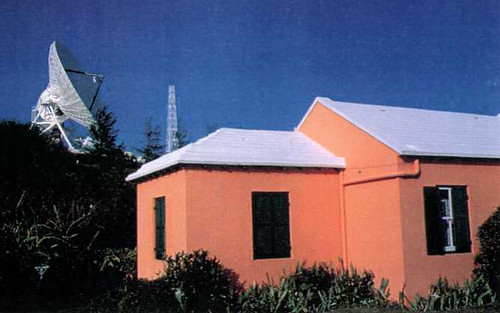
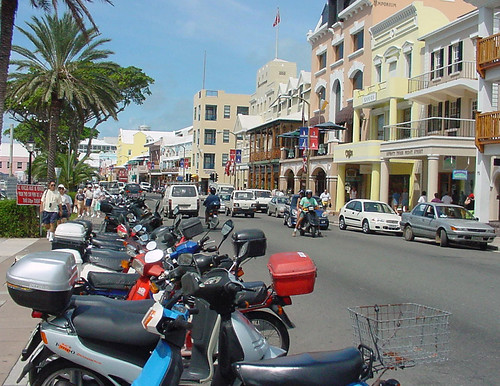
If you’re ever been to Bermuda, you may have noticed a very large satellite antenna in Devonshire Parish while motoring around the island on a rented scooter/moped/motorcycle. We read last month they’ve begun dismantling it since a new submarine cable is being light up for service:

World’s largest commercial satellite dish to be replaced by fibre optic cable

It’s out with the old and in with the new as Cable & Wireless begins tearing down its satellite dish, the Standard A Earth Station antenna.

The dish has been a Devonshire landmark for 24 years and is visible from North Shore and Middle Roads.

A new 800-mile submarine cable that will replace it is due to be operational by the end of October.

It has 700 times more capacity than the old cable it will replace, and will link all of C&W’s customers with access to their global network, the company said.

Like the satellite dish, the telecom firm’s existing undersea cable is obsolete and will be replaced by its new next-generation ‘Gemini Bermuda’ cable.

In its heyday the dish could carry 400 simultaneous circuit feeds to 15 different countries, and could withstand hurricane winds of up to 180mph, the company said.

As telecommunications technology evolves, dismantling outdated equipment like the dish marks the end of an era for Bermuda and indeed the world.

Weighing 400 tonnes and boasting a diameter of 300 meters, the 30-metre-high structure is the largest commercial satellite dish in the world.

"The new undersea cable will satisfy the growing demand for diverse, reliable high-speed data and broadband services which cannot be provided by the restricted capacity of the current cable," said Eddie Saints, C&W’s CEO. "This investment is one in a series of capital investments planned for the Bermuda marketplace in the near future in order to deliver truly world class communications services."

He assured reporters gathered at the facility for a press call yesterday that the transition from ageing cables and satellite transmitters, to state-of-the art fibre optic cables would be seamless.

"It’s extremely reliable and has withstood hurricanes," Mr. Saints said. "If one unit fails, a separate and equal (secondary) satellite takes over."

He said the company will continue to use the 400-tonne base of the station as high-speed data processing centre.

C&W has commissioned M.R. Construction to tear down the dish.

The $750,000 dismantling project, which began three weeks ago, will take another seven weeks to complete. "It cost money to put it up and it costs money to take it down," Mr. Saints said.

Most of the scrap metal will be recycled, some of it here, but most of the materials will go elsewhere.

"Carbon steel remains will be recycled as local mooring weights, [but some material will go to the] landfill," Mr. Saints said. "Other materials such as stainless steel and aluminum will be recycled in the United States."

We rocket scientists always favor recycling materials, so we’re glad to read they’ll be doing that. That’s why Bermuda is cool and at the forefront of technological innovation. Internet access is ample, to be sure.

This new cable, which is owned by Brasil Telecom and runs from Bermuda to New Jersey to Venezuela and Brazil — sort of a modern Bermuda Triangle made of fiber-optic cable — runs along the Continental Shelf, in water ranging from 20 to 600 meters in depth.
Not only are they moderninzing their telecommunications capabilities with other countries, they announced a country-wide RFID system for all their vehicles yesterday. Actually, it’s a first:

Bermuda’s Transport Control Department (TCD), an arm of Bermuda’s Ministry of Tourism and Transport, has launched an island-wide deployment of electronic vehicle registration (EVR) to automate compliance and enforcement using TransCore’s radio frequency identification (RFID) eGo® windshield sticker tags and readers. Initial deployment is underway.

The EVR system will automate enforcement of Bermuda’s vehicle-specific regulations including vehicle inspection, insurance, and registration and ensure the accuracy of vehicle data. Over the next five years, TCD expects to recover approximately $11 million in lost fees from unlicensed vehicles on the island’s roadways and reduce the number of non-compliant vehicles to less than 1 percent.

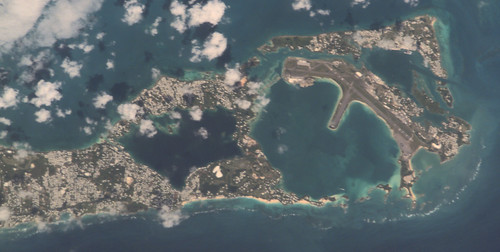
“Bermuda is a country with 53 square kilometers of land with 65,000 people and 47,000 moving vehicles. We’re the sixth largest population per square mile,” said Randy Rochester, Director of Bermuda’s Transport Control Department. “Bermuda has the world’s highest density per square kilometer of motor traffic on its roads. Consequently, we needed a system to facilitate compliance and lessen the burden on law-abiding citizens and our civil servants. EVR will expedite enforcement and ticketing of those not in compliance and recover lost fees more efficiently than our current manual system.”

TransCore is doing some good work — and they use satellite. We like that.
STS-117 Mission Video

Monday, July 9th, 2007

Very cool video by Andrewwski, courtesy of NASA SpaceFlight.com Six minutes of entertainment. They put this up on a server over at the Johnson Space Center and the crew viewed the video and loved it.

These are the kind of video edits NASA TV should be broadcasting!


Zhongxing-6B Launched

Monday, July 9th, 2007

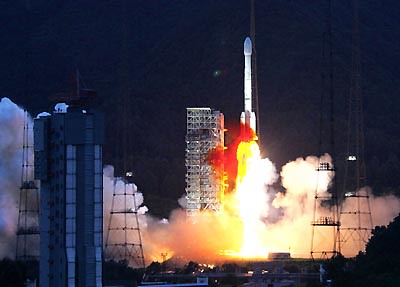
Zhongxing-6B (Chinasat-6B), a French-built communications satellite, had a nice launch from the Xichang Satellite Launch Center last week.


Via Xinhua:

The satellite was lifted by a Chinese Long March-3B carrier rocket which blasted off at 8:08 p.m. (Beijing Time) Thursday. It was the 101st launch mission for the Long March series of carrier rockets.

The satellite separated from the rocket 26 minutes after lift-off, entering its preset orbit.

"Chinasat 6B", manufactured by France’s Alcatel Alenia Space, has a designed lifespan of 15 years.

Fitted with 38 transponders, the satellite is expected to improve telecommunications transmission for Asia, the Pacific and Oceania.

A Tour de France First: HD

Monday, July 9th, 2007

The 2007 Tour de France kicked off on Saturday from London, England — and Stage One, which ended in Canterbury, has already featured some high drama.


London mayor Ken Livingstone wrote about the course of the race prior to the Grand Depart, and the standings so far can be found here. But race fans have no doubt already heard about Robbie McEwan’s incredible comeback from a crash early in the race. As one fan writes:

McEwen crashes 20km from the finish line and is out of the race due to the furious pace being set at the front of the peleton by teams such as Quick-Step, Milram, Credit Agricole and Lampre. He is somehow brought back into the peleton with just a few kilometers remaining by his teammates despite the best efforts of the sprinter teams to make sure he stays out of contention. He then works his way through the entire Tour de France field in the space of a couple of miles and, despite all the exertions and a wrist injury, appears in the last 200 metres to blow all the other sprinters away. One of the most historic non-mountain stage wins in the Tour de France.

Here’s the video on YouTube:

Fans outside of England wouldn’t know about McEwan’s comeback without satcom, of course, and this year marks the first time that le tour is being broadcast in HD, thanks to a suite of satcom services being provided by Globecast:

GlobeCast will supply French broadcaster France Televisions and the European Broadcasting Union (EBU) with satellite and microwave transmissions to provide complete HD coverage of the race. GlobeCast will be deploying up to eight SNG (satellite news gathering) and mobile microwave units at each stage of the race, supported by 30 technical professionals. That includes coverage of the race’s start in London, England–a first for the Tour–where GlobeCast recently launched a full-service broadcast and playout center.

GlobeCast mobile units stationed at various points along the course will transmit footage shot via motorcycle and helicopter by SFP (Société Française de Production) back to France Televisions’ production trucks at the finish line. GlobeCast will provide unilateral satellite contribution feeds to the channel’s master control room in Paris, and its mobile units will distribute the official world feed of the Tour de France to rights holders throughout the world on behalf of the EBU.

The overall communications solution provided to the Tour by France Telecom, which now markets all its services under the Orange brand, includes 1,500 temporary telephone lines to be deployed every day in the technical and press areas; high-speed Internet access in those areas; an upgraded mobile network over the entire course to ensure optimum coverage, mostly in 3G or 3G+; and a team of 50 technicians. The team will be mobilized around the clock, with support from 330 regional colleagues at each stage, and will handle the transport, assembly, operation and supervision of the necessary infrastructures and systems for five specific areas: stage finish line, organization headquarters, intermediate points, press room and stage departure village.

If you want to see the excitement of the tour in even higher definition than HD (or at least on a bigger screen), be sure to check out Wired to Win, an IMAX film about the Tour de France that  is now making its way to select cities.

DirecTV Satellite Launch Friday at 8:50 pm EDT

Thursday, July 5th, 2007

DirecTV customers have been promised 100 HD channels by September — and the delivery of that promise is riding on a rocket that launches tomorrow night.

The Proton Breeze M launch vehicle will lift off from Pad 39 at the Baikonur Cosmodrome, Kazakhstan, with the DIRECT 10 satellite on board. According to the International Launch Services (ILS) website, "this will be the debut of the Enhanced Proton Breeze M, which is capable of launching spacecraft over 6,000 kg into Geosynchronous Transfer Orbit (GTO)."

The payload is the Boeing-built Direct 10 satellite:

DIRECTV’s next-generation satellite features state-of-the-art antenna and payload subsystem that will provide customers with unparalleled national and local HDTV (High Definition Television) service. The powerful 131-transponder payload integrates 32 active and 12 spare TWTAs at Ka-band for national service and 55 active and 15 spare TWTAs for spot beams. The payload is powered by a gallium arsenide solar array that spans more than 48 meters. DIRECTV 10 will receive and transmit programming throughout the United States with two large Ka-band reflectors, each measuring 2.8 meters in diameter, and nine other Ka-band reflectors.

ILS is running a launch blog, where the most recent entry chronicles the rocket’s journey out to Pad 39 on Tuesday:

The rather uneventful train trip out to the pad could be watched from various points around Area 95 and drew the biggest crowd of onlookers we have seen out here so far. Everyone who wanted to attend was permitted on the pad deck to watch the incredible sight as the assembled ILV rolled horizontally into position next to the flame bucket. Then it was hydraulically rotated to its vertical launch position.

Talk about a photo opportunity. Pictures, videos, Russian and Americans alike… everyone tried to capture it in as many ways as they could. One of the favorite pictures to take is to pose as if one hand is pushing the rocket to vertical. It never really DOES look like one person is doing the lifting, but it is a tradition to try and get that shot to commemorate this exciting day.

The launch will be webcast live here. Also be sure to check out this photo gallery

Trees

Thursday, June 28th, 2007

Those pesky trees. Let’s say you are finally willing to make the satellite leap, when your installer gives you the bad news: the trees are in the way. Or even worse, let’s say you install a dish, only to have it blocked a year later as your tree-line skyrockets.

It’s a big problem and there isn’t a clear answer. Let’s start by addressing a few common comments on this subject’s many forums (here, here, and here).

I installed my dish in February, it worked fine in my wooded lot, but now I’ve completely lost my signal.

The problem could be, believe it or not, leaves. One woman in Illinois experienced this: "“As the trees started getting leaves on them, we’d get those little squares [on the TV screen]. Then it just kept telling us it’s acquiring a signal.” The installer apparently received a strong signal with the trees obstructing and assured the couple there wouldn’t be a problem. He didn’t consider the leaves come Spring.

My neighbor’s dish is blocked by branches, but his signal is perfect. Why me?

While the provider may have something to do with this, it could be simply a result of geometry. Most cheap, compact dishes are actually offset, so the line perpendicular to the dish’s face is not the actual direction of the signal. See the attached diagram (hat-tip to Aris):

My south-facing roof is completely blocked by trees. What do I do?

Your dish does not necessarily need to face south. Check with your provider and a professional installer. Also, consider a ground placement if there is enough open-space.

Before placing a dish, spend a considerable amount of time surveying your property, ideally with a satellite professional. And do not underestimate the growth of trees. It would be wise to identify your trees and research their maximum height and growth-rates. A Princeton American Elm, for example, can grow three to six feet per year during early development (AmericanElm.com). You can always trim your trees but this could be a costly affair—and don’t count on your local government to trim road-side trees to improve your tv reception.

But, as one reader points out, don’t just resign and let the trees win. Be creative.

So, if you do live in a place that is surrounded with trees and blocking the southern sky, don’t give up because there’s always something that can work out. I honestly didn’t think we stood a chance. But you can make it happen…so don’t give up.